Overview
The feasible region is a fundamental concept in linear programming that appears regularly on the SAT Math section, particularly within questions involving systems of linear inequalities. This topic combines algebraic reasoning with geometric visualization, requiring students to identify the solution set that simultaneously satisfies multiple constraints. On the SAT, feasible region problems test a student's ability to interpret graphical representations of inequality systems, understand bounded and unbounded regions, and often find optimal values at vertices of these regions.
Understanding feasible regions is essential for SAT success because these questions integrate multiple mathematical skills: graphing linear inequalities, solving systems of equations, identifying intersection points, and applying logical reasoning to constraint-based scenarios. The College Board frequently presents these problems in real-world contexts such as business optimization, resource allocation, or scheduling scenarios, making them both practical and conceptually rich. Students who master this topic gain a significant advantage, as feasible region questions often appear as medium-to-hard difficulty problems worth valuable points.
The feasible region concept bridges several key areas of math on the SAT. It builds directly upon knowledge of linear equations and inequalities, coordinate geometry, and systems of equations. Additionally, it connects to optimization problems and provides a visual framework for understanding how multiple constraints interact. This topic exemplifies the SAT's emphasis on mathematical modeling and problem-solving in realistic contexts, making it a high-yield area for focused study.
Learning Objectives
- [ ] Identify key features of feasible region including vertices, boundaries, and whether the region is bounded or unbounded
- [ ] Explain how feasible region appears on the SAT in both pure mathematical and real-world application contexts
- [ ] Apply feasible region concepts to answer SAT-style questions involving systems of inequalities
- [ ] Determine the coordinates of vertices within a feasible region by solving systems of linear equations
- [ ] Evaluate objective functions at vertices to find maximum or minimum values
- [ ] Distinguish between feasible and infeasible constraint systems
- [ ] Interpret shaded regions on coordinate planes and translate them into inequality notation
Prerequisites
- Linear equations and inequalities: Understanding how to graph individual linear inequalities is essential for constructing feasible regions from multiple constraints
- Coordinate plane fundamentals: Plotting points, identifying coordinates, and understanding quadrants provides the foundation for visualizing feasible regions
- Systems of linear equations: Solving two-equation systems algebraically is necessary for finding vertex coordinates where boundary lines intersect
- Inequality symbols and notation: Recognizing the difference between ≤, <, ≥, and > determines whether boundary lines are solid or dashed and which side to shade
- Slope-intercept and standard form: Converting between equation forms helps identify key features of boundary lines quickly
Why This Topic Matters
Feasible regions have extensive real-world applications in business, economics, engineering, and resource management. Companies use linear programming to maximize profits while staying within budget constraints, manufacturers optimize production schedules given limited resources, and logistics companies minimize shipping costs while meeting delivery requirements. Understanding feasible regions provides students with a practical mathematical tool for modeling and solving constraint-based optimization problems they'll encounter in college coursework and professional careers.
On the SAT, feasible region questions appear with moderate frequency, typically 1-2 questions per test administration. These problems most commonly appear in the Calculator section and are often presented as word problems requiring students to translate real-world constraints into mathematical inequalities. The College Board values this topic because it assesses multiple competencies simultaneously: algebraic manipulation, geometric reasoning, and practical problem-solving. Questions range from straightforward identification of feasible regions to more complex optimization problems requiring evaluation of objective functions at vertices.
Common SAT presentations include: graphical questions showing a shaded region with questions about which inequalities define it; word problems describing constraints that students must convert into inequalities and graph; and optimization scenarios asking for maximum or minimum values of expressions within the feasible region. The topic frequently appears in questions worth 2-3 minutes of testing time, making efficient solution strategies essential for score optimization.
Core Concepts
Definition and Basic Structure
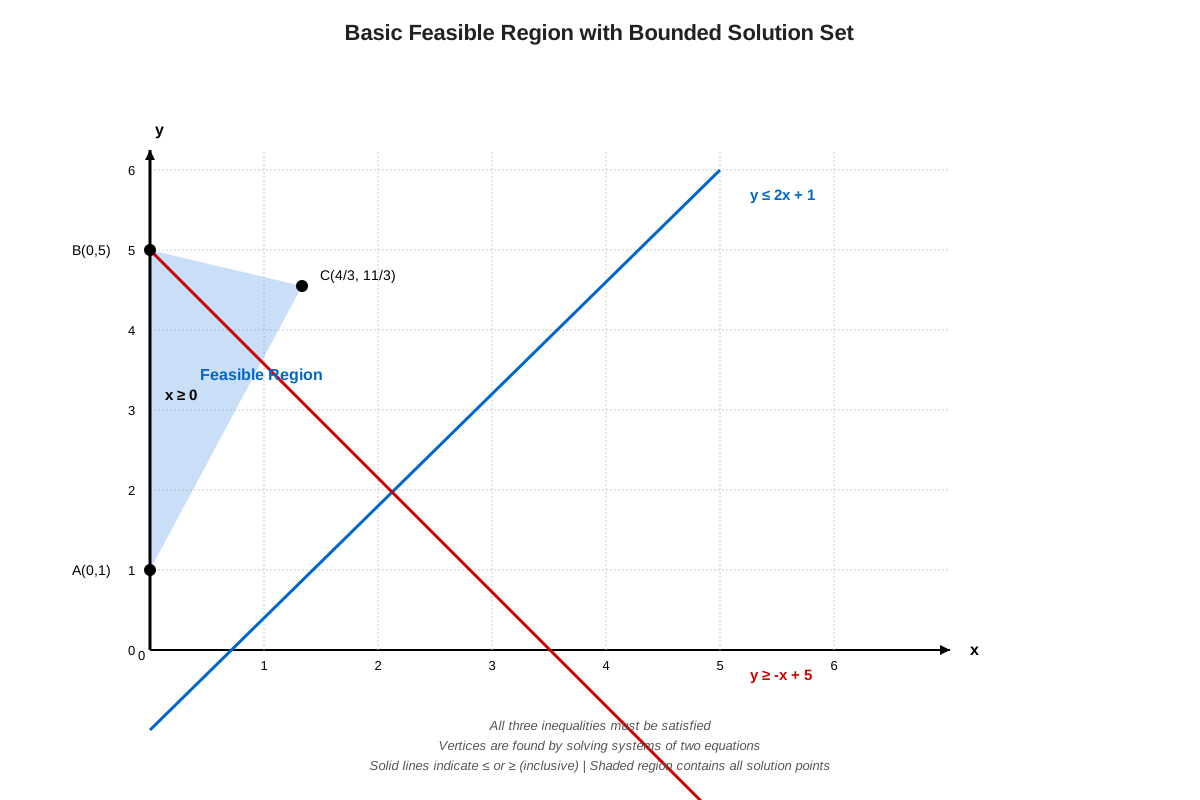
A feasible region is the set of all points on a coordinate plane that simultaneously satisfy a system of linear inequalities. This region represents all possible solutions that meet every constraint in the system. Geometrically, the feasible region appears as a shaded area bounded by lines (the boundary lines of each inequality). Each point within this region satisfies every inequality in the system, while points outside the region violate at least one constraint.
The boundaries of a feasible region are determined by the linear inequalities in the system. When an inequality uses ≤ or ≥, the boundary line is solid, indicating that points on the line are included in the solution set. When an inequality uses < or >, the boundary line is dashed, indicating that points on the line are excluded from the solution set. The feasible region itself is typically shaded or indicated visually to distinguish it from non-solution areas.
Components of a Feasible Region
Vertices (also called corner points) are the intersection points where two or more boundary lines meet. These points are critically important in linear programming because, according to the Corner Point Theorem, if an optimal solution exists for a linear objective function over a feasible region, it occurs at one of the vertices. On the SAT, students frequently need to identify vertex coordinates and evaluate expressions at these points.
Boundary lines form the edges of the feasible region. Each boundary line corresponds to one inequality in the system, written in the form of an equation (replacing the inequality symbol with an equals sign). To graph a boundary line, students should identify two points on the line (often using intercepts) or use slope-intercept form.
Interior points are all points strictly inside the feasible region that are not on any boundary line. These points satisfy all inequalities strictly (making them true with < or > rather than = included).
Bounded vs. Unbounded Regions
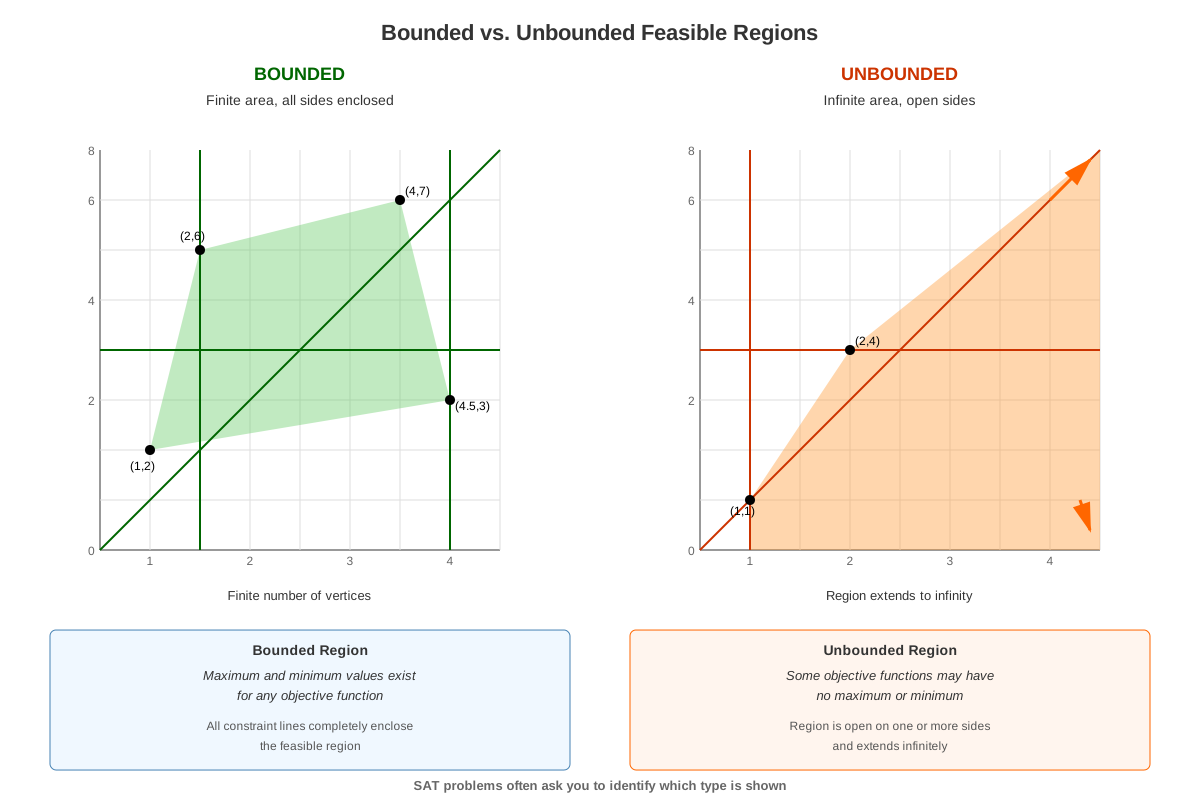
A bounded feasible region is completely enclosed by boundary lines, forming a polygon with a finite area. All vertices can be identified, and the region does not extend infinitely in any direction. Bounded regions typically result from systems where inequalities constrain the solution set from all sides. On the SAT, bounded regions are more common because they create well-defined optimization problems.
An unbounded feasible region extends infinitely in at least one direction. These regions occur when the system of inequalities doesn't fully enclose the solution set. For example, if constraints only limit solutions from below and to the left, the region extends infinitely upward and to the right. Unbounded regions can still have optimal solutions for certain objective functions, but some objective functions may have no maximum or minimum over unbounded regions.
Constructing a Feasible Region
The systematic process for constructing a feasible region involves these steps:
- Convert each inequality to equation form to identify the boundary line
- Graph each boundary line using intercepts, slope-intercept form, or point-plotting
- Determine line type (solid for ≤ or ≥, dashed for < or >)
- Identify the correct half-plane for each inequality by testing a point (often the origin if it's not on the line)
- Find the intersection of all half-planes—this overlap is the feasible region
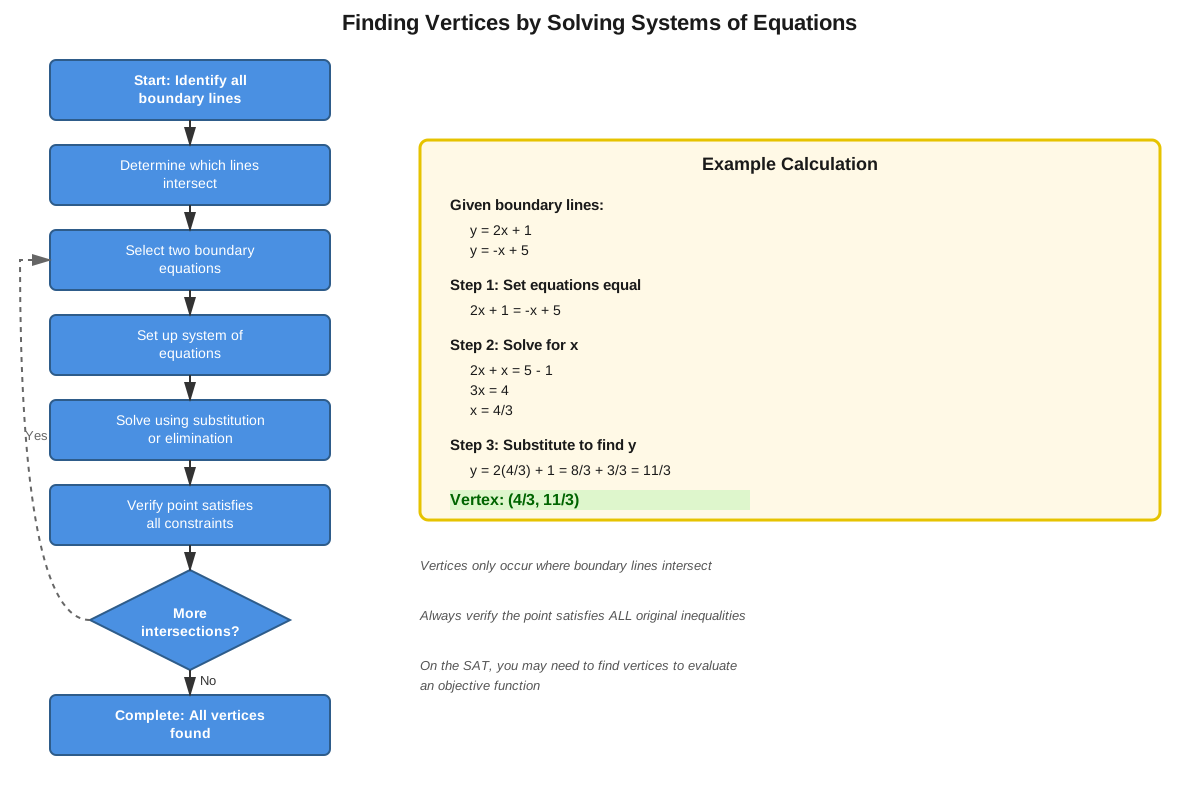
- Identify all vertices by solving systems of equations for each pair of intersecting boundary lines
Testing Points and Shading
To determine which side of a boundary line to shade, select a test point not on the line (the origin (0,0) is convenient when possible). Substitute the test point's coordinates into the original inequality. If the inequality is true, shade the side containing the test point; if false, shade the opposite side. When multiple inequalities are involved, the feasible region is where all shaded areas overlap.
Optimization and Objective Functions
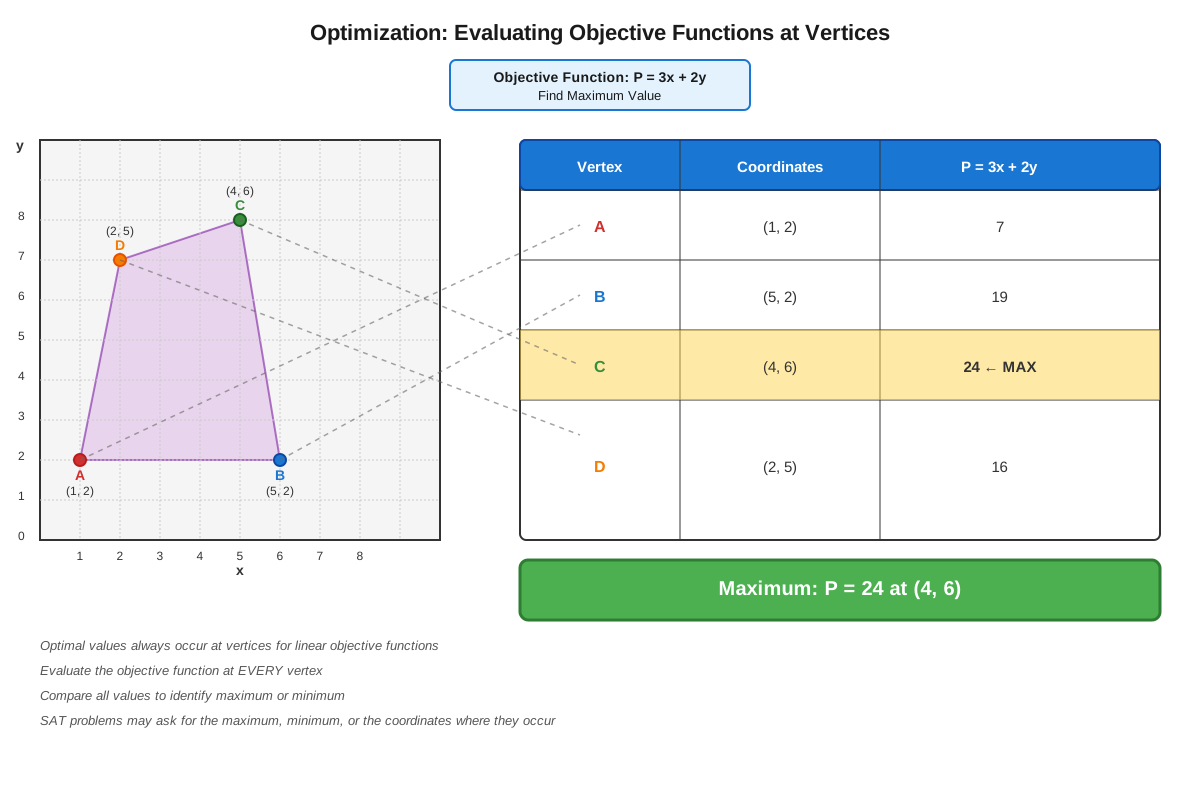
Many SAT feasible region problems involve an objective function—a linear expression to be maximized or minimized subject to the constraints. The objective function typically has the form f(x,y) = ax + by, where a and b are constants. To find the optimal value:
- Identify all vertices of the feasible region
- Evaluate the objective function at each vertex
- Compare values to determine which vertex yields the maximum or minimum
- State both the optimal value and the point where it occurs (if requested)
This approach works because of the Corner Point Theorem, which guarantees that linear functions achieve their extreme values at vertices of polygonal feasible regions.
Concept Relationships
The feasible region concept integrates multiple mathematical ideas into a unified framework. Linear inequalities serve as the foundation, with each inequality defining a half-plane on the coordinate system. When multiple inequalities are combined into a system of inequalities, their intersection creates the feasible region. This relationship can be expressed as: Individual Inequalities → Half-Planes → System of Inequalities → Feasible Region (intersection of half-planes).
The vertices of feasible regions emerge from systems of linear equations. Each vertex represents the solution to a system formed by setting two boundary line equations equal to each other. This connection flows as: Boundary Lines (from inequalities) → Pairs of Intersecting Lines → Systems of Two Equations → Vertex Coordinates.
When optimization is involved, the relationship extends further: Feasible Region + Objective Function → Evaluation at Vertices → Optimal Solution. This demonstrates how feasible regions bridge pure algebra (solving systems) with applied mathematics (optimization under constraints).
The concept also connects to coordinate geometry through the visual representation of solutions, to algebraic manipulation through equation solving, and to logical reasoning through constraint interpretation. Understanding these interconnections helps students recognize that feasible region problems integrate multiple skills rather than testing isolated concepts.
Quick check — test yourself on Feasible region so far.
Try Flashcards →High-Yield Facts
- ⭐ The feasible region is the intersection (overlap) of all half-planes defined by the system of inequalities
- ⭐ Vertices of the feasible region are found by solving systems of equations formed by pairs of boundary lines
- ⭐ For linear objective functions over polygonal feasible regions, optimal values occur at vertices
- ⭐ Solid boundary lines (from ≤ or ≥) include points on the line; dashed lines (from < or >) exclude them
- ⭐ A point is in the feasible region if and only if it satisfies ALL inequalities in the system simultaneously
- Bounded feasible regions form closed polygons; unbounded regions extend infinitely in at least one direction
- The origin (0,0) is the most convenient test point for determining which side of a boundary line to shade, unless the line passes through the origin
- If no points satisfy all constraints simultaneously, the system is infeasible (no feasible region exists)
- The number of vertices in a bounded feasible region equals the number of sides of the polygon formed
- Parallel boundary lines never intersect, so they don't create vertices together
- When graphing, always check whether boundary lines should be solid or dashed before shading
- The feasible region can be a single point, a line segment, or a two-dimensional area depending on the constraints
Common Misconceptions
Misconception: The feasible region includes all areas shaded by any of the inequalities. → Correction: The feasible region is only the area where ALL shaded regions overlap simultaneously. It's the intersection, not the union, of the individual solution sets.
Misconception: Vertices can be estimated visually from a graph without solving systems of equations. → Correction: While rough estimates may work for some problems, SAT questions often require exact coordinates. Always solve the system of equations formed by intersecting boundary lines algebraically to find precise vertex coordinates.
Misconception: The optimal value of an objective function always occurs at the vertex with the largest x-coordinate or y-coordinate. → Correction: The optimal vertex depends on the coefficients in the objective function. You must evaluate the function at ALL vertices and compare the results to determine which gives the maximum or minimum.
Misconception: If a boundary line is dashed, the entire feasible region must be open (not include any boundary points). → Correction: A feasible region can have some solid boundaries and some dashed boundaries. Points on solid boundaries are included in the region even if other boundaries are dashed.
Misconception: An unbounded feasible region means there is no solution to the system. → Correction: An unbounded feasible region contains infinitely many solutions—it simply extends infinitely in some direction. The system is still feasible; it just doesn't form a closed polygon.
Misconception: When testing points to determine shading direction, any point can be used. → Correction: While technically true, the test point must not lie on the boundary line itself. Choosing a point on the line will make the inequality appear true (for ≤ or ≥) or false (for < or >) regardless of which side should be shaded, leading to errors.
Worked Examples
Example 1: Identifying and Analyzing a Feasible Region
Problem: A company manufactures tables (x) and chairs (y). Each table requires 4 hours of labor and each chair requires 2 hours. The company has at most 40 hours of labor available. Additionally, the company must produce at least 5 tables and at least 3 chairs. Graph the feasible region and identify all vertices.
Solution:
First, translate the constraints into inequalities:
- Labor constraint: 4x + 2y ≤ 40
- Minimum tables: x ≥ 5
- Minimum chairs: y ≥ 3
- Non-negativity (implied): x ≥ 0, y ≥ 0
Next, identify boundary lines by converting inequalities to equations:
- Line 1: 4x + 2y = 40, which simplifies to 2x + y = 20
- Line 2: x = 5 (vertical line)
- Line 3: y = 3 (horizontal line)
Graph each boundary line:
- Line 1 (2x + y = 20): When x = 0, y = 20; when y = 0, x = 10. Plot points (0,20) and (10,0), draw a solid line
- Line 2 (x = 5): Vertical solid line through x = 5
- Line 3 (y = 3): Horizontal solid line through y = 3
Determine shading direction:
- For 4x + 2y ≤ 40: Test (0,0): 4(0) + 2(0) = 0 ≤ 40 ✓ Shade toward origin (below and left of line)
- For x ≥ 5: Shade to the right of x = 5
- For y ≥ 3: Shade above y = 3
The feasible region is where all three shaded areas overlap—a triangular region.
Find vertices by solving systems:
Vertex A (intersection of x = 5 and y = 3):
- Coordinates: (5, 3)
Vertex B (intersection of x = 5 and 2x + y = 20):
- Substitute x = 5: 2(5) + y = 20 → y = 10
- Coordinates: (5, 10)
Vertex C (intersection of y = 3 and 2x + y = 20):
- Substitute y = 3: 2x + 3 = 20 → 2x = 17 → x = 8.5
- Coordinates: (8.5, 3)
The feasible region is a triangle with vertices at (5, 3), (5, 10), and (8.5, 3).
This example demonstrates the complete process of translating word problems into mathematical constraints, graphing the system, and finding exact vertex coordinates—all essential skills for SAT feasible region questions.
Example 2: Optimization Problem
Problem: Using the feasible region from Example 1, suppose the company makes a profit of $50 per table and $30 per chair. What production combination maximizes profit?
Solution:
The objective function is: P(x,y) = 50x + 30y
According to the Corner Point Theorem, evaluate P at each vertex:
At vertex (5, 3):
P(5, 3) = 50(5) + 30(3) = 250 + 90 = 340
At vertex (5, 10):
P(5, 10) = 50(5) + 30(10) = 250 + 300 = 550
At vertex (8.5, 3):
P(8.5, 3) = 50(8.5) + 30(3) = 425 + 90 = 515
Comparing values: 340 < 515 < 550
The maximum profit of $550 occurs when the company produces 5 tables and 10 chairs.
This example illustrates the optimization process that frequently appears on SAT problems. Students must recognize that checking all vertices is necessary—the optimal solution isn't always obvious from the constraints alone.
Exam Strategy
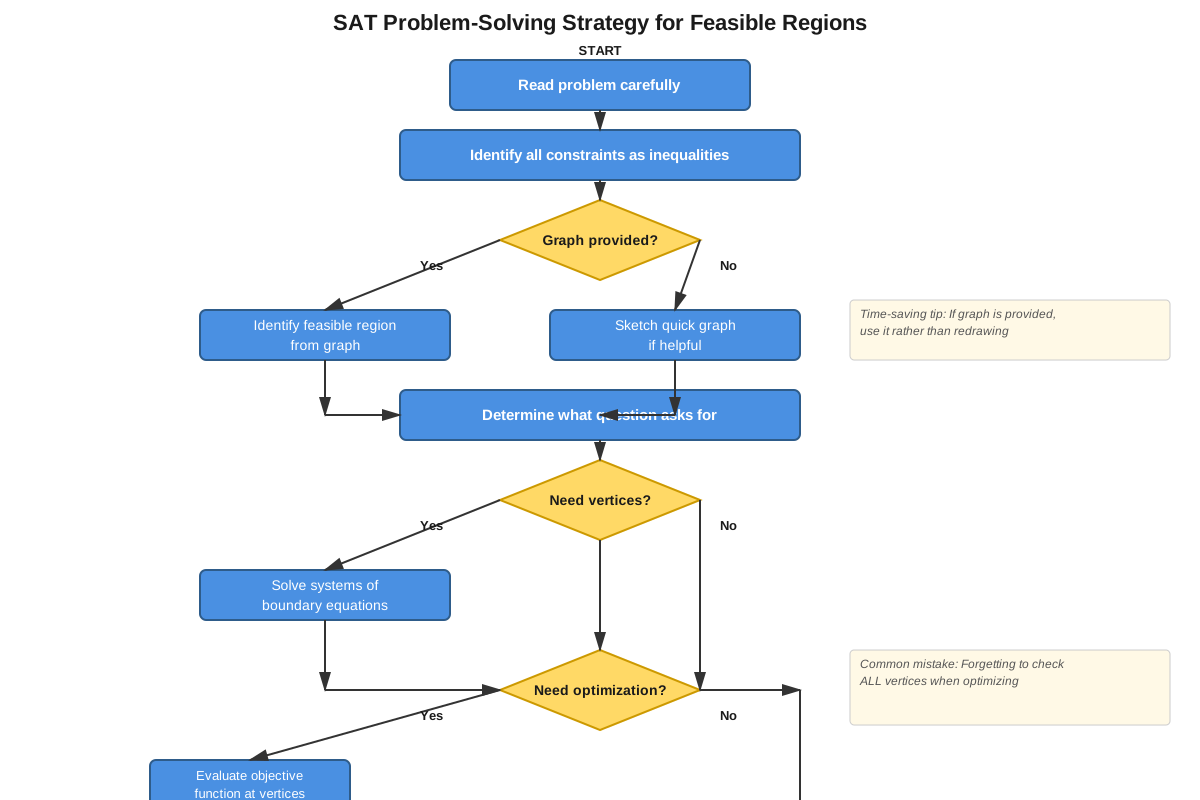
When approaching sat feasible region questions, begin by carefully reading the problem to identify all constraints. Look for trigger phrases like "at most" (≤), "at least" (≥), "no more than" (≤), "minimum" (≥), and "maximum" (≤). Create a variable key if the problem uses words instead of x and y, and systematically translate each constraint into an inequality.
If the problem provides a graph, examine it carefully before reading answer choices. Identify whether boundary lines are solid or dashed, note the shading direction, and locate all vertices. For questions asking which system of inequalities matches a graph, use process of elimination by testing one point clearly inside the feasible region and one point clearly outside it against each answer choice.
When constructing your own graph, work systematically: draw all boundary lines first, then determine shading for each inequality separately, and finally identify the overlap region. If time is limited and the question asks only about optimization, you may be able to identify vertices without fully shading the region—just find where boundary lines intersect.
For optimization problems, always evaluate the objective function at ALL vertices, even if one seems obviously optimal. SAT questions sometimes include distractors that catch students who make assumptions. Write out each calculation to avoid arithmetic errors, and double-check that you're answering the question asked (sometimes they want the maximum value, sometimes the coordinates where it occurs, sometimes both).
Time management is crucial: feasible region problems typically require 2-3 minutes. If you're spending more than 3 minutes, consider whether you're overcomplicating the approach. Many SAT feasible region questions can be solved by testing answer choices against constraints rather than fully graphing the system.
Memory Techniques
SOLID helps remember when boundary lines are solid:
- Solid lines for
- Or-equal-to symbols (≤ and ≥)
- Lines that
- Include the
- Defined boundary
VETO for finding optimal values:
- Vertices must be found
- Evaluate the objective function
- Test all corner points
- Optimal value is the max/min result
FISH for determining feasible regions:
- Find boundary lines
- Identify solid vs. dashed
- Shade each inequality
- Highlight the overlap (intersection)
Visualize the feasible region as a "safe zone" where all rules are followed—any point outside this zone breaks at least one rule (constraint). This mental model helps reinforce that the feasible region is the intersection of all constraints.
For remembering that optimal values occur at vertices, think: "Corners count most"—the extreme values of linear functions over polygonal regions always occur at the corners (vertices), never in the middle of the region.
Summary
The feasible region represents the complete solution set to a system of linear inequalities, visualized as a shaded area on the coordinate plane where all constraints are simultaneously satisfied. This concept integrates graphing skills, algebraic equation-solving, and logical reasoning about constraints. On the SAT, feasible region problems appear in both pure mathematical form and real-world application contexts, testing students' ability to translate verbal constraints into inequalities, graph systems accurately, identify vertices through solving systems of equations, and optimize objective functions using the Corner Point Theorem. Mastery requires understanding that the feasible region is the intersection (not union) of individual inequality solutions, that vertices are found algebraically by solving pairs of boundary line equations, and that optimal values of linear objective functions occur at these vertices. Success on SAT feasible region questions depends on systematic problem-solving: carefully translating constraints, accurately graphing with attention to solid versus dashed boundaries, precisely calculating vertex coordinates, and methodically evaluating objective functions at all corner points.
Key Takeaways
- The feasible region is the intersection of all half-planes defined by a system of inequalities—only points satisfying ALL constraints simultaneously are included
- Vertices (corner points) are found by solving systems of equations formed by pairs of intersecting boundary lines and are critical for optimization problems
- Solid boundary lines (≤ or ≥) include points on the line; dashed lines (< or >) exclude them—this distinction affects whether vertices are in the feasible region
- For linear objective functions over polygonal feasible regions, maximum and minimum values always occur at vertices, never at interior points
- Systematic approaches prevent errors: translate all constraints first, graph boundary lines second, determine shading third, identify the overlap region fourth, and find vertices last
- SAT feasible region problems frequently appear as word problems requiring translation of real-world constraints into mathematical inequalities
- Testing points (especially the origin when possible) efficiently determines which side of a boundary line to shade for each inequality
Related Topics
Linear Programming: Extends feasible region concepts to more complex optimization scenarios with additional constraints and multiple variables, commonly encountered in advanced mathematics and economics courses.
Systems of Linear Equations: Provides the algebraic foundation for finding vertex coordinates; mastering solution methods (substitution, elimination) directly improves feasible region problem-solving efficiency.
Absolute Value Inequalities: Creates V-shaped or inverted-V-shaped boundary regions that can be combined with linear inequalities to form more complex feasible regions.
Quadratic Inequalities: Introduces curved boundaries (parabolas) that can define feasible regions, appearing occasionally on advanced SAT problems and frequently in college mathematics.
Three-Dimensional Linear Programming: Extends feasible region concepts to three variables, creating feasible regions as polyhedra in space rather than polygons in a plane, relevant for multivariable calculus and optimization theory.
Practice CTA
Now that you've mastered the core concepts of feasible regions, it's time to solidify your understanding through active practice. Work through the practice questions to apply these strategies to SAT-style problems, and use the flashcards to reinforce key definitions and procedures. Remember, feasible region problems integrate multiple skills—each practice problem you complete strengthens your graphing accuracy, algebraic precision, and strategic thinking. Consistent practice with these high-yield problems will build the confidence and speed you need to excel on test day. You've got this!
Sign up free to keep reading
Create a free AnvayaPrep account to finish this SAT guide on Feasible region — plus flashcards and practice questions.