Overview
Rate systems are a critical category of problems on the SAT Math section that combine the concepts of rates (speed, work rate, flow rate, etc.) with systems of linear equations. These problems require students to set up and solve multiple equations simultaneously, where each equation represents a relationship involving rates, time, and distance or work completed. Rate systems appear frequently on the SAT because they test multiple mathematical competencies at once: translating word problems into algebraic expressions, manipulating equations, and applying logical reasoning to real-world scenarios.
Understanding sat rate systems is essential for achieving a competitive score because these problems typically appear as medium-to-hard difficulty questions that separate average performers from high scorers. The SAT consistently includes 2-4 rate system problems per test, often disguised within various contexts such as travel scenarios, work completion tasks, mixture problems, or flow rate situations. Mastering this topic provides students with a systematic approach to tackle what initially appear to be complex word problems by breaking them down into manageable algebraic relationships.
Rate systems connect directly to broader math concepts tested on the SAT, including linear equations, algebraic manipulation, proportional reasoning, and problem-solving strategies. They build upon foundational knowledge of the distance formula (d = rt), work formulas, and the principles of systems of equations. Students who master rate systems develop stronger analytical skills that transfer to other SAT math topics, including functions, data analysis, and advanced problem-solving questions. This topic serves as a bridge between basic algebra and more sophisticated mathematical modeling, making it an indispensable component of comprehensive SAT preparation.
Learning Objectives
- [ ] Identify key features of rate systems, including the variables involved and the relationships between rate, time, and quantity
- [ ] Explain how rate systems appears on the SAT, including common contexts and question formats
- [ ] Apply rate systems to answer SAT-style questions by setting up and solving systems of equations
- [ ] Translate complex word problems involving rates into algebraic equations with multiple variables
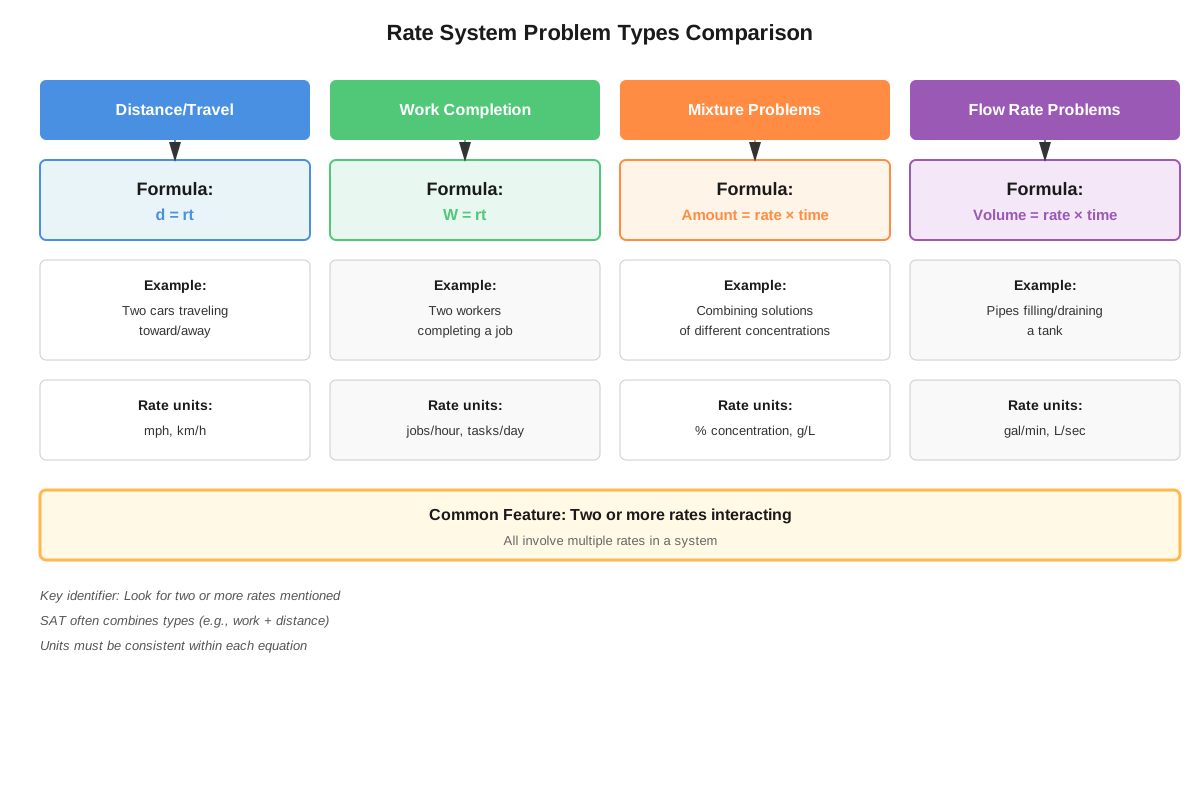
- [ ] Distinguish between different types of rate problems (distance/travel, work completion, mixture, and flow rates)
- [ ] Solve rate system problems using multiple methods (substitution, elimination, and graphical interpretation)
- [ ] Verify solutions to rate system problems by checking whether answers satisfy all given conditions
Prerequisites
- Basic algebraic manipulation: Essential for rearranging equations and isolating variables when solving systems
- Understanding of linear equations: Required to recognize and work with equations in the form y = mx + b or ax + by = c
- Familiarity with the distance formula (d = rt): Forms the foundation for most rate problems involving motion
- Ability to solve systems of two linear equations: The core skill needed to find solutions where multiple rate relationships intersect
- Unit conversion and dimensional analysis: Necessary for ensuring consistency when rates are expressed in different units (mph vs. km/h, hours vs. minutes)
- Proportional reasoning: Helps understand how changes in rate affect time or distance in inverse or direct relationships
Why This Topic Matters
Rate systems represent one of the most practical applications of algebra that students encounter in both academic and real-world contexts. These problems model everyday situations such as planning travel times, calculating project completion schedules, determining optimal mixing ratios, and analyzing flow rates in various systems. The ability to set up and solve rate systems demonstrates mathematical maturity and problem-solving sophistication that extends far beyond the SAT into fields like engineering, economics, logistics, and data science.
On the SAT, rate systems appear with remarkable consistency, typically accounting for 3-6% of all math questions. Based on analysis of released SAT exams, students can expect to encounter 2-4 rate system problems per test, distributed across both the calculator and no-calculator sections. These questions most commonly appear as multi-step word problems worth one point each, though they occasionally appear as Student-Produced Response (grid-in) questions. The College Board favors rate systems because they efficiently assess multiple mathematical standards simultaneously: modeling with mathematics, reasoning quantitatively, and working with linear relationships.
Rate system questions on the SAT typically manifest in several recurring contexts: travel problems where two objects move toward or away from each other; work problems where multiple workers or machines complete tasks at different rates; mixture problems involving combining substances with different concentrations or properties; and current/wind problems where an object's effective rate changes based on environmental factors. Recognizing these patterns allows students to quickly identify the problem type and apply the appropriate solution strategy, significantly improving both accuracy and speed under timed conditions.
Core Concepts
Understanding Rate Fundamentals
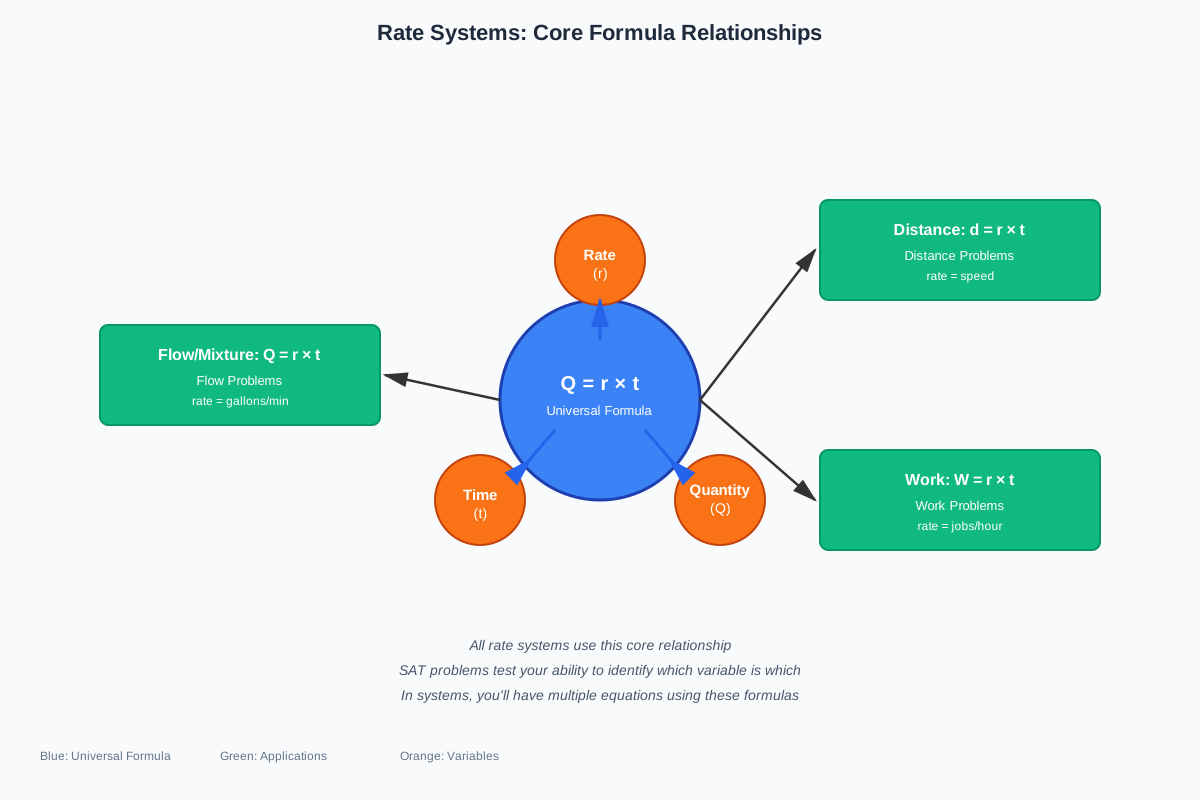
A rate is a ratio that compares two quantities with different units, expressing how one quantity changes relative to another. The most common rates on the SAT include speed (distance per unit time), work rate (portion of work completed per unit time), and flow rate (volume per unit time). The fundamental relationship for rate problems is:
Quantity = Rate × TimeFor distance problems, this becomes d = rt (distance equals rate times time). For work problems, it becomes W = rt (work completed equals work rate times time). Understanding that these formulas can be rearranged to solve for any variable (r = d/t or t = d/r) is crucial for setting up rate system equations.
Components of Rate Systems
A rate system involves two or more equations that must be satisfied simultaneously, where at least one equation involves a rate relationship. These systems typically include:
- Variables: Usually representing rates, times, distances, or quantities
- Constraints: Conditions that relate the variables (e.g., "the total distance is 300 miles")
- Rate relationships: Equations expressing how rate, time, and quantity interact
- System structure: The mathematical framework connecting all equations
The key to solving rate systems is identifying what each variable represents and how the given information translates into mathematical equations.
Types of Rate Systems on the SAT
Distance and Travel Problems
These problems involve objects moving at constant rates, either toward each other, away from each other, or in the same direction. The essential equations are:
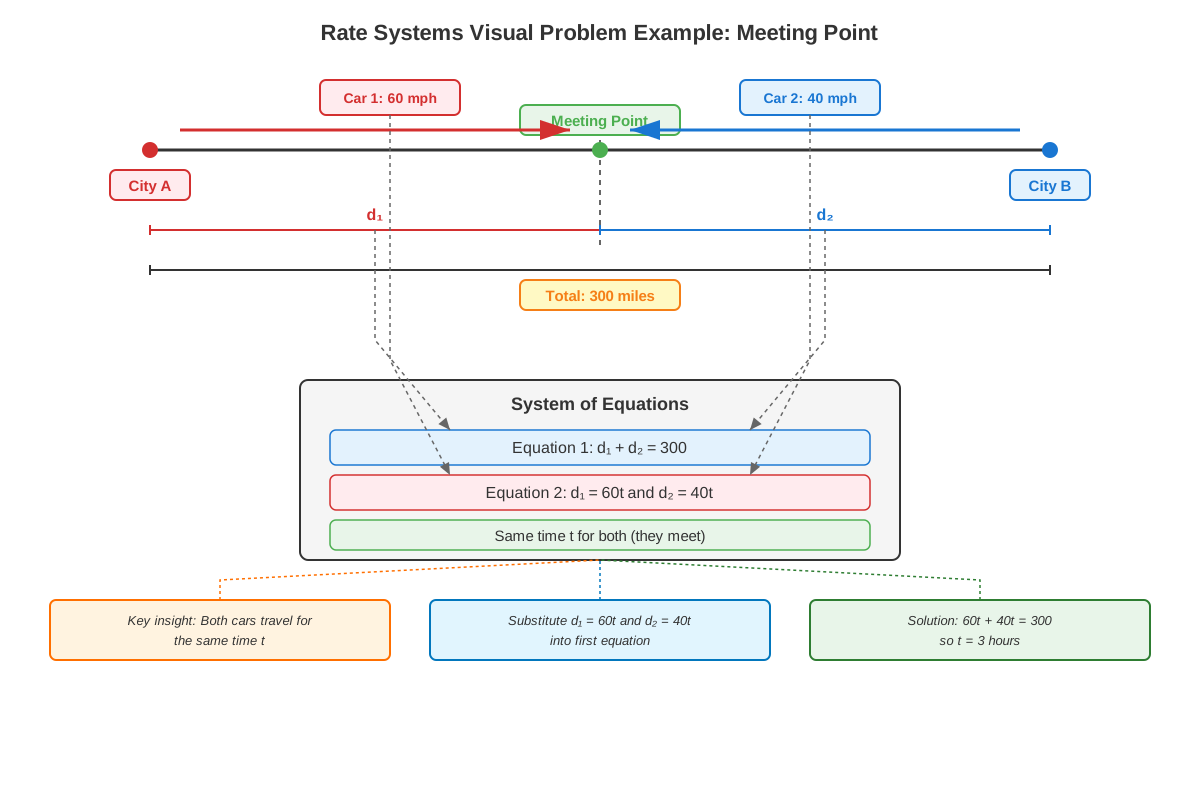
- Opposite directions (meeting): d₁ + d₂ = total distance, where d₁ = r₁t and d₂ = r₂t
- Same direction (catching up): d₁ = d₂ + initial separation, where both distances use the same time
- Round trip problems: distance going = distance returning, but rates or times differ
| Scenario | Key Relationship | Common Setup |
|---|---|---|
| Two objects meeting | Combined distance = Total separation | r₁t + r₂t = D |
| One object catching another | Faster object's distance = Slower object's distance + head start | r₁t = r₂t + d₀ |
| With/against current or wind | Effective rate = base rate ± current rate | (r + c)t₁ = (r - c)t₂ |
Work Rate Problems
Work problems involve completing tasks at specified rates. The fundamental principle is that work rates are additive when working together:
Combined rate = Rate₁ + Rate₂ + ... + RateₙIf person A completes a job in 4 hours, their work rate is 1/4 of the job per hour. If person B completes the same job in 6 hours, their rate is 1/6 per hour. Working together, their combined rate is 1/4 + 1/6 = 5/12 of the job per hour.
Mixture and Solution Problems
These problems involve combining substances with different properties (concentration, value, etc.). The key principle is that the total amount of the "active ingredient" is conserved:
(Concentration₁)(Amount₁) + (Concentration₂)(Amount₂) = (Final Concentration)(Total Amount)Setting Up Rate System Equations
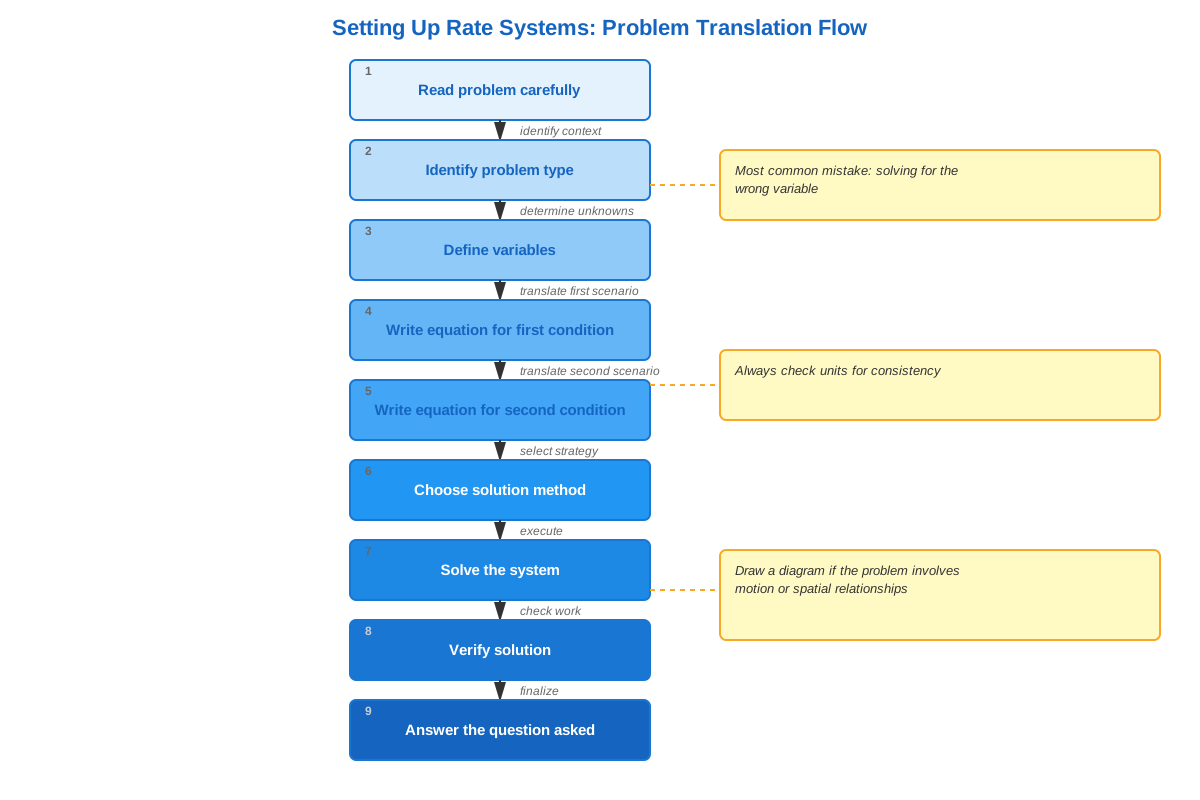
The systematic approach to setting up rate systems involves:
- Define variables clearly: Write down what each variable represents with units
- Identify the rate formula applicable: Distance, work, or mixture
- Extract information from the problem: Translate each sentence into mathematical relationships
- Write constraint equations: Express conditions like "total time is 5 hours" or "combined distance is 200 miles"
- Ensure dimensional consistency: Check that units match across equations
Solving Rate Systems
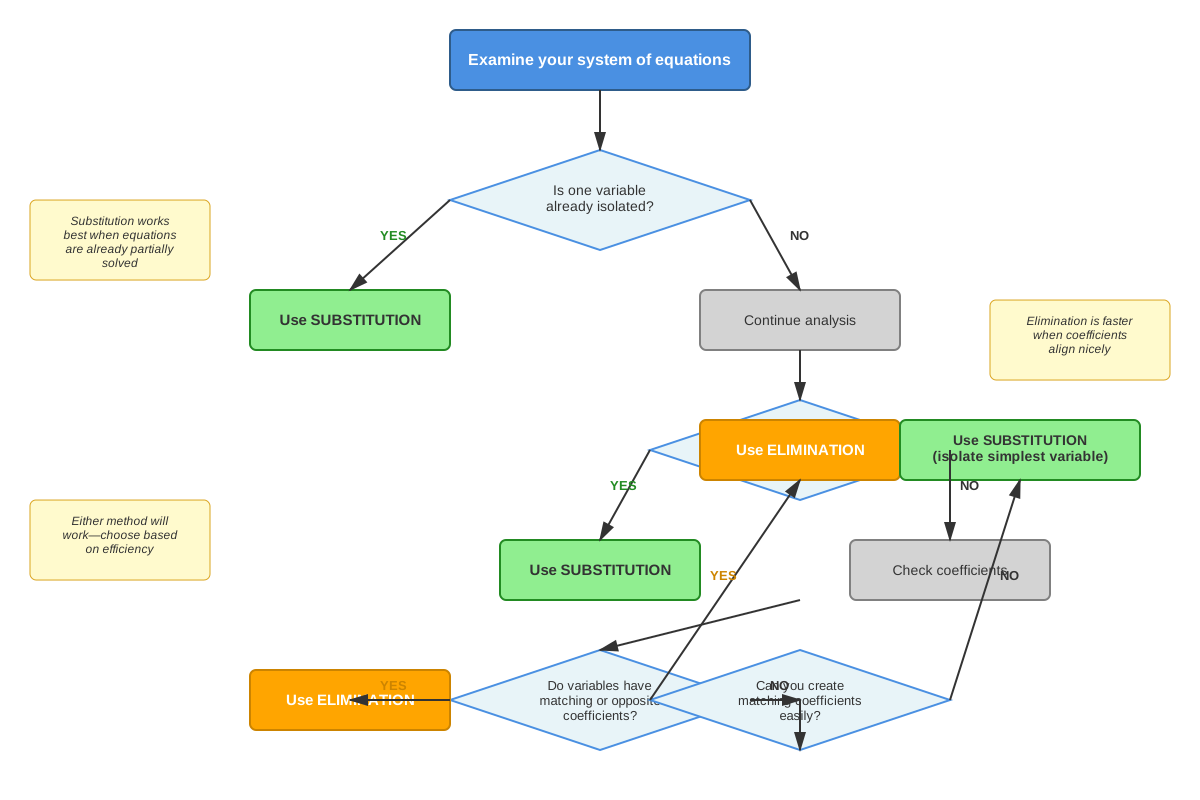
Rate systems can be solved using three primary methods:
Substitution Method: Solve one equation for a variable, then substitute into the other equation. This works well when one equation is easily solved for a single variable.
Elimination Method: Multiply equations by constants to make coefficients of one variable opposites, then add equations to eliminate that variable. This is efficient when both equations are in standard form.
Graphical Method: Less common on the SAT but useful for visualization. The solution is where the two lines intersect on a coordinate plane.
Special Considerations for Rate Systems
Inverse relationships: When rate increases, time decreases proportionally if distance/work remains constant (r₁t₁ = r₂t₂).
Average rate: The average rate for a trip is NOT the arithmetic mean of the rates. Instead, use:
Average rate = Total distance / Total timeRelative rates: When objects move in opposite directions, add their rates. When moving in the same direction, subtract rates to find the relative rate of approach or separation.
Concept Relationships
Rate systems integrate multiple mathematical concepts in a hierarchical structure. At the foundation lies basic rate formulas (d = rt, W = rt), which serve as the building blocks for all rate problems. These formulas connect directly to proportional reasoning, as rates express constant ratios between quantities. When a problem involves multiple rates or multiple time periods, these basic formulas expand into systems of linear equations, requiring simultaneous solution techniques.
The relationship flow follows this pattern: Rate formula → Multiple rate relationships → System of equations → Solution methods → Verification. Each step depends on the previous one, and mastery requires understanding how information flows through this chain. For example, recognizing that "two trains travel toward each other" triggers the relationship d₁ + d₂ = D, which then becomes r₁t + r₂t = D, creating a linear equation that combines with other constraints to form a solvable system.
Rate systems also connect laterally to other SAT math topics. They share solution techniques with general systems of linear equations, apply algebraic manipulation skills, require unit analysis similar to dimensional analysis in science, and often involve rational expressions when dealing with work rates. Understanding these connections helps students recognize that rate systems aren't isolated—they're applications of broader mathematical principles. This interconnectedness means that improving skills in one area (like solving systems of equations) directly enhances performance on rate system problems.
High-Yield Facts
- ⭐ The fundamental rate equation d = rt can be rearranged to solve for any variable: r = d/t or t = d/r
- ⭐ When two objects move toward each other, their combined rate of approach equals the sum of their individual rates
- ⭐ Work rates are additive: if working together, combined rate = rate₁ + rate₂
- ⭐ Average rate for a trip equals total distance divided by total time, NOT the average of the individual rates
- ⭐ In current/wind problems, effective rate with the current = base rate + current rate; against current = base rate - current rate
- If person A completes a job in x hours, their work rate is 1/x of the job per hour
- When objects move in the same direction, the relative rate equals the difference of their speeds
- In mixture problems, the amount of pure substance equals concentration × total volume
- Time must be consistent across all equations in a system (all in hours or all in minutes)
- The solution to a rate system must satisfy ALL equations simultaneously and make physical sense
- Round-trip problems often involve the same distance but different rates or times for each direction
- Distance traveled upstream plus distance traveled downstream can equal total distance or can represent different legs of a journey
- If two workers complete a job together in time t, and one works at rate r₁, the other's rate can be found using: r₂ = (1/t) - r₁
- Rate problems with three or more variables may require three or more equations to solve completely
- Converting all rates to the same units before setting up equations prevents calculation errors
Quick check — test yourself on Rate systems so far.
Try Flashcards →Common Misconceptions
Misconception: Average speed for a round trip is the arithmetic mean of the two speeds.
Correction: Average speed equals total distance divided by total time. If you travel 60 mph for one hour and 40 mph for one hour, the average speed is 50 mph only because the times are equal. If the distances are equal instead, the average speed is NOT 50 mph but rather 2d/(d/60 + d/40) = 48 mph.
Misconception: When two objects move toward each other, you subtract their speeds to find when they meet.
Correction: When moving toward each other, you ADD their speeds to find the combined rate of approach. If train A travels at 60 mph east and train B travels at 40 mph west toward train A, they approach each other at 60 + 40 = 100 mph.
Misconception: If person A takes 3 hours to complete a job and person B takes 6 hours, together they take 9 hours.
Correction: Work rates are additive, not times. Person A's rate is 1/3 job/hour and person B's rate is 1/6 job/hour. Together: 1/3 + 1/6 = 1/2 job/hour, so they complete the job in 2 hours, not 9 hours.
Misconception: In a current problem, if a boat travels 20 mph in still water and the current is 5 mph, the boat always travels at 20 mph.
Correction: The boat's effective speed depends on direction relative to the current. Downstream (with current): 20 + 5 = 25 mph. Upstream (against current): 20 - 5 = 15 mph. The 20 mph is only the speed in still water.
Misconception: If you travel half the distance at 30 mph and half the distance at 60 mph, you've traveled at each speed for the same amount of time.
Correction: Equal distances at different speeds require different times. At 30 mph, you spend more time covering your half than at 60 mph for the other half. If each half is 60 miles, the first half takes 2 hours and the second half takes 1 hour.
Misconception: In mixture problems, you can add concentrations directly.
Correction: You must multiply concentration by volume to find the amount of pure substance, then add those amounts. Mixing 2 liters of 30% solution with 3 liters of 50% solution gives (0.30)(2) + (0.50)(3) = 2.1 liters of pure substance in 5 liters total, which is 42% concentration, not 40% (the average of 30% and 50%).
Misconception: The variable t must represent the same time value in all equations.
Correction: While t often represents the same time, some problems involve different time periods (t₁ and t₂). Always check whether the problem describes simultaneous events or sequential events. "They both travel for 3 hours" means use the same t; "the first travels for 2 hours, then the second travels for 3 hours" requires different time variables.
Worked Examples
Example 1: Meeting Problem with Two Travelers
Problem: Two cyclists start from towns 150 miles apart and ride toward each other. Cyclist A travels at 18 mph and Cyclist B travels at 12 mph. How long will it take them to meet?
Solution:
Step 1: Define variables
- Let t = time (in hours) until they meet
- Distance traveled by A: d_A = 18t
- Distance traveled by B: d_B = 12t
Step 2: Set up the system
Since they're traveling toward each other, their combined distances equal the total separation:
d_A + d_B = 150
18t + 12t = 150
Step 3: Solve
30t = 150
t = 5
Step 4: Verify
- Cyclist A travels: 18(5) = 90 miles
- Cyclist B travels: 12(5) = 60 miles
- Total: 90 + 60 = 150 miles ✓
Answer: They will meet after 5 hours.
Connection to learning objectives: This example demonstrates identifying key features (two rates, one time, combined distance), recognizing the SAT format (straightforward word problem), and applying the solution method (setting up and solving a linear equation derived from the rate system).
Example 2: Work Rate Problem with Two Workers
Problem: Machine A can complete a production run in 6 hours. Machine B can complete the same production run in 9 hours. If both machines work together, how long will it take to complete the production run?
Solution:
Step 1: Determine individual work rates
- Machine A's rate: 1/6 of the job per hour
- Machine B's rate: 1/9 of the job per hour
Step 2: Find combined rate
When working together, rates are additive:
Combined rate = 1/6 + 1/9To add these fractions, find common denominator (18):
Combined rate = 3/18 + 2/18 = 5/18 of the job per hourStep 3: Calculate time to complete one full job
If they complete 5/18 of the job per hour, then:
Time = 1 job ÷ (5/18 job/hour) = 1 × 18/5 = 18/5 = 3.6 hoursStep 4: Verify
- In 3.6 hours, Machine A completes: 3.6/6 = 0.6 of the job
- In 3.6 hours, Machine B completes: 3.6/9 = 0.4 of the job
- Total: 0.6 + 0.4 = 1.0 (complete job) ✓
Answer: Working together, they complete the production run in 3.6 hours (or 3 hours 36 minutes).
Connection to learning objectives: This example shows how to identify work rate features (individual completion times, combined work), translate the problem into rate equations (1/6 + 1/9), and solve using the work rate formula. It also demonstrates the importance of verification to ensure the solution makes sense.
Example 3: Current Problem with Round Trip
Problem: A boat travels 24 miles upstream in 3 hours. The return trip downstream takes 2 hours. What is the speed of the boat in still water, and what is the speed of the current?
Solution:
Step 1: Define variables
- Let b = speed of boat in still water (mph)
- Let c = speed of current (mph)
Step 2: Set up equations using d = rt
Upstream (against current):
24 = (b - c)(3)
24 = 3b - 3c
8 = b - c  [Equation 1]
Downstream (with current):
24 = (b + c)(2)
24 = 2b + 2c
12 = b + c  [Equation 2]
Step 3: Solve the system using elimination
Add Equation 1 and Equation 2:
(b - c) + (b + c) = 8 + 12
2b = 20
b = 10
Substitute b = 10 into Equation 2:
10 + c = 12
c = 2
Step 4: Verify
- Upstream speed: 10 - 2 = 8 mph; Distance in 3 hours: 8(3) = 24 miles ✓
- Downstream speed: 10 + 2 = 12 mph; Distance in 2 hours: 12(2) = 24 miles ✓
Answer: The boat's speed in still water is 10 mph, and the current's speed is 2 mph.
Connection to learning objectives: This problem requires identifying multiple rate relationships (upstream and downstream), setting up a system of two equations with two unknowns, and applying the elimination method to solve—all key SAT rate system skills.
Exam Strategy
When approaching rate system problems on the SAT, begin by reading the entire problem carefully to identify what type of rate problem it is (distance, work, mixture, or current). Look for trigger phrases that indicate the problem structure: "traveling toward each other" signals a meeting problem; "working together" indicates a combined work rate problem; "with the current" and "against the current" reveal a current problem.
Create a systematic setup before attempting calculations. Write down what each variable represents, including units. This prevents confusion and helps catch errors. For example, write "Let r = rate of train A in mph" rather than just "r = rate." Draw a simple diagram or table to organize information, especially for distance problems. A table with columns for rate, time, and distance helps visualize the relationships.
Watch for these trigger words and phrases:
- "Toward each other" or "meet" → add rates
- "Same direction" or "catch up" → subtract rates
- "Together" or "combined" → add work rates
- "Upstream/downstream" or "with/against wind" → add/subtract current or wind speed
- "Average rate" → use total distance/total time, not arithmetic mean
- "Round trip" → same distance, possibly different rates or times
Use process of elimination effectively by checking whether answer choices make physical sense. If a boat travels 20 mph in still water with a 5 mph current, the downstream speed must be greater than 20 mph—eliminate any answer suggesting otherwise. If two workers together should complete a job faster than either alone, eliminate answers showing longer times.
Time allocation: Rate system problems typically require 1.5-2.5 minutes. If you're stuck after 2 minutes, mark the question and move on—you can return if time permits. Don't let one challenging rate problem consume time needed for easier questions. Practice identifying the problem type quickly (within 15-20 seconds) so you can apply the appropriate strategy immediately.
Check your work by substituting your answer back into the original conditions. This takes only 15-30 seconds and catches most calculation errors. Verify that your answer has the correct units and makes logical sense in context. If the problem asks for time and your answer is negative or unreasonably large, you've made an error.
Memory Techniques
D-R-T Triangle: Visualize a triangle with D (distance) at the top, R (rate) and T (time) at the bottom corners. Cover the variable you're solving for, and the remaining two show the operation: D = R × T, R = D/T, T = D/R. This works for any rate formula by substituting the appropriate quantity for D (work, volume, etc.).
TOWARD = ADD, AWAY = SUBTRACT: When objects move toward each other, ADD their rates. When one chases another (same direction), SUBTRACT rates. This mnemonic prevents the common error of subtracting when you should add.
"Work rates are FRACTIONS": Remember that if someone completes a job in n hours, their rate is 1/n per hour. The word "FRACTIONS" reminds you to flip the time to get the rate. Machine takes 5 hours → rate is 1/5 per hour.
"CURRENT CHANGES SPEED": For current/wind problems, remember that current CHANGES the effective speed. Visualize a plus sign for "with" (downstream, tailwind) and a minus sign for "against" (upstream, headwind). The boat's still-water speed is the base; current modifies it.
"Average is TOTAL over TOTAL": To avoid the arithmetic mean trap, remember "average rate = TOTAL distance / TOTAL time." The repetition of "TOTAL" emphasizes that you must sum distances and sum times separately before dividing.
W-R-T for Work Problems: Similar to D-R-T, use W-R-T where W = work completed (often 1 for a complete job), R = work rate (fraction per time unit), T = time. This keeps work problems parallel to distance problems in your mind.
Summary
Rate systems represent a crucial intersection of algebraic reasoning and real-world problem-solving on the SAT Math section. These problems require students to translate verbal descriptions into mathematical equations involving rates, times, and quantities, then solve systems of linear equations to find unknown values. The fundamental relationship—quantity equals rate times time—appears in various contexts including distance problems (d = rt), work problems (W = rt), and mixture problems. Success with rate systems depends on recognizing problem types quickly, setting up equations systematically, and applying appropriate solution methods such as substitution or elimination. Key principles include understanding that rates add when objects move toward each other or work together, that average rate equals total distance divided by total time (not the arithmetic mean of rates), and that effective rates change when currents or winds are involved. Students must avoid common pitfalls such as confusing when to add versus subtract rates, incorrectly calculating average rates, and failing to verify that solutions satisfy all given conditions. Mastery of rate systems not only improves SAT performance but also develops analytical thinking skills applicable across mathematics and science.
Key Takeaways
- Rate systems combine the fundamental formula (quantity = rate × time) with systems of linear equations to solve problems involving multiple rates or time periods
- The three main types of rate problems on the SAT are distance/travel problems, work rate problems, and mixture/current problems, each with characteristic setups
- When objects move toward each other, add their rates; when moving in the same direction, subtract rates to find relative speed
- Work rates are additive (combined rate = rate₁ + rate₂), and individual work rates equal 1/time to complete the job
- Average rate equals total distance divided by total time, NOT the arithmetic mean of individual rates—this is one of the most commonly tested concepts
- Always define variables clearly with units, set up all equations before solving, and verify solutions by checking that they satisfy all original conditions
- Current and wind problems require adding or subtracting the environmental rate from the base rate depending on direction (with or against)
Related Topics
Systems of Linear Equations (General): Rate systems are a specific application of general systems of linear equations. Mastering rate systems strengthens skills in solving any system of equations, whether by substitution, elimination, or graphical methods. This foundational skill appears throughout algebra and is essential for advanced mathematics.
Proportional Relationships and Direct/Inverse Variation: Understanding how quantities relate proportionally deepens comprehension of rate problems. When rate is constant, distance and time vary directly (d ∝ t). When distance is constant, rate and time vary inversely (r ∝ 1/t). These relationships appear frequently in SAT problems.
Rational Equations and Expressions: Work rate problems often involve adding fractions (1/a + 1/b), which connects to the broader topic of rational expressions. Students who master rate systems develop stronger skills in manipulating fractions and rational equations.
Word Problem Translation: Rate systems exemplify the critical skill of translating verbal descriptions into mathematical equations. This skill transfers to all SAT word problems, including those involving percentages, geometry, and data analysis.
Functions and Modeling: Advanced rate problems can be expressed as functions, where distance or work completed is a function of time. Understanding rate systems provides a foundation for more sophisticated mathematical modeling in precalculus and calculus.
Practice CTA
Now that you've mastered the core concepts of rate systems, it's time to put your knowledge into action! The practice questions and flashcards are specifically designed to reinforce the strategies and techniques you've learned in this guide. Each practice problem mirrors actual SAT question formats and difficulty levels, giving you authentic test preparation. Work through the problems systematically, applying the setup strategies and solution methods covered here. Remember, mastery comes through deliberate practice—each problem you solve strengthens your pattern recognition and problem-solving speed. You've built a solid foundation; now transform that knowledge into test-day confidence and points. Start practicing, and watch your rate system skills reach the next level!
Sign up free to keep reading
Create a free AnvayaPrep account to finish this SAT guide on Rate systems — plus flashcards and practice questions.