Overview
The altitude of a triangle is one of the most fundamental and frequently tested geometric concepts on the SAT. An altitude is a perpendicular line segment drawn from any vertex of a triangle to the line containing the opposite side (or the extension of that side). This seemingly simple definition unlocks a wealth of problem-solving opportunities, as altitudes create right angles that enable the use of the Pythagorean theorem, trigonometric ratios, and area formulas. Understanding altitudes is not merely about recognizing their geometric properties—it's about leveraging them as powerful tools to decompose complex triangles into manageable right triangles.
On the SAT Math section, altitude problems appear with remarkable consistency, often integrated into multi-step questions involving area calculations, coordinate geometry, and triangle similarity. The College Board frequently tests whether students can identify when an altitude is present (even when not explicitly labeled), construct altitudes strategically to solve problems, and apply the fundamental relationship between altitude and area: Area = ½ × base × altitude. Questions may present triangles in various orientations, require students to find missing side lengths using altitude-based relationships, or ask for coordinate calculations when triangles are positioned on the coordinate plane.
Mastery of altitudes connects directly to broader triangle concepts including the Pythagorean theorem, special right triangles (30-60-90 and 45-45-90), triangle area formulas, and coordinate geometry. Altitudes also serve as the foundation for understanding more advanced concepts like orthocenter (the intersection point of all three altitudes) and the relationship between different triangle centers. For SAT success, students must develop fluency in recognizing altitude-based problem structures and executing the appropriate solution strategies efficiently.
Learning Objectives
- [ ] Identify key features of altitude in triangles
- [ ] Explain how altitude appears on the SAT
- [ ] Apply altitude to answer SAT-style questions
- [ ] Construct altitudes in acute, right, and obtuse triangles and recognize their different positions
- [ ] Calculate the length of an altitude using the Pythagorean theorem and area formulas
- [ ] Solve coordinate geometry problems involving altitudes using slope relationships and distance formulas
- [ ] Recognize when drawing an altitude creates special right triangles that simplify problem-solving
Prerequisites
- Right angles and perpendicular lines: Altitudes always form 90-degree angles with the base, making perpendicularity recognition essential
- Pythagorean theorem (a² + b² = c²): Most altitude problems involve right triangles created when the altitude is drawn
- Triangle area formula (A = ½bh): The altitude serves as the height in this fundamental formula
- Basic coordinate geometry: Finding slopes, using the perpendicular slope relationship (m₁ × m₂ = -1), and calculating distances
- Properties of triangles: Understanding that triangles have three sides, three vertices, and interior angles summing to 180°
Why This Topic Matters
In real-world applications, altitudes represent the shortest distance from a point to a line—a concept fundamental to engineering, architecture, navigation, and computer graphics. Architects use altitude principles when calculating roof heights and structural supports. Surveyors employ perpendicular distance measurements (altitudes) when mapping terrain. In physics, the altitude concept appears in projectile motion problems and force decomposition.
On the SAT, altitude-related questions appear in approximately 8-12% of the geometry problems, making them high-yield content for score improvement. The College Board tests altitudes through multiple question formats: direct calculation problems asking for altitude length, area problems requiring altitude identification, coordinate geometry questions involving perpendicular lines, and multi-step problems where drawing an altitude is the key strategic insight. Questions typically appear in both the calculator and no-calculator sections, with difficulty ranging from straightforward applications to complex multi-concept integrations.
Common SAT question patterns include: (1) providing a triangle's area and base, then asking for the altitude; (2) giving all three side lengths and requiring altitude calculation through the Pythagorean theorem; (3) presenting a triangle on the coordinate plane and asking for the equation of the line containing an altitude; (4) embedding altitude concepts within word problems about real-world scenarios; and (5) requiring students to recognize that an altitude divides certain triangles (especially isosceles triangles) into congruent right triangles.
Core Concepts
Definition and Basic Properties
An altitude of a triangle is a line segment drawn from a vertex perpendicular to the opposite side (called the base) or to the line containing the opposite side. Every triangle has exactly three altitudes, one from each vertex. The key defining characteristic is perpendicularity—the altitude must form a 90-degree angle with the base.
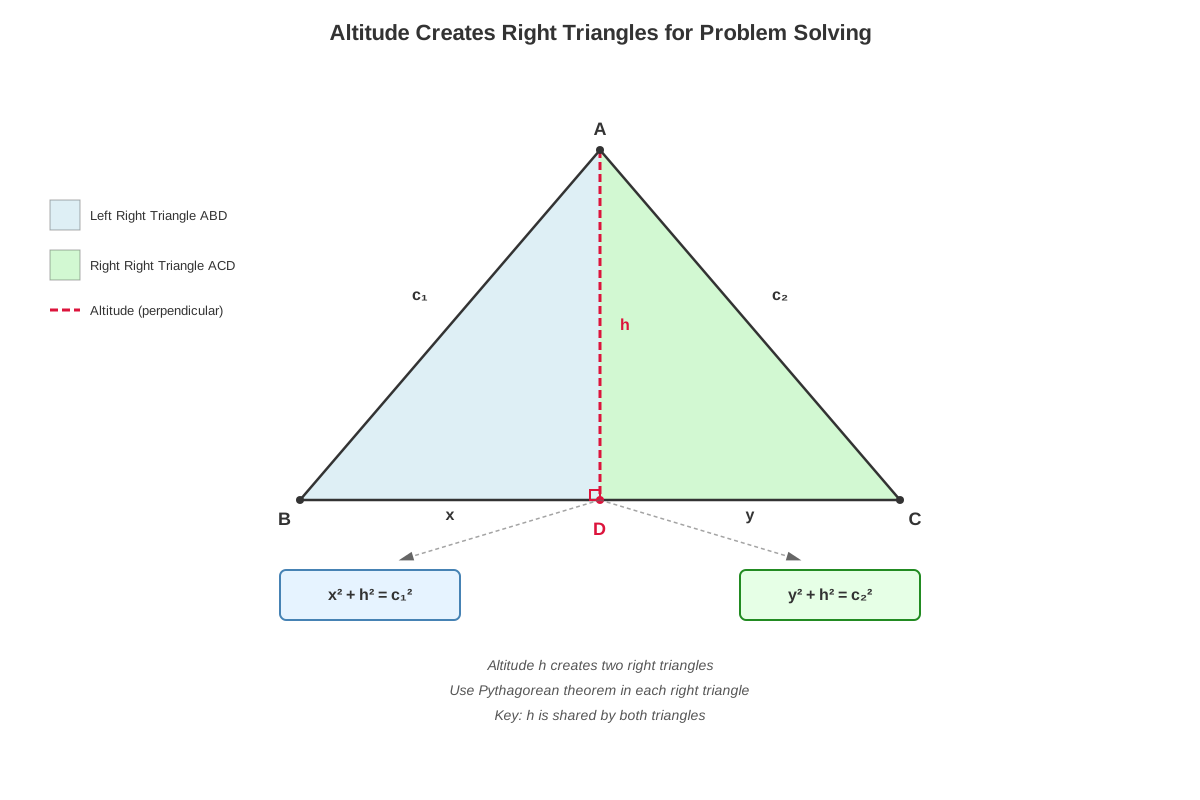
The altitude serves dual purposes in triangle geometry: it represents the height used in area calculations, and it creates right angles that enable the application of right triangle theorems. When an altitude is drawn, it divides the original triangle into two smaller right triangles, each sharing the altitude as a common leg.
Altitude Position in Different Triangle Types
The position of an altitude relative to the triangle varies dramatically based on triangle classification:
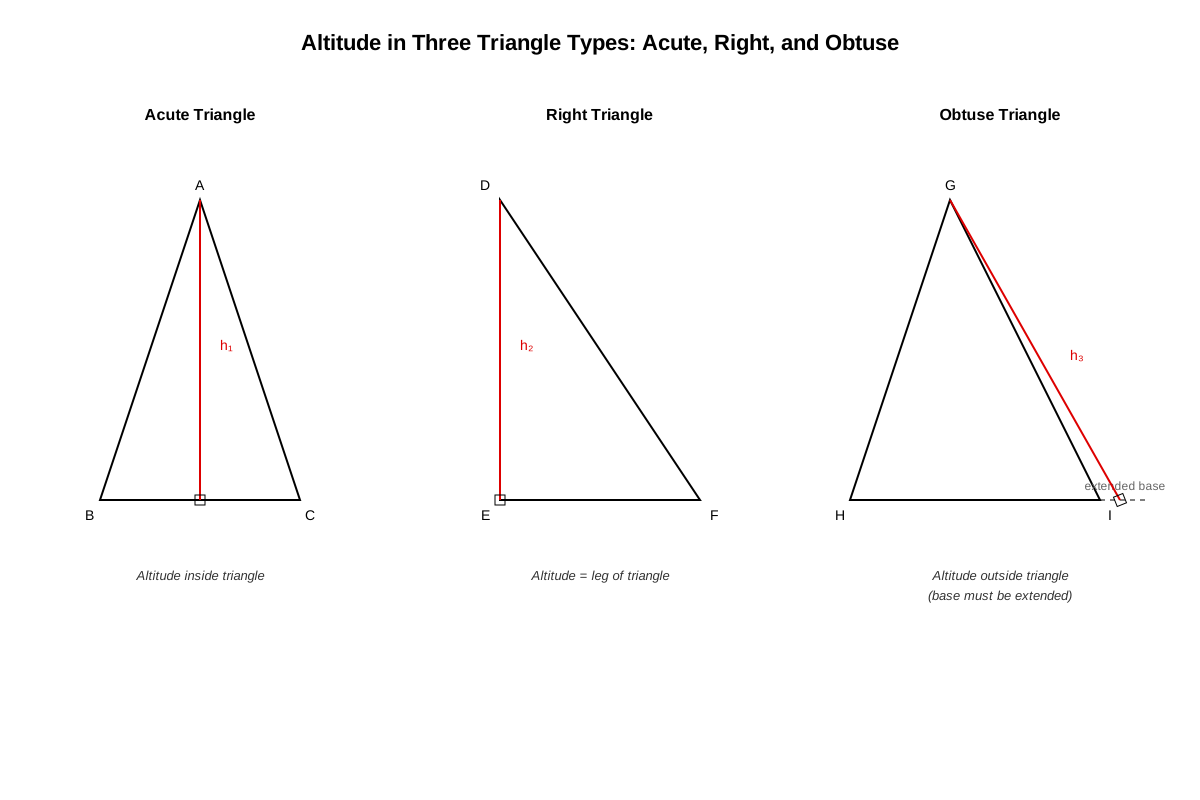
| Triangle Type | Altitude Position | Key Characteristics |
|---|---|---|
| Acute Triangle | All three altitudes lie inside the triangle | Each altitude connects a vertex to the opposite side within the triangle's interior |
| Right Triangle | Two altitudes are the legs themselves; the third is inside | The two legs meeting at the right angle serve as altitudes to each other |
| Obtuse Triangle | Two altitudes lie outside the triangle; one is inside | Altitudes from acute angle vertices must extend to the line containing the opposite side |
Understanding these positional differences is crucial for SAT problems because the test often presents obtuse triangles where students must recognize that the altitude extends beyond the triangle's visible boundaries.
Altitude and Area Relationship
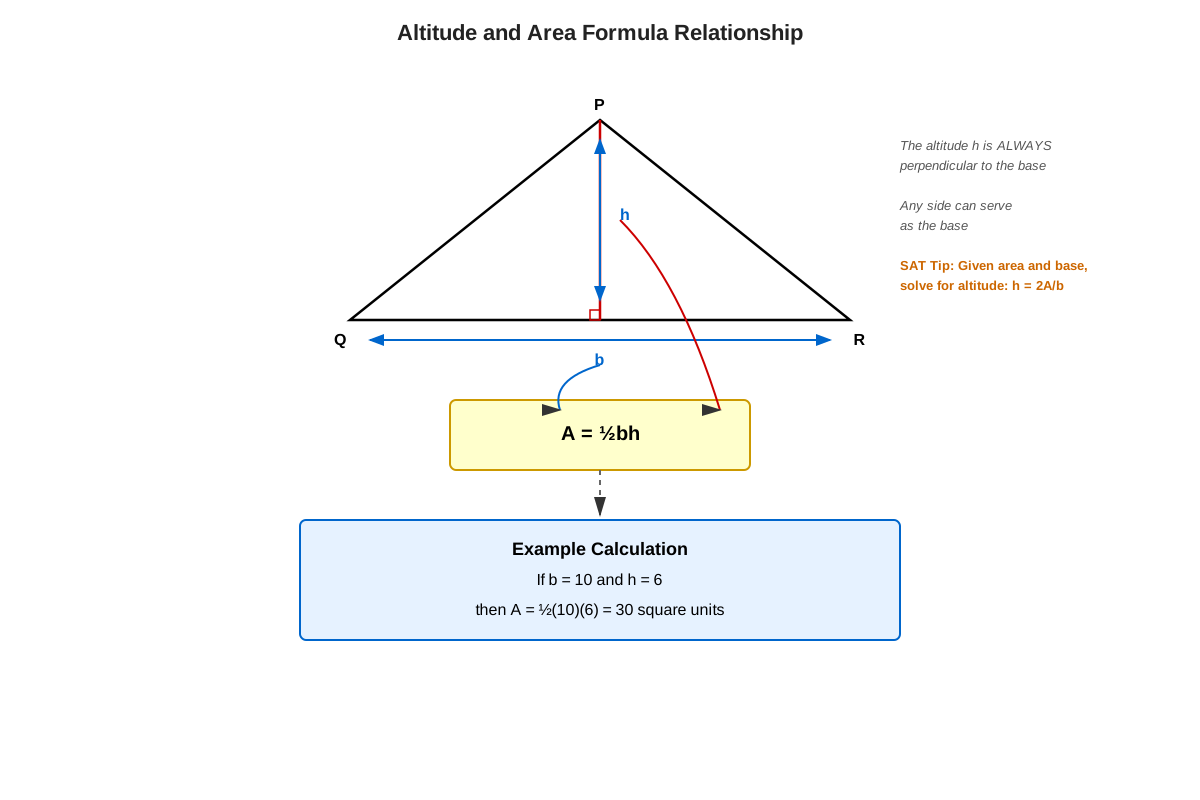
The most fundamental application of altitude is in the triangle area formula:
Area = ½ × base × altitudeThis relationship can be rearranged to solve for altitude when area and base are known:
altitude = (2 × Area) / baseOn the SAT, this formula appears in both direct and inverse applications. Students might be given the area and base to find altitude, or given the altitude and base to find area. More sophisticated problems provide the area and require students to identify which side serves as the base and calculate the corresponding altitude.
Altitude in Right Triangles
In right triangles, the altitude to the hypotenuse creates a special configuration with powerful properties. When an altitude is drawn from the right angle to the hypotenuse, it divides the original right triangle into two smaller right triangles that are similar to each other and to the original triangle.
This configuration yields the geometric mean relationships:
- The altitude to the hypotenuse is the geometric mean of the two segments it creates on the hypotenuse
- Each leg of the original triangle is the geometric mean of the hypotenuse and the segment of the hypotenuse adjacent to that leg
These relationships, while advanced, occasionally appear on challenging SAT questions.
Altitude in Isosceles and Equilateral Triangles
In isosceles triangles, the altitude from the vertex angle (the angle between the two equal sides) to the base has special properties:
- It bisects the vertex angle
- It bisects the base
- It serves as both the median and the angle bisector from that vertex
This creates two congruent right triangles, making calculations significantly simpler. For example, if an isosceles triangle has equal sides of length 10 and a base of length 12, the altitude to the base creates two right triangles with hypotenuse 10 and one leg 6, allowing easy calculation of the altitude using the Pythagorean theorem: altitude = √(10² - 6²) = √64 = 8.
In equilateral triangles with side length s, the altitude can be calculated using the formula:
altitude = (s√3) / 2This formula derives from the 30-60-90 triangle relationships and is worth memorizing for SAT efficiency.
Altitude in Coordinate Geometry
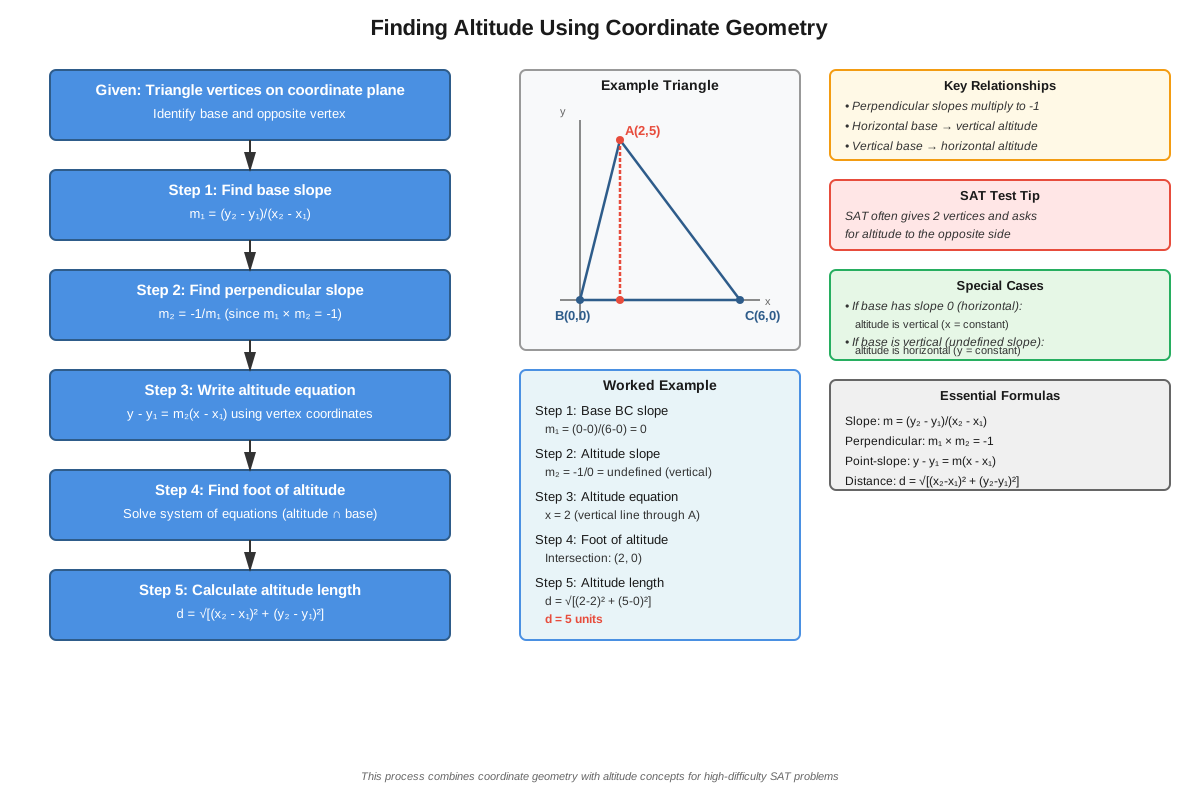
When triangles appear on the coordinate plane, finding an altitude requires understanding perpendicular slope relationships. If a side of the triangle has slope m, then any line perpendicular to it (including the altitude) has slope -1/m.
The process for finding an altitude equation in coordinate geometry:
- Identify the two points forming the base
- Calculate the slope of the base: m = (y₂ - y₁)/(x₂ - x₁)
- Find the perpendicular slope: m_perp = -1/m
- Use the vertex point (not on the base) and the perpendicular slope in point-slope form: y - y₁ = m_perp(x - x₁)
Calculating Altitude Length
Multiple methods exist for calculating altitude length, depending on available information:
Method 1: Using Area
If the triangle's area and base are known, rearrange the area formula:
altitude = (2 × Area) / base
Method 2: Using the Pythagorean Theorem
When the altitude divides the base into known segments, apply the Pythagorean theorem to one of the resulting right triangles.
Method 3: Using Heron's Formula and Area
For a triangle with sides a, b, and c:
- Calculate semi-perimeter: s = (a + b + c)/2
- Calculate area using Heron's formula: A = √[s(s-a)(s-b)(s-c)]
- Choose a base and calculate altitude: h = 2A/base
Method 4: Coordinate Distance
When working in the coordinate plane, find the perpendicular distance from a point to a line using the point-to-line distance formula.
Concept Relationships
The altitude concept serves as a central hub connecting multiple geometric principles. Altitude → creates → right angles → enables → Pythagorean theorem applications → leads to → side length calculations. This chain represents the most common problem-solving pathway on the SAT.
Simultaneously, altitude → defines → triangle height → determines → triangle area → connects to → coordinate geometry when triangles are positioned on the coordinate plane. This pathway appears frequently in multi-step SAT problems requiring both geometric and algebraic reasoning.
The relationship between altitude and triangle classification flows bidirectionally: triangle type → determines → altitude position (inside, outside, or coinciding with sides), while conversely, altitude position → reveals → triangle type (acute, right, or obtuse). This relationship helps students verify their work and catch errors.
In special triangles, altitude → creates → special right triangles (30-60-90 or 45-45-90) → enables → rapid calculations using memorized ratios. This connection is particularly powerful in isosceles and equilateral triangles.
For coordinate geometry, perpendicular lines → have → negative reciprocal slopes → defines → altitude direction → combined with → vertex coordinates → produces → altitude equation. This multi-step relationship appears regularly in SAT coordinate geometry questions.
Quick check — test yourself on Altitude so far.
Try Flashcards →High-Yield Facts
⭐ Every triangle has exactly three altitudes, one from each vertex to the opposite side (or its extension).
⭐ An altitude always forms a 90-degree angle with the base, making perpendicularity the defining characteristic.
⭐ The triangle area formula A = ½bh uses altitude as the height (h), regardless of triangle orientation.
⭐ In right triangles, the two legs serve as altitudes to each other, and the third altitude extends from the right angle to the hypotenuse.
⭐ In isosceles triangles, the altitude from the vertex angle to the base bisects both the angle and the base, creating two congruent right triangles.
- In obtuse triangles, two of the three altitudes lie outside the triangle and must be drawn to the extended base lines.
- The altitude to the hypotenuse of a right triangle creates two smaller triangles similar to the original and to each other.
- In equilateral triangles with side length s, the altitude equals (s√3)/2, derived from 30-60-90 triangle properties.
- On the coordinate plane, if a line has slope m, any perpendicular line (including an altitude) has slope -1/m.
- The three altitudes of any triangle intersect at a single point called the orthocenter, though this point's location varies by triangle type.
- When an altitude is drawn in a triangle, it creates two smaller triangles whose areas sum to the original triangle's area.
- The altitude can be calculated from area and base using the rearranged formula: h = 2A/b.
Common Misconceptions
Misconception: The altitude must always lie inside the triangle.
Correction: In obtuse triangles, two altitudes lie outside the triangle. They extend from vertices to the lines containing the opposite sides, not to the sides themselves. Always consider whether you need to extend the base line.
Misconception: The altitude is the same as the median or angle bisector.
Correction: These are three distinct line segments. The altitude is perpendicular to the opposite side; the median connects a vertex to the midpoint of the opposite side; the angle bisector divides an angle into two equal parts. They only coincide in special cases (like the altitude from the vertex angle in an isosceles triangle).
Misconception: In a right triangle, all three altitudes are inside the triangle.
Correction: In a right triangle, two of the altitudes are the legs themselves (they coincide with the sides), and only the altitude from the right angle to the hypotenuse is a separate segment inside the triangle.
Misconception: Any line from a vertex to the opposite side is an altitude.
Correction: The altitude must be perpendicular to the opposite side. A line from a vertex to the opposite side that isn't perpendicular is just a line segment, not an altitude. Always verify the 90-degree angle.
Misconception: The longest side of a triangle has the longest altitude.
Correction: Actually, the opposite is true: the longest side has the shortest altitude. Since Area = ½bh remains constant for a given triangle, as the base increases, the height (altitude) must decrease proportionally.
Misconception: On the coordinate plane, finding an altitude only requires finding the midpoint of the opposite side.
Correction: Finding an altitude requires using the perpendicular slope relationship and the vertex coordinates to write the equation of a line, not finding a midpoint. The midpoint is relevant for medians, not altitudes.
Misconception: The altitude always divides the base into two equal segments.
Correction: This only occurs in isosceles triangles when the altitude is drawn from the vertex angle. In scalene triangles, the altitude divides the base into two unequal segments.
Worked Examples
Example 1: Finding Altitude Using Area and Base
Problem: A triangle has an area of 48 square units and a base of 12 units. What is the length of the altitude to this base?
Solution:
Step 1: Identify the known values.
- Area = 48 square units
- Base = 12 units
- Altitude = unknown
Step 2: Recall the triangle area formula.
Area = ½ × base × altitude
Step 3: Substitute known values.
48 = ½ × 12 × altitude
48 = 6 × altitude
Step 4: Solve for altitude.
altitude = 48 ÷ 6
altitude = 8 units
Answer: The altitude is 8 units.
Connection to Learning Objectives: This problem demonstrates the direct application of the altitude-area relationship, a fundamental skill for SAT questions. Recognizing when to rearrange the area formula is essential for efficiency.
Example 2: Altitude in an Isosceles Triangle with Pythagorean Theorem
Problem: An isosceles triangle has two equal sides of length 13 cm and a base of length 10 cm. Find the length of the altitude from the vertex angle to the base.
Solution:
Step 1: Visualize the problem.
When we draw the altitude from the vertex angle to the base in an isosceles triangle, it bisects the base, creating two congruent right triangles.
Step 2: Identify the components of one right triangle.
- Hypotenuse = 13 cm (one of the equal sides)
- One leg = 5 cm (half of the 10 cm base)
- Other leg = altitude (unknown)
Step 3: Apply the Pythagorean theorem.
a² + b² = c²
altitude² + 5² = 13²
altitude² + 25 = 169
Step 4: Solve for altitude.
altitude² = 169 - 25
altitude² = 144
altitude = √144
altitude = 12 cm
Answer: The altitude is 12 cm.
Connection to Learning Objectives: This problem illustrates how altitudes in isosceles triangles create special configurations that simplify calculations. Recognizing that the altitude bisects the base is a key strategic insight that appears frequently on the SAT.
Example 3: Altitude in Coordinate Geometry
Problem: Triangle ABC has vertices at A(2, 5), B(6, 1), and C(8, 7). Find the equation of the altitude from vertex C to side AB.
Solution:
Step 1: Find the slope of side AB.
m_AB = (y₂ - y₁)/(x₂ - x₁) = (1 - 5)/(6 - 2) = -4/4 = -1
Step 2: Find the perpendicular slope (slope of the altitude).
Since perpendicular lines have slopes that are negative reciprocals:
m_altitude = -1/(-1) = 1
Step 3: Use point-slope form with vertex C(8, 7) and slope 1.
y - y₁ = m(x - x₁)
y - 7 = 1(x - 8)
y - 7 = x - 8
y = x - 1
Answer: The equation of the altitude from C to AB is y = x - 1.
Connection to Learning Objectives: This problem demonstrates the coordinate geometry application of altitude concepts, requiring students to integrate slope relationships with the perpendicularity definition. This type of multi-step reasoning is characteristic of medium-to-hard SAT questions.
Exam Strategy
When approaching altitude questions on the SAT, begin by identifying whether the altitude is explicitly shown or must be inferred. Trigger phrases include "height of the triangle," "perpendicular from vertex," "distance from point to line," and any mention of area combined with a base measurement. These phrases signal that altitude concepts are central to the solution.
For area-based questions, immediately check whether you have two of the three values in the formula A = ½bh. If you have area and base, calculate altitude directly. If you have area and altitude, solve for base. If you need area, identify which side to use as the base and locate or calculate the corresponding altitude.
When triangles appear in unusual orientations (not sitting flat with a horizontal base), mentally rotate the figure or redraw it in a standard position. The SAT intentionally presents triangles in various orientations to test whether students truly understand that any side can serve as the base, with the altitude being the perpendicular distance to that base.
For coordinate geometry altitude problems, follow this systematic approach:
- Calculate the slope of the base
- Find the negative reciprocal for the altitude's slope
- Use point-slope form with the vertex not on the base
- Simplify to the requested form (usually slope-intercept)
Time allocation: Simple altitude calculations (using the area formula) should take 30-45 seconds. Problems requiring the Pythagorean theorem typically need 60-90 seconds. Coordinate geometry altitude questions may require 90-120 seconds due to multiple calculation steps.
Process of elimination tips: If answer choices for altitude length are given, eliminate any values that would make the area impossibly large or small. For coordinate geometry, eliminate altitude equations whose slopes aren't perpendicular to the base. If the problem involves a special triangle (isosceles or equilateral), eliminate answers that don't reflect the symmetry properties.
Exam Tip: When stuck on an altitude problem, try drawing the altitude yourself if it's not shown. This single action often reveals the right triangles needed for solution and clarifies which theorem or formula to apply.
Memory Techniques
Mnemonic for Altitude Definition: "Altitude is Always At a right Angle" - The four A's remind you that altitude and perpendicularity are inseparable.
Visualization Strategy: Picture altitude as a "plumb line" dropping from a vertex—it always falls straight down (perpendicular) to the base, just like a carpenter's plumb bob hangs perpendicular to the ground.
Area Formula Memory: Think "Base and Height make Area" → A = ½B×H. The alphabetical order (A, B, H) helps recall the formula structure.
Acronym for Altitude Positions: AIR - Acute (Inside), Isosceles (Inside, special properties), Right (two are the legs). This reminds you that acute and isosceles triangles have altitudes inside, while right triangles have a unique configuration.
Perpendicular Slope Memory: "Negative Reciprocal" → New Road - When finding an altitude on the coordinate plane, you're taking a "new road" perpendicular to the original, using the negative reciprocal slope.
Isosceles Triangle Altitude: Remember "Bisects Both Base and angle" - The three B's remind you that the altitude from the vertex angle in an isosceles triangle has double bisecting duty.
Summary
Altitude is a foundational geometric concept that appears consistently throughout SAT Math questions, serving as both a direct problem element and a strategic tool for solving complex triangle problems. An altitude is defined as a perpendicular line segment from any vertex to the line containing the opposite side, creating the 90-degree angles that enable Pythagorean theorem applications and area calculations. Every triangle possesses three altitudes whose positions vary based on triangle classification: all inside for acute triangles, two outside for obtuse triangles, and coinciding with the legs for right triangles. The altitude-area relationship (A = ½bh) provides the most direct application, allowing students to calculate any one of the three values when the other two are known. In special triangles like isosceles and equilateral configurations, altitudes create predictable patterns and congruent right triangles that dramatically simplify calculations. Coordinate geometry applications require understanding perpendicular slope relationships (negative reciprocals) to construct altitude equations. Mastery of altitude concepts enables efficient problem-solving across multiple SAT question types, from straightforward area calculations to complex multi-step problems integrating coordinate geometry, triangle similarity, and the Pythagorean theorem.
Key Takeaways
- An altitude is always perpendicular to the opposite side (or its extension), forming a 90-degree angle that enables right triangle theorem applications
- The area formula A = ½bh uses altitude as height, and can be rearranged to solve for any unknown variable when two are given
- Altitude position varies by triangle type: inside for acute, two outside for obtuse, and coinciding with legs for right triangles
- In isosceles triangles, the altitude from the vertex angle bisects both the base and the angle, creating two congruent right triangles
- On the coordinate plane, altitudes have slopes that are negative reciprocals of the base's slope (m₁ × m₂ = -1)
- Drawing an altitude strategically often transforms a complex problem into manageable right triangles where the Pythagorean theorem applies
- The longest side of a triangle corresponds to the shortest altitude, since area remains constant while base and height vary inversely
Related Topics
Triangle Area Formulas: Beyond the basic altitude-based formula, explore Heron's formula for calculating area from three side lengths, and coordinate geometry area formulas using vertex coordinates. Mastering altitude concepts provides the foundation for understanding why these alternative formulas work.
Triangle Centers: The orthocenter (intersection of altitudes), centroid (intersection of medians), incenter (intersection of angle bisectors), and circumcenter (intersection of perpendicular bisectors) represent advanced triangle concepts. Understanding altitudes is the first step toward exploring these special points.
Similar Triangles: When an altitude is drawn to the hypotenuse of a right triangle, it creates similar triangles with powerful proportional relationships. This connection extends altitude applications into more sophisticated problem-solving.
Trigonometry in Right Triangles: Altitudes create right triangles where sine, cosine, and tangent ratios apply. This connection bridges pure geometry with trigonometric problem-solving.
Coordinate Geometry: Perpendicular lines, distance formulas, and equation writing all connect to altitude concepts. Strengthening altitude skills enhances overall coordinate geometry proficiency.
Practice CTA
Now that you've mastered the core concepts of altitude in triangles, it's time to solidify your understanding through active practice. Attempt the practice questions to test your ability to identify altitudes, apply the area formula, and solve coordinate geometry problems. Work through the flashcards to reinforce key definitions and relationships until they become automatic. Remember, SAT success comes not just from understanding concepts but from developing the speed and confidence to apply them under timed conditions. Each practice problem you solve strengthens the neural pathways that will serve you on test day. You've built a strong foundation—now transform that knowledge into points through deliberate practice!
Sign up free to keep reading
Create a free AnvayaPrep account to finish this SAT guide on Altitude — plus flashcards and practice questions.