Overview
The area of triangles is one of the most fundamental and frequently tested concepts in SAT geometry. Understanding how to calculate triangle area using various methods is essential not only for direct geometry questions but also for solving complex problems involving coordinate geometry, trigonometry, and real-world applications. On the SAT, triangle area questions appear in multiple forms: some provide straightforward base and height measurements, while others require students to identify these measurements from diagrams, coordinate planes, or word problems. Mastery of this topic directly impacts performance on approximately 10-15% of math questions on the exam.
Triangle area problems on the SAT test both computational skills and conceptual understanding. Students must recognize when to apply the standard formula, when to use alternative methods like Heron's formula or coordinate geometry approaches, and how to extract necessary information from complex diagrams. The topic connects deeply with other geometric concepts including the Pythagorean theorem, special right triangles, similar triangles, and coordinate geometry. Questions often embed triangle area calculations within larger problems involving polygons, circles, or three-dimensional figures.
The strategic importance of mastering triangle area cannot be overstated. These questions frequently appear as medium-difficulty problems that separate average scorers from high achievers. Students who can quickly identify the appropriate method, extract relevant measurements, and execute calculations accurately gain significant advantages in both time management and confidence. Furthermore, triangle area serves as a foundation for understanding more advanced topics like volumes of pyramids and cones, making it an essential building block for comprehensive SAT math preparation.
Learning Objectives
- [ ] Identify key features of area of triangles including base, height, and perpendicular relationships
- [ ] Explain how area of triangles appears on the SAT in various question formats and contexts
- [ ] Apply area of triangles formulas to answer SAT-style questions efficiently and accurately
- [ ] Calculate triangle area using the standard formula when base and height are given or can be determined
- [ ] Determine triangle area using coordinate geometry methods on the coordinate plane
- [ ] Recognize when to apply alternative area formulas including Heron's formula and trigonometric methods
- [ ] Solve multi-step problems that require finding missing dimensions before calculating area
Prerequisites
- Basic algebraic manipulation: Essential for rearranging the area formula to solve for unknown variables like base or height
- Understanding of perpendicular lines: Critical for identifying the correct height measurement, which must be perpendicular to the base
- Pythagorean theorem: Frequently needed to calculate missing side lengths or heights in right triangles
- Coordinate plane fundamentals: Required for problems involving triangles plotted on coordinate grids
- Properties of special right triangles (30-60-90 and 45-45-90): Often used to determine heights or side lengths efficiently
Why This Topic Matters
Triangle area calculations appear in numerous real-world contexts, from architecture and construction to land surveying and graphic design. Engineers use triangle area principles when calculating structural loads, while urban planners apply these concepts when determining property boundaries and land use. In computer graphics and game design, triangle area calculations are fundamental to rendering three-dimensional objects on two-dimensional screens. Understanding triangle area also provides the foundation for calculating areas of more complex polygons, which can always be decomposed into triangles.
On the SAT, triangle area questions appear with remarkable frequency, typically comprising 2-4 questions per test administration. These questions appear in both the calculator and no-calculator sections, testing different aspects of understanding. The College Board includes triangle area in approximately 12% of all geometry questions, making it one of the highest-yield geometry topics. Questions range from straightforward applications of the basic formula to complex multi-step problems requiring integration of multiple geometric concepts.
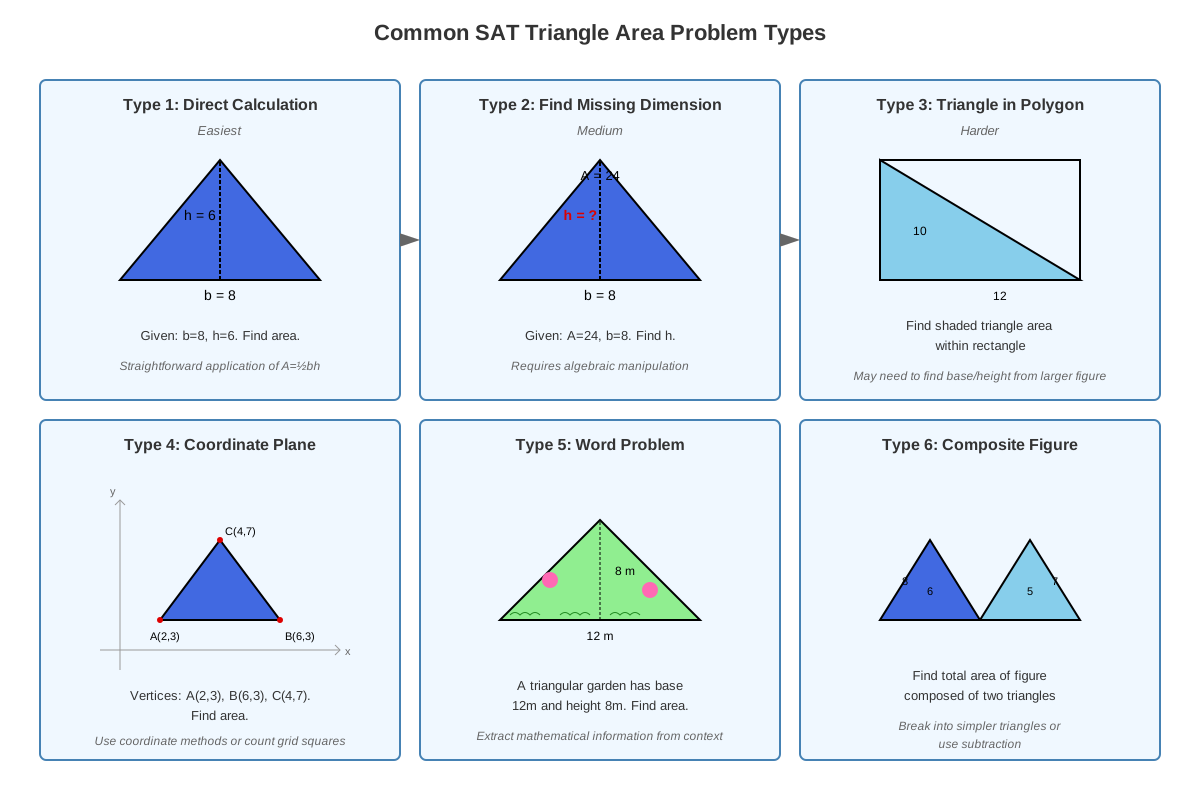
Common SAT question formats include: providing a triangle with labeled dimensions and asking for area directly; presenting a triangle on a coordinate plane requiring students to determine base and height; embedding triangle area within word problems about real-world scenarios; asking students to find a missing dimension given the area; and incorporating triangle area into questions about composite figures or three-dimensional shapes. The topic also appears in questions testing proportional reasoning, where students must determine how changes in dimensions affect area.
Core Concepts
The Standard Area Formula
The area of triangles is most commonly calculated using the fundamental formula:
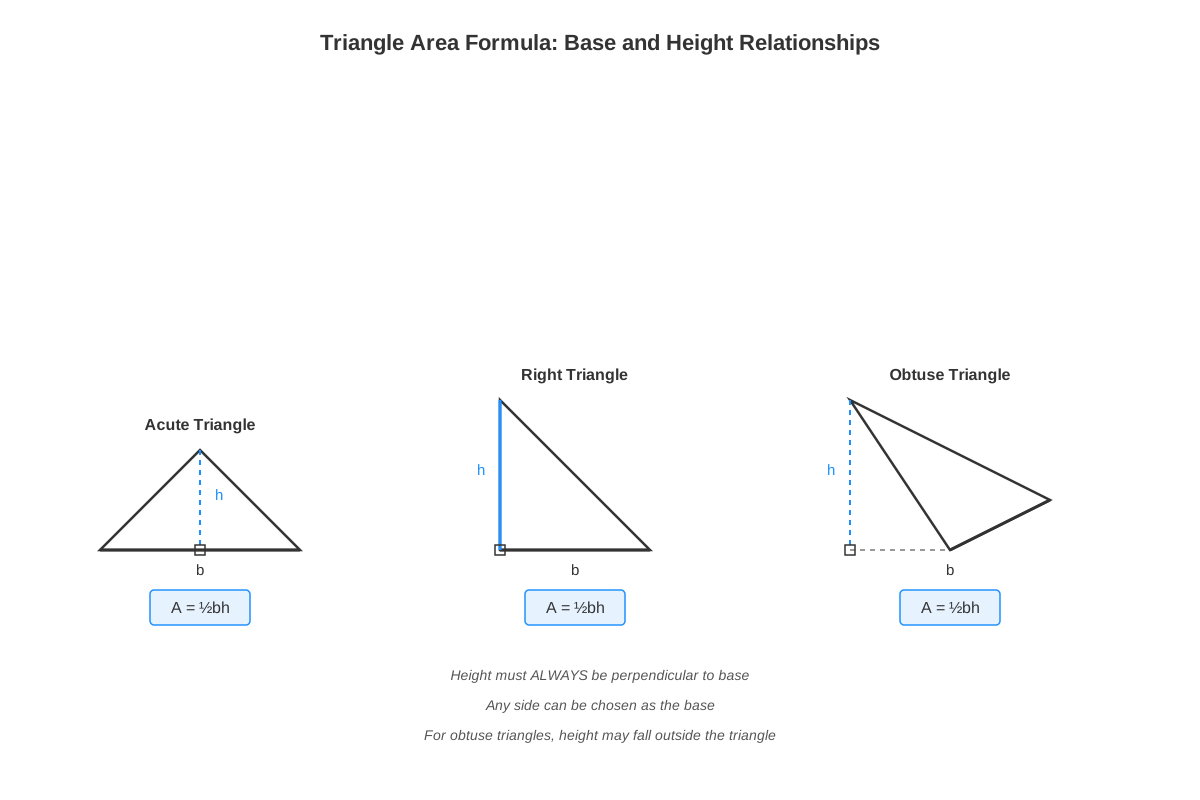
Area = (1/2) × base × heightThis formula applies to all triangles regardless of type (scalene, isosceles, equilateral, right, acute, or obtuse). The base can be any side of the triangle, while the height (also called altitude) must be the perpendicular distance from the base to the opposite vertex. This perpendicular relationship is crucial—the height must form a 90-degree angle with the base.
For right triangles, identifying base and height is straightforward: the two legs that form the right angle serve as base and height. For acute triangles, the height falls inside the triangle. For obtuse triangles, the height to certain bases may fall outside the triangle, requiring students to extend the base line to establish the perpendicular.
Identifying Base and Height in Various Orientations
A common challenge on the SAT involves recognizing base and height when triangles are oriented unusually. Students must remember that any side can serve as the base, and the corresponding height is always perpendicular to that chosen base. When a triangle appears rotated or positioned unconventionally, mentally rotating the figure or redrawing it can help identify these measurements.
In problems where the height is not explicitly given, students often must calculate it using:
- The Pythagorean theorem in right triangles
- Properties of special right triangles (30-60-90 or 45-45-90 triangles)
- Trigonometric relationships (though less common on the SAT)
- Coordinate geometry methods
Area Using Coordinates
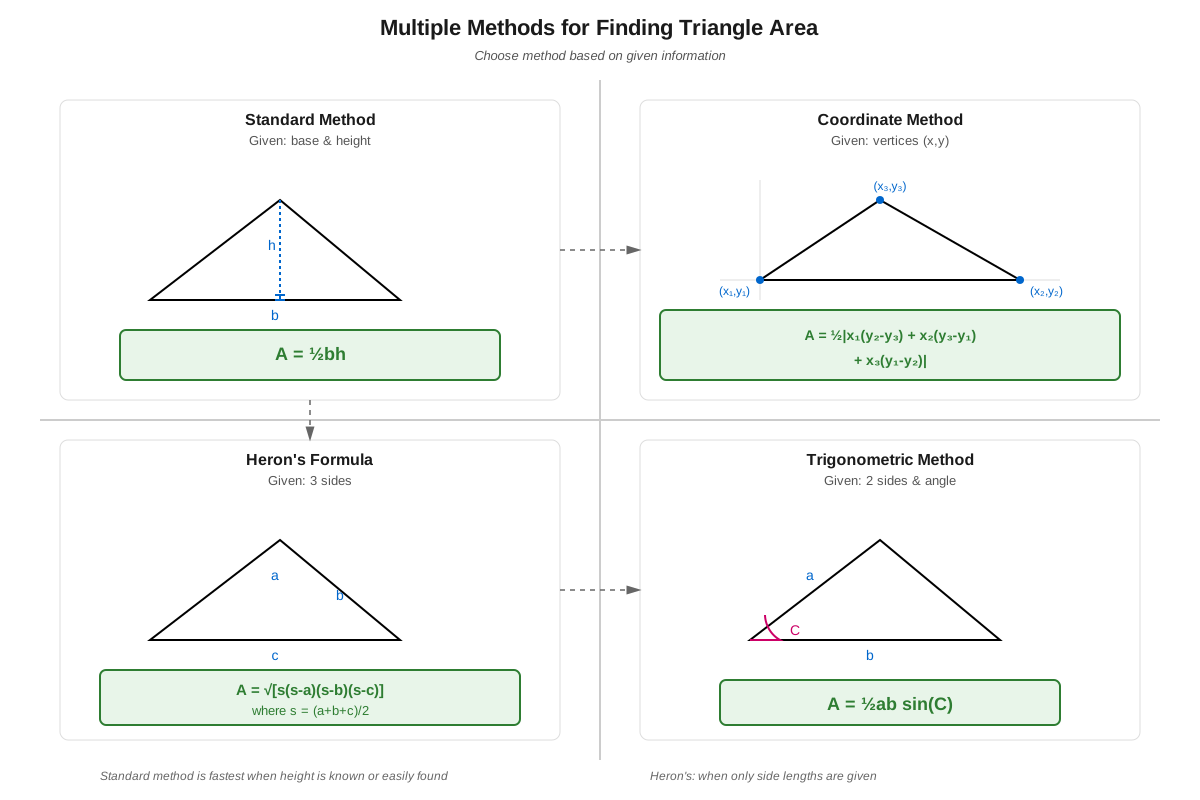
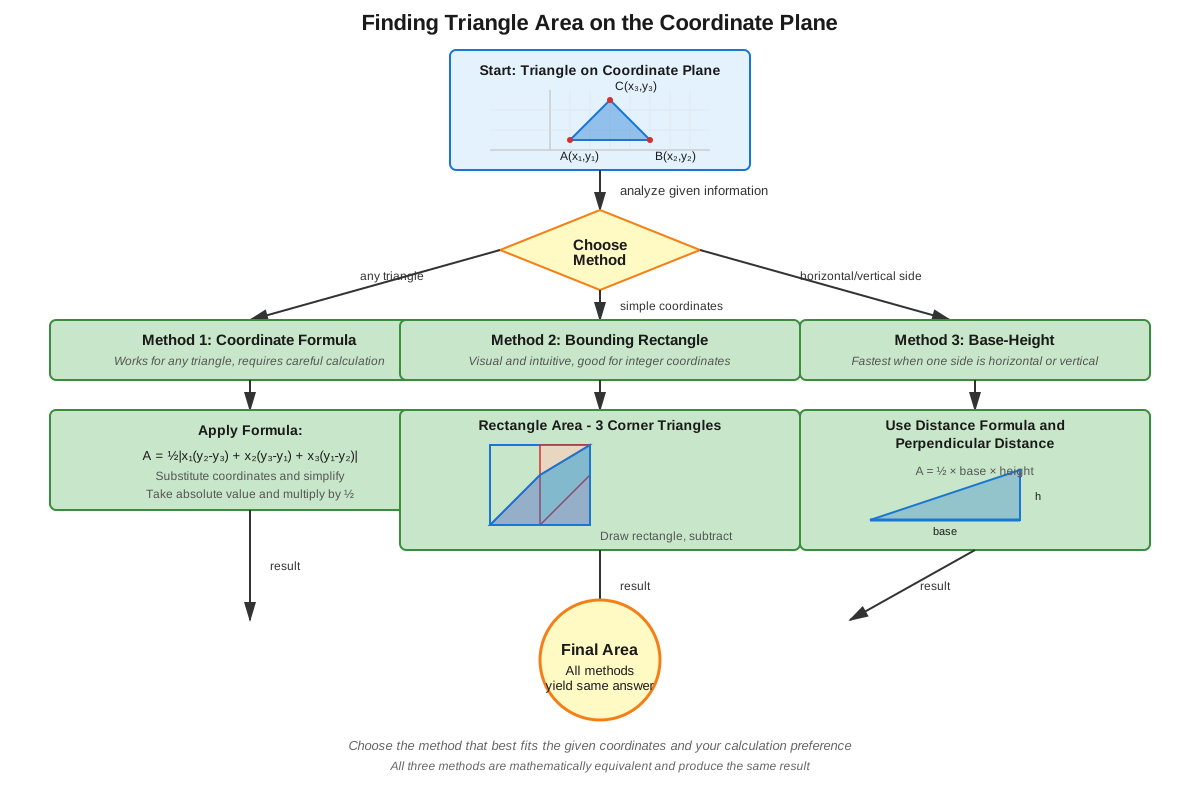
When a triangle is plotted on a coordinate plane, several methods exist for calculating area. The most systematic approach uses the coordinate formula:
Area = (1/2)|x₁(y₂ - y₃) + x₂(y₃ - y₁) + x₃(y₁ - y₂)|However, for SAT purposes, a more intuitive method often involves:
- Identifying if any side is horizontal or vertical (parallel to an axis)
- Using that side as the base and measuring its length by subtracting coordinates
- Finding the perpendicular distance from the opposite vertex to that base
- Applying the standard formula
Alternatively, students can use the "box method": draw a rectangle around the triangle, calculate the rectangle's area, then subtract the areas of the right triangles formed in the corners.
Heron's Formula
When all three side lengths are known but no height is given, Heron's formula provides an alternative calculation method:
Area = √[s(s-a)(s-b)(s-c)]where s is the semi-perimeter: s = (a + b + c)/2, and a, b, c are the three side lengths.
While less commonly needed on the SAT, Heron's formula occasionally appears in challenging problems where determining height would be cumbersome. Students should recognize when this formula is appropriate but shouldn't prioritize memorizing it over the standard formula.
Relationship Between Area and Side Lengths
Understanding how area scales with dimension changes is crucial for SAT problems involving similar triangles or proportional reasoning. Key principles include:
- If all linear dimensions (base and height) are multiplied by a factor k, the area is multiplied by k²
- Doubling the base while keeping height constant doubles the area
- If two triangles are similar with a similarity ratio of k:1, their areas have a ratio of k²:1
Special Triangle Areas
Equilateral triangles have a special area formula when only the side length s is known:
Area = (s²√3)/4This formula derives from using the standard area formula with height calculated as (s√3)/2, which comes from the 30-60-90 triangle properties. While not essential to memorize, recognizing this pattern can save time on SAT questions.
Isosceles triangles often appear in SAT problems because their symmetry allows for strategic height calculations. When the two equal sides and the base are known, dropping a perpendicular from the apex to the base creates two congruent right triangles, enabling Pythagorean theorem application.
Composite Figures and Triangle Decomposition
Many SAT problems require calculating areas of irregular polygons by decomposing them into triangles. The strategy involves:
- Identifying how to divide the figure into triangles (drawing diagonals)
- Calculating each triangle's area individually
- Summing the areas
Conversely, some problems present a larger figure and ask for the area of a triangular portion, requiring subtraction of areas.
Concept Relationships
The area of triangles serves as a central hub connecting multiple geometric concepts. The standard area formula (Area = ½bh) directly depends on understanding perpendicular lines and right angles, as the height must be perpendicular to the base. This perpendicular relationship leads naturally to the Pythagorean theorem, which is frequently needed to calculate the height when it's not directly provided.
The connection flows as follows: Triangle classification (right, acute, obtuse) → determines height location (inside or outside triangle) → requires perpendicular line construction → often necessitates Pythagorean theorem application → enables area calculation.
Triangle area connects to coordinate geometry through multiple pathways. Plotting triangles on coordinate planes requires understanding distance formula for calculating side lengths and recognizing horizontal/vertical lines for easy base-height identification. This relationship extends to slope concepts, as perpendicular lines have negative reciprocal slopes.
The topic also bridges to similar triangles and proportional reasoning. When triangles are similar with ratio k:1, their areas relate by k²:1, connecting linear scaling to area scaling. This relationship extends to scale factors in real-world applications.
Furthermore, triangle area serves as the foundation for calculating areas of other polygons (which decompose into triangles), surface areas of pyramids (composed of triangular faces), and volumes of pyramids and cones (which use triangle area in their formulas). The concept also connects to trigonometry through the formula Area = ½ab sin(C), though this appears less frequently on the SAT.
High-Yield Facts
⭐ The area formula Area = ½bh applies to ALL triangles, regardless of type or orientation
⭐ The height must ALWAYS be perpendicular to the base; this is the most common source of errors
⭐ For right triangles, the two legs automatically serve as base and height
⭐ When linear dimensions are multiplied by k, area is multiplied by k² (not k)
⭐ On coordinate planes, look for horizontal or vertical sides to use as base for easy calculation
- The area of an equilateral triangle with side s is (s²√3)/4
- In obtuse triangles, the height to the longest side falls inside the triangle
- Any triangle can be oriented so that any of its three sides serves as the base
- The altitude (height) of a triangle may fall outside the triangle when drawn to certain bases
- Two triangles with the same base and height have equal areas, regardless of shape
- The median of a triangle divides it into two triangles of equal area
- If a triangle is inscribed in a rectangle with one side along the rectangle's side, its area is half the rectangle's area
- Triangles between the same parallel lines with equal bases have equal areas
- The area of a triangle formed by three points on a coordinate plane can be found using the "shoelace formula"
- Doubling one dimension (base or height) while keeping the other constant doubles the area
Quick check — test yourself on Area of triangles so far.
Try Flashcards →Common Misconceptions
Misconception: Any two sides of a triangle can be used as base and height in the area formula.
Correction: Only perpendicular measurements work as base and height. The height must form a 90-degree angle with the base. Using two sides that aren't perpendicular (like two sides of an acute or obtuse triangle) will produce an incorrect area.
Misconception: The height of a triangle must be one of its sides.
Correction: The height is often NOT a side of the triangle. Only in right triangles do the legs serve as both sides and height. In other triangles, the height is an auxiliary line segment drawn perpendicular from a vertex to the opposite side (or its extension).
Misconception: Doubling all dimensions of a triangle doubles its area.
Correction: Doubling all linear dimensions multiplies the area by 4 (2²), not 2. If a triangle has area A and all dimensions are multiplied by k, the new area is k²A. This reflects the quadratic relationship between linear dimensions and area.
Misconception: The longest side of a triangle should always be used as the base.
Correction: Any side can serve as the base; the choice is arbitrary and should be based on convenience. Often, choosing the side for which the height is easiest to determine leads to the simplest calculation.
Misconception: In coordinate geometry, the area formula requires using the distance formula for all sides.
Correction: The most efficient approach usually involves identifying a horizontal or vertical side to use as the base (length found by simple subtraction) and then finding the perpendicular distance to the opposite vertex. The distance formula is rarely necessary for SAT triangle area problems.
Misconception: Isosceles triangles have a simpler area formula that doesn't require finding the height.
Correction: While isosceles triangles have symmetry that can simplify height calculation, they still require using Area = ½bh. The symmetry helps because dropping a perpendicular from the apex to the base creates two congruent right triangles, making the Pythagorean theorem application straightforward.
Misconception: If a triangle's area is given, there's only one possible set of base and height values.
Correction: Infinitely many base-height combinations can produce the same area. For example, a triangle with area 12 could have base 6 and height 4, or base 8 and height 3, or base 12 and height 2, etc. This principle is important when working backward from area to dimensions.
Worked Examples
Example 1: Standard Application with Hidden Height
Problem: Triangle ABC has a base AC of length 10 units. Side AB has length 13 units, and side BC has length 13 units. What is the area of triangle ABC?
Solution:
Step 1: Recognize that this is an isosceles triangle (AB = BC = 13).
Step 2: Identify that we have the base (AC = 10) but need to find the height. In an isosceles triangle, the height from vertex B to base AC bisects the base, creating two congruent right triangles.
Step 3: Each right triangle has:
- Hypotenuse = 13 (one of the equal sides)
- Base = 5 (half of AC)
- Height = h (unknown)
Step 4: Apply the Pythagorean theorem:
h² + 5² = 13²
h² + 25 = 169
h² = 144
h = 12
Step 5: Calculate area using Area = ½bh:
Area = ½ × 10 × 12 = 60 square unitsConnection to Learning Objectives: This problem demonstrates identifying key features (recognizing the isosceles triangle and that height bisects the base), and applying the area formula after determining the missing height through the Pythagorean theorem.
Example 2: Coordinate Geometry Application
Problem: Triangle PQR has vertices at P(2, 1), Q(8, 1), and R(5, 7). What is the area of triangle PQR?
Solution:
Step 1: Plot or visualize the points. Notice that P and Q have the same y-coordinate (y = 1), meaning side PQ is horizontal.
Step 2: Use PQ as the base. Calculate its length:
Base = 8 - 2 = 6 unitsStep 3: The height is the perpendicular distance from R to line PQ. Since PQ is horizontal at y = 1, the height is simply the difference in y-coordinates:
Height = 7 - 1 = 6 unitsStep 4: Calculate area:
Area = ½ × 6 × 6 = 18 square unitsAlternative Method (Box Method):
Step 1: Draw a rectangle with corners at (2, 1), (8, 1), (8, 7), and (2, 7).
Step 2: Rectangle area = 6 × 6 = 36 square units
Step 3: Subtract the three right triangles in the corners:
- Left triangle: ½ × 3 × 6 = 9
- Right triangle: ½ × 3 × 6 = 9
- Top triangle: ½ × 6 × 0 = 0 (R is directly above the midpoint)
Actually, recalculating: The corners form triangles with vertices (2,1)-(2,7)-(5,7), (5,7)-(8,7)-(8,1), and we need to be more careful.
Better approach: Use the direct method shown first, which is cleaner for this problem.
Connection to Learning Objectives: This demonstrates how triangle area appears on the SAT in coordinate geometry contexts and shows the efficient strategy of identifying horizontal or vertical sides.
Example 3: Working Backward from Area
Problem: A triangle has an area of 48 square centimeters and a height of 8 centimeters. If the base is increased by 4 centimeters while the height remains constant, what is the new area?
Solution:
Step 1: Find the original base using Area = ½bh:
48 = ½ × b × 8
48 = 4b
b = 12 cm
Step 2: Calculate the new base:
New base = 12 + 4 = 16 cmStep 3: Calculate the new area with the same height:
New Area = ½ × 16 × 8 = 64 square cmAlternative approach (proportional reasoning): Since only the base changed and area is directly proportional to base when height is constant, the area increases by the same factor as the base: 16/12 = 4/3, so new area = 48 × (4/3) = 64 square cm.
Connection to Learning Objectives: This problem requires applying the area formula in reverse to find a missing dimension, then using proportional reasoning to determine how dimensional changes affect area.
Exam Strategy
When approaching SAT area of triangles questions, begin by quickly assessing what information is provided and what the question asks. Look for these trigger phrases: "what is the area," "find the height," "how much greater is the area," or "if the dimensions are changed." These phrases indicate whether you're calculating area directly, working backward to find a dimension, or analyzing proportional changes.
Step-by-step approach for standard problems:
- Identify the triangle type (right, isosceles, equilateral, or general)
- Determine what measurements are given (sides, angles, coordinates)
- Identify if base and height are directly provided or must be calculated
- If height is missing, determine the method to find it (Pythagorean theorem, special triangles, coordinate geometry)
- Apply Area = ½bh carefully, ensuring units are consistent
- Check if the answer is reasonable (area should be positive and proportional to the figure's apparent size)
For coordinate geometry problems, immediately scan for horizontal or vertical sides. These provide the easiest base-height identification. If no sides are parallel to axes, consider the box method or the coordinate formula, but typically the SAT designs problems where the simpler approach works.
Process of elimination tips: When answer choices are given, eliminate options that are clearly too large or too small based on visual estimation. If the triangle appears to fit roughly 4 times inside a 10×10 square, its area should be around 25, not 100 or 5. Also eliminate answers with incorrect units (if the problem gives dimensions in feet, area should be in square feet).
Time allocation: Standard triangle area problems should take 45-60 seconds. If you're spending more than 90 seconds, you may be overcomplicating the approach. Consider whether there's a simpler method or if you should flag the question and return to it later. Multi-step problems involving triangle area as one component of a larger question may warrant 2-3 minutes.
Common trap answers: The SAT often includes trap answers that result from common errors, such as forgetting to multiply by ½, using two non-perpendicular sides as base and height, or confusing perimeter with area. Always verify that your calculation includes the ½ factor and uses perpendicular measurements.
Memory Techniques
Mnemonic for the area formula: "Before Halving, Base times Height" reminds you that Area = ½ × base × height, emphasizing that you multiply base and height first, then divide by 2 (or multiply by ½).
Visualization strategy: Picture every triangle as potentially being "flipped" to create a parallelogram. Two identical triangles form a parallelogram with area = base × height, so one triangle has half that area. This visual reinforces why the ½ factor exists.
Acronym for coordinate geometry: "H-V-E-P" = Horizontal or Vertical side, Easy Perpendicular. This reminds you to look for horizontal or vertical sides first when working with coordinate triangles, as they make finding the perpendicular distance easiest.
Right triangle reminder: "Legs Are Base And Height" (LABAH) helps remember that in right triangles, the two legs automatically serve as base and height—no additional calculation needed.
Scaling memory device: "Linear Squared for Area" (LSA) reminds you that when linear dimensions change by factor k, area changes by k². This prevents the common error of thinking that doubling dimensions doubles area.
Perpendicular check: Before calculating, mentally ask "Perpendicular Proven?" to ensure the height you're using actually forms a 90-degree angle with the base. This simple check prevents the most common error in triangle area problems.
Summary
The area of triangles is a foundational SAT geometry concept tested through various question formats including direct calculation, coordinate geometry applications, and multi-step problems. The fundamental formula Area = ½bh applies universally to all triangles, but success requires correctly identifying base and height as perpendicular measurements. For right triangles, the legs serve as base and height; for other triangles, the height must often be calculated using the Pythagorean theorem or special triangle properties. On coordinate planes, the most efficient approach involves identifying horizontal or vertical sides to use as the base, then measuring the perpendicular distance to the opposite vertex. Understanding how area scales with dimensional changes (linear factor k produces area factor k²) is crucial for proportional reasoning problems. Students must avoid common pitfalls including using non-perpendicular sides, forgetting the ½ factor, and misunderstanding how dimensional changes affect area. Mastery requires recognizing which calculation method is most efficient for each problem type and executing calculations accurately under time pressure.
Key Takeaways
- The formula Area = ½ × base × height applies to ALL triangles; the height must be perpendicular to the base
- In right triangles, the two legs automatically serve as base and height, making calculation straightforward
- When height isn't given, use the Pythagorean theorem, special triangle properties, or coordinate geometry to find it
- On coordinate planes, identify horizontal or vertical sides first for the easiest base-height determination
- When all linear dimensions change by factor k, area changes by k² (not k)
- Any side of a triangle can serve as the base; choose the one that makes finding the height easiest
- Triangle area problems appear in 10-15% of SAT geometry questions, making this a high-yield topic for focused study
Related Topics
Similar Triangles and Proportional Reasoning: Understanding how triangle areas relate when triangles are similar builds on area calculation skills and introduces scaling relationships essential for advanced geometry problems.
Pythagorean Theorem and Special Right Triangles: These topics provide the tools needed to calculate missing heights and sides in triangle area problems, making them natural companions to area calculations.
Coordinate Geometry: Plotting triangles on coordinate planes and calculating their areas bridges algebraic and geometric thinking, preparing students for more complex analytic geometry questions.
Polygons and Composite Figures: Mastering triangle area enables calculation of areas for any polygon through decomposition, extending the skill to more complex shapes.
Three-Dimensional Geometry: Triangle area serves as the foundation for calculating surface areas of pyramids and volumes of pyramidal and conical shapes, making it essential for solid geometry.
Practice CTA
Now that you've mastered the core concepts of triangle area, it's time to solidify your understanding through practice. Attempt the practice questions to test your ability to identify base and height, apply the area formula in various contexts, and solve multi-step problems efficiently. Use the flashcards to reinforce key formulas, common pitfalls, and strategic approaches. Remember, consistent practice with immediate feedback is the most effective way to build the speed and accuracy needed for SAT success. Each problem you solve strengthens your geometric intuition and brings you closer to your target score. You've got this!
Sign up free to keep reading
Create a free AnvayaPrep account to finish this SAT guide on Area of triangles — plus flashcards and practice questions.