Overview
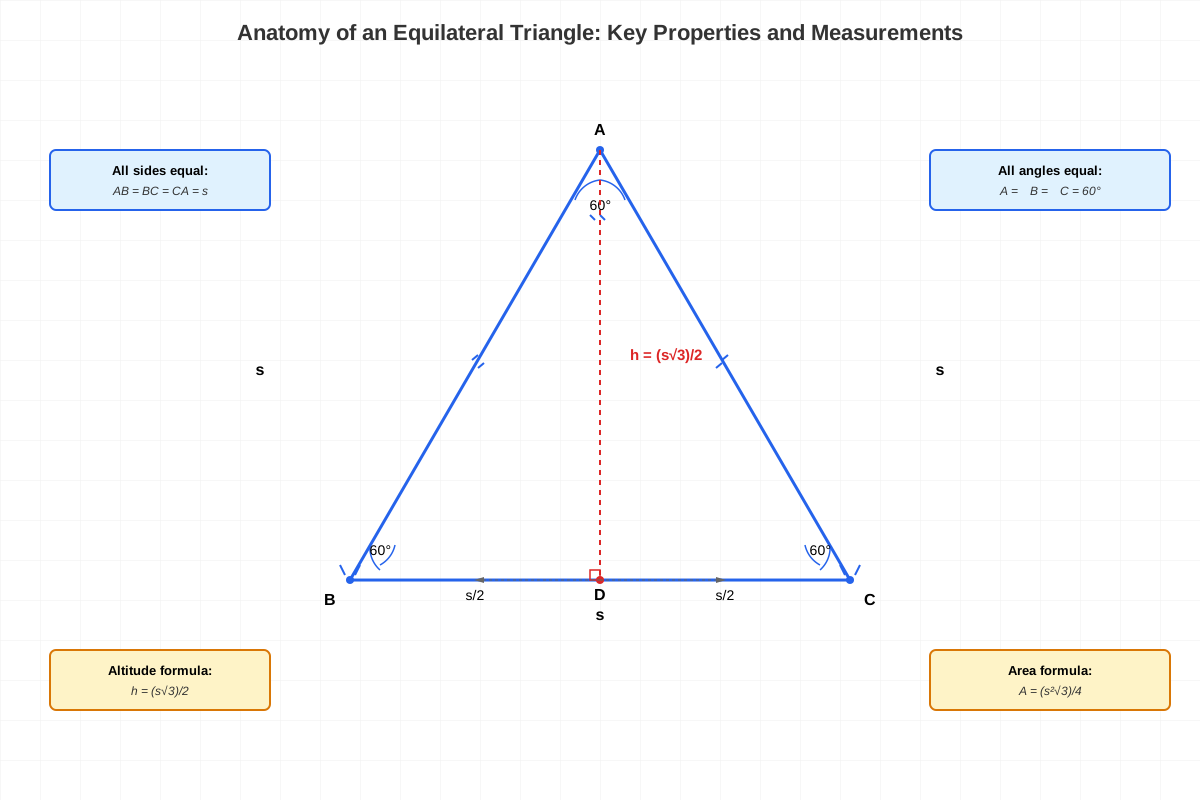
Equilateral triangles represent one of the most frequently tested geometric figures on the SAT and serve as a cornerstone for understanding more complex geometric relationships. An equilateral triangle is a special polygon where all three sides have equal length and all three interior angles measure exactly 60 degrees. This elegant symmetry makes equilateral triangles predictable and calculable, which is precisely why the SAT tests them repeatedly across multiple question types.
Understanding equilateral triangles is essential for SAT success because they appear in approximately 15-20% of geometry questions, either as the primary focus or embedded within more complex figures. These triangles frequently combine with other geometric concepts such as area calculations, coordinate geometry, trigonometry, and three-dimensional figures. The College Board favors equilateral triangles because they test multiple mathematical skills simultaneously: spatial reasoning, algebraic manipulation, and the application of geometric formulas.
The relationship between equilateral triangles and broader math concepts extends throughout the SAT curriculum. They connect directly to the Pythagorean theorem through their altitude calculations, relate to circle geometry when inscribed or circumscribed, and appear in coordinate plane problems requiring distance formulas. Mastering equilateral triangles provides a foundation for understanding isosceles triangles, regular polygons, and trigonometric ratios—all topics that build upon the fundamental properties explored here.
Learning Objectives
- [ ] Identify key features of equilateral triangles including side lengths, angle measures, and symmetry properties
- [ ] Explain how equilateral triangles appears on the SAT in various question formats and contexts
- [ ] Apply equilateral triangles concepts to answer SAT-style questions efficiently and accurately
- [ ] Calculate the altitude, area, and perimeter of equilateral triangles given any single measurement
- [ ] Recognize equilateral triangles embedded within complex geometric figures and extract relevant information
- [ ] Solve coordinate geometry problems involving equilateral triangles using distance and midpoint formulas
Prerequisites
- Basic triangle properties: Understanding that interior angles sum to 180° is essential for recognizing why equilateral triangles have 60° angles
- Pythagorean theorem: Required for deriving and applying the altitude formula for equilateral triangles
- Area formulas for triangles: The base-times-height formula serves as the foundation for equilateral triangle area calculations
- Algebraic manipulation: Solving equations with radicals and simplifying expressions containing √3 appears frequently
- Coordinate plane basics: Distance formula and plotting points are necessary for coordinate geometry applications
Why This Topic Matters
Equilateral triangles appear in real-world applications ranging from architectural design and structural engineering to molecular chemistry and crystallography. The inherent stability of equilateral triangular structures makes them fundamental to bridge trusses, geodesic domes, and even the hexagonal patterns found in honeycombs (which are composed of equilateral triangles). In navigation and surveying, equilateral triangles provide the basis for triangulation methods used in GPS technology.
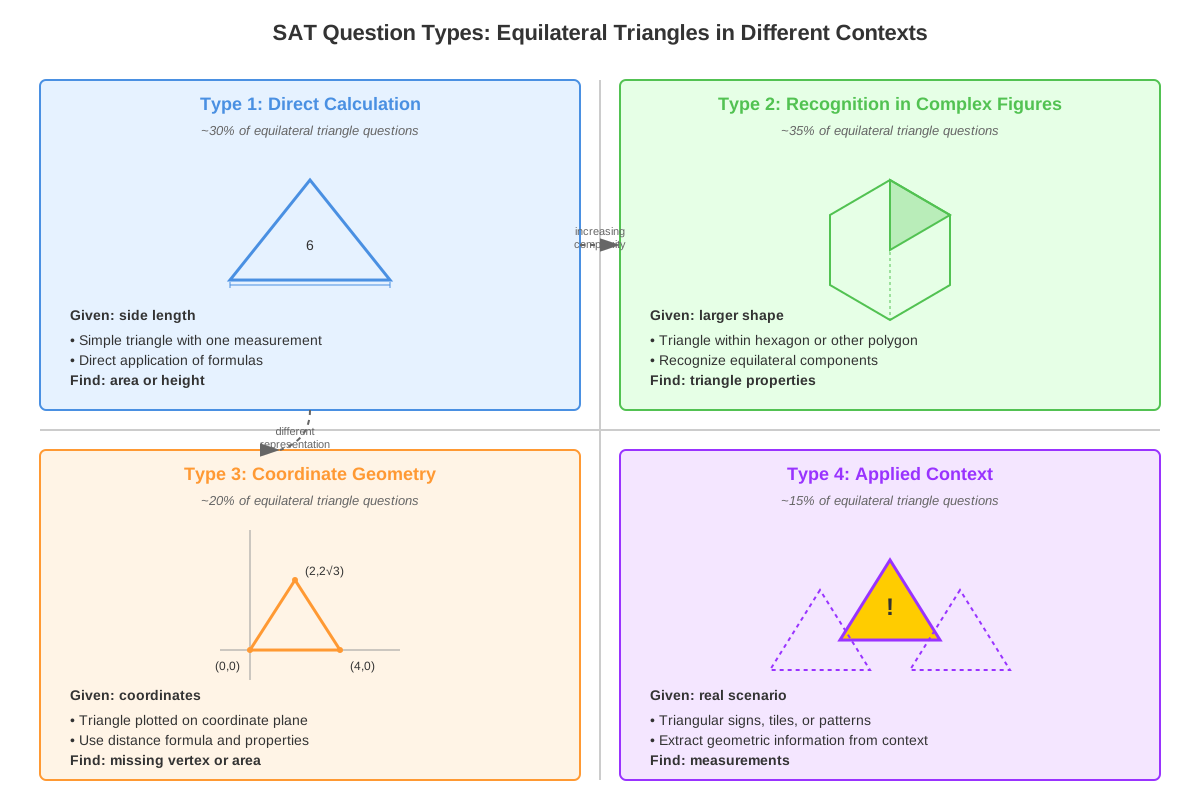
On the SAT, equilateral triangles appear in approximately 2-4 questions per test, making them one of the highest-yield geometry topics. They manifest in multiple question types: pure geometry problems asking for area or perimeter, coordinate geometry questions requiring calculation of vertices, complex figures where equilateral triangles are embedded within other shapes, and word problems involving real-world scenarios. The SAT particularly favors questions that combine equilateral triangles with other concepts, testing whether students can recognize the special properties and apply them efficiently under time pressure.
Common SAT question formats include: finding the area when given a side length, determining side length from area or altitude, calculating coordinates of vertices when one or two points are given, finding the perimeter of composite figures containing equilateral triangles, and solving for unknown variables in equations involving equilateral triangle properties. The test also frequently presents equilateral triangles within circles, rectangles, or other polygons, requiring students to identify the hidden equilateral triangle and extract its properties.
Core Concepts
Fundamental Properties of Equilateral Triangles
An equilateral triangle is defined by two equivalent conditions: all three sides are congruent (equal in length), and all three interior angles are congruent (each measuring 60°). These properties are interdependent—if one condition is true, the other must also be true. This makes equilateral triangles a special case of isosceles triangles (which have at least two equal sides) and represents the most symmetric type of triangle possible.
The sat equilateral triangles questions exploit this symmetry by testing whether students recognize that knowing any single measurement (side length, altitude, area, or perimeter) allows calculation of all other measurements. This predictability distinguishes equilateral triangles from general triangles, where multiple measurements are typically required.
Side Length and Perimeter Relationships
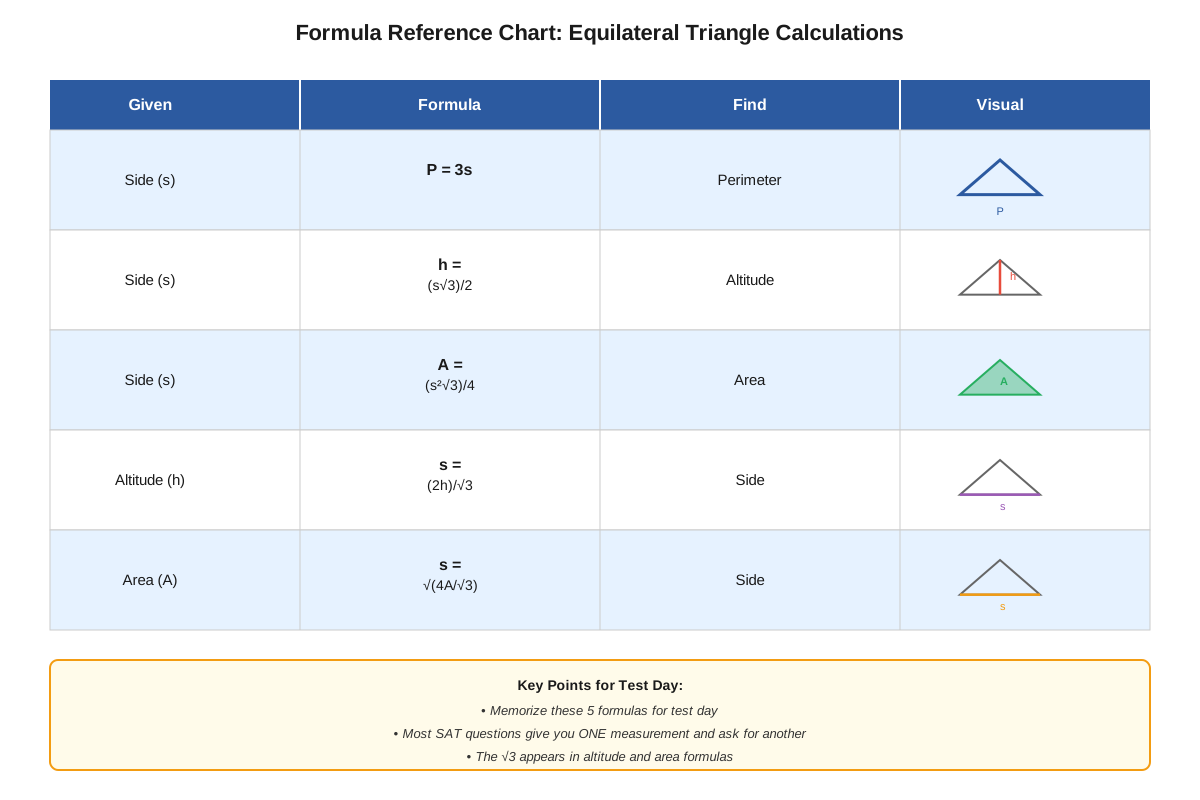
If an equilateral triangle has side length s, then its perimeter P is simply:
P = 3sConversely, given the perimeter, the side length equals P/3. This straightforward relationship appears frequently in SAT questions that provide perimeter and ask for area, or vice versa. The key insight is recognizing that perimeter serves as an intermediate step to finding the side length, which then unlocks all other properties.
Altitude Formula and Derivation
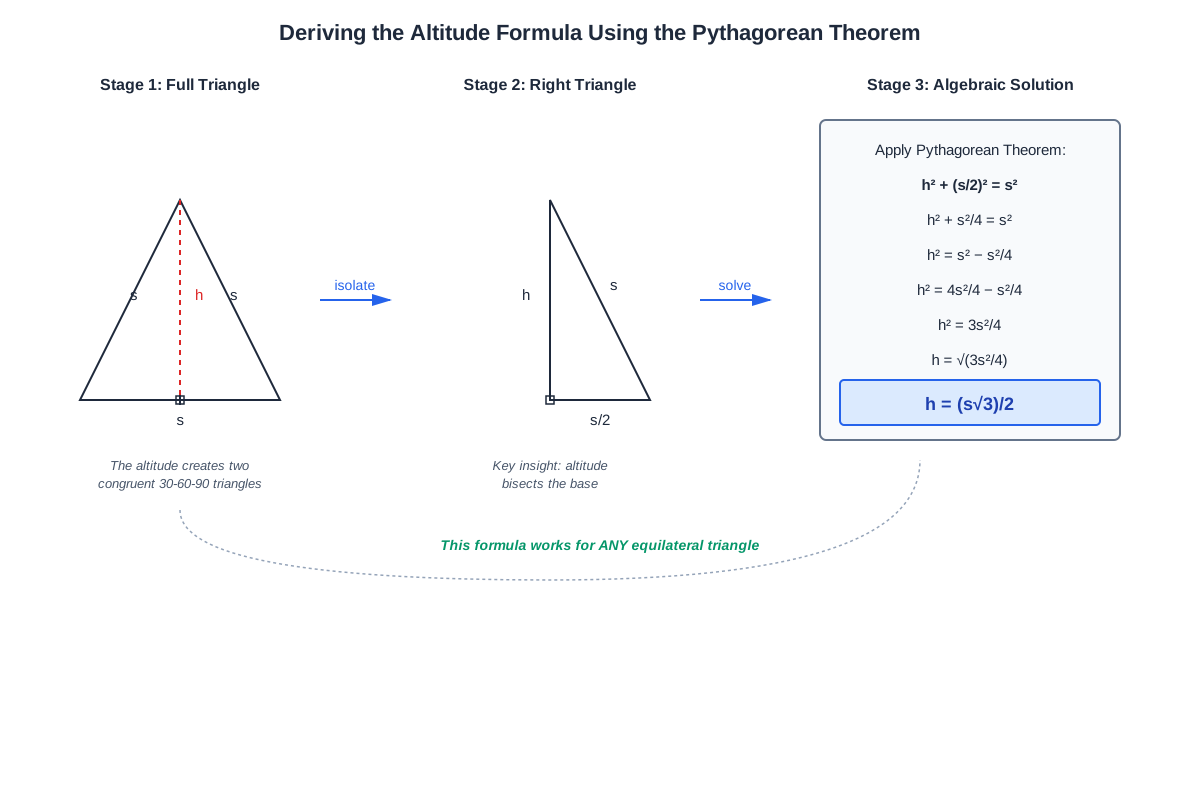
The altitude (height) of an equilateral triangle is one of the most tested concepts on the SAT. When an altitude is drawn from any vertex to the opposite side, it creates two congruent 30-60-90 right triangles. This special right triangle relationship is crucial for understanding the altitude formula.
For an equilateral triangle with side length s, the altitude h can be derived using the Pythagorean theorem. The altitude bisects the base, creating two segments of length s/2. Applying the Pythagorean theorem to one of the resulting right triangles:
h² + (s/2)² = s²
h² = s² - s²/4
h² = 3s²/4
h = (s√3)/2
This formula, h = (s√3)/2, must be memorized for SAT efficiency. Recognizing that the altitude involves √3 is a key pattern recognition skill.
Area Calculation Methods
The area of an equilateral triangle can be calculated using the standard triangle area formula (base times height divided by 2), but substituting the altitude formula yields a direct formula in terms of side length:
A = (1/2) × base × height
A = (1/2) × s × (s√3)/2
A = (s²√3)/4
The formula A = (s²√3)/4 is essential for SAT success. Many students waste time deriving this formula during the test; memorizing it saves valuable minutes. The SAT frequently provides area and asks for side length, requiring algebraic manipulation:
s² = 4A/√3
s = √(4A/√3) = 2√(A/√3)
Rationalizing the denominator yields: s = 2√(A√3)/3
The 30-60-90 Triangle Connection
Every altitude in an equilateral triangle creates two 30-60-90 triangles, a special right triangle with side ratios of 1 : √3 : 2. In the context of an equilateral triangle with side length s:
- The side opposite the 30° angle (half the base) = s/2
- The side opposite the 60° angle (the altitude) = (s√3)/2
- The hypotenuse (original side of equilateral triangle) = s
This relationship appears when SAT questions ask about angles, trigonometric ratios, or require decomposing equilateral triangles into right triangles for calculation purposes.
Coordinate Geometry Applications
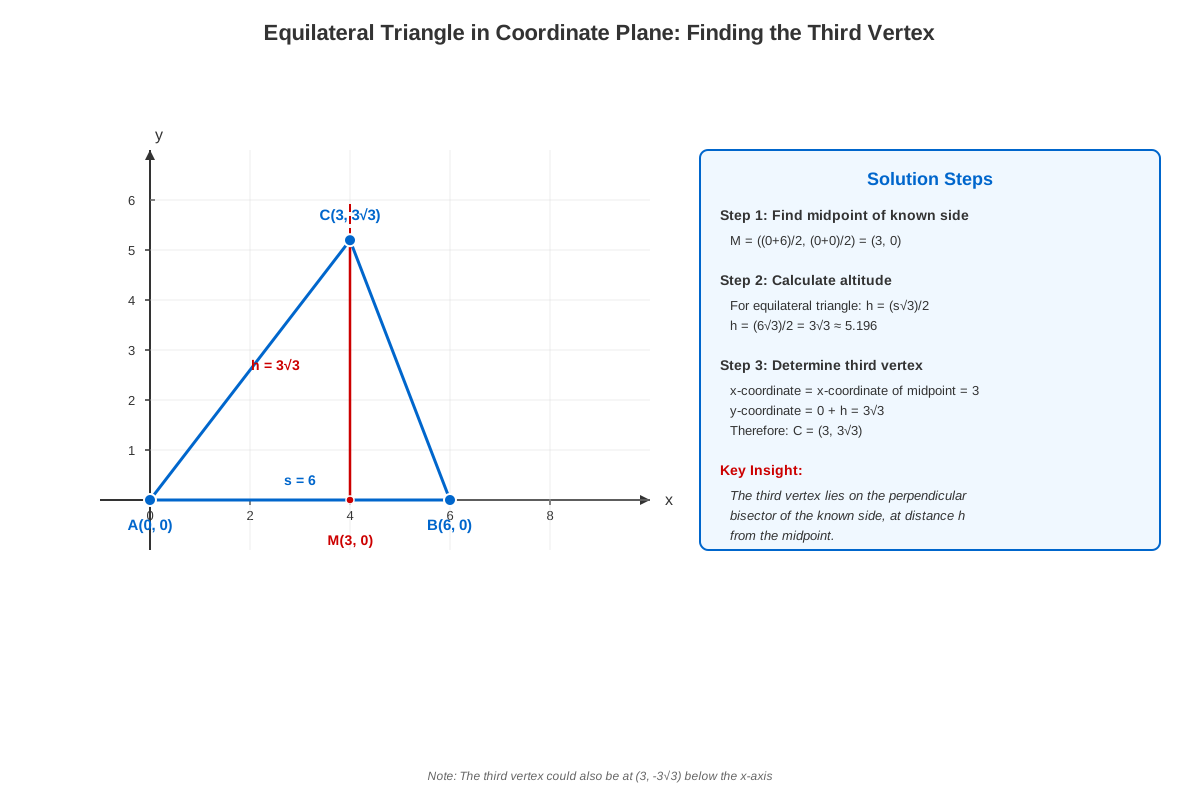
When equilateral triangles appear on the coordinate plane, the distance formula becomes essential. If two vertices are given, the third vertex can be found using the properties of equilateral triangles. For example, if two vertices are at (0, 0) and (6, 0), the side length is 6, and the third vertex must be at distance 6 from both given points.
The third vertex lies on the perpendicular bisector of the base at coordinates (3, 3√3) or (3, -3√3), depending on whether the triangle points upward or downward. The y-coordinate equals the altitude: (6√3)/2 = 3√3.
Inscribed and Circumscribed Circles
Equilateral triangles have special relationships with circles. The circumradius (radius of the circumscribed circle passing through all three vertices) is:
R = s/√3 = (s√3)/3The inradius (radius of the inscribed circle tangent to all three sides) is:
r = (s√3)/6Note that the circumradius is exactly twice the inradius: R = 2r. These formulas appear in advanced SAT questions combining circles and triangles.
Concept Relationships
The properties of equilateral triangles form an interconnected web where each measurement determines all others. The relationship flow follows this pattern:
Side length (s) → determines → Perimeter (3s) and Altitude (s√3/2) → which determine → Area (s²√3/4)
Conversely, working backward: Area → determines → Side length → determines → Altitude and Perimeter
The altitude serves as a bridge concept connecting equilateral triangles to 30-60-90 right triangles, which in turn connect to trigonometric ratios (sin 60° = √3/2, cos 60° = 1/2, tan 60° = √3). This relationship extends to the Pythagorean theorem, which provides the theoretical foundation for the altitude formula.
Equilateral triangles also connect upward to more complex topics: regular hexagons (composed of six equilateral triangles), three-dimensional geometry (tetrahedrons have equilateral triangle faces), and circle geometry (through inscribed and circumscribed relationships). Understanding these connections allows students to recognize equilateral triangles even when they're not explicitly labeled, a common SAT strategy.
The coordinate geometry applications link equilateral triangles to distance formula, midpoint formula, and slope concepts. When an equilateral triangle is positioned on the coordinate plane, these algebraic tools become necessary for calculating vertex positions and verifying equal side lengths.
High-Yield Facts
⭐ All three sides of an equilateral triangle are equal in length, and all three angles measure exactly 60°
⭐ The altitude formula for an equilateral triangle with side length s is h = (s√3)/2
⭐ The area formula for an equilateral triangle with side length s is A = (s²√3)/4
⭐ Drawing an altitude in an equilateral triangle creates two congruent 30-60-90 right triangles
⭐ The perimeter of an equilateral triangle is P = 3s, where s is the side length
- The altitude of an equilateral triangle bisects both the angle from which it's drawn (creating two 30° angles) and the opposite side (creating two equal segments)
- An equilateral triangle has three lines of symmetry, each passing through a vertex and the midpoint of the opposite side
- The ratio of altitude to side length is always √3/2, regardless of the triangle's size
- If the area of an equilateral triangle is A, the side length is s = 2√(A√3)/3
- The circumradius (radius of circumscribed circle) is R = (s√3)/3, and the inradius (radius of inscribed circle) is r = (s√3)/6
- In coordinate geometry, if an equilateral triangle has a horizontal base from (0,0) to (s,0), the third vertex is at (s/2, s√3/2)
- Six equilateral triangles with side length s can be arranged to form a regular hexagon with side length s
- The ratio of the area of an equilateral triangle to the area of its circumscribed circle is 3√3/(4π)
Quick check — test yourself on Equilateral triangles so far.
Try Flashcards →Common Misconceptions
Misconception: All triangles with equal angles are equilateral triangles of the same size.
Correction: While all equilateral triangles have 60° angles, they can be different sizes. Equal angles make triangles similar (same shape), not congruent (same size). Two equilateral triangles are similar to each other but only congruent if their side lengths are equal.
Misconception: The altitude of an equilateral triangle equals the side length.
Correction: The altitude is always shorter than the side length. Specifically, the altitude equals (s√3)/2 ≈ 0.866s, which is about 87% of the side length. Students often confuse the altitude with the side when setting up area calculations.
Misconception: The area formula A = (1/2)bh can only be used if you calculate the altitude separately; the formula A = (s²√3)/4 is different.
Correction: These formulas are equivalent. The formula A = (s²√3)/4 is simply the result of substituting h = (s√3)/2 into A = (1/2)bh. Both are correct, but the direct formula is faster on the SAT.
Misconception: When an equilateral triangle is divided by an altitude, the resulting triangles are 45-45-90 triangles.
Correction: The altitude creates two 30-60-90 triangles, not 45-45-90 triangles. The 30° angle is at the base, the 60° angle is at the top vertex, and the 90° angle is where the altitude meets the base. This is a critical distinction for applying the correct side ratios.
Misconception: If you know the perimeter of an equilateral triangle, you cannot find its area without additional information.
Correction: The perimeter alone is sufficient to find the area. Divide the perimeter by 3 to get the side length, then apply the area formula A = (s²√3)/4. The special properties of equilateral triangles mean that any single measurement determines all others.
Misconception: The √3 in equilateral triangle formulas can be approximated as 2 for quick calculations.
Correction: While √3 ≈ 1.732, approximating it as 2 introduces significant error (about 15%). On the SAT, answers are precise, and this approximation will lead to incorrect answer choices. Keep √3 in symbolic form until the final calculation, or use 1.732 if a decimal approximation is needed.
Misconception: An equilateral triangle positioned on the coordinate plane must have one side horizontal.
Correction: Equilateral triangles can be oriented at any angle on the coordinate plane. While problems often present them with a horizontal base for simplicity, students must be able to recognize and work with equilateral triangles in any orientation by using the distance formula to verify equal side lengths.
Worked Examples
Example 1: Finding Area from Perimeter
Problem: An equilateral triangle has a perimeter of 24 inches. What is its area in square inches?
Solution:
Step 1: Find the side length from the perimeter.
Since P = 3s, we have 24 = 3s, so s = 8 inches.
Step 2: Apply the area formula.
Using A = (s²√3)/4, we substitute s = 8:
A = (8²√3)/4
A = (64√3)/4
A = 16√3 square inches
Step 3: Verify using the altitude method (optional check).
The altitude is h = (8√3)/2 = 4√3 inches.
Using A = (1/2)bh: A = (1/2)(8)(4√3) = 16√3 square inches ✓
Answer: 16√3 square inches (approximately 27.71 square inches)
Connection to Learning Objectives: This problem demonstrates how to identify the key feature that perimeter determines side length, and how to apply the area formula efficiently—both essential SAT skills.
Example 2: Coordinate Geometry Application
Problem: In the xy-plane, an equilateral triangle has vertices at (0, 0) and (6, 0). If the third vertex is in the first quadrant, what are its coordinates?
Solution:
Step 1: Determine the side length.
The distance between (0, 0) and (6, 0) is 6 units, so s = 6.
Step 2: Find the x-coordinate of the third vertex.
By symmetry, the third vertex must lie on the perpendicular bisector of the base, which passes through the midpoint (3, 0). Therefore, the x-coordinate is 3.
Step 3: Find the y-coordinate using the altitude formula.
The altitude of an equilateral triangle with side length 6 is:
h = (6√3)/2 = 3√3
Since the third vertex is in the first quadrant (above the x-axis), the y-coordinate is positive.
Step 4: Verify using the distance formula.
The third vertex is at (3, 3√3). Check that it's distance 6 from both given points:
Distance from (0, 0): √[(3-0)² + (3√3-0)²] = √[9 + 27] = √36 = 6 ✓
Distance from (6, 0): √[(3-6)² + (3√3-0)²] = √[9 + 27] = √36 = 6 ✓
Answer: (3, 3√3) or approximately (3, 5.196)
Connection to Learning Objectives: This problem shows how equilateral triangles appear in coordinate geometry contexts on the SAT, requiring integration of the altitude formula with the distance formula and understanding of symmetry properties.
Exam Strategy
When approaching SAT equilateral triangles questions, begin by identifying what information is given and what is being asked. The most efficient strategy is to immediately convert any given measurement (perimeter, area, altitude) into the side length, since the side length is the key that unlocks all other properties. Write "s = ?" at the top of your work to remind yourself of this goal.
Trigger words and phrases to watch for include: "equilateral," "all sides equal," "regular triangle," "three equal sides," "three 60° angles," and "isosceles triangle with a 60° angle" (which must be equilateral). Also watch for implicit equilateral triangles in problems about regular hexagons, certain three-dimensional figures, or symmetric designs.
For process-of-elimination, remember that answers involving √3 are common for equilateral triangle problems, while answers involving √2 typically indicate 45-45-90 triangles (wrong for equilateral triangles). If a problem gives you an integer side length, the area will contain √3, and vice versa—if the area is an integer, the side length will contain √3. Use this pattern to eliminate impossible answer choices quickly.
Time allocation for equilateral triangle questions should be approximately 60-90 seconds for straightforward problems (given side length, find area) and 2-3 minutes for complex problems involving coordinate geometry or composite figures. If you find yourself spending more than 3 minutes, mark the question and return to it later. The key time-saver is memorizing the altitude and area formulas rather than deriving them during the test.
When equilateral triangles appear within complex figures, sketch and label the figure clearly. Draw in altitudes if they help you see 30-60-90 triangles. If the problem involves coordinate geometry, plot the points carefully and use symmetry to your advantage—the perpendicular bisector of any side passes through the opposite vertex.
For questions asking about multiple measurements (e.g., "find the perimeter and area"), calculate the side length first, then use it for both subsequent calculations. This approach is more efficient than trying to find relationships between perimeter and area directly.
Memory Techniques
Mnemonic for the area formula: "Squared Sqrt-three over Four" → A = (s²√3)/4. The three S's remind you that the formula involves the side length squared and √3, divided by 4.
Visualization strategy: Picture an equilateral triangle as a "perfect triangle" where everything is balanced and symmetric. When you draw an altitude, imagine it as a "knife cutting through the middle," creating two identical 30-60-90 triangles. This mental image helps recall that the altitude bisects both the base and the angle.
Acronym for properties: EASE - Equal sides, All angles 60°, Symmetric, Everything calculable from one measurement. This reminds you of the fundamental properties and the key insight that one measurement determines all others.
The √3 connection: Remember "3 for equilateral, √3 in formulas." The number 3 appears in the definition (three equal sides, three equal angles), and √3 appears in both the altitude and area formulas. This association helps you recall which special right triangle (30-60-90 with √3, not 45-45-90 with √2) relates to equilateral triangles.
Altitude approximation: The altitude is approximately 87% of the side length (since √3/2 ≈ 0.866). Visualize the altitude as "almost as tall as the side is long, but not quite." This helps you estimate whether your calculated altitude is reasonable.
Formula family: Group the formulas as a family: P = 3s (simplest), h = (s√3)/2 (involves √3), A = (s²√3)/4 (involves both squaring and √3). This hierarchy helps you remember which formulas are more complex and which to apply first.
Summary
Equilateral triangles are special polygons where all three sides are equal in length and all three angles measure exactly 60°. These triangles appear frequently on the SAT because their symmetry and predictability allow for testing multiple mathematical concepts simultaneously. The fundamental insight is that knowing any single measurement—side length, perimeter, altitude, or area—allows calculation of all other properties through specific formulas. The altitude formula h = (s√3)/2 and the area formula A = (s²√3)/4 are essential memorizations that save time and reduce errors. Drawing an altitude creates two 30-60-90 right triangles, connecting equilateral triangles to special right triangle ratios. On the SAT, equilateral triangles appear in pure geometry problems, coordinate geometry contexts, and embedded within complex figures. Success requires recognizing these triangles quickly, applying the appropriate formulas efficiently, and understanding the underlying relationships between measurements. The presence of √3 in calculations is a hallmark of equilateral triangle problems, distinguishing them from other triangle types.
Key Takeaways
- An equilateral triangle has three equal sides and three 60° angles; these properties are interdependent and define the triangle completely
- The altitude formula h = (s√3)/2 and area formula A = (s²√3)/4 must be memorized for SAT efficiency
- Any single measurement (side, perimeter, altitude, or area) determines all other properties of an equilateral triangle
- Drawing an altitude creates two congruent 30-60-90 right triangles, with side ratios 1 : √3 : 2
- The presence of √3 in formulas and answers is characteristic of equilateral triangle problems
- In coordinate geometry, use symmetry and the distance formula to locate vertices of equilateral triangles
- Equilateral triangles frequently appear embedded in complex figures; identifying them unlocks efficient solution paths
Related Topics
30-60-90 Special Right Triangles: Mastering equilateral triangles provides direct preparation for understanding 30-60-90 triangles, since every altitude in an equilateral triangle creates this special right triangle. The side ratios and trigonometric values follow naturally from equilateral triangle properties.
Isosceles Triangles: Equilateral triangles are a special case of isosceles triangles. Understanding the general properties of isosceles triangles (two equal sides, two equal angles) helps contextualize why equilateral triangles behave as they do.
Regular Polygons: Equilateral triangles are the simplest regular polygon. The concepts of equal sides and equal angles extend to regular hexagons, octagons, and other polygons, many of which can be decomposed into equilateral triangles.
Circle Geometry: The relationships between equilateral triangles and inscribed/circumscribed circles introduce important concepts about radii, chords, and arc lengths that appear in more advanced SAT geometry questions.
Three-Dimensional Geometry: Tetrahedrons (triangular pyramids) with equilateral triangle faces appear on the SAT, requiring application of equilateral triangle formulas to calculate surface area and volume.
Practice CTA
Now that you've mastered the core concepts of equilateral triangles, it's time to solidify your understanding through active practice. Attempt the practice questions to test your ability to recognize equilateral triangles in various contexts and apply the formulas efficiently under timed conditions. Use the flashcards to drill the essential formulas and properties until they become automatic. Remember, the difference between knowing these concepts and scoring points on test day is practice—the more problems you solve now, the more confident and efficient you'll be when you encounter equilateral triangles on the SAT. You've built a strong foundation; now transform that knowledge into points!
Sign up free to keep reading
Create a free AnvayaPrep account to finish this SAT guide on Equilateral triangles — plus flashcards and practice questions.