Overview
Isosceles triangles are one of the most frequently tested geometric figures on the SAT, appearing in approximately 15-20% of all geometry questions. An isosceles triangle is defined by having at least two sides of equal length, which creates a cascade of special properties that the SAT loves to test. Understanding these properties is not merely about memorizing definitions—it's about recognizing patterns that unlock solutions to complex multi-step problems involving angles, perimeter, area, and coordinate geometry.
The importance of mastering isosceles triangles extends far beyond isolated geometry questions. These triangles serve as building blocks for understanding more complex figures like rhombuses, regular polygons, and three-dimensional shapes. On the SAT, isosceles triangles frequently appear embedded within larger diagrams, requiring students to identify them as a critical first step toward solving the problem. The ability to quickly recognize an isosceles triangle and immediately recall its properties—particularly the base angles theorem—can save valuable time and prevent careless errors.
Within the broader math curriculum, isosceles triangles bridge multiple mathematical domains. They connect algebraic thinking (solving for unknown angles or sides) with geometric reasoning (using congruence and symmetry). They appear in coordinate geometry problems where students must calculate distances, in trigonometry contexts, and even in data analysis questions involving geometric probability. The SAT frequently combines isosceles triangle properties with other concepts like the Pythagorean theorem, similar triangles, and circle theorems, making this topic a cornerstone of geometric problem-solving that demands thorough mastery.
Learning Objectives
- [ ] Identify key features of isosceles triangles including equal sides, base angles, and the vertex angle
- [ ] Explain how isosceles triangles appears on the SAT in various question formats and diagram configurations
- [ ] Apply isosceles triangles properties to answer SAT-style questions involving angle measures, side lengths, and perimeter
- [ ] Calculate unknown angles in isosceles triangles using the base angles theorem and angle sum property
- [ ] Determine side lengths using properties of isosceles triangles combined with the Pythagorean theorem
- [ ] Recognize isosceles triangles embedded within complex geometric figures and coordinate plane problems
- [ ] Solve multi-step problems that combine isosceles triangle properties with other geometric concepts
Prerequisites
- Triangle basics: Understanding that triangles have three sides, three angles, and that the sum of interior angles equals 180° is fundamental to working with any specialized triangle type
- Angle relationships: Knowledge of complementary, supplementary, and vertical angles enables solving for unknown angles in diagrams containing isosceles triangles
- Basic algebra: The ability to set up and solve linear equations is essential since many isosceles triangle problems require solving for variables representing angles or side lengths
- Congruence concepts: Understanding what it means for segments or angles to be congruent provides the foundation for the defining property of isosceles triangles
- Pythagorean theorem: Many SAT problems combine isosceles triangles with right triangles, requiring application of a² + b² = c²
Why This Topic Matters
Isosceles triangles represent a perfect intersection of pattern recognition and logical reasoning—two skills the SAT explicitly tests. In real-world applications, isosceles triangles appear in architectural design (roof trusses, bridge supports), engineering (force distribution in structures), and even in nature (crystal formations, leaf shapes). Understanding their properties helps explain why certain structures are stable and why specific designs are aesthetically pleasing due to their inherent symmetry.
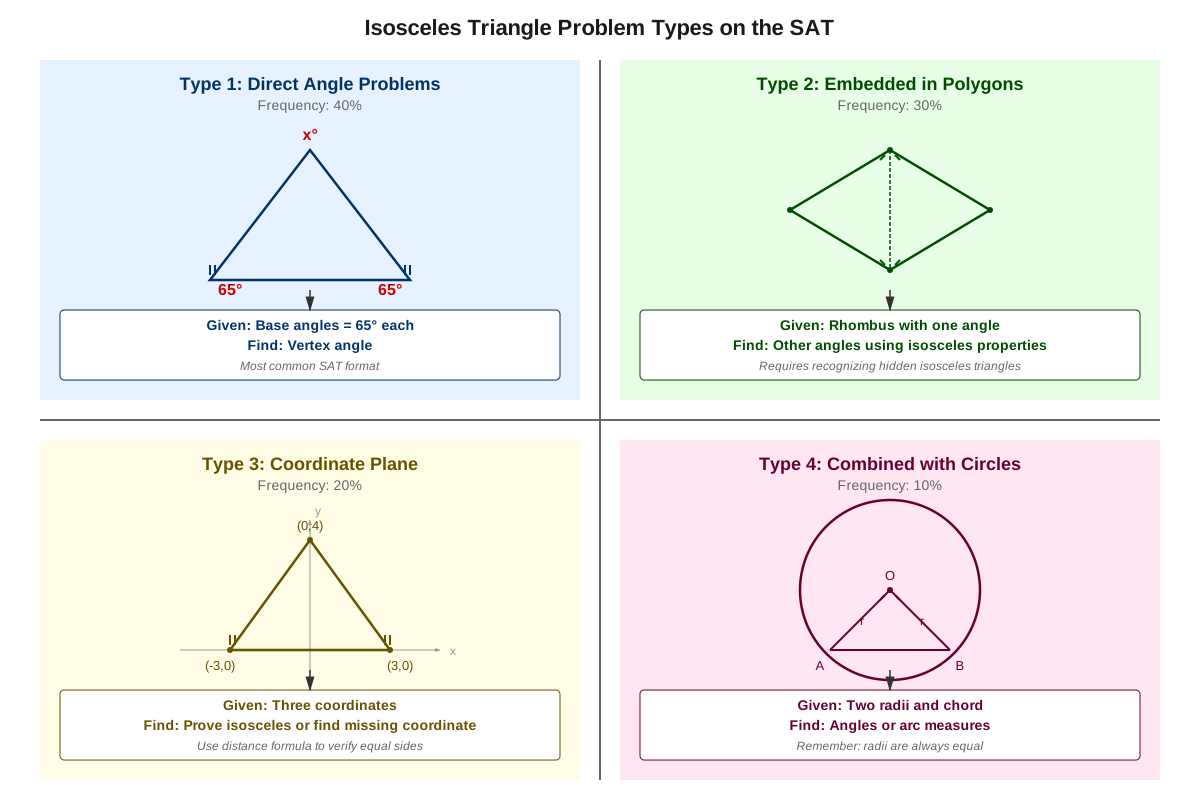
On the SAT, isosceles triangles appear in approximately 3-5 questions per test, making them one of the highest-yield geometry topics. They appear in multiple question formats: as standalone geometry problems in the calculator and no-calculator sections, embedded within coordinate geometry questions, as part of complex multi-figure diagrams, and occasionally in word problems requiring geometric modeling. The College Board particularly favors questions that test whether students can recognize an isosceles triangle from given information (such as two equal angles) rather than from explicit labeling.
Common SAT question types include: finding missing angle measures when one or two angles are given; determining side lengths when the perimeter and relationships between sides are provided; identifying isosceles triangles within coordinate plane problems by calculating distances; solving for variables in expressions representing angles or sides; and applying isosceles triangle properties to inscribed or circumscribed figures involving circles. The SAT also frequently tests isosceles right triangles (45-45-90 triangles) as a special case, combining isosceles properties with right triangle trigonometry.
Core Concepts
Definition and Basic Properties
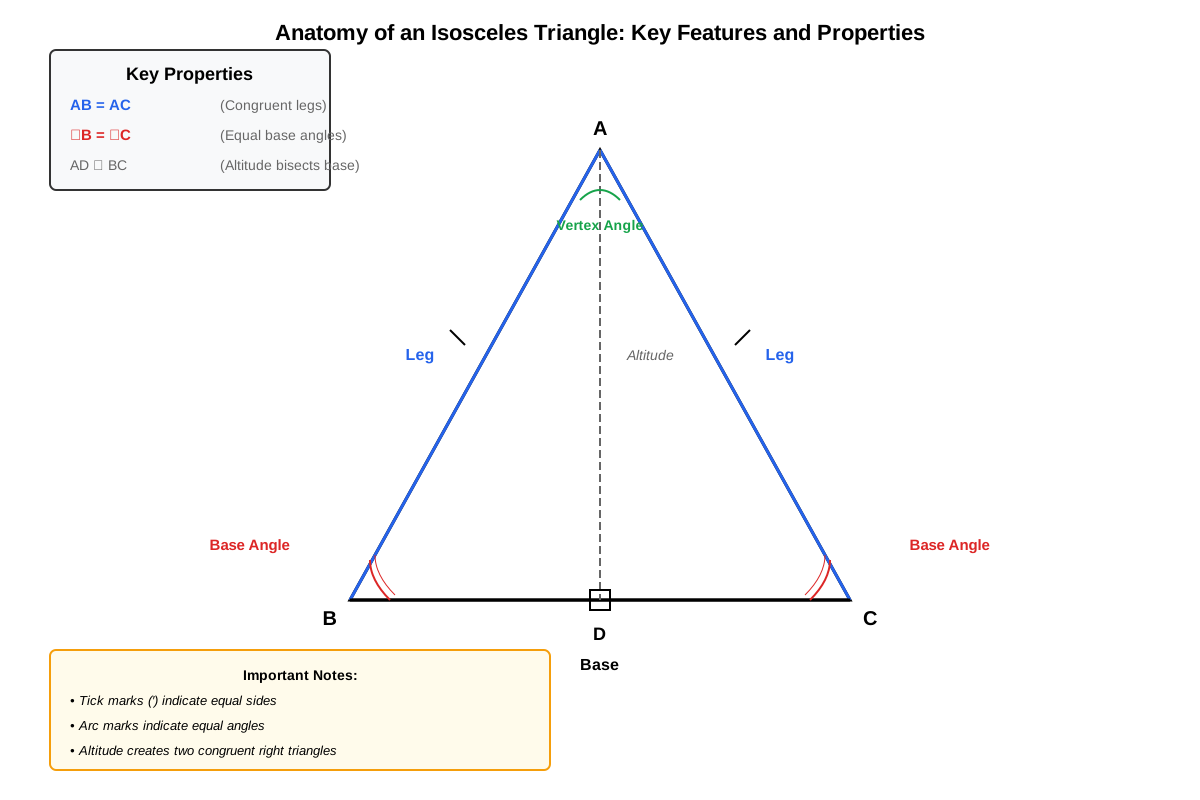
An isosceles triangle is a triangle with at least two congruent (equal-length) sides. These equal sides are called the legs of the isosceles triangle, while the third side is called the base. The angle formed by the two legs is called the vertex angle, and the two angles adjacent to the base are called the base angles. This terminology is crucial for the SAT because questions often refer to these specific parts by name.
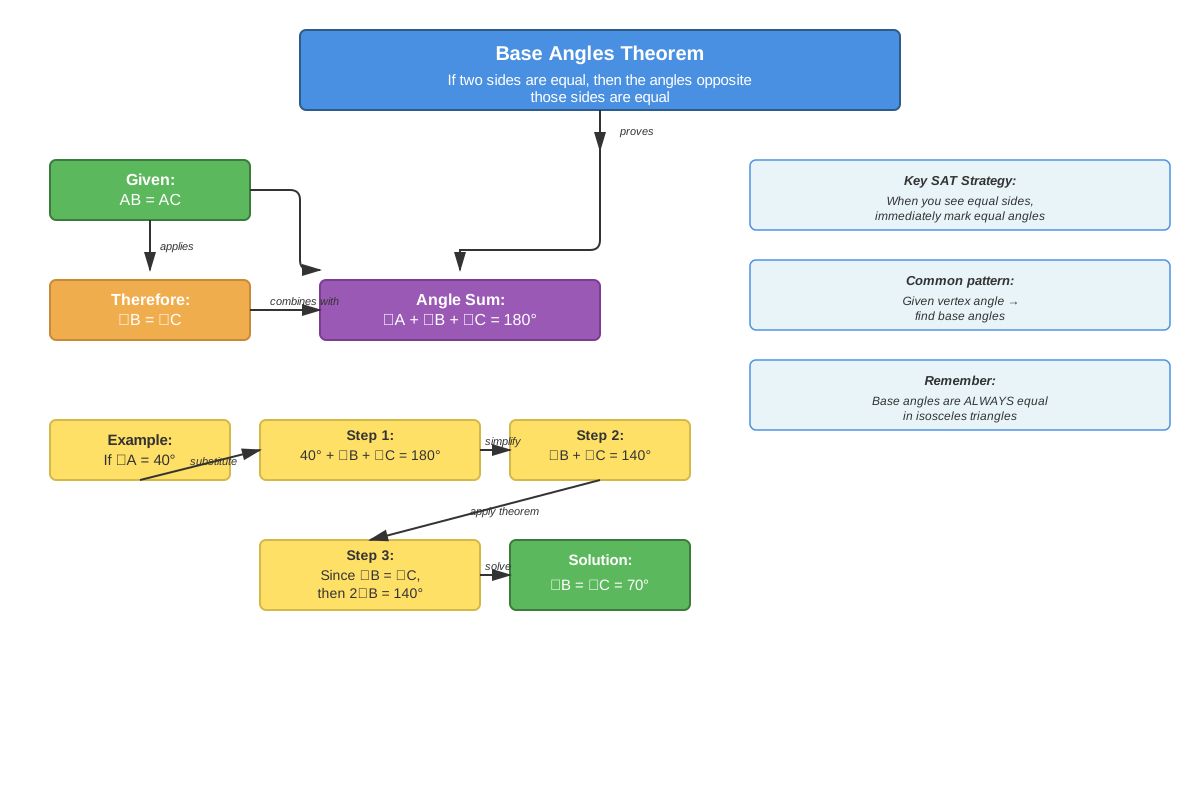
The fundamental theorem governing isosceles triangles is the Base Angles Theorem: If two sides of a triangle are congruent, then the angles opposite those sides are congruent. Conversely, if two angles of a triangle are congruent, then the sides opposite those angles are congruent. This bidirectional relationship is critical—the SAT tests both directions, and recognizing which direction to apply is often the key to solving a problem efficiently.
The Base Angles Theorem in Action
When working with isosceles triangles, the base angles theorem creates a powerful constraint. If you know one base angle, you automatically know the other. Combined with the fact that all triangle angles sum to 180°, this means you can find all three angles if you know just one angle in an isosceles triangle.
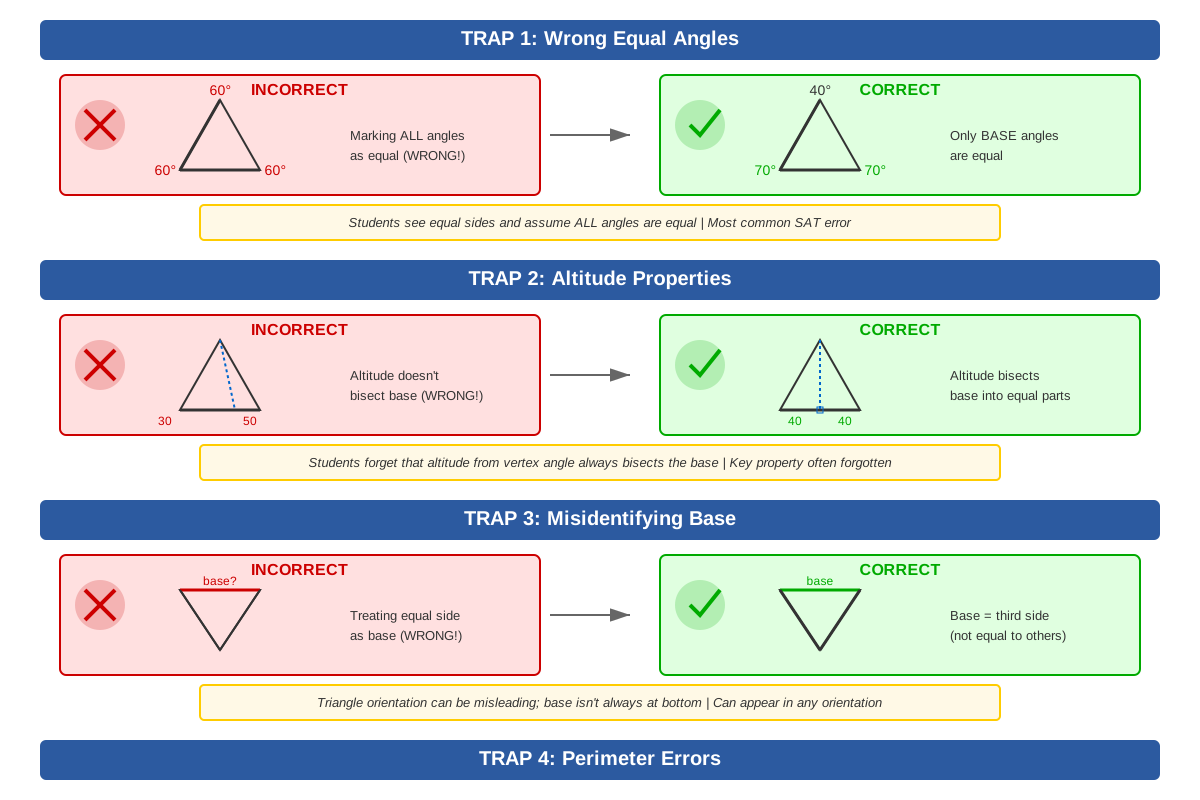
For example, if the vertex angle measures 40°, then the sum of the two base angles must be 180° - 40° = 140°. Since the base angles are equal, each base angle measures 140° ÷ 2 = 70°. Conversely, if one base angle measures 65°, the other base angle also measures 65°, and the vertex angle measures 180° - 65° - 65° = 50°.
Identifying Isosceles Triangles
The SAT rarely labels triangles as "isosceles" explicitly. Instead, students must identify them through various clues:
- Tick marks: Equal tick marks on two sides indicate those sides are congruent
- Arc marks: Equal arc marks on two angles indicate those angles are congruent, which means the triangle is isosceles
- Given information: Statements like "AB = AC" or "∠B = ∠C" in the problem text
- Coordinate geometry: Calculating that two sides have equal length using the distance formula
- Algebraic expressions: Recognizing that two side expressions are equal when simplified
Special Case: Isosceles Right Triangles
An isosceles right triangle is both isosceles and contains a 90° angle. This special case, also known as a 45-45-90 triangle, has the right angle as its vertex angle and two 45° base angles. The side length ratio in a 45-45-90 triangle is always 1:1:√2, where the legs have equal length and the hypotenuse is √2 times the length of each leg. This is one of the most frequently tested special right triangles on the SAT.
Altitude, Median, and Angle Bisector Properties
In an isosceles triangle, the altitude drawn from the vertex angle to the base has special properties: it is simultaneously the median (dividing the base into two equal segments), the angle bisector (dividing the vertex angle into two equal angles), and the perpendicular bisector of the base. This creates two congruent right triangles, which is often the key to solving SAT problems involving area or height.
This property is particularly useful because it allows you to apply the Pythagorean theorem. If an isosceles triangle has legs of length l and base of length b, the altitude h can be found using:
h² + (b/2)² = l²Perimeter and Area Calculations
The perimeter of an isosceles triangle with legs of length l and base b is simply:
P = 2l + bThe area can be calculated using the standard triangle area formula (½ × base × height), but finding the height often requires using the Pythagorean theorem with the altitude property mentioned above.
Relationship Between Angles and Sides
The size of the vertex angle determines the shape of the isosceles triangle:
| Vertex Angle | Base Angles | Triangle Type |
|---|---|---|
| < 60° | > 60° each | Obtuse isosceles (obtuse base angles) |
| = 60° | = 60° each | Equilateral (special case) |
| Between 60° and 90° | Between 45° and 60° | Acute isosceles |
| = 90° | = 45° each | Isosceles right triangle |
| > 90° | < 45° each | Obtuse isosceles (obtuse vertex angle) |
Understanding this relationship helps with estimation and eliminating incorrect answer choices on the SAT.
Concept Relationships
The properties of isosceles triangles form an interconnected web of relationships. The definition (two equal sides) → leads to → the base angles theorem (two equal angles) → combines with → the triangle angle sum (180°) → enables → solving for all unknown angles. This chain of reasoning appears in virtually every SAT question involving isosceles triangles.
The altitude property → creates → two congruent right triangles → allows application of → the Pythagorean theorem → enables calculation of → heights, areas, and unknown side lengths. This connection between isosceles triangles and right triangles is particularly high-yield for the SAT.
Isosceles triangles connect to prerequisite knowledge of basic triangle properties by being a special case with additional constraints. They relate to congruence through the base angles theorem and to symmetry through their line of symmetry along the altitude from the vertex angle. They connect forward to similar triangles (isosceles triangles with equal vertex angles are similar) and to trigonometry (the altitude creates right triangles where trigonometric ratios can be applied).
In coordinate geometry, isosceles triangles connect to the distance formula (for identifying equal sides) and to slope (the altitude from the vertex is perpendicular to the base). They also relate to circles since the two equal sides can be radii, making any triangle formed by two radii and a chord an isosceles triangle.
Quick check — test yourself on Isosceles triangles so far.
Try Flashcards →High-Yield Facts
⭐ In an isosceles triangle, the base angles (angles opposite the equal sides) are always congruent.
⭐ If two angles in a triangle are equal, the triangle must be isosceles, with the equal sides opposite those equal angles.
⭐ The altitude from the vertex angle to the base bisects both the vertex angle and the base, creating two congruent right triangles.
⭐ In an isosceles right triangle (45-45-90), the sides are in the ratio 1:1:√2 (leg:leg:hypotenuse).
⭐ If you know one angle in an isosceles triangle, you can find all three angles using the base angles theorem and the 180° angle sum.
- An equilateral triangle is a special case of an isosceles triangle where all three sides (and all three angles) are equal.
- The vertex angle and one base angle in an isosceles triangle are supplementary only when the base angles each measure 90°, which is impossible in a triangle.
- The perimeter of an isosceles triangle equals twice the leg length plus the base length.
- Isosceles triangles have exactly one line of symmetry, running from the vertex angle to the midpoint of the base.
- In any isosceles triangle, the vertex angle can range from just above 0° to just below 180°, but the base angles must each be less than 90° when the vertex angle exceeds 0°.
- When an isosceles triangle is inscribed in a circle with the base as a chord, the vertex angle lies on the circle and the perpendicular from the center to the chord passes through the vertex.
- The area of an isosceles triangle can be expressed as (b/4)√(4l² - b²), where l is the leg length and b is the base length.
Common Misconceptions
Misconception: All isosceles triangles have a 90° angle. → Correction: Only isosceles right triangles (45-45-90 triangles) have a 90° angle. Most isosceles triangles have three acute angles or one obtuse angle and two acute angles.
Misconception: The base of an isosceles triangle is always the bottom side in a diagram. → Correction: The base is defined as the side that is different from the two equal sides, regardless of the triangle's orientation. The SAT often rotates triangles to test whether students understand the definition rather than relying on visual position.
Misconception: If a triangle has two equal angles, those must be the base angles. → Correction: While the two equal angles are indeed the base angles by definition, students sometimes forget that this means the sides opposite these angles are the legs (equal sides), not the base. The base is opposite the vertex angle.
Misconception: The altitude of an isosceles triangle always creates two 45-45-90 triangles. → Correction: The altitude creates two congruent right triangles, but they are only 45-45-90 triangles when the original isosceles triangle is an isosceles right triangle. In other isosceles triangles, the altitude creates right triangles with different angle measures.
Misconception: An isosceles triangle must have exactly two equal sides. → Correction: An isosceles triangle has at least two equal sides. An equilateral triangle (with all three sides equal) is technically a special case of an isosceles triangle, though it's usually classified separately.
Misconception: The vertex angle is always the largest angle in an isosceles triangle. → Correction: The vertex angle can be the smallest, largest, or equal to the base angles depending on its measure. When the vertex angle is less than 60°, the base angles are larger. When it equals 60°, all angles are equal (equilateral). When it exceeds 60°, it's the largest angle.
Misconception: You need to know all three sides to determine if a triangle is isosceles. → Correction: Knowing that two angles are equal is sufficient to conclude the triangle is isosceles, even without any side length information.
Worked Examples
Example 1: Finding All Angles
Problem: In triangle ABC, AB = AC, and angle A measures 38°. What is the measure of angle B?
Solution:
Step 1: Identify the triangle type. Since AB = AC, triangle ABC is isosceles with legs AB and AC.
Step 2: Identify which angle is which. Angle A is the vertex angle (formed by the two equal sides). Angles B and C are the base angles.
Step 3: Apply the base angles theorem. Since the triangle is isosceles, the base angles are equal: angle B = angle C.
Step 4: Use the triangle angle sum property. The sum of all angles in a triangle is 180°:
angle A + angle B + angle C = 180°
38° + angle B + angle B = 180°
38° + 2(angle B) = 180°
2(angle B) = 142°
angle B = 71°
Step 5: Verify the answer. Angle A = 38°, angle B = 71°, angle C = 71°. Sum: 38° + 71° + 71° = 180° ✓
Answer: Angle B measures 71°.
Connection to learning objectives: This problem demonstrates identifying key features (equal sides, vertex angle, base angles) and applying the base angles theorem to solve for unknown angles—core skills for SAT isosceles triangle questions.
Example 2: Multi-Step Problem with Altitude
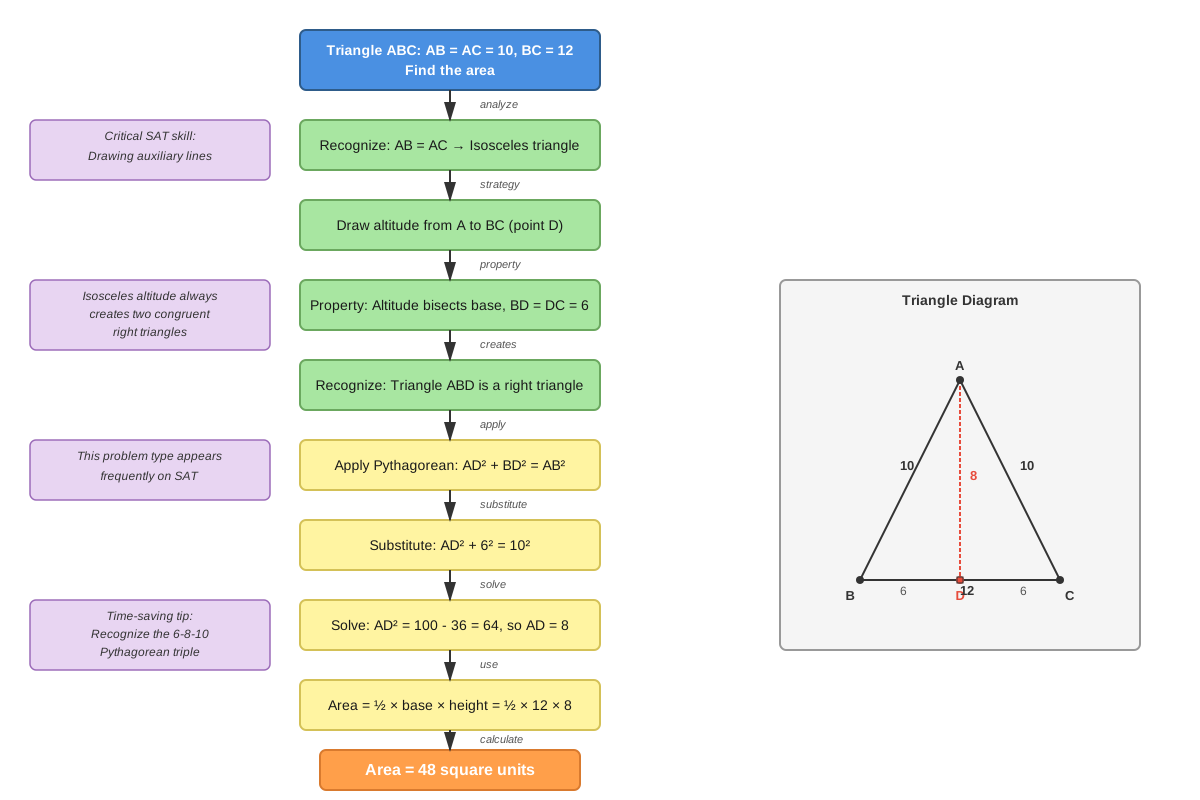
Problem: Triangle PQR is isosceles with PQ = PR = 10. The base QR has length 12. What is the area of triangle PQR?
Solution:
Step 1: Identify the triangle configuration. PQ and PR are the equal legs (length 10), and QR is the base (length 12). The vertex angle is at P.
Step 2: Recognize that we need the height to find the area. The area formula is ½ × base × height = ½ × 12 × h, but we don't know h yet.
Step 3: Use the altitude property. The altitude from P to QR bisects QR, creating two congruent right triangles. Let's call the point where the altitude meets QR point M. Then QM = MR = 6.
Step 4: Apply the Pythagorean theorem. In right triangle PMQ:
PM² + QM² = PQ²
PM² + 6² = 10²
PM² + 36 = 100
PM² = 64
PM = 8
Step 5: Calculate the area.
Area = ½ × base × height
Area = ½ × 12 × 8
Area = 48Answer: The area of triangle PQR is 48 square units.
Connection to learning objectives: This problem combines multiple isosceles triangle properties (altitude bisects the base, creates right triangles) with the Pythagorean theorem, demonstrating the multi-step problem-solving that frequently appears on the SAT.
Exam Strategy
When approaching sat isosceles triangles questions, begin by scanning the diagram for indicators of equal sides or angles. Look for tick marks, arc marks, or statements in the problem text. If no explicit indicators exist, check whether the problem provides information that implies equality (such as "the triangle has a perimeter of 30 and two sides each measure 12").
Trigger words and phrases to watch for include: "isosceles," "two equal sides," "two equal angles," "legs," "base angles," "vertex angle," and any statement indicating congruence between two sides or angles. Also watch for special cases like "isosceles right triangle" or "45-45-90 triangle," which activate additional properties.
For process of elimination, use these strategies:
- If a question asks for an angle measure and you know one angle, calculate what the others must be and eliminate any answer choice that doesn't fit the 180° sum
- If answer choices include angle measures, eliminate any that would make the base angles unequal when the triangle is stated to be isosceles
- For side length questions, eliminate answers that would violate the triangle inequality (the sum of any two sides must exceed the third side)
- If a diagram shows an isosceles triangle that appears acute, eliminate answer choices that would make it obtuse or right
Time allocation: Most isosceles triangle questions should take 45-90 seconds. If you find yourself spending more than 90 seconds, you may be missing a key insight—usually the base angles theorem or the altitude property. Consider marking the question and returning to it after completing easier problems.
Exam Tip: Always write down what you know immediately. If AB = AC, write "base angles B and C are equal" next to the diagram. This external working memory prevents errors and often reveals the solution path.
Memory Techniques
Mnemonic for the Base Angles Theorem: "Equal Sides, Equal Angles" (ESEA). When you see equal sides, think equal angles opposite them, and vice versa.
Visualization strategy: Picture an isosceles triangle as a mountain with a peak (vertex angle) and a flat base. The two paths up the mountain (the legs) are equally difficult (equal length), so the angles at which they meet the base (base angles) must be equal. This mental image helps remember that equal sides create equal base angles.
Acronym for altitude properties: "BAMP" - the altitude from the vertex angle is a Bisector (of the angle), Altitude (perpendicular to base), Median (bisects the base), and Perpendicular bisector (of the base). All four properties in one line.
Memory hook for 45-45-90 triangles: "One-One-Root-Two" - the sides are in ratio 1:1:√2. Say this phrase rhythmically to remember the special right triangle ratio for isosceles right triangles.
Angle relationship memory aid: "Vertex Varies, Bases Balance" - the vertex angle can be any measure (that makes a valid triangle), but the base angles must always balance each other (be equal).
Summary
Isosceles triangles are defined by having at least two congruent sides, which creates a cascade of properties that the SAT frequently tests. The base angles theorem—that angles opposite equal sides are themselves equal—is the cornerstone of solving isosceles triangle problems. Combined with the triangle angle sum of 180°, this theorem allows students to find all angles when given just one angle measure. The altitude from the vertex angle to the base has special properties: it bisects both the base and the vertex angle while creating two congruent right triangles, enabling application of the Pythagorean theorem for finding heights and areas. Isosceles right triangles (45-45-90) represent a special case with sides in the ratio 1:1:√2. Success on SAT isosceles triangle questions requires recognizing these triangles from various clues (tick marks, equal angles, coordinate geometry), applying the base angles theorem bidirectionally, and combining isosceles properties with other geometric concepts in multi-step problems.
Key Takeaways
- An isosceles triangle has at least two equal sides (legs), and the angles opposite these sides (base angles) are always equal
- If you know one angle in an isosceles triangle, you can find all three using the base angles theorem and the 180° angle sum
- The altitude from the vertex angle to the base bisects both the base and the vertex angle, creating two congruent right triangles
- Isosceles right triangles (45-45-90) have sides in the ratio 1:1:√2 and appear frequently on the SAT
- Look for tick marks, arc marks, or statements about equal sides/angles to identify isosceles triangles—they're rarely labeled explicitly
- The base angles theorem works both ways: equal sides → equal angles, and equal angles → equal sides
- Combining isosceles triangle properties with the Pythagorean theorem is a high-yield strategy for multi-step SAT problems
Related Topics
Equilateral Triangles: A special case of isosceles triangles where all three sides and all three angles are equal (each angle measures 60°). Mastering isosceles triangles provides the foundation for understanding equilateral triangle properties and their applications in regular polygons.
30-60-90 Triangles: Another special right triangle that often appears alongside isosceles triangles on the SAT. Understanding both special right triangles enables solving a wider range of geometry problems efficiently.
Triangle Congruence: The base angles theorem is essentially a statement about congruent parts of triangles. Deeper study of congruence (SSS, SAS, ASA, AAS) builds on the reasoning developed through isosceles triangles.
Coordinate Geometry with Triangles: Applying the distance formula to identify isosceles triangles in the coordinate plane, and using slope to verify perpendicular altitudes, extends isosceles triangle concepts to algebraic contexts.
Circle Theorems: Isosceles triangles frequently appear in circle problems, particularly when two radii form the legs of the triangle. Understanding isosceles triangles is prerequisite knowledge for inscribed angle theorems and chord properties.
Practice CTA
Now that you've mastered the core concepts of isosceles triangles, it's time to solidify your understanding through active practice. Attempt the practice questions to test your ability to identify isosceles triangles, apply the base angles theorem, and solve multi-step problems under timed conditions. Use the flashcards to reinforce key properties and theorems until they become automatic. Remember, the difference between knowing these concepts and scoring points on test day is practice—the more problems you solve, the faster you'll recognize patterns and the more confident you'll feel when isosceles triangles appear on your SAT. You've got this!
Sign up free to keep reading
Create a free AnvayaPrep account to finish this SAT guide on Isosceles triangles — plus flashcards and practice questions.