Overview
SAT triangle traps represent one of the most frequently tested categories of deceptive question design on the SAT Math section. These questions deliberately present triangles in ways that violate student assumptions or exploit common reasoning errors. The College Board consistently includes these traps to differentiate between students who have memorized formulas and those who truly understand geometric principles. Triangle trap questions often appear straightforward at first glance, but contain subtle features—such as non-standard orientations, missing information that cannot be assumed, or figures that are intentionally not drawn to scale—that lead unprepared students to incorrect answers.
Understanding sat triangle traps is essential for achieving a competitive math score because these questions appear in approximately 15-20% of all geometry problems on the test. They frequently combine multiple concepts, requiring students to recognize when standard triangle properties apply and when they do not. The most dangerous aspect of these traps is that incorrect answers are specifically designed to match what students would calculate if they make common assumptions, making wrong answers feel intuitively "right."
Mastering triangle traps connects directly to broader SAT Math competencies including spatial reasoning, critical reading of diagrams, and the ability to distinguish between what is given versus what must be proven. This topic builds upon fundamental triangle properties while preparing students for more complex geometric reasoning required in coordinate geometry, trigonometry, and proof-based problems that appear throughout the test.
Learning Objectives
- [ ] Identify key features of SAT triangle traps
- [ ] Explain how SAT triangle traps appears on the SAT
- [ ] Apply SAT triangle traps to answer SAT-style questions
- [ ] Distinguish between information that can be assumed from a diagram versus information that must be explicitly stated
- [ ] Recognize when a triangle figure is marked "not drawn to scale" and adjust problem-solving approach accordingly
- [ ] Evaluate whether sufficient information exists to determine specific triangle properties or measurements
Prerequisites
- Basic triangle properties: Understanding that the sum of interior angles equals 180° and that the sum of any two sides must exceed the third side is fundamental to recognizing when trap conditions exist
- Triangle classification: Knowledge of equilateral, isosceles, right, acute, and obtuse triangles enables recognition of when the SAT presents misleading visual representations
- Pythagorean theorem: Familiarity with a² + b² = c² for right triangles is necessary because many traps involve assuming right angles that aren't actually present
- Angle relationships: Understanding complementary, supplementary, and vertical angles helps identify when angle measures can or cannot be determined
- Similar and congruent triangles: Recognition of when triangles share proportional relationships prevents errors in problems involving multiple triangles
Why This Topic Matters
Triangle traps appear on virtually every SAT administration, making them one of the highest-yield topics for focused study. According to College Board data, geometry questions constitute approximately 10% of the SAT Math section, and triangle-related problems represent the largest subset within geometry. Among these triangle questions, roughly 60-70% contain at least one trap element designed to test whether students can distinguish between visual appearance and mathematical reality.
In real-world applications, the critical thinking skills developed through mastering triangle traps extend far beyond geometry. Engineers must verify that visual representations match actual specifications; architects cannot assume measurements from scaled drawings without confirmation; and data analysts must distinguish between correlation suggested by visual patterns and causation proven by evidence. The SAT uses triangle traps as a proxy for measuring analytical reasoning and the ability to question assumptions—skills essential across STEM fields and quantitative disciplines.
On the exam, triangle traps most commonly appear in three formats: (1) multiple-choice questions where the diagram suggests a specific triangle type that isn't actually stated, (2) grid-in questions where students must recognize that insufficient information exists to determine a unique answer, and (3) word problems where the description allows for multiple triangle configurations. These questions typically appear in the middle-to-difficult range of each Math section, serving as discriminators between students scoring in the 600s versus those achieving 700+.
Core Concepts
The "Not Drawn to Scale" Warning
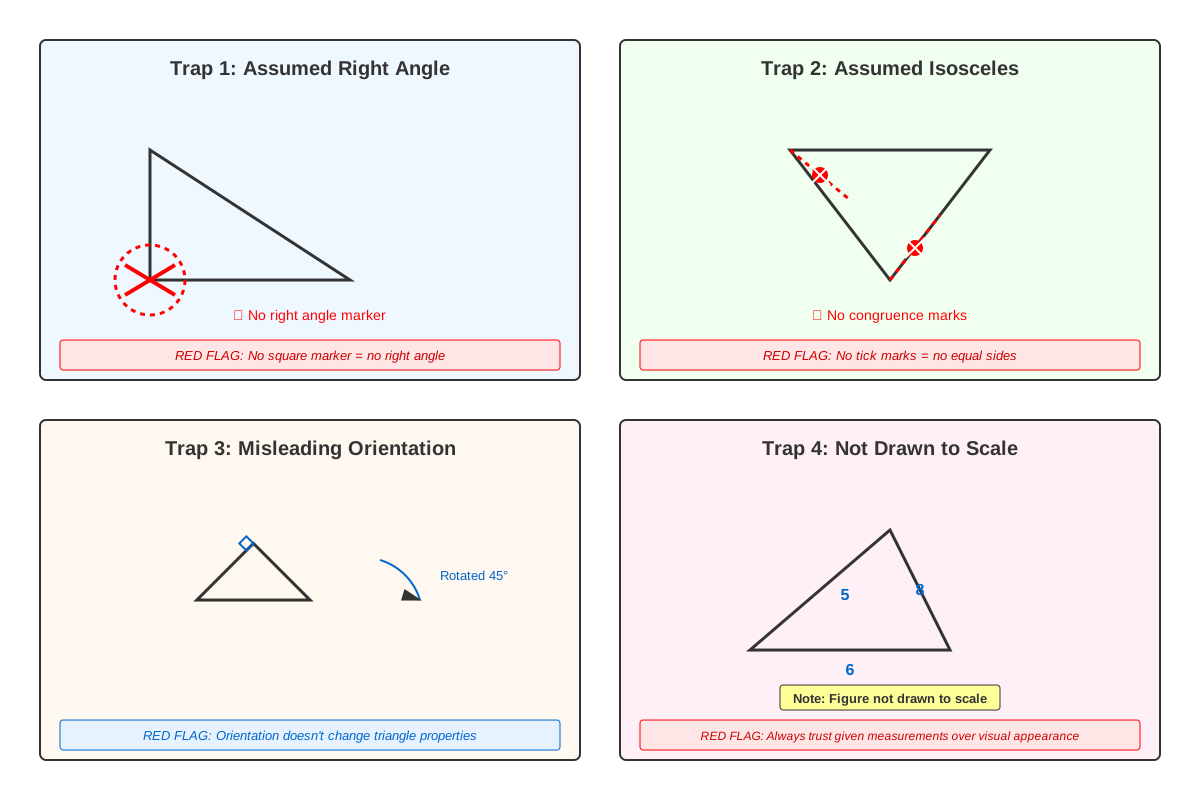
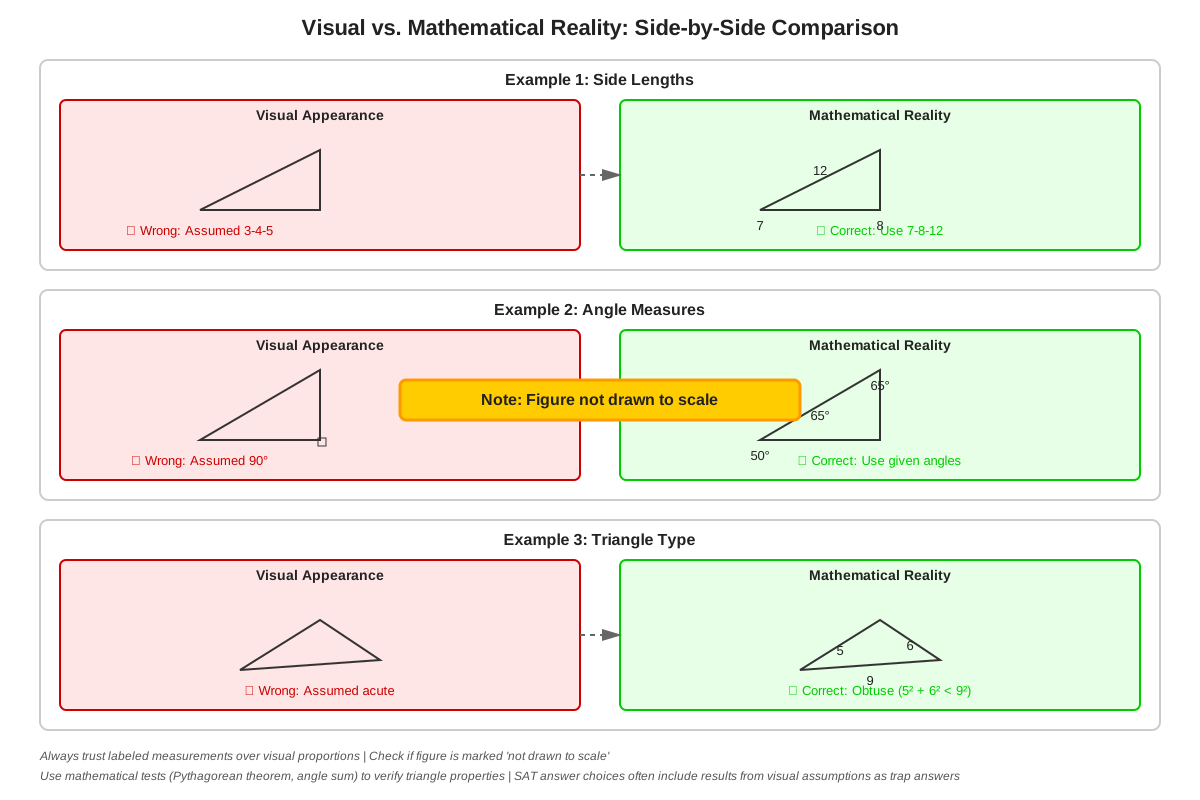
The phrase "Note: Figure not drawn to scale" is the SAT's explicit signal that visual appearance cannot be trusted. When this warning appears, students must rely exclusively on stated measurements, marked angles, and proven relationships rather than what the diagram suggests. This trap exploits the human brain's tendency to process visual information faster than textual information, causing students to make snap judgments based on appearance.
The critical strategy when encountering this warning involves:
- Reading all given information before looking at the diagram
- Marking only the explicitly stated measurements on the figure
- Questioning any assumption about angle measures, side lengths, or triangle type
- Considering extreme cases that satisfy the given constraints
For example, if a triangle shows what appears to be a right angle at vertex B, but no right angle is marked or stated, the angle could actually be 89° or 91°—close enough to look perpendicular but mathematically distinct.
The Isosceles Triangle Assumption Trap
One of the most prevalent sat sat triangle traps involves triangles that visually appear isosceles (having two equal sides) but lack the necessary markings or statements to confirm this property. The SAT deliberately draws triangles with two sides that look equal in length, knowing that students will assume equality and incorrectly conclude that the base angles are also equal.
Valid indicators of isosceles triangles include:
- Tick marks showing two sides are congruent
- Explicit statement that two sides have equal length
- Angle markings showing two angles are congruent (which proves the opposite sides are equal)
- Given measurements that numerically establish two sides are equal
Invalid assumptions include:
- Visual appearance of equal sides without markings
- Symmetrical positioning in the diagram
- Equal-looking angles without measurement or marking
| Valid Evidence | Invalid Evidence |
|---|---|
| "AB = AC" stated in problem | Sides AB and AC look the same length |
| Tick marks on two sides | Triangle appears symmetrical |
| "∠B = ∠C" given | Angles look equal in diagram |
| Calculated values prove equality | "Seems like" it should be isosceles |
The Right Angle Assumption Trap
Students frequently assume right angles exist when they see perpendicular-looking lines, especially when triangles are drawn on coordinate grids or when one side appears horizontal and another vertical. Unless a right angle is marked with a small square symbol, explicitly stated, or can be proven through given information, it cannot be assumed.
The SAT exploits this trap by:
- Drawing angles that measure 88° or 92° but appear to be 90°
- Positioning triangles so sides align with grid lines without actually being perpendicular
- Creating scenarios where students might incorrectly apply the Pythagorean theorem
- Presenting problems where assuming a right angle leads to one of the wrong answer choices
To avoid this trap, students must verify right angles through:
- The right angle square symbol (∟)
- Explicit statements like "AC ⊥ BC" or "angle ABC = 90°"
- Proven relationships (such as slopes of -1 and 1 being perpendicular)
- Given side lengths that satisfy the Pythagorean theorem
The Insufficient Information Trap
Some SAT triangle problems deliberately provide less information than students expect, testing whether they recognize that a unique solution cannot be determined. These questions often appear as grid-in problems where students waste time trying to calculate an answer that doesn't exist, or as multiple-choice questions where "Cannot be determined" is the correct answer.
Common insufficient information scenarios include:
- Given only one side and one non-included angle (not enough to determine the triangle)
- Provided with angle measures but no side lengths (can determine shape but not size)
- Supplied with two sides but no information about the included angle (multiple triangles possible)
- Given ratios without actual measurements (determines proportions but not absolute values)
The Exterior Angle Trap
The exterior angle of a triangle equals the sum of the two non-adjacent interior angles—a property the SAT uses to create traps. Students often confuse exterior angles with supplementary angles or fail to recognize when an angle shown outside the triangle can be used to find interior angles.
Key exterior angle relationships:
- Exterior angle = sum of two remote interior angles
- Exterior angle + adjacent interior angle = 180° (linear pair)
- Each triangle has six exterior angles (two at each vertex)
- The sum of all exterior angles (one at each vertex) = 360°
The trap occurs when students either forget to use the exterior angle theorem or incorrectly apply it by adding the wrong angles together.
The Triangle Inequality Trap
The triangle inequality theorem states that the sum of any two sides must be greater than the third side. The SAT creates traps by asking whether certain side lengths can form a triangle, or by providing two sides and asking for the range of possible values for the third side.
For a triangle with sides a, b, and c:
- a + b > c
- a + c > b
- b + c > a
Students fall into this trap by:
- Forgetting to check all three inequalities
- Using ≥ instead of > (equality would create a degenerate triangle—a straight line)
- Incorrectly calculating the range for an unknown side
- Assuming any three positive numbers can form a triangle
The Overlapping Triangles Trap
When diagrams show multiple triangles sharing sides or vertices, the SAT tests whether students can correctly identify which measurements apply to which triangle. These problems require careful labeling and often involve similar triangles, congruent triangles, or triangles that share an altitude or median.
Strategies for overlapping triangle problems:
- Redraw each triangle separately
- Label all known measurements on each separate drawing
- Identify shared sides or angles
- Apply properties specific to each triangle type
- Use relationships between the triangles to find unknown values
Concept Relationships
The various triangle traps interconnect through the fundamental principle that visual appearance must be verified by mathematical evidence. The "not drawn to scale" warning → triggers the need to verify all assumptions → which requires checking for isosceles properties, right angles, and sufficient information → leading to application of specific theorems like triangle inequality or exterior angles.
The isosceles assumption trap connects directly to the angle-side relationship (if two sides are equal, then the opposite angles are equal, and vice versa). This bidirectional relationship means that proving either equal sides or equal angles automatically proves the other, but assuming either without proof leads to errors.
The right angle trap relates to the Pythagorean theorem application: assuming a right angle → leads to incorrect use of a² + b² = c² → produces a wrong answer that appears among the choices. Conversely, if three sides satisfy the Pythagorean theorem, this proves a right angle exists (the converse of the Pythagorean theorem).
The insufficient information trap connects to all other traps because recognizing missing information requires understanding what information is necessary. For example, knowing that two sides and a non-included angle don't determine a unique triangle (the ambiguous case) prevents wasted calculation time.
These concepts collectively build toward the meta-skill of critical diagram reading: the ability to extract only valid information from geometric figures while resisting the brain's tendency to fill in assumed details. This skill extends beyond triangles to all SAT geometry problems involving circles, quadrilaterals, and three-dimensional figures.
Quick check — test yourself on SAT triangle traps so far.
Try Flashcards →High-Yield Facts
⭐ The phrase "Note: Figure not drawn to scale" means you cannot trust any visual appearance—only explicitly stated or marked information is valid
⭐ A triangle that looks isosceles is NOT isosceles unless it has tick marks on two sides, equal angle markings, or a statement confirming equal sides
⭐ Right angles must be marked with a square symbol (∟) or explicitly stated—perpendicular-looking lines are not necessarily perpendicular
⭐ The sum of any two sides of a triangle must be strictly greater than (not equal to) the third side
⭐ An exterior angle of a triangle equals the sum of the two non-adjacent interior angles
- The sum of all three interior angles in any triangle always equals exactly 180°, regardless of triangle type
- If only two sides and a non-included angle are given, multiple different triangles might satisfy the conditions (insufficient information)
- When a triangle appears on a coordinate grid, do not assume sides are perpendicular just because they align with axes
- The longest side of a triangle is always opposite the largest angle; the shortest side is opposite the smallest angle
- In any triangle, if you know two angles, you automatically know the third angle (180° minus the sum of the other two)
- Similar triangles have the same shape but not necessarily the same size; congruent triangles have both the same shape and size
- The altitude of a triangle (height) is not necessarily one of the sides—it's the perpendicular distance from a vertex to the opposite side
- Equilateral triangles are always isosceles, but isosceles triangles are not always equilateral
Common Misconceptions
Misconception: If a triangle looks like it has a right angle in the diagram, it's safe to use the Pythagorean theorem.
Correction: The Pythagorean theorem can only be applied when a right angle is explicitly marked with a square symbol, stated in the problem, or proven through given information. Visual appearance, especially when "not drawn to scale" appears, cannot be trusted.
Misconception: When two sides of a triangle look equal in length, the triangle is isosceles and the base angles are equal.
Correction: Isosceles properties can only be used when equality is marked (with tick marks), stated explicitly, or proven through calculation. The SAT deliberately draws triangles that appear isosceles but aren't to trap students who rely on visual judgment.
Misconception: If you're given two sides of a triangle, you can find the third side.
Correction: Two sides alone provide only a range for the third side. If sides a and b are known, the third side c must satisfy |a - b| < c < a + b. A unique value requires additional information such as the included angle or a statement that the triangle is right-angled.
Misconception: All angles that look like they're about 90° can be treated as right angles for calculation purposes.
Correction: Even a 1° difference from 90° means the Pythagorean theorem doesn't apply and angle relationships change. The SAT specifically designs trap answers based on students incorrectly assuming right angles.
Misconception: When a problem asks "What is the value of x?" there must always be enough information to find a specific numerical answer.
Correction: Some SAT questions test whether students recognize insufficient information. The correct answer might be "Cannot be determined from the information given" or, in grid-in questions, students might waste time searching for a solution that doesn't exist.
Misconception: If two triangles share a side, they must be congruent or similar.
Correction: Sharing a side (or even sharing two sides) doesn't automatically make triangles congruent or similar. Specific congruence criteria (SSS, SAS, ASA, AAS) or similarity criteria (AA, SAS, SSS) must be satisfied.
Misconception: The exterior angle is always supplementary to the interior angle at the same vertex.
Correction: While an exterior angle and its adjacent interior angle do form a linear pair (summing to 180°), the exterior angle also equals the sum of the two remote interior angles—a relationship that's often more useful for solving SAT problems.
Worked Examples
Example 1: The Isosceles Assumption Trap
Problem: In triangle ABC, angle A measures 50° and angle B measures 65°. The triangle is drawn so that sides AB and AC appear to be equal in length, but no tick marks or measurements are shown. What is the measure of angle C?
Solution:
Step 1: Identify what is given explicitly.
- Angle A = 50°
- Angle B = 65°
- Visual appearance suggests isosceles triangle (but this is not stated or marked)
Step 2: Recognize the trap.
The diagram suggests AB = AC, which would make this an isosceles triangle with base angles B and C equal. If we fell for this trap, we might incorrectly conclude that angle C = 65° (equal to angle B).
Step 3: Apply the correct principle.
The sum of angles in any triangle equals 180°, regardless of whether it's isosceles. We don't need to know if it's isosceles to find angle C.
Step 4: Calculate.
Angle C = 180° - angle A - angle B
Angle C = 180° - 50° - 65°
Angle C = 65°
Step 5: Verify the answer.
Interestingly, angle C does equal 65°, the same as angle B. This means the triangle actually IS isosceles (with AC = AB), but we didn't need to assume this—we proved it through calculation. The trap would have been if we assumed it was isosceles and then tried to use that assumption to find angle A or side lengths, which would have led us astray if the angles had been different.
Key Learning: Always use the angle sum property (180°) when you have two angles and need to find the third. Don't rely on visual appearance to determine triangle type.
Example 2: The Insufficient Information Trap
Problem: Triangle DEF has side DE = 8 and side EF = 6. Point G lies on side DF. What is the length of DF?
Solution:
Step 1: Identify what is given.
- Side DE = 8
- Side EF = 6
- Point G is on side DF (but no information about where on DF)
Step 2: Consider what we need to find DF.
To determine a unique length for DF, we would need one of the following:
- The measure of angle E (the included angle between the two known sides)
- Information that the triangle is right-angled at a specific vertex
- The length of DF stated directly
- Additional angle information that would determine the triangle's shape
Step 3: Apply the triangle inequality theorem.
While we can't find the exact length of DF, we can determine the range of possible values:
- DF must be greater than |DE - EF| = |8 - 6| = 2
- DF must be less than DE + EF = 8 + 6 = 14
- Therefore: 2 < DF < 14
Step 4: Recognize the trap.
Students might assume:
- The triangle is right-angled at E (leading to DF = √(64 + 36) = 10)
- The triangle is isosceles with DE = DF = 8
- Point G's position somehow determines DF (it doesn't—G is irrelevant)
Step 5: Conclusion.
Without additional information, DF cannot be uniquely determined. If this were a multiple-choice question, "Cannot be determined" would be correct. If it were a grid-in, students should recognize they're missing information rather than spending time trying to calculate a specific value.
Key Learning: Two sides alone don't determine a triangle's third side. Always check whether you have sufficient information before attempting calculations. The mention of point G is a red herring—extra information designed to make the problem seem more complex than it is.
Exam Strategy
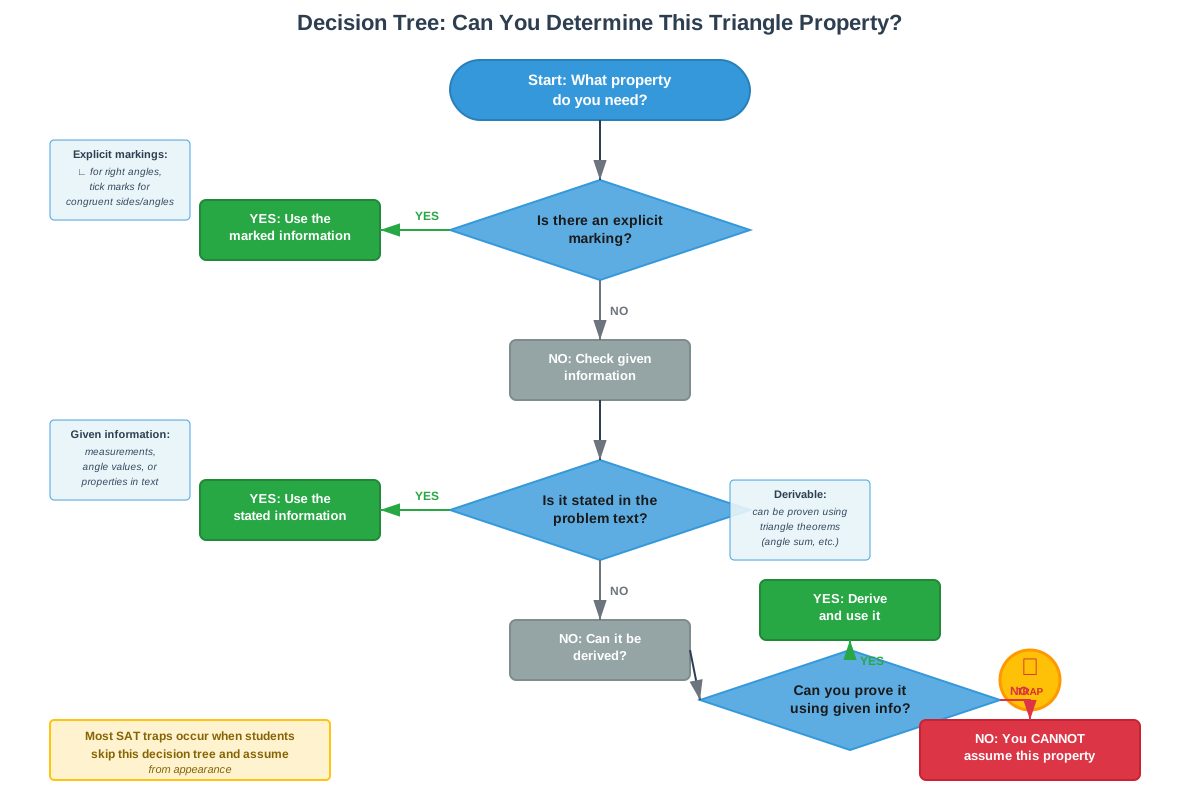
When approaching triangle problems on the SAT, implement this systematic process:
First 10 seconds: Scan for trap indicators
- Look for "Note: Figure not drawn to scale"
- Check whether right angles are marked with square symbols
- Verify whether equal sides are marked with tick marks
- Identify if any angles or sides are labeled with variables versus numbers
Next 20 seconds: Catalog given information
- Write down all stated measurements
- Mark all indicated equal sides or angles on the diagram
- Note what is NOT given (missing angles, unmarked sides)
- Identify what the question asks for
Trigger words that signal specific traps:
- "Appears to be" or "looks like" → Don't trust visual appearance
- "Could be" or "might be" → Multiple possibilities exist
- "Must be" → Requires proof, not assumption
- "If possible" → May be testing whether something can be determined
Process of elimination strategies:
- Eliminate answers that require assumptions not supported by given information
- Remove answers that violate the triangle inequality theorem
- Discard answers that would make angle sums not equal 180°
- Check remaining answers against all given constraints
Time allocation:
- Simple triangle problems (one trap): 30-45 seconds
- Medium complexity (multiple traps or overlapping triangles): 60-90 seconds
- Complex problems (multiple triangles with insufficient information tests): 90-120 seconds
If you've spent more than 2 minutes on a triangle problem, you're likely either falling for a trap or missing that the answer is "cannot be determined." Mark it, move on, and return if time permits.
Red flag situations requiring extra caution:
- Any triangle on a coordinate grid without marked right angles
- Problems giving you two sides and asking for the third without angle information
- Diagrams showing multiple triangles sharing sides or vertices
- Questions asking "which of the following MUST be true" (testing logical necessity versus possibility)
Memory Techniques
SCALE mnemonic for "Not Drawn to Scale" problems:
- Stated information only
- Check all markings
- Assumptions are dangerous
- Look for what's missing
- Explicit proof required
RIGHT acronym for verifying right angles:
- Right angle symbol present?
- Is it stated explicitly?
- Given sides satisfy Pythagorean theorem?
- Has perpendicularity been proven?
- Trust nothing else
The "Two-Tick Rule": If you don't see two tick marks (or other equality indicators), don't assume two sides are equal. Visualize tick marks as the "proof stamps" that authorize you to use isosceles properties.
Triangle Inequality Memory Aid: "The shortcut is always shorter than the long way around." The direct path (one side) must be shorter than going the long way (sum of the other two sides). This helps remember that any side < sum of other two sides.
Exterior Angle Visualization: Picture the exterior angle as a "mouth" that "eats" (equals) the two remote interior angles. The exterior angle is always "hungry" for those two angles specifically—not the adjacent one.
The "Three-Check System" for any triangle problem:
- Check what's marked (tick marks, angle symbols, measurements)
- Check what's stated (in the problem text)
- Check what's missing (what you wish you knew but don't)
Summary
SAT triangle traps represent systematic question designs that exploit common student assumptions about geometric figures. The fundamental principle underlying all triangle traps is that visual appearance cannot be trusted unless confirmed by explicit markings, stated information, or proven relationships. The most prevalent traps involve assuming triangles are isosceles based on appearance, assuming right angles exist without proper indication, and failing to recognize when insufficient information prevents determining a unique answer. Success requires disciplined adherence to mathematical proof rather than visual intuition, systematic verification of all assumptions, and recognition of the specific indicators that authorize use of special triangle properties. Students must internalize that the SAT deliberately includes trap answers matching what would be calculated if common assumptions were made, making wrong answers feel intuitively correct. Mastery involves developing a reflexive skepticism toward diagrams, especially when "not drawn to scale" appears, and building the habit of distinguishing between what appears to be true versus what must be true based on given information.
Key Takeaways
- Never trust visual appearance in SAT triangle diagrams—only use explicitly marked or stated information
- The phrase "Note: Figure not drawn to scale" is a warning that the diagram is deliberately misleading
- Isosceles triangles require tick marks, equal angle markings, or explicit statements—visual symmetry is insufficient
- Right angles must be marked with a square symbol (∟) or stated explicitly; perpendicular-looking lines prove nothing
- Two sides alone don't determine a triangle's third side; the triangle inequality gives only a range of possible values
- Always verify you have sufficient information before attempting calculations—some problems test whether you recognize missing information
- The exterior angle of a triangle equals the sum of the two non-adjacent interior angles, providing an alternative to the 180° angle sum
Related Topics
Triangle Similarity and Congruence: Building on triangle trap awareness, this topic explores when triangles can be proven identical or proportional, requiring the same careful attention to sufficient conditions versus assumptions.
Coordinate Geometry with Triangles: Extends triangle concepts to the coordinate plane, where trap questions often involve assuming perpendicularity from grid alignment or calculating areas without verifying triangle types.
Trigonometry in Right Triangles: Mastering right angle verification through triangle traps prepares students for trigonometric ratios, where incorrectly assuming right angles leads to misapplication of sine, cosine, and tangent.
Special Right Triangles (30-60-90 and 45-45-90): These triangles have specific side ratios, but trap questions test whether students verify the triangle type before applying these ratios.
Circle-Triangle Relationships: Advanced problems combine circles with inscribed or circumscribed triangles, where triangle trap principles apply to more complex configurations.
Practice CTA
Now that you understand the systematic ways the SAT creates triangle traps, you're ready to apply this knowledge to practice questions. Work through the practice problems carefully, actively looking for trap indicators and verifying every assumption before calculating. Use the flashcards to reinforce recognition of valid versus invalid triangle properties. Remember: every trap you learn to recognize now is a question you'll answer correctly on test day. The difference between a good score and a great score often comes down to avoiding these carefully designed traps—and you now have the tools to do exactly that.
Sign up free to keep reading
Create a free AnvayaPrep account to finish this SAT guide on SAT triangle traps — plus flashcards and practice questions.