Overview
Scalene triangles are one of the three fundamental triangle classifications based on side length, distinguished by having all three sides of different lengths and all three angles of different measures. While this classification may seem straightforward, understanding scalene triangles is essential for success on the SAT because they appear frequently in geometry problems, often combined with other concepts such as the Pythagorean theorem, triangle inequality, area calculations, and coordinate geometry. Unlike isosceles or equilateral triangles that possess symmetry properties, scalene triangles require students to work with general triangle principles without the benefit of equal sides or angles.
On the SAT math section, scalene triangles test a student's ability to apply fundamental geometric principles flexibly and without relying on special cases. Questions involving scalene triangles often require multi-step reasoning, combining knowledge of angle relationships, side length constraints, perimeter and area formulas, and coordinate plane applications. These problems assess whether students truly understand triangle properties rather than simply memorizing formulas for special cases.
The significance of sat scalene triangles extends beyond isolated geometry questions. They frequently appear in complex problem-solving scenarios that integrate algebra, trigonometry basics, and analytical reasoning. Mastering scalene triangles builds the foundation for understanding more advanced geometric concepts and demonstrates the critical thinking skills that the SAT values. Since approximately 15-20% of SAT math questions involve geometric figures, and triangles constitute a substantial portion of these questions, proficiency with scalene triangles directly impacts overall test performance.
Learning Objectives
- [ ] Identify key features of scalene triangles including unequal side lengths and unequal angle measures
- [ ] Explain how scalene triangles appears on the SAT in various question formats and contexts
- [ ] Apply scalene triangles concepts to answer SAT-style questions efficiently and accurately
- [ ] Determine whether a given triangle is scalene using side lengths, angle measures, or coordinate geometry
- [ ] Calculate perimeter, area, and other properties of scalene triangles using appropriate formulas
- [ ] Apply the triangle inequality theorem to determine valid side length combinations for scalene triangles
- [ ] Solve multi-step problems involving scalene triangles in coordinate plane contexts
Prerequisites
- Basic triangle properties: Understanding that triangles have three sides, three angles, and that angle measures sum to 180° is fundamental to working with any triangle classification
- Triangle classification by sides: Knowing the definitions of equilateral (all sides equal) and isosceles (two sides equal) triangles provides the contrast needed to understand scalene triangles
- Pythagorean theorem: Many SAT problems involving scalene triangles include right triangles, requiring application of a² + b² = c²
- Coordinate plane fundamentals: Calculating distances between points using the distance formula is essential for coordinate geometry problems involving scalene triangles
- Basic algebraic manipulation: Solving equations and inequalities is necessary for determining unknown side lengths or angles in scalene triangle problems
Why This Topic Matters
Scalene triangles represent the most general case of triangular geometry, making them essential for developing comprehensive geometric reasoning skills. In real-world applications, scalene triangles appear in engineering, architecture, navigation, and computer graphics where irregular shapes are the norm rather than the exception. Understanding how to work with triangles that lack symmetry prepares students for practical problem-solving in fields requiring spatial reasoning.
On the SAT, scalene triangles appear in approximately 3-5 questions per test, either as the primary focus or as part of more complex geometric scenarios. These questions typically fall into several categories: identifying triangle types from given information, calculating missing measurements, applying the triangle inequality theorem, finding areas using various methods, and solving coordinate geometry problems. The College Board frequently uses scalene triangles to test whether students can apply general principles rather than relying on memorized special cases.
Common question formats include: providing three side lengths and asking students to classify the triangle; presenting a coordinate plane with three vertices and requiring area or perimeter calculations; giving two sides and an angle constraint to determine possible values for the third side; and embedding scalene triangles within larger geometric figures where students must identify relevant properties. The versatility of scalene triangle questions makes them high-yield study material, as mastering this topic simultaneously strengthens understanding of general triangle properties, inequality reasoning, and geometric calculation skills.
Core Concepts
Definition and Identifying Characteristics
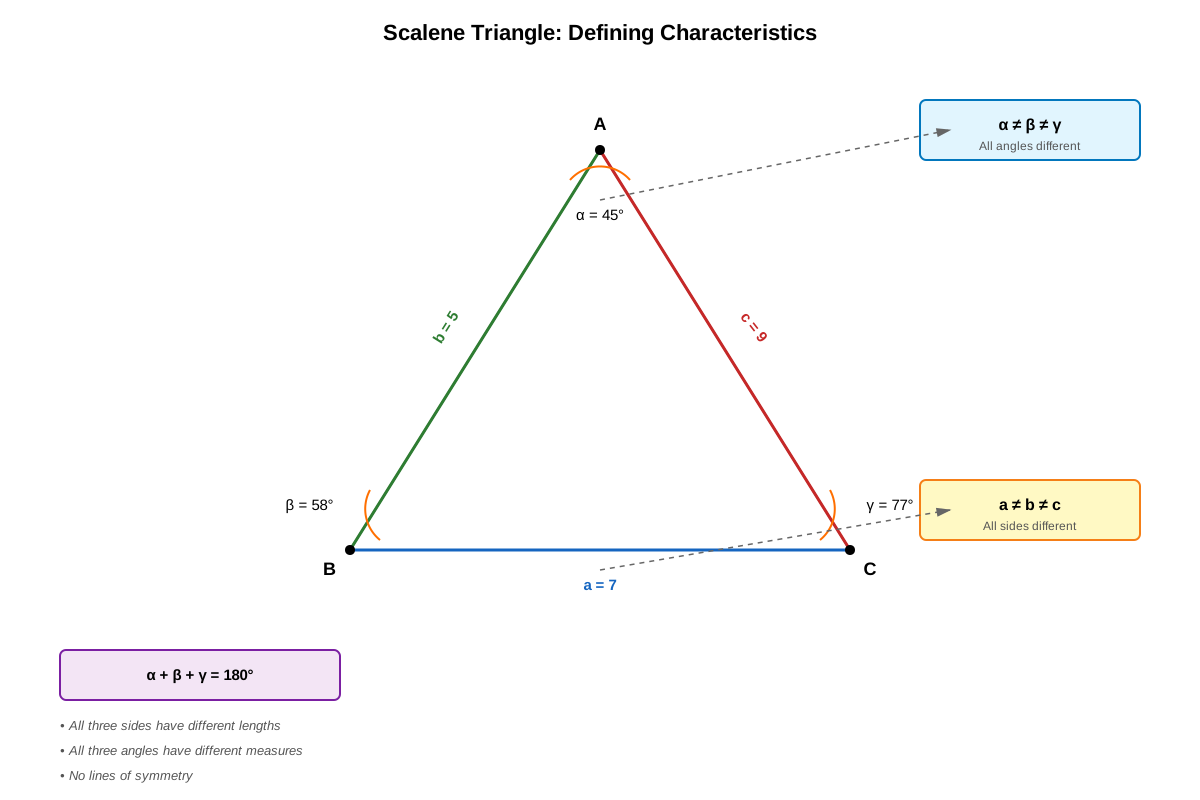
A scalene triangle is defined as a triangle in which all three sides have different lengths. As a direct consequence of having three unequal sides, a scalene triangle also has three angles of different measures. This distinguishes scalene triangles from isosceles triangles (which have at least two equal sides) and equilateral triangles (which have three equal sides). The term "scalene" derives from the Greek word "skalenos," meaning uneven or unequal.
To identify whether a triangle is scalene, students must verify that no two sides are equal in length. Given three side lengths a, b, and c, the triangle is scalene if and only if a ≠ b, b ≠ c, and a ≠ c. Similarly, examining the three angles α, β, and γ, the triangle is scalene when α ≠ β, β ≠ γ, and α ≠ γ. On the SAT, questions may provide side lengths directly, present coordinates requiring distance calculations, or give angle measures to determine triangle classification.
Triangle Inequality Theorem Application
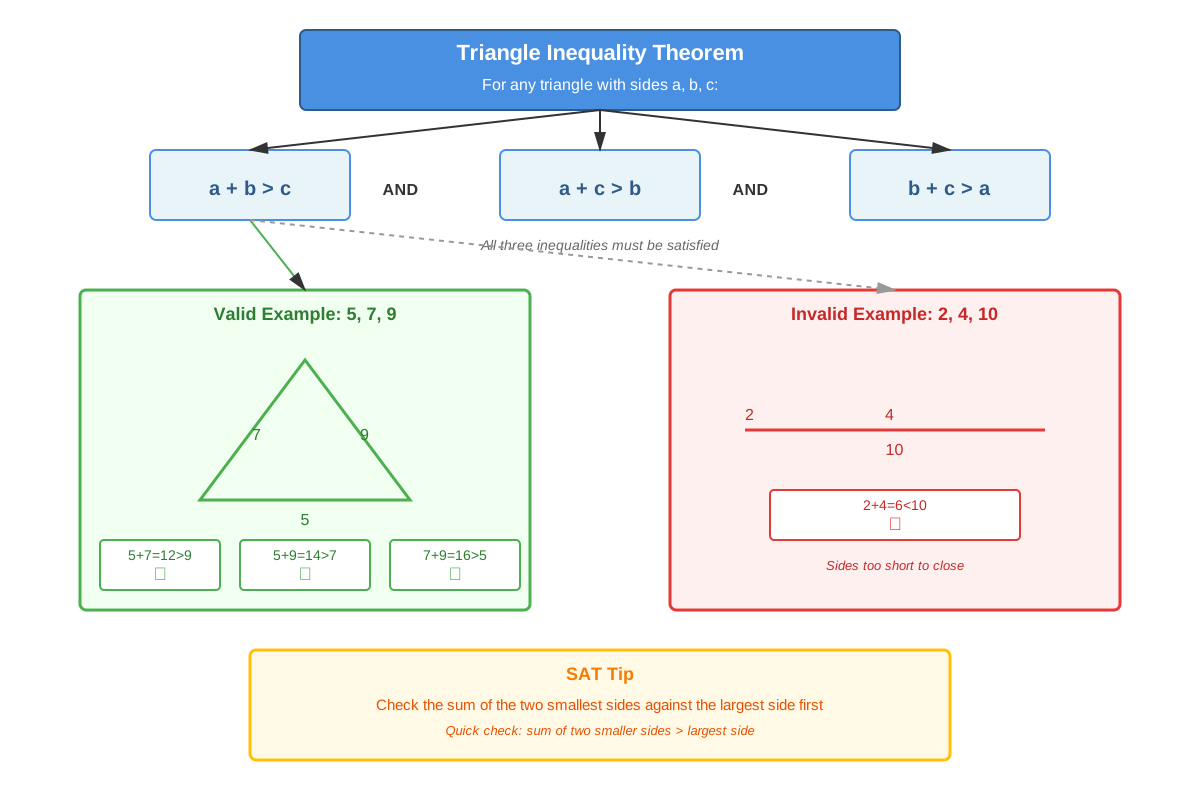
The triangle inequality theorem states that the sum of the lengths of any two sides of a triangle must be greater than the length of the third side. For a scalene triangle with sides a, b, and c, three conditions must simultaneously hold:
- a + b > c
- a + c > b
- b + c > a
This theorem is particularly important for SAT questions that ask whether given measurements can form a valid triangle or that require determining the range of possible values for an unknown side. For scalene triangles specifically, students must also ensure that all three sides are different lengths while satisfying the inequality constraints.
Angle-Side Relationships
In any triangle, including scalene triangles, there exists a fundamental relationship between side lengths and opposite angles: the longest side is opposite the largest angle, and the shortest side is opposite the smallest angle. For a scalene triangle with sides a < b < c and opposite angles α, β, and γ respectively, the relationship α < β < γ always holds.
This property proves invaluable for SAT questions requiring logical reasoning about triangle measurements. If a problem states that one angle is larger than another, students can immediately deduce the relative lengths of the opposite sides. Conversely, given information about side length ordering allows conclusions about angle measure ordering.
Perimeter and Area Calculations
The perimeter of a scalene triangle equals the sum of all three side lengths: P = a + b + c. This straightforward calculation appears frequently on the SAT, often as part of multi-step problems.
Calculating the area of a scalene triangle requires different approaches depending on available information:
Method 1: Base and Height
When the base and corresponding perpendicular height are known:
Area = (1/2) × base × heightMethod 2: Heron's Formula
When all three side lengths are known but no height is given:
s = (a + b + c)/2  (semi-perimeter)
Area = √[s(s-a)(s-b)(s-c)]
Method 3: Coordinate Geometry
When vertices are given as coordinates (x₁, y₁), (x₂, y₂), (x₃, y₃):
Area = (1/2)|x₁(y₂ - y₃) + x₂(y₃ - y₁) + x₃(y₁ - y₂)|Scalene Right Triangles
A scalene triangle can also be a right triangle if one angle measures exactly 90°. Scalene right triangles are particularly common on the SAT because they combine the properties of both classifications. In a scalene right triangle, all three sides have different lengths, and the Pythagorean theorem applies: a² + b² = c², where c is the hypotenuse.
Common Pythagorean triples like 3-4-5, 5-12-13, and 8-15-17 represent scalene right triangles. However, the SAT also tests non-Pythagorean scalene right triangles where students must use the Pythagorean theorem to find missing sides, often resulting in irrational values.
Coordinate Plane Applications
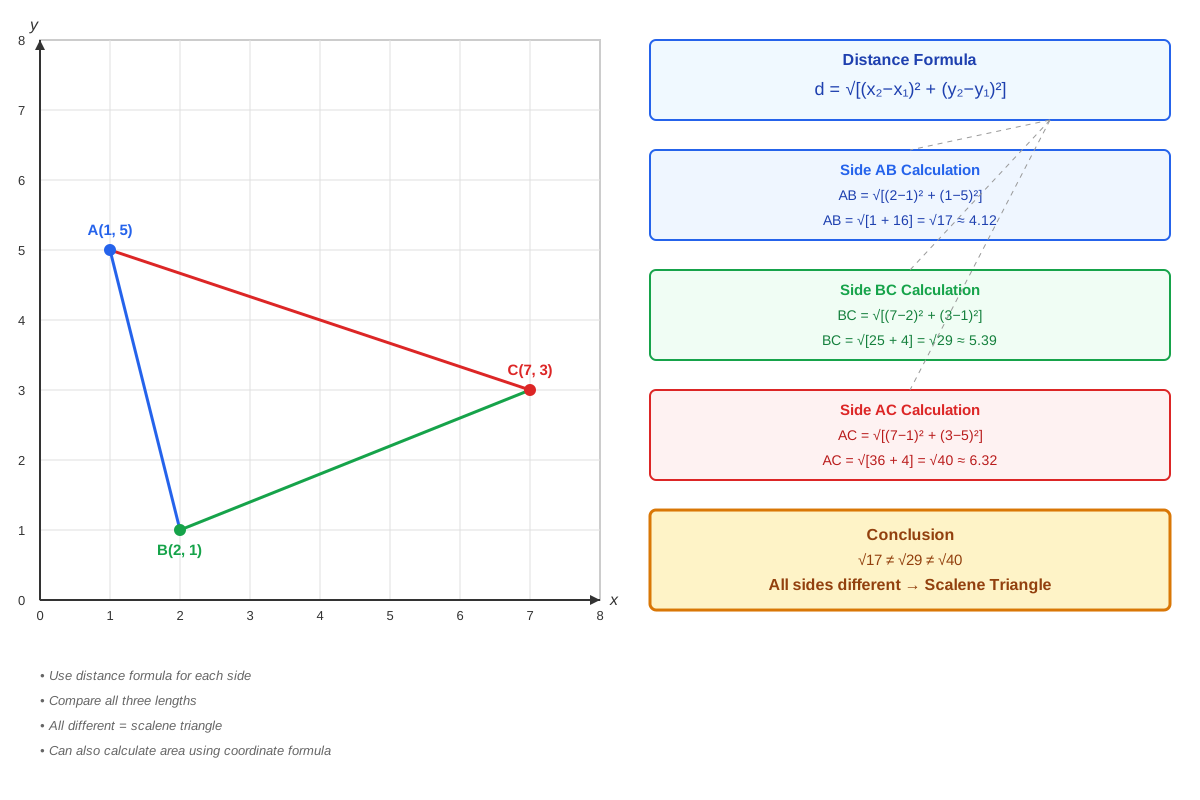
SAT questions frequently present scalene triangles on the coordinate plane, requiring students to:
- Calculate side lengths using the distance formula: d = √[(x₂-x₁)² + (y₂-y₁)²]
- Verify that all three calculated distances are different (confirming scalene classification)
- Determine area using the coordinate formula or by calculating base and height
- Apply the triangle inequality theorem to verify the figure forms a valid triangle
These problems test multiple skills simultaneously: coordinate geometry, distance calculations, triangle classification, and area computation.
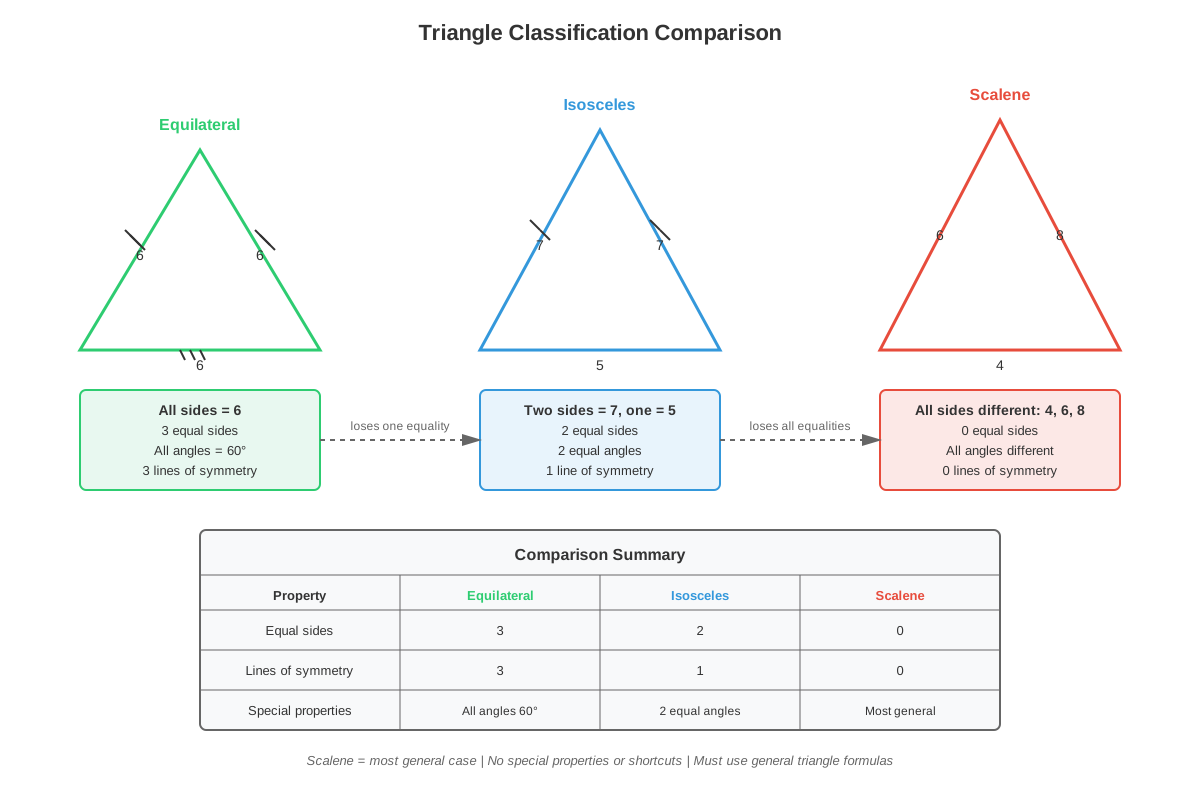
Comparison of Triangle Types
| Triangle Type | Side Relationships | Angle Relationships | Symmetry | SAT Frequency |
|---|---|---|---|---|
| Scalene | All sides different (a ≠ b ≠ c) | All angles different | None | High |
| Isosceles | Two sides equal | Two angles equal | One line of symmetry | High |
| Equilateral | All sides equal | All angles 60° | Three lines of symmetry | Medium |
Concept Relationships
The understanding of scalene triangles builds directly upon fundamental triangle properties, particularly the angle sum property (angles sum to 180°) and basic definitions of triangles. Scalene triangles represent the most general case → when students remove the constraint of equal sides, they must rely on universal triangle principles rather than symmetry shortcuts.
The triangle inequality theorem → connects directly to scalene triangle identification → because students must verify both that three lengths can form a triangle AND that all three lengths differ. This dual requirement makes scalene triangle problems more complex than simply checking for equal sides.
Scalene triangles → frequently combine with right triangle properties → creating scalene right triangles that require both classification skills and Pythagorean theorem application. This intersection tests whether students can recognize that triangles can satisfy multiple classification criteria simultaneously (classified by both sides and angles).
Coordinate geometry concepts → enable scalene triangle problems on the coordinate plane → requiring distance formula application to determine side lengths → followed by triangle classification and area calculation. This chain of reasoning represents the multi-step problem-solving that the SAT emphasizes.
Area calculation methods → vary based on available information → with Heron's formula specifically useful for scalene triangles when only side lengths are known. Understanding when to apply each area formula → demonstrates flexible problem-solving → a key SAT math skill.
Quick check — test yourself on Scalene triangles so far.
Try Flashcards →High-Yield Facts
⭐ A scalene triangle has all three sides of different lengths and all three angles of different measures
⭐ The triangle inequality theorem requires that the sum of any two sides must exceed the third side: a + b > c, a + c > b, and b + c > a
⭐ In any triangle, the longest side is opposite the largest angle, and the shortest side is opposite the smallest angle
⭐ The area of a scalene triangle can be calculated using base × height ÷ 2, Heron's formula, or the coordinate formula depending on given information
⭐ A triangle can be both scalene and right-angled simultaneously, requiring application of both classification criteria and the Pythagorean theorem
- The perimeter of any triangle, including scalene triangles, equals the sum of all three side lengths
- Heron's formula [Area = √(s(s-a)(s-b)(s-c)) where s is the semi-perimeter] is particularly useful for scalene triangles when all sides are known but height is not
- On the coordinate plane, the distance formula d = √[(x₂-x₁)² + (y₂-y₁)²] determines side lengths for classification
- Common Pythagorean triples (3-4-5, 5-12-13, 8-15-17) represent scalene right triangles frequently appearing on the SAT
- The coordinate area formula Area = (1/2)|x₁(y₂ - y₃) + x₂(y₃ - y₁) + x₃(y₁ - y₂)| works for any triangle given three vertices
- Scalene triangles have no lines of symmetry, unlike isosceles (one line) or equilateral triangles (three lines)
- The difference between the two shorter sides must be less than the longest side for a valid triangle
Common Misconceptions
Misconception: All triangles that are not equilateral are scalene triangles.
Correction: Triangles are classified into three categories by side length: equilateral (all sides equal), isosceles (exactly two sides equal), and scalene (all sides different). Isosceles triangles are neither equilateral nor scalene.
Misconception: If a triangle has a right angle, it cannot be scalene.
Correction: A triangle can simultaneously be classified by both its angles and its sides. A scalene right triangle has one 90° angle AND three sides of different lengths. The classifications are independent and can coexist.
Misconception: Any three positive numbers can form the sides of a scalene triangle as long as they are all different.
Correction: The triangle inequality theorem must be satisfied. For example, sides of length 2, 3, and 10 are all different but cannot form a triangle because 2 + 3 < 10. All three inequality conditions must hold simultaneously.
Misconception: The largest angle in a scalene triangle is always opposite the side labeled "c" or the hypotenuse.
Correction: The largest angle is opposite the longest side, regardless of how sides are labeled. Only in right triangles is the hypotenuse guaranteed to be the longest side. In non-right scalene triangles, any side could be longest depending on the specific measurements.
Misconception: Heron's formula only works for scalene triangles.
Correction: Heron's formula works for all triangles when three side lengths are known. It is particularly useful for scalene triangles because they lack the symmetry properties that might enable simpler area calculations, but the formula applies universally.
Misconception: If two angles in a triangle are different, the triangle must be scalene.
Correction: An isosceles triangle has two equal angles (opposite the equal sides) and one different angle. Only when all three angles are different is the triangle guaranteed to be scalene. Two different angles are necessary but not sufficient for scalene classification.
Worked Examples
Example 1: Identifying Triangle Type and Applying Triangle Inequality
Problem: A triangle has sides of length x, x + 3, and 15. If the triangle is scalene, what is the range of possible integer values for x?
Solution:
Step 1: Apply the triangle inequality theorem. Three conditions must hold:
- x + (x + 3) > 15
- x + 15 > x + 3
- (x + 3) + 15 > x
Step 2: Solve each inequality:
- 2x + 3 > 15 → 2x > 12 → x > 6
- x + 15 > x + 3 → 15 > 3 (always true)
- x + 18 > x → 18 > 0 (always true)
Step 3: The binding constraint is x > 6, so x ≥ 7 for integer values.
Step 4: Apply the scalene condition—all sides must be different:
- x ≠ x + 3 (automatically satisfied)
- x ≠ 15 (so x cannot equal 15)
- x + 3 ≠ 15 (so x cannot equal 12)
Step 5: Determine upper bound. As x increases, we need x + (x + 3) > 15, which we've established requires x > 6. There's no upper limit from triangle inequality, but we must exclude x = 12 and x = 15.
Step 6: Consider practical SAT context. The question likely expects a finite range. Check if there's an implied upper bound. If x becomes very large, x + 3 ≈ x, potentially violating the scalene condition in spirit, but mathematically x can be any integer greater than 6 except 12 and 15.
Answer: For a typical SAT question, the range would be x ∈ {7, 8, 9, 10, 11, 13, 14, 16, 17, ...}, excluding 12 and 15. If the question asks for values where x < 20, the answer would be: 7, 8, 9, 10, 11, 13, 14, 16, 17, 18, 19.
Connection to Learning Objectives: This problem requires identifying scalene triangle features (all sides different) and applying the triangle inequality theorem, demonstrating mastery of core scalene triangle concepts.
Example 2: Coordinate Plane Scalene Triangle Area
Problem: Triangle ABC has vertices at A(2, 3), B(7, 5), and C(4, 9). Verify that the triangle is scalene and find its area.
Solution:
Step 1: Calculate all three side lengths using the distance formula d = √[(x₂-x₁)² + (y₂-y₁)²]
Side AB:
AB = √[(7-2)² + (5-3)²] = √[25 + 4] = √29
Side BC:
BC = √[(4-7)² + (9-5)²] = √[9 + 16] = √25 = 5
Side AC:
AC = √[(4-2)² + (9-3)²] = √[4 + 36] = √40 = 2√10
Step 2: Verify scalene classification by confirming all sides are different:
- √29 ≈ 5.39
- 5
- 2√10 ≈ 6.32
All three values are different, so the triangle is scalene. ✓
Step 3: Calculate area using the coordinate formula:
Area = (1/2)|x₁(y₂ - y₃) + x₂(y₃ - y₁) + x₃(y₁ - y₂)|
Area = (1/2)|2(5 - 9) + 7(9 - 3) + 4(3 - 5)|
Area = (1/2)|2(-4) + 7(6) + 4(-2)|
Area = (1/2)|-8 + 42 - 8|
Area = (1/2)|26|
Area = 13
Answer: The triangle is scalene (all sides different), and its area is 13 square units.
Connection to Learning Objectives: This problem demonstrates how scalene triangles appear on the SAT in coordinate geometry contexts, requiring students to apply distance formula calculations, verify triangle classification, and compute area using coordinate-specific methods.
Exam Strategy
When approaching SAT questions involving scalene triangles, begin by identifying what information is provided and what the question asks. Look for trigger phrases such as "all sides are different," "no two sides are equal," or explicit statements that a triangle is scalene. Conversely, if a problem provides three measurements and asks for triangle classification, calculate or compare all three values to determine if they're all different.
Process of elimination works effectively on multiple-choice questions about triangle classification. If answer choices include "isosceles," "equilateral," or "scalene," immediately eliminate options that contradict given information. For example, if two sides are explicitly stated as equal, eliminate "scalene" immediately. If all sides are different, eliminate both "isosceles" and "equilateral."
For questions involving the triangle inequality theorem, a quick check involves comparing the sum of the two smaller sides to the largest side. If this single comparison fails, the triangle is invalid, saving time on checking all three conditions. However, when determining ranges of possible values, all three inequality conditions must be considered.
Time allocation for scalene triangle questions should typically be 60-90 seconds for straightforward classification problems and 2-3 minutes for multi-step problems involving coordinate geometry or area calculations. If a problem requires Heron's formula with complex arithmetic, consider whether alternative methods (like coordinate formula or finding height) might be faster.
Watch for compound questions that test scalene triangles alongside other concepts. Common combinations include: scalene triangles with the Pythagorean theorem (scalene right triangles), scalene triangles with coordinate geometry (requiring distance formula), and scalene triangles with inequality reasoning (determining possible side lengths). Recognize these patterns to activate relevant knowledge efficiently.
When coordinate plane problems present three vertices, develop a systematic approach: (1) calculate all three side lengths, (2) verify triangle inequality if needed, (3) classify the triangle, (4) calculate area using the most efficient method. This sequence prevents errors and ensures all aspects of the question are addressed.
Memory Techniques
Mnemonic for Triangle Classification by Sides:
"Everyone Is Special" → Equilateral (all equal), Isosceles (two equal), Scalene (none equal)
Visualization Strategy for Triangle Inequality:
Imagine trying to connect three sticks end-to-end to form a triangle. If one stick is longer than the other two combined, the ends won't meet—the triangle "collapses." This mental image reinforces why a + b > c must hold.
Acronym for Area Methods:
"BHC" → Base-Height method, Heron's formula, Coordinate formula
Remember: Choose the method based on what information is Given.
Memory Hook for Angle-Side Relationship:
"Longest Lies opposite Largest" → The Longest side Lies opposite the Largest angle. The triple-L pattern makes this relationship memorable.
Coordinate Area Formula Memory:
Think of the formula as a "diagonal dance": start with x₁, multiply by the y-values that skip one vertex (y₂ - y₃), then move to x₂ and repeat the pattern. The alternating pattern helps recall the formula structure.
Summary
Scalene triangles, characterized by having all three sides of different lengths and all three angles of different measures, represent the most general case of triangular geometry on the SAT. Understanding scalene triangles requires mastery of fundamental principles including the triangle inequality theorem (the sum of any two sides must exceed the third), angle-side relationships (longest side opposite largest angle), and various area calculation methods. On the SAT, scalene triangles appear in diverse contexts: classification problems requiring comparison of side lengths or angles, coordinate geometry questions demanding distance formula application, and multi-step problems combining triangle properties with algebraic reasoning. Students must recognize that scalene triangles can simultaneously satisfy other classifications—particularly as right triangles—requiring flexible application of multiple geometric principles. Success with scalene triangle questions depends on systematic problem-solving: verify all sides are different, apply appropriate formulas based on given information, and check that the triangle inequality theorem is satisfied when determining valid measurements. The high frequency of scalene triangle questions on the SAT, combined with their integration with other mathematical concepts, makes this topic essential for achieving competitive scores.
Key Takeaways
- A scalene triangle has all three sides of different lengths and consequently all three angles of different measures, with no lines of symmetry
- The triangle inequality theorem (a + b > c, a + c > b, b + c > a) must be satisfied for any valid triangle, including scalene triangles
- The longest side of any triangle is always opposite the largest angle, and the shortest side is opposite the smallest angle—a relationship crucial for logical reasoning on SAT questions
- Area calculations for scalene triangles use different methods depending on available information: base × height ÷ 2, Heron's formula when all sides are known, or the coordinate formula for vertices on a plane
- Scalene triangles frequently appear in SAT coordinate geometry problems, requiring distance formula application to determine side lengths before classification and area calculation
- A triangle can be both scalene and right-angled simultaneously, combining the properties of both classifications and requiring integrated problem-solving
- Systematic verification of all three sides being different is essential for confirming scalene classification, as eliminating only one or two equal sides is insufficient
Related Topics
Isosceles and Equilateral Triangles: Understanding the other triangle classifications by side length provides essential contrast to scalene triangles and enables quick elimination of incorrect answer choices on classification questions.
Triangle Congruence and Similarity: Mastering scalene triangles builds toward understanding when triangles are congruent (identical) or similar (same shape, different size), concepts that appear in more advanced SAT geometry questions.
Trigonometry Basics: The Law of Sines and Law of Cosines extend triangle problem-solving beyond right triangles, with scalene triangles providing the general case where these laws prove most useful.
Coordinate Geometry: Advanced coordinate plane problems often involve scalene triangles as components of larger figures, requiring integration of distance, slope, and area concepts.
Optimization Problems: Some SAT questions ask for maximum or minimum values related to triangle measurements, with scalene triangles providing the general case for such optimization reasoning.
Practice CTA
Now that you've mastered the core concepts of scalene triangles, it's time to solidify your understanding through active practice. Attempt the practice questions designed specifically for this topic, focusing on applying the triangle inequality theorem, calculating areas using multiple methods, and solving coordinate geometry problems. Use the flashcards to reinforce key definitions and relationships until they become automatic. Remember: the SAT rewards not just knowledge but also speed and accuracy, which only come through deliberate practice. Each problem you solve strengthens your geometric reasoning and builds confidence for test day. You've got this—start practicing now!
Sign up free to keep reading
Create a free AnvayaPrep account to finish this SAT guide on Scalene triangles — plus flashcards and practice questions.