Overview
Triangle basics form one of the most fundamental and frequently tested concepts in SAT math. Understanding triangles is not merely about memorizing formulas—it requires recognizing properties, relationships, and patterns that appear across multiple question types. The SAT tests triangle concepts in approximately 10-15% of all math questions, making this topic one of the highest-yield areas for score improvement. Questions range from straightforward angle calculations to complex multi-step problems involving area, perimeter, and special triangle relationships.
Triangles serve as building blocks for more advanced geometric concepts tested on the SAT, including coordinate geometry, trigonometry, and three-dimensional figures. Mastery of triangle basics enables students to tackle problems involving polygons (which can be decomposed into triangles), circle geometry (where triangles often appear inscribed or as radii), and real-world application problems. The SAT frequently embeds triangle concepts within word problems, requiring students to extract geometric relationships from verbal descriptions.
The importance of sat triangle basics extends beyond isolated geometry questions. Triangle properties appear in algebra problems involving systems of equations, in data analysis questions requiring spatial reasoning, and in calculator and no-calculator sections alike. Students who develop strong foundational knowledge of triangle properties, classifications, and theorems gain a significant strategic advantage, as these concepts provide multiple pathways to solutions and enable efficient problem-solving under time pressure.
Learning Objectives
- [ ] Identify key features of Triangle basics
- [ ] Explain how Triangle basics appears on the SAT
- [ ] Apply Triangle basics to answer SAT-style questions
- [ ] Calculate missing angles using the Triangle Angle Sum Theorem
- [ ] Classify triangles by both side lengths and angle measures
- [ ] Determine when the Triangle Inequality Theorem applies and use it to evaluate possible side lengths
- [ ] Apply the Exterior Angle Theorem to solve multi-step problems
Prerequisites
- Basic angle relationships: Understanding complementary, supplementary, and vertical angles is essential for working with triangle angle problems
- Algebraic equation solving: Triangle problems frequently require setting up and solving linear equations to find unknown values
- Properties of equality: Recognizing when sides or angles are equal based on given information enables proper triangle classification
- Basic arithmetic operations: Calculating perimeter, working with fractions in angle measures, and performing multi-step calculations are fundamental skills
Why This Topic Matters
Triangle concepts appear in real-world applications ranging from architecture and engineering to navigation and computer graphics. Structural engineers use triangle properties to design stable frameworks, while surveyors employ triangle relationships to measure distances indirectly. GPS technology relies on triangulation principles, and graphic designers use triangle tessellations in visual compositions. Understanding triangle basics provides practical problem-solving tools applicable far beyond standardized testing.
On the SAT, triangle questions appear with remarkable consistency. Approximately 3-5 questions per test directly assess triangle knowledge, while another 5-8 questions incorporate triangle concepts as part of more complex problems. The College Board reports that geometry questions (predominantly featuring triangles) account for roughly 10% of the total math section. These questions appear in both multiple-choice and student-produced response formats, across calculator and no-calculator sections.
Triangle basics commonly appear in several distinct question formats on the SAT: direct angle calculation problems where students must find missing angles using the Triangle Angle Sum Theorem; classification problems requiring identification of triangle types based on given properties; word problems describing real-world scenarios that translate into triangle relationships; multi-step problems combining triangle properties with algebraic reasoning; and diagram-based questions where students must extract information from figures. The SAT particularly favors questions that test conceptual understanding rather than rote memorization, requiring students to apply multiple properties simultaneously.
Core Concepts
Triangle Definition and Classification
A triangle is a closed two-dimensional polygon with exactly three sides, three vertices (corners), and three interior angles. Every triangle exists in a plane and represents the simplest polygon possible. The fundamental property that distinguishes triangles from all other geometric figures is that any three non-collinear points determine exactly one unique triangle.
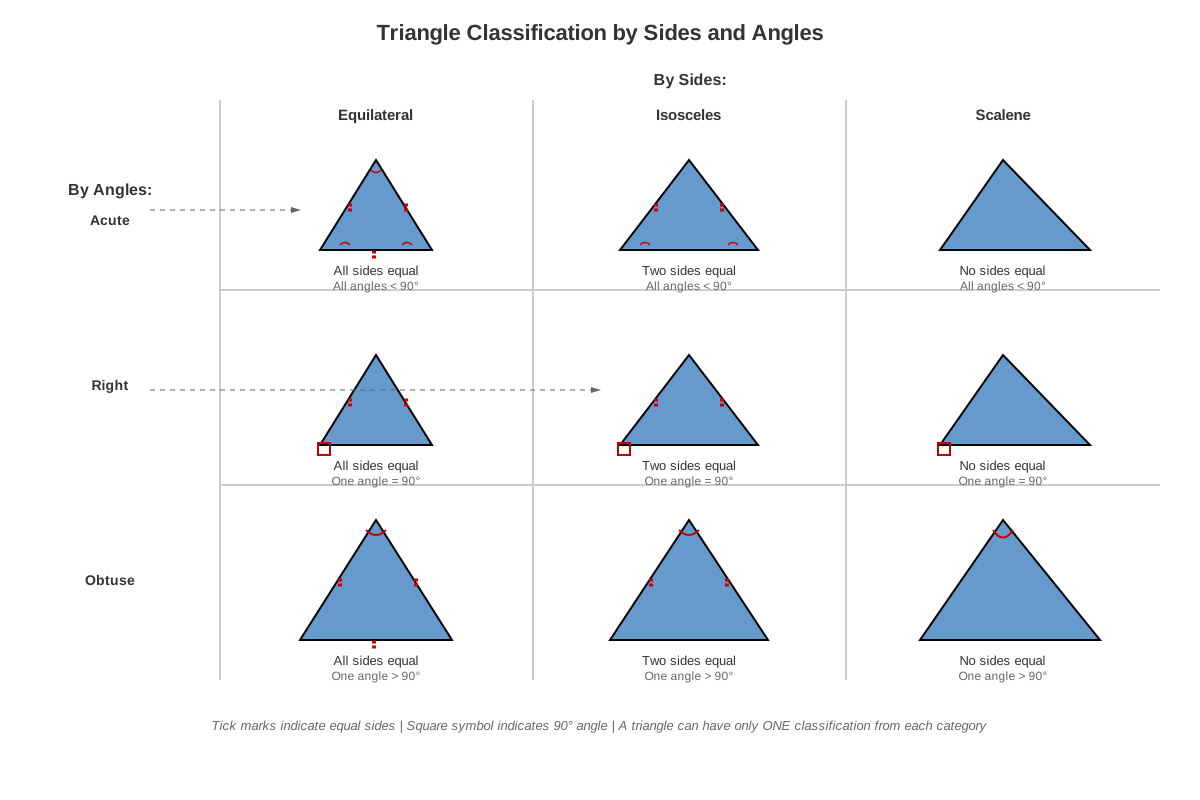
Triangles can be classified by their side lengths into three categories:
- Equilateral triangles: All three sides have equal length, and consequently all three angles measure 60°
- Isosceles triangles: Exactly two sides have equal length (called legs), and the angles opposite these equal sides (called base angles) are also equal
- Scalene triangles: All three sides have different lengths, and all three angles have different measures
Triangles can also be classified by their angle measures:
- Acute triangles: All three interior angles measure less than 90°
- Right triangles: Exactly one interior angle measures exactly 90° (the right angle)
- Obtuse triangles: Exactly one interior angle measures greater than 90° but less than 180°
These classification systems are independent, meaning a triangle can simultaneously belong to one category from each system (for example, a right isosceles triangle or an obtuse scalene triangle).
Triangle Angle Sum Theorem
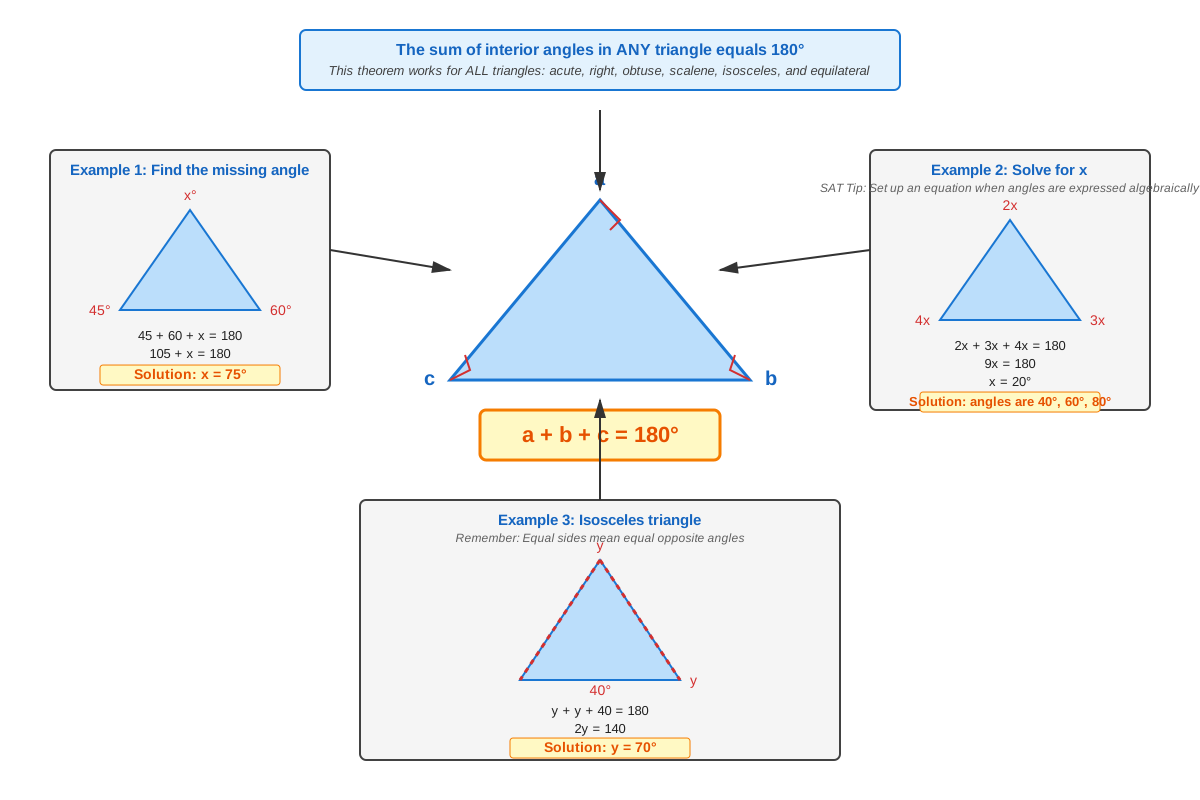
The Triangle Angle Sum Theorem states that the sum of the three interior angles of any triangle always equals 180°. This is perhaps the most frequently tested triangle property on the SAT. Mathematically expressed:
∠A + ∠B + ∠C = 180°This theorem applies universally to all triangles regardless of their size, shape, or classification. The SAT exploits this property in numerous ways: providing two angles and asking for the third, giving algebraic expressions for angles and requiring students to solve for variables, or embedding this relationship within more complex multi-step problems.
When working with the Triangle Angle Sum Theorem, students must recognize that if two angles are known, the third angle is completely determined. This creates a powerful constraint that the SAT uses to test logical reasoning. For example, if one angle measures 90° (right triangle), the other two angles must sum to 90°, making them complementary.
Exterior Angle Theorem
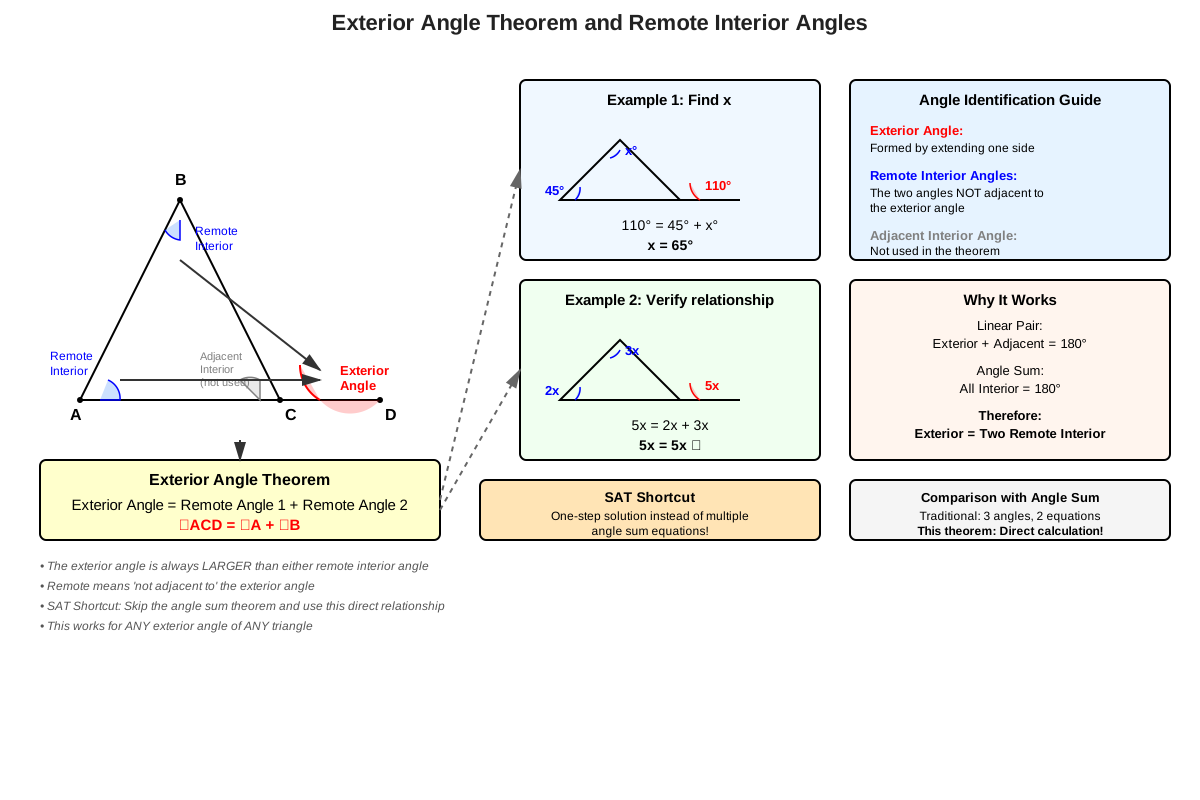
An exterior angle of a triangle is formed when one side of the triangle is extended beyond a vertex. The Exterior Angle Theorem states that the measure of an exterior angle equals the sum of the measures of the two non-adjacent interior angles (called remote interior angles).
Exterior Angle = Remote Interior Angle₁ + Remote Interior Angle₂This theorem provides an alternative method for solving angle problems and often creates shortcuts on SAT questions. Rather than finding all interior angles first, students can sometimes directly calculate an exterior angle or work backward from an exterior angle to find interior angles.
The Exterior Angle Theorem connects directly to the Triangle Angle Sum Theorem. Since an exterior angle and its adjacent interior angle form a linear pair (summing to 180°), and all three interior angles sum to 180°, the relationship follows logically. The SAT frequently tests whether students recognize this connection.
Triangle Inequality Theorem
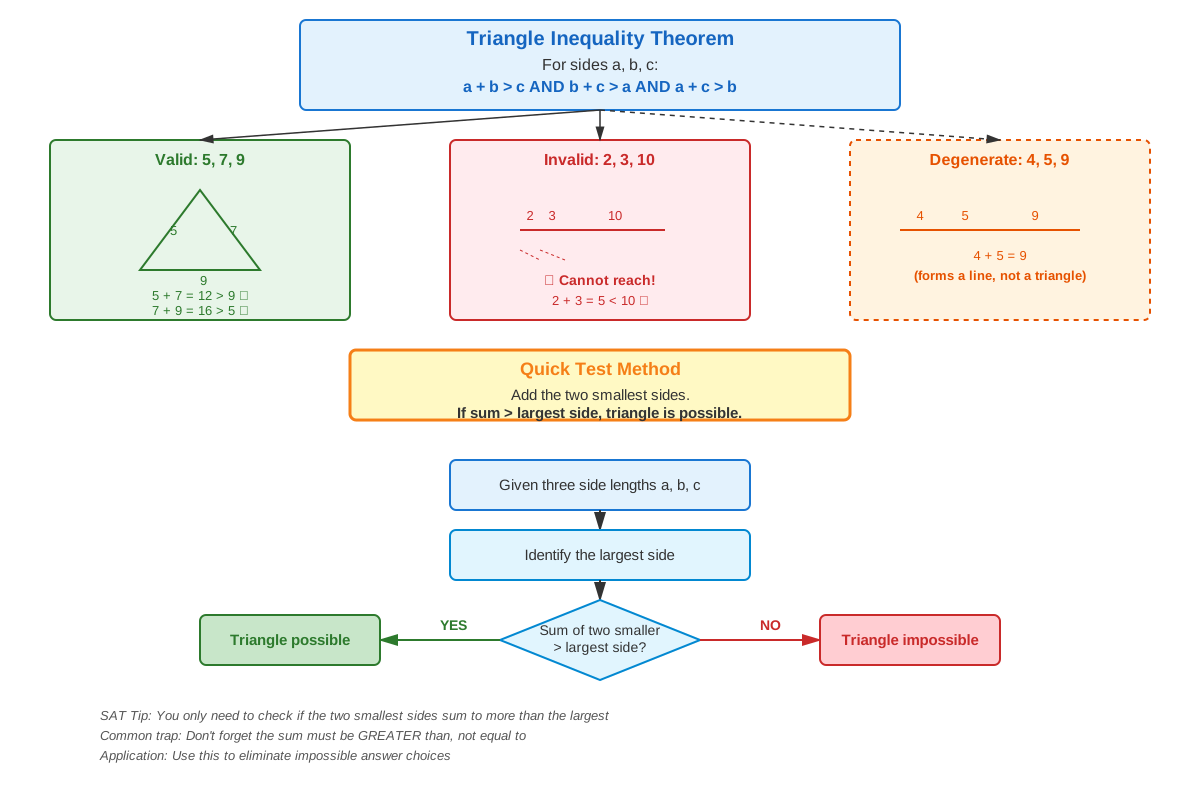
The Triangle Inequality Theorem establishes constraints on possible side lengths for any triangle. It states that the sum of the lengths of any two sides of a triangle must be greater than the length of the third side. This must hold true for all three possible combinations:
a + b > c
b + c > a
a + c > b
This theorem answers the question: "Can these three lengths form a triangle?" The SAT uses this concept to test logical reasoning, often presenting answer choices with different side length combinations and asking which could or could not form a triangle.
A useful corollary states that the difference between any two sides must be less than the third side. This provides both upper and lower bounds for possible third side lengths when two sides are known. If two sides measure 5 and 8, the third side must be greater than 3 (the difference) and less than 13 (the sum).
Triangle Perimeter and Basic Measurements
The perimeter of a triangle is the sum of the lengths of all three sides:
Perimeter = side₁ + side₂ + side₃While conceptually simple, perimeter calculations on the SAT often involve algebraic expressions, requiring students to combine like terms or solve equations. Questions might provide the perimeter and relationships between sides, requiring students to determine individual side lengths.
The base and height of a triangle are perpendicular measurements used primarily for area calculations (covered in more advanced topics). However, understanding that height represents the perpendicular distance from a vertex to the opposite side (or its extension) is fundamental to triangle basics.
Special Properties of Isosceles and Equilateral Triangles
Isosceles triangles possess special properties that the SAT tests frequently:
- The two sides of equal length are called legs
- The third side is called the base
- The angles opposite the equal sides (base angles) are equal
- The angle between the two equal sides is called the vertex angle
- A line segment from the vertex angle to the midpoint of the base is perpendicular to the base and bisects the vertex angle
Equilateral triangles have even more restrictive properties:
- All sides equal in length
- All angles measure exactly 60°
- All properties of isosceles triangles apply to any side chosen as the base
- Possess three lines of symmetry
- Have rotational symmetry of 120°
| Triangle Type | Equal Sides | Equal Angles | Angle Constraints |
|---|---|---|---|
| Equilateral | All 3 | All 3 (each 60°) | All angles = 60° |
| Isosceles | Exactly 2 | Exactly 2 | Base angles equal |
| Scalene | None | None | All different |
| Right | Any combination | None (one is 90°) | One angle = 90° |
| Acute | Any combination | None | All angles < 90° |
| Obtuse | Any combination | None | One angle > 90° |
Concept Relationships
The Triangle Angle Sum Theorem serves as the foundation for understanding the Exterior Angle Theorem. Since interior angles sum to 180° and an exterior angle forms a linear pair with its adjacent interior angle (also summing to 180°), the exterior angle must equal the sum of the two remote interior angles. This logical chain demonstrates how fundamental properties generate derived theorems.
Triangle classification by sides directly influences angle properties. When a triangle is classified as isosceles (two equal sides), this immediately determines that two angles are equal. When classified as equilateral (three equal sides), all angles must be 60° by the Triangle Angle Sum Theorem. This bidirectional relationship—sides determining angles and angles determining sides—creates multiple solution pathways for SAT problems.
The Triangle Inequality Theorem connects to triangle existence and construction. Before applying any other triangle property, students must verify that given side lengths can actually form a triangle. This theorem acts as a gatekeeper, determining whether subsequent calculations are even meaningful. On the SAT, this often appears in "which of the following could be..." questions.
Perimeter calculations integrate with algebraic reasoning when side lengths are expressed as variables or expressions. Students must combine the geometric concept of perimeter with algebraic manipulation skills, demonstrating how triangle basics connects to the broader SAT math curriculum. This intersection appears frequently in problems requiring systems of equations or inequality reasoning.
The relationship map flows as follows: Triangle Definition → Classification Systems (by sides and angles) → Triangle Angle Sum Theorem → Exterior Angle Theorem → Special Triangle Properties (isosceles/equilateral) → Triangle Inequality Theorem → Application to Complex Problems.
Quick check — test yourself on Triangle basics so far.
Try Flashcards →High-Yield Facts
⭐ The sum of the interior angles of any triangle always equals exactly 180°
⭐ An exterior angle of a triangle equals the sum of the two remote interior angles
⭐ In an isosceles triangle, the angles opposite the equal sides are equal (base angles are congruent)
⭐ All angles in an equilateral triangle measure exactly 60°
⭐ The sum of any two sides of a triangle must be greater than the third side (Triangle Inequality Theorem)
- A triangle can be classified by both side lengths and angle measures simultaneously
- In a right triangle, the two non-right angles are complementary (sum to 90°)
- A scalene triangle has no equal sides and no equal angles
- The largest angle in a triangle is opposite the longest side
- The smallest angle in a triangle is opposite the shortest side
- An obtuse triangle can have only one obtuse angle
- An acute triangle has all three angles measuring less than 90°
- The exterior angles of a triangle, one at each vertex, sum to 360°
- If two angles of a triangle are equal, the sides opposite those angles are equal (making it isosceles)
- The difference between any two sides of a triangle must be less than the third side
Common Misconceptions
Misconception: All triangles with a 90° angle are isosceles. → Correction: Right triangles can be scalene, isosceles, or (theoretically, though not commonly discussed) have any side length relationship. The right angle only determines that one angle is 90°; it doesn't constrain the side length relationships unless additional information is provided.
Misconception: The Triangle Inequality Theorem means each side must be greater than the sum of the other two. → Correction: The Triangle Inequality Theorem states that the sum of any two sides must be GREATER than (not less than) the third side. This is the opposite of what this misconception suggests and is critical for determining valid triangle side lengths.
Misconception: An exterior angle equals the adjacent interior angle. → Correction: An exterior angle and its adjacent interior angle are supplementary (sum to 180°), not equal. The exterior angle equals the sum of the two remote (non-adjacent) interior angles, which is a completely different relationship.
Misconception: If a triangle has two equal angles, it must be equilateral. → Correction: Two equal angles make a triangle isosceles, not equilateral. Equilateral triangles require all three angles to be equal (each measuring 60°). A triangle with two 70° angles and one 40° angle is isosceles but not equilateral.
Misconception: The perimeter of a triangle determines its shape uniquely. → Correction: Infinitely many triangles can have the same perimeter but completely different shapes. Perimeter alone provides no information about angle measures or the specific distribution of side lengths. For example, triangles with sides (3, 4, 5), (2, 5, 5), and (4, 4, 4) all have perimeter 12 but are completely different shapes.
Misconception: In any triangle, if you know one angle, you can determine the other two. → Correction: Knowing one angle only constrains the sum of the other two angles (they must sum to 180° minus the known angle), but infinitely many combinations of two angles can satisfy this constraint. You need at least two angles to determine the third uniquely.
Misconception: The longest side of a triangle is always opposite the right angle. → Correction: The longest side is opposite the largest angle, whatever that angle may be. Only in right triangles is the longest side (hypotenuse) opposite the right angle, because the right angle is the largest angle in that specific triangle type.
Worked Examples
Example 1: Multi-Step Angle Problem with Algebra
Problem: In triangle ABC, angle A measures (2x + 10)°, angle B measures (3x - 5)°, and angle C measures (x + 25)°. Find the measure of the largest angle.
Solution:
Step 1: Apply the Triangle Angle Sum Theorem. The sum of all three angles must equal 180°.
(2x + 10) + (3x - 5) + (x + 25) = 180Step 2: Combine like terms on the left side.
2x + 3x + x + 10 - 5 + 25 = 180
6x + 30 = 180
Step 3: Solve for x.
6x = 150
x = 25
Step 4: Substitute x = 25 back into each angle expression.
- Angle A = 2(25) + 10 = 50 + 10 = 60°
- Angle B = 3(25) - 5 = 75 - 5 = 70°
- Angle C = 25 + 25 = 50°
Step 5: Verify the solution by checking that angles sum to 180°.
60 + 70 + 50 = 180 ✓Step 6: Identify the largest angle. Angle B measures 70°, which is the largest.
Answer: The largest angle measures 70°.
This problem demonstrates the application of the Triangle Angle Sum Theorem combined with algebraic reasoning, a common SAT question type. The problem requires careful attention to combining like terms and substituting back to find actual angle measures rather than just solving for the variable.
Example 2: Triangle Inequality Application
Problem: A triangle has two sides with lengths 7 and 12. Which of the following could NOT be the length of the third side?
A) 6
B) 10
C) 15
D) 19
Solution:
Step 1: Apply the Triangle Inequality Theorem. For sides a = 7, b = 12, and unknown side c, three inequalities must all be satisfied:
7 + 12 > c  →  c < 19
7 + c > 12  →  c > 5
12 + c > 7  →  c > -5 (always true for positive lengths)
Step 2: Combine the constraints. The third side must satisfy: 5 < c < 19
Step 3: Evaluate each answer choice:
- Choice A: c = 6. Check: 5 < 6 < 19 ✓ (This COULD be the third side)
- Choice B: c = 10. Check: 5 < 10 < 19 ✓ (This COULD be the third side)
- Choice C: c = 15. Check: 5 < 15 < 19 ✓ (This COULD be the third side)
- Choice D: c = 19. Check: 5 < 19 is true, but 19 < 19 is false ✗
Step 4: Verify choice D fails the Triangle Inequality. If c = 19:
7 + 12 = 19 (not greater than 19, violates the theorem)Answer: D) 19 could NOT be the length of the third side.
This problem tests understanding of the Triangle Inequality Theorem and the critical distinction between "greater than" and "greater than or equal to." The sum of two sides must be strictly greater than the third side, not equal to it. This example also demonstrates the SAT's preference for testing conceptual understanding through "which could NOT" question formats.
Exam Strategy
When approaching SAT triangle problems, begin by identifying what type of triangle is described or shown. Look for keywords like "isosceles," "equilateral," "right," or visual cues in diagrams such as tick marks indicating equal sides or square symbols indicating right angles. This classification immediately activates relevant properties and constraints.
Trigger words and phrases to watch for include:
- "The sum of two angles" → likely testing Triangle Angle Sum Theorem
- "Exterior angle" → apply Exterior Angle Theorem
- "Could be the length" or "could NOT be" → Triangle Inequality Theorem
- "Isosceles" or "two equal sides" → base angles are equal
- "Equilateral" → all angles are 60°, all sides equal
- "Complementary angles in a triangle" → indicates a right triangle
For process-of-elimination strategies, use the Triangle Angle Sum Theorem to eliminate impossible angle combinations. If answer choices provide angle measures, quickly check whether they sum to 180°. For side length questions, apply the Triangle Inequality Theorem to eliminate choices that violate the constraint that the sum of two sides must exceed the third.
Time allocation for triangle basics questions should average 45-60 seconds for straightforward angle calculations and 90-120 seconds for multi-step problems involving algebra or multiple triangle properties. If a problem requires more than two minutes, mark it for review and move forward—these questions often have elegant shortcuts that become apparent on a second look.
Draw on diagrams when none are provided. The SAT sometimes presents triangle problems in pure text, expecting students to visualize the situation. A quick sketch with labeled angles and sides often reveals relationships that aren't obvious from the verbal description alone. Mark equal sides with tick marks and equal angles with arc symbols to track relationships visually.
When problems involve variables, consider whether plugging in specific numbers might simplify the problem. For example, if a problem asks about an isosceles triangle with base angles of x°, try x = 50° to see what the vertex angle would be (80°), which might help identify patterns or eliminate wrong answers.
Memory Techniques
Angle Sum Mnemonic: "Triangles Always Sum to 180" (TAS-180). The acronym TAS reminds you of the Triangle Angle Sum theorem, with 180 built into the phrase.
Triangle Inequality Memory Device: "Two Together Beat One" - the sum of any two sides must beat (be greater than) the remaining one side. This phrase captures the essence of the Triangle Inequality Theorem in simple, memorable language.
Exterior Angle Visualization: Picture the exterior angle as a "greedy angle" that "eats" the two remote interior angles. The exterior angle's measure equals what it "consumed" from inside the triangle. This anthropomorphic visualization helps students remember that the exterior angle equals the sum of the two remote interior angles.
Isosceles Triangle Acronym: "Base Angles Equal" (BAE). In an isosceles triangle, the BAE property reminds you that base angles are equal, and this property is your "bae" (friend) on the SAT.
Classification Memory Matrix: Create a mental 2×2 grid:
- Horizontal axis: Sides (All equal / Two equal / None equal)
- Vertical axis: Angles (All < 90° / One = 90° / One > 90°)
This matrix helps organize the nine possible triangle classifications and prevents confusion between side-based and angle-based categories.
Equilateral = 60° Connection: "Equilateral has equi-angles, and 180 ÷ 3 = 60." The prefix "equi-" appears in both terms, reinforcing that equal sides mean equal angles, and dividing 180° by 3 equal parts gives 60° each.
Summary
Triangle basics represent essential foundational knowledge for SAT math success, appearing in approximately 10-15% of all math questions either directly or as components of more complex problems. The Triangle Angle Sum Theorem—stating that interior angles always sum to 180°—serves as the cornerstone property from which other relationships derive. Students must master triangle classification by both sides (equilateral, isosceles, scalene) and angles (acute, right, obtuse), recognizing that these systems operate independently. The Exterior Angle Theorem provides a powerful shortcut, establishing that any exterior angle equals the sum of the two remote interior angles. The Triangle Inequality Theorem determines whether three given lengths can form a valid triangle by requiring that the sum of any two sides exceeds the third side. Special properties of isosceles triangles (equal base angles opposite equal sides) and equilateral triangles (all angles measuring 60°) appear frequently in SAT questions. Mastery requires not just memorizing these properties but understanding their logical connections and applying them flexibly across diverse problem types, from pure angle calculations to algebraic multi-step problems to real-world applications.
Key Takeaways
- The sum of interior angles in any triangle always equals exactly 180°, regardless of triangle type or size
- An exterior angle equals the sum of the two remote interior angles, providing an alternative solution pathway
- The Triangle Inequality Theorem states that the sum of any two sides must be greater than the third side
- Isosceles triangles have two equal sides and two equal base angles opposite those sides
- Equilateral triangles have all sides equal and all angles measuring exactly 60°
- Triangle classification by sides (equilateral/isosceles/scalene) is independent of classification by angles (acute/right/obtuse)
- The largest angle in a triangle is always opposite the longest side, and the smallest angle is opposite the shortest side
Related Topics
Special Right Triangles (45-45-90 and 30-60-90): Building on triangle basics, these special triangles have fixed side ratios that enable rapid calculations without the Pythagorean theorem. Mastering basic triangle properties is essential before tackling these specific cases.
Pythagorean Theorem and Right Triangle Applications: Right triangles, introduced in triangle basics, become the foundation for the Pythagorean theorem (a² + b² = c²), one of the most tested concepts on the SAT.
Triangle Similarity and Congruence: Understanding basic triangle properties enables recognition of when triangles are similar (same shape, different size) or congruent (identical), concepts that appear in approximately 5% of SAT math questions.
Triangle Area and Advanced Measurements: The formula for triangle area (½ × base × height) builds directly on understanding triangle structure and the relationship between base and height established in triangle basics.
Coordinate Geometry with Triangles: Triangles plotted on the coordinate plane combine triangle basics with algebraic concepts, requiring students to calculate distances, slopes, and areas using both geometric and algebraic reasoning.
Practice CTA
Now that you've mastered the core concepts of triangle basics, it's time to solidify your understanding through active practice. Attempt the practice questions designed specifically for this topic, focusing on applying the Triangle Angle Sum Theorem, Triangle Inequality Theorem, and classification principles. Work through the flashcards to reinforce high-yield facts and special properties. Remember, the difference between understanding a concept and mastering it for test day lies in repeated, deliberate practice. Each problem you solve strengthens your pattern recognition and builds the confidence needed to tackle any triangle question the SAT presents. You've built a strong foundation—now transform that knowledge into points!
Sign up free to keep reading
Create a free AnvayaPrep account to finish this SAT guide on Triangle basics — plus flashcards and practice questions.