Overview
The triangle inequality theorem is one of the most fundamental principles in geometry, establishing the relationship between the lengths of the sides of any triangle. This theorem states that the sum of the lengths of any two sides of a triangle must be greater than the length of the third side. While this concept may seem straightforward, it appears frequently on the SAT in various forms, from direct questions about possible side lengths to more complex problems involving geometric reasoning and algebraic manipulation.
Understanding the triangle inequality is essential for SAT success because it forms the foundation for many geometric proofs and problem-solving strategies. Questions involving this concept typically appear 1-2 times per SAT math section, often integrated with other geometric principles such as perimeter calculations, coordinate geometry, or algebraic inequalities. The College Board values this topic because it tests both conceptual understanding and the ability to apply logical reasoning to spatial relationships.
The triangle inequality connects to broader mathematical concepts including inequalities, absolute value, distance formulas, and optimization problems. Mastering this topic strengthens spatial reasoning skills and provides tools for eliminating impossible answer choices in geometry questions. Students who thoroughly understand the triangle inequality can quickly identify valid triangle configurations and solve complex multi-step problems that combine geometric and algebraic reasoning.
Learning Objectives
- [ ] Identify key features of Triangle inequality
- [ ] Explain how Triangle inequality appears on the SAT
- [ ] Apply Triangle inequality to answer SAT-style questions
- [ ] Determine the range of possible values for an unknown side length given two known sides
- [ ] Recognize when a set of three lengths cannot form a valid triangle
- [ ] Solve compound inequality problems involving triangle side lengths
- [ ] Apply the triangle inequality theorem to coordinate geometry and distance problems
Prerequisites
- Basic inequality notation and solving: Understanding symbols like <, >, ≤, ≥ and solving simple inequalities is essential for working with the mathematical expressions in triangle inequality problems
- Properties of triangles: Familiarity with what defines a triangle and basic triangle terminology (sides, vertices, perimeter) provides the geometric foundation for this theorem
- Algebraic manipulation: The ability to rearrange equations and solve for variables is necessary when finding unknown side lengths
- Number line concepts: Understanding how to represent ranges and intervals helps visualize possible values for triangle sides
Why This Topic Matters
The triangle inequality theorem has practical applications in navigation, architecture, engineering, and computer graphics. In real-world scenarios, it helps determine whether three points can form a triangle, which is crucial in surveying, construction planning, and GPS triangulation. Urban planners use this principle when designing road networks, and software engineers apply it in collision detection algorithms for video games and simulations.
On the SAT, triangle inequality questions appear with moderate frequency—typically 1-2 questions per test, accounting for approximately 2-4% of the math section. These questions can appear in both the calculator and no-calculator portions, often as multiple-choice or grid-in questions. The College Board particularly favors this topic because it efficiently tests multiple skills: geometric reasoning, algebraic manipulation, and logical thinking.
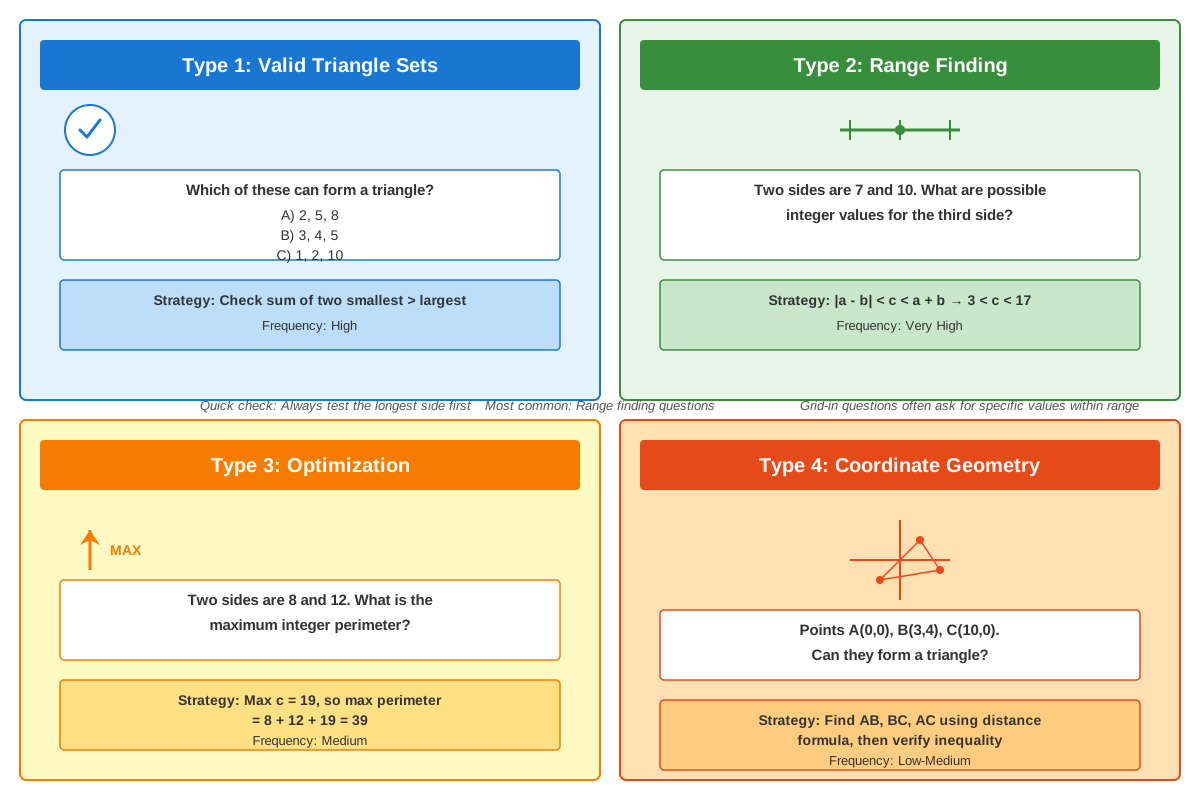
Common SAT question formats include: determining which set of three numbers can form a triangle; finding the range of possible values for a third side given two sides; identifying the maximum or minimum possible perimeter; and applying the theorem to coordinate geometry problems where students must calculate distances between points. The triangle inequality also appears in more complex problems involving isosceles or equilateral triangles, where students must combine this theorem with other geometric properties.
Core Concepts
The Triangle Inequality Theorem
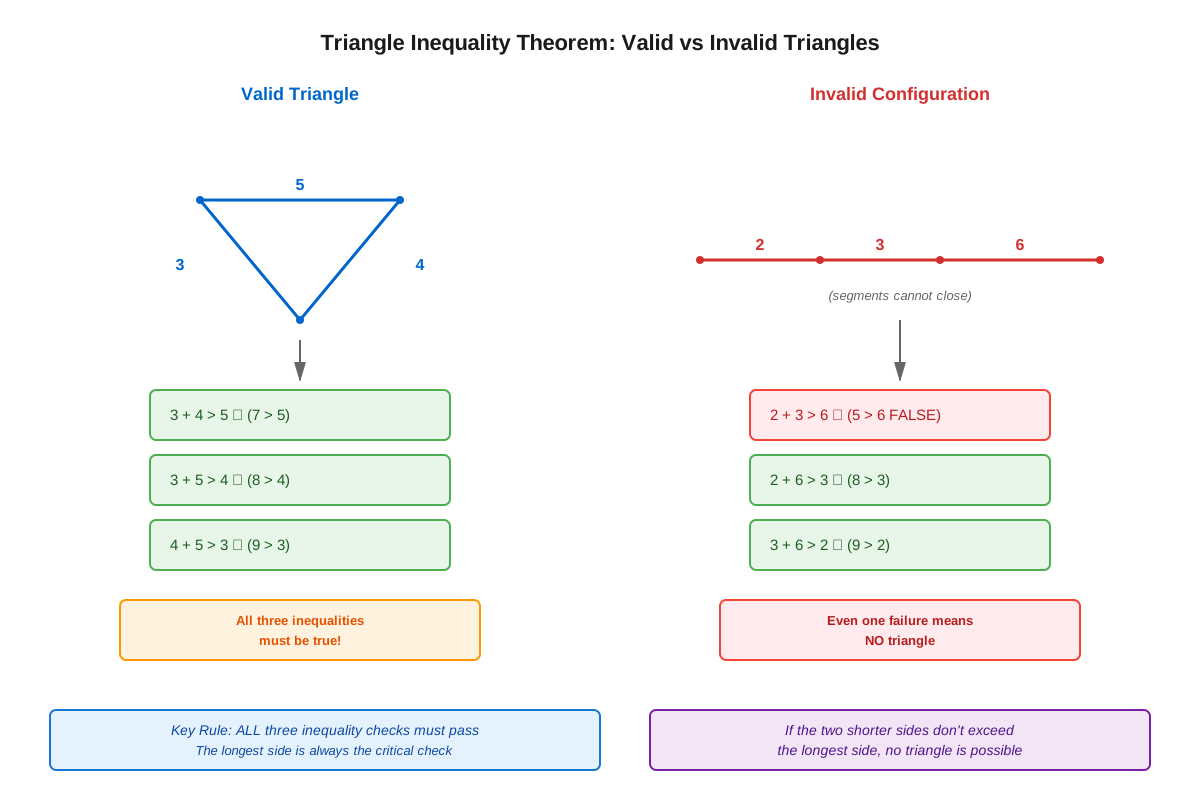
The triangle inequality theorem states that for any triangle with sides of lengths a, b, and c, the following three conditions must all be true:
- a + b > c
- a + c > b
- b + c > a
In words: the sum of the lengths of any two sides must be strictly greater than (not equal to) the length of the remaining side. This is not just a property that triangles happen to have—it's a defining characteristic. If three line segments don't satisfy all three inequalities, they cannot be arranged to form a triangle.
The intuitive explanation is straightforward: imagine trying to connect three sticks end-to-end to form a triangle. If one stick is too long compared to the other two, the shorter sticks won't be able to "reach" each other to close the triangle. For example, if you have sticks of length 3, 4, and 10, the 3 and 4 sticks together only span 7 units, which is less than the 10-unit stick, making it impossible to form a triangle.
Finding the Range of Possible Side Lengths
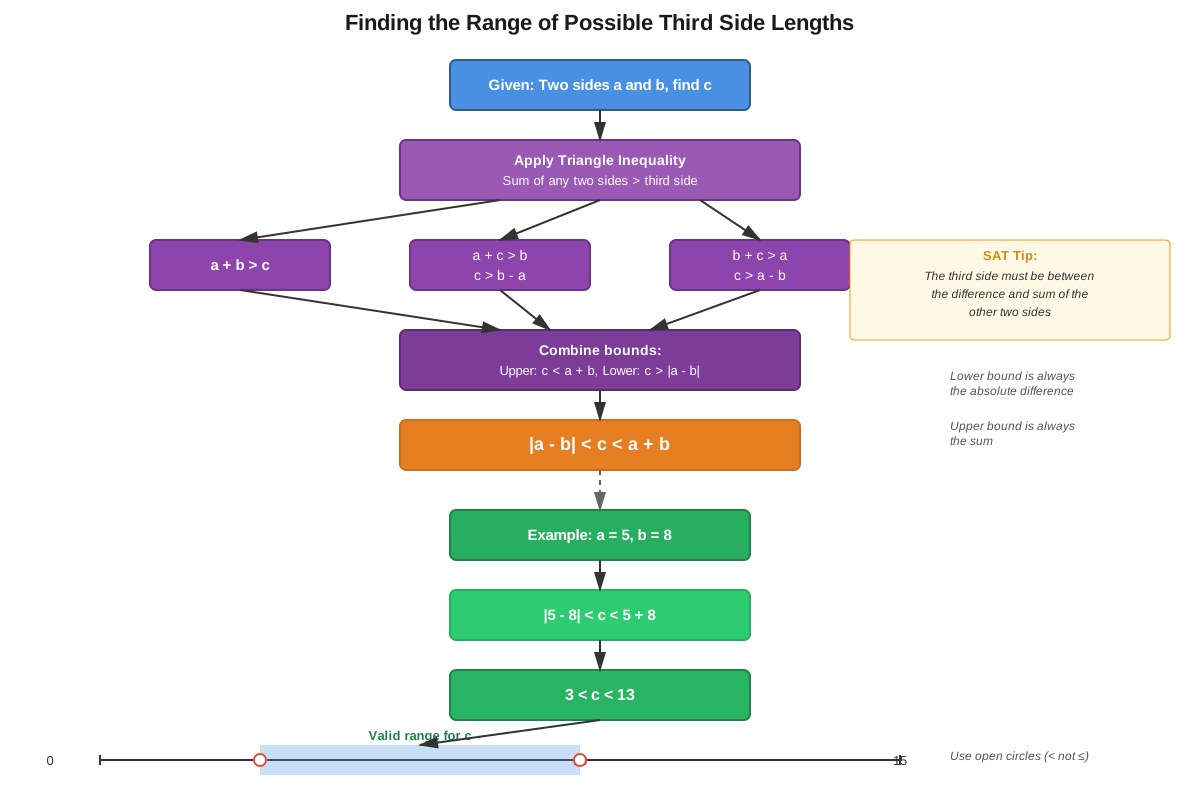
One of the most common SAT triangle inequality applications involves finding the possible range for an unknown third side when two sides are known. Given two sides with lengths a and b, the third side c must satisfy:
|a - b| < c < a + bThis compound inequality provides both the minimum and maximum possible values for the third side. The lower bound (|a - b|) represents the difference between the two known sides, and the upper bound (a + b) represents their sum. The third side must fall strictly between these values.
Example: If a triangle has sides of length 5 and 8, what are the possible values for the third side?
- Maximum value: 5 + 8 = 13 (the third side must be less than 13)
- Minimum value: |8 - 5| = 3 (the third side must be greater than 3)
- Therefore: 3 < c < 13
The third side could be 4, 5, 6, 7, 8, 9, 10, 11, or 12 (if we're considering integer values), but not 3 or 13.
Testing Whether Three Lengths Form a Triangle
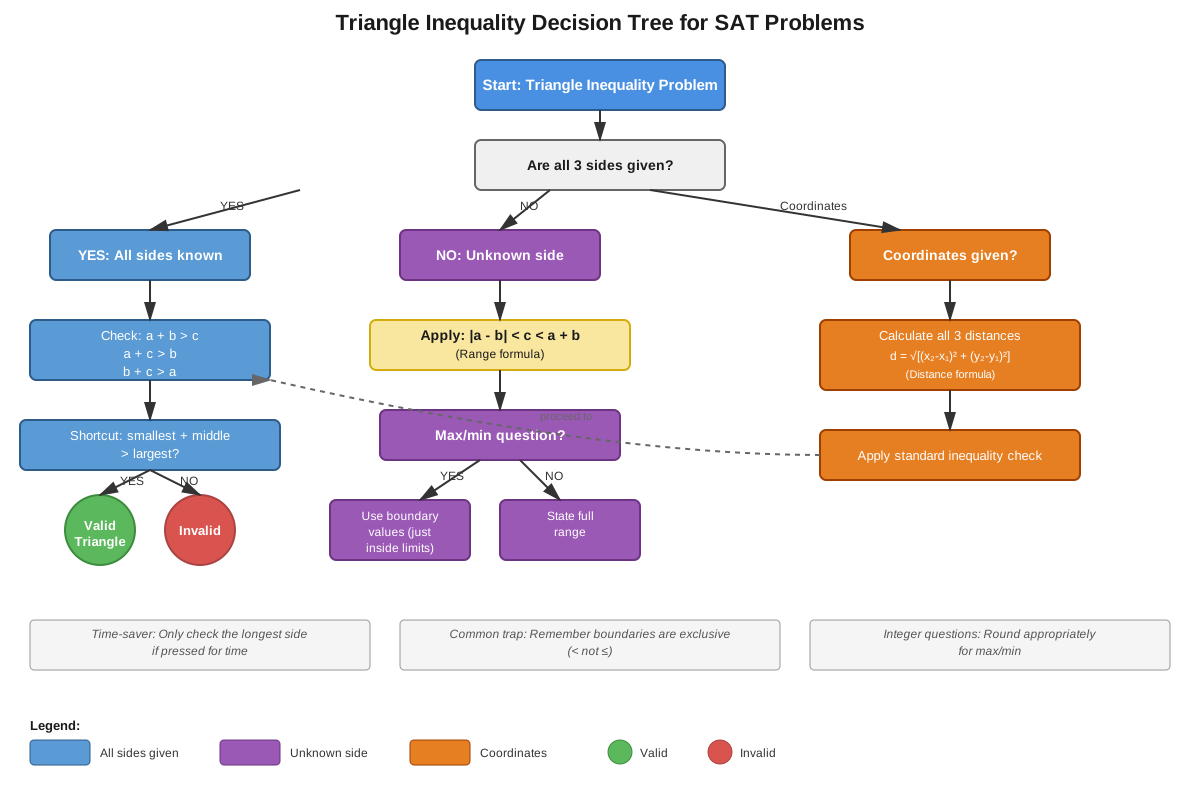
To verify whether three given lengths can form a valid triangle, check all three inequality conditions. However, there's a shortcut: if the sum of the two smaller sides is greater than the largest side, then all three conditions are automatically satisfied.
Efficient method:
- Identify the longest side
- Add the two shorter sides
- If the sum > longest side, the three lengths form a valid triangle
- If the sum ≤ longest side, they cannot form a triangle
| Side Lengths | Longest Side | Sum of Other Two | Valid Triangle? |
|---|---|---|---|
| 3, 4, 5 | 5 | 3 + 4 = 7 > 5 | Yes ✓ |
| 2, 3, 6 | 6 | 2 + 3 = 5 < 6 | No ✗ |
| 5, 5, 8 | 8 | 5 + 5 = 10 > 8 | Yes ✓ |
| 1, 2, 3 | 3 | 1 + 2 = 3 = 3 | No ✗ |
Degenerate Triangles
When the sum of two sides exactly equals the third side (a + b = c), the result is called a degenerate triangle. This configuration creates a straight line rather than a true triangle—the three points are collinear. The SAT considers degenerate triangles as invalid, which is why the triangle inequality uses strict inequality (>) rather than greater-than-or-equal-to (≥).
Application to Perimeter Problems
The triangle inequality theorem helps solve optimization problems involving perimeter. If two sides are fixed, the perimeter is minimized when the third side is as small as possible (approaching |a - b|) and maximized when the third side is as large as possible (approaching a + b).
For a triangle with sides 6 and 10:
- Minimum possible perimeter: approaches 6 + 10 + 4 = 20 (but never equals it)
- Maximum possible perimeter: approaches 6 + 10 + 16 = 32 (but never equals it)
- Actual perimeter range: 20 < P < 32
Algebraic Applications
SAT questions often present the triangle inequality in algebraic form, where one or more sides are expressed as variables or expressions. Students must set up and solve compound inequalities.
Example: If a triangle has sides of length x, x + 2, and 10, what are the possible values of x?
Three conditions must be satisfied:
- x + (x + 2) > 10 → 2x + 2 > 10 → x > 4
- x + 10 > x + 2 → 10 > 2 (always true)
- (x + 2) + 10 > x → 12 > 0 (always true)
Additionally, all sides must be positive: x > 0 and x + 2 > 0
Combining all conditions: x > 4
Concept Relationships
The triangle inequality theorem serves as a gateway concept connecting several mathematical domains. At its foundation, it relies on basic inequality properties and algebraic manipulation, which students use to set up and solve the compound inequalities that arise in triangle problems.
The theorem directly connects to triangle classification concepts: when applying the triangle inequality to isosceles triangles (two equal sides), students must consider that two of the sides in the inequality are identical, simplifying the analysis. For equilateral triangles (three equal sides), the triangle inequality is automatically satisfied since a + a > a simplifies to 2a > a, which is always true for positive values.
Relationship flow: Basic inequalities → Triangle inequality theorem → Valid triangle determination → Perimeter optimization → Coordinate geometry applications
The triangle inequality extends into coordinate geometry through the distance formula. When three points are given in the coordinate plane, students calculate the distances between pairs of points and then apply the triangle inequality to determine whether the points form a valid triangle. This connection appears frequently on the SAT in multi-step problems.
The theorem also relates to absolute value concepts, particularly in the formula |a - b| < c < a + b. Understanding absolute value as distance helps students visualize why the difference between two sides provides the lower bound for the third side.
Looking forward, mastery of the triangle inequality prepares students for more advanced topics including the Law of Cosines and triangle congruence theorems, where understanding valid side length relationships is essential for proving geometric properties.
Quick check — test yourself on Triangle inequality so far.
Try Flashcards →High-Yield Facts
⭐ The sum of any two sides of a triangle must be strictly greater than the third side (this is the core definition and appears in some form on nearly every triangle inequality question)
⭐ Given two sides a and b, the third side c must satisfy: |a - b| < c < a + b (this formula is the most efficient way to find the range of possible values)
⭐ To quickly check if three lengths form a triangle, verify that the sum of the two smallest sides exceeds the largest side (this shortcut saves time on the SAT)
⭐ The triangle inequality uses strict inequality (>) not greater-than-or-equal-to (≥) because equal sums create degenerate triangles (straight lines)
⭐ All three sides of a triangle must be positive numbers (this additional constraint often eliminates answer choices in algebraic problems)
- The minimum possible value for the third side approaches (but never equals) the absolute difference of the other two sides
- The maximum possible value for the third side approaches (but never equals) the sum of the other two sides
- In an isosceles triangle with two sides of length a, the third side b must satisfy: 0 < b < 2a
- The triangle inequality applies to all triangles regardless of type (scalene, isosceles, equilateral, right, acute, or obtuse)
- When solving for an unknown side algebraically, students must check all three inequality conditions and combine them with any additional constraints
- The perimeter of a triangle with two fixed sides is minimized when the third side approaches its minimum value and maximized when it approaches its maximum value
- In coordinate geometry problems, the triangle inequality can be used to verify that three points are not collinear
Common Misconceptions
Misconception: The sum of two sides must be greater than or equal to the third side → Correction: The inequality must be strict (>), not inclusive (≥). When the sum equals the third side, the three segments form a straight line (degenerate triangle), not a valid triangle. The SAT will mark such configurations as invalid.
Misconception: Only one inequality condition needs to be checked → Correction: All three inequality conditions (a + b > c, a + c > b, and b + c > a) must be satisfied. While checking that the sum of the two smaller sides exceeds the largest side is an efficient shortcut, in algebraic problems where sides are expressed as variables, all three conditions may yield different constraints that must all be satisfied simultaneously.
Misconception: The third side can equal the sum or difference of the other two sides → Correction: The third side must fall strictly between these bounds. If c = a + b or c = |a - b|, the configuration is degenerate. The correct range is |a - b| < c < a + b, with strict inequalities on both ends.
Misconception: Negative values are acceptable for side lengths in algebraic problems → Correction: All side lengths must be positive real numbers. When solving algebraic triangle inequality problems, students must add the constraint that each side length > 0, which often provides additional restrictions on the variable.
Misconception: The triangle inequality only applies to triangles drawn in standard position → Correction: The theorem is a fundamental property that applies to all triangles regardless of orientation, position, or how they're drawn. It applies equally to triangles in coordinate geometry, triangles described only by side lengths, and triangles embedded in complex figures.
Misconception: If two sides are equal (isosceles triangle), the triangle inequality doesn't apply → Correction: The triangle inequality applies to all triangles without exception. For an isosceles triangle with sides a, a, and b, the inequality simplifies to 2a > b and a + b > a (which reduces to b > 0), but these conditions still must be checked.
Worked Examples
Example 1: Finding the Range of Possible Values
Question: A triangle has two sides with lengths 7 and 12. If the length of the third side is an integer, how many possible values are there for the third side?
Solution:
Step 1: Apply the triangle inequality formula to find the range.
Given sides a = 7 and b = 12, the third side c must satisfy:
|a - b| < c < a + b
Step 2: Calculate the bounds.
- Lower bound: |7 - 12| = |-5| = 5
- Upper bound: 7 + 12 = 19
- Therefore: 5 < c < 19
Step 3: Identify integer values in this range.
Since c must be strictly greater than 5 and strictly less than 19, the possible integer values are:
6, 7, 8, 9, 10, 11, 12, 13, 14, 15, 16, 17, 18
Step 4: Count the possibilities.
There are 13 possible integer values for the third side.
Connection to learning objectives: This problem directly applies the triangle inequality to find possible side lengths, demonstrating the core formula and how to interpret strict inequalities when counting integer solutions.
Example 2: Algebraic Application with Variable Sides
Question: A triangle has sides of length x + 3, 2x - 1, and 15, where x is a positive number. What is the range of possible values for x?
Solution:
Step 1: Set up all three triangle inequality conditions.
- (x + 3) + (2x - 1) > 15
- (x + 3) + 15 > 2x - 1
- (2x - 1) + 15 > x + 3
Step 2: Solve each inequality.
Condition 1: (x + 3) + (2x - 1) > 15
- 3x + 2 > 15
- 3x > 13
- x > 13/3 ≈ 4.33
Condition 2: (x + 3) + 15 > 2x - 1
- x + 18 > 2x - 1
- 18 + 1 > 2x - x
- 19 > x
- x < 19
Condition 3: (2x - 1) + 15 > x + 3
- 2x + 14 > x + 3
- x > -11 (always satisfied since x is positive)
Step 3: Ensure all sides are positive.
- x + 3 > 0 → x > -3 (satisfied if x is positive)
- 2x - 1 > 0 → x > 0.5
- 15 > 0 (always true)
Step 4: Combine all constraints.
The most restrictive conditions are:
- x > 13/3 (from condition 1)
- x < 19 (from condition 2)
Answer: 13/3 < x < 19, or approximately 4.33 < x < 19
Connection to learning objectives: This problem demonstrates how the triangle inequality appears in algebraic form on the SAT, requiring students to set up multiple inequalities, solve them systematically, and combine the results to find the valid range for the variable.
Exam Strategy
When approaching SAT triangle inequality questions, begin by identifying what information is given and what is being asked. Most questions fall into three categories: (1) determining if three lengths can form a triangle, (2) finding the range of possible values for an unknown side, or (3) solving for a variable in an algebraic expression.
Trigger words and phrases to watch for:
- "could be the length of the third side"
- "possible values"
- "which of the following could NOT form a triangle"
- "maximum/minimum perimeter"
- "range of values"
- "how many integer values"
Step-by-step approach:
- Identify the known sides: Write down the lengths of any sides that are given, even if they're expressed algebraically
- Apply the appropriate formula: For finding ranges, use |a - b| < c < a + b; for verification, check if the sum of the two smaller sides exceeds the largest
- Check all constraints: Don't forget that all sides must be positive and that inequalities are strict (not inclusive)
- Eliminate impossible answers: Use the bounds to quickly eliminate answer choices that fall outside the valid range
Process-of-elimination tips:
- If a question asks which set of three numbers CAN form a triangle, eliminate any choice where the sum of the two smallest numbers is less than or equal to the largest
- If finding possible values for a third side, immediately eliminate any answer choice that equals the sum or difference of the given sides
- For algebraic problems, eliminate answer choices that would make any side length negative or zero
- When multiple conditions must be satisfied, eliminate answers that violate any single condition
Time allocation: Triangle inequality questions typically require 45-90 seconds. Straightforward verification problems (can these three lengths form a triangle?) should take about 30-45 seconds. Algebraic problems requiring multiple inequality solutions may take 90-120 seconds. If a problem is taking longer, mark it and return after completing easier questions.
Exam Tip: On grid-in questions asking for the number of possible integer values, be careful with the endpoints. Since the inequalities are strict, values exactly equal to the bounds are NOT included in the count.
Memory Techniques
Mnemonic for the basic theorem: "Two Sides Must Exceed the third" (TSME) - The sum of Two Sides Must Exceed the third side.
Visualization strategy: Picture a triangle as a rope with three segments. If one segment is too long, the other two can't stretch far enough to meet and close the triangle. The rope would just hang in a line or V-shape. This mental image reinforces why the sum of two sides must exceed the third.
The "Difference-to-Sum" rule: For finding the range of the third side, remember "Difference to Sum" (DS). The third side must be between the Difference and the Sum of the other two sides (exclusive).
Acronym for checking: SAL - Sum the two smaller sides, compare to the Largest. If Sum > Largest, you have a valid triangle.
Finger trick for quick checking: Hold up three fingers representing the three sides. The two shorter fingers (sides) together must reach past the longest finger (side). This physical representation helps kinesthetic learners remember the concept.
Rhyme for strict inequality: "Equal makes a line, not a sign of a triangle fine." This reminds students that equality creates a degenerate case, not a valid triangle.
Summary
The triangle inequality theorem is a fundamental geometric principle stating that the sum of any two sides of a triangle must be strictly greater than the third side. This concept appears regularly on the SAT in various forms, from direct verification questions to complex algebraic problems. The most efficient formula for finding the range of a possible third side is |a - b| < c < a + b, which provides both the minimum (the absolute difference) and maximum (the sum) bounds. To verify whether three given lengths can form a triangle, check that the sum of the two smallest sides exceeds the largest side. All three inequality conditions must be satisfied, all sides must be positive, and the inequalities must be strict (not inclusive) to avoid degenerate triangles. SAT questions often combine the triangle inequality with algebraic expressions, requiring students to set up and solve compound inequalities while respecting all constraints. Mastery of this topic enables quick elimination of impossible answer choices and provides a foundation for more advanced geometric reasoning.
Key Takeaways
- The triangle inequality theorem states that for any triangle, the sum of any two sides must be strictly greater than the third side (a + b > c)
- Given two sides a and b, the third side c must satisfy |a - b| < c < a + b, with strict inequalities on both ends
- The quickest verification method is checking whether the sum of the two smallest sides exceeds the largest side
- All three inequality conditions must be satisfied, and all side lengths must be positive real numbers
- Degenerate triangles (where the sum equals the third side) form straight lines and are not considered valid triangles on the SAT
- Algebraic triangle inequality problems require setting up multiple inequalities, solving each one, and finding the intersection of all valid ranges
- The triangle inequality connects to perimeter optimization, coordinate geometry, and other geometric properties tested on the SAT
Related Topics
Triangle Classification and Properties: Understanding how triangles are categorized (scalene, isosceles, equilateral) and their special properties builds on the triangle inequality, as certain classifications impose additional constraints on side lengths.
Pythagorean Theorem and Right Triangles: The relationship between the sides of right triangles provides another set of constraints that work alongside the triangle inequality, particularly in problems involving both concepts.
Coordinate Geometry and Distance Formula: Applying the triangle inequality to points in the coordinate plane requires calculating distances using the distance formula, then verifying the triangle inequality conditions.
Absolute Value and Inequalities: The formula |a - b| < c < a + b directly incorporates absolute value, and mastering this topic strengthens understanding of how to interpret and solve compound inequalities.
Perimeter and Optimization: Finding maximum and minimum perimeters given constraints on side lengths extends the triangle inequality into optimization problems that appear on the SAT.
Practice CTA
Now that you've mastered the triangle inequality theorem, it's time to solidify your understanding through practice! Work through the practice questions to test your ability to apply these concepts under exam conditions. The flashcards will help you memorize the key formulas and facts for quick recall on test day. Remember, the triangle inequality appears on virtually every SAT, so investing time in practice now will pay dividends in points on exam day. You've got this!
Sign up free to keep reading
Create a free AnvayaPrep account to finish this SAT guide on Triangle inequality — plus flashcards and practice questions.