Overview
Essential clauses are fundamental grammatical structures that provide necessary information to identify or define the noun they modify. Unlike nonessential clauses, which add supplementary details, essential clauses cannot be removed from a sentence without fundamentally altering its meaning or making it unclear. On the SAT Reading and Writing section (RW), understanding essential clauses is critical for correctly punctuating sentences, particularly when deciding whether to use commas around modifying phrases.
The SAT frequently tests students' ability to distinguish between essential and nonessential clauses through punctuation questions. These questions typically present a sentence with a modifying clause and ask students to determine the correct punctuation—specifically whether commas should set off the clause. Misidentifying an essential clause as nonessential (or vice versa) leads to incorrect comma placement, which the SAT considers a significant grammatical error. Students who master this concept gain a substantial advantage on approximately 10-15% of all grammar questions on the test.
Essential clauses connect directly to broader concepts in sentence structure and boundaries. They relate to restrictive versus nonrestrictive elements, relative clause construction, and the fundamental principle that punctuation should reflect meaning. Understanding essential clauses also reinforces comprehension of how modifying elements function within sentences—a skill that improves both grammar question performance and overall reading comprehension. This topic serves as a cornerstone for mastering the Conventions of Standard English domain, which comprises roughly half of all SAT Reading and Writing questions.
Learning Objectives
- [ ] Identify key features of essential clauses
- [ ] Explain how essential clauses appear on the SAT
- [ ] Apply essential clauses to answer SAT-style questions
- [ ] Distinguish between essential and nonessential clauses based on meaning and context
- [ ] Correctly punctuate sentences containing essential clauses
- [ ] Recognize common SAT patterns that signal essential versus nonessential information
- [ ] Evaluate whether removing a clause changes the fundamental meaning of a sentence
Prerequisites
- Basic sentence structure: Understanding subjects, verbs, and objects is necessary to identify what elements are being modified by clauses
- Relative pronouns: Familiarity with words like "who," "which," "that," and "whom" helps recognize clause structures
- Comma usage fundamentals: Basic knowledge of comma rules provides context for understanding when commas should and should not appear
- Noun identification: Recognizing nouns and noun phrases enables students to identify what essential clauses are modifying
Why This Topic Matters
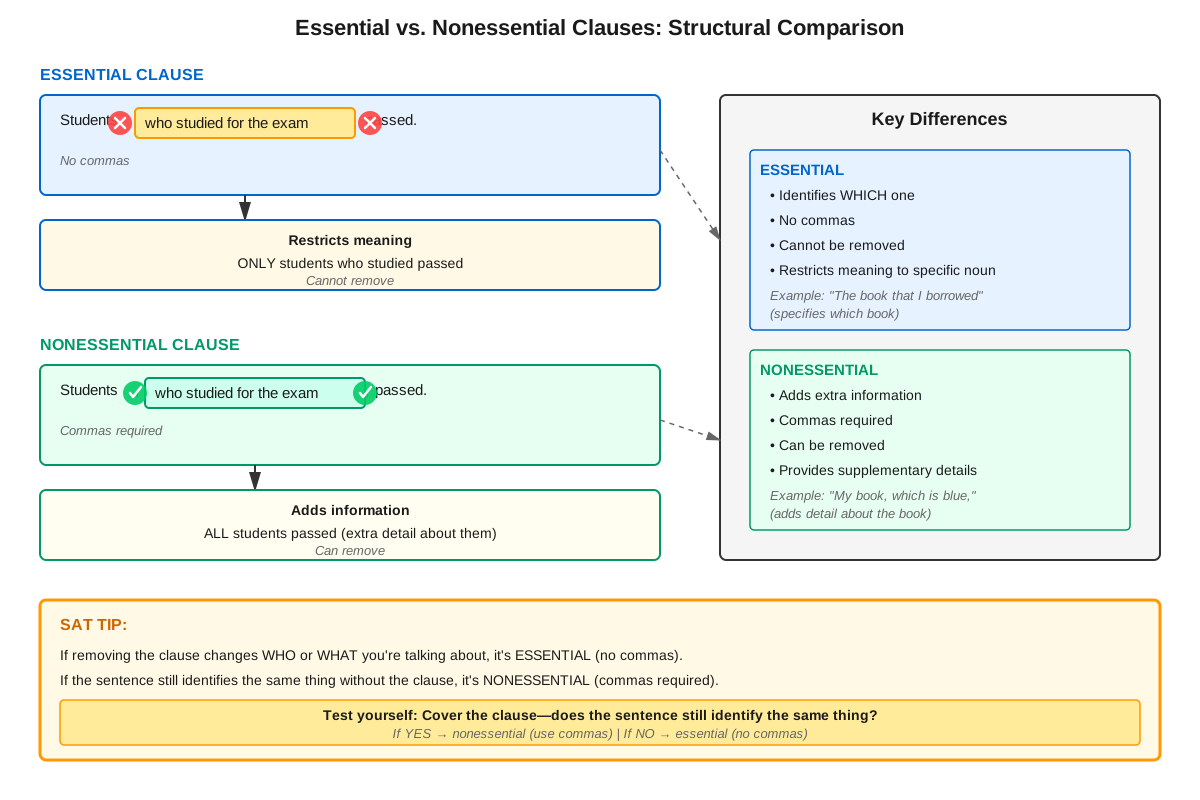
Essential clauses appear in virtually every form of professional and academic writing, making them crucial for effective communication beyond the SAT. In legal documents, scientific papers, and technical writing, the distinction between essential and nonessential information can change the entire meaning of a statement. For example, "Students who studied for the exam passed" (essential clause) means only those who studied passed, while "Students, who studied for the exam, passed" (nonessential clause) means all students passed and they all happened to study.
On the SAT, essential clause questions appear with remarkable frequency—typically 2-4 questions per test administration. These questions most commonly appear in the Standard English Conventions category, specifically within punctuation questions. The College Board consistently includes these questions because they test both grammatical knowledge and reading comprehension simultaneously. Students must read carefully to determine whether information is necessary for identification or merely supplementary.
The SAT presents essential clause questions in several predictable formats: sentences with relative clauses requiring punctuation decisions, appositives that may or may not need commas, and participial phrases that modify nouns. Questions often provide four answer choices that differ only in punctuation, forcing students to determine whether the modifying element is essential or nonessential. Additionally, essential clause concepts appear indirectly in sentence combination questions and in questions about maintaining consistency within a passage's punctuation style.
Core Concepts
Definition and Function of Essential Clauses
An essential clause (also called a restrictive clause) is a dependent clause that provides information necessary to identify or define the noun it modifies. The clause "restricts" or "limits" the meaning of the noun, specifying which particular person, place, thing, or idea is being discussed. Without this information, the sentence becomes ambiguous or changes meaning entirely.
Essential clauses answer the implicit question "Which one?" For example, in the sentence "The student who scored highest received a scholarship," the clause "who scored highest" is essential because it identifies which specific student received the scholarship. Removing this clause would leave "The student received a scholarship," which fails to specify which student is being discussed.
The critical grammatical rule is that essential clauses are not set off by commas. This punctuation convention signals to readers that the information is integral to the sentence's meaning. The absence of commas indicates that the clause cannot be removed without fundamentally altering what the sentence communicates.
Characteristics of Essential Clauses
Essential clauses possess several identifying features that distinguish them from nonessential clauses:
- Necessity for identification: The clause provides information required to identify which specific noun is being discussed
- No comma separation: Essential clauses are not preceded or followed by commas
- Use of "that": While "which" can introduce essential clauses, "that" exclusively introduces essential clauses in formal writing
- Meaning alteration: Removing the clause changes the fundamental meaning or makes the sentence unclear
- Restrictive function: The clause narrows down or restricts the set of possible referents
Essential vs. Nonessential Clauses
Understanding the distinction between essential and nonessential clauses is fundamental to SAT success. The following table illustrates key differences:
| Feature | Essential Clause | Nonessential Clause |
|---|---|---|
| Function | Identifies/defines the noun | Adds extra information |
| Punctuation | No commas | Set off by commas |
| Relative pronouns | "that," "who," "whom," "which" | "which," "who," "whom" (not "that") |
| Removability | Cannot remove without changing meaning | Can remove without changing core meaning |
| Information type | Restrictive/necessary | Supplementary/parenthetical |
Consider these examples:
- Essential: "The book that changed my perspective was written in 1960." (Which book? The one that changed my perspective—this identifies the specific book)
- Nonessential: "The book, which was written in 1960, changed my perspective." (The book is already identified; the publication date is extra information)
The "That" vs. "Which" Distinction
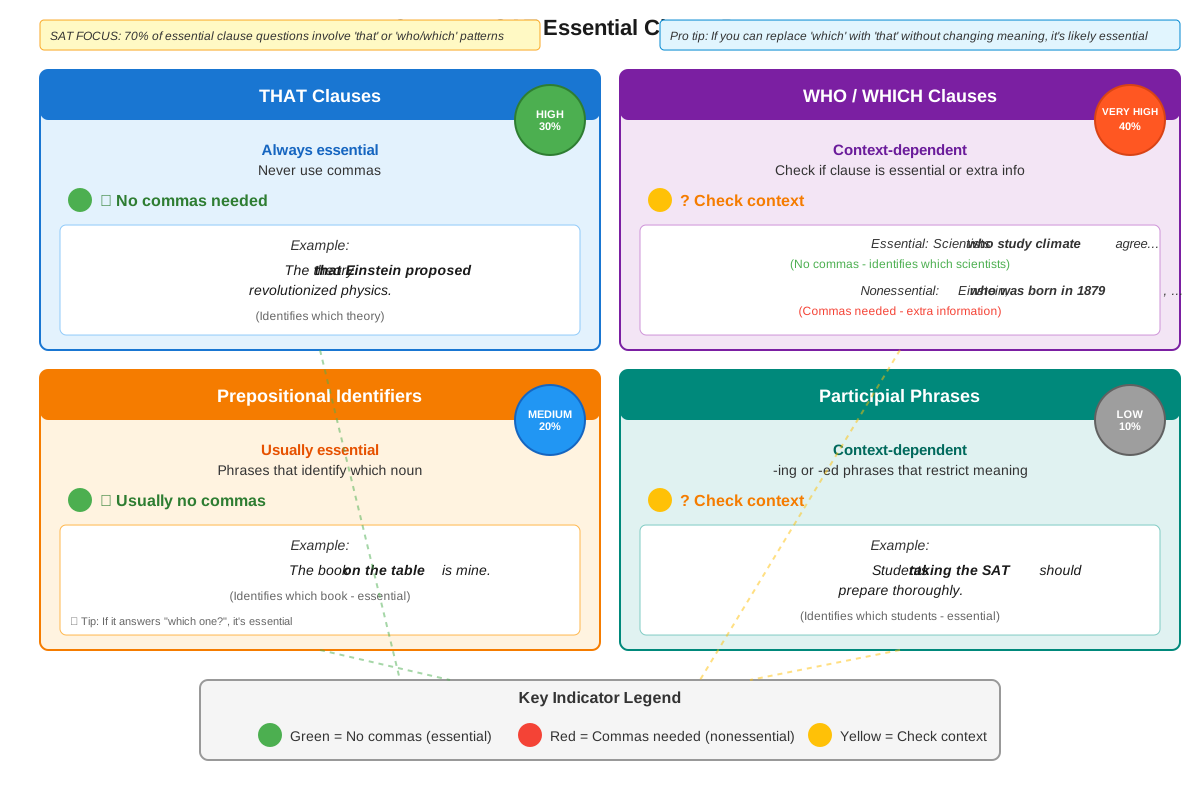
In formal American English, which the SAT tests, "that" introduces essential clauses while "which" typically introduces nonessential clauses. This distinction serves as a reliable signal for identifying clause type:
- "The research that supports this conclusion is extensive." (essential—no commas)
- "The research, which supports this conclusion, is extensive." (nonessential—with commas)
However, "which" can introduce essential clauses when no comma precedes it, though this usage is less common in contemporary American English. The SAT occasionally tests whether students recognize that the presence or absence of commas, not merely the choice of relative pronoun, determines whether a clause is essential.
Context-Dependent Essential Clauses
Whether a clause is essential or nonessential often depends on context rather than the clause itself. The same modifying phrase can be essential in one context and nonessential in another:
- Essential context: "My sister who lives in Boston is visiting." (Implies I have multiple sisters; the clause identifies which one)
- Nonessential context: "My sister, who lives in Boston, is visiting." (Implies I have one sister; her location is extra information)
The SAT tests this contextual understanding by providing passages where students must determine from surrounding sentences whether information is identifying or supplementary. Reading the full context is essential for answering these questions correctly.
Common Essential Clause Structures
Essential clauses appear in several predictable grammatical patterns on the SAT:
Relative clauses with "that": "The method that researchers used was innovative."
Relative clauses with "who/whom": "Students who complete the assignment early receive bonus points."
Adjective clauses without relative pronouns: "The book I read last week was fascinating." (The relative pronoun "that" is implied)
Participial phrases: "The scientist conducting the experiment discovered unexpected results." (When the phrase is necessary for identification)
Prepositional phrases: "The house on the corner needs repairs." (When the phrase identifies which house)
Testing Essential Clauses on the SAT
The SAT tests essential clauses primarily through punctuation questions that present four answer choices differing only in comma placement. A typical question stem reads: "Which choice completes the text so that it conforms to the conventions of standard English?"
The answer choices might look like:
- A) theory that explains
- B) theory, that explains,
- C) theory, that explains
- D) theory that explains,
Students must determine whether the clause beginning with "that" is essential (requiring no commas) or whether the sentence structure requires different punctuation. The correct answer depends on whether the clause identifies which theory or provides supplementary information about an already-identified theory.
Concept Relationships
Essential clauses connect to multiple grammatical concepts tested on the SAT. Understanding these relationships strengthens overall grammar mastery and improves question-answering efficiency.
Essential clauses → Comma usage: The primary connection is to comma rules. Essential clauses demonstrate that commas should not separate necessary information from the words they modify. This principle extends to other grammatical structures like essential appositives and essential participial phrases.
Essential clauses → Relative pronouns: Essential clauses rely on relative pronouns ("that," "which," "who," "whom") to connect the dependent clause to the noun being modified. Understanding relative pronoun function is prerequisite knowledge for identifying essential clauses.
Essential clauses → Sentence meaning: Essential clauses directly impact sentence meaning, connecting this grammatical concept to reading comprehension. Students must read for meaning to determine whether information is identifying or supplementary.
Essential clauses → Nonessential clauses: These concepts exist in direct contrast. Understanding one requires understanding the other. The SAT often tests whether students can distinguish between them in similar contexts.
Essential clauses → Restrictive vs. nonrestrictive elements: Essential clauses are one type of restrictive element. This broader category includes essential appositives and essential modifying phrases, all following the same punctuation rules.
Essential clauses → Sentence boundaries: Proper punctuation of essential clauses helps maintain clear sentence boundaries and prevents comma splices or run-on sentences when clauses appear in complex sentence structures.
The relationship map flows as follows: Basic sentence structure → Noun identification → Relative pronouns → Essential clauses → Comma rules → Sentence meaning → Overall punctuation mastery
High-Yield Facts
⭐ Essential clauses provide information necessary to identify which specific noun is being discussed and are not set off by commas.
⭐ The relative pronoun "that" exclusively introduces essential clauses in formal American English, while "which" typically introduces nonessential clauses.
⭐ Removing an essential clause from a sentence changes the fundamental meaning or makes the sentence unclear.
⭐ Essential clauses answer the question "Which one?" about the noun they modify.
⭐ On the SAT, essential clause questions most commonly appear as punctuation questions with answer choices differing only in comma placement.
- Essential clauses are also called restrictive clauses because they restrict or limit the meaning of the noun.
- Nonessential clauses are set off by commas (or dashes/parentheses), while essential clauses have no punctuation separating them from the noun.
- Context determines whether a clause is essential; the same phrase can be essential or nonessential depending on surrounding information.
- Essential clauses can be introduced by "who," "whom," "whose," "that," or "which" (without commas).
- When a relative pronoun is the object of the clause, it can be omitted: "The book [that] I read" is acceptable.
- Essential participial phrases follow the same punctuation rules as essential clauses—no commas when the information is necessary for identification.
- The SAT tests essential clauses 2-4 times per test administration, making this a high-yield topic for score improvement.
Quick check — test yourself on Essential clauses so far.
Try Flashcards →Common Misconceptions
Misconception: All clauses beginning with "which" are nonessential and require commas.
Correction: While "which" typically introduces nonessential clauses in American English, it can introduce essential clauses when no comma precedes it. The presence or absence of commas, combined with whether the information is necessary for identification, determines whether a clause is essential.
Misconception: Essential clauses are always short, and nonessential clauses are always long.
Correction: Length has no bearing on whether a clause is essential or nonessential. A lengthy clause can be essential if it provides necessary identifying information, while a brief clause can be nonessential if it merely adds supplementary details.
Misconception: If a sentence makes grammatical sense without a clause, that clause must be nonessential.
Correction: Grammatical completeness differs from meaning preservation. A sentence might be grammatically complete without a clause but still require that clause to maintain its intended meaning. For example, "The students passed" is grammatically complete, but "The students who studied passed" conveys a different, more specific meaning.
Misconception: Essential clauses only modify the noun immediately preceding them.
Correction: While essential clauses typically follow the noun they modify, understanding the logical relationship requires reading the full sentence context. Sometimes the noun being modified appears earlier in the sentence, and the clause's position is determined by sentence structure rather than proximity alone.
Misconception: On the SAT, if "that" appears in the answer choice, it's automatically correct.
Correction: While "that" introduces essential clauses, the correct answer depends on whether the clause should be essential based on context. Sometimes the information should be nonessential, requiring "which" with commas instead. Students must analyze meaning, not just apply mechanical rules about relative pronouns.
Misconception: Essential clauses always begin with relative pronouns.
Correction: Essential clauses can be formed with implied relative pronouns (e.g., "The book I read" where "that" is understood) or with participial phrases that function as essential modifiers (e.g., "The scientist conducting the experiment" where no relative pronoun appears).
Worked Examples
Example 1: Identifying Essential vs. Nonessential
Question: Which choice completes the text so that it conforms to the conventions of standard English?
"The novel _____ explores themes of identity and belonging has won numerous literary awards."
A) that
B) that,
C) , which
D) , which,
Solution Process:
Step 1: Identify the clause and what it modifies.
The clause "explores themes of identity and belonging" modifies "novel." We need to determine if this information is essential for identifying which novel or if it's supplementary information about an already-identified novel.
Step 2: Apply the "Which one?" test.
Ask: "Which novel has won awards?" The answer is "the novel that explores themes of identity and belonging." This information identifies which specific novel is being discussed, suggesting the clause is essential.
Step 3: Consider the context.
The sentence doesn't provide any other way to identify the novel (no title, no author). Without the clause, "The novel has won numerous literary awards" doesn't specify which novel. This confirms the clause is essential.
Step 4: Apply punctuation rules.
Essential clauses are not set off by commas. This eliminates choices C and D, which include commas before "which."
Step 5: Choose between remaining options.
Choice A uses "that" with no commas—correct for an essential clause. Choice B incorrectly places a comma after "that," which would separate the essential clause from the noun it modifies.
Answer: A) that
Connection to learning objectives: This example demonstrates identifying key features of essential clauses (provides necessary identifying information) and applying essential clause knowledge to answer SAT-style questions.
Example 2: Context-Dependent Essential Clauses
Question: Which choice completes the text so that it conforms to the conventions of standard English?
"Dr. Martinez has published three books on climate science. Her most recent book _____ examines the impact of rising sea levels was released last month."
A) that
B) that,
C) , which
D) , which,
Solution Process:
Step 1: Analyze the context provided.
The passage mentions that Dr. Martinez has published three books. The second sentence refers to "her most recent book," which already identifies which book is being discussed—it's the most recent one.
Step 2: Determine if the clause is identifying or supplementary.
The clause "examines the impact of rising sea levels" describes what the book is about, but this information isn't necessary to identify which book because "most recent" already does that. The clause provides supplementary information about an already-identified book.
Step 3: Classify the clause type.
Since the clause adds extra information rather than identifying which book, it's nonessential. Nonessential clauses must be set off by commas.
Step 4: Evaluate relative pronoun choice.
Nonessential clauses typically use "which" rather than "that" in formal American English. This eliminates choices A and B.
Step 5: Determine comma placement.
A nonessential clause requires commas on both sides (or a comma before and a period/semicolon after). Choice C has only one comma before "which," which is incorrect if the clause continues to the end of the sentence. Choice D has commas on both sides of the clause.
Wait—reconsider: Looking at the sentence structure, the clause continues to the end of the sentence ("was released last month" is the main verb). Therefore, we need a comma before "which" but not after "examines the impact of rising sea levels" because the sentence continues with the main clause.
Revised analysis: The structure is "Her most recent book, which examines the impact of rising sea levels, was released last month." The nonessential clause interrupts the main clause, so it needs commas on both sides.
Answer: D) , which,
Connection to learning objectives: This example illustrates how context determines whether a clause is essential and demonstrates the application of essential clause concepts to complex SAT questions where students must read carefully to understand the sentence structure.
Exam Strategy
Approaching Essential Clause Questions
When encountering a potential essential clause question on the SAT, follow this systematic approach:
- Read the entire sentence and surrounding context before looking at answer choices. Understanding the full meaning is crucial for determining whether information is identifying or supplementary.
- Identify the noun being modified and the clause that modifies it. Ask yourself: "What is this clause describing or limiting?"
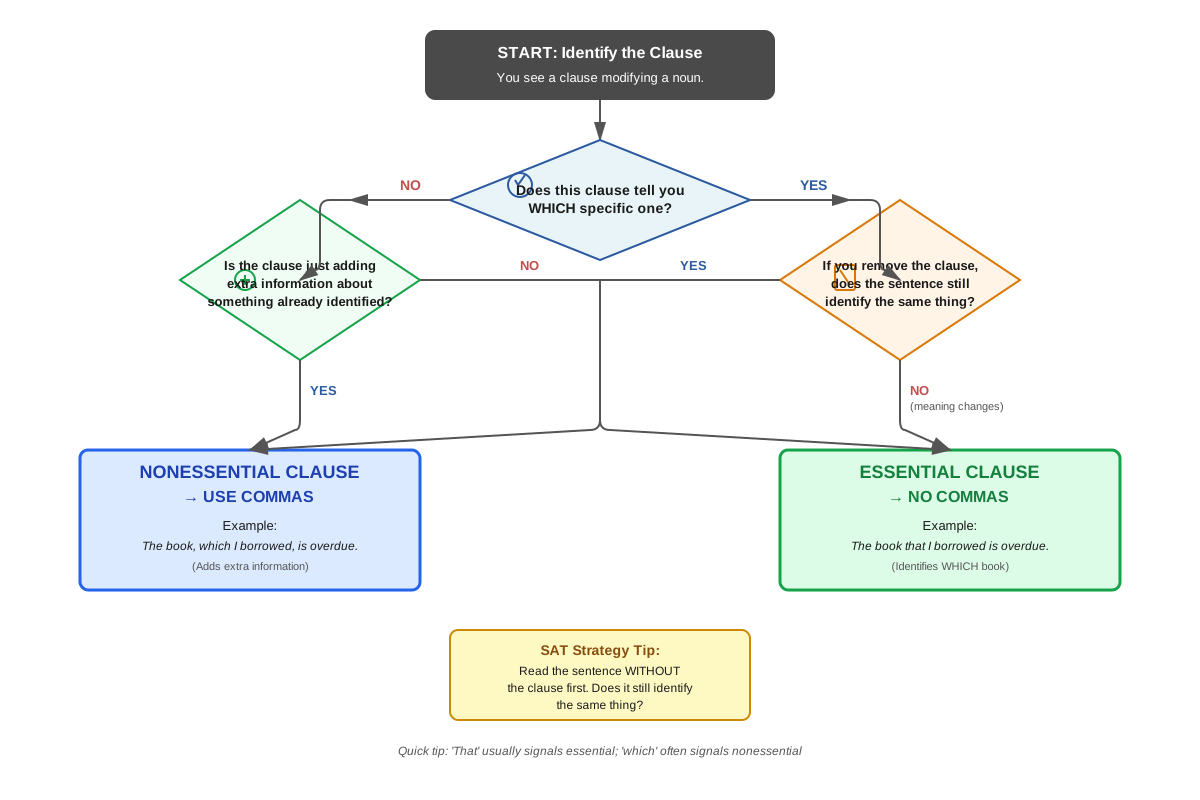
- Apply the "Which one?" test: Does the clause answer the question "Which [noun]?" If yes, it's likely essential. If the noun is already clearly identified, the clause is likely nonessential.
- Use the removal test: Mentally remove the clause. Does the sentence's fundamental meaning change, or does it become unclear which specific thing you're discussing? If yes, the clause is essential.
- Check for context clues in surrounding sentences that might indicate whether the noun is already identified or needs the clause for identification.
Trigger Words and Phrases
Watch for these signals that indicate essential clause questions:
- Answer choices that differ only in comma placement around a clause
- The presence of relative pronouns: "that," "which," "who," "whom"
- Phrases like "the one," "the only," or other indicators that suggest identification is necessary
- Multiple similar nouns mentioned in the passage, suggesting a clause might be needed to distinguish between them
- Questions asking about "conventions of standard English" or "punctuation"
Process of Elimination Tips
Eliminate answers with "that" preceded by a comma: In standard English, "that" introducing a clause should never have a comma before it.
Eliminate answers that use "which" without commas for clearly essential clauses: If the clause obviously identifies which noun, "which" without commas is incorrect in formal American English.
Eliminate answers that separate clearly essential information with commas: If removing the clause makes the sentence unclear or changes its meaning, any answer choice with commas around the clause is incorrect.
Eliminate answers that fail to set off clearly nonessential information: If the noun is already fully identified and the clause adds extra details, answers without commas are incorrect.
Time Allocation
Essential clause questions should take approximately 30-45 seconds to answer. Spending more time usually indicates overthinking. If uncertain, apply the "Which one?" test quickly and move forward. These questions test a single concept, so extended deliberation rarely improves accuracy.
Exam Tip: If you're stuck between two answers, one with commas and one without, reread the sentence with the clause removed. If the sentence still clearly identifies what you're talking about, choose the answer with commas (nonessential). If the sentence becomes vague or changes meaning, choose the answer without commas (essential).
Memory Techniques
The TRIM Mnemonic
Use TRIM to remember essential clause characteristics:
- That (not which with commas) introduces essential clauses
- Restrictive function—narrows down which noun you mean
- Identifies which specific noun is being discussed
- Meaning changes if you remove the clause
The Comma Test Visualization
Visualize commas as removable brackets. If you can lift the clause out of the sentence (like removing something in brackets) without changing the core meaning, it needs commas. If removing it creates a gap in meaning, no commas belong there.
The "Which One?" Chant
When uncertain, mentally ask: "Which one, which one, does this clause tell me which one?" If the answer is yes, no commas. If the answer is no, add commas.
The That/Which Distinction
Remember: "That" is essential, "which" is extra (when "which" has commas). This rhyme helps recall that "that" introduces essential clauses while "which" with commas introduces nonessential clauses.
The Context Clue
Think of essential clauses as ID badges—they identify which specific person/thing you mean. If the noun already has its "ID badge" from context, additional information doesn't need to be attached directly (use commas). If the noun needs the clause as its "ID badge," attach it directly (no commas).
Summary
Essential clauses are dependent clauses that provide information necessary to identify or define the noun they modify, and they must not be set off by commas. The SAT frequently tests students' ability to distinguish essential clauses from nonessential clauses through punctuation questions, making this concept critical for achieving high scores on the Reading and Writing section. Essential clauses answer the question "Which one?" about the noun they modify, and removing them changes the sentence's fundamental meaning or creates ambiguity. The relative pronoun "that" exclusively introduces essential clauses in formal American English, while "which" typically introduces nonessential clauses (though "which" without commas can introduce essential clauses). Context determines whether a clause is essential—the same modifying phrase can be essential in one context and nonessential in another depending on whether the noun is already clearly identified. Students must read carefully, apply the "Which one?" test, and consider whether removing the clause changes meaning to correctly answer SAT questions on this topic.
Key Takeaways
- Essential clauses provide necessary identifying information and are never set off by commas
- Use "that" for essential clauses and "which" with commas for nonessential clauses in formal writing
- Apply the "Which one?" test: if the clause answers which specific noun, it's essential
- Context determines whether a clause is essential—read surrounding sentences carefully
- Removing an essential clause changes the sentence's fundamental meaning or creates ambiguity
- Essential clause questions appear 2-4 times per SAT test, making this a high-yield topic
- On the SAT, answer choices typically differ only in comma placement around the clause
Related Topics
Nonessential Clauses and Phrases: Understanding essential clauses naturally leads to mastering nonessential clauses, which provide supplementary information and require comma separation. These concepts are two sides of the same coin.
Appositives: Essential and nonessential appositives follow the same punctuation rules as essential and nonessential clauses. Mastering essential clauses provides the foundation for correctly punctuating appositives.
Relative Pronouns and Pronoun Reference: Deeper study of relative pronouns ("who," "whom," "whose," "which," "that") and their proper usage builds on essential clause knowledge.
Comma Usage Rules: Essential clauses are one application of broader comma rules. Mastering this topic enables progression to other comma usage scenarios tested on the SAT.
Sentence Structure and Boundaries: Understanding how essential clauses fit within complex sentence structures prepares students for questions about sentence combining, fragments, and run-ons.
Practice CTA
Now that you've mastered the core concepts of essential clauses, it's time to reinforce your learning through active practice. Attempt the practice questions to apply these concepts to SAT-style scenarios, and use the flashcards to memorize high-yield facts and distinctions. Remember: understanding the theory is just the first step—consistent practice with realistic questions is what transforms knowledge into test-day success. Each practice question you complete strengthens your ability to quickly identify essential clauses and apply correct punctuation under timed conditions. You've built a strong foundation; now make it automatic through deliberate practice!
Sign up free to keep reading
Create a free AnvayaPrep account to finish this SAT guide on Essential clauses — plus flashcards and practice questions.