Overview
Independent clauses form the backbone of English sentence structure and represent one of the most frequently tested concepts in the SAT Reading and Writing (RW) section. An independent clause is a group of words that contains a subject and a predicate (verb) and expresses a complete thought that can stand alone as a sentence. Understanding independent clauses is not merely an academic exercise—it is essential for recognizing proper sentence boundaries, identifying run-on sentences, fixing comma splices, and determining when punctuation marks like semicolons and periods are appropriate.
The SAT tests independent clauses extensively because they serve as the foundation for understanding sentence structure, one of the four major domains in the Reading and Writing section. Questions involving independent clauses appear in approximately 15-20% of all grammar questions, making this a high-yield topic that directly impacts test scores. Students who master independent clauses gain the ability to quickly identify sentence boundary errors, which are among the most common mistakes tested on the exam. This knowledge also enables students to understand more complex sentence structures, including compound and complex sentences.
Independent clauses connect to virtually every other grammar concept tested on the SAT. They are essential for understanding dependent clauses, coordinating conjunctions, subordinating conjunctions, semicolon usage, colon usage, and comma rules. Without a solid grasp of what makes a clause independent, students struggle with punctuation questions, sentence fragment identification, and the proper joining of ideas. Mastering this topic creates a ripple effect that improves performance across multiple question types in the Reading and Writing section.
Learning Objectives
- [ ] Identify key features of independent clauses
- [ ] Explain how independent clauses appear on the SAT
- [ ] Apply independent clauses to answer SAT-style questions
- [ ] Distinguish between independent and dependent clauses in complex sentences
- [ ] Recognize and correct common sentence boundary errors involving independent clauses
- [ ] Evaluate the appropriate punctuation needed to join or separate independent clauses
- [ ] Analyze sentence structures to determine the number and relationship of independent clauses
Prerequisites
- Basic sentence structure: Understanding subjects and predicates is essential because independent clauses must contain both elements.
- Parts of speech: Recognizing nouns, verbs, adjectives, and adverbs helps identify the components that make up independent clauses.
- Simple sentence construction: Familiarity with how basic sentences work provides the foundation for understanding how independent clauses function.
- Punctuation basics: Knowledge of periods, commas, and semicolons is necessary because these marks frequently appear in questions about independent clauses.
Why This Topic Matters
Independent clauses represent a fundamental building block of clear, effective communication in both academic and professional writing. In real-world applications, the ability to construct and punctuate independent clauses correctly ensures that written communication is clear, professional, and free from ambiguity. College essays, business emails, research papers, and professional reports all require proper handling of independent clauses to convey ideas effectively.
On the SAT, independent clauses appear in approximately 4-6 questions per test, accounting for roughly 10-15% of the total Reading and Writing score. These questions typically fall into several categories: identifying sentence fragments, correcting run-on sentences, choosing appropriate punctuation between clauses, and determining whether clauses should be combined or separated. The College Board specifically tests independent clauses because they represent a core competency in standard written English that students need for college-level work.
Common SAT question formats involving independent clauses include: (1) selecting the correct punctuation mark to join two independent clauses, (2) identifying whether a sentence is complete or contains a fragment, (3) choosing between a period, semicolon, comma with coordinating conjunction, or other punctuation, and (4) revising run-on sentences where two independent clauses are improperly joined. These questions often appear in the "Standard English Conventions" category and require students to apply their knowledge of sentence boundaries quickly and accurately under timed conditions.
Core Concepts
Definition and Essential Components
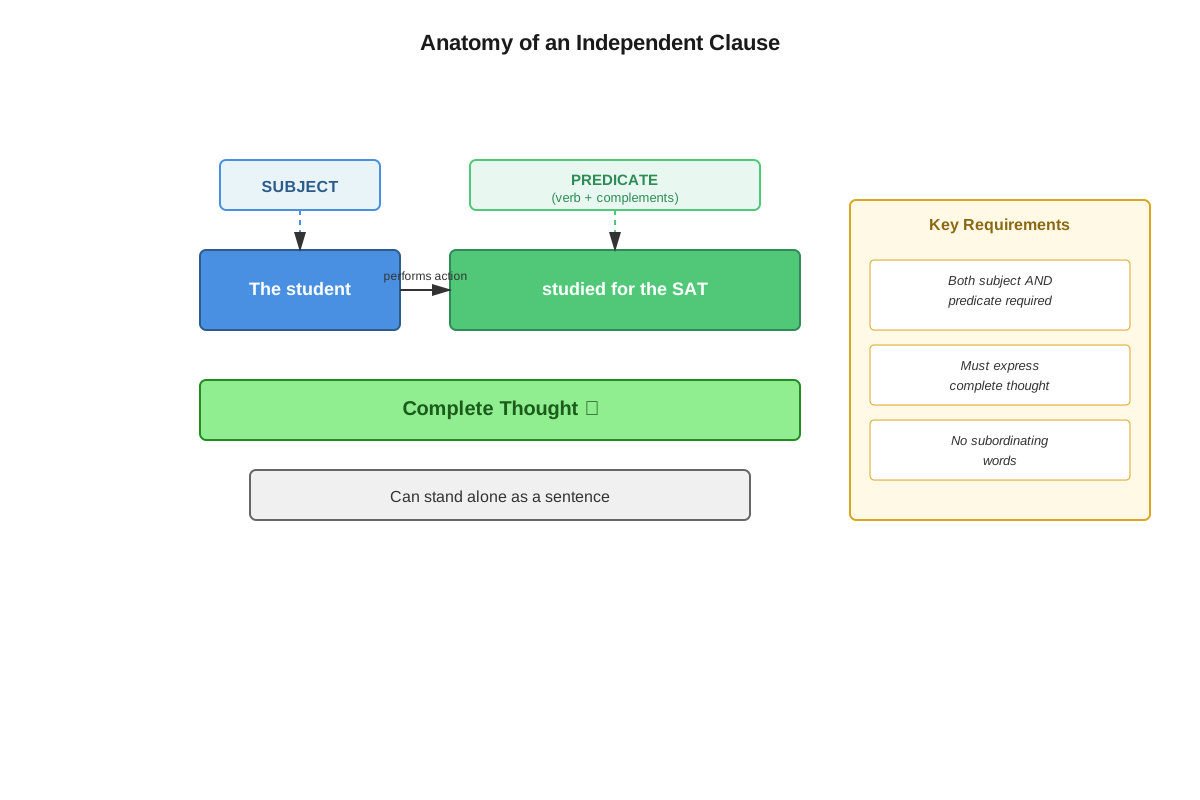
An independent clause is a group of words that contains both a subject and a predicate and expresses a complete thought that can stand alone as a sentence. The subject identifies who or what the sentence is about, while the predicate contains the verb and provides information about the subject's action or state of being. The "complete thought" requirement means that the clause does not leave the reader waiting for additional information to understand the basic meaning.
For example, "The student studied" is an independent clause because it has a subject (student), a predicate (studied), and expresses a complete thought. In contrast, "Because the student studied" is not an independent clause—even though it has a subject and predicate, the word "because" makes it dependent, leaving the reader expecting more information.
The Three Requirements Test
Every independent clause must satisfy three specific requirements:
- Contains a subject: The clause must have a noun or pronoun that performs the action or is described
- Contains a predicate: The clause must have a verb that shows action or state of being
- Expresses a complete thought: The clause must make sense standing alone without additional information
Students can apply this three-part test to any group of words to determine whether it qualifies as an independent clause. If even one requirement is missing, the clause is either dependent or a fragment.
Independent Clauses vs. Dependent Clauses
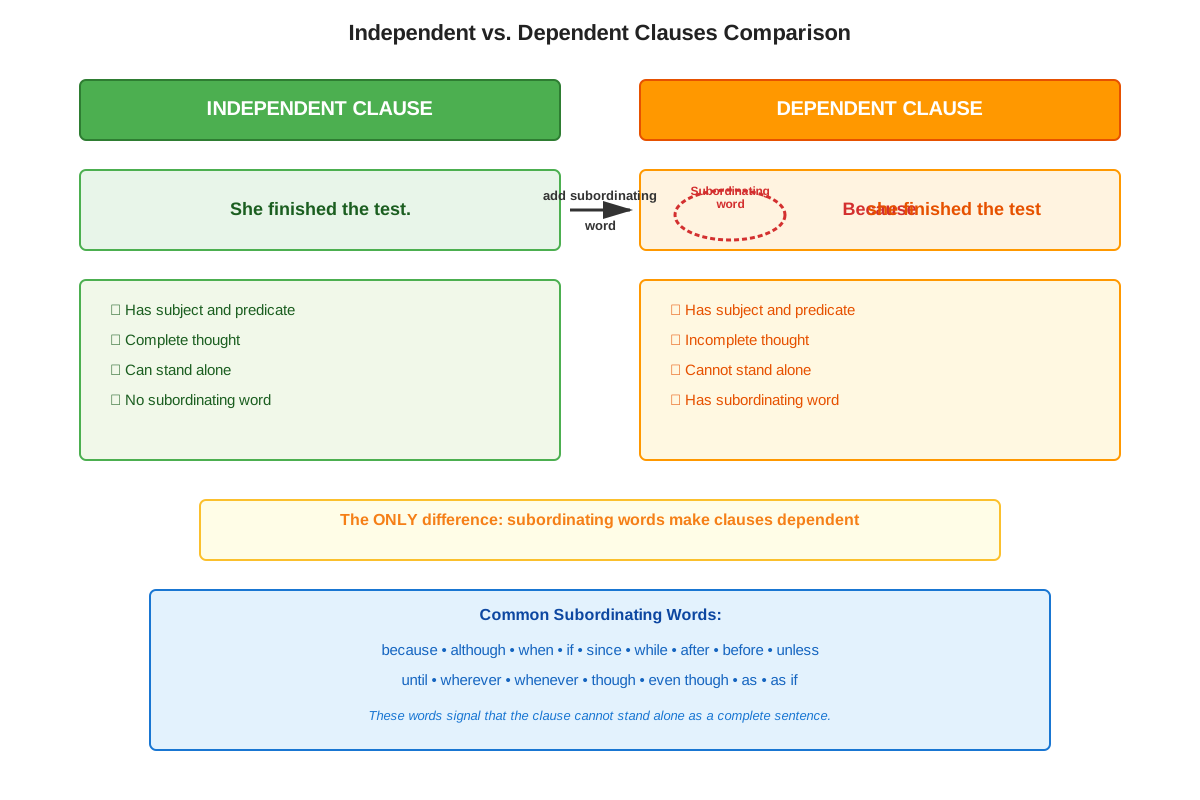
Understanding the distinction between independent and dependent clauses is crucial for SAT success. While both types contain subjects and predicates, they differ in their ability to stand alone:
| Feature | Independent Clause | Dependent Clause |
|---|---|---|
| Subject | Yes | Yes |
| Predicate | Yes | Yes |
| Complete thought | Yes | No |
| Can stand alone | Yes | No |
| Begins with subordinator | No | Usually yes |
| Example | "She finished the test" | "After she finished the test" |
Dependent clauses typically begin with subordinating conjunctions (because, although, since, when, if, after, before, while, unless) or relative pronouns (who, whom, whose, which, that). These words signal that the clause cannot stand alone and must be attached to an independent clause.
Joining Independent Clauses
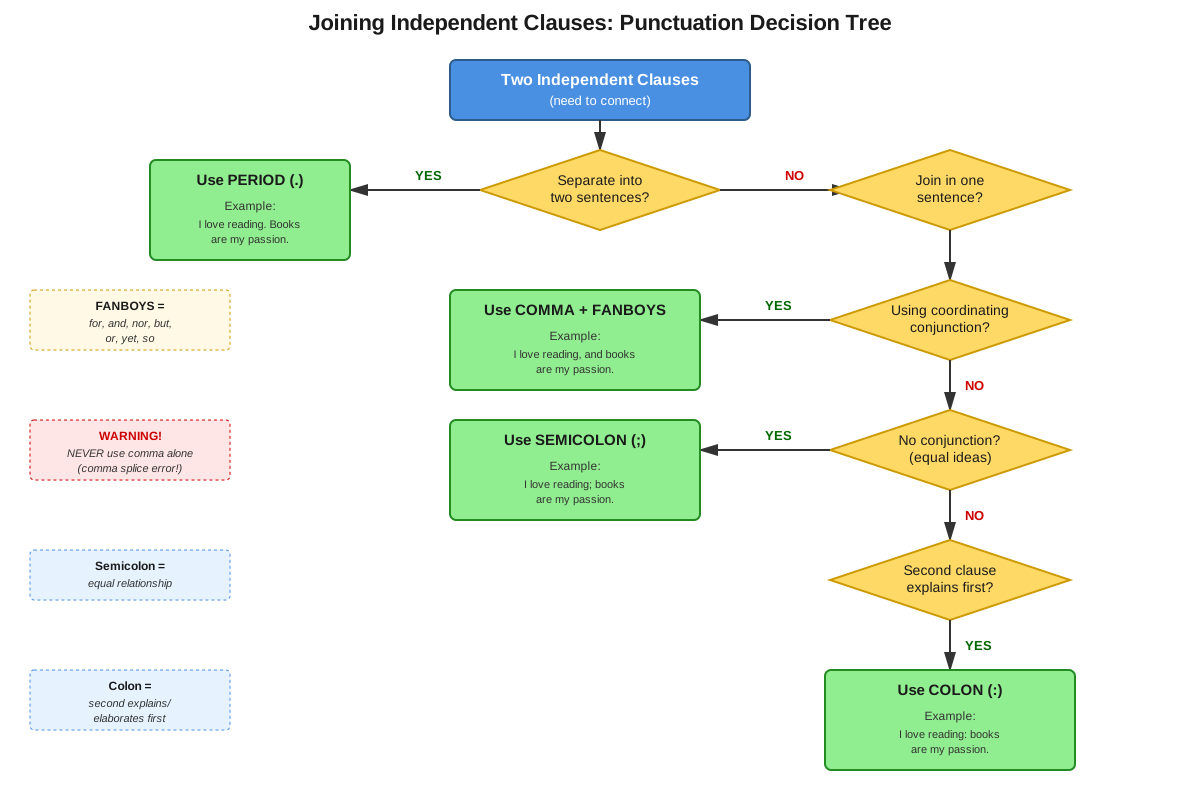
The SAT frequently tests how independent clauses can be properly joined. There are four main methods:
Method 1: Period or Semicolon
Two independent clauses can be separated by a period, creating two sentences, or joined by a semicolon:
- "The experiment succeeded. The researchers celebrated."
- "The experiment succeeded; the researchers celebrated."
Method 2: Comma + Coordinating Conjunction
Independent clauses can be joined with a comma followed by one of the seven coordinating conjunctions (FANBOYS: for, and, nor, but, or, yet, so):
- "The experiment succeeded, and the researchers celebrated."
Method 3: Semicolon + Conjunctive Adverb + Comma
Independent clauses can be joined with a semicolon, followed by a conjunctive adverb (however, therefore, moreover, furthermore, consequently, nevertheless), followed by a comma:
- "The experiment succeeded; therefore, the researchers celebrated."
Method 4: Colon (when appropriate)
When the second independent clause explains, illustrates, or elaborates on the first, a colon may be used:
- "The results were clear: the hypothesis had been proven correct."
Common Sentence Boundary Errors
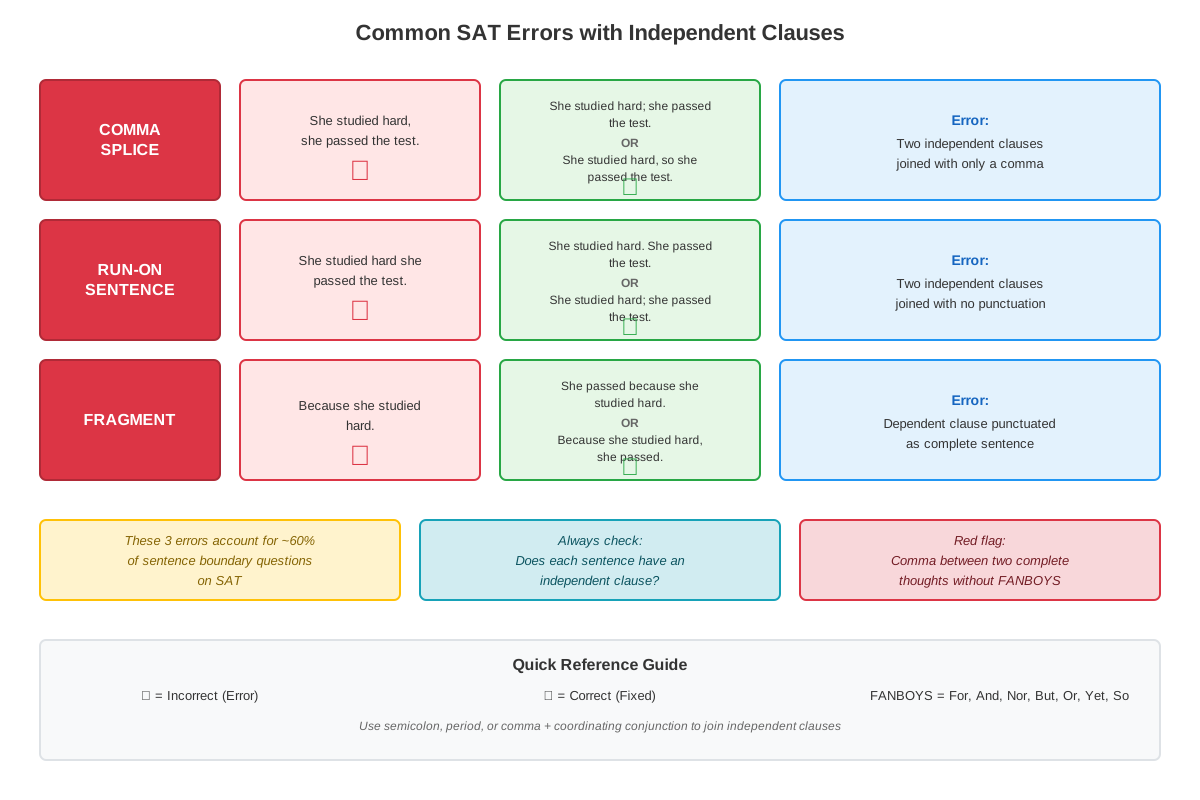
The SAT tests three major errors involving independent clauses:
Run-on Sentences (Fused Sentences)
Two independent clauses joined with no punctuation:
- ❌ "The student studied hard she passed the exam"
- ✅ "The student studied hard. She passed the exam."
Comma Splices
Two independent clauses joined with only a comma (no coordinating conjunction):
- ❌ "The student studied hard, she passed the exam"
- ✅ "The student studied hard, so she passed the exam."
Sentence Fragments
A dependent clause or phrase punctuated as if it were a complete sentence:
- ❌ "Because the student studied hard."
- ✅ "Because the student studied hard, she passed the exam."
Recognizing Independent Clauses in Complex Sentences
Many SAT sentences contain multiple clauses, and students must identify which are independent. Consider this sentence: "Although the weather was poor, the game continued, and the fans remained enthusiastic."
This sentence contains:
- One dependent clause: "Although the weather was poor"
- Two independent clauses: "the game continued" and "the fans remained enthusiastic"
The ability to parse complex sentences into their component clauses is essential for answering SAT questions correctly.
Concept Relationships
Independent clauses serve as the central hub connecting multiple grammar concepts tested on the SAT. The relationship map flows as follows:
Subject + Predicate → Independent Clause → Sentence Types → Punctuation Rules
Understanding subjects and predicates enables recognition of independent clauses, which in turn allows students to identify sentence types (simple, compound, complex, compound-complex). This knowledge then determines which punctuation rules apply.
Independent clauses connect directly to coordinating conjunctions because these seven words (FANBOYS) are the only conjunctions that can join two independent clauses with just a comma. They also connect to semicolons because semicolons specifically join independent clauses that are closely related in meaning. The relationship extends to dependent clauses through contrast—understanding what makes a clause independent clarifies what makes another clause dependent.
The concept also links to comma usage because one of the most common comma rules involves joining independent clauses with a comma plus coordinating conjunction. Additionally, independent clauses relate to sentence fragments through opposition—a fragment is essentially a failed independent clause that lacks one of the three essential requirements.
Finally, independent clauses connect to parallelism and modifier placement because these concepts often operate within the structure of independent clauses, requiring students to understand clause boundaries to apply these rules correctly.
High-Yield Facts
⭐ An independent clause must contain a subject, a predicate, and express a complete thought that can stand alone as a sentence.
⭐ Two independent clauses cannot be joined with only a comma—this creates a comma splice, one of the most frequently tested errors on the SAT.
⭐ A semicolon can only join two independent clauses; it cannot join an independent clause to a dependent clause or fragment.
⭐ The seven coordinating conjunctions (for, and, nor, but, or, yet, so) can join independent clauses when preceded by a comma.
⭐ Words like "however," "therefore," and "moreover" are conjunctive adverbs, not coordinating conjunctions, and require a semicolon before them when joining independent clauses.
- A period can always separate two independent clauses into two complete sentences.
- Subordinating conjunctions (because, although, since, when, if) turn independent clauses into dependent clauses.
- An independent clause can function as a complete sentence by itself.
- Multiple independent clauses in one sentence create a compound sentence.
- The presence of a subject and verb does not automatically make a clause independent—it must also express a complete thought.
- Colons can join independent clauses when the second clause explains or elaborates on the first.
- Run-on sentences (fused sentences) occur when two independent clauses are joined with no punctuation at all.
Quick check — test yourself on Independent clauses so far.
Try Flashcards →Common Misconceptions
Misconception: Any group of words with a subject and verb is an independent clause.
Correction: The clause must also express a complete thought. "When the bell rang" has a subject (bell) and verb (rang) but is dependent because "when" makes it incomplete.
Misconception: A comma can join any two independent clauses.
Correction: A comma alone creates a comma splice. Independent clauses need either a comma plus coordinating conjunction, a semicolon, or a period to be properly joined.
Misconception: Long sentences are always independent clauses, and short sentences are always fragments.
Correction: Length does not determine whether a clause is independent. "She ran" is an independent clause despite being only two words, while "Because the extremely dedicated student studied diligently for many hours" is a dependent clause despite its length.
Misconception: Words like "however" and "therefore" can join independent clauses with just a comma, like coordinating conjunctions.
Correction: These conjunctive adverbs require a semicolon before them when joining independent clauses: "The test was difficult; however, she passed."
Misconception: A semicolon and a comma are interchangeable punctuation marks.
Correction: Semicolons specifically join independent clauses or separate complex items in a list, while commas have many different functions and cannot join independent clauses without a coordinating conjunction.
Misconception: Every sentence must contain only one independent clause.
Correction: Sentences can contain multiple independent clauses (compound sentences) or a combination of independent and dependent clauses (complex or compound-complex sentences).
Misconception: Starting a sentence with "and" or "but" is always wrong.
Correction: While these are coordinating conjunctions, they can begin sentences when the previous sentence provides context. However, the clause following "and" or "but" must still be independent.
Worked Examples
Example 1: Identifying and Correcting a Comma Splice
Question: Which choice best corrects the sentence boundary error?
"The laboratory results were inconclusive, the researchers decided to repeat the experiment."
A) NO CHANGE
B) inconclusive; the researchers
C) inconclusive the researchers
D) inconclusive, and the researchers
Solution:
Step 1: Identify the clauses in the sentence.
- First clause: "The laboratory results were inconclusive" (subject: results, predicate: were inconclusive, complete thought: ✓)
- Second clause: "the researchers decided to repeat the experiment" (subject: researchers, predicate: decided, complete thought: ✓)
Step 2: Recognize that both clauses are independent.
Both clauses pass the three-requirement test, so we have two independent clauses.
Step 3: Identify the error.
The original sentence joins two independent clauses with only a comma, creating a comma splice.
Step 4: Evaluate each answer choice.
- Choice A: Keeps the comma splice—incorrect
- Choice B: Uses a semicolon to join the independent clauses—correct
- Choice C: Creates a run-on sentence with no punctuation—incorrect
- Choice D: Uses comma + coordinating conjunction—also correct
Step 5: Choose the best answer.
Both B and D are grammatically correct. On the actual SAT, only one would be offered, or the question would ask for a specific style. Choice B is more concise, making it the stronger choice.
Answer: B
Connection to Learning Objectives: This example demonstrates the ability to identify independent clauses, recognize sentence boundary errors, and apply correct punctuation rules—addressing objectives 1, 3, and 5.
Example 2: Distinguishing Independent from Dependent Clauses
Question: Which of the following contains two independent clauses?
A) Although the storm was severe, the building remained intact.
B) The storm was severe, and the building remained intact.
C) The storm was severe because the winds were strong.
D) When the storm was severe, the building remained intact.
Solution:
Step 1: Analyze Choice A.
- "Although the storm was severe" = dependent clause (subordinating conjunction "although")
- "the building remained intact" = independent clause
- Result: One dependent, one independent—not the answer
Step 2: Analyze Choice B.
- "The storm was severe" = independent clause (subject: storm, predicate: was severe, complete thought: ✓)
- "the building remained intact" = independent clause (subject: building, predicate: remained intact, complete thought: ✓)
- Result: Two independent clauses joined by comma + coordinating conjunction "and"—this is the answer
Step 3: Analyze Choice C (to confirm).
- "The storm was severe" = independent clause
- "because the winds were strong" = dependent clause (subordinating conjunction "because")
- Result: One independent, one dependent—not the answer
Step 4: Analyze Choice D (to confirm).
- "When the storm was severe" = dependent clause (subordinating conjunction "when")
- "the building remained intact" = independent clause
- Result: One dependent, one independent—not the answer
Answer: B
Connection to Learning Objectives: This example requires distinguishing between independent and dependent clauses and recognizing how subordinating conjunctions affect clause independence—addressing objectives 1, 4, and 6.
Exam Strategy
When approaching sat independent clauses questions on the Reading and Writing section, follow this systematic process:
Step 1: Identify all clauses in the sentence
Locate each subject-verb combination and determine where one clause ends and another begins. Circle or mentally note each subject and underline each main verb.
Step 2: Test each clause for independence
Apply the three-requirement test to each clause: Does it have a subject? Does it have a predicate? Does it express a complete thought? If all three answers are yes, it's independent.
Step 3: Check the punctuation between clauses
If two independent clauses appear in the sentence, examine what connects them. Look for comma splices (comma only), run-ons (no punctuation), or correct punctuation (period, semicolon, or comma + coordinating conjunction).
Step 4: Watch for trigger words
- Subordinating conjunctions (because, although, since, when, if, after, before, while, unless) signal dependent clauses
- Coordinating conjunctions (for, and, nor, but, or, yet, so) can join independent clauses with a comma
- Conjunctive adverbs (however, therefore, moreover, furthermore) require semicolons before them
Step 5: Eliminate obviously wrong answers
Remove choices that create comma splices, run-ons, or sentence fragments. On the SAT, these are never correct.
Exam Tip: If you see two independent clauses in a sentence, immediately check what's between them. If it's just a comma with no coordinating conjunction, it's wrong. If there's no punctuation at all, it's wrong. These are the two most common traps.
Time Allocation: Spend no more than 45-60 seconds on independent clause questions. These are typically straightforward once you identify the clause types. If you're taking longer, you may be overthinking—trust the three-requirement test and move on.
Process of Elimination Strategy:
- Eliminate any choice that joins two independent clauses with only a comma
- Eliminate any choice that uses a semicolon before a dependent clause
- Eliminate any choice that creates a sentence fragment
- Choose from the remaining grammatically correct options based on clarity and conciseness
Memory Techniques
The "SPC" Mnemonic for Independent Clauses
Remember that every independent clause needs:
- Subject
- Predicate
- Complete thought
The "FANBOYS" Acronym for Coordinating Conjunctions
These seven words can join independent clauses with a comma:
- For
- And
- Nor
- But
- Or
- Yet
- So
The "AAAWWUBBIS" Mnemonic for Subordinating Conjunctions
These words create dependent clauses:
- After, Although, As
- When, While, Where
- Unless, Until
- Because, Before
- If
- Since
Visualization Strategy: The Bridge Technique
Imagine two independent clauses as two islands. They can be:
- Separated by water (period)
- Connected by a strong bridge (semicolon)
- Connected by a bridge with a support beam (comma + coordinating conjunction)
- Never connected by a weak plank (comma alone)
The "Stand Alone" Test
When in doubt, try reading the clause by itself. If it sounds complete and doesn't leave you waiting for more information, it's independent. If you're left asking "What happened?" or "Then what?", it's dependent.
Summary
Independent clauses represent the fundamental unit of complete sentences in English and are extensively tested on the SAT Reading and Writing section. An independent clause must contain three essential elements: a subject, a predicate, and a complete thought that can stand alone. The SAT primarily tests independent clauses through questions about sentence boundaries, requiring students to identify and correct comma splices, run-on sentences, and fragments. Two independent clauses can be properly joined using a period, a semicolon, a comma plus coordinating conjunction (FANBOYS), or occasionally a colon when the second clause explains the first. The most common errors involve joining independent clauses with only a comma (comma splice) or with no punctuation at all (run-on sentence). Understanding independent clauses is essential because this knowledge underlies virtually every other grammar concept tested on the SAT, including punctuation rules, sentence structure, and clause relationships. Students who master independent clauses gain the ability to quickly identify sentence boundary errors and select correct punctuation, directly improving their Reading and Writing scores.
Key Takeaways
- An independent clause must have a subject, a predicate, and express a complete thought that can stand alone as a sentence
- Two independent clauses cannot be joined with only a comma—this creates a comma splice, one of the most frequently tested errors on the SAT
- The four correct ways to join independent clauses are: period, semicolon, comma + coordinating conjunction (FANBOYS), or colon (when appropriate)
- Subordinating conjunctions (because, although, when, if, since) turn independent clauses into dependent clauses
- Conjunctive adverbs (however, therefore, moreover) require a semicolon before them when joining independent clauses, not just a comma
- The ability to identify independent clauses is foundational for understanding all sentence structure questions on the SAT
- Apply the three-requirement test (subject, predicate, complete thought) to quickly determine if a clause is independent
Related Topics
Dependent Clauses and Subordination: Understanding dependent clauses deepens comprehension of how complex sentences function and how subordinating conjunctions change clause relationships. Mastering independent clauses makes dependent clauses easier to recognize by contrast.
Semicolon and Colon Usage: These punctuation marks have specific rules related to independent clauses. Semicolons join independent clauses, while colons can introduce explanations or lists after independent clauses.
Comma Rules and Coordinating Conjunctions: The proper use of commas with FANBOYS to join independent clauses extends to other comma rules, including introductory elements and nonessential clauses.
Sentence Types and Variety: Understanding independent clauses enables recognition of simple, compound, complex, and compound-complex sentences, which is essential for both grammar questions and effective writing.
Run-on Sentences and Fragments: These common errors directly relate to independent clauses—run-ons improperly join them, while fragments fail to create them.
Practice CTA
Now that you understand independent clauses and how they appear on the SAT, it's time to reinforce your knowledge through active practice. Complete the practice questions to test your ability to identify independent clauses, recognize sentence boundary errors, and apply correct punctuation rules under timed conditions. Use the flashcards to memorize key concepts like coordinating conjunctions, subordinating conjunctions, and the three requirements of independent clauses. Remember: understanding the concept is just the first step—consistent practice transforms knowledge into the automatic recognition skills you need to excel on test day. Every practice question you complete builds the pattern recognition that leads to faster, more accurate responses on the actual SAT. You've got this!
Sign up free to keep reading
Create a free AnvayaPrep account to finish this SAT guide on Independent clauses — plus flashcards and practice questions.