Overview
Dependent clauses are fundamental building blocks of sentence structure that appear frequently on the SAT Reading and Writing (RW) section. A dependent clause contains a subject and a verb but cannot stand alone as a complete sentence because it begins with a subordinating word that creates incompleteness. Understanding dependent clauses is crucial for identifying sentence boundaries, recognizing fragments, and correctly punctuating complex sentences—all skills tested extensively on the SAT.
The SAT tests dependent clauses in multiple question formats, including sentence structure questions, punctuation questions, and transition questions. Students who master dependent clauses gain the ability to identify run-on sentences, comma splices, and fragments—three of the most common error types on the exam. Additionally, understanding how dependent clauses function enables students to recognize proper comma placement, determine when semicolons are appropriate, and identify logical relationships between ideas within sentences.
Dependent clauses connect directly to broader concepts in sentence structure and grammar. They work in tandem with independent clauses to create complex and compound-complex sentences, and they require specific punctuation rules that differ from those governing independent clauses. Mastering dependent clauses provides the foundation for understanding sentence boundaries, which is essential for success on approximately 15-20% of SAT Reading and Writing questions.
Learning Objectives
- [ ] Identify key features of dependent clauses
- [ ] Explain how dependent clauses appears on the SAT
- [ ] Apply dependent clauses to answer SAT-style questions
- [ ] Distinguish between dependent and independent clauses in complex sentences
- [ ] Recognize all types of dependent clauses (subordinate, relative, and noun clauses)
- [ ] Apply correct punctuation rules when dependent clauses appear in various sentence positions
- [ ] Identify and correct sentence fragments caused by dependent clauses standing alone
Prerequisites
- Independent clauses: Understanding what makes a clause independent (subject + verb + complete thought) is essential because dependent clauses are defined in contrast to independent clauses
- Basic sentence structure: Knowledge of subjects, verbs, and objects helps identify the components within dependent clauses
- Parts of speech: Familiarity with conjunctions, pronouns, and adverbs enables recognition of the words that introduce dependent clauses
- Complete sentences: Understanding what constitutes a complete sentence allows students to recognize when dependent clauses create fragments
Why This Topic Matters
Dependent clauses represent one of the highest-yield topics for SAT preparation because they appear in multiple question types across the Reading and Writing section. Research on SAT question patterns shows that sentence structure and boundaries questions—which heavily feature dependent clauses—comprise approximately 15-20% of the entire RW section. This translates to roughly 7-10 questions per test, making dependent clauses one of the most frequently tested grammatical concepts.
In real-world writing, dependent clauses enable sophisticated expression by showing relationships between ideas, adding descriptive detail, and creating sentence variety. Professional writers use dependent clauses to indicate cause-and-effect relationships, temporal sequences, conditions, and contrasts. Students who understand dependent clauses can both analyze complex texts more effectively and produce more nuanced writing in academic and professional contexts.
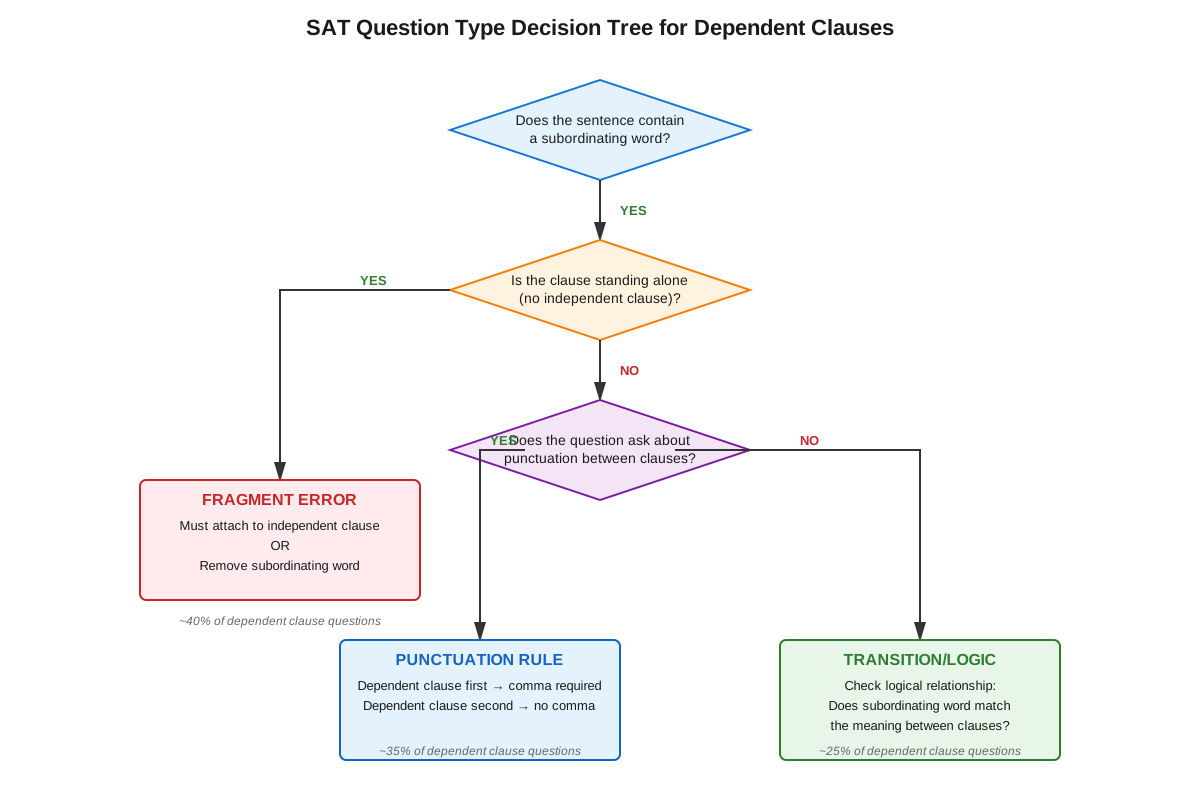
On the SAT, dependent clauses most commonly appear in questions testing: (1) whether a sentence is complete or a fragment, (2) whether punctuation correctly separates or connects clauses, (3) whether a transition word appropriately shows the relationship between ideas, and (4) whether sentence boundaries are properly marked. The exam frequently presents sentences where dependent clauses are incorrectly punctuated as complete sentences or where the relationship between a dependent and independent clause is unclear. Recognizing these patterns is essential for achieving a high score on the Reading and Writing section.
Core Concepts
Definition and Structure of Dependent Clauses
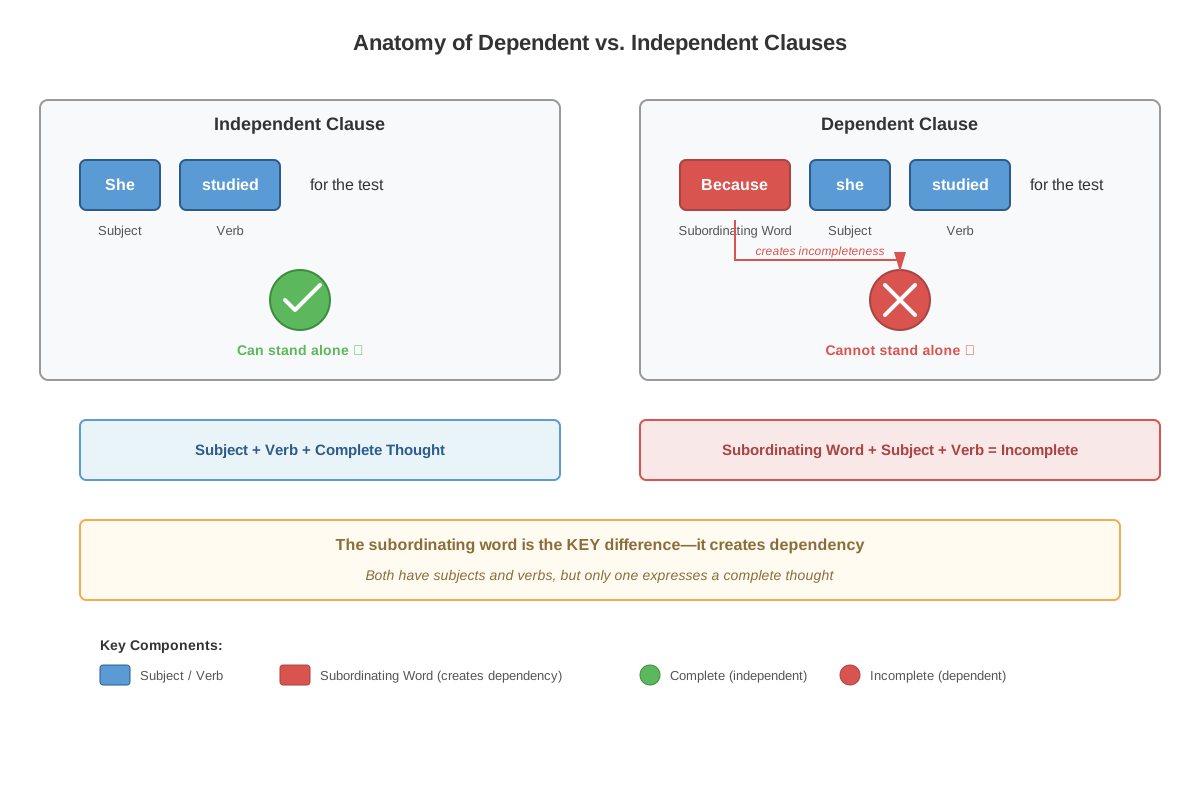
A dependent clause (also called a subordinate clause) is a group of words that contains both a subject and a verb but cannot stand alone as a complete sentence. The clause is "dependent" because it relies on an independent clause to complete its meaning. Dependent clauses begin with subordinating words that signal incompleteness, creating a sense that more information is needed.
The basic structure of a dependent clause follows this pattern:
Subordinating word + Subject + Verb (+ additional elements)
For example: "because the storm arrived" contains a subordinating word (because), a subject (storm), and a verb (arrived), but it leaves the reader waiting for more information. This incompleteness distinguishes dependent clauses from independent clauses.
Types of Subordinating Words
Three main categories of words introduce sat dependent clauses:
1. Subordinating Conjunctions
These words show relationships such as time, cause, condition, or contrast:
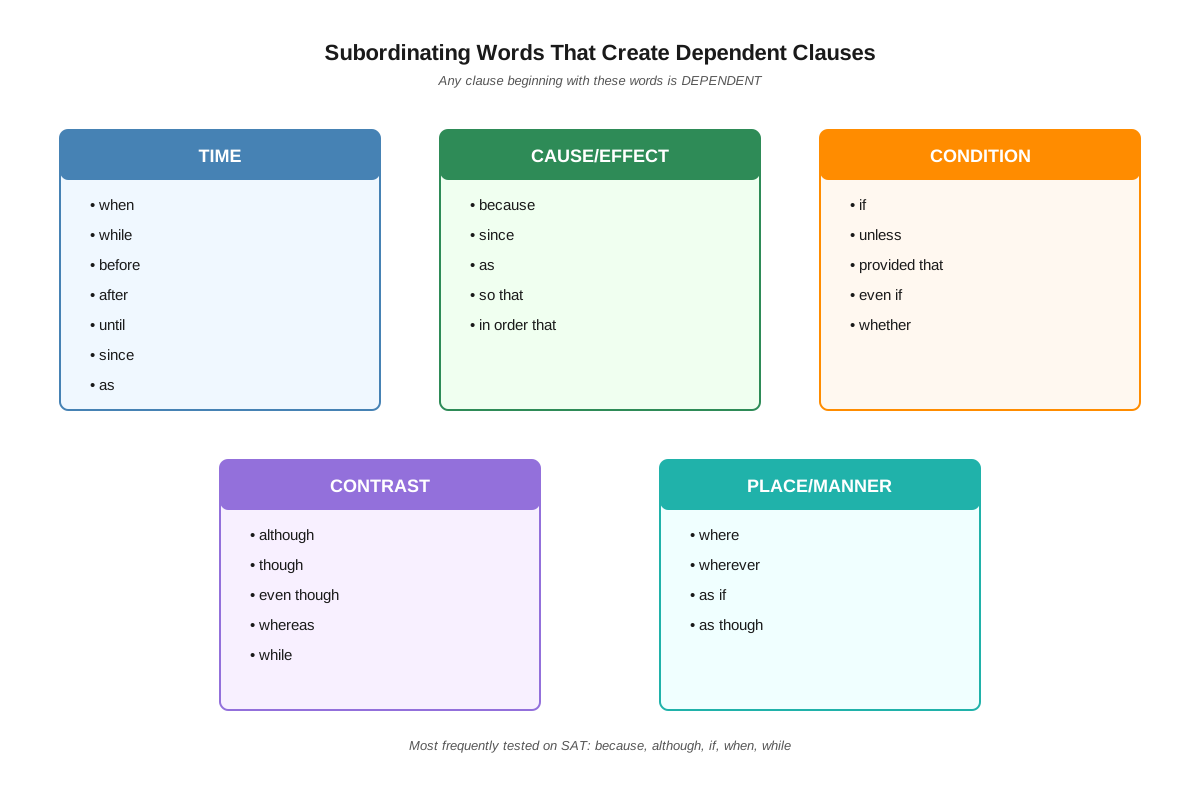
| Relationship | Subordinating Conjunctions |
|---|---|
| Time | when, while, before, after, since, until, as, whenever |
| Cause/Reason | because, since, as |
| Condition | if, unless, provided that, as long as |
| Contrast | although, though, even though, whereas, while |
| Purpose | so that, in order that |
2. Relative Pronouns
These words introduce clauses that describe or identify nouns:
- who, whom, whose (for people)
- which, that (for things)
- where (for places)
- when (for times)
3. Noun Clause Introducers
These words introduce clauses that function as nouns:
- that, whether, if
- who, what, which, when, where, why, how
Three Main Types of Dependent Clauses
Subordinate Clauses (Adverbial Clauses)
Subordinate clauses function as adverbs, modifying verbs, adjectives, or other adverbs. They answer questions like when, where, why, how, or under what conditions.
Examples:
- "Although the experiment failed, the researchers learned valuable information." (shows contrast)
- "The team celebrated after they won the championship." (shows time)
- "Because the library closes early, students must plan accordingly." (shows cause)
Relative Clauses (Adjective Clauses)
Relative clauses function as adjectives, describing or identifying nouns. They typically begin with relative pronouns and immediately follow the noun they modify.
Examples:
- "The scientist who discovered the cure received international recognition." (describes scientist)
- "The book that won the award explores historical themes." (identifies which book)
- "The laboratory where the research occurred has been renovated." (describes laboratory)
Noun Clauses
Noun clauses function as nouns within sentences, serving as subjects, objects, or complements. They often begin with "that," "whether," or question words.
Examples:
- "What the professor explained was difficult to understand." (subject)
- "The committee will decide whether the proposal is approved." (object)
- "The problem is that the data contradicts the hypothesis." (complement)
Punctuation Rules for Dependent Clauses
The position of a dependent clause within a sentence determines punctuation requirements:
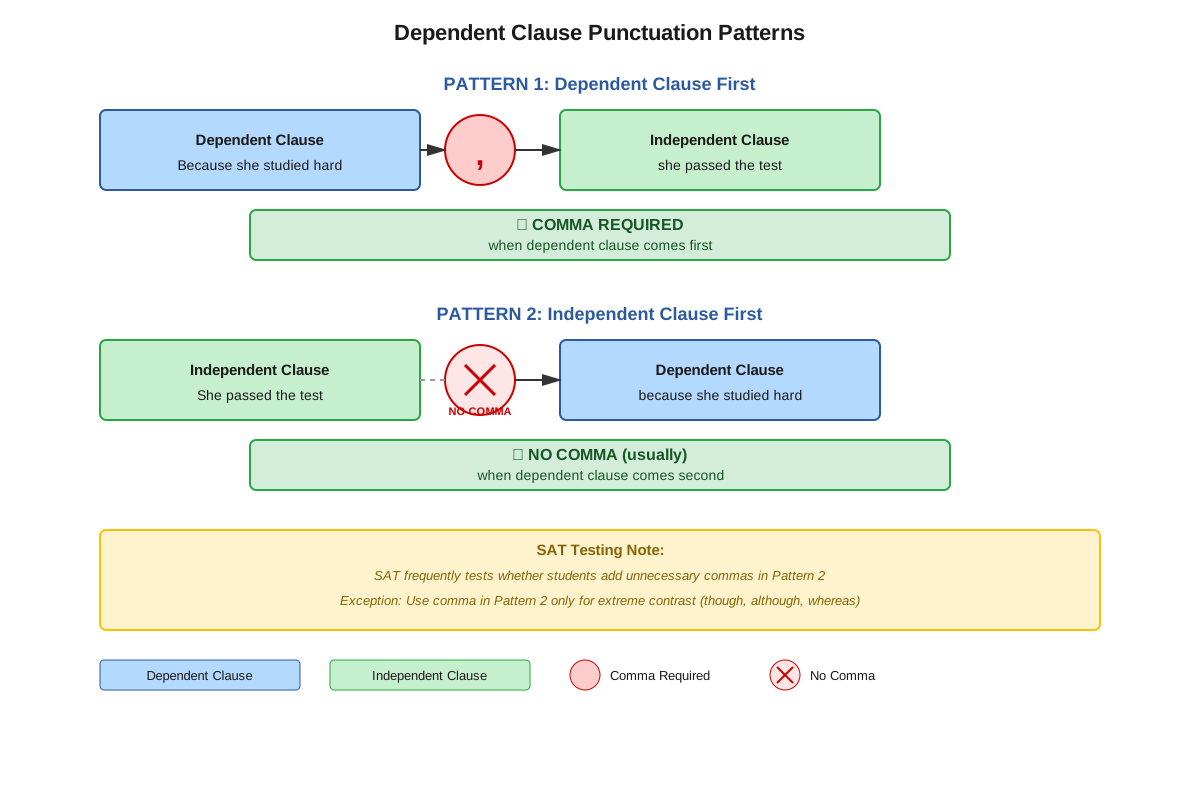
Rule 1: Introductory Dependent Clause
When a dependent clause begins a sentence, place a comma after it:
- "Because the temperature dropped, the pipes froze."
- "Although she studied extensively, the exam was challenging."
Rule 2: Dependent Clause at the End
When a dependent clause ends a sentence, typically no comma is needed:
- "The pipes froze because the temperature dropped."
- "The exam was challenging although she studied extensively."
Exception: Use a comma before a dependent clause at the end if it shows contrast (with "although," "though," "even though"):
- "The exam was challenging, although she studied extensively."
Rule 3: Dependent Clause in the Middle
When a dependent clause interrupts the main sentence (especially relative clauses), punctuation depends on whether the information is essential:
- Essential (no commas): "Students who study regularly perform better on exams."
- Non-essential (commas): "Dr. Martinez, who teaches biology, received an award."
Dependent Clauses vs. Independent Clauses
Understanding the distinction between dependent and independent clauses is crucial for the rw section:
| Feature | Independent Clause | Dependent Clause |
|---|---|---|
| Can stand alone | Yes | No |
| Contains subject + verb | Yes | Yes |
| Expresses complete thought | Yes | No |
| Begins with subordinating word | No | Yes |
| Example | "The rain stopped." | "After the rain stopped" |
Common Fragment Errors
The most frequent error involving dependent clauses on the SAT is treating them as complete sentences. This creates a sentence fragment:
Incorrect: "Because the experiment failed. The researchers redesigned their approach."
Correct: "Because the experiment failed, the researchers redesigned their approach."
Incorrect: "The theory that revolutionized physics. It changed scientific understanding."
Correct: "The theory that revolutionized physics changed scientific understanding."
Concept Relationships
Dependent clauses form the foundation of complex sentence structure, connecting directly to multiple grammatical concepts. The relationship map flows as follows:
Basic Sentence Structure → Independent Clauses → Dependent Clauses → Complex Sentences → Punctuation Rules → Sentence Boundaries
Dependent clauses cannot exist in isolation; they must attach to independent clauses, creating complex sentences (one independent + one dependent) or compound-complex sentences (multiple independent + one or more dependent). The type of dependent clause determines its function within the sentence: subordinate clauses modify actions or states, relative clauses modify nouns, and noun clauses serve as sentence components.
The subordinating words that introduce dependent clauses connect to the broader topic of transitions and logical relationships. Words like "although" and "because" signal specific logical connections between ideas, which relates directly to transition questions on the SAT. Additionally, the punctuation rules for dependent clauses connect to comma usage, semicolon rules, and sentence boundary identification.
Understanding dependent clauses enables progression to advanced topics including: parallel structure (ensuring dependent clauses match in form), modifier placement (positioning dependent clauses to avoid ambiguity), and rhetorical effectiveness (using dependent clauses to emphasize or subordinate ideas). The concept also connects backward to prerequisite knowledge of subjects and verbs, as identifying these elements within dependent clauses is essential for recognizing clause boundaries.
High-Yield Facts
⭐ A dependent clause contains a subject and verb but cannot stand alone as a complete sentence.
⭐ Dependent clauses always begin with subordinating words (subordinating conjunctions, relative pronouns, or noun clause introducers).
⭐ When a dependent clause starts a sentence, it must be followed by a comma before the independent clause.
⭐ A dependent clause standing alone creates a sentence fragment, one of the most common SAT errors.
⭐ When a dependent clause ends a sentence, no comma is typically needed (except for contrast clauses).
- Subordinating conjunctions include: because, although, since, when, while, if, unless, after, before, and until.
- Relative pronouns (who, which, that, whom, whose) introduce dependent clauses that describe nouns.
- Essential relative clauses (restrictive) require no commas; non-essential relative clauses (non-restrictive) require commas on both sides.
- Two independent clauses cannot be joined with just a comma; if one clause becomes dependent, a comma alone is sufficient.
- The word "that" can introduce both noun clauses and relative clauses, depending on context.
- Dependent clauses can appear at the beginning, middle, or end of sentences, with different punctuation requirements for each position.
- The SAT frequently tests whether students can identify when a period incorrectly separates a dependent clause from its independent clause.
- Subordinate clauses answer questions like when, where, why, how, or under what conditions about the main clause.
Quick check — test yourself on Dependent clauses so far.
Try Flashcards →Common Misconceptions
Misconception: All clauses beginning with "that" are dependent clauses.
Correction: While "that" often introduces dependent clauses, the word can also function as a demonstrative pronoun or adjective in independent clauses. The key is whether the clause can stand alone: "That book is expensive" (independent) vs. "the book that I bought" (dependent).
Misconception: Dependent clauses always require commas.
Correction: Comma usage depends on the position and type of dependent clause. Introductory dependent clauses require commas, but dependent clauses at the end of sentences typically do not. Essential relative clauses never take commas, regardless of position.
Misconception: A group of words with a subject and verb is always a complete sentence.
Correction: A clause needs three elements to be complete: subject, verb, AND a complete thought. Dependent clauses have subjects and verbs but lack complete thoughts because subordinating words create incompleteness.
Misconception: Semicolons can connect dependent clauses to independent clauses.
Correction: Semicolons join only independent clauses. When a dependent clause connects to an independent clause, use a comma (if the dependent clause comes first) or no punctuation (if it comes last), but never a semicolon.
Misconception: Longer clauses are more likely to be independent, and shorter clauses are more likely to be dependent.
Correction: Length has no relationship to clause type. A two-word clause like "Birds fly" is independent, while a lengthy clause beginning with "although" remains dependent regardless of how many words follow.
Misconception: The words "however" and "therefore" create dependent clauses.
Correction: These are conjunctive adverbs, not subordinating conjunctions. They do not create dependent clauses. A clause beginning with "however" or "therefore" remains independent and requires a semicolon or period before it (not just a comma).
Misconception: All clauses beginning with "since" show time relationships.
Correction: "Since" can indicate either time ("since yesterday") or cause ("since the experiment failed"). Context determines meaning, but both uses create dependent clauses.
Worked Examples
Example 1: Identifying and Correcting Fragment Errors
Question: Which choice correctly combines the following two groups of words?
"Although the research team collected extensive data over three years. Their findings remained inconclusive."
A) NO CHANGE
B) years, their findings
C) years; their findings
D) years their findings
Solution:
Step 1: Identify the clauses and their types.
- First group: "Although the research team collected extensive data over three years"
- Contains: subordinating conjunction (Although) + subject (team) + verb (collected)
- Type: Dependent clause (cannot stand alone)
- Second group: "Their findings remained inconclusive"
- Contains: subject (findings) + verb (remained) + complete thought
- Type: Independent clause (can stand alone)
Step 2: Recognize the error.
The period after "years" incorrectly separates a dependent clause from the independent clause it must attach to, creating a sentence fragment.
Step 3: Apply punctuation rules.
When a dependent clause introduces a sentence, it must be followed by a comma (not a period or semicolon) before the independent clause.
Step 4: Evaluate choices.
- A) NO CHANGE: Incorrect—creates a fragment
- B) years, their findings: Correct—comma properly connects introductory dependent clause to independent clause
- C) years; their findings: Incorrect—semicolons only join independent clauses
- D) years their findings: Incorrect—no punctuation creates a run-on
Answer: B
Connection to Learning Objectives: This example demonstrates how to identify dependent clauses by their subordinating words, recognize fragment errors, and apply correct punctuation rules—all essential skills for SAT sentence structure questions.
Example 2: Essential vs. Non-Essential Relative Clauses
Question: Which choice provides correct punctuation?
"The scientist who discovered the new species received international recognition."
A) NO CHANGE
B) scientist, who discovered the new species,
C) scientist who discovered the new species,
D) scientist, who discovered the new species
Solution:
Step 1: Identify the relative clause.
"who discovered the new species" is a dependent clause introduced by the relative pronoun "who."
Step 2: Determine if the clause is essential or non-essential.
Ask: Does the clause identify which scientist, or does it add extra information about an already-identified scientist?
- The clause identifies WHICH scientist (the one who made this specific discovery)
- Without this clause, we wouldn't know which scientist is being discussed
- Therefore, the clause is ESSENTIAL (restrictive)
Step 3: Apply the punctuation rule.
Essential relative clauses require NO commas because the information is necessary to identify the noun.
Step 4: Evaluate choices.
- A) NO CHANGE: Correct—no commas around essential clause
- B) scientist, who discovered the new species,: Incorrect—commas suggest non-essential information
- C) scientist who discovered the new species,: Incorrect—comma after but not before is inconsistent
- D) scientist, who discovered the new species: Incorrect—comma before but not after is inconsistent
Answer: A
Connection to Learning Objectives: This example shows how to identify relative clauses, distinguish between essential and non-essential information, and apply appropriate punctuation rules—skills that appear frequently on SAT questions testing dependent clauses.
Exam Strategy
Approaching Dependent Clause Questions
Step 1: Identify Clause Boundaries
When you see a sentence structure question, immediately locate all subjects and verbs. Mark where each clause begins and ends. This visual organization helps prevent errors.
Step 2: Check for Subordinating Words
Scan the beginning of each clause for subordinating conjunctions (because, although, when, etc.) or relative pronouns (who, which, that). These words signal dependent clauses.
Step 3: Test for Completeness
Read each clause in isolation. If it leaves you waiting for more information, it's dependent. If it expresses a complete thought, it's independent.
Step 4: Apply Position-Based Punctuation Rules
- Dependent clause first → comma required
- Dependent clause last → usually no comma (except contrast)
- Dependent clause middle → commas depend on essential vs. non-essential
Trigger Words and Phrases
Watch for these high-frequency signals on the SAT:
Fragment Triggers: Look for periods or semicolons immediately after words like "because," "although," "since," "when," "while," "if," "unless," "after," "before," or "until." These often indicate incorrect sentence boundaries.
Punctuation Triggers: Questions asking about comma placement frequently test dependent clause rules. If you see a subordinating word, immediately check whether the clause is introductory (needs comma) or final (usually no comma).
Transition Triggers: When a question asks about transitions or logical relationships, consider whether making one clause dependent (by adding a subordinating conjunction) would clarify the relationship between ideas.
Process of Elimination Tips
Eliminate choices that:
- Place periods or semicolons between dependent and independent clauses
- Use commas to separate two independent clauses without a coordinating conjunction
- Add commas around essential relative clauses
- Omit commas after introductory dependent clauses
- Create fragments by leaving dependent clauses standing alone
Favor choices that:
- Use commas after introductory dependent clauses
- Omit commas when dependent clauses end sentences (unless showing contrast)
- Recognize that semicolons only join independent clauses
- Maintain parallel structure when multiple dependent clauses appear
Time Allocation
Dependent clause questions should take 30-45 seconds each. If you can quickly identify the subordinating word and clause type, apply the position-based punctuation rule immediately. Don't overthink these questions—the rules are consistent and mechanical. If you're spending more than one minute on a dependent clause question, mark it and return after completing easier questions.
Memory Techniques
FANBOYS vs. AAAWWUBBIS
Remember that coordinating conjunctions (FANBOYS: For, And, Nor, But, Or, Yet, So) join independent clauses, while subordinating conjunctions create dependent clauses. Use AAAWWUBBIS to remember common subordinating conjunctions:
- After
- Although
- As
- When
- While
- Until
- Because
- Before
- If
- Since
The "Incomplete Thought" Test
Visualize a dependent clause as a sentence with a question mark hovering over it. When you read "Because the storm arrived," imagine a floating "?" appearing—your brain is asking "What happened because the storm arrived?" This mental image reinforces that dependent clauses create incompleteness.
Comma Position Mnemonic: "First Needs Rest"
When a dependent clause comes first in a sentence, it needs a comma to rest before the independent clause. This simple phrase helps remember that introductory dependent clauses require commas.
The Semicolon Rule
Remember: Semicolons are snobs—they only connect equals. Since semicolons join only independent clauses (equals), they never connect dependent clauses to independent clauses. This personification makes the rule memorable.
Essential vs. Non-Essential: The "Remove It" Test
To determine if a relative clause needs commas, imagine physically removing it from the sentence. If the sentence still identifies the specific noun clearly, the clause is non-essential (use commas). If removing it makes the sentence unclear about which noun you mean, the clause is essential (no commas).
Summary
Dependent clauses are groups of words containing subjects and verbs that cannot stand alone as complete sentences because they begin with subordinating words. These clauses appear in three main types: subordinate clauses (functioning as adverbs), relative clauses (functioning as adjectives), and noun clauses (functioning as nouns). The SAT tests dependent clauses extensively through sentence structure questions, punctuation questions, and fragment identification. Success requires recognizing subordinating words (subordinating conjunctions, relative pronouns, and noun clause introducers), understanding that dependent clauses must attach to independent clauses, and applying position-based punctuation rules. When dependent clauses introduce sentences, commas are required; when they end sentences, commas are typically omitted except for contrast clauses. The most common error is treating dependent clauses as complete sentences, creating fragments. Mastering dependent clauses enables students to identify sentence boundaries correctly, apply appropriate punctuation, and recognize the logical relationships between ideas—skills essential for achieving high scores on the SAT Reading and Writing section.
Key Takeaways
- Dependent clauses contain subjects and verbs but cannot stand alone because subordinating words create incompleteness
- Three main types exist: subordinate clauses (adverbial function), relative clauses (adjectival function), and noun clauses (nominal function)
- Introductory dependent clauses require commas; dependent clauses at sentence ends typically do not (except for contrast)
- A dependent clause standing alone creates a sentence fragment, one of the most frequently tested errors on the SAT
- Semicolons never connect dependent clauses to independent clauses—they only join independent clauses
- Essential relative clauses need no commas; non-essential relative clauses require commas on both sides
- Recognizing subordinating words (because, although, when, who, which, that, etc.) is the first step in identifying dependent clauses
Related Topics
Independent Clauses and Sentence Types: Understanding how dependent clauses combine with independent clauses to form complex and compound-complex sentences builds directly on dependent clause knowledge and enables analysis of sophisticated sentence structures.
Comma Usage and Punctuation Rules: Mastering dependent clauses provides the foundation for understanding comma rules in complex sentences, including rules for introductory elements, non-essential information, and clause separation.
Sentence Fragments and Run-Ons: Dependent clause mastery is essential for identifying and correcting fragments (dependent clauses standing alone) and run-ons (improperly connected clauses), two major error types on the SAT.
Transitions and Logical Relationships: Subordinating conjunctions that introduce dependent clauses signal specific logical relationships (cause, contrast, condition, time), connecting to broader questions about transitions and coherence.
Modifier Placement: Understanding how relative clauses function as modifiers enables progression to advanced topics about modifier placement and avoiding ambiguous or misplaced modifiers.
Practice CTA
Now that you've mastered the core concepts of dependent clauses, it's time to reinforce your learning through active practice. Complete the practice questions to test your ability to identify dependent clauses, apply punctuation rules, and correct common errors. Use the flashcards to memorize subordinating words and punctuation rules until they become automatic. Remember: dependent clauses appear on 15-20% of SAT Reading and Writing questions, making this one of the highest-yield topics for your preparation. Every question you practice brings you closer to mastering sentence structure and achieving your target score. Start practicing now to transform your understanding into exam-day success!
Sign up free to keep reading
Create a free AnvayaPrep account to finish this SAT guide on Dependent clauses — plus flashcards and practice questions.