Overview
Introductory elements are words, phrases, or clauses that appear at the beginning of a sentence before the main independent clause. These elements provide context, set the scene, or add supplementary information to the core message of the sentence. On the SAT Reading and Writing section, understanding introductory elements is crucial because the exam frequently tests whether students can correctly punctuate these elements—specifically, whether they should be followed by a comma. This seemingly simple punctuation decision actually requires students to recognize sentence structure, identify where the main clause begins, and apply consistent rules about setting off introductory material.
The SAT places significant emphasis on introductory elements within its broader testing of sentence boundaries and punctuation conventions. Questions about sat introductory elements typically appear in the Standard English Conventions domain, where students must choose the correct punctuation or identify errors in sentence construction. These questions assess whether students understand that certain introductory elements require comma separation while others do not, and whether they can distinguish between different types of introductory material based on length, grammatical function, and relationship to the main clause.
Mastering introductory elements connects directly to broader rw (Reading and Writing) skills tested on the SAT, including sentence structure recognition, clause identification, and punctuation conventions. This topic intersects with understanding dependent and independent clauses, recognizing transitional expressions, and applying comma rules consistently. Students who excel at identifying and punctuating introductory elements demonstrate sophisticated sentence-level comprehension—a skill that enhances both their ability to answer convention questions correctly and their overall reading comprehension when parsing complex sentences in passages.
Learning Objectives
- [ ] Identify key features of introductory elements in sentences
- [ ] Explain how introductory elements appears on the SAT
- [ ] Apply introductory elements to answer SAT-style questions
- [ ] Distinguish between different types of introductory elements (words, phrases, and clauses)
- [ ] Determine when introductory elements require comma separation
- [ ] Recognize common introductory element patterns that appear in SAT passages
- [ ] Evaluate sentences to identify where the main clause begins after introductory material
Prerequisites
- Basic sentence structure: Understanding subjects, verbs, and complete sentences is essential because introductory elements precede the main clause, and students must identify where that main clause begins.
- Parts of speech: Recognizing adverbs, prepositions, and conjunctions helps identify the type and function of introductory elements.
- Clause types: Distinguishing between dependent and independent clauses is necessary because many introductory elements are dependent clauses that must be separated from the main clause.
- Fundamental comma rules: Basic comma usage knowledge provides the foundation for understanding when introductory elements require punctuation.
Why This Topic Matters
In real-world writing, introductory elements serve critical functions: they establish time frames, provide context, create logical connections between ideas, and add stylistic variety to sentence construction. Professional writers, journalists, and academics use introductory elements to guide readers through complex arguments and narratives. Understanding how to construct and punctuate these elements correctly ensures clear communication and prevents misreading.
On the SAT, introductory elements appear with remarkable frequency—typically in 2-4 questions per test administration. These questions most commonly appear in the Standard English Conventions category, where they account for approximately 10-15% of all punctuation-related questions. The exam tests this concept through multiple question formats: students may need to choose the correct punctuation after an introductory element, identify whether a comma is necessary, or select the properly constructed sentence from multiple options. The SAT particularly favors testing introductory dependent clauses, transitional expressions, and prepositional phrases.
In SAT passages, introductory elements appear across all content domains—from science and history passages to literary excerpts. The exam writers deliberately include sentences with various introductory constructions to test whether students can recognize structural patterns regardless of content. Questions often present four answer choices that differ only in punctuation, requiring students to determine whether the introductory element needs comma separation. This topic's high yield on the exam makes it essential for students targeting scores above 650 in the Reading and Writing section.
Core Concepts
Definition and Function of Introductory Elements
An introductory element is any word, phrase, or clause that appears before the main subject and verb of a sentence, providing additional information that modifies, qualifies, or contextualizes the main clause. These elements are not essential to the grammatical completeness of the sentence—the main clause could stand alone—but they add meaning, nuance, or logical connection. The key characteristic of introductory elements is their position: they always precede the main independent clause and typically (though not always) require comma separation.
Introductory elements serve several rhetorical functions. They can establish temporal relationships ("Before the experiment began"), indicate cause and effect ("Because of the storm"), provide contrast ("Despite the challenges"), add emphasis ("Surprisingly"), or create smooth transitions between ideas ("Furthermore"). Understanding these functions helps students recognize introductory elements even when they appear in unfamiliar contexts.
Types of Introductory Elements
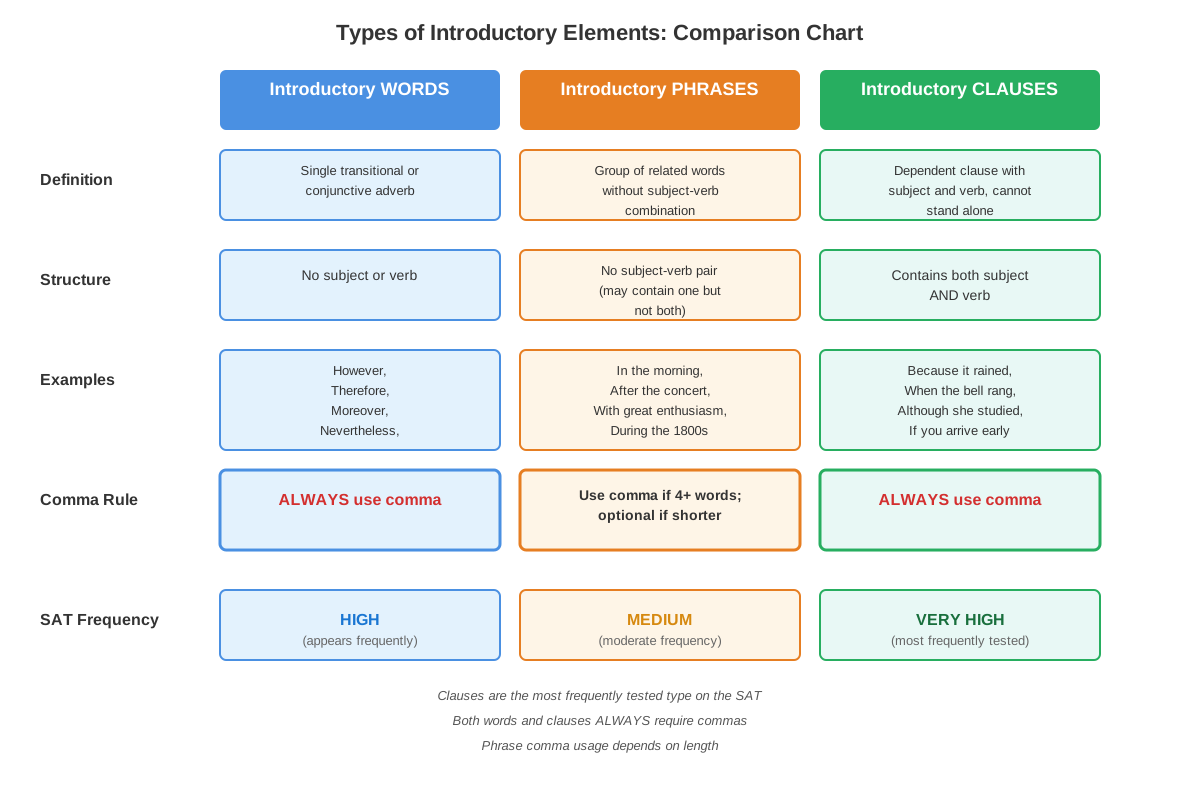
Introductory Words
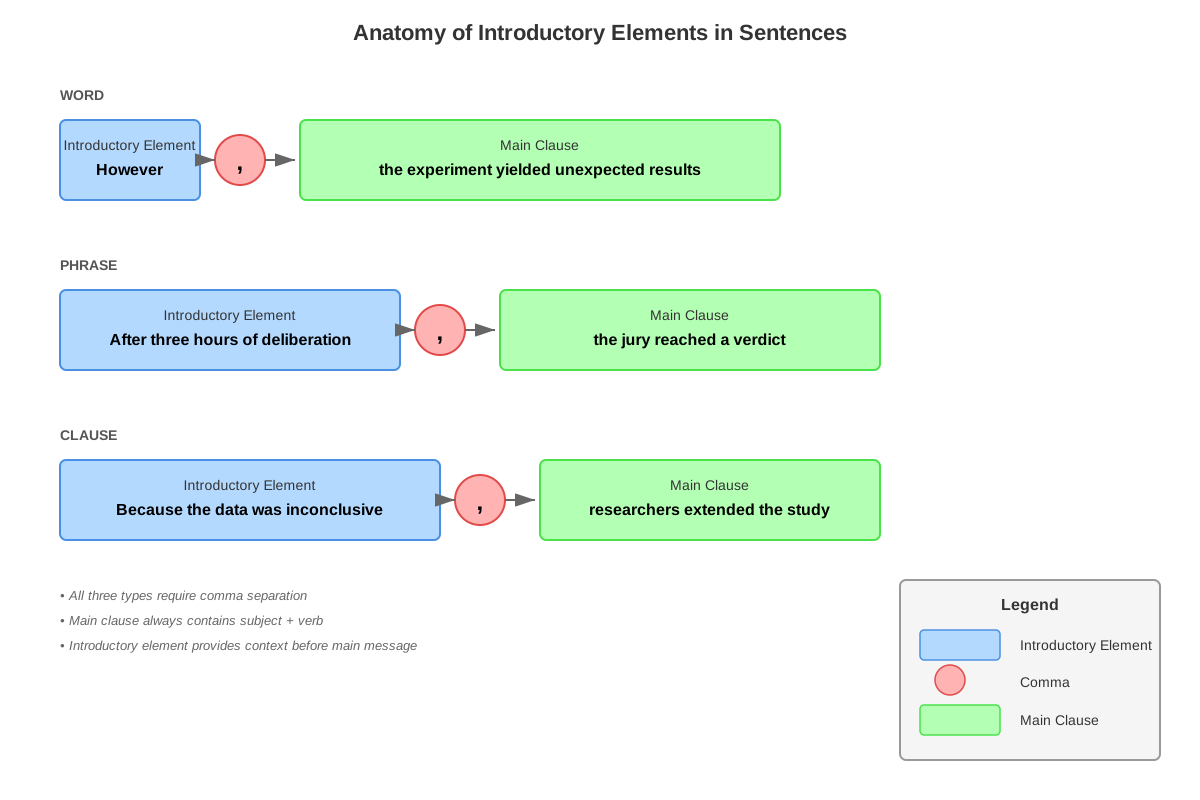
Single-word introductory elements include transitional adverbs and interjections that modify the entire sentence rather than a specific word. Common examples include: "However," "Therefore," "Nevertheless," "Furthermore," "Meanwhile," "Consequently," and "Indeed." These words typically require a comma after them because they function as sentence modifiers rather than as part of the main clause structure.
Example: "However, the results contradicted the hypothesis."
Some single introductory words, particularly short adverbs like "Then," "Now," "Soon," or "Next," may not require commas when they flow naturally into the sentence without creating a pause. The SAT generally follows the convention that transitional words of emphasis or contrast require commas, while simple temporal adverbs may not.
Introductory Phrases
Introductory phrases are groups of related words without a subject-verb combination that precede the main clause. These fall into several categories:
Prepositional phrases: These begin with a preposition and include its object. Short prepositional phrases (typically three words or fewer) often do not require commas, while longer ones generally do.
- Short: "In 1969 astronauts landed on the moon." (comma optional)
- Long: "In the early morning hours before dawn, the researchers began their observations." (comma required)
Participial phrases: These begin with a present or past participle (-ing or -ed verb forms) and modify the subject of the main clause.
- "Walking through the forest, the biologist discovered a new species."
- "Exhausted by the journey, the travelers rested."
Infinitive phrases: These begin with "to" plus a verb and express purpose or intention.
- "To understand the phenomenon, scientists conducted multiple experiments."
Absolute phrases: These contain a noun and a participle but don't grammatically connect to the rest of the sentence.
- "The experiment complete, the team analyzed the data."
Introductory Dependent Clauses
Introductory dependent clauses contain a subject and verb but cannot stand alone as complete sentences. They begin with subordinating conjunctions such as "because," "although," "when," "if," "while," "since," "unless," "after," "before," or "though." These clauses always require a comma when they introduce a sentence—this is one of the most tested rules on the SAT.
Example: "When the temperature dropped below freezing, the water crystallized."
The subordinating conjunction signals that the clause is dependent and must be followed by an independent clause. Students must recognize that the comma appears at the boundary between the dependent clause and the independent clause, not after the subordinating conjunction itself.
Comma Rules for Introductory Elements
The SAT tests specific, consistent rules about when introductory elements require commas:
| Type of Introductory Element | Comma Required? | Example |
|---|---|---|
| Dependent clause | Always | "Although it rained, the game continued." |
| Long prepositional phrase (4+ words) | Yes | "In the middle of the night, the alarm sounded." |
| Short prepositional phrase (1-3 words) | Usually no | "In 2020 the pandemic began." |
| Participial phrase | Always | "Running quickly, she caught the bus." |
| Infinitive phrase | Usually yes | "To succeed, students must study." |
| Transitional word/phrase | Usually yes | "However, the theory was disproven." |
| Absolute phrase | Always | "The sun having set, darkness fell." |
The underlying principle is that commas separate introductory elements from the main clause to prevent misreading and to signal where the core sentence begins. Longer introductory elements almost always require commas because they create more distance between the reader and the main subject-verb combination.
Identifying Where the Main Clause Begins
The critical skill for SAT questions is identifying the boundary between the introductory element and the main clause. The main clause begins with the subject that performs the action of the main verb. Students should ask: "What is the complete thought that could stand alone as a sentence?" Everything before that point is introductory material.
Process for identification:
- Locate the main subject (the "who" or "what" performing the main action)
- Locate the main verb (the action or state of being)
- Everything before the main subject is introductory material
- Apply the appropriate comma rule based on the type and length of that material
Example: "After the committee reviewed all proposals, the board made its decision."
- Main subject: "the board"
- Main verb: "made"
- Introductory element: "After the committee reviewed all proposals" (dependent clause)
- Comma required: Yes (dependent clause rule)
Concept Relationships
The concept of introductory elements builds directly on understanding clause structure → students must first distinguish dependent from independent clauses before they can identify when an introductory clause requires comma separation. This foundational knowledge leads to → recognizing sentence boundaries, which is essential for avoiding comma splices and run-on sentences.
Within the topic itself, the relationship flows as follows: Identifying introductory elements → requires → classifying their type (word, phrase, or clause) → which determines → applying the correct comma rule → resulting in → proper punctuation of the sentence.
Introductory elements connect to transitional expressions because many transitional words and phrases function as introductory elements. They also relate to participial phrases and modifier placement because misplaced introductory modifiers create dangling modifier errors—another common SAT testing point.
Understanding introductory elements enhances comprehension of sentence variety and rhetorical effectiveness because writers use these elements to create sophisticated sentence structures. This knowledge also supports reading comprehension because students who recognize introductory elements can more quickly identify the main point of complex sentences in passages.
High-Yield Facts
⭐ Introductory dependent clauses always require a comma before the main clause.
⭐ Subordinating conjunctions (when, because, although, if, since, while, etc.) signal dependent clauses that need comma separation when introductory.
⭐ Long prepositional phrases (4+ words) at the beginning of sentences typically require commas.
⭐ Transitional words like "however," "therefore," and "furthermore" require commas when they introduce sentences.
⭐ Participial phrases at the beginning of sentences always require commas and must modify the subject of the main clause.
- Short prepositional phrases (1-3 words) usually do not require commas unless needed for clarity.
- Infinitive phrases used as introductory elements typically require comma separation.
- The comma after an introductory element appears at the boundary between the introductory material and the main clause, not within the introductory element itself.
- Absolute phrases (noun + participle combinations) always require comma separation when introductory.
- Multiple introductory elements in sequence still require only one comma—at the point where the main clause begins.
- Introductory elements are optional additions; removing them leaves a grammatically complete sentence.
- The SAT rarely tests exceptions to comma rules; it focuses on clear-cut cases where rules apply consistently.
Quick check — test yourself on Introductory elements so far.
Try Flashcards →Common Misconceptions
Misconception: All introductory words require commas. → Correction: Short, simple adverbs like "then," "now," or "soon" often flow naturally into sentences without commas. Only transitional words that create a pause or modify the entire sentence consistently require commas.
Misconception: The comma goes after the subordinating conjunction in an introductory dependent clause. → Correction: The comma appears at the end of the entire dependent clause, separating it from the independent clause. For example: "When the bell rang, class ended" (not "When, the bell rang class ended").
Misconception: All prepositional phrases at the beginning of sentences need commas. → Correction: Short prepositional phrases (typically three words or fewer) often do not require commas. "In 1969 astronauts landed on the moon" is correct without a comma.
Misconception: Introductory elements are the same as the subject of the sentence. → Correction: Introductory elements come before the subject and provide context or modification. The subject is part of the main clause that follows the introductory material.
Misconception: If a sentence sounds fine without a pause, no comma is needed after an introductory element. → Correction: Comma rules for introductory elements are based on grammatical structure, not on whether a pause "sounds" necessary. Dependent clauses and participial phrases require commas regardless of how they sound when read aloud.
Misconception: Longer sentences automatically need more commas. → Correction: Comma placement depends on sentence structure, not length. A long sentence might need no commas if it has a simple structure, while a short sentence with an introductory element requires proper comma separation.
Worked Examples
Example 1: Identifying and Punctuating an Introductory Dependent Clause
Question: Which choice correctly punctuates the following sentence?
"Because the data supported the hypothesis the researchers published their findings."
A) Because the data supported the hypothesis the researchers published their findings.
B) Because, the data supported the hypothesis the researchers published their findings.
C) Because the data supported the hypothesis, the researchers published their findings.
D) Because the data supported, the hypothesis the researchers published their findings.
Solution Process:
Step 1: Identify the introductory element. The word "Because" is a subordinating conjunction, signaling a dependent clause. We need to find where this clause ends.
Step 2: Locate the subject and verb of the dependent clause. Subject: "the data"; Verb: "supported." The dependent clause is "Because the data supported the hypothesis."
Step 3: Identify the main clause. Subject: "the researchers"; Verb: "published." The main clause is "the researchers published their findings."
Step 4: Apply the rule. Introductory dependent clauses always require a comma at the boundary between the dependent clause and the independent clause.
Step 5: Evaluate choices:
- Choice A: No comma—violates the rule for introductory dependent clauses
- Choice B: Comma after "Because"—incorrect placement; the comma should separate clauses, not appear within the dependent clause
- Choice C: Comma after "hypothesis"—correct placement at the boundary between clauses
- Choice D: Comma after "supported"—incorrect placement; interrupts the dependent clause
Answer: C
Connection to Learning Objectives: This example demonstrates identifying introductory elements (dependent clause), explaining how they appear on the SAT (punctuation choice questions), and applying rules to answer questions correctly.
Example 2: Distinguishing Between Introductory Phrase Types
Question: Which sentence is correctly punctuated?
A) To understand the economic impact researchers analyzed decades of data.
B) In 2019 the study began.
C) Walking through the laboratory the scientist noticed an error.
D) Having completed the experiment the team celebrated.
Solution Process:
Step 1: Analyze each sentence's introductory element.
Sentence A: "To understand the economic impact" is an infinitive phrase (to + verb). Infinitive phrases used as introductory elements typically require commas. This sentence is missing a comma after "impact."
Sentence B: "In 2019" is a short prepositional phrase (three words). Short prepositional phrases often do not require commas. This sentence is correctly punctuated.
Sentence C: "Walking through the laboratory" is a participial phrase (present participle + modifiers). Participial phrases always require commas when introductory. This sentence is missing a comma after "laboratory."
Sentence D: "Having completed the experiment" is a participial phrase (perfect participle). This requires a comma. This sentence is missing a comma after "experiment."
Step 2: Identify the correctly punctuated sentence.
Only Sentence B follows the appropriate rule for its introductory element type.
Answer: B
Alternative Correct Versions:
- A) To understand the economic impact, researchers analyzed decades of data.
- C) Walking through the laboratory, the scientist noticed an error.
- D) Having completed the experiment, the team celebrated.
Connection to Learning Objectives: This example requires distinguishing between different types of introductory elements and determining when comma separation is required based on type and length—demonstrating mastery of key features and application to SAT-style questions.
Exam Strategy
When approaching SAT questions about introductory elements, follow this systematic process:
Step 1: Identify the main subject and verb. Ask yourself: "What is the core sentence that could stand alone?" Everything before the main subject is potentially introductory material.
Step 2: Classify the introductory element. Determine whether it's a word, phrase, or clause. Look for signal words:
- Subordinating conjunctions (when, because, although, if, while, since) → dependent clause
- Prepositions (in, on, at, during, after, before) → prepositional phrase
- -ing or -ed verb forms → participial phrase
- "To" + verb → infinitive phrase
- Transitional words (however, therefore, furthermore) → single word or transitional phrase
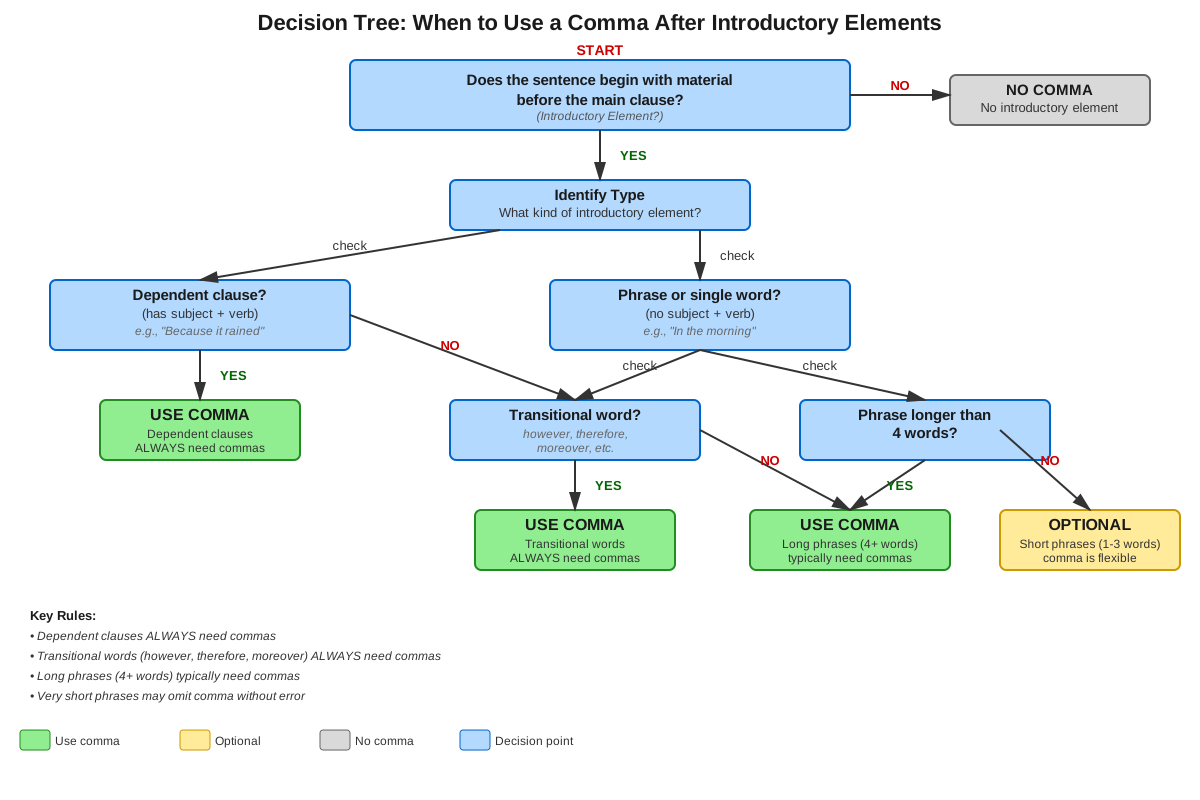
Step 3: Apply the appropriate rule. Use the decision tree:
- Dependent clause? → Always comma
- Participial phrase? → Always comma
- Long phrase (4+ words)? → Usually comma
- Short phrase (1-3 words)? → Usually no comma
- Transitional word? → Usually comma
Step 4: Eliminate wrong answers. On the SAT, incorrect choices often include:
- No punctuation when a comma is required
- Comma in the wrong location (within the introductory element rather than at the boundary)
- Unnecessary commas after short prepositional phrases
- Semicolons or other punctuation instead of commas
Exam Tip: If you see a subordinating conjunction at the beginning of a sentence, immediately look for the comma at the end of that dependent clause. This is one of the most reliable patterns on the SAT.
Trigger words and phrases to watch for:
- "When," "because," "although," "if," "since," "while" → signals dependent clause requiring comma
- "However," "therefore," "furthermore," "moreover" → signals transitional word requiring comma
- "-ing" word at the start → likely participial phrase requiring comma
- "To [verb]" at the start → likely infinitive phrase requiring comma
Time allocation: These questions should take 20-30 seconds each. If you can quickly identify the main clause boundary and classify the introductory element type, the correct answer becomes obvious. Don't overthink—the SAT tests consistent, clear-cut rules rather than exceptions.
Process of elimination strategy: When uncertain, eliminate choices with commas in obviously wrong positions (like immediately after subordinating conjunctions) and choices that place semicolons or colons after introductory elements. The SAT almost never uses semicolons or colons to separate introductory elements from main clauses.
Memory Techniques
FANBOYS vs. AAAWWUBBIS: While FANBOYS helps remember coordinating conjunctions, AAAWWUBBIS helps remember subordinating conjunctions that create dependent clauses requiring commas when introductory:
- After, Although, As, When, While, Until, Because, Before, If, Since
The "Remove It" Test: If you can remove the introductory element and still have a complete sentence, you've correctly identified it. This helps distinguish introductory material from the main clause.
The "Long = Comma" Rule: For prepositional phrases, remember: if you can count to four or more words, add a comma. This simple counting technique works for most SAT questions involving introductory prepositional phrases.
The Boundary Visualization: Imagine a fence between the introductory element and the main clause. The comma is the gate in that fence. This helps you remember that the comma goes at the boundary, not within either section.
The "-ING Alert": When you see an -ing word at the start of a sentence, immediately think "participial phrase = comma required." This pattern appears frequently on the SAT.
The "However" Family: Group transitional words together mentally: However, Therefore, Furthermore, Moreover, Nevertheless, Consequently. All require commas when they introduce sentences. Think of them as the "formal transition family" that always dresses up with a comma.
Summary
Introductory elements are words, phrases, or clauses that appear before the main independent clause of a sentence, providing context, transition, or additional information. Mastering this topic requires three core skills: identifying where the main clause begins, classifying the type of introductory element, and applying the appropriate comma rule. The SAT consistently tests whether students can recognize that introductory dependent clauses always require commas, that long phrases typically need comma separation, and that participial phrases must be set off from the main clause. Success on these questions depends on systematically locating the main subject and verb, determining what precedes them, and understanding that commas mark the boundary between introductory material and the core sentence. This topic appears frequently on the SAT—in approximately 10-15% of punctuation questions—making it essential for students targeting high scores in the Reading and Writing section. The rules are consistent and predictable, rewarding students who practice identifying sentence structure and applying comma conventions methodically.
Key Takeaways
- Introductory elements precede the main clause and provide context, transition, or modification; they are not essential to the sentence's grammatical completeness.
- Introductory dependent clauses (beginning with subordinating conjunctions like "when," "because," "although") always require a comma at the boundary with the main clause.
- Participial phrases (-ing or -ed verb forms) at the beginning of sentences always require comma separation and must modify the subject of the main clause.
- Long prepositional phrases (four or more words) typically require commas, while short ones (three words or fewer) usually do not.
- Transitional words like "however," "therefore," and "furthermore" require commas when they introduce sentences.
- The comma appears at the boundary between the introductory element and the main clause, not within the introductory element itself.
- Identifying the main subject and verb is the critical first step in determining where introductory material ends and the main clause begins.
Related Topics
Dependent and Independent Clauses: Understanding clause types is foundational to recognizing introductory dependent clauses. Mastering introductory elements strengthens your ability to identify and correctly punctuate all clause relationships.
Comma Splices and Run-On Sentences: Introductory elements relate to broader sentence boundary issues. Students who understand where sentences properly begin and end can avoid these common errors.
Participial Phrases and Dangling Modifiers: Introductory participial phrases must modify the subject of the main clause. This topic extends into modifier placement and avoiding dangling modifier errors.
Transitional Expressions: Many introductory elements function as transitions between ideas. Understanding how to punctuate these expressions enhances both sentence-level correctness and paragraph coherence.
Sentence Variety and Rhetorical Effectiveness: Mastering introductory elements enables writers to create more sophisticated sentence structures, varying sentence openings for stylistic effect—a skill tested in the rhetorical synthesis questions on the SAT.
Practice CTA
Now that you've mastered the core concepts of introductory elements, it's time to solidify your understanding through practice. Attempt the practice questions to apply these rules to SAT-style scenarios, and use the flashcards to reinforce your recognition of different introductory element types and their punctuation requirements. Remember: these questions appear frequently on the SAT, and consistent practice with identifying sentence structure will build the automaticity you need to answer quickly and confidently on test day. Each practice question you complete strengthens your pattern recognition and brings you closer to your target score. You've got this!
Sign up free to keep reading
Create a free AnvayaPrep account to finish this SAT guide on Introductory elements — plus flashcards and practice questions.