Overview
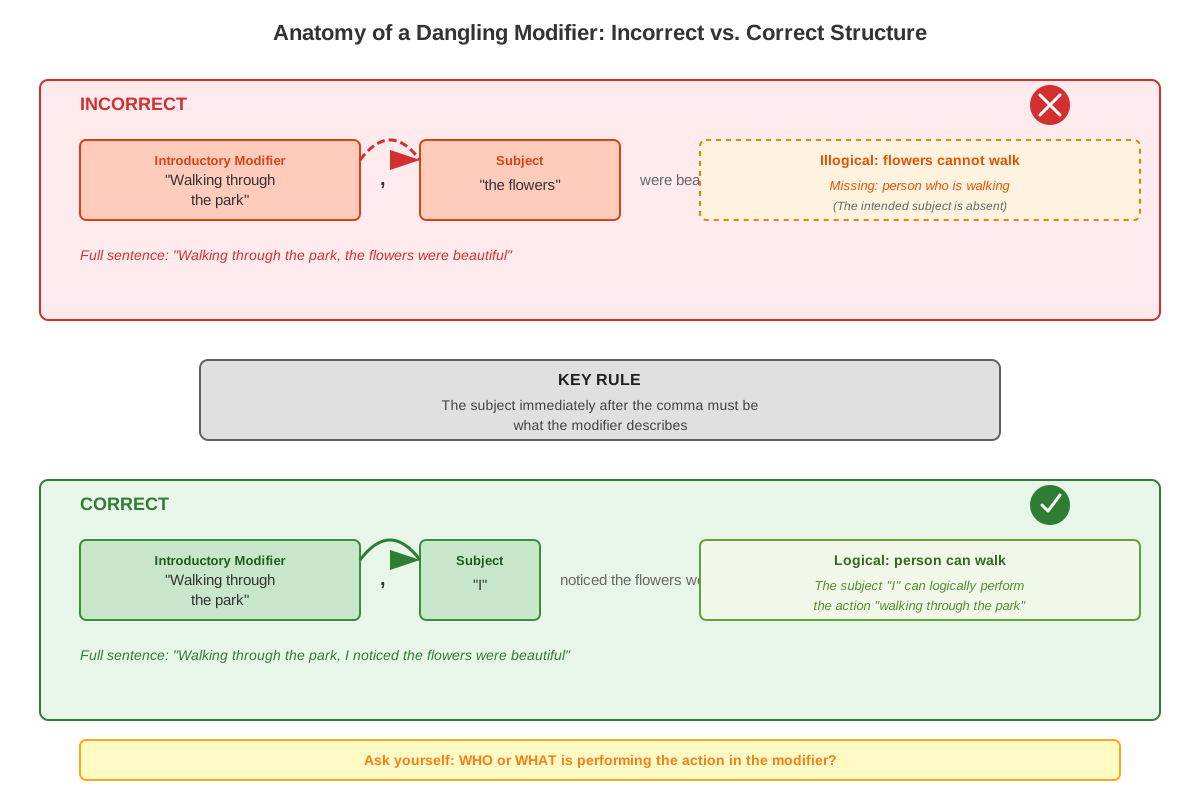
Dangling modifiers represent one of the most frequently tested grammatical concepts in the SAT Reading and Writing (RW) section. A dangling modifier occurs when a descriptive phrase at the beginning or end of a sentence fails to clearly and logically modify the intended subject. Instead of modifying the correct noun, the modifier "dangles" without a proper anchor, creating confusion or unintended humor. For example, "Walking through the park, the flowers were beautiful" incorrectly suggests that the flowers were walking through the park, when the writer meant that a person was walking.
Understanding sat dangling modifiers is essential because these questions appear consistently across multiple test administrations, typically in 1-3 questions per exam. The SAT tests this concept to assess whether students can recognize and correct unclear sentence structures that obscure meaning. Mastering dangling modifiers demonstrates command of Standard English conventions and the ability to ensure that sentences communicate ideas precisely and logically—skills that extend beyond test-taking into academic and professional writing.
Within the broader context of Form, Structure, and Sense, dangling modifiers connect directly to other modifier-related concepts such as misplaced modifiers, parallel structure, and subject-verb agreement. All these topics share a common thread: ensuring that sentence elements relate to each other in clear, logical ways. When students master dangling modifiers, they develop a stronger intuition for sentence structure overall, making it easier to identify other structural errors and to construct more sophisticated, grammatically sound sentences in their own writing.
Learning Objectives
- [ ] Identify key features of dangling modifiers in sentences
- [ ] Explain how dangling modifiers appears on the SAT
- [ ] Apply dangling modifiers to answer SAT-style questions
- [ ] Distinguish between dangling modifiers and correctly placed modifiers
- [ ] Recognize the most common sentence patterns that create dangling modifiers
- [ ] Correct dangling modifiers by restructuring sentences appropriately
- [ ] Evaluate multiple answer choices to select the option that eliminates dangling modifiers while maintaining sentence meaning
Prerequisites
- Basic sentence structure: Understanding subjects, verbs, and objects is essential because dangling modifiers occur when the relationship between these elements breaks down
- Parts of speech: Recognizing nouns, verbs, adjectives, and participles helps identify what a modifier is trying to describe
- Phrase types: Familiarity with participial phrases, prepositional phrases, and infinitive phrases enables students to spot modifying elements that might dangle
- Logical sentence meaning: The ability to assess whether a sentence makes logical sense is crucial for detecting when a modifier doesn't match its intended subject
Why This Topic Matters
Dangling modifiers matter in real-world contexts because they create ambiguity and confusion in professional, academic, and technical writing. In business communications, scientific reports, and legal documents, unclear modification can lead to misinterpretation of critical information. For instance, "After reviewing the data, the conclusion was obvious" fails to specify who reviewed the data, potentially obscuring accountability in a research context.
On the SAT, dangling modifier questions appear with high frequency—typically 1-3 questions per test administration, making them a reliable source of points for prepared students. These questions most commonly appear in the Standard English Conventions domain, which comprises approximately 26% of the Reading and Writing section. The College Board specifically tests dangling modifiers because they represent a common error in student writing and because correcting them requires both grammatical knowledge and logical reasoning.
The SAT presents dangling modifiers in several characteristic ways: sentences beginning with participial phrases (e.g., "Having finished the project..."), sentences with introductory prepositional phrases describing actions or states, and sentences where passive voice construction has obscured the logical subject. Questions typically provide four versions of a sentence or clause, with only one option correctly positioning the modifier and its subject. Students must recognize not just grammatical correctness but also logical coherence and preservation of the original meaning.
Core Concepts
What Is a Dangling Modifier?
A dangling modifier is a word, phrase, or clause that describes something that has been left out of the sentence or that does not clearly and logically relate to the word it's supposed to modify. Most commonly, dangling modifiers appear as introductory phrases—particularly participial phrases, infinitive phrases, or prepositional phrases—that begin a sentence but fail to connect logically with the subject that immediately follows.
The fundamental rule governing modifiers is proximity and logic: a modifying phrase should be placed next to the word it modifies, and the relationship must make logical sense. When a sentence begins with a modifying phrase, the subject of the main clause must be the person or thing performing the action or experiencing the state described in that phrase.
Anatomy of a Dangling Modifier
Consider this classic example: "Running quickly to catch the bus, my backpack fell off my shoulder." The introductory phrase "Running quickly to catch the bus" is a participial phrase that should modify whoever was running. However, the subject of the main clause is "my backpack," which creates an illogical statement suggesting that the backpack was running to catch the bus.
The corrected version requires restructuring: "Running quickly to catch the bus, I felt my backpack fall off my shoulder" or "As I ran quickly to catch the bus, my backpack fell off my shoulder." Both corrections ensure that the person running (I) is properly identified as the subject.
Common Patterns That Create Dangling Modifiers
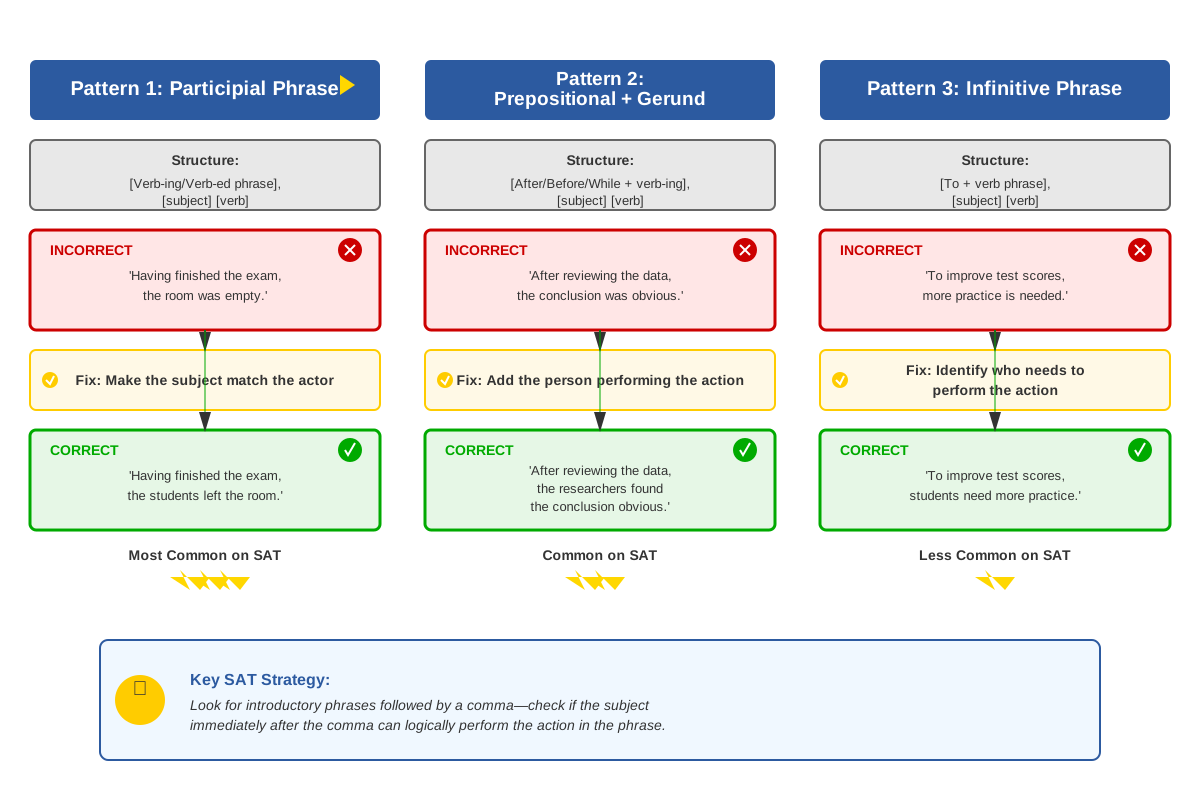
| Pattern Type | Dangling Example | Corrected Version |
|---|---|---|
| Participial phrase | "Having studied all night, the exam was easy." | "Having studied all night, Maria found the exam easy." |
| Infinitive phrase | "To improve test scores, more practice is needed." | "To improve test scores, students need more practice." |
| Prepositional phrase | "At the age of five, my family moved to Texas." | "When I was five, my family moved to Texas." |
| Elliptical clause | "While reviewing the data, several errors were found." | "While reviewing the data, the team found several errors." |
The Subject Immediately Following Rule
The most reliable method for identifying dangling modifiers on the SAT involves checking what immediately follows the introductory comma. After an introductory modifying phrase, the very next word (or words) should be the subject that logically performs the action or experiences the state described in that phrase.
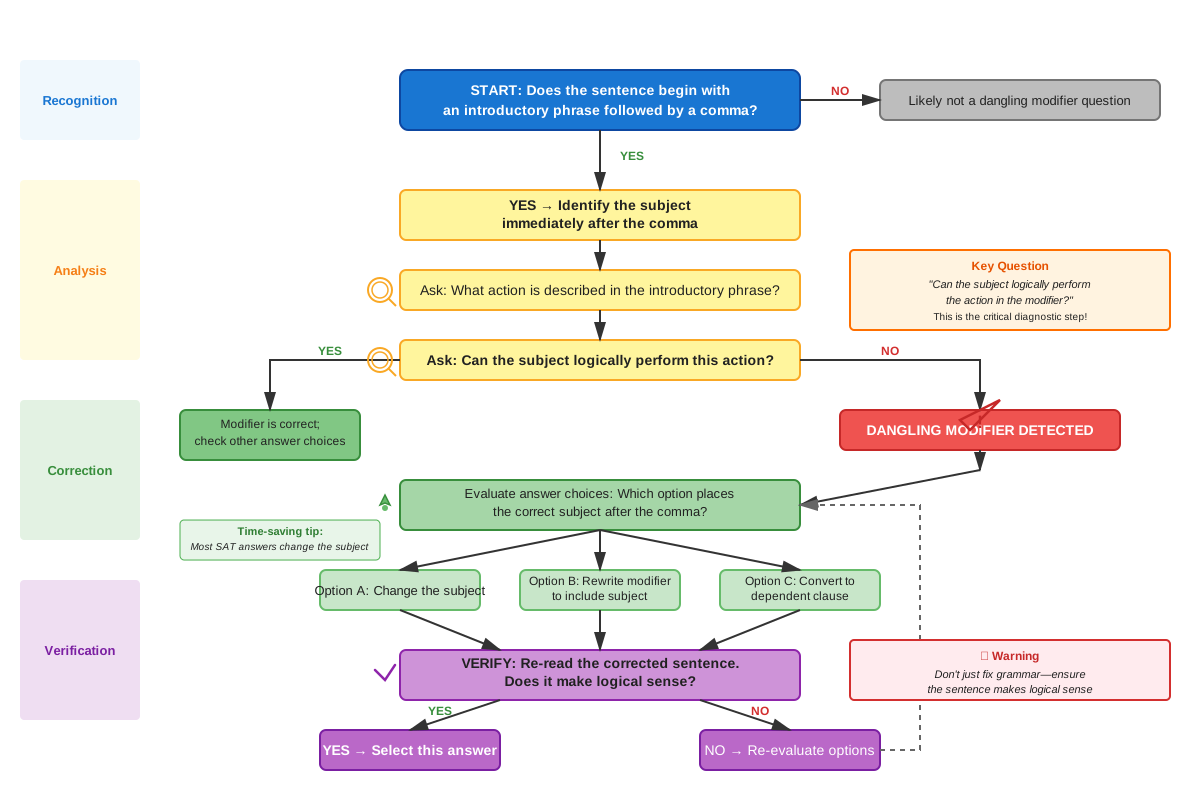
Process for checking:
- Identify the introductory phrase before the comma
- Determine what action or state it describes
- Check the subject immediately after the comma
- Ask: "Can this subject logically perform this action or experience this state?"
- If no, the modifier is dangling
Passive Voice and Dangling Modifiers
Passive voice constructions frequently create dangling modifiers because they obscure the actor performing an action. Consider: "After being carefully examined, the results were published." The phrase "after being carefully examined" suggests something was examined, but "the results" were published, not examined. The data or samples were examined, creating a logical disconnect.
Correction requires either activating the voice or clarifying the subject: "After the samples were carefully examined, the researchers published the results" or "After carefully examining the samples, the researchers published the results."
Acceptable Absolute Phrases
Not all introductory phrases require a matching subject. Absolute phrases—which contain a noun and a participle but don't modify a specific word—are grammatically acceptable: "The exam having ended, students left the room." Similarly, some introductory expressions function as sentence adverbs and don't require a specific subject: "Generally speaking, the policy was effective."
However, the SAT rarely tests these exceptions. Most SAT questions focus on clear-cut cases where a participial or infinitive phrase requires a logical subject.
Correcting Dangling Modifiers: Three Strategies
Strategy 1: Add the appropriate subject after the comma
- Dangling: "While walking through the museum, the paintings were impressive."
- Corrected: "While walking through the museum, we found the paintings impressive."
Strategy 2: Restructure the introductory phrase into a dependent clause
- Dangling: "After reviewing the applications, the decision was difficult."
- Corrected: "After we reviewed the applications, the decision was difficult."
Strategy 3: Move the modifier next to what it modifies
- Dangling: "Covered in chocolate, I served the strawberries."
- Corrected: "I served the strawberries covered in chocolate."
Concept Relationships
Dangling modifiers connect intimately with several other grammatical concepts tested on the SAT. Understanding these relationships strengthens overall command of sentence structure.
Dangling Modifiers → Misplaced Modifiers: Both involve incorrect modifier placement, but misplaced modifiers have a clear subject in the sentence—it's just in the wrong position. Dangling modifiers lack a logical subject entirely. Mastering dangling modifiers first makes misplaced modifiers easier to identify.
Dangling Modifiers → Passive Voice: Passive constructions often create dangling modifiers by removing the actor from the subject position. Understanding when passive voice obscures meaning helps prevent dangling modifiers.
Dangling Modifiers → Logical Coherence: Beyond grammar, dangling modifiers represent failures of logical expression. This connects to broader reading comprehension skills—the ability to assess whether a statement makes sense.
Dangling Modifiers → Parallel Structure: Both concepts require elements within a sentence to match in form and logic. Parallel structure ensures consistency across lists and comparisons; dangling modifiers ensure consistency between modifiers and subjects.
Relationship map: Sentence Structure Fundamentals → Modifier Placement Rules → Dangling Modifiers + Misplaced Modifiers → Logical Sentence Construction → Clear Communication
High-Yield Facts
⭐ A dangling modifier occurs when an introductory phrase doesn't logically connect to the subject immediately following the comma.
⭐ The subject that appears immediately after an introductory modifying phrase must be able to logically perform the action described in that phrase.
⭐ Participial phrases (beginning with -ing or -ed verbs) are the most common source of dangling modifiers on the SAT.
⭐ Passive voice constructions frequently create dangling modifiers by obscuring the true actor of an action.
⭐ To correct a dangling modifier, either add the appropriate subject after the comma or restructure the introductory phrase into a complete clause.
- Infinitive phrases (beginning with "to + verb") can also create dangling modifiers when the subject doesn't match the intended actor.
- Prepositional phrases describing age, time, or condition often dangle when they illogically modify the wrong subject.
- The SAT will never correct a dangling modifier by simply removing the introductory phrase—the meaning must be preserved.
- Elliptical clauses (with implied subjects like "while reviewing" instead of "while I was reviewing") require special attention because the implied subject must match the main clause subject.
- Dangling modifiers create unintentional humor or absurdity, which is often the quickest way to spot them during initial reading.
- On the SAT, three of the four answer choices typically contain some form of error; only one will both correct the dangling modifier and maintain logical meaning.
Quick check — test yourself on Dangling modifiers so far.
Try Flashcards →Common Misconceptions
Misconception: Any sentence beginning with an -ing word contains a dangling modifier.
Correction: Participial phrases are grammatically correct when the subject immediately following the comma can logically perform the action. "Running through the park, Sarah felt energized" is correct because Sarah was running.
Misconception: Dangling modifiers only occur at the beginning of sentences.
Correction: While most SAT questions test introductory modifiers, dangling modifiers can also appear at the end of sentences: "The experiment was completed successfully, having followed all protocols carefully." The modifier should describe who followed the protocols.
Misconception: If a sentence sounds okay when read aloud, it doesn't have a dangling modifier.
Correction: Many dangling modifiers sound acceptable in casual speech but violate written Standard English conventions. The SAT tests formal written English, which requires strict logical connections between modifiers and subjects.
Misconception: Adding more words to the introductory phrase will fix a dangling modifier.
Correction: The problem isn't the length or detail of the modifier—it's the mismatch between the modifier and the subject. Only changing the subject or restructuring the sentence will correct the error.
Misconception: Dangling modifiers are the same as sentence fragments.
Correction: A sentence with a dangling modifier is grammatically complete (it has a subject and verb) but logically flawed. A fragment lacks essential sentence elements. "Walking through the park" is a fragment; "Walking through the park, the flowers were beautiful" is a complete sentence with a dangling modifier.
Misconception: The correct answer will always be the shortest option.
Correction: While the SAT values conciseness, correcting a dangling modifier sometimes requires adding words to clarify the subject. The correct answer prioritizes logical clarity over brevity.
Worked Examples
Example 1: Participial Phrase Dangling Modifier
Question: Which choice completes the sentence with correct grammar and logical meaning?
"Having prepared extensively for the presentation, _____________."
A) the audience was impressed by the speaker's confidence
B) the speaker's confidence impressed the audience
C) confidence was displayed by the speaker to the audience
D) the speaker displayed confidence that impressed the audience
Step 1: Identify the introductory modifier
"Having prepared extensively for the presentation" is a participial phrase describing who prepared.
Step 2: Determine who logically performed this action
Someone (a person) prepared for the presentation. The subject after the comma must be that person.
Step 3: Evaluate each choice
- Choice A: "the audience" is the subject. Did the audience prepare? No—illogical. Dangling modifier.
- Choice B: "the speaker's confidence" is the subject. Did confidence prepare? No—illogical. Dangling modifier.
- Choice C: "confidence" is the subject. Did confidence prepare? No—illogical. Dangling modifier.
- Choice D: "the speaker" is the subject. Did the speaker prepare? Yes—logical match!
Step 4: Verify meaning preservation
Choice D maintains the intended meaning: the speaker prepared, then displayed confidence.
Answer: D
Connection to learning objectives: This example demonstrates identifying the key feature of dangling modifiers (mismatch between modifier and subject) and applying the concept to select the correct SAT answer.
Example 2: Infinitive Phrase with Passive Voice
Question: Which choice best combines the sentences while maintaining correct grammar?
"The goal was to reduce energy consumption. Significant changes were made to the building's design."
A) To reduce energy consumption, significant changes were made to the building's design.
B) To reduce energy consumption, the architects made significant changes to the building's design.
C) Significant changes were made to the building's design to reduce energy consumption.
D) The building's design, to reduce energy consumption, had significant changes made to it.
Step 1: Identify potential modifiers
"To reduce energy consumption" is an infinitive phrase expressing purpose. Who wanted to reduce consumption?
Step 2: Analyze the logical actor
People (architects, designers, or building owners) wanted to reduce consumption, not the changes themselves or the building.
Step 3: Evaluate each choice
- Choice A: "significant changes" is the subject. Do changes want to reduce consumption? This is illogical—changes are the means, not the actor. Dangling modifier.
- Choice B: "the architects" is the subject. Do architects want to reduce consumption? Yes—logical. The architects made changes for this purpose.
- Choice C: This restructures to avoid the dangling modifier by placing the infinitive phrase after the main clause, where it clearly modifies the purpose of the changes. This is grammatically acceptable.
- Choice D: Awkward construction with unnecessary passive voice, though technically not dangling.
Step 4: Choose the clearest, most concise option
Both B and C are grammatically correct, but B more clearly identifies the actor and follows standard SAT preference for active voice and clear subjects.
Answer: B
Connection to learning objectives: This example shows how passive voice creates dangling modifiers and demonstrates the strategy of adding an appropriate subject to correct the error.
Exam Strategy
Systematic Approach to Dangling Modifier Questions
When encountering a potential dangling modifier question on the SAT, follow this process:
- Identify the introductory element: Look for phrases before the first comma, especially those beginning with -ing words, -ed words, or "to + verb."
- Ask "Who or what?": Determine who or what logically performs the action or experiences the state described in the introductory phrase.
- Check the subject after the comma: The word or phrase immediately following the comma should answer your "who or what" question.
- Apply the logic test: Mentally insert the subject into the introductory phrase. Does it make sense? "The data, having analyzed the results..." makes no sense because data cannot analyze.
- Eliminate illogical options first: Cross out any choice where the subject cannot logically perform the modifier's action.
Trigger Words and Phrases
Watch for these high-frequency patterns that often signal dangling modifier questions:
- Participial phrases: "Having completed," "Walking through," "Surprised by," "Located in"
- Infinitive phrases: "To achieve," "To understand," "To improve"
- Prepositional phrases with age/time: "At the age of," "During the meeting," "After the experiment"
- Elliptical clauses: "While reviewing," "When considering," "Before deciding"
Process of Elimination Tips
Exam Tip: If three answer choices begin with different subjects but one begins with the same subject as the original, that matching subject is often (but not always) correct—verify the logic.
- Eliminate passive constructions first when the introductory phrase describes an action requiring a clear actor
- Eliminate abstract nouns as subjects (like "the decision," "the results," "the conclusion") when the modifier describes a human action (like analyzing, deciding, or concluding)
- Keep options that add clarifying subjects even if they're longer—correctness trumps brevity
- Verify that corrections preserve the original meaning—the SAT won't ask you to change what the sentence is trying to say
Time Allocation
Dangling modifier questions should take 30-45 seconds once you're practiced. They require careful reading but follow predictable patterns. If you're spending more than a minute, you may be overthinking—return to the basic question: "Can this subject logically do what the modifier describes?"
Memory Techniques
The "Can It?" Mnemonic
Check the comma
Ask who acts
Name the subject
Is it logical?
Test by inserting
After reading an introductory phrase, mentally run through "CAN IT?" to verify the modifier isn't dangling.
The Subject-Swap Visualization
Visualize physically performing the action described in the modifier. Then check if the subject after the comma could be doing that action. If you can't picture "the data analyzing results" or "the conclusion reviewing evidence," the modifier is dangling.
The "Immediately After" Rule
Remember: Introductory phrase → Always check → Subject immediately after comma
The acronym IAS reminds you that the subject immediately after the comma is always what you should check first.
The Participial Phrase Pattern
For -ing and -ed words starting sentences, remember: PING
Participle starts sentence
Identify the actor
Next word after comma must be that actor
Grammar requires logical match
Summary
Dangling modifiers represent a critical grammar concept on the SAT Reading and Writing section, appearing in 1-3 questions per test. A dangling modifier occurs when an introductory phrase—typically a participial phrase, infinitive phrase, or prepositional phrase—fails to logically connect with the subject immediately following the comma. The fundamental principle is proximity and logic: the subject after the comma must be able to perform the action or experience the state described in the modifier. Common patterns include sentences beginning with -ing or -ed verbs, infinitive phrases expressing purpose, and passive voice constructions that obscure the true actor. To correct dangling modifiers, students can add an appropriate subject after the comma, restructure the introductory phrase into a dependent clause, or reposition the modifier. Success on these questions requires both grammatical knowledge and logical reasoning—the ability to assess whether a sentence makes sense beyond just following rules. Mastering dangling modifiers strengthens overall command of sentence structure and prepares students for related concepts like misplaced modifiers and parallel structure.
Key Takeaways
- Dangling modifiers occur when introductory phrases don't logically match the subject immediately following the comma
- The subject after the comma must be able to perform the action described in the introductory modifier
- Participial phrases (-ing and -ed verbs) and infinitive phrases (to + verb) are the most common sources of dangling modifiers on the SAT
- Passive voice frequently creates dangling modifiers by removing the actor from the subject position
- Correcting dangling modifiers requires either adding the appropriate subject or restructuring the sentence, not just removing words
- Apply the logic test: mentally insert the subject into the modifier's action to verify it makes sense
- On the SAT, eliminate answer choices where abstract nouns or objects appear as subjects when the modifier describes human actions
Related Topics
Misplaced Modifiers: While dangling modifiers lack a logical subject entirely, misplaced modifiers have the correct subject in the sentence but in the wrong position, creating ambiguity or unintended meanings. Mastering dangling modifiers provides the foundation for identifying and correcting misplaced modifiers.
Parallel Structure: This concept requires that elements in a series or comparison maintain consistent grammatical form. Like dangling modifiers, parallel structure questions test the ability to recognize and correct structural inconsistencies that obscure meaning.
Subject-Verb Agreement: Understanding how subjects and verbs must agree in number connects to dangling modifiers through the broader principle that sentence elements must relate logically and grammatically.
Passive vs. Active Voice: Since passive constructions often create dangling modifiers, understanding when to use active voice strengthens the ability to write clear, direct sentences without modification errors.
Sentence Structure and Clauses: Advanced understanding of independent and dependent clauses, along with various phrase types, enables more sophisticated analysis of how modifiers function within complex sentences.
Practice CTA
Now that you've mastered the core concepts of dangling modifiers, it's time to reinforce your learning through active practice. Attempt the practice questions to apply these strategies to SAT-style problems, and use the flashcards to memorize high-yield facts and common patterns. Remember: recognizing dangling modifiers becomes intuitive with practice. Each question you work through strengthens your ability to spot these errors quickly and confidently on test day. You've built a solid foundation—now transform that knowledge into points!
Sign up free to keep reading
Create a free AnvayaPrep account to finish this SAT guide on Dangling modifiers — plus flashcards and practice questions.