Overview
Sentence combining is a critical skill tested in the SAT Reading and Writing (RW) section that requires students to merge multiple short, choppy sentences into a single, grammatically correct, and stylistically effective sentence. This skill goes beyond simple grammar knowledge—it tests a student's ability to recognize logical relationships between ideas, maintain proper punctuation, and create clear, concise prose that flows naturally. On the SAT, sat sentence combining questions typically present students with a passage containing underlined portions where multiple sentences could be merged, asking them to select the revision that best combines the information while preserving meaning and adhering to standard English conventions.
Understanding sentence combining is essential for SAT success because these questions appear frequently throughout the RW section and directly impact both the Expression of Ideas and Standard English Conventions domains. Students who master this topic can quickly identify opportunities to improve sentence structure, eliminate redundancy, and create more sophisticated writing. The ability to combine sentences effectively demonstrates advanced writing maturity—a quality the SAT consistently rewards with higher scores.
This topic sits at the intersection of grammar, punctuation, and rhetorical effectiveness within the Boundaries and Sentence Structure unit. It builds upon foundational knowledge of independent and dependent clauses, coordination and subordination, and punctuation rules while connecting forward to broader concepts of style, tone, and passage organization. Mastering sentence combining enables students to tackle related questions about transitions, logical flow, and effective expression with greater confidence and accuracy.
Learning Objectives
- [ ] Identify key features of sentence combining
- [ ] Explain how sentence combining appears on the SAT
- [ ] Apply sentence combining to answer SAT-style questions
- [ ] Distinguish between effective and ineffective methods of combining sentences
- [ ] Evaluate combined sentences for grammatical correctness and logical coherence
- [ ] Recognize when sentences should remain separate versus when they should be merged
- [ ] Select appropriate punctuation and conjunctions for different sentence-combining scenarios
Prerequisites
- Independent and dependent clauses: Understanding clause types is fundamental because sentence combining requires knowing which clauses can stand alone and which need support
- Coordinating and subordinating conjunctions: These are the primary tools used to join sentences, making knowledge of their functions essential
- Comma rules and semicolon usage: Proper punctuation determines whether combined sentences are grammatically correct or create run-ons and comma splices
- Sentence fragments and run-on sentences: Recognizing these errors helps students avoid creating them when combining sentences
- Subject-verb agreement: Combined sentences must maintain agreement throughout, even when clauses are merged
Why This Topic Matters
In real-world writing, the ability to combine sentences effectively separates competent writers from exceptional ones. Professional writers, journalists, and academics constantly make decisions about sentence structure to control pacing, emphasize relationships between ideas, and maintain reader engagement. Choppy, repetitive sentences create a juvenile tone and obscure logical connections, while skillfully combined sentences demonstrate sophistication and clarity. This skill transfers directly to college writing, where professors expect students to craft complex, nuanced arguments with varied sentence structures.
On the SAT, sentence combining questions appear with high frequency—students can expect to encounter 3-5 such questions per test administration. These questions typically appear as part of the Standard English Conventions domain but also intersect with Expression of Ideas when the focus shifts to rhetorical effectiveness. The College Board reports that approximately 15-20% of all grammar and usage questions involve some aspect of sentence structure and boundaries, making this one of the highest-yield topics for focused study.
Sentence combining appears in SAT passages in several predictable ways: passages may contain a series of short, choppy sentences that could be streamlined; sentences with repeated subjects or predicates that create redundancy; or separate sentences expressing closely related ideas that would flow better if merged. The test consistently rewards students who can identify these opportunities and select revisions that improve both correctness and effectiveness without changing the original meaning.
Core Concepts
The Fundamentals of Sentence Combining
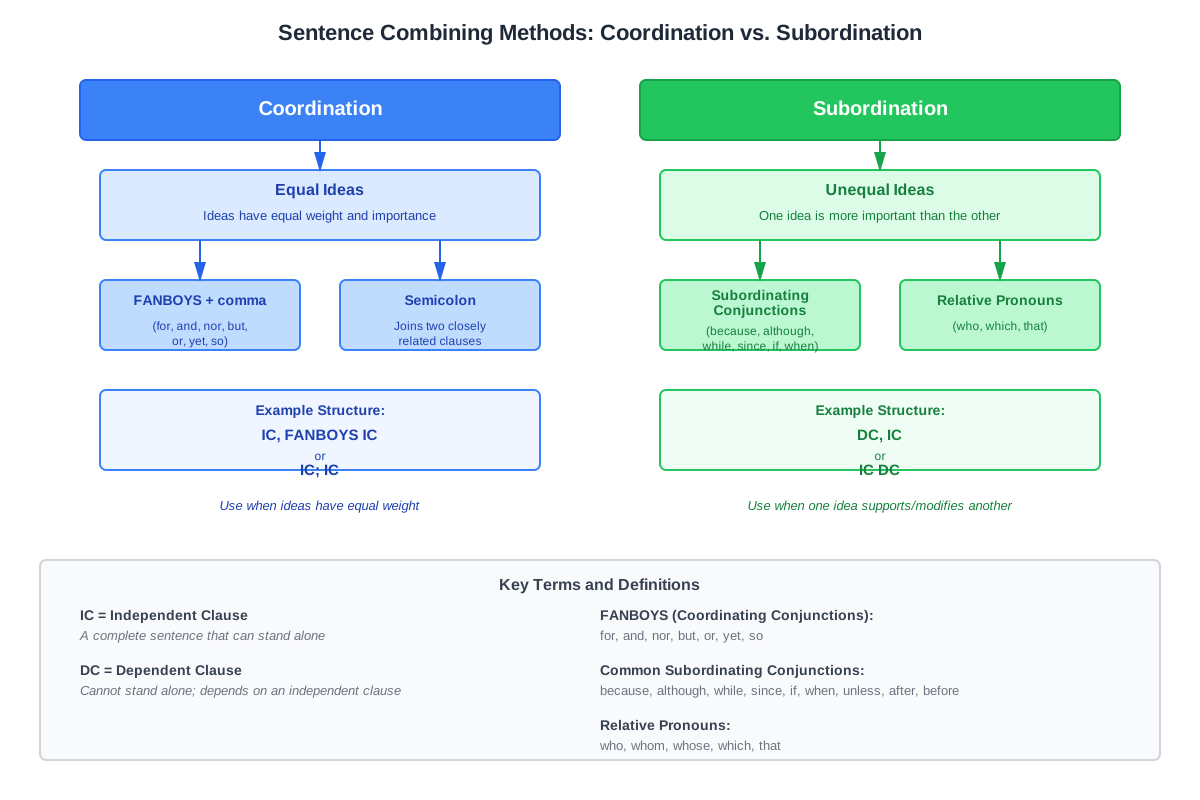
Sentence combining refers to the process of merging two or more sentences into a single sentence while maintaining grammatical correctness, preserving the original meaning, and improving overall clarity or flow. This process requires understanding the logical relationship between the ideas being combined—whether they are equally important (coordination), whether one idea depends on or modifies another (subordination), or whether they represent a list or series.
The SAT tests sentence combining through questions that present underlined portions of text containing multiple sentences. Students must evaluate whether the sentences should be combined and, if so, which method of combination is most effective. The correct answer will always be grammatically correct, but among grammatically correct options, students must choose the one that best expresses the relationship between ideas and maintains the style and tone of the passage.
Coordination: Combining Equal Ideas
When two sentences express ideas of equal importance, coordination is the appropriate combining method. Coordination uses coordinating conjunctions (for, and, nor, but, or, yet, so—remembered by the acronym FANBOYS) to join independent clauses. The resulting structure is called a compound sentence.
Basic coordination pattern: Independent clause + comma + coordinating conjunction + independent clause
Example:
- Before: "The experiment succeeded. The results were unexpected."
- After: "The experiment succeeded, but the results were unexpected."
Alternatively, closely related independent clauses can be joined with a semicolon when no coordinating conjunction is needed:
Example:
- Before: "The data was clear. The conclusion was inevitable."
- After: "The data was clear; the conclusion was inevitable."
A third coordination option uses a semicolon followed by a conjunctive adverb (however, therefore, moreover, nevertheless, consequently) and a comma:
Example:
- Before: "The hypothesis was disproven. The research continued."
- After: "The hypothesis was disproven; nevertheless, the research continued."
Subordination: Combining Unequal Ideas
When one idea is more important than another or when one idea provides context for another, subordination is the appropriate method. Subordination uses subordinating conjunctions (because, although, since, while, when, if, unless, after, before, etc.) to create complex sentences with one independent clause and one or more dependent clauses.
Basic subordination pattern: Subordinating conjunction + dependent clause + comma + independent clause
OR: Independent clause + subordinating conjunction + dependent clause (no comma needed)
Example:
- Before: "The temperature dropped. The experiment had to be postponed."
- After: "Because the temperature dropped, the experiment had to be postponed."
- Alternative: "The experiment had to be postponed because the temperature dropped."
Subordination can also be achieved through relative pronouns (who, which, that, whose, whom) to create adjective clauses:
Example:
- Before: "The scientist made the discovery. She received international recognition."
- After: "The scientist who made the discovery received international recognition."
Reduction and Embedding
Sometimes the most effective sentence combining involves reducing one sentence to a phrase and embedding it within another sentence. This technique eliminates redundancy and creates more concise prose.
Participial phrases (using -ing or -ed verb forms):
- Before: "The researcher analyzed the data. She discovered a pattern."
- After: "Analyzing the data, the researcher discovered a pattern."
Appositive phrases (renaming or explaining a noun):
- Before: "Dr. Martinez led the study. She is a renowned biochemist."
- After: "Dr. Martinez, a renowned biochemist, led the study."
Prepositional phrases:
- Before: "The lab is located in Boston. It conducts groundbreaking research."
- After: "The lab in Boston conducts groundbreaking research."
Punctuation in Combined Sentences
Proper punctuation is non-negotiable in sentence combining. The SAT frequently tests whether students can distinguish between correct and incorrect punctuation in combined sentences.
| Combining Method | Punctuation Rule | Example |
|---|---|---|
| Coordinating conjunction | Comma before conjunction | "The test was difficult, but I passed." |
| Semicolon alone | Semicolon between clauses | "The test was difficult; I passed anyway." |
| Semicolon + conjunctive adverb | Semicolon before, comma after | "The test was difficult; however, I passed." |
| Subordinating conjunction (dependent first) | Comma after dependent clause | "Although the test was difficult, I passed." |
| Subordinating conjunction (independent first) | No comma | "I passed although the test was difficult." |
| Participial phrase | Comma after phrase | "Having studied thoroughly, I passed the test." |
| Appositive phrase | Commas around appositive | "The test, a comprehensive exam, was difficult." |
Common Errors in Sentence Combining
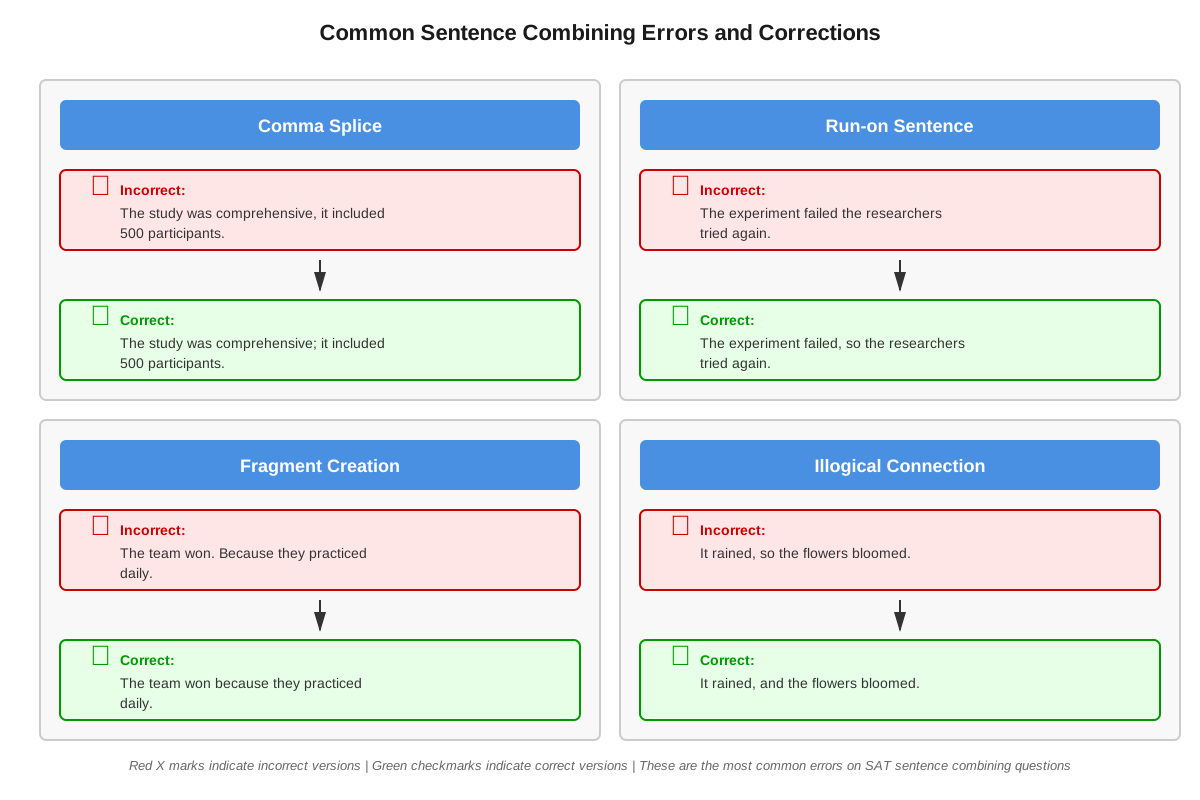
Comma splices occur when two independent clauses are joined with only a comma:
- Incorrect: "The experiment failed, the team tried again."
- Correct: "The experiment failed, so the team tried again."
Run-on sentences (fused sentences) occur when two independent clauses are joined with no punctuation:
- Incorrect: "The experiment failed the team tried again."
- Correct: "The experiment failed. The team tried again."
Faulty subordination occurs when the wrong clause is made dependent:
- Incorrect: "Because the experiment succeeded, the results were published." (implies success is surprising)
- Better: "Because the results were significant, they were published."
Concept Relationships
Sentence combining integrates multiple grammatical concepts into a single skill. At its foundation, it requires understanding independent and dependent clauses → which determines whether coordination or subordination is appropriate → which dictates punctuation choices → which ensures the combined sentence avoids fragments, run-ons, and comma splices.
The relationship between coordination and subordination is particularly important: coordination treats ideas as equal partners, while subordination creates a hierarchy of importance. This choice affects not just grammar but also rhetorical effectiveness—the Expression of Ideas domain on the SAT. When a passage emphasizes cause-and-effect relationships, subordination with "because" or "since" is typically more effective than coordination with "and."
Sentence combining also connects forward to transitions and logical flow. A well-combined sentence can eliminate the need for transitional words by making relationships between ideas explicit through structure. For example, combining "The study concluded. The results were inconclusive" into "Although the study concluded, the results were inconclusive" eliminates the need for a separate transitional phrase like "However."
Finally, sentence combining relates to concision and redundancy. The SAT frequently tests whether students can recognize that combining sentences eliminates unnecessary repetition of subjects, verbs, or ideas, making prose more efficient and sophisticated.
Quick check — test yourself on Sentence combining so far.
Try Flashcards →High-Yield Facts
⭐ Comma + coordinating conjunction is the only way to join two independent clauses with a comma (comma alone creates a comma splice)
⭐ Semicolons can join independent clauses without a conjunction, but both clauses must be independent and closely related
⭐ Subordinating conjunctions create dependent clauses that cannot stand alone as sentences
⭐ When a dependent clause begins a sentence, it must be followed by a comma before the independent clause
⭐ When an independent clause comes first, no comma is needed before a subordinating conjunction that introduces a dependent clause
- Conjunctive adverbs (however, therefore, moreover) require a semicolon before and a comma after when joining independent clauses
- Participial phrases at the beginning of a sentence must be followed by a comma and must modify the subject of the main clause (to avoid dangling modifiers)
- Appositive phrases that provide non-essential information are set off by commas; essential appositives have no commas
- Relative pronouns (who, which, that) create adjective clauses that modify nouns in the main clause
- The choice between coordination and subordination affects meaning: coordination suggests equal importance, while subordination emphasizes one idea over another
- Combined sentences must maintain parallel structure when listing items or actions
- Effective sentence combining eliminates redundancy without changing the original meaning
- The SAT prefers concise, clear combinations over wordy or awkward constructions
Common Misconceptions
Misconception: Any two sentences can be combined with a comma.
Correction: A comma alone cannot join two independent clauses—this creates a comma splice. Commas can only join independent clauses when paired with a coordinating conjunction (FANBOYS), or they can separate a dependent clause from an independent clause.
Misconception: Semicolons and commas are interchangeable.
Correction: Semicolons join independent clauses of equal importance; commas separate dependent clauses from independent clauses or join independent clauses when used with coordinating conjunctions. Using a semicolon before a dependent clause is incorrect.
Misconception: Longer, more complex combined sentences are always better than shorter sentences.
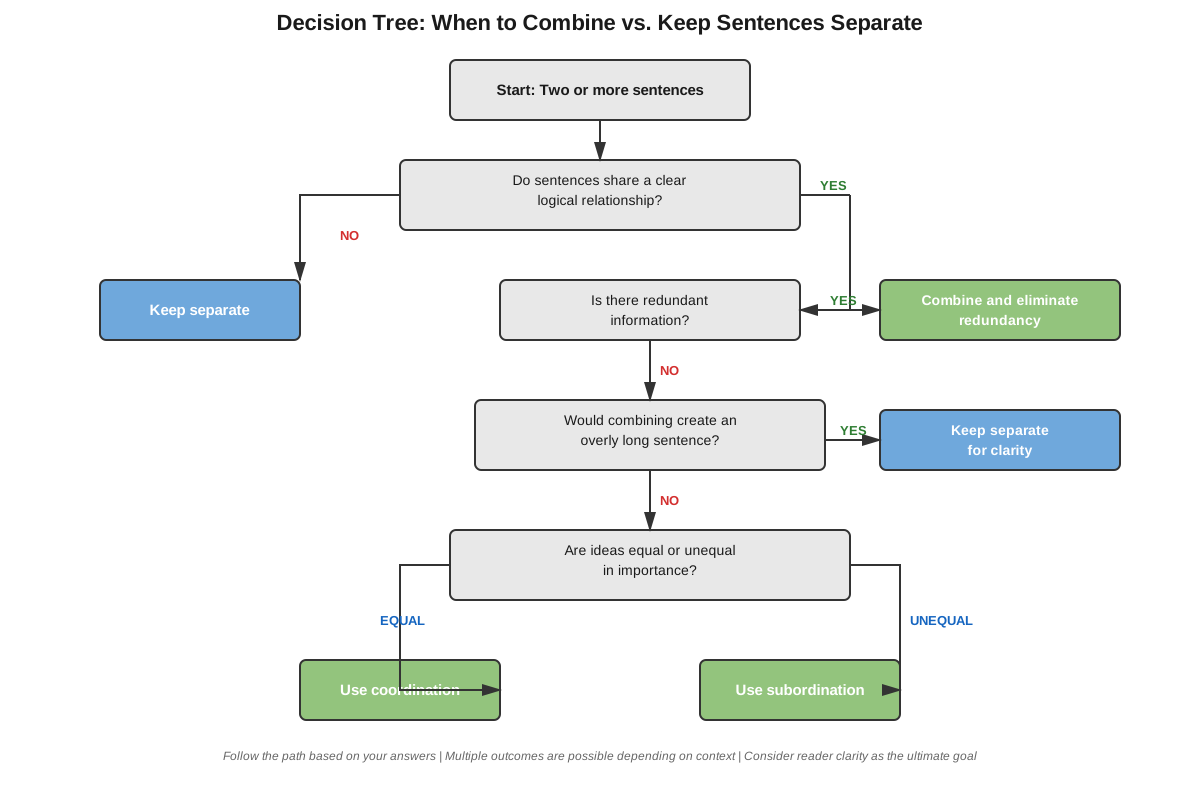
Correction: The SAT values clarity and effectiveness over complexity. Sometimes sentences should remain separate for emphasis, clarity, or pacing. The best answer combines sentences when doing so improves flow and eliminates redundancy, not simply for the sake of combining.
Misconception: "However" is a coordinating conjunction that can follow a comma.
Correction: "However" is a conjunctive adverb, not a coordinating conjunction. It requires a semicolon before it (or a period, making it start a new sentence) and a comma after it when joining independent clauses.
Misconception: All subordinating conjunctions mean the same thing.
Correction: Different subordinating conjunctions express different logical relationships: "because" shows causation, "although" shows contrast, "when" shows time, "if" shows condition. Choosing the wrong subordinating conjunction changes the meaning of the sentence.
Misconception: Combined sentences should always keep all the words from the original sentences.
Correction: Effective sentence combining often involves reducing redundancy by eliminating repeated subjects, verbs, or ideas. The goal is to preserve meaning, not every single word.
Worked Examples
Example 1: Coordination vs. Subordination
Passage: "The archaeological team discovered ancient pottery. The pottery dated back to 3000 BCE. This finding challenged existing theories about the region's settlement."
Question: Which choice most effectively combines the sentences at the underlined portion?
A) pottery, and the pottery dated back to 3000 BCE, this finding challenged
B) pottery dating back to 3000 BCE, a finding that challenged
C) pottery; the pottery dated back to 3000 BCE, and this finding challenged
D) pottery, which dated back to 3000 BCE, and this finding challenged
Step 1: Identify the relationships between ideas.
- Sentence 1: Main discovery (pottery)
- Sentence 2: Detail about the pottery (date)
- Sentence 3: Significance of the discovery (challenged theories)
Step 2: Evaluate each option.
Option A creates a comma splice after "3000 BCE" (two independent clauses joined with only a comma).
Option B uses a participial phrase ("dating back to 3000 BCE") to embed the second sentence and an appositive phrase ("a finding that challenged") to embed the third sentence. This is grammatically correct and concise.
Option C uses a semicolon correctly but is wordy and awkward, repeating "the pottery."
Option D uses "which" correctly to create a relative clause but then creates a comma splice with "and this finding challenged."
Step 3: Select the best answer.
Answer: B - This option effectively combines all three sentences using reduction and embedding, eliminating redundancy while maintaining clarity and grammatical correctness.
Connection to learning objectives: This example demonstrates how to identify effective combining methods (subordination through participial and appositive phrases) and apply them to SAT-style questions.
Example 2: Punctuation in Combined Sentences
Passage: "Marine biologists have long studied dolphin communication. They have discovered that dolphins use distinct whistles. These whistles function as names."
Question: Which choice most effectively combines the underlined sentences?
A) communication, they have discovered that dolphins use distinct whistles, these whistles function
B) communication; discovering that dolphins use distinct whistles that function
C) communication, discovering that dolphins use distinct whistles that function
D) communication and have discovered that dolphins use distinct whistles that function
Step 1: Identify the subject and relationships.
- All three sentences share the same subject (marine biologists/they)
- Sentence 2 and 3 are closely related (whistles and their function)
Step 2: Evaluate each option.
Option A creates multiple comma splices—grammatically incorrect.
Option B uses a semicolon followed by a participial phrase, but this creates a fragment after the semicolon (no independent clause).
Option C uses a participial phrase ("discovering") to combine the second sentence with the first, then uses a relative clause ("that function") to combine the third sentence. However, this creates a dangling modifier—"discovering" should modify "biologists," but the sentence structure makes it unclear.
Option D maintains the subject "marine biologists" and uses compound verbs ("have studied" and "have discovered") connected by "and," then uses a relative clause ("that function") to embed the third sentence. This is grammatically correct and clear.
Step 3: Select the best answer.
Answer: D - This option correctly combines the sentences by using compound verbs and a relative clause, maintaining parallel structure and clarity.
Connection to learning objectives: This example shows how to distinguish between effective and ineffective combining methods, particularly regarding punctuation and maintaining clear subjects.
Exam Strategy
When approaching sentence combining questions on the SAT, follow this systematic process:
Step 1: Read the entire passage context (not just the underlined portion) to understand the logical flow and relationships between ideas. The surrounding sentences often provide clues about whether ideas should be coordinated, subordinated, or kept separate.
Step 2: Identify the relationship between the sentences being combined. Ask: Are these ideas equal in importance (coordination)? Does one idea provide context or modify another (subordination)? Is there redundancy that should be eliminated?
Step 3: Eliminate grammatically incorrect options first. Look for comma splices, run-ons, fragments, and incorrect punctuation. This typically eliminates 1-2 options immediately.
Step 4: Among grammatically correct options, choose the most concise and clear. The SAT consistently favors options that eliminate redundancy without sacrificing clarity or changing meaning.
Trigger words to watch for: "combine," "merge," "most effectively," "best accomplishes," "clearest," "most concise"
Process-of-elimination tips:
- Eliminate any option with a comma splice (comma joining two independent clauses without a coordinating conjunction)
- Eliminate options that change the original meaning or create logical errors
- Eliminate unnecessarily wordy options when a more concise alternative exists
- Eliminate options with misplaced modifiers or unclear pronoun references
Time allocation: Sentence combining questions should take 30-45 seconds each. If you're spending more than a minute, eliminate obvious wrong answers and make your best guess to avoid losing time for other questions.
Common trap: The SAT often includes an option that is grammatically correct but stylistically awkward or wordy. Don't choose it just because it's correct—look for the option that is both correct AND effective.
Memory Techniques
FANBOYS acronym for coordinating conjunctions: For, And, Nor, But, Or, Yet, So
"Comma + FANBOYS" rule: Visualize a comma and a coordinating conjunction as a bridge connecting two independent clauses. Without both parts of the bridge, the clauses fall into the water (creating a comma splice or run-on).
"Dependent = Comma" rule: When a dependent clause starts a sentence, imagine it as an introduction that needs a comma to separate it from the main event (the independent clause). When the independent clause comes first, no introduction is needed.
Semicolon = Period substitute: Think of semicolons as "strong commas" or "weak periods"—they can only separate independent clauses that could stand alone as sentences with a period.
AAAWWUBBIS for common subordinating conjunctions: After, Although, As, When, While, Until, Because, Before, If, Since
Visualization for coordination vs. subordination: Picture coordination as two people standing side-by-side (equal importance) and subordination as one person standing on a platform while another provides support from below (unequal importance).
Summary
Sentence combining is a high-yield SAT skill that requires students to merge multiple sentences into grammatically correct, stylistically effective constructions. The process involves understanding the logical relationships between ideas and choosing appropriate combining methods: coordination for equal ideas using coordinating conjunctions or semicolons, subordination for unequal ideas using subordinating conjunctions or relative pronouns, and reduction/embedding for eliminating redundancy through phrases. Proper punctuation is critical—comma splices and run-on sentences are always incorrect, while the choice between commas, semicolons, and no punctuation depends on clause types and combining methods. The SAT tests this skill frequently, rewarding students who can identify opportunities to improve sentence structure while maintaining clarity and conciseness. Success requires systematic evaluation of answer choices, eliminating grammatically incorrect options first, then selecting the most effective option among those that remain. Mastering sentence combining improves not only SAT scores but also overall writing sophistication, making it an essential skill for college readiness.
Key Takeaways
- Sentence combining requires choosing between coordination (equal ideas), subordination (unequal ideas), or reduction/embedding (eliminating redundancy)
- Comma + coordinating conjunction is the only way to join independent clauses with a comma; comma alone creates a comma splice
- Semicolons join independent clauses without conjunctions; dependent clauses beginning sentences need commas after them
- The SAT rewards concise, clear combinations that eliminate redundancy without changing meaning
- Systematic elimination of grammatically incorrect options, followed by selection of the most effective remaining choice, is the most efficient strategy
- Understanding the logical relationship between ideas (cause-effect, contrast, time, condition) determines which combining method is most appropriate
- Sentence combining questions appear frequently on the SAT and are highly predictable, making them excellent opportunities for score improvement
Related Topics
Transitions and Logical Flow: After mastering sentence combining, students should study how transitional words and phrases connect ideas between sentences and paragraphs. Effective sentence combining can sometimes eliminate the need for explicit transitions by making relationships clear through structure.
Parallel Structure: This topic builds on sentence combining by focusing on maintaining consistent grammatical form when listing items or actions within combined sentences. Parallel structure is essential for clarity and is frequently tested alongside combining questions.
Modifier Placement: Understanding how to correctly place and punctuate modifying phrases is crucial for avoiding dangling and misplaced modifiers when combining sentences through reduction and embedding.
Concision and Redundancy: This topic extends sentence combining principles by focusing on eliminating wordiness and unnecessary repetition throughout passages, not just when combining sentences.
Rhetorical Synthesis: Advanced students should study how sentence structure choices affect tone, emphasis, and persuasiveness—skills that connect sentence combining to the Expression of Ideas domain.
Practice CTA
Now that you've mastered the core concepts of sentence combining, it's time to put your knowledge into practice! Complete the practice questions to reinforce your understanding and build the speed and accuracy you need for test day. The flashcards will help you memorize key rules and punctuation patterns until they become automatic. Remember: sentence combining is one of the most predictable and high-yield topics on the SAT—every minute you invest in practice translates directly to points on test day. You've got this!
Sign up free to keep reading
Create a free AnvayaPrep account to finish this SAT guide on Sentence combining — plus flashcards and practice questions.