Overview
Parallel structure is one of the most frequently tested grammar concepts in the SAT Reading and Writing (RW) section. This principle requires that elements in a sentence that perform similar functions or express related ideas must maintain the same grammatical form. When a sentence lists actions, descriptions, or ideas, each item in that list must follow an identical pattern—whether that means using all gerunds, all infinitives, all nouns, or all clauses of the same type. Violations of parallel structure create awkward, confusing sentences that disrupt the reader's comprehension and signal poor writing quality.
On the sat parallel structure questions, test-makers deliberately present sentences where one element breaks the established pattern, creating a grammatical inconsistency. Students must identify these breaks and select the answer choice that restores parallelism. These questions appear regularly throughout the exam, often embedded within passages about science, history, literature, or social studies. Mastering parallel structure is essential not only for earning points on direct grammar questions but also for understanding the logical relationships between ideas in complex sentences.
Parallel structure connects deeply to other concepts in the Form, Structure, and Sense unit. It relates to sentence boundaries (because parallel elements often appear in compound structures), punctuation (particularly with commas and semicolons separating parallel items), and logical cohesion (since parallel structure clarifies relationships between ideas). Understanding parallelism also strengthens overall writing clarity, making it a foundational skill that supports performance across multiple question types in the Reading and Writing section.
Learning Objectives
- [ ] Identify key features of parallel structure in sentences and lists
- [ ] Explain how parallel structure appears on the SAT and recognize common violation patterns
- [ ] Apply parallel structure principles to answer SAT-style questions accurately
- [ ] Distinguish between different types of parallel constructions (verbs, nouns, phrases, clauses)
- [ ] Evaluate answer choices to determine which option maintains grammatical consistency
- [ ] Recognize trigger words and conjunctions that signal the need for parallel structure
Prerequisites
- Basic parts of speech: Understanding nouns, verbs, adjectives, and adverbs is essential because parallel structure requires matching these grammatical forms across list items or related sentence elements.
- Phrase and clause identification: Recognizing prepositional phrases, infinitive phrases, gerund phrases, and dependent clauses enables students to match these structures when parallelism is required.
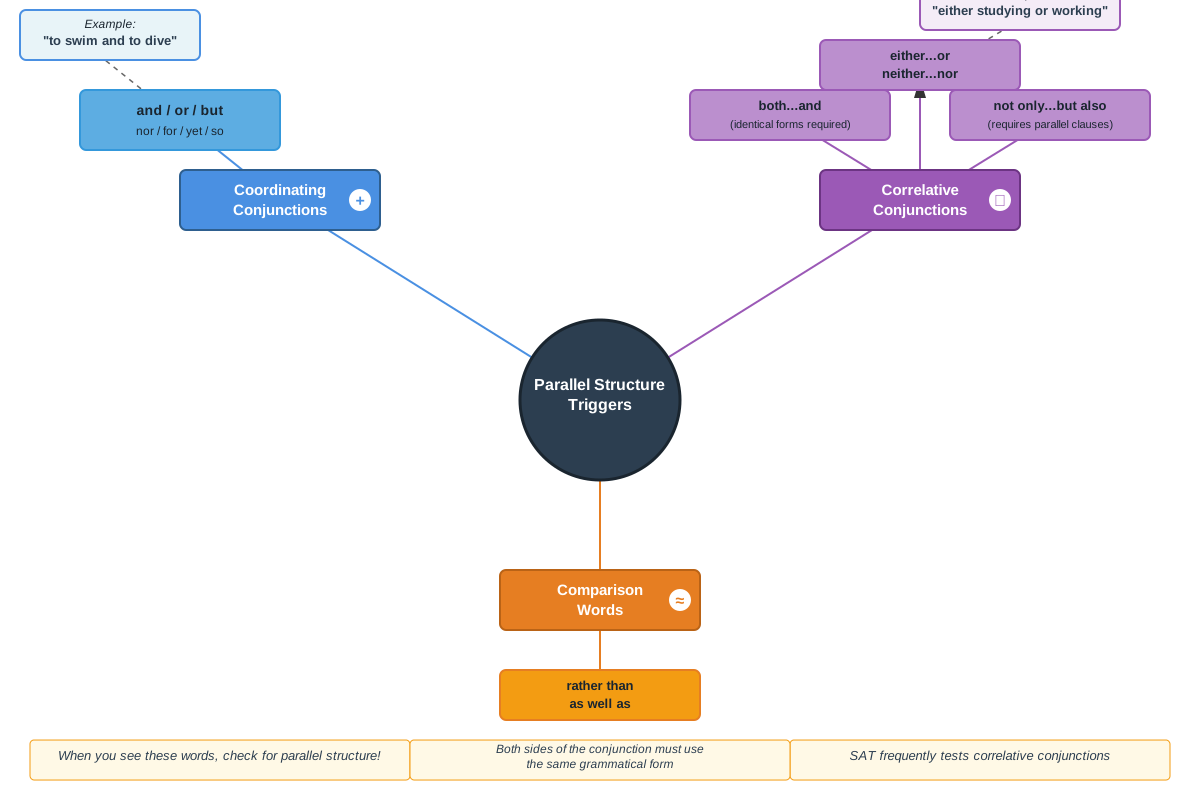
- Coordinating and correlative conjunctions: Knowledge of words like "and," "or," "but," and pairs like "either...or" and "not only...but also" helps identify where parallel structure must be maintained.
- Sentence structure fundamentals: Understanding subjects, predicates, and modifiers provides the foundation for recognizing when elements serve similar grammatical functions and therefore require parallel forms.
Why This Topic Matters
Parallel structure questions appear in approximately 10-15% of SAT Reading and Writing questions, making this one of the highest-yield grammar topics to master. The College Board consistently includes 2-4 parallel structure questions per exam, and these questions span all difficulty levels. Students who master this concept gain reliable points because parallel structure questions follow predictable patterns and can be answered systematically.
Beyond the exam, parallel structure is fundamental to clear, professional writing. Effective communication in academic papers, business documents, and persuasive essays depends on maintaining grammatical consistency. Readers process parallel structures more easily, making arguments more convincing and explanations more comprehensible. Legal documents, scientific papers, and policy statements all rely heavily on parallel structure to convey complex information without ambiguity.
On the SAT, parallel structure appears in several contexts: lists of actions or characteristics, comparisons using "than" or "as," correlative conjunction pairs, and compound sentence elements. The test often embeds these questions in passages about scientific research (listing experimental procedures), historical analysis (comparing different time periods or policies), or literary criticism (describing multiple aspects of a work). Recognizing these patterns allows students to anticipate where parallelism issues might arise and approach questions strategically.
Core Concepts
Definition and Basic Principle
Parallel structure (also called parallelism) is the grammatical principle requiring that sentence elements serving equivalent functions must take identical grammatical forms. When a sentence presents a series of items, compares two things, or connects ideas with coordinating conjunctions, each element must match in structure. This matching can occur at multiple levels: word type (all nouns or all verbs), phrase type (all prepositional phrases or all infinitive phrases), or clause type (all independent clauses or all dependent clauses).
The fundamental rule is simple: if elements are joined by coordinating conjunctions (and, or, but, nor, for, yet, so) or presented in a list, they must be grammatically parallel. This principle extends to correlative conjunctions (either...or, neither...nor, not only...but also, both...and) and comparative structures (more...than, as...as).
Types of Parallel Structures
Parallel Words
When listing individual words, all items must be the same part of speech:
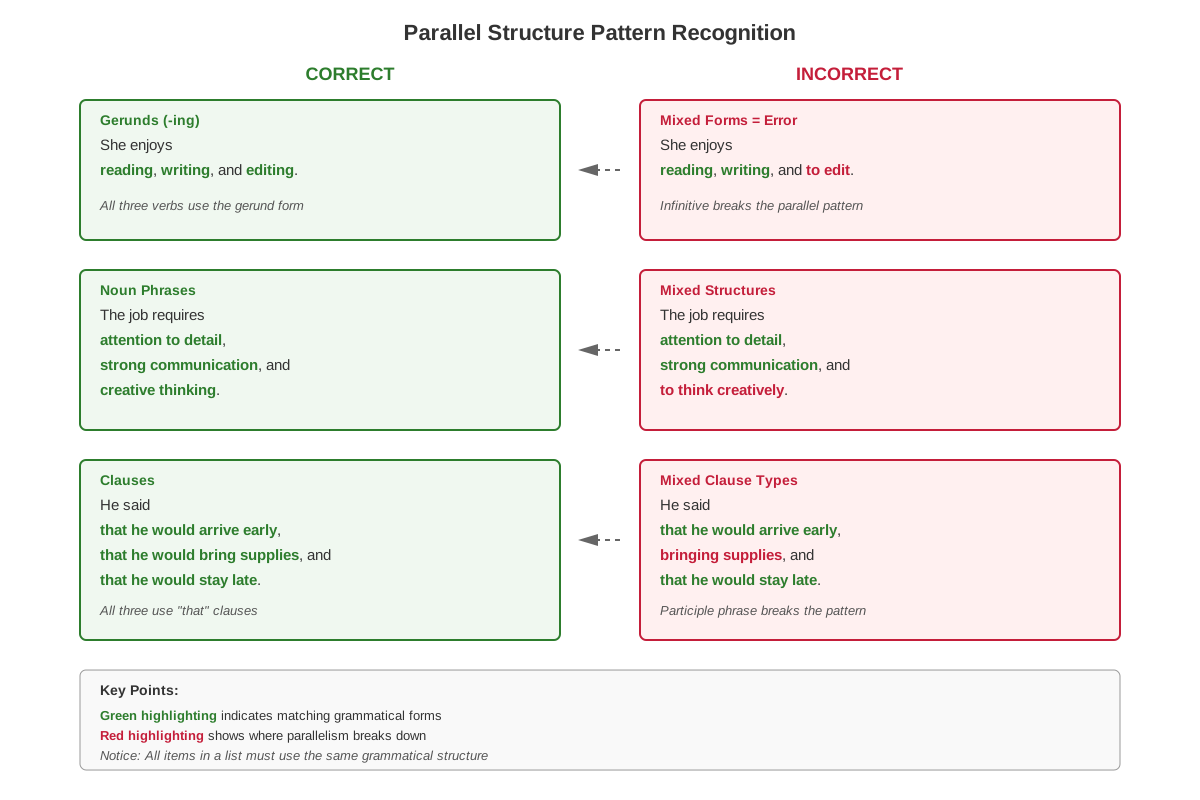
Correct: The scientist was intelligent, dedicated, and thorough. (all adjectives)
Incorrect: The scientist was intelligent, dedicated, and showed thoroughness. (two adjectives, one verb phrase)
Parallel Phrases
When listing phrases, all must follow the same structural pattern:
Correct: The committee plans to review the data, to analyze the results, and to publish the findings. (all infinitive phrases)
Incorrect: The committee plans to review the data, analyzing the results, and publication of the findings. (infinitive, gerund phrase, noun phrase)
Correct: She succeeded by studying consistently, by asking questions, and by practicing regularly. (all prepositional phrases with gerunds)
Parallel Clauses
When connecting clauses, maintain consistent structure:
Correct: The researcher discovered that the hypothesis was flawed and that the methodology needed revision. (both "that" clauses)
Incorrect: The researcher discovered that the hypothesis was flawed and the methodology needing revision. (complete clause, then fragment)
Parallel Structure with Correlative Conjunctions
Correlative conjunctions create pairs that must be followed by parallel elements:
| Correlative Pair | Correct Example | Incorrect Example |
|---|---|---|
| either...or | Either study now or study later | Either study now or later |
| neither...nor | Neither the teacher nor the students | Neither the teacher nor do students |
| not only...but also | Not only intelligent but also creative | Not only intelligent but also shows creativity |
| both...and | Both in theory and in practice | Both in theory and practically |
The key principle: whatever grammatical structure follows the first element must also follow the second element.
Parallel Structure in Comparisons
Comparative structures using "than," "as," or "like" require parallel elements on both sides:
Correct: Writing an essay is more challenging than solving a math problem. (gerund phrase compared to gerund phrase)
Incorrect: Writing an essay is more challenging than to solve a math problem. (gerund phrase compared to infinitive phrase)
Correct: The new policy affects teachers as much as it affects students. (complete clause compared to complete clause)
Parallel Structure in Lists and Series
When presenting three or more items, maintain consistent grammatical form throughout:
Correct: The course covers grammar, punctuation, and style. (all nouns)
Incorrect: The course covers grammar, punctuation, and how to develop style. (two nouns, one clause)
Correct: Successful students attend class regularly, complete assignments promptly, and participate actively. (all verb phrases with adverbs)
Articles, Prepositions, and Helping Verbs in Parallel Structures
When articles (a, an, the), prepositions (in, on, at), or helping verbs (will, can, should) appear before parallel elements, they can either be repeated before each item or stated once before the entire series:
Both correct:
- The plan addresses the economic, the social, and the environmental impacts.
- The plan addresses the economic, social, and environmental impacts.
Incorrect: The plan addresses the economic, social, and the environmental impacts. (inconsistent article use)
Both correct:
- She will draft the proposal, review the budget, and submit the application.
- She will draft the proposal, will review the budget, and will submit the application.
Incorrect: She will draft the proposal, review the budget, and will submit the application. (inconsistent helping verb use)
Concept Relationships
Parallel structure functions as a organizing principle that connects multiple grammar concepts. Coordination (using conjunctions to join equal elements) requires parallel structure, creating a direct relationship: Coordination → necessitates → Parallel Structure. When writers use "and," "or," or "but" to connect sentence elements, those elements must be grammatically equivalent.
Sentence clarity depends heavily on parallel structure. The relationship flows: Parallel Structure → enhances → Sentence Clarity → improves → Reader Comprehension. When parallelism breaks down, readers must work harder to process the sentence, often re-reading to understand the intended meaning.
Parallel structure also connects to logical relationships between ideas. The pattern is: Similar Ideas → expressed through → Parallel Structure → signals → Equal Importance. When a writer presents three characteristics of a subject using parallel adjectives, the structure itself communicates that these three traits deserve equal consideration.
The concept extends to punctuation rules, particularly comma usage in series. The relationship: Parallel Elements → separated by → Commas → following → Series Punctuation Rules. Understanding parallelism helps students recognize when commas are necessary and where they should be placed.
Finally, parallel structure relates to rhetorical effectiveness. The connection: Parallel Structure → creates → Rhythm and Emphasis → strengthens → Persuasive Impact. Many famous speeches and memorable writing passages employ deliberate parallelism to make ideas more powerful and memorable.
High-Yield Facts
⭐ Parallel structure requires that elements joined by coordinating conjunctions (and, or, but) must have identical grammatical forms.
⭐ Correlative conjunctions (either...or, neither...nor, not only...but also, both...and) must be followed by parallel structures on both sides of the pair.
⭐ In comparisons using "than" or "as," the elements being compared must be grammatically parallel.
⭐ Lists of three or more items must maintain the same grammatical form throughout the entire series.
⭐ When a helping verb or preposition appears before parallel elements, it must either be repeated before each element or stated once before the entire series—never inconsistently.
- Infinitive phrases (to + verb) cannot be mixed with gerund phrases (-ing form) in parallel structures.
- When listing actions, all verbs must be in the same tense and form.
- Parallel structure applies to single words, phrases, and entire clauses—the level must remain consistent.
- Articles (a, an, the) before parallel elements should be used consistently: either before all items or only before the first.
- Parallel structure errors are often hidden in longer sentences where the parallel elements are separated by multiple words.
- The SAT frequently tests parallelism in sentences with three-part lists, where the third element breaks the pattern.
- Prepositional phrases in parallel structures must use the same preposition pattern or clearly different prepositions—mixing similar prepositions inconsistently creates errors.
Quick check — test yourself on Parallel structure so far.
Try Flashcards →Common Misconceptions
Misconception: As long as the meaning is clear, parallel structure doesn't matter. → Correction: The SAT tests standard written English, which requires grammatical parallelism regardless of whether meaning is technically understandable. Parallel structure is a fundamental rule of formal writing.
Misconception: Parallel structure only applies to lists of three or more items. → Correction: Parallelism is required whenever coordinating conjunctions join elements, even in two-part structures. "She enjoys reading and to write" is incorrect despite having only two elements.
Misconception: Mixing infinitives and gerunds is acceptable because they're both verb forms. → Correction: Infinitives (to read) and gerunds (reading) are different grammatical structures and cannot be used interchangeably in parallel constructions. Choose one form and maintain it throughout.
Misconception: In correlative conjunctions, only the words immediately following each conjunction need to be parallel. → Correction: The entire grammatical structure following each part of the correlative pair must be parallel. "Either to study math or science" is incorrect; it should be "either to study math or to study science" or "to study either math or science."
Misconception: If the first two items in a list are parallel, the third can be different. → Correction: All elements in a series must maintain the same grammatical form. The SAT specifically tests this by making the first two items parallel and breaking the pattern with the third, hoping students won't notice the shift.
Misconception: Parallel structure is only about verbs. → Correction: Parallelism applies to all parts of speech and grammatical structures: nouns, adjectives, adverbs, phrases, and clauses. Any elements serving equivalent functions must be parallel.
Misconception: Adding extra words to one element doesn't break parallelism as long as the core structure matches. → Correction: While some modification is acceptable, significantly different structures break parallelism. "She likes swimming, running, and to ride her bike quickly through the park" is not parallel despite all being activities.
Worked Examples
Example 1: Identifying and Correcting Parallel Structure Errors
Question: The research team plans to collect data from surveys, conducting interviews with participants, and the analysis of historical records.
Which choice maintains parallel structure?
A) NO CHANGE
B) to collect data from surveys, to conduct interviews with participants, and to analyze historical records
C) collecting data from surveys, conducting interviews with participants, and analyzing historical records
D) data collection from surveys, conducting interviews with participants, and analysis of historical records
Solution Process:
Step 1: Identify the parallel elements. The sentence lists three activities the research team plans to do, connected by commas and "and."
Step 2: Analyze the current structure:
- First element: "to collect data from surveys" (infinitive phrase)
- Second element: "conducting interviews with participants" (gerund phrase)
- Third element: "the analysis of historical records" (noun phrase)
Step 3: Recognize the error. The three elements use different grammatical forms, violating parallel structure.
Step 4: Evaluate each answer choice:
- Choice A: Maintains the error (three different structures)
- Choice B: All three elements are infinitive phrases (to collect, to conduct, to analyze) ✓
- Choice C: All three elements are gerund phrases (collecting, conducting, analyzing) ✓
- Choice D: Mixes noun phrases with a gerund phrase (not parallel)
Step 5: Choose between B and C. Both are grammatically correct and parallel. However, the sentence begins with "plans to," which naturally leads to infinitive phrases. Choice B maintains consistency with the introductory verb phrase.
Answer: B
Connection to Learning Objectives: This example demonstrates how to identify parallel structure violations (Objective 1), recognize how the SAT presents these errors (Objective 2), and apply systematic analysis to select the correct answer (Objective 3).
Example 2: Correlative Conjunctions and Parallelism
Question: The new policy will benefit not only students who participate in extracurricular activities but also helping those who focus exclusively on academics.
Which choice maintains parallel structure?
A) NO CHANGE
B) but also it helps
C) but also those who focus
D) but also to help
Solution Process:
Step 1: Identify the correlative conjunction pair: "not only...but also"
Step 2: Determine what follows "not only": "students who participate in extracurricular activities" (noun phrase with modifying clause)
Step 3: Analyze what currently follows "but also": "helping those who focus exclusively on academics" (gerund phrase)
Step 4: Apply the parallelism rule for correlative conjunctions. The structure after "but also" must match the structure after "not only."
Step 5: Evaluate answer choices:
- Choice A: "helping those" (gerund phrase) doesn't match "students who" (noun phrase)
- Choice B: "it helps" (subject + verb) doesn't match "students who" (noun phrase)
- Choice C: "those who focus" (noun phrase with modifying clause) matches "students who participate" (noun phrase with modifying clause) ✓
- Choice D: "to help" (infinitive) doesn't match "students who" (noun phrase)
Step 6: Verify the complete sentence with Choice C: "The new policy will benefit not only students who participate in extracurricular activities but also those who focus exclusively on academics." Both elements after the correlative pair are noun phrases with "who" clauses.
Answer: C
Connection to Learning Objectives: This example shows how to recognize correlative conjunctions as parallelism triggers (Objective 4), evaluate answer choices systematically (Objective 5), and apply parallel structure principles to challenging sentence constructions (Objective 3).
Exam Strategy
Systematic Approach to Parallel Structure Questions
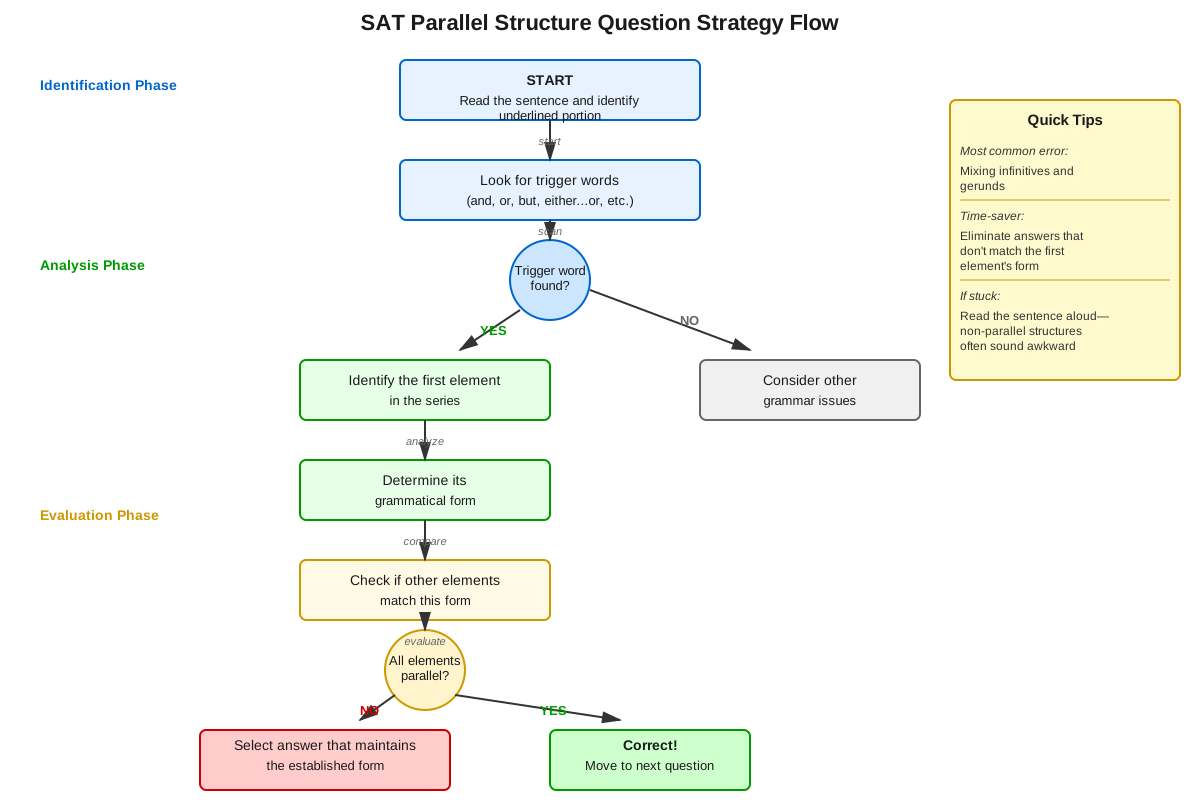
When encountering a potential parallel structure question on the SAT, follow this process:
- Identify coordinating or correlative conjunctions in the sentence or answer choices. Words like "and," "or," "but," "either...or," and "not only...but also" signal potential parallelism.
- Locate the parallel elements by finding what the conjunctions connect. Mark or mentally note each element.
- Analyze the grammatical form of each element. Ask: Is this a noun, verb, adjective, phrase, or clause? What specific type?
- Check for consistency across all elements. Do they all match, or does one break the pattern?
- Eliminate answer choices that maintain or create parallelism errors.
Trigger Words and Phrases
Watch for these high-frequency parallelism signals:
- Coordinating conjunctions: and, or, but, nor, for, yet, so
- Correlative conjunctions: either...or, neither...nor, not only...but also, both...and, whether...or
- Comparison words: than, as...as, more...than, less...than, like
- Series indicators: commas separating three or more items
- Repeated prepositions or articles: in...in, the...the (signals parallel structure)
Process of Elimination Tips
Eliminate choices that:
- Mix infinitives (to + verb) with gerunds (-ing forms)
- Combine noun phrases with verb phrases in a list
- Use different clause structures after correlative conjunctions
- Inconsistently include or omit articles, prepositions, or helping verbs
- Present one element in a significantly different length or complexity without maintaining grammatical form
Keep choices that:
- Maintain identical grammatical structures across all parallel elements
- Consistently use or omit helping words (articles, prepositions)
- Match the grammatical form established by the first element in a series
Time Allocation
Parallel structure questions should take 30-45 seconds each. They're typically more straightforward than rhetorical or logical questions because they follow mechanical rules. If a question takes longer than one minute, mark it and return later—you may be overthinking a straightforward parallelism issue.
Exam Tip: When three items are listed, the SAT often makes the first two parallel and breaks the pattern with the third. Always check the final element in a series carefully.
Exam Tip: If you're unsure between two answer choices that both seem parallel, read the entire sentence aloud (mentally) with each option. The correct parallel structure will sound more natural and rhythmic.
Memory Techniques
The "Match Game" Mnemonic
Remember: P.A.R.A.L.L.E.L. = Parts Are Required As Like-Looking Elements Listed
This reminds you that all parts in a parallel structure must look alike grammatically.
The "Three-Part Test" for Lists
When you see a list, apply the "Same-Same-Same" rule:
- Same part of speech (all nouns, all verbs, all adjectives)
- Same phrase type (all infinitives, all gerunds, all prepositional phrases)
- Same clause structure (all independent, all dependent, all "that" clauses)
Visualization Strategy: The Balance Scale
Picture parallel elements on a balance scale. Each element must have the same grammatical "weight" (structure) to keep the scale balanced. If one element is an infinitive and another is a gerund, the scale tips—the structure is unbalanced and incorrect.
The "Either-Or" Reminder
For correlative conjunctions, use this memory device: "What follows FIRST must match what follows SECOND."
Visualize the correlative pair as bookends—whatever comes after the first bookend must match what comes after the second bookend.
The "And Test"
When checking if elements are parallel, try inserting "and" between them (even if "and" isn't in the original sentence). If the resulting phrase sounds awkward, the elements aren't parallel.
Example: "to swim and running" sounds wrong → not parallel
"to swim and to run" sounds right → parallel
Summary
Parallel structure is a fundamental grammar principle requiring that sentence elements serving equivalent functions maintain identical grammatical forms. On the SAT Reading and Writing section, parallel structure questions appear regularly, testing whether students can identify and correct inconsistencies in lists, comparisons, and constructions using coordinating or correlative conjunctions. The core rule is straightforward: when elements are joined by conjunctions like "and," "or," or "but," or presented in a series, they must match in grammatical structure—whether that means all nouns, all infinitive phrases, all gerund phrases, or all clauses of the same type. Correlative conjunctions (either...or, not only...but also, both...and, neither...nor) require special attention because the grammatical structure following the first element must exactly match the structure following the second element. Mastering parallel structure involves recognizing trigger words, systematically analyzing the grammatical form of each element, and selecting answer choices that maintain consistency throughout the sentence. This skill is highly testable, appears in multiple questions per exam, and can be mastered through deliberate practice and application of systematic checking strategies.
Key Takeaways
- Parallel structure requires grammatical consistency: Elements joined by conjunctions or presented in lists must have identical grammatical forms (all nouns, all verbs, all phrases of the same type).
- Coordinating conjunctions signal parallelism: When you see "and," "or," or "but" connecting elements, check that both sides match grammatically.
- Correlative conjunctions demand exact structural matches: Whatever grammatical structure follows the first element (either, not only, both) must also follow the second element (or, but also, and).
- Infinitives and gerunds cannot mix: "To read and writing" is incorrect; choose either "to read and to write" or "reading and writing."
- The SAT often breaks parallelism in the third element: When checking lists of three items, pay special attention to whether the final item matches the pattern established by the first two.
- Systematic checking prevents errors: Identify conjunctions, locate parallel elements, analyze their grammatical forms, and verify consistency across all elements.
- Parallel structure questions are high-yield: These questions appear frequently, follow predictable patterns, and can be answered reliably with proper technique.
Related Topics
Comma Usage and Series Punctuation: Understanding parallel structure enhances comma placement skills, particularly in series of three or more items. Proper punctuation of parallel elements is essential for clarity and correctness.
Sentence Combining and Coordination: Parallel structure is fundamental to effectively combining sentences using coordinating conjunctions. Mastering parallelism enables more sophisticated sentence construction.
Modifier Placement: Parallel structures often include modifiers, and understanding parallelism helps ensure modifiers are placed correctly and consistently across parallel elements.
Rhetorical Synthesis: Advanced parallel structure creates rhetorical effects like emphasis and rhythm. Understanding basic parallelism prepares students for analyzing how writers use parallel structure for persuasive purposes.
Verb Tense Consistency: Parallel structure in verb phrases requires consistent tense usage, connecting parallelism to broader verb tense principles tested on the SAT.
Practice CTA
Now that you've mastered the principles of parallel structure, it's time to reinforce your learning through active practice. Complete the practice questions to test your ability to identify parallelism errors and select correct answer choices under timed conditions. Use the flashcards to memorize trigger words, common error patterns, and key rules for quick recall during the exam. Remember: parallel structure questions are among the most reliable point-earners on the SAT because they follow consistent rules—with focused practice, you can answer these questions confidently and accurately every time. Your investment in mastering this high-yield topic will pay dividends on test day!
Sign up free to keep reading
Create a free AnvayaPrep account to finish this SAT guide on Parallel structure — plus flashcards and practice questions.