Overview
The central idea of a passage represents the author's primary message, main point, or overarching argument that unifies all elements of a text. On the SAT Reading and Writing section, identifying the central idea is one of the most fundamental and frequently tested skills. Unlike supporting details that provide specific examples or evidence, the central idea encompasses the broader purpose and meaning that the author intends to convey throughout the entire passage.
Understanding how to identify and articulate the sat central idea of a passage is crucial because it serves as the foundation for answering numerous question types on the exam. Questions about central ideas typically ask students to synthesize information from multiple sentences or paragraphs, distinguish between main points and supporting details, and recognize how different parts of a passage work together to communicate a unified message. This skill directly impacts performance on approximately 15-20% of rw (Reading and Writing) questions, making it one of the highest-yield topics for score improvement.
The ability to identify central ideas connects to virtually every other reading comprehension skill tested on the SAT. Once students master this concept, they can more effectively analyze author's purpose, evaluate supporting evidence, understand text structure, and make inferences. The central idea acts as an anchor point that helps readers navigate complex passages, distinguish relevant from irrelevant information, and maintain focus on what truly matters in a text. This skill transcends the SAT itself, forming the basis for college-level reading, research, and critical thinking across all academic disciplines.
Learning Objectives
- [ ] Identify key features of Central idea of a passage
- [ ] Explain how Central idea of a passage appears on the SAT
- [ ] Apply Central idea of a passage to answer SAT-style questions
- [ ] Distinguish between central ideas and supporting details in passages of varying lengths
- [ ] Synthesize information from multiple paragraphs to formulate an accurate central idea statement
- [ ] Evaluate answer choices to identify those that are too broad, too narrow, or off-topic
- [ ] Recognize how topic sentences, transitions, and concluding statements signal central ideas
Prerequisites
- Basic reading comprehension: The ability to understand literal meaning in sentences and paragraphs is necessary before identifying overarching themes
- Vocabulary knowledge: Familiarity with common academic vocabulary helps students understand passage content and answer choices
- Paragraph structure awareness: Understanding that paragraphs contain topic sentences and supporting details provides the foundation for recognizing how ideas are organized
- Ability to summarize: The skill of condensing information into shorter form directly relates to identifying what's most important in a passage
Why This Topic Matters
Central idea questions appear with remarkable consistency on every SAT administration, typically comprising 3-5 questions per test. These questions assess a student's ability to comprehend text at a holistic level rather than focusing on isolated details. The College Board considers this skill essential because college coursework demands that students quickly grasp the main arguments in textbooks, research articles, and primary sources across disciplines from biology to history to literature.
In real-world applications, identifying central ideas enables effective note-taking, efficient studying, critical evaluation of arguments, and clear communication. Professionals in every field must regularly extract key points from reports, articles, emails, and presentations. The ability to distinguish essential information from supporting details directly impacts productivity and decision-making quality.
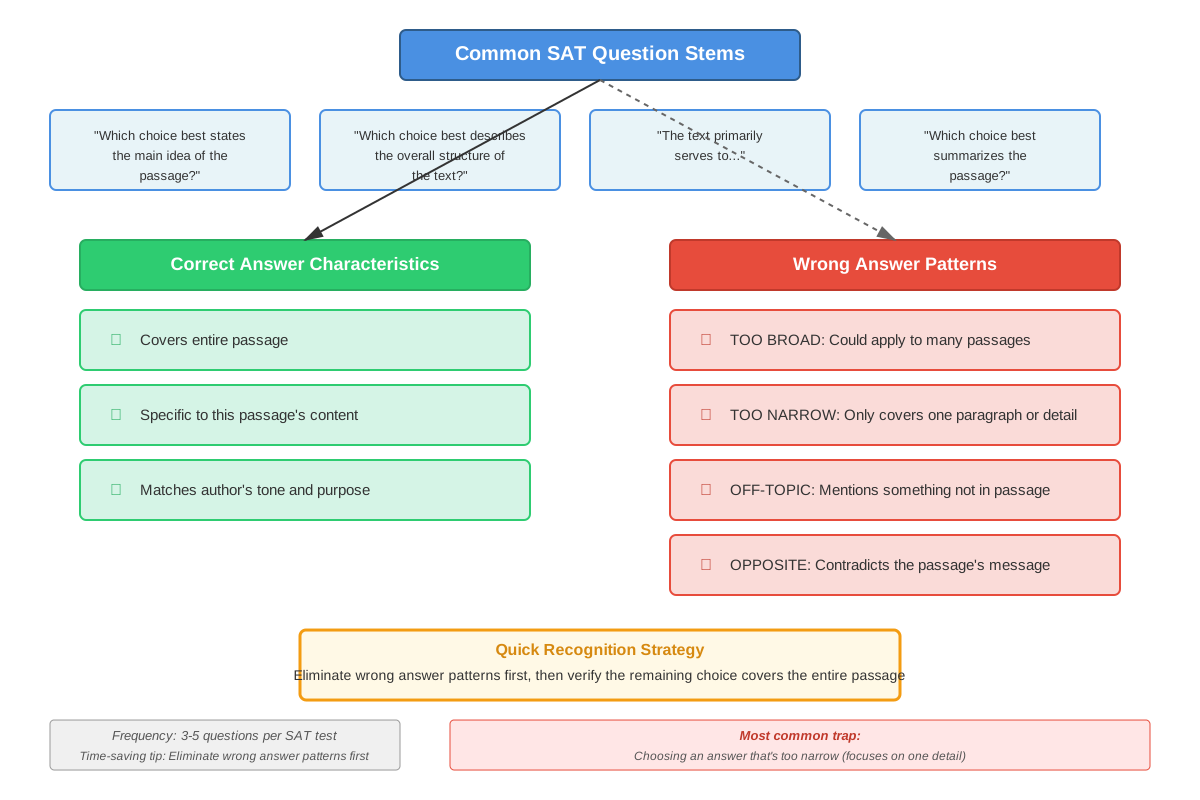
On the SAT, central idea questions commonly appear in several formats: "Which choice best states the main idea of the text?", "The text primarily serves to...", "The central claim of the passage is that...", or "Which choice best describes the overall structure of the text?" These questions may follow passages ranging from 25 to 150 words in the digital SAT format, covering topics in literature, history, social science, and natural science. The passages may be informational, argumentative, or narrative in nature, requiring students to adapt their approach based on text type.
Core Concepts
Defining Central Idea
The central idea of a passage is the most important point or message that the author wants readers to understand. It represents the unifying concept that connects all parts of the text and answers the question: "What is this passage mainly about?" A well-articulated central idea is neither too specific (focusing on a single detail) nor too broad (applying to many texts beyond the one at hand). It captures the essence of what the author is communicating in a single, comprehensive statement.
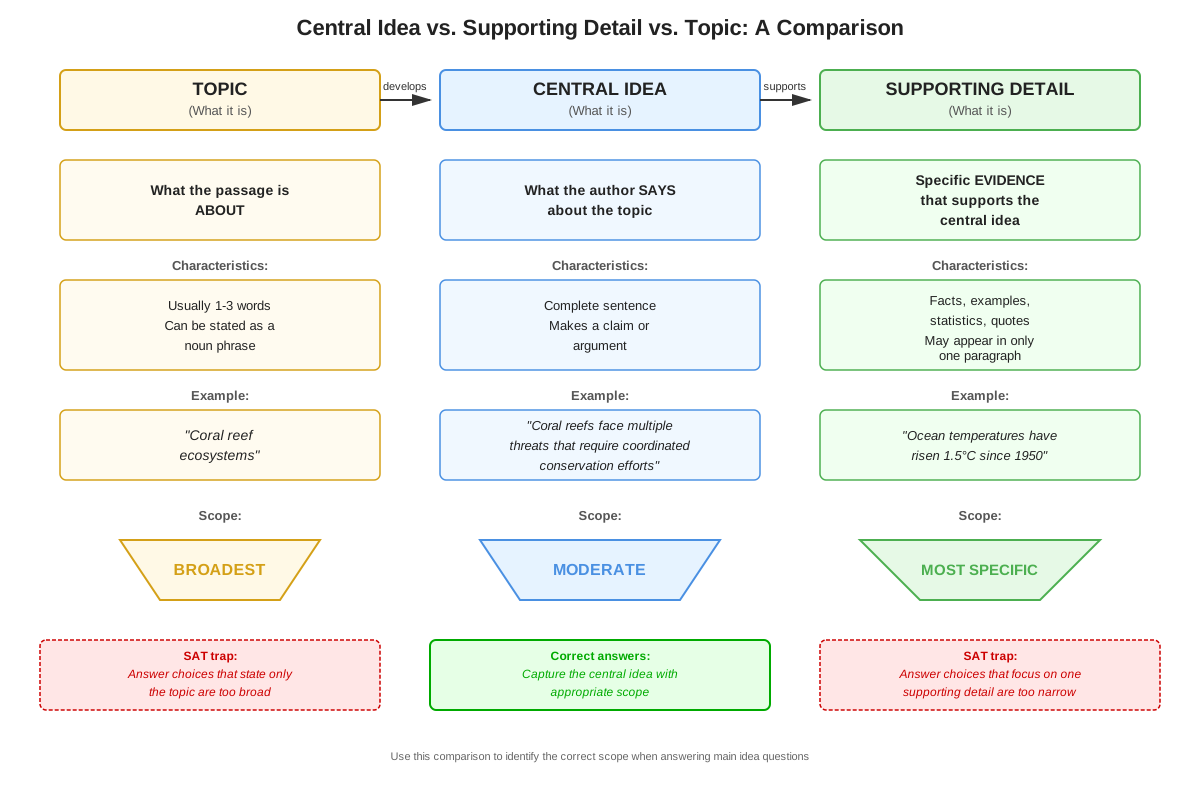
Central ideas differ from topics. The topic is simply the subject matter (e.g., "climate change"), while the central idea expresses what the author wants to say about that topic (e.g., "Recent climate change is primarily driven by human activities and requires immediate policy intervention"). The central idea includes both the subject and the author's perspective, claim, or main point about that subject.
Components of a Strong Central Idea
A complete central idea statement typically includes three elements:
- The topic or subject: What the passage is about
- The author's perspective or claim: What the author believes, argues, or wants to explain about the topic
- The scope: The boundaries of what the passage covers
For example, in a passage about renewable energy, a weak central idea might be "This passage is about solar power" (too vague, missing perspective). A strong central idea would be "Solar power technology has become economically competitive with fossil fuels in many regions, making it a viable solution for reducing carbon emissions" (includes topic, perspective, and appropriate scope).
Types of Central Ideas by Passage Type
Different passage types present central ideas in distinct ways:
| Passage Type | Central Idea Characteristics | Example Signal Phrases |
|---|---|---|
| Argumentative | States a claim or position the author defends | "argues that," "claims," "contends" |
| Informational/Expository | Explains a concept, process, or phenomenon | "describes," "explains," "presents" |
| Narrative | Conveys a theme or insight through storytelling | "illustrates," "demonstrates through," "explores" |
| Comparative | Analyzes similarities/differences between subjects | "contrasts," "compares," "distinguishes between" |
Locating Central Ideas in Text Structure
While central ideas unify entire passages, authors often signal them in predictable locations:
Opening sentences or paragraphs: Many passages state the central idea explicitly in the introduction, especially in academic and journalistic writing. The first sentence frequently introduces the topic, while subsequent sentences narrow to the specific central idea.
Concluding sentences or paragraphs: Authors often restate or synthesize their central idea at the end, particularly in argumentative texts. These conclusions may use phrases like "therefore," "thus," "in sum," or "ultimately."
Repeated concepts: Ideas that appear multiple times throughout a passage, even if worded differently, often point to the central idea. Authors reinforce their main point through repetition and elaboration.
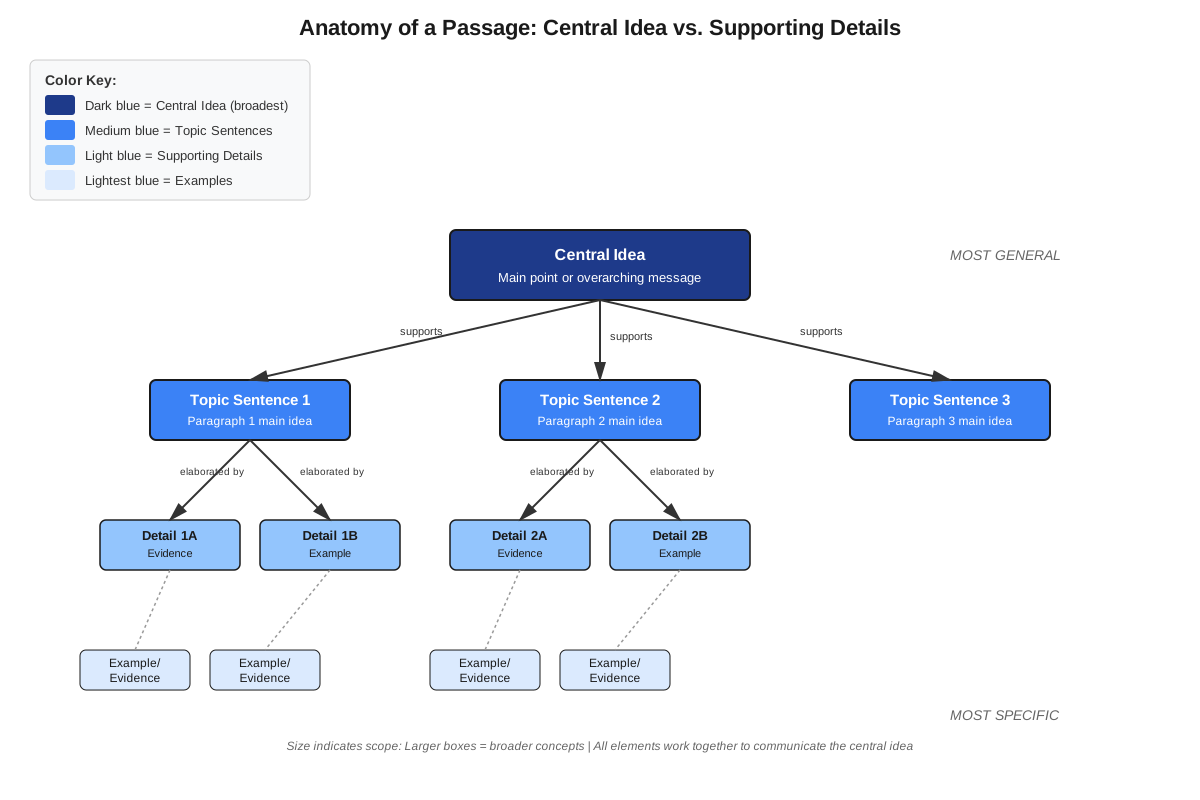
Topic sentences: In multi-paragraph passages, topic sentences (usually the first sentence of each paragraph) often relate directly to the central idea, with each paragraph exploring one aspect of the main point.
Distinguishing Central Ideas from Supporting Details
The most common challenge students face is confusing supporting details with central ideas. Supporting details are specific facts, examples, statistics, anecdotes, or descriptions that illustrate, prove, or elaborate on the central idea. They answer questions like "how?" or "what evidence supports this?" rather than "what is the main point?"
Consider this distinction: If a passage discusses how Marie Curie discovered radium, describes her laboratory conditions, mentions her Nobel Prizes, and explains the significance of her work for modern medicine, the central idea is NOT "Marie Curie won Nobel Prizes" (a supporting detail) but rather "Marie Curie's groundbreaking research on radioactivity transformed both scientific understanding and medical treatment" (the overarching point that all details support).
A useful test: Remove a potential central idea from the passage. If the passage still makes sense and holds together, it was likely a supporting detail. If removing it causes the passage to lose coherence or purpose, it's probably the central idea.
Synthesis and Inference
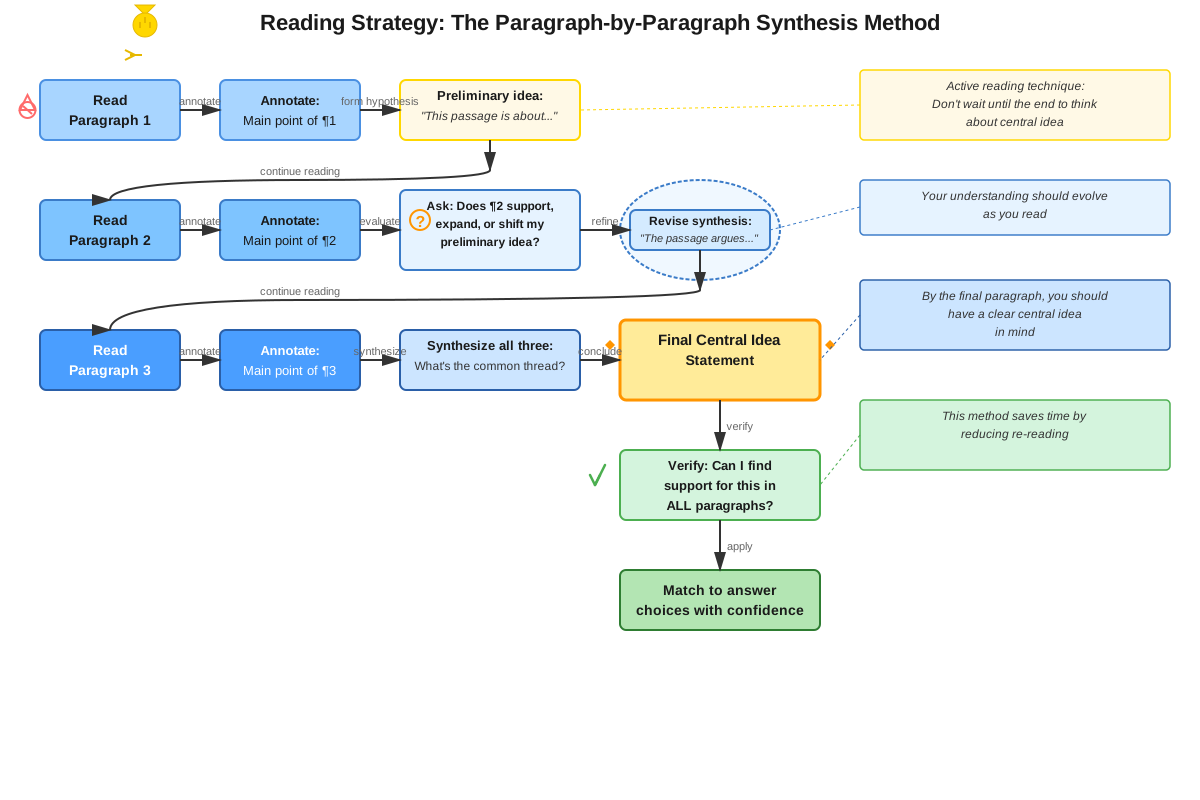
Some SAT passages do not state the central idea explicitly. Instead, readers must synthesize information from multiple sentences or paragraphs to infer the main point. This requires:
- Identifying what each paragraph or section contributes
- Finding the common thread connecting all parts
- Formulating a statement that encompasses the entire passage
- Ensuring the statement is supported by the text without adding outside information
For example, a passage might describe several failed attempts to solve a problem, then present a successful approach. The central idea isn't explicitly stated but can be inferred: "After multiple unsuccessful strategies, researchers finally achieved success through [specific approach]."
Concept Relationships
The central idea serves as the hierarchical peak of passage comprehension. All other elements—supporting details, examples, evidence, and explanations—exist to develop, illustrate, or prove the central idea. This creates a pyramid structure: Central Idea (top) → Major Supporting Points (middle) → Specific Details and Examples (bottom).
Understanding central ideas enables students to tackle related SAT question types more effectively. Author's purpose questions become easier because the purpose often aligns with communicating the central idea. Text structure questions are simplified because organizational patterns (cause-effect, problem-solution, chronological) serve to present the central idea effectively. Inference questions frequently require understanding the central idea as context for making logical deductions.
The relationship flows as follows: Topic Identification → Central Idea Recognition → Supporting Detail Analysis → Inference and Application. Students must first identify what a passage is about (topic), then determine what the author wants to say about it (central idea), then understand how details support that idea, and finally make inferences based on this framework.
Central idea skills also connect to the prerequisite knowledge of paragraph structure. Just as a paragraph has a topic sentence (its central idea) supported by detail sentences, a multi-paragraph passage has an overall central idea supported by paragraph-level main points. This fractal pattern—where the same structure repeats at different scales—helps students navigate texts of any length.
High-Yield Facts
⭐ The central idea must be supported by the entire passage, not just one paragraph or section
⭐ Central ideas are often implied rather than explicitly stated, requiring synthesis of multiple sentences
⭐ Answer choices that focus on a single detail or example are too narrow to be the central idea
⭐ The correct central idea answer will not introduce information not mentioned in the passage
⭐ Central ideas in SAT passages are typically neutral or objective in tone, avoiding extreme language
- Central idea questions may ask about "main idea," "primary purpose," "central claim," or "overall point"—these are functionally equivalent
- The first and last sentences of a passage are statistically the most likely locations for explicit central idea statements
- Transition words like "however," "therefore," and "in fact" often signal important shifts that clarify the central idea
- In comparative passages, the central idea often focuses on the relationship between the subjects, not just describing each separately
- Eliminating answer choices that are too broad (could apply to many passages) or too narrow (only cover part of the passage) is highly effective
Quick check — test yourself on Central idea of a passage so far.
Try Flashcards →Common Misconceptions
Misconception: The central idea is always stated in the first sentence of the passage.
Correction: While opening sentences often introduce the topic or central idea, many passages build toward their main point gradually or state it in the conclusion. Some passages require readers to synthesize information from multiple locations to identify the central idea.
Misconception: The longest or most detailed part of the passage represents the central idea.
Correction: Length and detail indicate supporting evidence, not necessarily the central idea. Authors often spend considerable space developing examples and evidence to support a central idea that may be stated briefly or implied.
Misconception: If a statement is true according to the passage, it could be the central idea.
Correction: Many true statements in a passage are supporting details. The central idea must be the overarching point that unifies the entire passage, not just an accurate detail mentioned within it.
Misconception: The central idea should include all the specific examples mentioned in the passage.
Correction: The central idea operates at a higher level of generality than specific examples. It should encompass what the examples collectively illustrate without listing each one individually.
Misconception: Personal interpretation or outside knowledge should guide central idea identification.
Correction: The central idea must be based solely on what the passage states or clearly implies. Bringing in outside knowledge or personal opinions leads to incorrect answers that, while potentially valid in general, don't reflect the passage's actual focus.
Misconception: Central ideas are always complex and sophisticated.
Correction: Some passages have relatively straightforward central ideas. Complexity varies by passage, and students should avoid selecting unnecessarily complicated answer choices when a simpler option accurately captures the main point.
Worked Examples
Example 1: Scientific Passage
Passage: "For decades, scientists believed that the human brain stopped producing new neurons after early childhood. This assumption shaped neuroscience research and clinical approaches to brain injury. However, studies in the 1990s revealed that neurogenesis—the formation of new neurons—continues throughout life in specific brain regions, particularly the hippocampus. This discovery has profound implications for understanding learning, memory, and recovery from neurological damage. Researchers now investigate how lifestyle factors like exercise and stress affect adult neurogenesis, opening new avenues for therapeutic interventions."
Question: Which choice best states the main idea of the text?
A) The hippocampus is the brain region where new neurons form throughout a person's life.
B) Exercise and stress levels can influence the formation of new neurons in adult brains.
C) The discovery that adult brains can produce new neurons has transformed neuroscience research and treatment approaches.
D) Scientists in the 1990s conducted important studies about brain development and neurological damage.
Analysis:
Step 1: Identify the topic. The passage discusses neurogenesis (new neuron formation) in adult brains.
Step 2: Determine what the author emphasizes. The passage contrasts old beliefs with new discoveries and emphasizes the significance of this change.
Step 3: Evaluate each answer choice:
- Choice A: Too narrow. This is a supporting detail about where neurogenesis occurs, but doesn't capture the passage's emphasis on the discovery's significance.
- Choice B: Too narrow. This is mentioned only in the final sentence as one application of the discovery, not the main point.
- Choice C: Correct. This captures the full scope: the discovery (what changed), its nature (adult neurogenesis), and its impact (transformed research and treatment). This encompasses the entire passage.
- Choice D: Too vague and incomplete. While true, this doesn't specify what the studies revealed or why they matter.
Answer: C
Connection to Learning Objectives: This example demonstrates identifying key features (the discovery and its implications), recognizing how central ideas appear on the SAT (requiring synthesis of multiple sentences), and applying the concept to answer questions correctly.
Example 2: Historical Passage
Passage: "The Silk Road was not a single road but a network of trade routes connecting East Asia with the Mediterranean region. Merchants transported silk, spices, precious metals, and other goods across thousands of miles. Yet the Silk Road's most significant impact may have been cultural rather than economic. Ideas, religions, technologies, and artistic styles traveled alongside commercial goods. Buddhism spread from India to China along these routes. Chinese papermaking techniques reached the Islamic world and eventually Europe. The exchange of astronomical and mathematical knowledge enriched civilizations at both ends of the network."
Question: The text primarily serves to:
A) Describe the various goods that merchants transported along the Silk Road
B) Explain the geographic extent of the trade routes between Asia and Europe
C) Argue that the Silk Road's cultural exchanges were more important than its economic functions
D) Compare the spread of Buddhism with the transmission of Chinese technologies
Analysis:
Step 1: Identify the passage structure. The first two sentences introduce the Silk Road and its commercial function. The third sentence ("Yet...") signals a shift to the main point. The remaining sentences provide examples supporting that main point.
Step 2: Recognize the author's emphasis. The word "Yet" and the phrase "most significant impact" indicate the author's central claim: cultural impact exceeded economic impact.
Step 3: Evaluate answer choices:
- Choice A: Too narrow. Goods are mentioned briefly but aren't the focus of most of the passage.
- Choice B: Too narrow. Geographic extent is mentioned in passing but not developed.
- Choice C: Correct. This captures the author's main argument (signaled by "Yet" and "most significant") and reflects the passage's structure: brief mention of trade, then extended discussion of cultural exchange.
- Choice D: Too narrow. Buddhism and technology are examples supporting the main point, not the main point itself. The passage doesn't compare these two specifically.
Answer: C
Connection to Learning Objectives: This example shows how to distinguish between central ideas and supporting details, recognize signal words that indicate the author's main point, and evaluate answer choices for appropriate scope.
Exam Strategy
Step-by-Step Approach
When encountering a central idea question on the SAT, follow this systematic process:
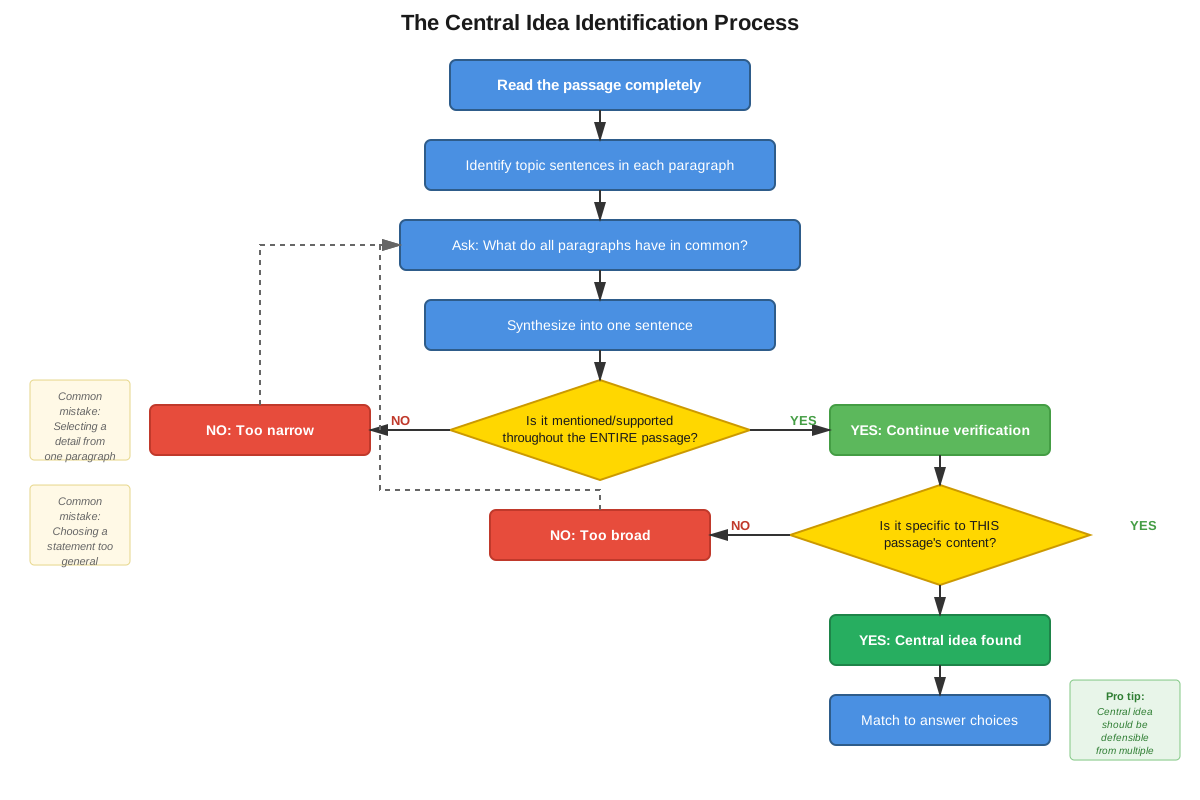
- Read the entire passage first before looking at answer choices. Attempting to identify the central idea while reading choices often leads to confirmation bias.
- Identify the topic in your own words. Ask: "What is this passage about?"
- Determine the author's main point about that topic. Ask: "What does the author want me to understand about this topic?"
- Formulate your own central idea statement before reading answer choices. This prevents answer choices from influencing your interpretation.
- Eliminate clearly wrong answers using the "too broad, too narrow, off-topic" framework.
- Select the answer that best matches your pre-formulated central idea.
Trigger Words and Phrases
Central idea questions use predictable language. Watch for these question stems:
- "Which choice best states the main idea of the text?"
- "The text primarily serves to..."
- "Which choice best describes the overall structure of the text?"
- "The central claim of the passage is that..."
- "The author's primary purpose is to..."
- "Which choice best summarizes the text?"
In answer choices, be cautious of:
- Extreme language ("always," "never," "only," "completely") unless the passage itself uses such language
- Specific details that appear in the passage but don't represent the main point
- Accurate statements that address only part of the passage
- Outside information not mentioned in the passage
Process of Elimination Framework
Use this three-category system to eliminate wrong answers:
Too Narrow: The answer choice focuses on a single detail, example, or paragraph rather than the entire passage. Ask: "Does this cover everything in the passage, or just one part?"
Too Broad: The answer choice is so general it could apply to many passages beyond this one. Ask: "Is this specific enough to distinguish this passage from others on similar topics?"
Off-Topic: The answer choice introduces ideas not discussed in the passage or misrepresents what the passage actually says. Ask: "Is every part of this answer choice supported by the passage?"
The correct answer will be "just right"—specific enough to capture this particular passage's focus while broad enough to encompass all its parts.
Time Allocation
Central idea questions typically require 45-60 seconds to answer effectively. Spend:
- 20-30 seconds reading and understanding the passage
- 10-15 seconds formulating your own central idea
- 15-20 seconds evaluating answer choices
If you find yourself spending more than 90 seconds on a central idea question, mark it for review and move on. These questions should be among the more straightforward on the test when approached systematically.
Exam Tip: If two answer choices seem equally valid, the one that encompasses more of the passage is usually correct. Central ideas should be comprehensive, not partial.
Memory Techniques
The MAIN Acronym
Use MAIN to remember what a central idea must be:
- Most important point (not a supporting detail)
- All parts of the passage (not just one section)
- In the text (not outside information)
- Neutral scope (not too broad or too narrow)
The Umbrella Visualization
Picture the central idea as an umbrella, with supporting details as raindrops beneath it. Every detail in the passage should fit under the umbrella of the central idea. If a potential central idea doesn't cover all the details, it's too narrow. If it's so large it could cover details from many other passages, it's too broad.
The "Delete Test"
When unsure whether something is the central idea or a supporting detail, imagine deleting it from the passage. If the passage loses its core meaning and purpose, it's the central idea. If the passage still makes sense and holds together, it's a supporting detail.
The Three-Word Summary
Practice reducing passages to three words: Topic + Action + Focus. For example: "Neurogenesis + transforms + neuroscience" or "Silk Road + facilitated + cultural exchange." This forces you to identify the essential elements and often reveals the central idea.
Signal Word Awareness
Memorize these common signal words that often precede or indicate central ideas:
- Contrast signals: however, yet, but, nevertheless, despite (often introduce the author's main point after acknowledging an opposing view)
- Emphasis signals: importantly, significantly, primarily, especially, above all
- Conclusion signals: therefore, thus, consequently, in sum, ultimately
Summary
The central idea of a passage represents the author's primary message or main point that unifies all elements of the text. On the SAT Reading and Writing section, identifying central ideas is a high-frequency, high-value skill that appears in multiple question formats across diverse passage types. The central idea differs from the topic (the subject matter) by including the author's perspective or claim about that topic. It also differs from supporting details, which provide specific examples, evidence, or elaboration. Effective central idea identification requires synthesizing information from the entire passage, distinguishing between main points and details, and selecting answers with appropriate scope—neither too broad nor too narrow. Students should formulate their own central idea before evaluating answer choices, use signal words to locate key statements, and apply systematic elimination strategies. Mastering this skill not only improves SAT performance but also builds essential college-level reading comprehension abilities.
Key Takeaways
- The central idea encompasses the entire passage and represents the author's main point, not just the topic or a supporting detail
- Central ideas may be stated explicitly (often in opening or closing sentences) or require synthesis of information from multiple parts of the passage
- Wrong answer choices typically fall into three categories: too narrow (focusing on details), too broad (applying to many passages), or off-topic (introducing unsupported information)
- Signal words like "however," "primarily," and "therefore" often indicate shifts to or emphasis on the central idea
- Formulating your own central idea statement before reading answer choices prevents confirmation bias and improves accuracy
- The correct answer must be supported by the entire passage without introducing outside information or personal interpretation
- Central idea mastery enables better performance on related question types including author's purpose, text structure, and inference questions
Related Topics
Supporting Details and Evidence: After mastering central ideas, students should study how authors use specific details, examples, and evidence to develop and support their main points. This builds on central idea skills by examining the relationship between general claims and specific support.
Author's Purpose and Point of View: Understanding why authors write passages and what perspectives they bring connects directly to central idea identification, as the purpose often aligns with communicating the central idea.
Text Structure and Organization: Analyzing how passages are organized (cause-effect, problem-solution, compare-contrast, chronological) helps students recognize how structure serves to present central ideas effectively.
Inference and Implication: Many central ideas are implied rather than stated explicitly, making inference skills essential for advanced central idea questions.
Synthesis Across Multiple Texts: The digital SAT sometimes presents paired passages, requiring students to identify how central ideas relate across texts—a natural extension of single-passage central idea skills.
Practice CTA
Now that you understand the core concepts and strategies for identifying central ideas, it's time to apply this knowledge! Work through the practice questions to test your ability to distinguish central ideas from supporting details, eliminate incorrect answer choices, and select the best answer under timed conditions. Use the flashcards to reinforce key concepts and signal words. Remember: central idea questions are among the most predictable on the SAT—master the systematic approach outlined in this guide, and you'll see consistent improvement in your performance. Every practice question you complete strengthens your pattern recognition and builds the confidence you need for test day success!
Sign up free to keep reading
Create a free AnvayaPrep account to finish this SAT guide on Central idea of a passage — plus flashcards and practice questions.