Overview
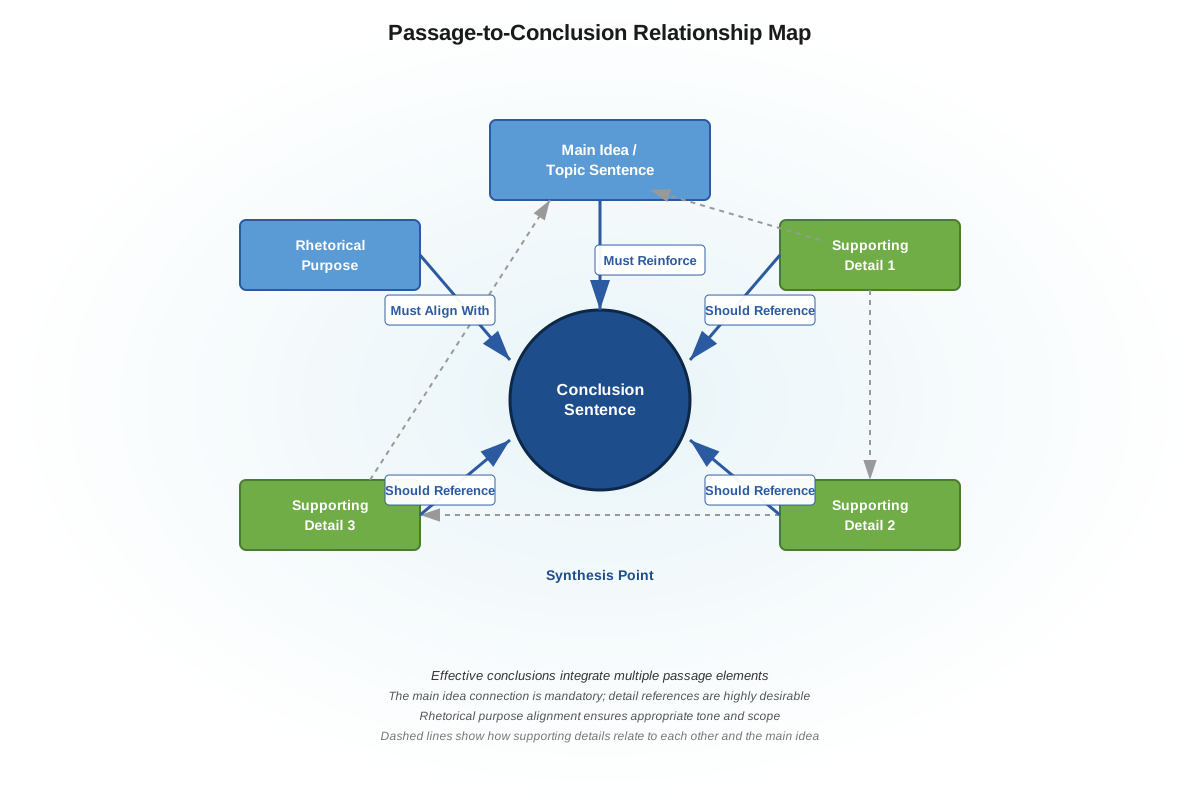
Conclusion sentences are a critical component of the SAT Reading and Writing (RW) section, appearing frequently in questions that test a student's ability to understand how ideas flow and connect within a passage. These questions require students to identify or select the most appropriate sentence to end a paragraph or passage, ensuring logical coherence, thematic consistency, and effective closure of the ideas presented. Mastering conclusion sentences is essential because they test multiple skills simultaneously: comprehension of main ideas, recognition of supporting details, understanding of rhetorical purpose, and awareness of transitional logic.
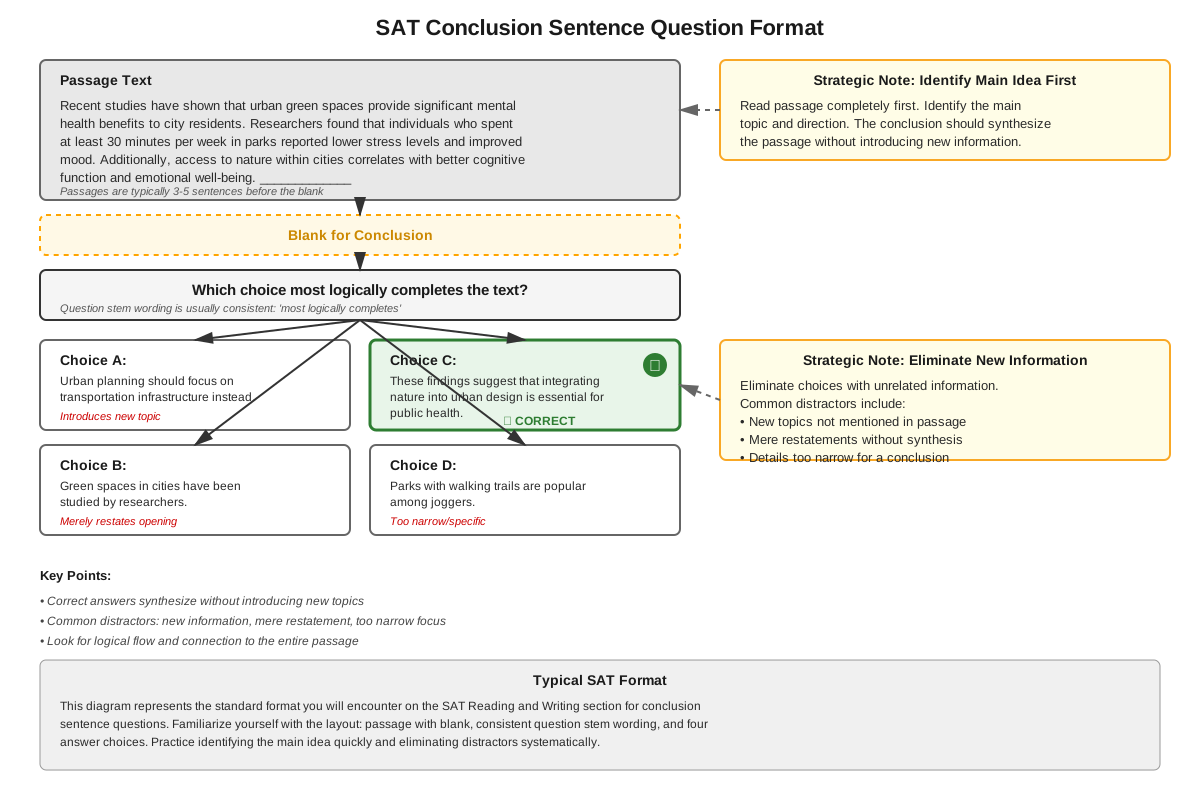
On the SAT, sat conclusion sentences questions typically present a passage with a blank at the end of a paragraph or the entire text, followed by four answer choices. Students must determine which option best completes the passage by synthesizing information, recognizing the author's purpose, and understanding how effective conclusions reinforce or extend the central argument. These questions assess whether students can distinguish between sentences that merely restate information, those that introduce irrelevant details, and those that provide meaningful closure or insight.
Understanding conclusion sentences connects directly to broader RW skills tested throughout the SAT, including identifying central ideas, analyzing supporting evidence, and recognizing organizational patterns. Strong performance on these questions demonstrates mastery of reading comprehension, logical reasoning, and rhetorical awareness—skills that appear across multiple question types in the Reading and Writing section. Because conclusion sentences require synthesizing the entire passage's content and purpose, they serve as an excellent measure of holistic comprehension rather than isolated fact recall.
Learning Objectives
- [ ] Identify key features of conclusion sentences
- [ ] Explain how conclusion sentences appears on the SAT
- [ ] Apply conclusion sentences to answer SAT-style questions
- [ ] Distinguish between effective and ineffective conclusion sentences based on logical flow and thematic relevance
- [ ] Analyze the relationship between a conclusion sentence and the preceding content in a passage
- [ ] Evaluate conclusion sentences for their ability to provide closure without introducing new, unrelated information
- [ ] Recognize common patterns and structures in high-quality conclusion sentences
Prerequisites
- Understanding of main ideas and topic sentences: Conclusion sentences must align with and reinforce the central point established earlier in the passage
- Recognition of supporting details: Effective conclusions often reference or synthesize key supporting evidence presented in the body of the text
- Basic paragraph structure knowledge: Understanding how introduction, body, and conclusion work together helps identify appropriate concluding statements
- Familiarity with rhetorical purpose: Recognizing whether a passage aims to inform, persuade, describe, or narrate helps determine what type of conclusion is appropriate
Why This Topic Matters
Conclusion sentences represent a high-frequency question type on the SAT, appearing in approximately 10-15% of Reading and Writing questions. These questions are particularly valuable because they assess multiple competencies simultaneously, making them efficient indicators of overall reading comprehension ability. Students who master conclusion sentences typically demonstrate strong performance across other question types because the skills required—synthesis, logical reasoning, and rhetorical awareness—transfer broadly.
In real-world contexts, the ability to craft and recognize effective conclusions is fundamental to academic writing, professional communication, and critical reading. Whether analyzing research papers, evaluating arguments in news articles, or composing essays, understanding how conclusions function enables more sophisticated engagement with written material. This skill directly supports college readiness, as academic writing at the university level demands clear, purposeful conclusions that synthesize complex ideas.
On the SAT, conclusion sentence questions most commonly appear in passages of 50-150 words from various disciplines including science, social studies, humanities, and literature. The passages may be informative, argumentative, or narrative in nature, and the conclusion must match the passage's tone, purpose, and scope. Questions typically ask students to select which sentence "most logically completes the text" or "best concludes the passage," requiring careful attention to both content and rhetorical function.
Core Concepts
Defining Effective Conclusion Sentences
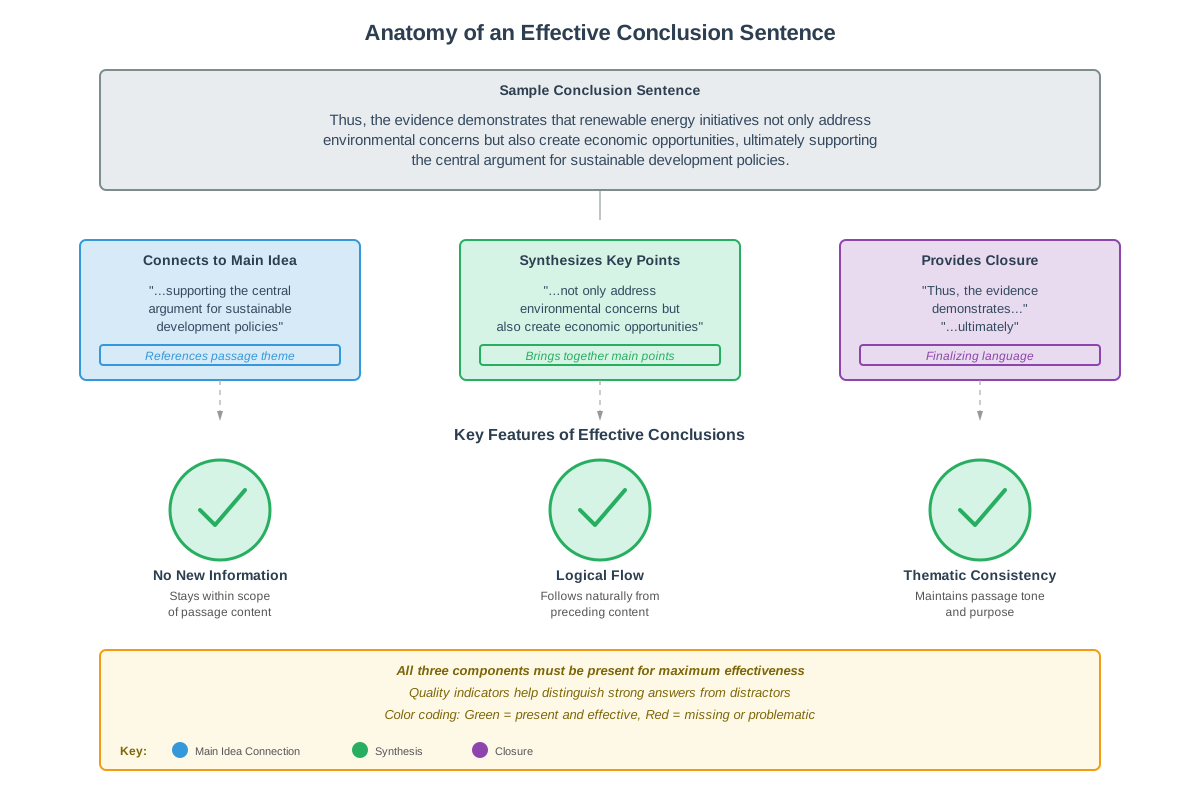
An effective conclusion sentence serves as the final statement in a paragraph or passage, providing closure while reinforcing the main idea without simply repeating it verbatim. The best conclusions accomplish one or more of the following functions: synthesizing key points, offering a final insight or implication, connecting back to the opening idea, or suggesting broader significance. Unlike body sentences that introduce new supporting evidence, conclusion sentences work with information already presented, transforming it into a satisfying endpoint.
The key distinction between conclusion sentences and other sentence types lies in their backward-looking nature. While topic sentences introduce what's to come and body sentences develop ideas with new information, conclusion sentences reflect on what has been established. They answer the implicit question: "So what?" or "What does this all mean?" This reflective quality makes them essential for creating coherent, purposeful writing.
Characteristics of Strong Conclusion Sentences
Strong conclusion sentences share several identifiable features that distinguish them from weaker alternatives:
| Feature | Description | Example Context |
|---|---|---|
| Thematic alignment | Directly relates to the passage's central idea | A passage about climate change impacts concludes with effects on ecosystems, not unrelated policy details |
| Logical flow | Follows naturally from preceding sentences | After discussing three benefits, concludes by summarizing their collective importance |
| Appropriate scope | Matches the breadth of the passage | A paragraph about one species doesn't conclude with claims about all animals |
| No new major claims | Avoids introducing entirely new topics | Doesn't suddenly mention unrelated research or different subjects |
| Purposeful tone | Maintains consistency with passage voice | An objective scientific passage doesn't end with emotional appeals |
Types of Conclusion Sentences on the SAT
The SAT features several distinct patterns of conclusion sentences, each serving different rhetorical purposes:
- Synthesizing conclusions: These combine multiple points from the passage into a unified statement, showing how separate ideas connect to support the main argument. Example: After discussing three separate benefits of urban gardens, the conclusion might state how these benefits collectively improve community well-being.
- Implication conclusions: These extend the passage's ideas by suggesting consequences, applications, or broader significance without introducing completely new topics. Example: A passage about a scientific discovery might conclude by noting what this finding enables researchers to investigate next.
- Reinforcing conclusions: These restate the main idea using different language, often with added emphasis or a slightly expanded perspective. Example: After explaining how a historical figure influenced policy, the conclusion might emphasize their lasting legacy using fresh phrasing.
- Circular conclusions: These connect back to an idea, question, or scenario introduced at the passage's beginning, creating a sense of completeness. Example: A passage opening with a question about animal behavior concludes by answering that question based on evidence presented.
Common Pitfalls in Conclusion Sentences
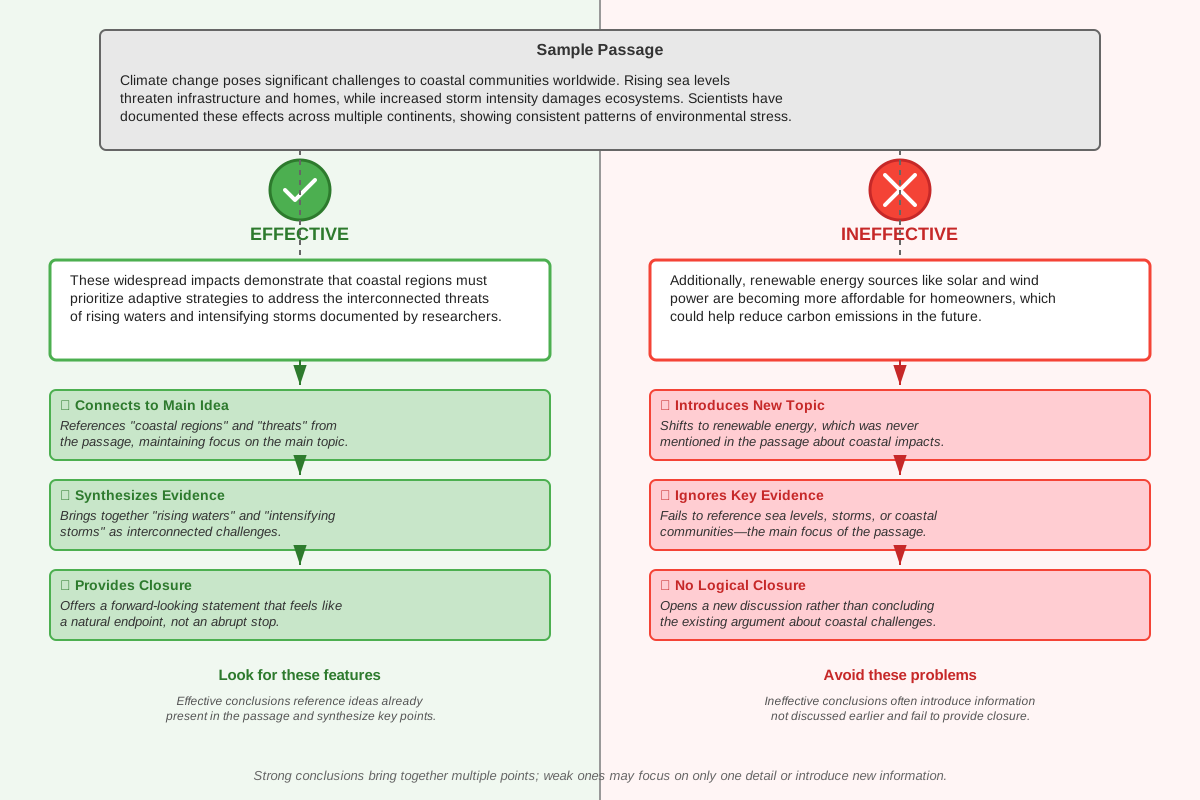
Understanding what makes conclusions ineffective is equally important for SAT success. Weak conclusion sentences typically exhibit one or more of these problems:
- Introducing new information: Adding facts, examples, or concepts not mentioned earlier disrupts logical flow and leaves readers with unresolved questions
- Being too narrow: Focusing on a minor detail rather than the broader point fails to provide appropriate closure
- Being too broad: Making sweeping claims that exceed the passage's scope undermines credibility and coherence
- Contradicting earlier content: Stating something inconsistent with previous sentences creates confusion and logical errors
- Lacking connection: Failing to relate clearly to the main idea makes the conclusion feel arbitrary or disconnected
Analyzing Conclusion Sentence Context
To select the correct conclusion sentence on the SAT, students must analyze several contextual elements:
Passage purpose: Determine whether the text aims to inform, persuade, describe, or narrate. Informative passages typically conclude with summaries or implications, while persuasive passages often end with reinforced claims or calls to consider the argument's importance.
Tone and style: Match the conclusion's language to the passage's voice. Formal academic passages require formal conclusions; conversational passages allow more relaxed phrasing.
Structural patterns: Identify how the passage organizes information (chronologically, by importance, by category, etc.) to ensure the conclusion aligns with this structure.
Key terms and concepts: Note which terms appear repeatedly or receive emphasis, as effective conclusions typically reference these central concepts rather than peripheral details.
Concept Relationships
The skill of identifying effective conclusion sentences builds directly on understanding central ideas, as conclusions must align with and reinforce the main point. This relationship flows in one direction: students must first identify what the passage is primarily about before evaluating which conclusion best serves that central idea. Without accurately determining the main idea, selecting an appropriate conclusion becomes guesswork.
Supporting details connect to conclusion sentences through synthesis—effective conclusions often reference or combine key supporting points without simply listing them. The relationship works as follows: Supporting Details → Provide Evidence → Conclusion Synthesizes Evidence → Reinforces Central Idea. This chain demonstrates how conclusions serve as the final link connecting all passage elements.
Within the topic itself, the concepts relate hierarchically: Understanding the definition and purpose of conclusion sentences enables recognition of their key characteristics, which in turn allows students to distinguish between effective and ineffective options on exam questions. This progression moves from theoretical understanding to practical application.
The connection to rhetorical purpose is bidirectional: understanding a passage's purpose helps identify appropriate conclusions, while analyzing conclusion options can clarify the author's overall intent. Similarly, logical flow and conclusion sentences inform each other—strong logical flow throughout a passage makes the appropriate conclusion more obvious, while a well-chosen conclusion reinforces the passage's coherence.
High-Yield Facts
⭐ Effective conclusion sentences reinforce the main idea without repeating it word-for-word
⭐ Conclusion sentences should not introduce major new information or topics not mentioned in the passage
⭐ The best conclusions match the passage's scope—neither too narrow nor too broad
⭐ Conclusion sentences must maintain consistency with the passage's tone and purpose
⭐ Strong conclusions often synthesize multiple points or suggest implications based on presented information
- Conclusion sentence questions appear in approximately 10-15% of SAT Reading and Writing questions
- The correct answer will always have clear logical connection to preceding sentences
- Incorrect answers often include accurate information that doesn't function well as a conclusion
- Circular conclusions that reference the opening are particularly effective in shorter passages
- Conclusions in scientific passages often state implications or applications of findings
- Conclusions in historical passages frequently emphasize significance or lasting impact
- The phrase "most logically completes the text" signals a conclusion sentence question
- Effective conclusions can be one sentence or occasionally two closely related sentences
- Transition words like "thus," "therefore," and "ultimately" often (but not always) signal conclusions
- Reading the passage without looking at answer choices first helps identify what type of conclusion is needed
Quick check — test yourself on Conclusion sentences so far.
Try Flashcards →Common Misconceptions
Misconception: Conclusion sentences must always summarize everything mentioned in the passage.
Correction: While some conclusions do summarize, others suggest implications, emphasize significance, or connect to opening ideas. The key is providing appropriate closure, not necessarily comprehensive summary.
Misconception: The longest or most detailed answer choice is usually the best conclusion.
Correction: Effective conclusions are often concise and focused. Length doesn't indicate quality; relevance and logical connection matter most. Overly detailed conclusions may introduce inappropriate new information.
Misconception: Conclusion sentences should introduce new evidence to make the passage more interesting.
Correction: Conclusions work with information already presented in the passage. Introducing new evidence creates an incomplete argument and leaves readers with unresolved questions.
Misconception: Any sentence that relates to the general topic can serve as an effective conclusion.
Correction: Conclusions must specifically relate to the passage's particular focus and main idea, not just the broad topic. A passage about one aspect of climate change shouldn't conclude with unrelated climate information.
Misconception: Formal academic passages always require conclusions with words like "therefore" or "in conclusion."
Correction: While transition words can signal conclusions, they're not required. Many effective conclusions flow naturally from previous sentences without explicit transitional markers.
Misconception: The correct conclusion is always the one that sounds most impressive or uses sophisticated vocabulary.
Correction: The best conclusion is the one that logically completes the passage's argument and maintains appropriate tone, regardless of vocabulary complexity. Overly sophisticated language that doesn't match the passage's style is incorrect.
Misconception: If an answer choice contains true information from the passage, it must be a good conclusion.
Correction: An answer can accurately reference passage content but still function poorly as a conclusion if it focuses on minor details, lacks appropriate scope, or doesn't provide closure.
Worked Examples
Example 1: Scientific Passage
Passage:
"Researchers studying coral reef ecosystems have discovered that parrotfish play a crucial role in maintaining reef health. These colorful fish consume algae that would otherwise overwhelm and kill coral. By grazing on algae-covered surfaces, parrotfish prevent algae from blocking sunlight that corals need for photosynthesis. Additionally, parrotfish excrete sand as they digest coral rock, contributing to beach formation. Studies show that reefs with healthy parrotfish populations demonstrate significantly better recovery rates after environmental disturbances. __________"
Answer Choices:
A) Parrotfish are found in tropical and subtropical waters around the world.
B) Many other fish species also contribute to reef ecosystem balance.
C) These findings underscore the importance of protecting parrotfish populations for reef conservation.
D) Coral reefs face numerous threats including climate change and pollution.
Analysis:
First, identify the central idea: Parrotfish are crucial for coral reef health through their algae-eating behavior and other contributions.
Next, evaluate each option:
Option A provides factual information about parrotfish distribution but doesn't connect to the passage's focus on their ecological role. This introduces related but tangential information rather than concluding the argument about their importance. Eliminate.
Option B shifts focus to other fish species, which weren't mentioned in the passage. While potentially true, this introduces a new topic rather than concluding the discussion of parrotfish. This violates the principle that conclusions shouldn't introduce major new subjects. Eliminate.
Option C synthesizes the passage's key points (algae consumption, reef health, recovery rates) and suggests the implication: parrotfish need protection. This provides appropriate closure by connecting the scientific findings to their practical significance. The word "these findings" explicitly references the evidence presented, and "underscore the importance" provides evaluative closure without introducing new information. Strong candidate.
Option D mentions threats to coral reefs, which weren't discussed in the passage. While thematically related to reef conservation, this introduces a new topic (threats) rather than concluding the specific argument about parrotfish. Eliminate.
Correct Answer: C
This conclusion effectively synthesizes the passage's evidence and suggests its practical implication (conservation importance) without introducing unrelated topics. It maintains appropriate scope and provides purposeful closure.
Example 2: Historical Passage
Passage:
"In the early 20th century, mathematician Emmy Noether made groundbreaking contributions to abstract algebra and theoretical physics. Despite facing significant discrimination as a woman in academia, she developed Noether's theorem, which established a fundamental connection between symmetry and conservation laws in physics. Her work provided the mathematical foundation for Einstein's general relativity theory. Noether also mentored numerous students who went on to become influential mathematicians themselves. __________"
Answer Choices:
A) Einstein's theory of general relativity revolutionized our understanding of gravity and spacetime.
B) Women continue to face challenges in STEM fields today.
C) Noether's intellectual legacy extends far beyond her own publications through both her theoretical innovations and her influence on subsequent generations of mathematicians.
D) Abstract algebra involves the study of algebraic structures such as groups, rings, and fields.
Analysis:
Identify the central idea: Emmy Noether made important contributions to mathematics and physics despite discrimination, through both her theoretical work and mentorship.
Evaluate each option:
Option A shifts focus entirely to Einstein's theory rather than Noether's contributions. While the passage mentions Einstein, he's not the subject. This conclusion would leave Noether's story incomplete. Eliminate.
Option B addresses gender discrimination in STEM, which relates to the passage's mention of discrimination Noether faced. However, this conclusion shifts to a modern, broader topic rather than concluding Noether's specific story. It introduces a new time period and scope. Eliminate.
Option C synthesizes both major threads of the passage: Noether's theoretical work ("theoretical innovations") and her mentorship ("influence on subsequent generations"). The phrase "intellectual legacy" provides appropriate closure by emphasizing lasting significance, and "extends far beyond her own publications" captures how both her direct work and indirect influence matter. This maintains focus on Noether while providing evaluative closure. Strong candidate.
Option D defines abstract algebra, one area Noether worked in, but this provides background information rather than conclusion. Defining terms belongs in introductory or body sentences, not conclusions. This doesn't provide closure or synthesis. Eliminate.
Correct Answer: C
This conclusion successfully synthesizes the passage's two main points (theoretical contributions and mentorship) and emphasizes Noether's lasting significance, providing appropriate closure to her biographical sketch.
Exam Strategy
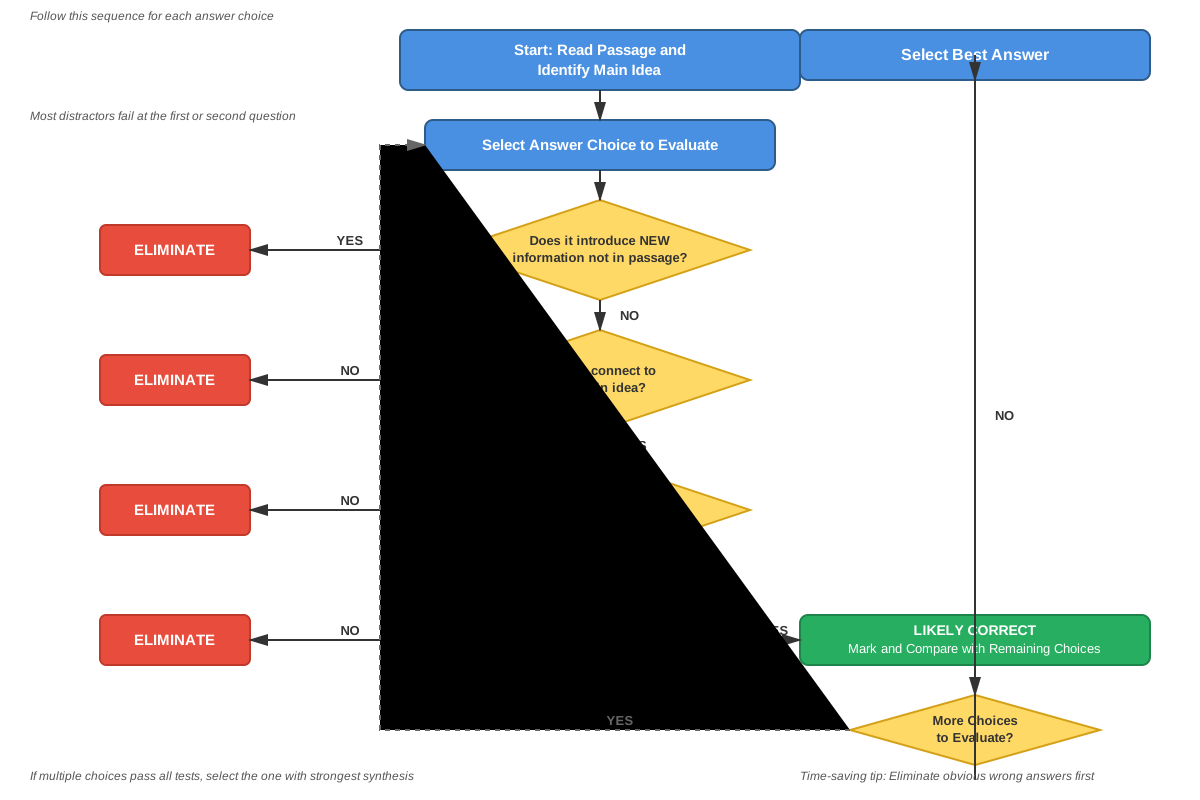
When approaching sat conclusion sentences questions, follow this systematic process:
Step 1: Read the entire passage first without looking at answer choices. This prevents premature judgment and allows natural comprehension of the passage's flow and purpose. As you read, mentally note: What is this passage mainly about? What point is the author making?
Step 2: Identify the passage's central idea and purpose. Ask yourself: Is this passage informing, persuading, describing, or narrating? What's the main point? This determines what type of conclusion is appropriate.
Step 3: Before reading answer choices, predict what an effective conclusion might do. Should it summarize key points? Suggest an implication? Emphasize significance? Connect back to the opening? This prediction serves as a benchmark for evaluating options.
Step 4: Eliminate answers that introduce new major topics. Any choice that brings up subjects not mentioned in the passage can be immediately eliminated. Watch for answers that are thematically related but topically different.
Step 5: Eliminate answers with inappropriate scope. Remove options that are too narrow (focusing on minor details) or too broad (making claims beyond the passage's scope).
Step 6: Check remaining options for logical flow. Read the last sentence of the passage followed by each remaining answer choice. Does it flow naturally? Does it feel like a satisfying endpoint?
Exam Tip: Trigger phrases that often signal conclusion sentence questions include "most logically completes the text," "best concludes the passage," and "which choice most effectively ends the passage."
Time allocation: Spend approximately 45-60 seconds per conclusion sentence question. These questions require careful reading but shouldn't demand extensive analysis once you understand the passage's main idea.
Process of elimination specific strategies:
- Answers with absolute language ("always," "never," "all") are often too broad unless the passage itself uses such language
- Answers that repeat the topic sentence nearly verbatim are usually incorrect—conclusions should advance beyond mere repetition
- Answers containing accurate information from the passage aren't automatically correct; they must also function well as conclusions
- When two answers seem similar, the one that better synthesizes multiple passage elements is typically correct
Memory Techniques
CLOSE Acronym for evaluating conclusion sentences:
- Connects to main idea
- Logical flow from previous sentences
- Omits new major topics
- Scope matches passage breadth
- Echoes key concepts without exact repetition
The "So What?" Test: After reading a potential conclusion, ask "So what?" If the conclusion answers this question by providing significance, implication, or synthesis, it's likely effective. If it leaves you wondering why this information matters or how it relates, it's probably incorrect.
Visualization Strategy: Picture the passage as a journey. The introduction sets the destination, body sentences travel toward it, and the conclusion announces arrival. If a conclusion sentence feels like you're suddenly traveling somewhere else, it's wrong.
The Bookend Technique: For passages with clear opening statements, imagine the conclusion as the matching bookend. While not identical, effective conclusions often mirror or respond to opening ideas, creating symmetry.
Three-Part Check Mnemonic - "RTS":
- Relevant to main idea?
- Tone matches passage?
- Synthesizes rather than introduces?
Summary
Conclusion sentences represent a high-yield question type on the SAT Reading and Writing section, testing students' ability to identify statements that provide logical, appropriate closure to passages. Effective conclusions reinforce the central idea without repetition, maintain consistency with the passage's tone and purpose, and avoid introducing major new topics or claims. The best conclusions synthesize key points, suggest implications based on presented information, or emphasize significance while matching the passage's scope—neither too narrow nor too broad. Success on these questions requires identifying the passage's main idea and purpose, eliminating options that introduce unrelated topics or have inappropriate scope, and selecting the choice that provides the most satisfying and logical endpoint. Students should approach these questions systematically by reading the full passage first, predicting what type of conclusion is needed, and using process of elimination to remove clearly inappropriate options before selecting the answer that best completes the logical flow.
Key Takeaways
- Conclusion sentences must reinforce the main idea and provide closure without introducing major new topics or information
- The correct conclusion will always maintain consistency with the passage's tone, purpose, and scope
- Effective conclusions often synthesize multiple points from the passage or suggest implications based on presented evidence
- Eliminate answer choices that are too narrow (focusing on minor details) or too broad (exceeding the passage's scope)
- Read the entire passage before evaluating answer choices to understand the central idea and natural flow
- The phrase "most logically completes the text" signals a conclusion sentence question requiring careful attention to logical flow
- Strong conclusions reference key concepts from the passage using fresh language rather than exact repetition
Related Topics
Topic Sentences and Main Ideas: Understanding how passages establish their central point helps identify conclusions that appropriately reinforce these ideas. Mastering conclusion sentences builds naturally on main idea identification skills.
Transitions and Logical Flow: Conclusion sentences represent the final transition in a passage's logical structure. Studying how transitions connect ideas throughout passages enhances ability to recognize appropriate conclusions.
Rhetorical Purpose and Tone: Analyzing why authors write passages and how they convey attitude directly supports selecting conclusions that match purpose and maintain tonal consistency.
Supporting Details and Evidence: Since effective conclusions often synthesize supporting points, understanding how evidence functions in passages strengthens conclusion evaluation skills.
Paragraph Structure and Organization: Recognizing how paragraphs organize information (chronologically, by importance, by category) helps predict what type of conclusion will provide appropriate closure.
Practice CTA
Now that you've mastered the core concepts of conclusion sentences, it's time to apply this knowledge! Work through the practice questions to test your ability to identify effective conclusions in various passage types. The flashcards will help reinforce key characteristics and common patterns. Remember: conclusion sentence questions reward careful reading and systematic thinking. Each practice question you complete strengthens your pattern recognition and builds confidence for test day. You've got this!
Sign up free to keep reading
Create a free AnvayaPrep account to finish this SAT guide on Conclusion sentences — plus flashcards and practice questions.