Overview
The function of a sentence is a critical analytical skill tested extensively on the SAT Reading and Writing section. This concept requires students to understand not just what a sentence says, but why the author included it and how it contributes to the passage's overall purpose. Rather than focusing on surface-level comprehension, function questions demand that students think like literary architects, examining how each sentence serves as a building block in the author's argumentative or narrative structure.
On the SAT, function questions typically ask students to identify whether a sentence introduces a claim, provides supporting evidence, offers a counterargument, presents an example, establishes context, or serves another rhetorical purpose. These questions appear frequently in the RW (Reading and Writing) section and are considered high-value targets because they assess deeper comprehension skills that correlate strongly with college readiness. Students who master sentence function analysis demonstrate the ability to navigate complex texts strategically, a skill that extends far beyond standardized testing into academic writing and critical reading.
Understanding sentence function connects directly to other essential Reading and Writing concepts, including main idea identification, author's purpose, rhetorical strategies, and passage structure. When students can accurately determine why an author included specific sentences, they gain insight into the passage's organizational logic, making it easier to answer questions about central ideas, supporting details, and the relationships between different parts of the text. This skill forms the foundation for sophisticated reading comprehension and is particularly valuable for tackling the most challenging passages on test day.
Learning Objectives
- [ ] Identify key features of function of a sentence
- [ ] Explain how function of a sentence appears on the SAT
- [ ] Apply function of a sentence to answer SAT-style questions
- [ ] Distinguish between different sentence functions (evidence, claim, counterargument, example, transition)
- [ ] Analyze how sentence placement affects its function within a passage
- [ ] Evaluate the relationship between a sentence's function and the author's overall purpose
Prerequisites
- Basic reading comprehension: Understanding literal meaning is necessary before analyzing rhetorical function
- Paragraph structure knowledge: Recognizing topic sentences, supporting details, and conclusions helps identify sentence roles
- Argument components: Familiarity with claims, evidence, and reasoning enables identification of argumentative sentence functions
- Transition words and phrases: Understanding connective language helps determine how sentences relate to surrounding text
Why This Topic Matters
In academic and professional contexts, the ability to analyze sentence function is essential for critical reading, effective writing, and persuasive communication. Lawyers must identify which sentences in legal documents establish precedent versus those that provide supporting citations. Scientists need to distinguish between sentences that state hypotheses and those that present experimental results. Business professionals must recognize whether a sentence in a proposal introduces a problem or offers a solution. This analytical skill underpins all sophisticated text interaction.
On the SAT, sentence function questions appear with remarkable frequency—typically 3-5 questions per test administration. These questions often appear in the "Craft and Structure" category and are considered medium-to-high difficulty. The College Board includes these questions because they assess skills that predict college success: the ability to understand not just content, but rhetorical strategy and organizational logic.
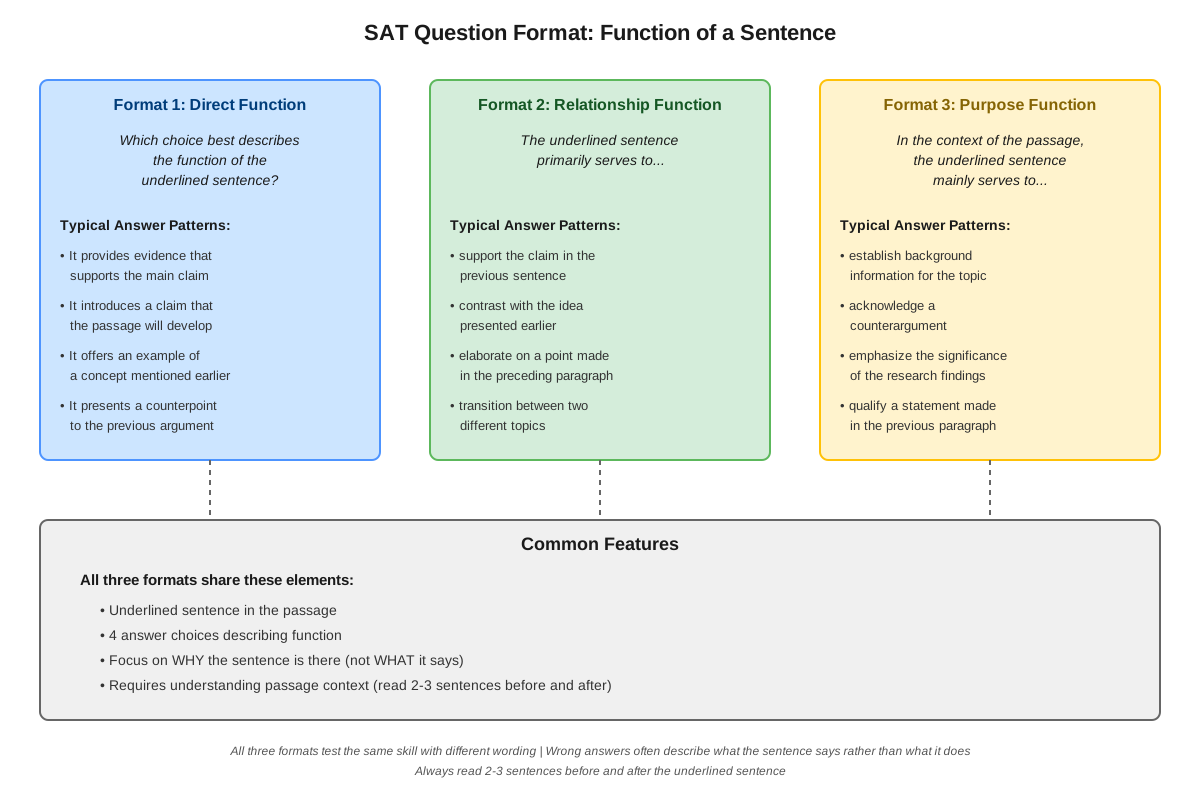
Function questions commonly appear in several formats: "Which choice best describes the function of the underlined sentence?" or "The author includes the sentence primarily to..." These questions may reference sentences that introduce new topics, provide statistical evidence, acknowledge opposing viewpoints, illustrate abstract concepts with concrete examples, or create transitions between ideas. Passages from all domains—literature, history, science, and social studies—can feature function questions, making this a universally applicable skill across the entire Reading and Writing section.
Core Concepts
Understanding Sentence Function
The function of a sentence refers to the specific role that sentence plays within the larger context of a paragraph or passage. Unlike simple comprehension questions that ask "what does this sentence say?", function questions ask "why did the author include this sentence?" and "how does it contribute to the passage's purpose?" Every sentence in a well-constructed passage serves a deliberate purpose, whether advancing an argument, providing necessary background, or connecting disparate ideas.
Identifying sentence function requires students to zoom out from the sentence itself and consider its relationship to surrounding sentences, the paragraph's main idea, and the passage's overall purpose. A sentence stating "The experiment yielded unexpected results" might function as a transition to a discussion of surprising findings, a claim that requires supporting evidence, or a conclusion drawn from previously presented data—its function depends entirely on context.
Primary Sentence Functions
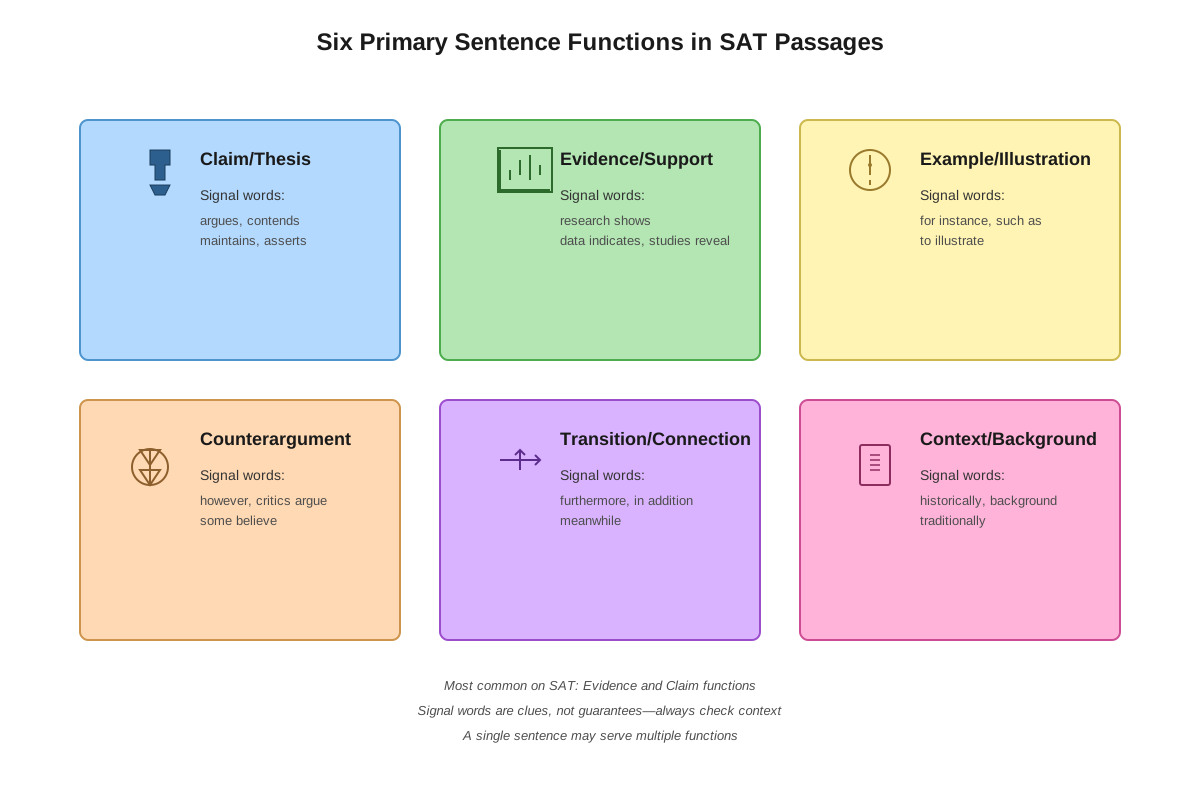
SAT function of a sentence questions typically involve one of several common rhetorical purposes:
| Function Type | Purpose | Common Indicators |
|---|---|---|
| Claim/Thesis | States the main argument or position | "argues that," "suggests," "proposes" |
| Evidence | Provides support for a claim | Statistics, quotes, study results, facts |
| Example | Illustrates an abstract concept | "For instance," "such as," specific cases |
| Counterargument | Presents opposing viewpoint | "However," "critics argue," "some believe" |
| Concession | Acknowledges limitation or opposing point | "Although," "while it's true," "admittedly" |
| Context/Background | Establishes necessary information | Historical details, definitions, setting |
| Transition | Connects ideas or shifts focus | "Furthermore," "in contrast," "turning to" |
| Conclusion | Summarizes or draws final inference | "Therefore," "ultimately," "in sum" |
Analyzing Contextual Clues
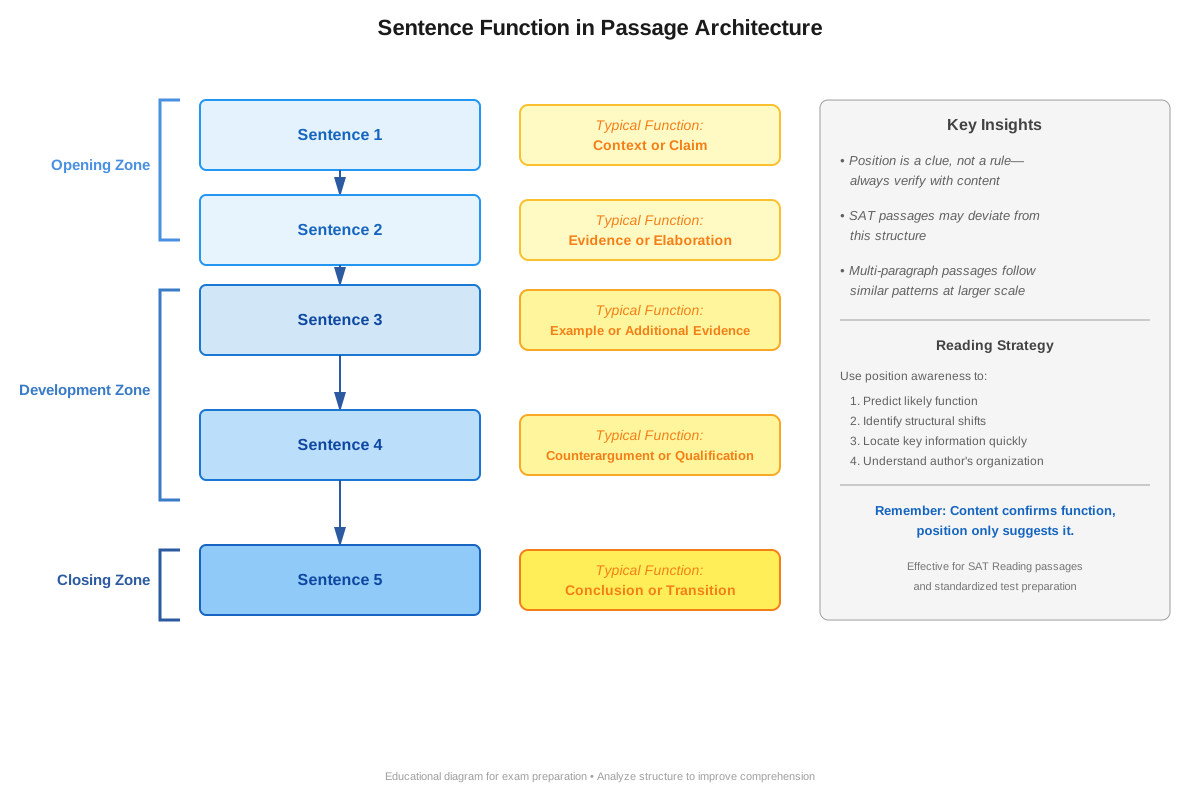
Determining sentence function requires systematic analysis of multiple contextual elements. The sentence's position within the paragraph provides crucial information: opening sentences often introduce topics or state claims, middle sentences typically provide evidence or examples, and concluding sentences frequently synthesize information or transition to new ideas.
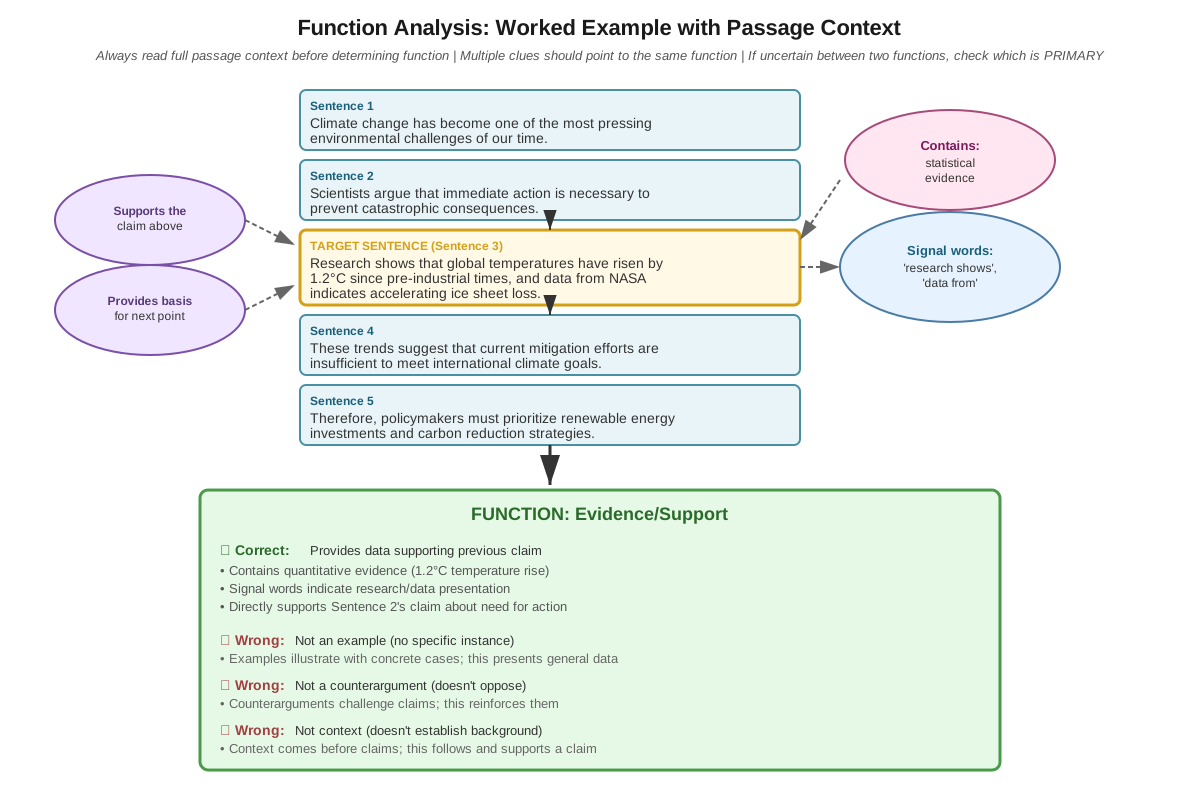
The content of surrounding sentences reveals function through contrast and connection. If the sentence in question presents data, and the preceding sentence made a claim, the function is likely evidential support. If the sentence introduces a qualification after several sentences of strong assertion, it likely serves as a concession or acknowledgment of complexity.
Transitional language within and around the target sentence offers explicit clues. Words like "however" signal contrast or counterargument, "for example" indicates illustration, "consequently" suggests causal relationship, and "additionally" points to supplementary evidence. However, students must avoid over-relying on transition words alone, as function depends on the complete rhetorical context.
The Relationship Between Function and Purpose
Sentence function operates in service of the author's broader purpose—whether to persuade, inform, entertain, or explain. In persuasive passages, sentences function as components of argumentation: claims require evidence, potential objections need addressing, and logical connections must be established. In informative passages, sentences function to build understanding: definitions clarify terms, examples make abstract concepts concrete, and organizational sentences guide readers through complex information.
Understanding this relationship helps students predict likely sentence functions. In a passage arguing for policy change, a sentence presenting statistics about current problems likely functions as evidence supporting the need for change. In a passage explaining a scientific phenomenon, a sentence describing a familiar everyday experience likely functions as an analogy to make the concept accessible.
Common Function Patterns in SAT Passages
SAT passages exhibit predictable structural patterns that help identify sentence function. Problem-solution structures typically include sentences that establish a problem (context), explain its significance (claim), present potential solutions (examples), and evaluate their effectiveness (analysis). Compare-contrast structures feature sentences that introduce items being compared (context), highlight similarities (evidence), emphasize differences (evidence), and draw conclusions about significance (claim).
Chronological narratives in historical or scientific passages use sentences to establish timeframes (context), describe events or discoveries (evidence), explain causes and effects (analysis), and assess impact (conclusion). Argument structures employ sentences to state positions (claim), provide supporting reasons (evidence), address counterarguments (concession/rebuttal), and reinforce conclusions (synthesis).
Recognizing these patterns allows students to anticipate sentence functions based on passage type and structure, making function identification more efficient and accurate.
Concept Relationships
The concept of sentence function connects intimately with multiple reading comprehension skills. Main idea identification depends on recognizing which sentences state central claims versus which provide supporting details—essentially a function analysis task. When students can identify that a sentence functions as the thesis, they've simultaneously identified the passage's main idea.
Author's purpose and sentence function are reciprocal concepts: understanding why the author wrote the passage helps predict individual sentence functions, while analyzing sentence functions reveals the author's overall purpose. A passage filled with sentences functioning as evidence and examples likely has an informative purpose, while one dominated by claim and counterargument sentences suggests persuasive intent.
The relationship map flows as follows: Passage Purpose → determines → Paragraph Structure → shapes → Sentence Function → creates → Rhetorical Effect → achieves → Author's Goal. Simultaneously, analyzing individual sentence functions builds understanding in reverse: Sentence Function → reveals → Paragraph Organization → clarifies → Passage Structure → illuminates → Author's Purpose.
Sentence function also connects to transition and coherence concepts. Sentences functioning as transitions explicitly link ideas, while understanding how sentences function together reveals implicit coherence. A sentence functioning as evidence only makes sense following a claim; recognizing this functional relationship reveals the passage's logical flow even without explicit transition words.
High-Yield Facts
⭐ Sentence function questions ask "why" the author included a sentence, not "what" the sentence says
⭐ Context is essential—the same sentence could serve different functions in different passages
⭐ Opening sentences of paragraphs frequently introduce new topics or state claims
⭐ Sentences containing statistics, study results, or specific examples typically function as evidence
⭐ Transition words provide clues but don't solely determine function
- Sentences with "however" or "yet" often introduce counterarguments or contrasting information
- Concluding sentences frequently synthesize information or transition to the next paragraph
- Sentences that acknowledge limitations or opposing views function as concessions
- Questions about sentence function often include the phrase "primarily to" or "mainly serves to"
- The correct answer will align with both the sentence's content and the passage's overall purpose
- Incorrect answers often describe what the sentence literally says rather than its rhetorical function
Quick check — test yourself on Function of a sentence so far.
Try Flashcards →Common Misconceptions
Misconception: A sentence's function is determined solely by its content.
Correction: Function depends on context and relationship to surrounding sentences. A sentence stating "Crime rates decreased by 15%" could function as evidence supporting a claim about policy effectiveness, as context establishing a problem's resolution, or as an example of statistical trends—its function depends on what comes before and after.
Misconception: Transition words always indicate a sentence's function.
Correction: While transition words provide clues, they don't definitively establish function. "However" might introduce a counterargument, but it could also signal a complicating factor that supports the main argument. The complete rhetorical context determines function.
Misconception: Evidence sentences only contain statistics or quotes.
Correction: Evidence includes any information supporting a claim: historical facts, logical reasoning, expert testimony, experimental results, or observational data. A sentence describing what happened in a historical event functions as evidence if it supports a claim about that event's significance.
Misconception: Every sentence has only one possible function.
Correction: Some sentences serve multiple functions simultaneously. A sentence might provide evidence for one claim while also serving as context for the next paragraph. However, SAT questions ask for the primary or main function—the most important role the sentence plays.
Misconception: Function questions are just asking for the main idea of the sentence.
Correction: Main idea describes content; function describes purpose. A sentence's main idea might be "pollution levels have increased," but its function could be to provide evidence, establish a problem requiring solution, or offer context for discussing environmental policy.
Worked Examples
Example 1: Scientific Passage
Passage excerpt:
"For decades, scientists believed that adult brains could not generate new neurons. However, research conducted in the 1990s revealed neurogenesis—the formation of new neurons—in the hippocampus of adult mammals. In one landmark study, researchers injected mice with a chemical marker that labels dividing cells, then examined their brains weeks later. The presence of marked neurons in the hippocampus provided direct evidence of adult neurogenesis. This discovery revolutionized neuroscience and opened new avenues for treating neurological disorders."
Question: The primary function of the underlined sentence ("The presence of marked neurons...") is to:
Analysis Process:
- Identify the sentence's content: It describes what the researchers found—marked neurons proving new neuron formation.
- Examine preceding context: The previous sentence describes the experimental method (injecting markers and examining brains).
- Determine relationship: This sentence presents the results of the experiment described in the previous sentence.
- Consider the broader context: The paragraph discusses the discovery of adult neurogenesis. The first sentence establishes old belief, the second introduces new findings, the third describes a study, and our target sentence presents that study's results.
- Identify the function: This sentence provides evidence supporting the claim that adult neurogenesis occurs. It shows the concrete proof that validated the discovery mentioned in the second sentence.
Answer: The sentence primarily functions to provide evidence supporting the claim that adult brains can generate new neurons.
Connection to learning objectives: This example demonstrates how to identify sentence function by analyzing context, recognizing evidence patterns, and understanding how scientific passages structure claims and support.
Example 2: Argumentative Passage
Passage excerpt:
"Urban planners should prioritize pedestrian-friendly infrastructure in city design. Cities with extensive sidewalks, crosswalks, and pedestrian zones report higher rates of walking and cycling, which reduces traffic congestion and air pollution. Critics argue that such infrastructure is expensive and reduces space for vehicles. While construction costs are significant, the long-term health and environmental benefits far outweigh initial expenses. Copenhagen, for instance, invested heavily in pedestrian infrastructure in the 1960s and now enjoys some of the world's lowest urban pollution levels and highest quality-of-life ratings."
Question: The primary function of the underlined sentence ("Critics argue that such infrastructure...") is to:
Analysis Process:
- Identify content: The sentence presents an opposing viewpoint about costs and vehicle space.
- Note transition language: "Critics argue" explicitly signals an opposing perspective.
- Examine position: This sentence appears after two sentences supporting pedestrian infrastructure, then is followed by a rebuttal.
- Recognize the pattern: Claim → Evidence → Counterargument → Rebuttal → Example—a classic argumentative structure.
- Determine function: This sentence introduces a counterargument that the author will subsequently address, strengthening the overall argument by acknowledging and refuting opposition.
Answer: The sentence primarily functions to present a counterargument that the author will address, thereby strengthening the overall argument through acknowledgment of opposing views.
Connection to learning objectives: This example shows how sentence function relates to argumentative structure and how recognizing patterns helps identify function efficiently.
Exam Strategy
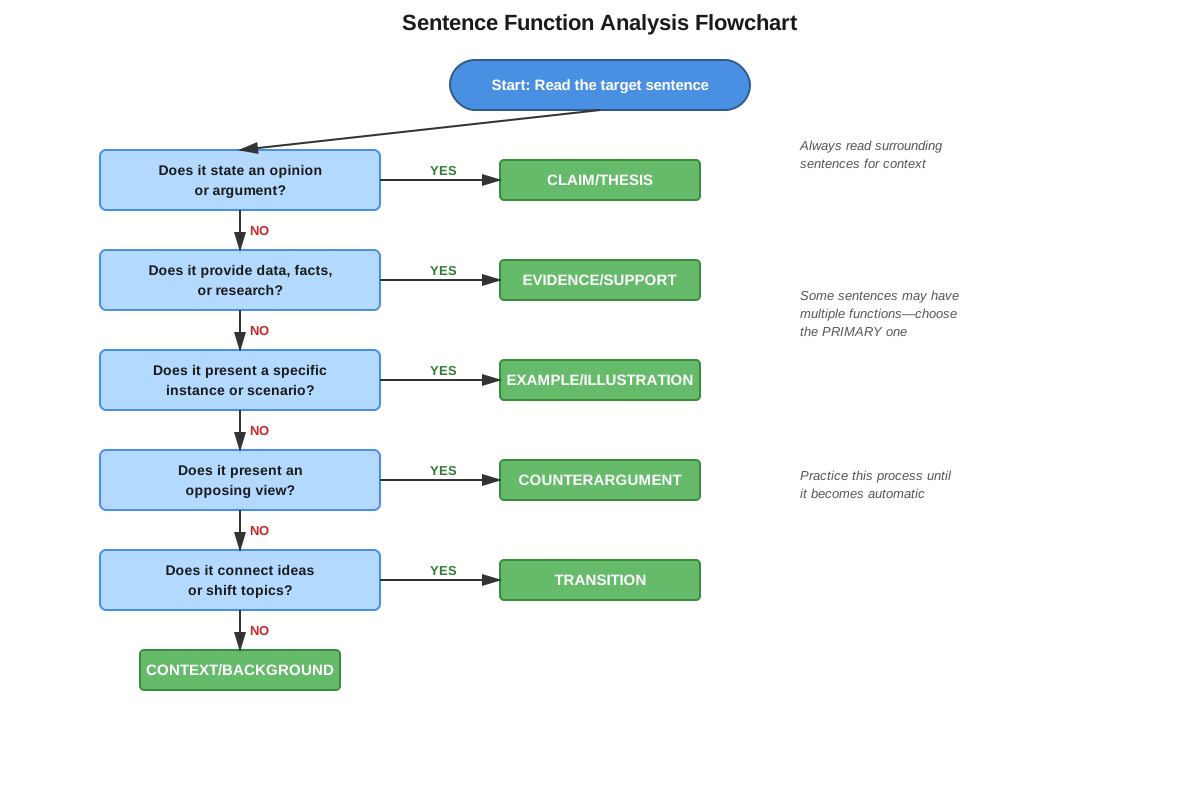
When approaching sat function of a sentence questions, employ a systematic three-step process: Read → Relate → Reason.
Read the target sentence carefully, but don't stop there—read at least one sentence before and one sentence after to establish context. Function cannot be determined in isolation. If the target sentence is the first or last in a paragraph, read into the adjacent paragraph to understand transitions.
Relate the sentence to its surroundings by asking specific questions: Does this sentence make a claim or support one? Does it introduce new information or elaborate on existing information? Does it agree with or contrast against the previous sentence? Does the next sentence build on it, qualify it, or shift away from it? These relationships reveal function.
Reason about the author's purpose: Why would the author include this sentence at this specific location? What would be missing if this sentence were removed? How does this sentence advance the passage's overall goal?
Exam Tip: Trigger phrases in answer choices help identify correct responses. Look for "provide evidence," "introduce a claim," "present a counterargument," "offer an example," "establish context," or "create a transition." Incorrect answers often use phrases like "explain the meaning" or "describe the content"—these focus on what the sentence says rather than why it's there.
Process of elimination is particularly effective for function questions. Eliminate answers that:
- Describe content rather than purpose
- Mention ideas not present in the sentence
- Mischaracterize the relationship to surrounding sentences
- Contradict the passage's overall purpose or tone
Time allocation: Spend 45-60 seconds on function questions. They require more context analysis than simple comprehension questions but shouldn't require rereading the entire passage. If you're uncertain, mark the question and return after completing faster questions, but make an educated guess before moving on.
Watch for these trigger words in passages that signal specific functions:
- Evidence indicators: "research shows," "data reveals," "studies indicate," "statistics demonstrate"
- Claim indicators: "argues," "proposes," "suggests," "maintains," "contends"
- Counterargument indicators: "critics," "opponents," "however," "nevertheless," "some argue"
- Example indicators: "for instance," "such as," "consider," "take the case of"
- Conclusion indicators: "therefore," "thus," "consequently," "ultimately," "in sum"
Memory Techniques
Use the acronym EFFECT to remember the six most common sentence functions:
- Evidence (supports a claim with facts, data, or examples)
- Foundation (establishes context or background information)
- Focus (states the main claim or thesis)
- Exception (presents counterargument or contrasting view)
- Connection (creates transition between ideas)
- Termination (concludes or synthesizes information)
Visualize passages as buildings where each sentence is a structural component: foundation sentences establish context, frame sentences state claims, brick sentences provide evidence, window sentences offer examples that let readers "see" concepts, and roof sentences conclude or transition. This architectural metaphor helps remember that function relates to structural role.
For remembering the relationship between position and function, use the mnemonic "TOP-MID-END":
- Topic introduction or Opening claim at Paragraph start
- Main evidence and Illustrative Details in the middle
- Ending synthesis or Next-paragraph Direction at conclusion
Create a mental function checklist using the question "CWER" (pronounced "queer"):
- Claim: Does it state a position?
- Warrant: Does it provide evidence or reasoning?
- Exception: Does it present opposition or qualification?
- Relation: Does it connect or transition ideas?
Summary
Mastering sentence function analysis is essential for SAT Reading and Writing success. This skill requires understanding that every sentence serves a deliberate rhetorical purpose within the passage's structure—whether stating claims, providing evidence, presenting counterarguments, offering examples, establishing context, creating transitions, or drawing conclusions. Function questions assess not what a sentence says, but why the author included it and how it contributes to the passage's overall purpose. Success depends on analyzing context: examining surrounding sentences, recognizing structural patterns, identifying transition language, and connecting individual sentence functions to the author's broader goals. Students must distinguish between content (what the sentence states) and function (why it's there), avoid over-relying on transition words alone, and systematically evaluate relationships between sentences. By employing strategic reading techniques—reading surrounding context, relating sentences to each other, and reasoning about authorial purpose—students can efficiently and accurately identify sentence functions across all passage types.
Key Takeaways
- Sentence function describes why an author included a sentence, not what the sentence says
- Context is essential—always read surrounding sentences to determine function accurately
- Common functions include claim, evidence, example, counterargument, concession, context, transition, and conclusion
- The same sentence could serve different functions in different contexts; function depends on relationships
- Effective strategy involves reading context, relating sentences to each other, and reasoning about author's purpose
- Transition words provide clues but don't solely determine function; complete rhetorical context matters most
- Function questions appear frequently on the SAT (3-5 per test) and are considered high-value targets for score improvement
Related Topics
Main Ideas and Supporting Details: Understanding sentence function directly enhances the ability to distinguish between central claims and supporting evidence, as these are essentially function categories. Mastering sentence function makes main idea questions significantly easier.
Author's Purpose and Point of View: Analyzing why authors include specific sentences reveals their overall purpose and perspective. Sentence function analysis is the microscopic view of the macroscopic author's purpose concept.
Rhetorical Strategies and Devices: Sentence function connects to broader rhetorical analysis, including how authors use structure, evidence, and argumentation to achieve their goals. This topic builds the foundation for advanced rhetorical analysis.
Passage Structure and Organization: Understanding how individual sentences function together reveals overall passage organization patterns, including problem-solution, cause-effect, compare-contrast, and chronological structures.
Transitions and Coherence: Recognizing sentences that function as transitions or that create coherence through their relationships deepens understanding of how passages achieve logical flow and unity.
Practice CTA
Now that you've mastered the core concepts of sentence function analysis, it's time to put your knowledge into action! Complete the practice questions to test your ability to identify sentence functions in various passage types and contexts. Use the flashcards to reinforce key concepts and common function patterns. Remember: sentence function questions are high-yield targets on the SAT—mastering this skill will directly improve your Reading and Writing score. Approach each practice question systematically using the Read-Relate-Reason strategy, and review any questions you miss to understand why the correct answer accurately describes the sentence's function. You've built a strong foundation; now strengthen it through deliberate practice!
Sign up free to keep reading
Create a free AnvayaPrep account to finish this SAT guide on Function of a sentence — plus flashcards and practice questions.