Overview
Evidence contradiction is a critical skill tested in the SAT Reading and Writing section, specifically within the Command of Evidence question type. These questions require students to evaluate whether a given piece of evidence supports, contradicts, or is irrelevant to a stated claim. Unlike straightforward comprehension questions, evidence contradiction items demand that students actively analyze the logical relationship between claims and supporting information, identifying when evidence actually undermines rather than supports an argument.
On the SAT, sat evidence contradiction questions typically present a passage containing a claim or hypothesis, followed by four answer choices that each contain potential evidence. Students must determine which piece of evidence directly contradicts the claim presented. This question type assesses critical thinking skills essential for college-level reading: the ability to distinguish between supporting and contradictory information, recognize logical inconsistencies, and evaluate the strength of argumentative relationships. These skills extend beyond test-taking into academic research, scientific reasoning, and everyday information literacy.
Within the broader RW (Reading and Writing) section architecture, evidence contradiction questions form part of the Command of Evidence domain, which accounts for approximately 12-15% of all Reading and Writing questions. This topic connects directly to other evidence-based skills like identifying supporting evidence, evaluating research claims, and synthesizing information across multiple sources. Mastering evidence contradiction strengthens overall analytical reading abilities and prepares students for the rigorous textual analysis required in college coursework across all disciplines.
Learning Objectives
- [ ] Identify key features of evidence contradiction
- [ ] Explain how evidence contradiction appears on the SAT
- [ ] Apply evidence contradiction to answer SAT-style questions
- [ ] Distinguish between evidence that contradicts, supports, or is neutral to a given claim
- [ ] Analyze the logical relationship between claims and multiple pieces of evidence
- [ ] Evaluate the strength and relevance of contradictory evidence in various contexts
Prerequisites
- Basic reading comprehension: Understanding main ideas and supporting details is essential for identifying what a claim actually states before determining what contradicts it
- Logical reasoning fundamentals: Recognizing cause-and-effect relationships and basic argumentation structure helps students identify when evidence works against a claim
- Vocabulary in context: Understanding academic and domain-specific vocabulary ensures students accurately interpret both claims and evidence
- Passage annotation skills: The ability to mark key information while reading helps track claims and potential contradictions efficiently
Why This Topic Matters
Evidence contradiction skills extend far beyond standardized testing into real-world applications. In an era of information abundance and misinformation, the ability to identify when evidence contradicts a claim is essential for evaluating news sources, scientific studies, political arguments, and marketing claims. College students regularly encounter research that challenges established theories, and professionals across fields must evaluate whether new data supports or contradicts existing models and practices.
On the SAT specifically, evidence contradiction questions appear with high frequency—typically 2-4 questions per test administration. These questions carry the same weight as all other Reading and Writing questions, making them significant contributors to overall scores. The College Board has increasingly emphasized Command of Evidence questions in recent test iterations, recognizing that evidence evaluation skills predict college readiness more accurately than simple recall or vocabulary knowledge.
Evidence contradiction questions most commonly appear in passages drawn from natural sciences, social sciences, and humanities research contexts. Students might encounter a passage describing a scientific hypothesis followed by experimental results, a historical claim followed by archaeological findings, or a literary interpretation followed by textual evidence. The passages are typically 25-150 words long and present information clearly, but the challenge lies in accurately identifying the logical relationship between claim and evidence rather than in decoding complex prose.
Core Concepts
Understanding Evidence Contradiction
Evidence contradiction occurs when a piece of information directly opposes, refutes, or undermines a stated claim, hypothesis, or conclusion. The contradiction must be explicit and logical—the evidence must make the claim less likely to be true or demonstrate that the claim is factually incorrect. Contradictory evidence doesn't merely present an alternative perspective; it actively challenges the validity of the original assertion.
The key to identifying contradiction lies in understanding the logical relationship between statements. If a claim states "X causes Y," contradictory evidence might show that "X is present but Y does not occur" or "Y occurs without X being present." If a claim asserts "All members of group A have characteristic B," contradictory evidence would demonstrate "Some members of group A lack characteristic B."
Types of Claims Subject to Contradiction
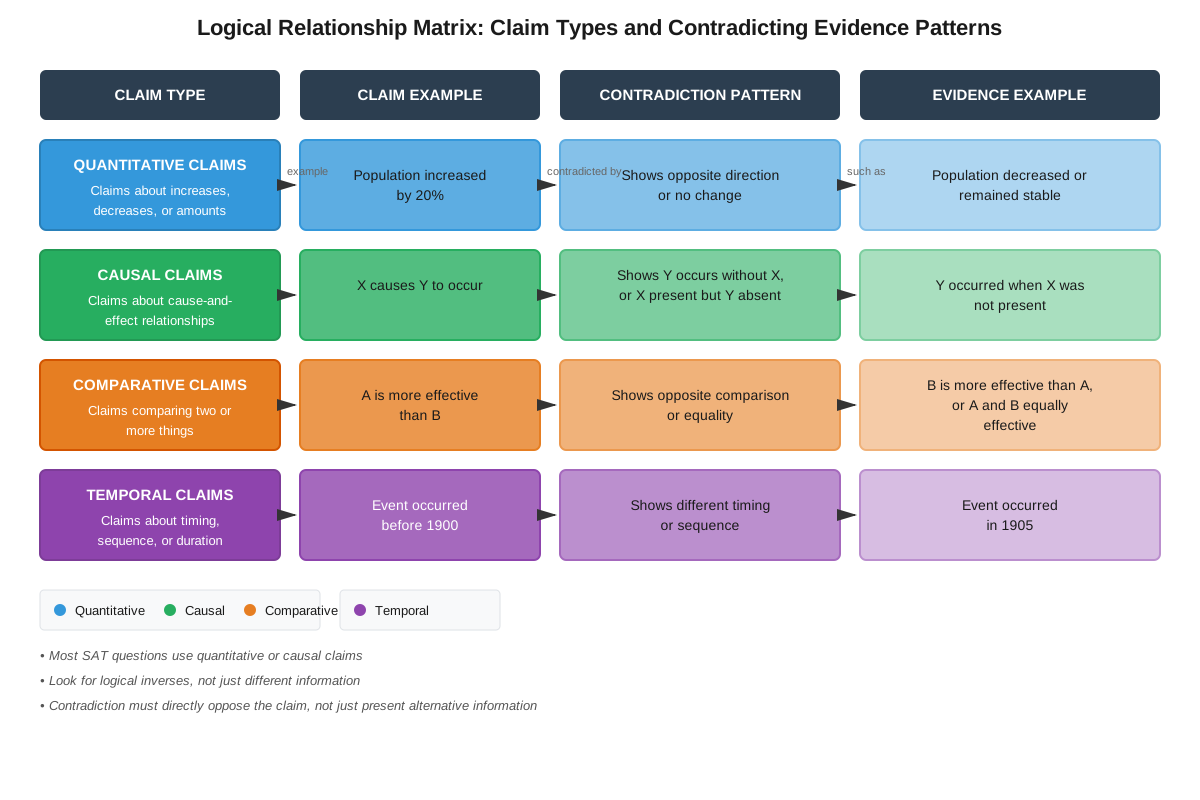
Claims on the SAT evidence contradiction questions typically fall into several categories:
Causal claims assert that one phenomenon causes another. Contradictory evidence might show the effect occurring without the cause, the cause occurring without the effect, or an alternative explanation for the observed effect.
Universal claims use absolute language like "all," "every," "always," or "never." These claims are particularly vulnerable to contradiction—a single counterexample suffices to contradict a universal claim.
Comparative claims assert that one thing is greater, lesser, more frequent, or different from another. Contradictory evidence presents data showing the opposite relationship or no significant difference.
Descriptive claims characterize a phenomenon, group, or situation in specific ways. Contradictory evidence provides observations or data that don't match the description.
Distinguishing Contradiction from Other Relationships
Understanding what contradiction is requires equally understanding what it is not:
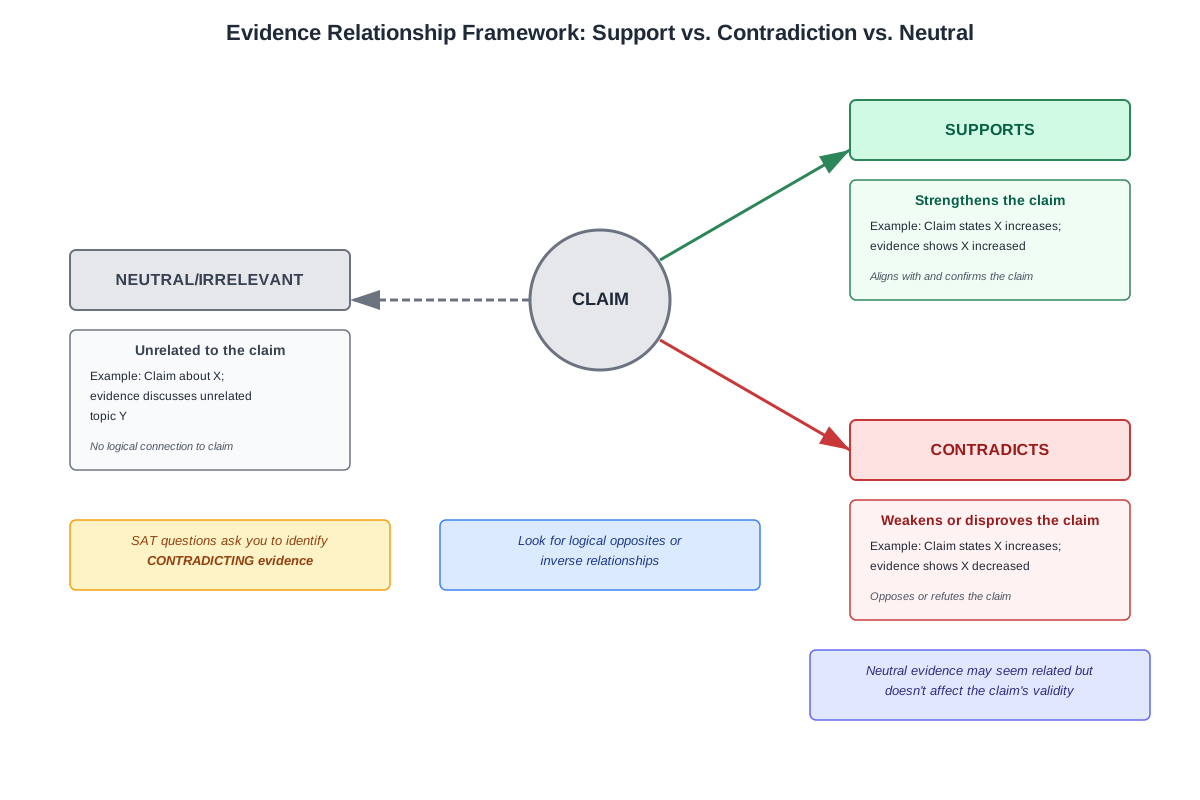
| Relationship Type | Definition | Example |
|---|---|---|
| Contradiction | Evidence directly opposes the claim | Claim: "All birds can fly." Evidence: "Penguins are birds that cannot fly." |
| Support | Evidence strengthens or confirms the claim | Claim: "Exercise improves mood." Evidence: "Study participants reported better mood after exercising." |
| Neutral/Irrelevant | Evidence neither supports nor contradicts | Claim: "Reading improves vocabulary." Evidence: "Many people enjoy reading fiction." |
| Qualification | Evidence adds nuance without contradicting | Claim: "Technology increases productivity." Evidence: "Technology increases productivity when properly implemented." |
The Anatomy of SAT Evidence Contradiction Questions
SAT evidence contradiction questions follow a consistent structure. The question stem typically includes:
- A brief passage (25-150 words) establishing context
- A clearly stated claim, hypothesis, or conclusion
- A question asking which finding/evidence would contradict the claim
- Four answer choices, each presenting different evidence
The question stem usually contains phrases like "Which finding would contradict," "Which observation would challenge," or "Which result would call into question." These trigger phrases signal that students must identify contradictory rather than supporting evidence.
The answer choices are carefully constructed to include:
- One choice that genuinely contradicts the claim (correct answer)
- One or two choices that support the claim (attractive distractors)
- One or two choices that are neutral or irrelevant to the claim
Evaluating Evidence Strength
Not all contradictions are equally strong. On the SAT, the correct answer will present clear, direct contradiction rather than weak or tangential opposition. Strong contradictory evidence:
- Directly addresses the same subject as the claim
- Uses comparable scope (doesn't compare different populations or contexts inappropriately)
- Presents factual information rather than opinions or hypotheticals
- Creates a logical impossibility or significant improbability for the claim
Weak or irrelevant evidence might seem contradictory at first glance but fails one or more of these criteria. For example, if a claim discusses "most teenagers," evidence about "some adults" would be irrelevant regardless of what it shows.
Context and Scope Matching
A critical but often overlooked aspect of evidence contradiction is scope matching. The evidence must address the same scope as the claim to genuinely contradict it. Consider these examples:
- Claim about "all mammals" can be contradicted by evidence about "some mammals"
- Claim about "teenagers in urban areas" cannot be contradicted by evidence about "adults in rural areas"
- Claim about "short-term effects" cannot be contradicted by evidence about "long-term effects" (different scope)
Students must carefully analyze whether the evidence and claim discuss the same population, time frame, geographic area, and conditions. Mismatched scope is a common feature of distractor answers.
Concept Relationships
Evidence contradiction skills build directly on fundamental reading comprehension abilities. Students must first accurately understand what a claim asserts (prerequisite: basic comprehension) before they can identify what would contradict it. This understanding requires parsing sentence structure and recognizing the scope and limitations of claims (prerequisite: logical reasoning).
Within the topic itself, concepts connect in a logical progression: Understanding what constitutes contradiction → Distinguishing contradiction from other evidence relationships → Recognizing different claim types → Matching evidence scope to claim scope → Evaluating contradiction strength. Each concept depends on mastery of the previous ones.
The relationship map flows as follows:
Claim Identification → Claim Type Classification (causal, universal, comparative, descriptive) → Scope Analysis (population, time, conditions) → Evidence Evaluation (contradicts, supports, neutral) → Strength Assessment (direct vs. tangential) → Answer Selection
Evidence contradiction connects to other Command of Evidence skills tested on the SAT. The inverse skill—identifying supporting evidence—uses the same analytical framework but requires opposite conclusions. Evidence synthesis questions require students to evaluate multiple pieces of evidence simultaneously, including both supporting and contradictory information. Research interpretation questions often present contradictory findings that students must reconcile or explain.
High-Yield Facts
⭐ Evidence contradicts a claim when it makes the claim less likely to be true or demonstrates the claim is factually incorrect
⭐ Universal claims (using "all," "every," "always," "never") can be contradicted by a single counterexample
⭐ The scope of evidence must match the scope of the claim for genuine contradiction to occur
⭐ SAT evidence contradiction questions typically include answer choices that support the claim as distractors
⭐ Contradictory evidence must address the same subject, population, and conditions as the original claim
- Evidence that is merely irrelevant or neutral does not contradict a claim, even if it doesn't support it
- Causal claims are contradicted by evidence showing the effect without the cause or the cause without the effect
- Comparative claims are contradicted by evidence showing the opposite relationship or no significant difference
- The question stem will explicitly ask for evidence that "contradicts," "challenges," or "calls into question" the claim
- Strong contradictory evidence creates a logical impossibility or significant improbability for the claim to be true
- Evidence about a different population, time period, or context than the claim typically cannot contradict it
- Qualification or nuance is not the same as contradiction—evidence can add complexity without opposing the claim
Quick check — test yourself on Evidence contradiction so far.
Try Flashcards →Common Misconceptions
Misconception: Any evidence that doesn't support a claim contradicts it. → Correction: Evidence can be neutral or irrelevant without contradicting a claim. Contradiction requires active opposition—the evidence must make the claim less likely to be true, not simply fail to make it more likely.
Misconception: Evidence from a different context or population can contradict a claim about a specific group. → Correction: Scope must match for genuine contradiction. Evidence about adults cannot contradict claims specifically about teenagers; evidence about long-term effects cannot contradict claims about short-term effects.
Misconception: Contradictory evidence must completely disprove a claim. → Correction: Evidence can contradict a claim by significantly challenging it or showing exceptions, even if it doesn't definitively disprove every aspect. A single flightless bird contradicts "all birds can fly" even though most birds do fly.
Misconception: If evidence seems negative or presents problems, it contradicts any positive claim. → Correction: The evidence must specifically oppose the logical content of the claim. Negative information about a different aspect of the topic doesn't contradict a specific positive claim.
Misconception: Supporting evidence for an alternative explanation contradicts the original claim. → Correction: Multiple explanations can coexist unless they are mutually exclusive. Evidence supporting explanation B doesn't necessarily contradict explanation A unless they cannot both be true simultaneously.
Misconception: Qualified or nuanced evidence contradicts absolute claims. → Correction: Evidence that adds conditions or limitations may refine a claim without contradicting it. "X is true under certain conditions" doesn't contradict "X is true" unless the conditions are absent in the original claim's context.
Worked Examples
Example 1: Scientific Hypothesis
Passage and Claim:
"Researchers have hypothesized that increased screen time before bed disrupts sleep quality in adolescents by suppressing melatonin production. They propose that the blue light emitted by electronic devices interferes with the body's natural circadian rhythms, making it more difficult for teenagers to fall asleep and reducing overall sleep duration."
Question: Which finding, if true, would most directly contradict the researchers' hypothesis?
Answer Choices:
A) A study showing that adolescents who use blue-light filtering apps before bed report the same sleep difficulties as those who don't use such filters
B) Research indicating that adolescents who read printed books before bed fall asleep more quickly than those who use electronic devices
C) Data revealing that many adolescents use electronic devices for more than three hours before bedtime
D) Findings that adolescents who exercise regularly sleep better than those who don't, regardless of screen time
Step-by-Step Analysis:
First, identify the claim's core components: The hypothesis states that screen time disrupts sleep BECAUSE blue light suppresses melatonin and interferes with circadian rhythms. This is a causal claim with a specific mechanism.
Second, evaluate each answer choice:
Choice A presents evidence that removing blue light (via filters) doesn't improve sleep. This directly contradicts the proposed mechanism—if blue light were the cause, filtering it should improve sleep. This is strong contradictory evidence.
Choice B supports the hypothesis by showing that non-screen activities (printed books) lead to better sleep outcomes, consistent with the claim that screens disrupt sleep.
Choice C is neutral/irrelevant—it describes behavior but doesn't address whether screen time actually disrupts sleep or the mechanism involved.
Choice D introduces a different factor (exercise) that affects sleep. While it mentions screen time, it doesn't directly address whether screen time disrupts sleep; it simply shows another factor is more important. This is tangentially related but not direct contradiction.
Correct Answer: A
This example demonstrates how contradictory evidence often challenges the proposed mechanism or shows that removing the supposed cause doesn't eliminate the effect.
Example 2: Historical Claim
Passage and Claim:
"Historian Dr. Martinez argues that the decline of the ancient Mayan civilization was primarily caused by prolonged drought conditions that made agriculture unsustainable. She contends that climate data from the period shows severe water shortages that would have made it impossible to support large urban populations, forcing widespread abandonment of major cities."
Question: Which finding would most strongly challenge Dr. Martinez's argument?
Answer Choices:
A) Archaeological evidence showing that Mayan cities had sophisticated water management systems including large reservoirs
B) Climate records indicating that the drought period coincided with the decline of Mayan cities
C) Analysis of settlement patterns showing that many Mayan cities were abandoned during the same time period
D) Agricultural studies demonstrating that the crops grown by the Mayans required substantial water
Step-by-Step Analysis:
Identify the claim structure: This is a causal claim stating that drought caused civilization decline by making agriculture unsustainable and cities unable to support populations.
Evaluate each choice:
Choice A presents evidence that Mayans had technology to manage water scarcity. This contradicts the claim that drought made agriculture "impossible" and cities "unsustainable"—if they had sophisticated water management, they could potentially have sustained agriculture despite drought.
Choice B supports the hypothesis by confirming the temporal correlation between drought and decline.
Choice C supports the claim by confirming that cities were indeed abandoned, which is part of what the hypothesis explains.
Choice D supports the claim by establishing that Mayan agriculture was vulnerable to water shortages, making drought more likely to cause problems.
Correct Answer: A
This example illustrates how contradictory evidence often shows that the proposed cause wouldn't necessarily produce the claimed effect, or that mitigating factors existed.
Exam Strategy
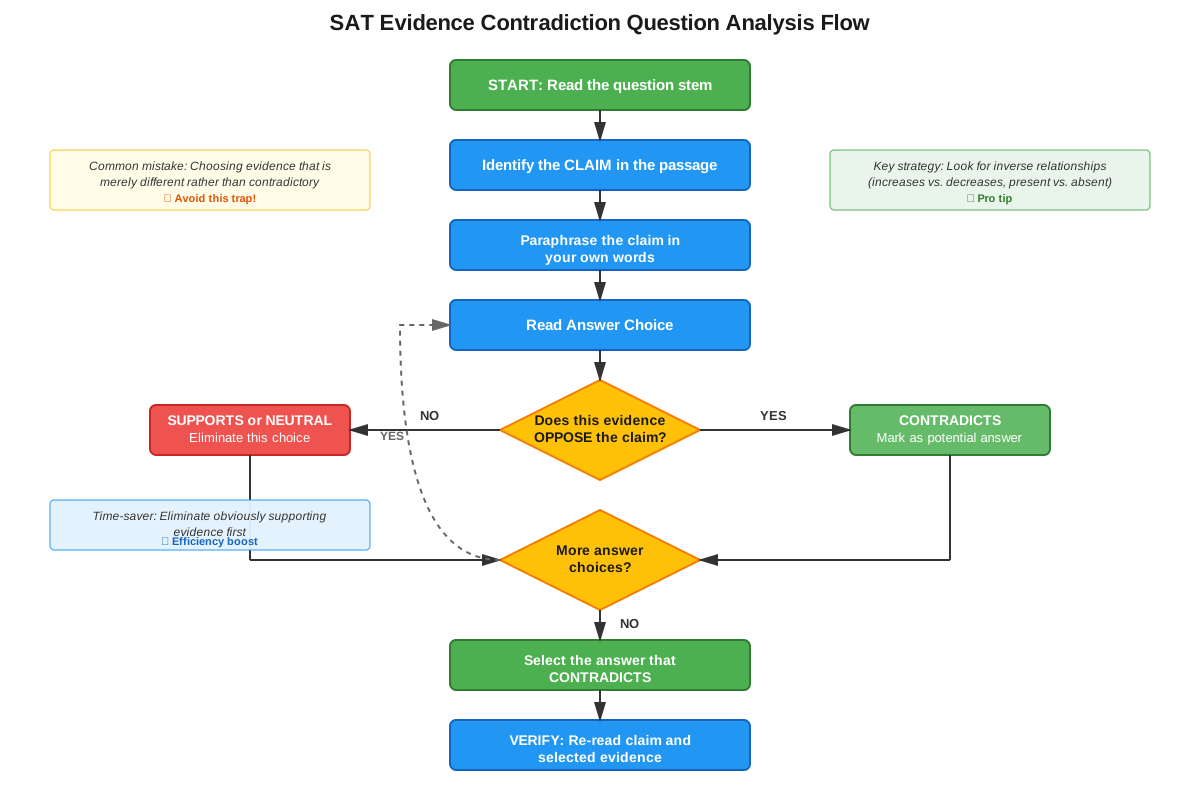
When approaching SAT evidence contradiction questions, follow this systematic process:
Step 1: Identify and underline the claim in the passage. Pay special attention to the scope (all, some, most), the subject (who or what), and any causal language (causes, leads to, results in).
Step 2: Classify the claim type (causal, universal, comparative, descriptive). This helps predict what kind of evidence would contradict it.
Step 3: Before reading answer choices, mentally predict what would contradict the claim. For universal claims, think of counterexamples. For causal claims, think of situations where the cause exists without the effect or vice versa.
Step 4: Eliminate supporting evidence first. Answer choices that strengthen or confirm the claim are common distractors. Cross them out immediately.
Step 5: Eliminate irrelevant evidence. Check whether each remaining choice addresses the same scope, population, and context as the claim.
Step 6: Select the choice that most directly opposes the logical content of the claim.
Exam Tip: Watch for these trigger words in question stems: "contradict," "challenge," "call into question," "undermine," "cast doubt on," "weaken," "refute." All signal you're looking for contradictory evidence.
Exam Tip: Be suspicious of answer choices that introduce entirely new topics or populations not mentioned in the claim. Scope mismatch is the most common feature of incorrect answers.
Time allocation: Evidence contradiction questions should take 45-60 seconds each. If you're spending more than 75 seconds, you may be overthinking. The contradiction should be relatively clear once you've accurately identified what the claim asserts.
Process of elimination strategy:
- First pass: Eliminate obvious supporting evidence (usually 1-2 choices)
- Second pass: Eliminate irrelevant or mismatched scope (usually 1 choice)
- Final decision: Choose the remaining option that directly opposes the claim
Memory Techniques
SCOPE Acronym for evaluating whether evidence can contradict a claim:
- Subject: Does the evidence address the same subject?
- Conditions: Does the evidence describe the same conditions/context?
- Opposite: Does the evidence present opposite information?
- Population: Does the evidence discuss the same group?
- Explicit: Is the contradiction direct and clear?
The Counterexample Rule: Visualize universal claims as walls. A single counterexample is like a hole in the wall—one hole proves the wall isn't solid. Remember: "One exception breaks the 'all' rule."
Cause-Effect Flip: For causal claims, visualize a light switch (cause) and light bulb (effect). Contradictory evidence shows either: (1) switch on, bulb off, or (2) switch off, bulb on. If the claimed connection were real, neither should be possible.
The Three Buckets Visualization: When reading answer choices, mentally sort them into three buckets: SUPPORTS (agrees with claim), CONTRADICTS (opposes claim), and NEUTRAL (irrelevant). Only one bucket should have the correct answer.
Scope Matching Mantra: "Same subject, same scope, opposite conclusion." Repeat this when evaluating whether evidence genuinely contradicts a claim.
Summary
Evidence contradiction is a fundamental analytical skill tested in the SAT Reading and Writing section that requires students to identify when information directly opposes or undermines a stated claim. Success on these questions depends on accurately understanding what a claim asserts, recognizing the type of claim being made (causal, universal, comparative, or descriptive), and evaluating whether evidence genuinely contradicts the claim or merely fails to support it. The critical distinction lies in understanding that contradictory evidence must match the claim's scope—addressing the same population, context, and conditions—while presenting information that makes the claim less likely to be true or demonstrates it is factually incorrect. Students must distinguish contradiction from support, neutrality, and qualification, recognizing that evidence can add nuance or present alternative perspectives without actually contradicting a claim. Mastering this skill requires systematic analysis: identifying the claim, classifying its type, predicting what would contradict it, and eliminating answer choices that support the claim or address different scopes before selecting the option that most directly opposes the claim's logical content.
Key Takeaways
- Evidence contradicts a claim when it directly opposes the claim's logical content and makes it less likely to be true, not merely when it fails to support it
- Scope matching is essential—evidence must address the same population, context, time frame, and conditions as the claim to genuinely contradict it
- Universal claims using "all," "every," "always," or "never" can be contradicted by a single counterexample that demonstrates an exception
- Causal claims are contradicted by evidence showing the proposed cause without the effect, the effect without the cause, or an alternative explanation
- SAT evidence contradiction questions typically include supporting evidence as distractors; eliminate these first during the process of elimination
- The question stem will explicitly signal that you're looking for contradictory evidence using words like "contradict," "challenge," "undermine," or "call into question"
- Strong contradictory evidence creates a logical impossibility or significant improbability for the claim, while weak or irrelevant evidence may seem negative without actually opposing the claim
Related Topics
Identifying Supporting Evidence: The inverse skill of evidence contradiction, requiring students to select evidence that strengthens or confirms a claim rather than opposing it. Mastering contradiction makes identifying support more intuitive.
Evidence Synthesis: Advanced Command of Evidence questions that require evaluating multiple pieces of evidence simultaneously, including both supporting and contradictory information, to reach conclusions.
Logical Reasoning and Argumentation: Broader critical thinking skills involving premise-conclusion relationships, logical fallacies, and argument structure that underpin all evidence evaluation tasks.
Research Interpretation: Questions requiring students to understand study design, data analysis, and how findings relate to hypotheses—often involving contradictory results that must be explained or reconciled.
Textual Evidence Citation: Questions asking students to identify which specific portion of a passage supports or contradicts a claim, combining evidence evaluation with precise textual reference skills.
Practice CTA
Now that you've mastered the core concepts of evidence contradiction, it's time to put your skills to the test! Work through the practice questions to apply your understanding of claim types, scope matching, and contradiction identification in realistic SAT contexts. The flashcards will help reinforce the key distinctions between contradiction, support, and neutrality that are essential for quick, accurate performance on test day. Remember: evidence contradiction questions are highly predictable once you understand the patterns—consistent practice will build the confidence and speed you need to excel on this high-yield question type. You've got this!
Sign up free to keep reading
Create a free AnvayaPrep account to finish this SAT guide on Evidence contradiction — plus flashcards and practice questions.