Overview
The SAT Reading and Writing section frequently tests students' ability to evaluate and interpret evidence in science passages. These questions require students to identify which textual evidence best supports a given claim, hypothesis, or conclusion drawn from scientific research. Unlike traditional reading comprehension that focuses on literary analysis or rhetorical strategies, SAT evidence in science passages demands that students think like scientists—connecting data, observations, and experimental findings to broader scientific arguments.
Understanding how to work with evidence in science passages is essential because these questions appear consistently throughout the RW (Reading and Writing) section, often comprising 15-20% of all questions. Students must navigate passages discussing biology, chemistry, physics, earth science, and social sciences, extracting relevant supporting details while ignoring distractors. The ability to distinguish between strong and weak evidence, recognize the relationship between claims and data, and understand how scientists build arguments is fundamental not only for SAT success but for college-level scientific literacy.
This topic connects directly to broader Command of Evidence skills tested on the SAT. While evidence questions appear across all passage types—literary, historical, and argumentative—science passages present unique challenges. They often include technical vocabulary, numerical data, experimental descriptions, and logical reasoning chains that require careful analysis. Mastering evidence evaluation in scientific contexts strengthens overall critical reading skills and prepares students for the analytical demands of college coursework across disciplines.
Learning Objectives
- [ ] Identify key features of evidence in science passages
- [ ] Explain how evidence in science passages appears on the SAT
- [ ] Apply evidence in science passages to answer SAT-style questions
- [ ] Distinguish between relevant and irrelevant evidence when evaluating scientific claims
- [ ] Analyze the logical connection between experimental data and scientific conclusions
- [ ] Evaluate the strength and sufficiency of evidence supporting scientific hypotheses
- [ ] Recognize common patterns in how scientists present and defend their findings
Prerequisites
- Basic reading comprehension skills: Students must be able to understand main ideas and supporting details in informational texts, as science passages build upon these fundamental skills.
- Familiarity with scientific method concepts: Understanding hypothesis, experiment, observation, and conclusion helps students recognize the structure of scientific arguments.
- Ability to identify claims and supporting details: Science evidence questions require distinguishing between what scientists claim and what data supports those claims.
- Comfort with technical vocabulary in context: While the SAT doesn't require specialized science knowledge, students should be able to infer meaning from context clues when encountering unfamiliar terms.
Why This Topic Matters
Evidence evaluation in science passages represents a critical real-world skill that extends far beyond standardized testing. In an era of information abundance, the ability to assess whether data actually supports a claim is essential for informed citizenship, from evaluating health recommendations to understanding climate science. Scientists themselves spend considerable time determining whether their observations justify their conclusions, making this skill central to scientific literacy.
On the SAT, evidence questions in science passages appear with remarkable consistency. Approximately 3-5 questions per test directly assess evidence evaluation skills in scientific contexts. These questions typically follow one of several formats: selecting which sentence best supports a stated conclusion, identifying what evidence would strengthen or weaken a hypothesis, or determining what a researcher's findings suggest. The passages themselves span diverse scientific disciplines, though biological and social sciences appear most frequently, followed by earth science, chemistry, and physics.
Common manifestations include passages describing recent research studies, explanations of natural phenomena supported by observational data, discussions of competing scientific theories with supporting evidence, and presentations of experimental results with interpretations. Students encounter questions asking them to identify which quoted sentence provides the best evidence for a previous answer, to determine what finding would most strongly support a researcher's claim, or to recognize which detail from the passage best illustrates a scientific principle. The ability to quickly locate, evaluate, and connect evidence to claims directly impacts both accuracy and pacing on test day.
Core Concepts
Understanding Scientific Evidence
Evidence in scientific contexts refers to observations, measurements, experimental results, or documented phenomena that scientists use to support claims, test hypotheses, or draw conclusions. Unlike opinions or unsupported assertions, scientific evidence must be verifiable, reproducible, and directly relevant to the claim it supports. On the SAT, students must recognize that not all information in a passage constitutes evidence for a particular claim—some details provide background, context, or alternative perspectives.
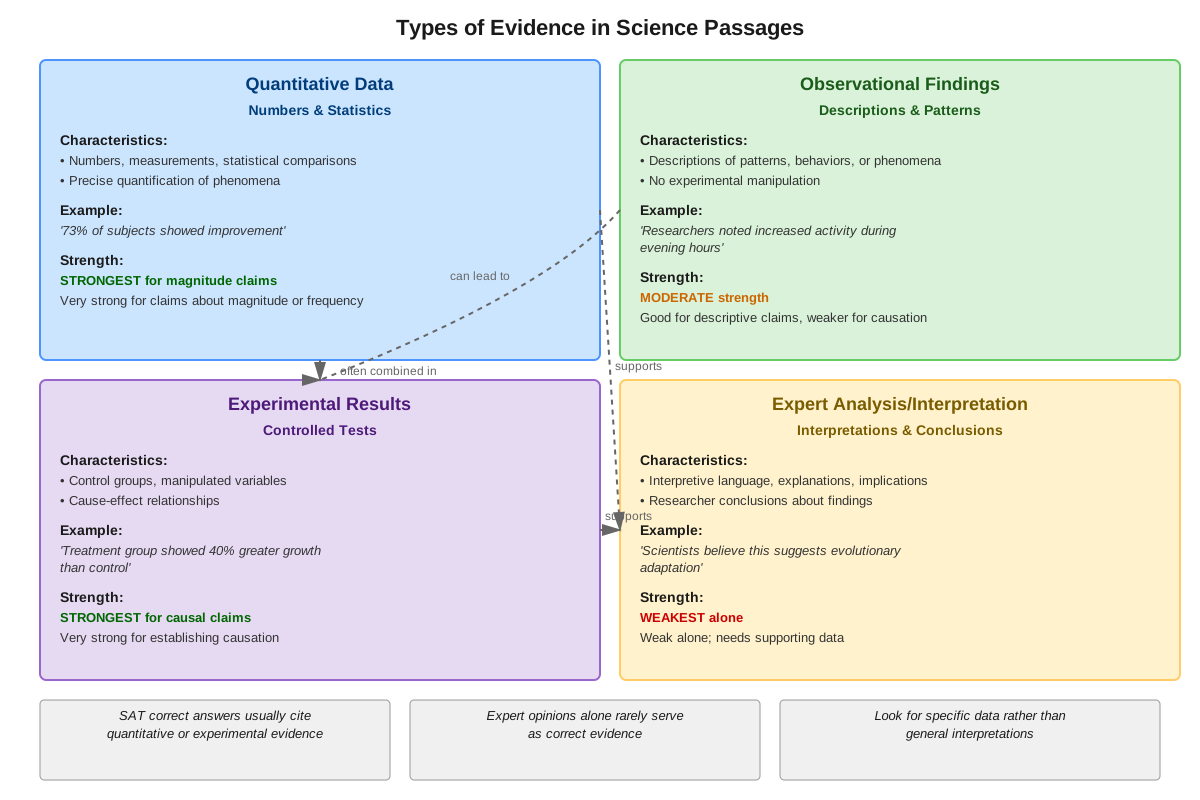
Scientific evidence typically falls into several categories: empirical data (numerical measurements, statistical findings, quantitative results), observational evidence (documented patterns, behaviors, or phenomena), experimental results (outcomes from controlled tests), and comparative evidence (differences between groups, conditions, or time periods). The SAT tests whether students can identify which type of evidence best supports a specific scientific argument.
The Claim-Evidence Relationship
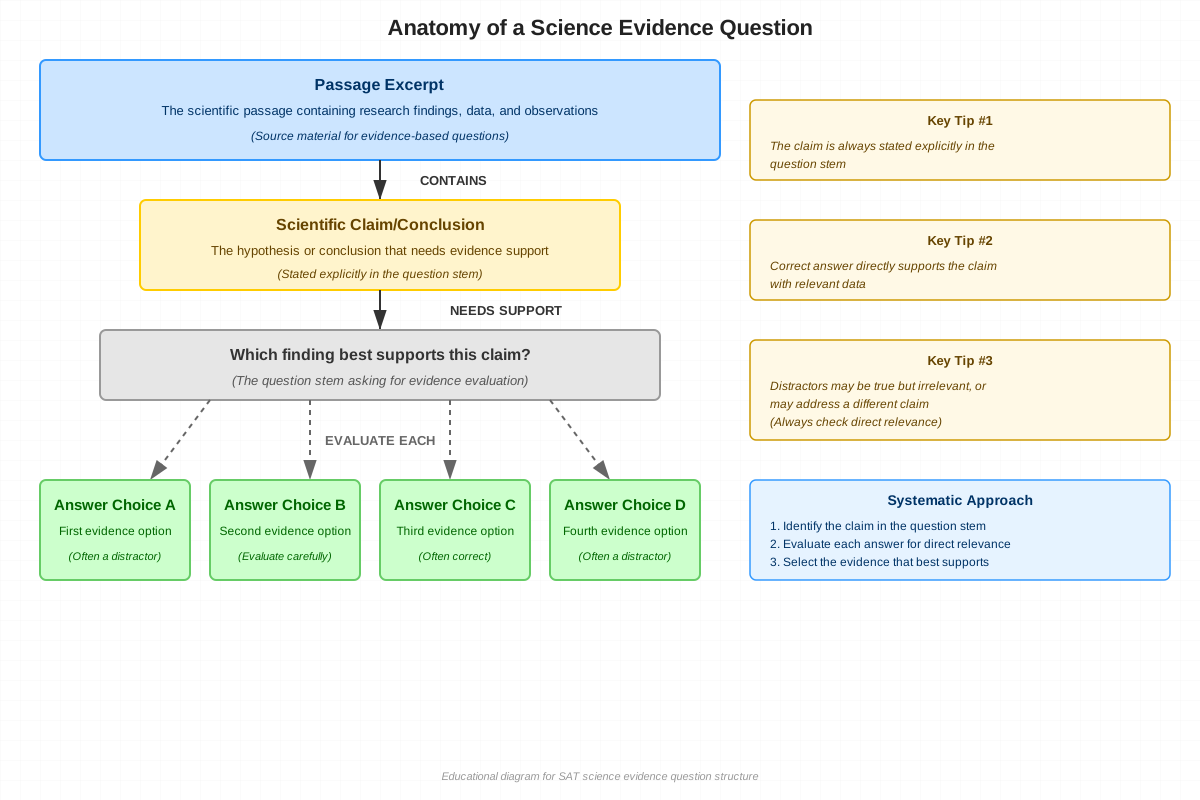
Every evidence question on the SAT involves a claim-evidence relationship—a logical connection between what scientists assert and what data supports that assertion. Strong evidence directly addresses the claim, provides specific rather than general support, and eliminates alternative explanations. Weak evidence may be tangentially related, too vague, or fail to distinguish between competing hypotheses.
Consider this structure:
Claim → Evidence → Reasoning
The claim states what the scientist believes to be true. The evidence provides the observations or data supporting that belief. The reasoning (sometimes implicit) explains why the evidence supports the claim. SAT questions often test whether students can identify which evidence best completes this logical chain.
Types of Evidence Questions
The SAT presents evidence questions in science passages through several distinct formats:
| Question Type | What It Asks | Key Strategy |
|---|---|---|
| Direct Support | Which sentence best supports the claim that...? | Find evidence that directly addresses all parts of the claim |
| Best Evidence | Which choice provides the best evidence for the answer to the previous question? | Ensure the evidence supports both the claim AND your previous answer |
| Strengthening | Which finding would most strengthen the hypothesis? | Look for evidence that eliminates alternative explanations |
| Illustration | Which detail best illustrates the principle that...? | Find a specific example of the general principle in action |
| Suggestion | The researcher's findings suggest that...? | Identify what the data logically implies, not what it explicitly states |
Evaluating Evidence Quality
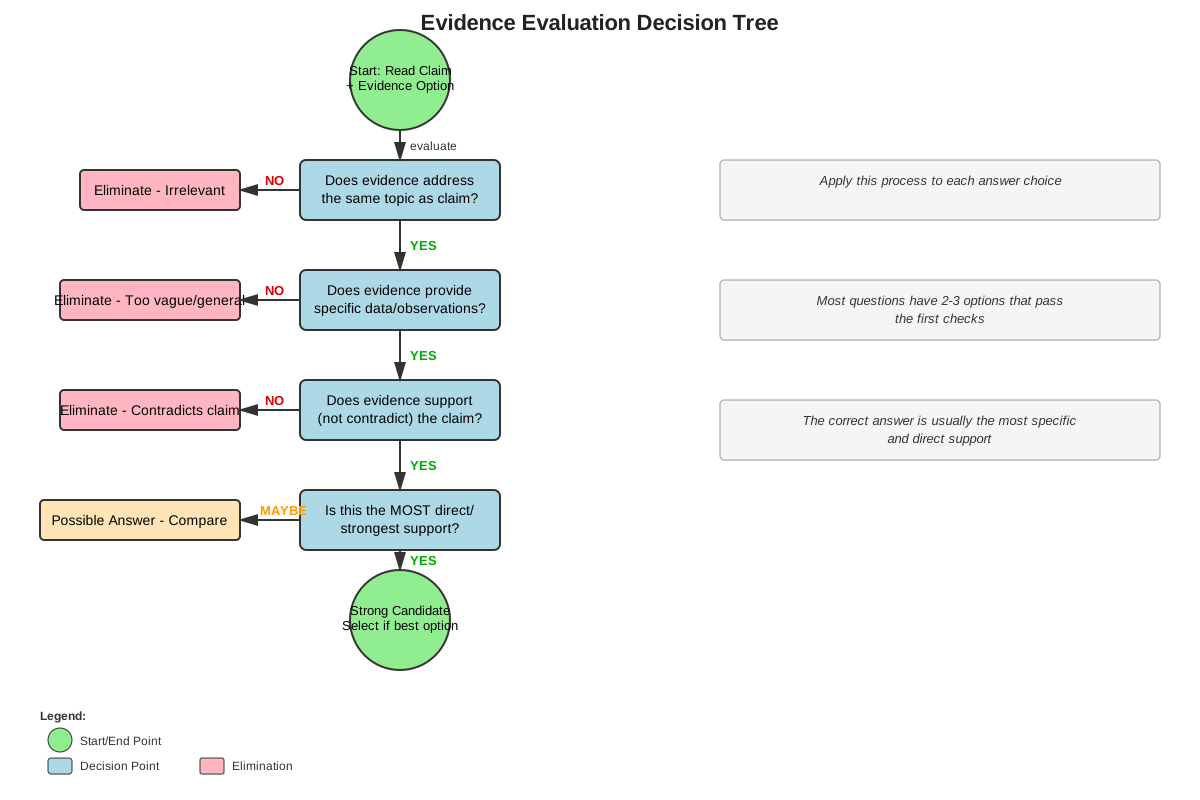
Not all evidence carries equal weight. The SAT expects students to distinguish between strong evidence (specific, directly relevant, sufficient to support the claim) and weak evidence (vague, tangentially related, insufficient alone). Strong evidence typically includes specific measurements, clear comparisons, controlled experimental results, or documented patterns. Weak evidence often involves general statements, single observations without replication, or information that could support multiple competing claims.
When evaluating evidence quality, consider these criteria:
- Relevance: Does the evidence directly address the specific claim being made?
- Specificity: Does the evidence provide concrete details rather than vague generalizations?
- Sufficiency: Is the evidence adequate to support the claim, or would additional data be needed?
- Clarity: Does the connection between evidence and claim require minimal inferential leaps?
Context and Background vs. Evidence
A critical skill for SAT success involves distinguishing between contextual information and actual evidence. Science passages often include background information, definitions, historical context, or descriptions of methodology. While this information helps readers understand the research, it doesn't constitute evidence for the scientist's conclusions. Evidence specifically refers to the findings, observations, or results that support claims.
For example, a passage might describe how researchers studied bird migration patterns (methodology/context) and then report that "birds equipped with GPS trackers consistently flew 200 miles further when tailwinds exceeded 15 mph" (evidence). Only the second statement provides evidence for a claim about wind's effect on migration distance.
Implicit vs. Explicit Evidence
Sometimes evidence appears explicitly in the passage, with clear statements like "the data showed" or "researchers observed." Other times, evidence is implicit, requiring students to recognize that certain details, though not labeled as evidence, actually support a claim. The SAT tests both recognition of explicitly marked evidence and the ability to identify implicit supporting details.
Explicit evidence markers include phrases like:
- "The results demonstrated..."
- "Measurements revealed..."
- "Observations indicated..."
- "Data showed..."
Implicit evidence appears as factual statements without such markers but still provides support for claims made elsewhere in the passage.
Quantitative Evidence in Science Passages
Many SAT science passages include quantitative evidence—numerical data, percentages, measurements, or statistical findings. Students must interpret these numbers in context, understanding what they reveal about the phenomenon being studied. Questions may ask which numerical finding best supports a claim or what a particular measurement suggests about a hypothesis.
When encountering quantitative evidence, focus on:
- The magnitude of differences (large vs. small changes)
- Comparisons between groups or conditions
- Trends over time or across variables
- The relationship between measurements and claims
Concept Relationships
The concepts within evidence evaluation in science passages form an interconnected system. Understanding scientific evidence as a category provides the foundation for recognizing the claim-evidence relationship, which in turn enables students to distinguish between strong and weak evidence. The ability to evaluate evidence quality depends on understanding the difference between context and actual evidence, while recognizing implicit versus explicit evidence requires first understanding what constitutes evidence at all.
This topic builds directly on prerequisite knowledge of basic reading comprehension and the scientific method. The skill of identifying claims and supporting details (prerequisite) expands into the more sophisticated task of evaluating whether specific evidence adequately supports scientific claims. Understanding hypothesis and conclusion (prerequisite) enables recognition of the claim-evidence relationship structure.
The relationship map flows as follows:
Scientific Method Understanding → Recognition of Claims → Identification of Evidence Types → Evaluation of Claim-Evidence Relationships → Assessment of Evidence Quality → Selection of Best Supporting Evidence
This topic also connects forward to other Command of Evidence skills tested on the SAT, including evaluating evidence in historical and literary passages, synthesizing information across multiple texts, and analyzing rhetorical strategies. The analytical framework developed through science evidence questions transfers to all evidence-based reasoning tasks.
High-Yield Facts
⭐ Evidence questions in science passages appear 3-5 times per SAT test, making them high-frequency question types.
⭐ The best evidence directly addresses all components of the claim, not just part of it.
⭐ Background information and methodology descriptions are context, not evidence for the study's conclusions.
⭐ Strong evidence includes specific measurements, clear comparisons, or documented patterns rather than general statements.
⭐ When two answer choices seem relevant, choose the one that more specifically and directly supports the claim.
- Evidence can be quantitative (numerical data) or qualitative (observations, descriptions, patterns).
- The SAT never requires outside scientific knowledge; all necessary information appears in the passage.
- "Best evidence" questions always refer back to a previous question, and the correct answer must support both the claim and your previous answer choice.
- Evidence that could support multiple competing hypotheses is weaker than evidence that specifically supports one hypothesis.
- Phrases like "the data showed," "measurements revealed," and "researchers observed" often signal explicit evidence.
- The correct answer to evidence questions often appears in the same paragraph as the claim it supports, though not always.
- Eliminating answer choices that provide context rather than evidence quickly narrows options.
- Evidence questions test logical reasoning about what supports a claim, not memorization of scientific facts.
Quick check — test yourself on Evidence in science passages so far.
Try Flashcards →Common Misconceptions
Misconception: Any factual statement in a science passage counts as evidence for any claim in that passage.
Correction: Evidence must be specifically relevant to the particular claim being evaluated. A fact about one aspect of a study doesn't necessarily support conclusions about a different aspect.
Misconception: The longest or most detailed answer choice is usually correct for evidence questions.
Correction: The best evidence is the most relevant and specific, not necessarily the longest. Concise statements often provide stronger support than lengthy descriptions that include irrelevant details.
Misconception: Evidence questions require understanding complex scientific concepts or specialized knowledge.
Correction: The SAT tests reading comprehension and logical reasoning, not science content knowledge. All information needed to answer evidence questions appears in the passage, and questions focus on the relationship between claims and support rather than scientific expertise.
Misconception: If an answer choice mentions the same topic as the claim, it must be the correct evidence.
Correction: Topical relevance is necessary but insufficient. The evidence must specifically support the claim's assertion about that topic, not merely discuss the same subject.
Misconception: Evidence always appears immediately before or after the claim it supports.
Correction: While evidence often appears near related claims, it can appear anywhere in the passage. Students must read the entire passage and understand its structure rather than assuming proximity indicates support.
Misconception: Personal opinions or interpretations count as evidence if they come from scientists.
Correction: Scientific evidence consists of observations, measurements, and documented findings, not opinions. Even expert opinions require supporting data to constitute evidence.
Misconception: All data presented in a passage is equally strong evidence.
Correction: Evidence varies in quality based on specificity, relevance, and how directly it addresses the claim. Students must evaluate which evidence provides the strongest support.
Worked Examples
Example 1: Identifying Best Supporting Evidence
Passage Excerpt:
"Researchers studying coral reef resilience examined 50 reef systems across the Pacific Ocean over a five-year period. They hypothesized that reefs with greater fish species diversity would show stronger recovery after bleaching events. The team documented bleaching incidents and subsequent recovery rates at each location. Reefs with more than 200 fish species recovered 65% of their coral coverage within two years, while reefs with fewer than 100 species recovered only 30% of coverage in the same timeframe. Water temperature and nutrient levels were similar across all study sites."
Question: Which finding best supports the researchers' hypothesis about species diversity and reef recovery?
Answer Choices:
A) The team documented bleaching incidents and recovery rates at each location.
B) Water temperature and nutrient levels were similar across all study sites.
C) Reefs with more than 200 fish species recovered 65% of their coral coverage within two years, while reefs with fewer than 100 species recovered only 30%.
D) Researchers studied 50 reef systems across the Pacific Ocean over five years.
Solution Process:
Step 1: Identify the claim. The hypothesis states that reefs with greater fish species diversity would show stronger recovery after bleaching.
Step 2: Determine what evidence would support this claim. We need data showing a relationship between species diversity (independent variable) and recovery strength (dependent variable).
Step 3: Evaluate each choice:
- Choice A describes methodology (what they documented) but provides no actual findings—this is context, not evidence.
- Choice B addresses a potential confounding variable, which is important for study design but doesn't directly support the hypothesis about diversity and recovery.
- Choice C provides specific comparative data showing that high-diversity reefs (200+ species) recovered much better (65%) than low-diversity reefs (<100 species, 30%)—this directly supports the hypothesis.
- Choice D describes the study scope but provides no findings—this is background information.
Step 4: Select the answer that most directly and specifically supports the claim. Choice C provides quantitative evidence of the exact relationship the hypothesis predicted.
Correct Answer: C
Connection to Learning Objectives: This example demonstrates identifying key features of evidence (quantitative comparison), explaining how evidence appears on the SAT (embedded within passage context), and applying evidence evaluation to answer questions (distinguishing evidence from context).
Example 2: Evaluating Evidence Strength
Passage Excerpt:
"Dr. Martinez investigated whether exposure to classical music affects plant growth. She hypothesized that plants exposed to music would grow taller than plants in silence. In her experiment, she placed 20 tomato seedlings in a greenhouse, with 10 exposed to Mozart for 3 hours daily and 10 kept in silence. After six weeks, she measured plant height. The music-exposed plants averaged 24 cm in height, while the control group averaged 18 cm. Additionally, Dr. Martinez noted that the music-exposed plants appeared to have darker green leaves, though she did not measure chlorophyll levels quantitatively."
Question: Which statement represents the strongest evidence for Dr. Martinez's hypothesis?
Answer Choices:
A) Dr. Martinez placed 20 tomato seedlings in a greenhouse for her experiment.
B) The music-exposed plants appeared to have darker green leaves.
C) Plants exposed to Mozart for 3 hours daily averaged 24 cm in height, while control plants averaged 18 cm.
D) The experiment lasted six weeks before measurements were taken.
Solution Process:
Step 1: Identify the hypothesis. Plants exposed to music would grow taller than plants in silence.
Step 2: Determine what constitutes strong evidence. We need specific, quantitative data comparing height between the two groups.
Step 3: Evaluate evidence quality for each choice:
- Choice A describes experimental setup—this is methodology, not evidence of results.
- Choice B mentions an observation about leaf color, which is interesting but doesn't address the hypothesis about height. Additionally, this observation is qualitative ("appeared to have") rather than measured, making it weaker evidence.
- Choice C provides specific, quantitative measurements directly comparing the dependent variable (height) between experimental and control groups, showing a substantial difference (24 cm vs. 18 cm).
- Choice D describes the experimental timeline—this is procedural information, not evidence for the hypothesis.
Step 4: Apply evidence quality criteria. Choice C is relevant (addresses height), specific (provides exact measurements), sufficient (shows clear difference), and clear (direct comparison between groups).
Correct Answer: C
Connection to Learning Objectives: This example demonstrates distinguishing between relevant and irrelevant evidence, analyzing the logical connection between data and conclusions, and evaluating evidence strength and sufficiency.
Exam Strategy
When approaching evidence questions in science passages on the SAT, employ a systematic strategy that maximizes accuracy while managing time effectively.
Step 1: Identify the Claim First
Before looking at answer choices, clearly identify what claim, hypothesis, or conclusion needs support. Underline or mentally note the specific assertion being made. Pay attention to all components of the claim—if it makes multiple assertions, the evidence must address all of them.
Step 2: Predict What Evidence Would Look Like
Before reading answer choices, briefly consider what type of evidence would support this claim. Would it be a comparison? A measurement? An observation? This prediction helps you recognize the correct answer more quickly.
Step 3: Eliminate Context and Background
Immediately eliminate answer choices that provide methodology, background information, definitions, or general context rather than actual findings or observations. These often appear as tempting wrong answers but don't constitute evidence.
Trigger Words to Watch For:
Evidence indicators (often signal correct answers):
- "showed," "demonstrated," "revealed," "indicated"
- "measured," "observed," "found," "discovered"
- Specific numbers, percentages, or measurements
- Comparative language: "more than," "less than," "higher," "lower"
Context indicators (often signal wrong answers):
- "studied," "examined," "investigated" (without results)
- "hypothesized," "predicted," "expected" (the claim itself, not evidence)
- "in order to," "to determine," "to test" (purpose, not findings)
- General background without specific findings
Step 4: Apply the Relevance Test
For remaining answer choices, ask: "Does this directly address the specific claim?" Evidence that discusses related topics but doesn't specifically support the claim should be eliminated.
Step 5: Apply the Specificity Test
If multiple choices seem relevant, choose the one that provides more specific, concrete support. Vague statements are weaker than precise measurements or clear observations.
Time Allocation Advice:
Spend 30-45 seconds on evidence questions. If you're uncertain between two choices, mark the question and return to it after completing easier questions. Evidence questions often become clearer after you've read the entire passage and answered other questions about it.
For "Best Evidence" Paired Questions:
These questions ask you to provide evidence for your answer to the previous question. Always verify that your evidence choice supports both the claim in the previous question AND your selected answer. If you're uncertain about the previous question, consider working backward—evaluate which evidence is strongest, then reconsider your previous answer based on that evidence.
Memory Techniques
DIRECT Mnemonic for Evaluating Evidence Quality:
- Directly addresses the claim (not tangentially related)
- Includes specific details (not vague generalizations)
- Relevant to the exact assertion being made
- Explicit connection to the claim (minimal inferential leaps)
- Clear and unambiguous (not open to multiple interpretations)
- Testable or measurable (based on observations or data)
The "Evidence vs. Context" Visualization:
Picture a target with concentric circles. The bullseye represents the claim. Evidence is an arrow that hits the bullseye directly. Context is the background scenery—important for understanding the situation but not hitting the target. When evaluating answer choices, visualize which ones are arrows hitting the bullseye versus which ones are just scenery.
The "3-S Rule" for Strong Evidence:
- Specific (includes concrete details, numbers, or clear observations)
- Supportive (directly addresses what the claim asserts)
- Sufficient (adequate to justify the conclusion without requiring additional data)
Question Type Acronym - SIBS:
Remember the four main evidence question types with SIBS:
- Support (Which sentence supports the claim?)
- Illustrate (Which detail illustrates the principle?)
- Best evidence (Which provides best evidence for the previous answer?)
- Strengthen (Which finding would strengthen the hypothesis?)
Summary
Evidence in science passages represents a high-frequency, high-importance question type on the SAT Reading and Writing section. Success requires understanding that scientific evidence consists of specific observations, measurements, or experimental results that directly support claims, hypotheses, or conclusions. Students must distinguish between actual evidence and contextual information like background, methodology, or general statements. The claim-evidence relationship forms the logical core of these questions—strong evidence directly addresses all components of a claim with specific, relevant details, while weak evidence is vague, tangentially related, or insufficient. Evidence appears in various forms including quantitative data, observational patterns, experimental results, and comparative findings. The SAT tests whether students can identify which evidence best supports a given claim, evaluate evidence quality, and recognize the logical connections between scientific assertions and their supporting data. Mastering this topic requires systematic evaluation of answer choices, elimination of context masquerading as evidence, and selection of the most specific and directly relevant support. These skills extend beyond test-taking to essential scientific literacy needed for college and informed citizenship.
Key Takeaways
- Evidence in science passages consists of specific findings, observations, or measurements that support scientific claims, not background information or methodology descriptions.
- The best evidence directly addresses all components of the claim with specific, concrete details rather than vague or tangential information.
- Strong evidence includes quantitative data, clear comparisons, documented patterns, or experimental results that specifically support the assertion being made.
- Context, background, and methodology are not evidence for conclusions—they explain how research was conducted but don't support what was found.
- Evidence questions appear 3-5 times per SAT test and never require outside scientific knowledge; all necessary information is in the passage.
- Systematic evaluation using the DIRECT criteria (Directly addresses, Includes specifics, Relevant, Explicit connection, Clear, Testable) helps identify correct answers efficiently.
- For paired "best evidence" questions, verify that your evidence choice supports both the claim and your previous answer selection.
Related Topics
Evidence in Historical and Literary Passages: While this guide focuses on science passages, the SAT also tests evidence evaluation in historical documents and literary texts. The same fundamental principles apply—identifying claims and supporting details—but the evidence types differ (historical documents use primary sources, eyewitness accounts, and period-specific data; literary passages use textual details, character actions, and narrative elements).
Synthesizing Information Across Multiple Texts: Advanced Command of Evidence questions ask students to integrate information from paired passages or combine textual and graphical information. Mastering evidence evaluation in single science passages provides the foundation for these more complex synthesis tasks.
Analyzing Quantitative Information: Many science passages include graphs, tables, or charts. Understanding how to extract evidence from visual data representations builds on the skills developed through textual evidence evaluation.
Rhetorical Analysis and Author's Purpose: While evidence questions focus on logical support for claims, understanding why authors present evidence in particular ways connects to broader rhetorical analysis skills tested throughout the Reading and Writing section.
Practice CTA
Now that you've mastered the core concepts of evidence in science passages, it's time to apply these skills! Complete the practice questions to test your ability to identify strong evidence, distinguish between context and support, and evaluate claim-evidence relationships. Use the flashcards to reinforce key concepts and trigger words that signal evidence versus context. Remember, evidence evaluation is a skill that improves with deliberate practice—each question you work through strengthens your ability to think like a scientist and reason logically about what supports scientific claims. You've built a solid foundation; now demonstrate your mastery!
Sign up free to keep reading
Create a free AnvayaPrep account to finish this SAT guide on Evidence in science passages — plus flashcards and practice questions.