Overview
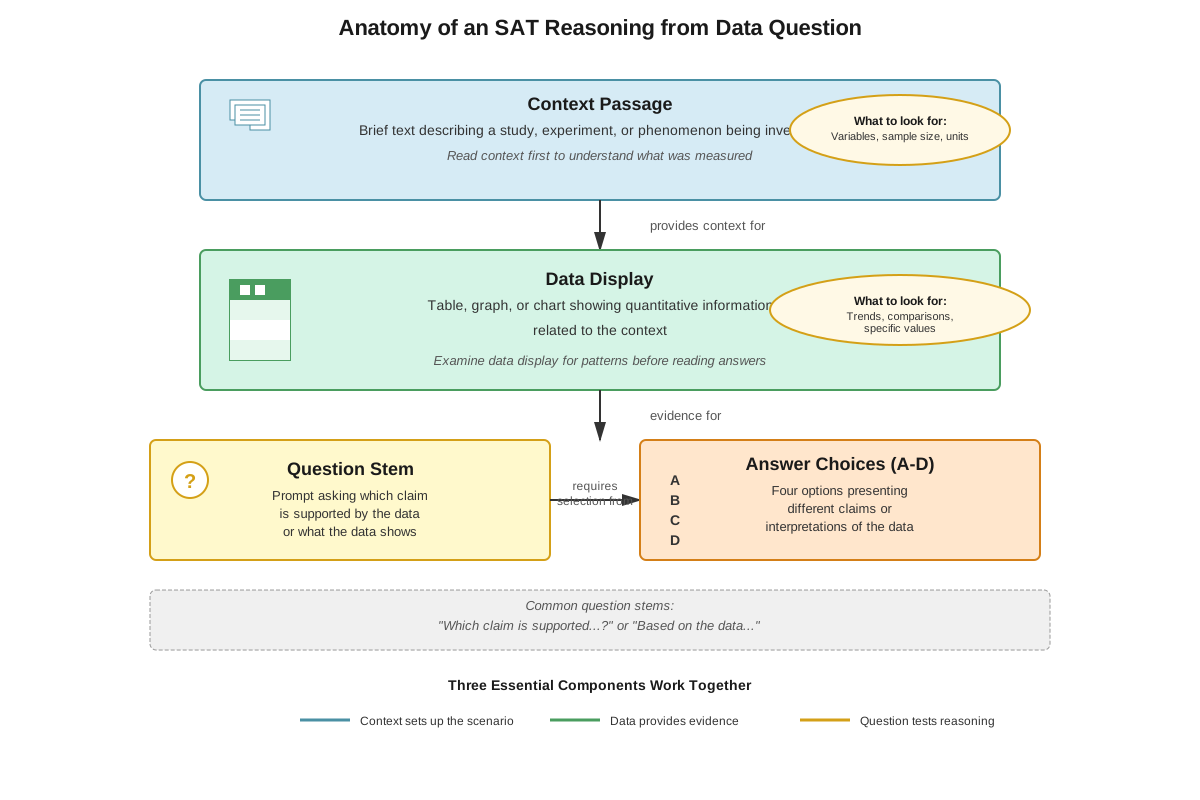
Reasoning from data is a critical skill tested in the SAT Reading and Writing (RW) section, specifically within the Command of Evidence question type. This skill requires students to interpret quantitative information presented in tables, charts, graphs, and other data displays, then draw accurate conclusions or identify claims that are properly supported by the evidence. Unlike traditional reading comprehension questions that focus solely on textual analysis, reasoning from data questions integrate numerical literacy with critical thinking, asking students to bridge the gap between visual/quantitative information and verbal claims.
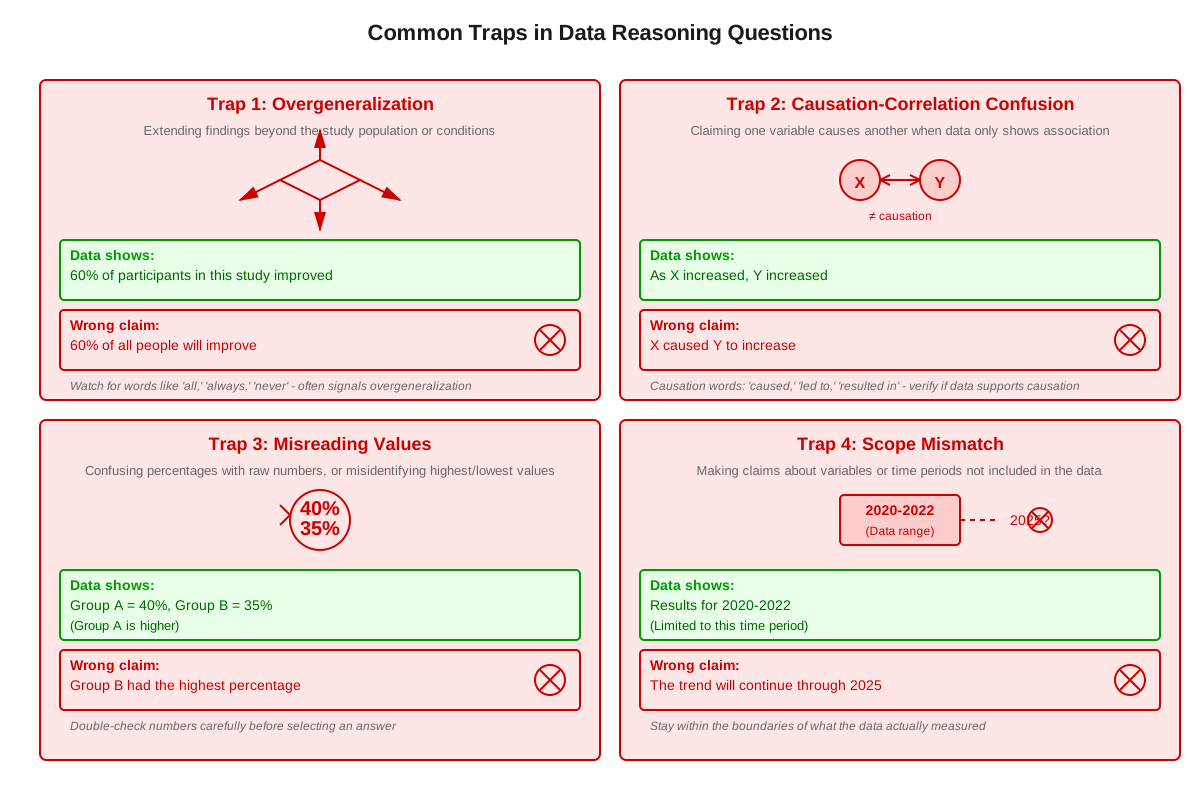
The SAT places significant emphasis on this topic because it reflects real-world academic and professional demands. College coursework across disciplines—from social sciences to natural sciences—requires students to evaluate research findings, interpret statistical information, and assess whether conclusions are warranted by the data presented. On the exam, these questions typically present a brief passage describing a study or phenomenon, accompanied by a table or graph displaying relevant data. Students must then select the answer choice that accurately reflects what the data shows, avoiding common traps like overgeneralization, causation-correlation confusion, or misreading numerical relationships.
Within the broader Reading and Writing section, reasoning from data questions represent a unique intersection of quantitative reasoning and evidence evaluation. They connect to other Command of Evidence skills by requiring students to distinguish between supported and unsupported claims, but add the complexity of working with numerical rather than purely textual evidence. Mastering this topic strengthens overall analytical skills and prepares students for the data-rich academic environment they'll encounter in college.
Learning Objectives
- [ ] Identify key features of reasoning from data questions on the SAT
- [ ] Explain how reasoning from data appears on the SAT and what makes these questions distinct
- [ ] Apply reasoning from data skills to answer SAT-style questions accurately
- [ ] Distinguish between claims that are supported versus unsupported by presented data
- [ ] Recognize common data presentation formats (tables, bar graphs, line graphs, scatterplots) and extract relevant information from each
- [ ] Identify logical fallacies in data interpretation, including overgeneralization and causation errors
- [ ] Evaluate the scope and limitations of conclusions based on specific datasets
Prerequisites
- Basic graph and table reading: Understanding how to locate specific values in rows, columns, and axes is essential for extracting the correct information from data displays.
- Percentage and proportion concepts: Many data interpretation questions require comparing relative values or understanding what percentages represent.
- Fundamental statistical vocabulary: Terms like "increase," "decrease," "correlation," and "trend" appear frequently in both questions and answer choices.
- Reading comprehension skills: Students must understand the context passage that accompanies the data to know what question is being investigated.
Why This Topic Matters
In real-world contexts, the ability to reason from data is fundamental to informed citizenship and professional success. Medical patients evaluate treatment options based on clinical trial data, voters assess policy proposals using economic statistics, and professionals across fields make decisions by interpreting performance metrics and research findings. The skill of critically examining whether claims are actually supported by presented evidence protects against misinformation and enables evidence-based decision-making.
On the SAT, reasoning from data questions appear consistently throughout the Reading and Writing section, typically comprising 3-5 questions per test. These questions carry the same weight as other question types, making them a significant component of the overall score. According to College Board data, these questions are considered medium-to-high difficulty, with many students struggling because they require both careful data reading and logical reasoning—rushing through either component leads to errors.
These questions most commonly appear in passages discussing scientific studies, social science research, or historical data analysis. The data might show experimental results comparing different conditions, survey findings across demographic groups, changes in measurements over time, or relationships between two variables. The accompanying text typically describes the study's purpose or context, while the visual display presents the actual findings. Students must synthesize both components to identify which conclusion is warranted.
Core Concepts
Understanding Data Displays
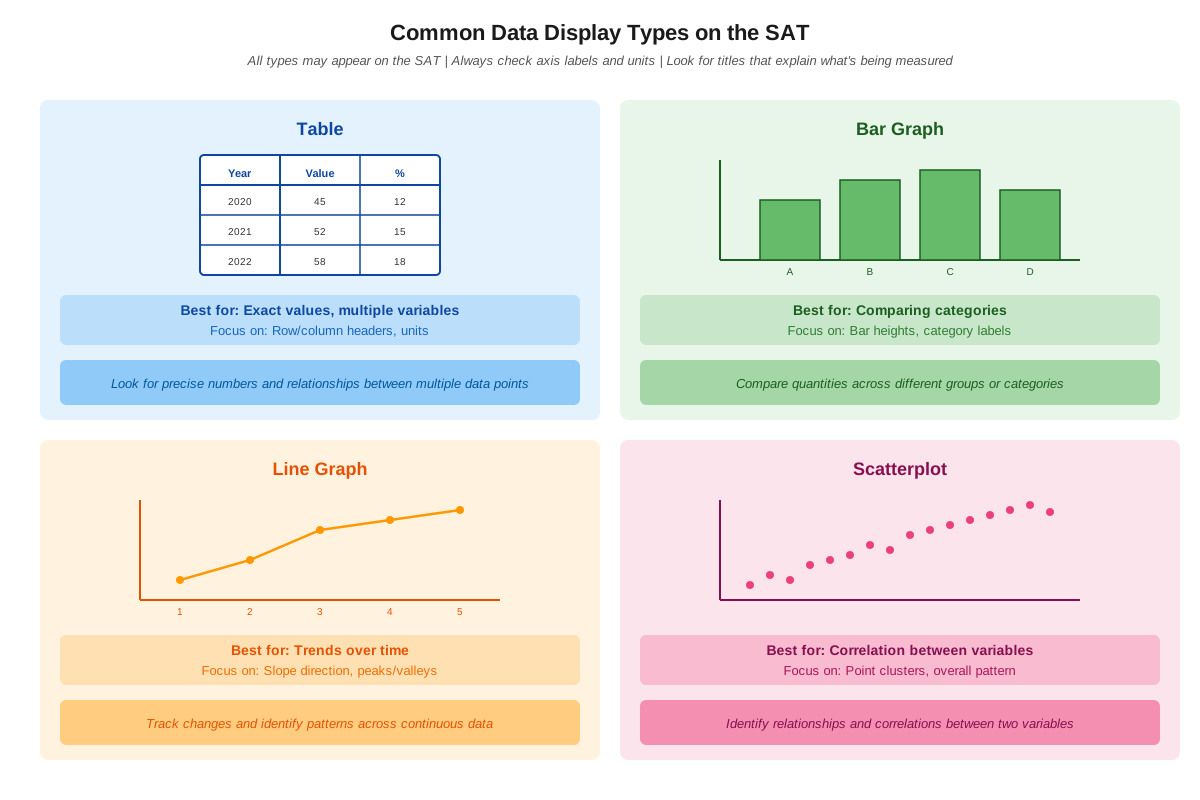
The foundation of sat reasoning from data questions lies in accurately interpreting various data presentation formats. Tables organize information in rows and columns, with headers indicating what each row and column represents. When reading tables, students must carefully track which row and column intersection contains the needed value, paying attention to units and labels. Bar graphs display categorical data using rectangular bars whose lengths represent values, making comparisons between categories visually apparent. Line graphs show how values change over time or across a continuous variable, with the x-axis typically representing the independent variable and the y-axis showing the dependent variable.
Each display format has specific features that students must recognize. Tables excel at presenting precise numerical values but require more effort to identify patterns. Graphs make trends and comparisons more visually obvious but may sacrifice numerical precision. Understanding these trade-offs helps students know where to look for specific types of information.
Identifying Supported Claims
The core skill in reasoning from data is distinguishing between claims that are directly supported by the presented evidence and those that go beyond what the data actually shows. A supported claim accurately describes a pattern, relationship, or finding that can be verified by examining the data. For example, if a table shows that Group A scored 85 and Group B scored 72, a supported claim would be "Group A scored higher than Group B" or "Group A's score exceeded Group B's score by 13 points."
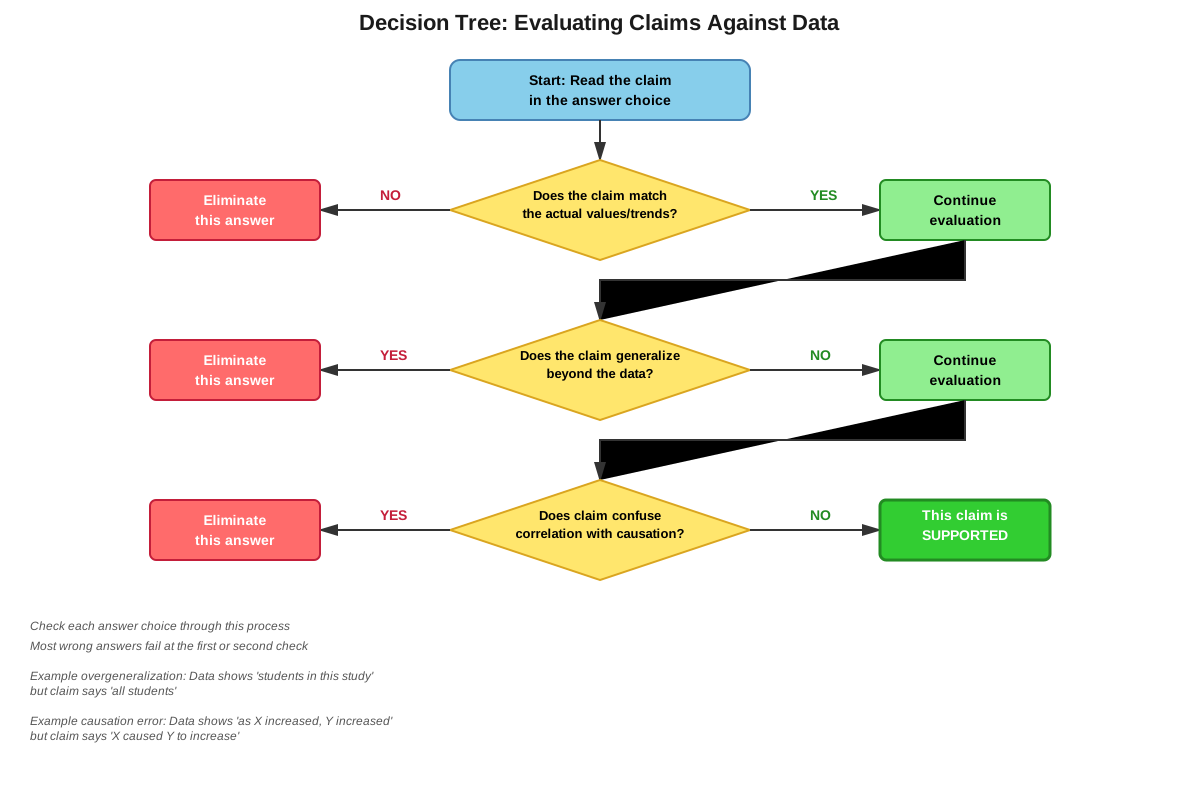
Unsupported claims fall into several categories. Some make statements about data points not included in the display—for instance, claiming something about a third group when only two groups are shown. Others overgeneralize by extending findings beyond the study's scope, such as claiming a pattern holds for all populations when data only covers one specific demographic. Still others confuse correlation with causation, asserting that one variable causes another when the data only shows they change together.
Scope and Limitations
Every dataset has boundaries that constrain what conclusions can legitimately be drawn. The scope refers to what populations, time periods, conditions, or variables the data actually covers. If a study examines college students aged 18-22, conclusions should not be extended to all adults. If data covers years 2010-2015, claims about 2020 are unsupported. Recognizing scope requires careful attention to the passage's description of the study and the labels on data displays.
Limitations include factors that restrict the strength or generalizability of conclusions. Sample size affects reliability—findings from 10 participants are less robust than those from 1,000. The specific conditions under which data was collected matter; laboratory results may not apply to real-world settings. Students must evaluate whether answer choices respect these limitations or inappropriately extend conclusions beyond what the evidence warrants.
Quantitative Relationships
Many reasoning from data questions require identifying specific types of relationships between variables. A positive correlation means both variables increase together or decrease together. A negative correlation means as one variable increases, the other decreases. No correlation means the variables don't show a consistent relationship. Critically, correlation does not establish causation—two variables might both be influenced by a third factor, or their relationship might be coincidental.
Magnitude of change is another key concept. Students must distinguish between absolute change (the numerical difference between values) and relative change (the percentage or proportional difference). A change from 10 to 20 and a change from 100 to 110 both represent an absolute increase of 10, but the relative changes differ dramatically (100% versus 10%).
Comparative Analysis
SAT questions frequently require comparing values across categories, time periods, or conditions. Effective comparison requires identifying the relevant data points, calculating differences when necessary, and accurately describing the relationship. Comparison questions might ask which group showed the greatest increase, which category had the highest value, or whether one variable consistently exceeded another across all conditions.
| Comparison Type | What to Look For | Common Traps |
|---|---|---|
| Between groups | Specific values for each group | Confusing which group is which |
| Over time | Starting and ending values, trend direction | Mistaking absolute for relative change |
| Across conditions | Patterns that hold in all vs. some conditions | Overgeneralizing from one condition |
| Proportional | Relative sizes, percentages | Comparing absolute numbers when proportions matter |
Concept Relationships
The concepts within reasoning from data build upon each other in a logical progression. Understanding data displays serves as the foundation—students cannot extract information if they cannot read the format. This skill leads directly to identifying supported claims, which requires not just reading values but understanding what those values mean in context. Scope and limitations refines claim identification by adding boundaries—a claim might accurately describe the data shown but still be unsupported if it extends beyond the study's scope.
Quantitative relationships and comparative analysis represent applications of the foundational skills. Once students can read displays and understand scope, they can identify whether variables correlate, whether changes are meaningful, and how different categories compare. These higher-level skills integrate multiple concepts: comparing groups requires reading the display accurately, understanding what the numbers represent, and recognizing whether the comparison respects the data's limitations.
The relationship map flows as follows: Data Display Literacy → Accurate Value Extraction → Claim Evaluation → Scope Recognition → Relationship Identification → Comparative Conclusions. Each step depends on the previous ones, and weakness at any stage compromises performance on the entire question type.
High-Yield Facts
- ⭐ Reasoning from data questions always include a visual display (table, graph, or chart) that contains the evidence needed to answer the question
- ⭐ The correct answer must be directly supported by the data shown—no outside knowledge or assumptions are needed
- ⭐ Correlation between two variables does not prove that one causes the other
- ⭐ Claims about populations or time periods not included in the data are automatically unsupported
- ⭐ Pay careful attention to axis labels, units, and table headers—misreading these leads to selecting wrong values
- Answer choices often include values that appear in the data but don't answer the actual question being asked
- Percentage change and absolute change are different—a small absolute change can be a large percentage change and vice versa
- The passage context explains what was studied, while the data display shows the results—both are necessary
- "Suggests," "indicates," and "supports" in answer choices signal appropriate caution about what data shows
- Extreme language like "proves," "always," or "never" in answer choices often signals overgeneralization
- When comparing groups, verify that you're looking at the correct row/column for each group
- Line graphs show trends over time, but a trend in the past doesn't guarantee the same pattern continues into the future
Quick check — test yourself on Reasoning from data so far.
Try Flashcards →Common Misconceptions
Misconception: If two variables correlate in the data, one must cause the other.
Correction: Correlation only shows that variables change together; causation requires experimental evidence showing that manipulating one variable produces changes in the other. Both variables might be influenced by a third factor not shown in the data.
Misconception: The correct answer will use the largest or most extreme numbers from the data display.
Correction: The correct answer accurately addresses what the question asks, which might involve moderate values, specific comparisons, or trends rather than extreme numbers. Test-makers include extreme values as distractors.
Misconception: If a pattern holds for the data shown, it will hold for all similar situations.
Correction: Conclusions are limited to the scope of the study. Data about teenagers doesn't support claims about adults; data from one region doesn't support claims about other regions unless the study explicitly covered them.
Misconception: Reasoning from data questions require complex mathematical calculations.
Correction: These questions test data interpretation and logical reasoning, not computational skill. Any necessary calculations are simple (basic addition, subtraction, or comparing which number is larger). The challenge lies in identifying what to compare and interpreting what it means.
Misconception: The passage text and data display will always agree perfectly.
Correction: While they won't contradict each other, the passage provides context while the data provides evidence. Sometimes answer choices make claims that sound plausible based on the passage but aren't actually supported by the specific numbers in the display.
Misconception: Increases shown in data are always significant or meaningful.
Correction: The data shows what changed, but without additional context (like margin of error or statistical significance), students cannot determine whether changes are meaningful. The SAT tests whether students can accurately describe what the data shows, not whether changes are important.
Worked Examples
Example 1: Interpreting a Table with Multiple Variables
Passage and Data:
A researcher studied the effect of study duration on test scores for two groups of students: those who studied alone and those who studied in groups. The results are shown in the table below.
| Study Duration | Alone (Average Score) | Group (Average Score) |
|---|---|---|
| 1 hour | 72 | 68 |
| 2 hours | 78 | 79 |
| 3 hours | 81 | 85 |
Question: Which statement is best supported by the data?
A) Studying alone is more effective than studying in groups.
B) For students who studied for 3 hours, the average score for those who studied in groups exceeded the average score for those who studied alone.
C) Increasing study duration causes test scores to improve.
D) Students who study in groups for 1 hour will score lower than students who study alone for any duration.
Solution:
First, identify what each answer choice claims and whether the data supports it.
Choice A makes a broad generalization about effectiveness. Looking at the data, students who studied alone scored higher at 1 hour (72 vs. 68), but students in groups scored higher at 2 hours (79 vs. 78) and 3 hours (85 vs. 81). Since neither method is consistently superior, this claim is unsupported.
Choice B makes a specific comparison: at 3 hours, group study (85) exceeded alone study (81). Checking the table confirms this is accurate. This is a supported claim.
Choice C uses causal language ("causes"). While scores do increase with duration for both groups, correlation doesn't prove causation. The data shows an association but doesn't prove that duration causes the improvement—other factors might be involved. This is unsupported.
Choice D makes an absolute claim about all durations. The data shows group study at 1 hour scored 68, while alone study at 1 hour scored 72. However, group study at 2 hours (79) and 3 hours (85) both exceed alone study at 1 hour (72), so the claim that group study at 1 hour scores lower than alone study "for any duration" is false.
Answer: B — This is the only statement that accurately describes a specific relationship shown in the data without overgeneralizing or implying causation.
Example 2: Analyzing a Line Graph
Passage and Data:
Scientists measured the population of two bird species in a forest preserve from 2015 to 2020. The graph below shows the results.
[Description: Line graph with years 2015-2020 on x-axis and population (in hundreds) on y-axis. Species A starts at 400 in 2015, increases to 500 in 2017, then decreases to 450 in 2020. Species B starts at 300 in 2015, remains steady at 300 through 2017, then increases to 450 in 2020.]
Question: Based on the graph, which statement about the bird populations is accurate?
A) Species A's population was always greater than Species B's population.
B) By 2020, both species had equal populations.
C) Species B's population showed no change between 2015 and 2017.
D) The decline in Species A's population after 2017 was caused by the increase in Species B's population.
Solution:
Examine each claim against the graph data.
Choice A: Species A started higher (400 vs. 300) and remained higher through 2017. However, by 2020, both reached 450, meaning they were equal, not with A still greater. This claim is false.
Choice B: The graph shows both species at 450 in 2020. This is directly supported by the data.
Choice C: Species B shows 300 in both 2015 and 2017, indicating no change during that period. This is also supported. However, we need to determine which answer is most complete and accurate.
Choice D: While Species A declined after 2017 and Species B increased, the data only shows correlation in timing, not causation. The graph cannot prove that one population change caused the other. This is unsupported.
Both B and C are technically accurate, but examining them more carefully: Choice C accurately describes a specific portion of the data (Species B from 2015-2017), while Choice B describes the endpoint relationship. Both are supported, but in SAT questions, when multiple answers seem correct, look for the one that most directly addresses the overall question about "the bird populations" (plural). Choice B addresses both species, while C addresses only one species during a limited timeframe.
Answer: B — This statement is directly verifiable from the graph and addresses both populations mentioned in the question stem.
Exam Strategy
When approaching rw reasoning from data questions, follow a systematic process. First, read the question stem carefully to understand exactly what claim or relationship you need to evaluate. Before looking at answer choices, examine the data display to understand its structure: What variables are shown? What are the units? What time period or categories are covered? Then read the brief passage to understand the context—what was being studied and why.
Trigger words that indicate reasoning from data questions include: "based on the table/graph," "the data support/indicate," "according to the figure," and "which statement is best supported by." These phrases signal that the answer must come directly from the visual display, not from background knowledge or assumptions.
Process of elimination is particularly effective for this question type. Eliminate answer choices that:
- Reference data points not shown in the display
- Use causal language (causes, leads to, results in) when only correlation is shown
- Make absolute claims (always, never, all, none) that go beyond the data
- Extend conclusions beyond the study's scope (wrong population, time period, or conditions)
- Misread values from the display (wrong row, column, or data point)
Time allocation: Spend 30-45 seconds reading the passage and examining the data display, then 30-45 seconds evaluating answer choices. Don't rush the initial data reading—misreading the display wastes more time than careful initial examination. If a question seems difficult, mark it and return after completing easier questions, but don't leave it blank.
A critical strategy is to verify your answer by checking the data display one final time. Locate the specific values or relationships your chosen answer references and confirm they match what the display shows. This final verification catches errors from misreading labels or confusing similar values.
Memory Techniques
SCOPE - Remember what limits data interpretation:
- Sample: Who/what was actually studied?
- Conditions: Under what circumstances?
- Outcomes: What was actually measured?
- Period: What time frame?
- Extent: How far can conclusions reach?
READ - For approaching data displays:
- Review the labels (axes, headers, units)
- Examine the scale and range
- Analyze what's being compared
- Determine the overall pattern or trend
CLAIM - To evaluate answer choices:
- Check if values are actually in the data
- Look for overgeneralization beyond scope
- Avoid causation when only correlation shown
- Identify extreme language (always/never)
- Match the answer to what's asked
Visualize the data display as a locked box containing specific pieces of information. The correct answer is a key that fits perfectly—it opens the box using only what's inside. Wrong answers are keys that either don't fit (reference missing data), try to open a different box (wrong scope), or claim to open boxes that don't exist (overgeneralization).
Summary
Reasoning from data is a high-yield SAT skill that requires students to interpret quantitative information from tables, graphs, and charts, then identify claims that are directly supported by the evidence presented. Success depends on accurately reading data displays, understanding the scope and limitations of what the data shows, distinguishing correlation from causation, and avoiding overgeneralization beyond what the evidence warrants. The key principle is that correct answers must be verifiable by examining the specific values and relationships shown in the display—no outside knowledge, assumptions, or logical leaps are needed. Students must integrate information from both the brief contextual passage and the visual display, using the passage to understand what was studied and the display to see what was found. Common errors include misreading labels or values, confusing correlation with causation, extending conclusions beyond the study's scope, and selecting answers that contain data values but don't actually answer the question asked. Mastering this topic requires careful, systematic analysis of both the question stem and the data display, followed by methodical evaluation of each answer choice against the evidence.
Key Takeaways
- Reasoning from data questions require identifying claims that are directly supported by presented tables, graphs, or charts—no outside knowledge needed
- Always check axis labels, table headers, and units before extracting values to avoid misreading the display
- Correlation between variables does not prove causation; data can show variables change together without proving one causes the other
- Conclusions are limited to the scope of the study—the specific populations, time periods, and conditions actually covered by the data
- Eliminate answer choices that use extreme language (always/never), reference missing data points, or extend beyond the study's scope
- The passage provides context about what was studied; the data display provides the evidence—both are necessary to answer correctly
- Verify your selected answer by locating the specific values or relationships it references in the data display
Related Topics
Command of Evidence - Textual Evidence: While reasoning from data focuses on quantitative evidence, textual evidence questions require identifying which passage excerpt best supports a claim. Mastering both develops comprehensive evidence evaluation skills.
Problem Solving and Data Analysis (Math Section): The math section includes questions requiring interpretation of graphs and tables with more complex calculations. Skills developed in RW reasoning from data transfer directly to these quantitative questions.
Experimental Design and Scientific Method: Understanding how studies are conducted, what variables mean, and why scope matters connects reasoning from data to broader scientific literacy tested across the SAT.
Statistical Reasoning: More advanced data interpretation involving concepts like mean, median, range, and margin of error builds on foundational reasoning from data skills.
Practice CTA
Now that you understand the core concepts and strategies for reasoning from data questions, it's time to apply these skills! Work through the practice questions to reinforce your ability to interpret data displays, evaluate claims, and identify supported conclusions. Use the flashcards to memorize key concepts like the difference between correlation and causation, common data display formats, and trigger words that signal these question types. Remember: reasoning from data is highly learnable—systematic practice with careful attention to scope and evidence will build the confidence and accuracy you need to excel on test day. Each practice question you complete strengthens your pattern recognition and helps you avoid common traps. You've got this!
Sign up free to keep reading
Create a free AnvayaPrep account to finish this SAT guide on Reasoning from data — plus flashcards and practice questions.