Overview
Parallel phrasing (also called parallelism or parallel structure) is a fundamental writing principle that requires grammatically equivalent elements in a sentence to maintain the same structural form. When items appear in a list, comparison, or series, they must share consistent grammatical patterns—whether nouns with nouns, verbs with verbs, or phrases with phrases. This consistency creates clarity, rhythm, and professional polish in writing.
On the SAT Reading and Writing section, parallel phrasing questions appear frequently in the Expression of Ideas domain, testing whether students can identify and correct structural inconsistencies. These questions assess a student's ability to recognize when sentence elements that serve similar functions fail to match in form. The College Board considers this skill essential because parallel structure directly impacts clarity and readability—qualities that distinguish effective college-level writing from amateur prose.
Understanding sat parallel phrasing connects directly to broader rw (Reading and Writing) competencies, particularly sentence structure, grammatical relationships, and stylistic consistency. Mastery of parallelism strengthens performance across multiple question types, including those testing transitions, logical flow, and rhetorical effectiveness. Students who internalize parallel structure principles gain a significant advantage, as these questions often appear 3-5 times per test and can be answered quickly once the pattern recognition becomes automatic.
Learning Objectives
- [ ] Identify key features of parallel phrasing in sentences and passages
- [ ] Explain how parallel phrasing appears on the SAT Reading and Writing section
- [ ] Apply parallel phrasing principles to answer SAT-style questions accurately
- [ ] Distinguish between correct parallel structure and common parallelism errors
- [ ] Evaluate multiple answer choices to select the option with proper parallel construction
- [ ] Recognize trigger patterns that signal parallelism requirements in test questions
Prerequisites
- Basic parts of speech identification: Understanding nouns, verbs, adjectives, adverbs, and phrases is essential because parallel structure requires matching these grammatical categories.
- Sentence structure fundamentals: Recognizing subjects, predicates, clauses, and phrases enables students to identify which sentence elements must be parallel.
- Coordinating conjunctions: Familiarity with FANBOYS (for, and, nor, but, or, yet, so) helps identify where parallel elements typically appear.
- Verb forms and tenses: Distinguishing between infinitives, gerunds, and conjugated verbs is crucial for maintaining parallel verb structures.
Why This Topic Matters
Parallel phrasing represents one of the most testable and high-yield concepts in SAT Reading and Writing. According to College Board data, parallelism questions appear in approximately 8-12% of Expression of Ideas questions, making them among the most frequent grammar-related items on the exam. These questions typically appear as revision tasks where students must select the answer choice that maintains consistency with established patterns in the sentence.
In real-world applications, parallel structure distinguishes professional writing from amateur work. College essays, business communications, and academic papers all require parallelism to convey ideas clearly and persuasively. Readers subconsciously expect parallel construction in lists and comparisons; violations of this expectation create confusion and undermine credibility.
On the SAT, parallel phrasing questions commonly appear in several formats: lists with three or more items, comparisons using "than" or "as," correlative conjunctions (both/and, either/or, not only/but also), and compound sentence structures. The test frequently embeds these questions in passages about science, history, or social studies, requiring students to focus on grammatical structure rather than content. Students who master parallelism can answer these questions in 20-30 seconds, creating valuable time for more challenging items.
Core Concepts
Definition and Fundamental Principle
Parallel phrasing requires that sentence elements serving equivalent grammatical functions maintain identical structural forms. When a sentence presents multiple items in a series, comparison, or compound structure, each element must match the grammatical pattern established by the first item. This principle applies across all grammatical categories: if the first item is a noun, all items must be nouns; if the first uses an infinitive verb form, all must use infinitives.
The fundamental rule states: grammatically equivalent elements require structurally equivalent forms. This means examining not just individual words but entire phrases and clauses to ensure consistency. A sentence violates parallelism when it shifts between different grammatical structures mid-series, creating what grammarians call a "faulty parallel structure."
Types of Parallel Structures
Lists and Series
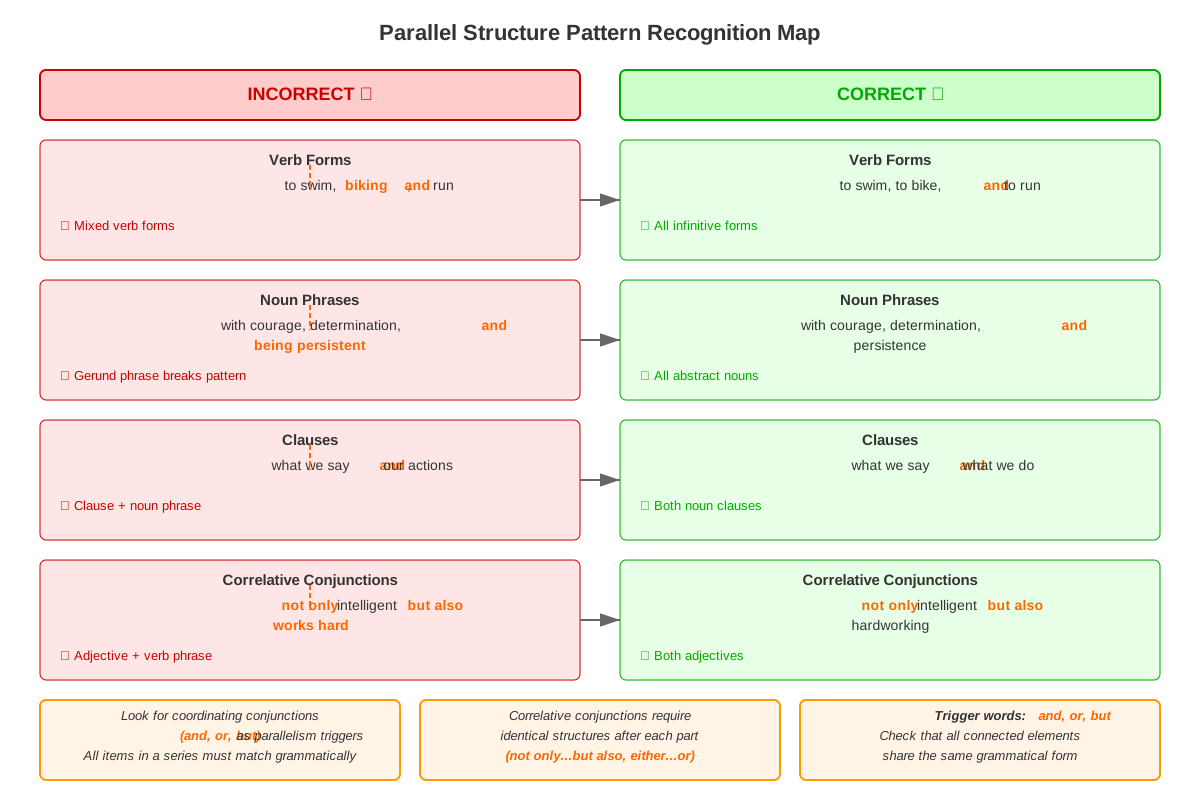
The most common parallelism scenario involves three or more items in a list. Each item must match the grammatical form of the others:
Correct: The scientist conducted experiments, analyzed data, and published findings. (three past-tense verbs)
Incorrect: The scientist conducted experiments, analyzed data, and is publishing findings. (shifts to present progressive)
Correct: Success requires dedication, persistence, and creativity. (three nouns)
Incorrect: Success requires dedication, being persistent, and creativity. (shifts to gerund phrase)
Comparisons
Sentences using "than," "as," or "like" to draw comparisons must maintain parallel structure on both sides of the comparison word:
Correct: Reading actively is more effective than reading passively. (gerund phrase compared to gerund phrase)
Incorrect: Reading actively is more effective than to read passively. (gerund phrase compared to infinitive phrase)
Correlative Conjunctions
Correlative conjunction pairs (both/and, either/or, neither/nor, not only/but also, whether/or) require parallel elements immediately following each conjunction:
Correct: The program benefits not only students but also teachers. (noun following each conjunction)
Incorrect: The program not only benefits students but also teachers. (verb phrase following first, noun following second)
Grammatical Categories in Parallelism
| Category | Example of Parallel Structure | Example of Faulty Structure |
|---|---|---|
| Nouns | courage, strength, wisdom | courage, being strong, wisdom |
| Verbs (same tense) | ran, jumped, swam | ran, jumping, swam |
| Infinitives | to read, to write, to speak | to read, writing, to speak |
| Gerunds | reading, writing, speaking | reading, to write, speaking |
| Adjectives | quick, efficient, reliable | quick, with efficiency, reliable |
| Prepositional phrases | in the morning, during lunch, after school | in the morning, lunch, after school |
| Dependent clauses | what she said, how she acted, why she left | what she said, her actions, why she left |
Verb Form Consistency
Maintaining parallel verb forms presents particular challenges because English offers multiple ways to express actions. The three primary verb forms that must remain consistent are:
- Infinitives (to + base verb): to run, to think, to create
- Gerunds (-ing form as noun): running, thinking, creating
- Conjugated verbs (tensed forms): runs/ran, thinks/thought, creates/created
Within conjugated verbs, tense must also remain consistent unless the meaning requires a time shift. Mixing these forms within a parallel structure creates errors that the SAT frequently tests.
Phrase and Clause Parallelism
Beyond individual words, entire phrases and clauses must maintain parallel structure. This includes:
- Prepositional phrases: "in the house, on the roof, and under the porch" (all prepositional phrases)
- Noun phrases: "the red car, the blue truck, and the green motorcycle" (all article + adjective + noun)
- Dependent clauses: "whoever arrives first, whoever brings supplies, and whoever volunteers" (all dependent clauses with same structure)
Articles and Determiners
When using articles (a, an, the) or determiners (this, that, these, those) in parallel structures, consistency matters. Either include the article/determiner before each item or only before the first:
Correct: the president, the vice president, and the treasurer
Correct: the president, vice president, and treasurer
Incorrect: the president, vice president, and the treasurer (inconsistent pattern)
Concept Relationships
Parallel phrasing connects intimately with several other grammatical and rhetorical concepts. At its foundation, parallelism depends on parts of speech identification → which enables → recognition of grammatical categories → which leads to → detection of structural inconsistencies.
The relationship between parallel structure and sentence clarity is direct: proper parallelism → creates → predictable patterns → which produce → easier comprehension. Conversely, faulty parallelism → generates → reader confusion → which undermines → communication effectiveness.
Parallelism also connects to rhetorical effectiveness in the Expression of Ideas domain. Writers use parallel structure deliberately to create emphasis, rhythm, and memorable phrasing. Famous examples include "government of the people, by the people, for the people" and "I came, I saw, I conquered"—both using parallelism for rhetorical impact.
Within SAT Reading and Writing, parallel phrasing questions often overlap with concision and precision questions. An answer choice might be both non-parallel and wordy, requiring students to recognize multiple errors. Understanding these connections helps students approach revision questions strategically, checking for multiple potential issues simultaneously.
High-Yield Facts
⭐ Parallel structure requires grammatically equivalent elements to maintain identical structural forms throughout a series, list, or comparison.
⭐ Correlative conjunctions (both/and, either/or, neither/nor, not only/but also) must be followed by parallel grammatical structures.
⭐ Items in a list of three or more must all share the same grammatical form: all nouns, all verbs in the same tense, all phrases of the same type.
⭐ Comparisons using "than" or "as" require parallel structures on both sides of the comparison word.
⭐ Mixing infinitives (to + verb) with gerunds (-ing forms) within the same series creates a parallelism error.
- Verb tenses within parallel structures must remain consistent unless meaning requires a time shift.
- Prepositional phrases in a series must all begin with prepositions and follow the same pattern.
- When using articles or determiners in parallel lists, either include them before each item or only before the first item—not inconsistently.
- Dependent clauses in parallel structures must maintain the same clause type and structure.
- Adjectives and adverbs cannot be mixed in parallel structures; all modifiers must be the same type.
⭐ The SAT tests parallelism most frequently in Expression of Ideas questions where students must revise sentences for clarity and effectiveness.
- Parallel structure violations often occur at the end of lists, where writers lose track of the established pattern.
- Compound predicates (multiple verbs sharing the same subject) must maintain parallel verb forms.
- Parallel structure applies to both independent and dependent clauses when they appear in series.
- The shortest grammatically correct answer is often correct on parallelism questions, as wordiness frequently accompanies structural errors.
Quick check — test yourself on Parallel phrasing so far.
Try Flashcards →Common Misconceptions
Misconception: Parallel structure only applies to lists of three or more items.
Correction: Parallelism applies to any series of two or more grammatically equivalent elements, including comparisons, compound structures, and paired conjunctions. Even two items joined by "and" or "or" must be parallel.
Misconception: As long as words have similar meanings, they can have different grammatical forms in parallel structures.
Correction: Meaning similarity is irrelevant to parallelism; only grammatical form matters. "Running" and "to run" have identical meanings but different grammatical forms, making them non-parallel when used together in a series.
Misconception: Mixing active and passive voice is acceptable in parallel structures if the tense remains the same.
Correction: Voice must remain consistent in parallel structures. Mixing "The team won the game" (active) with "the trophy was received" (passive) creates a parallelism error even though both use past tense.
Misconception: Parallelism errors are always obvious and easy to spot.
Correction: Many parallelism violations are subtle, especially in longer sentences with complex structures. The SAT deliberately creates plausible-sounding but non-parallel constructions that require careful analysis to detect.
Misconception: If a sentence sounds correct when read aloud, it must have proper parallel structure.
Correction: Many parallelism errors sound acceptable in casual speech but violate formal written English standards. The SAT tests formal written conventions, not conversational patterns. Students must analyze grammatical structure, not rely solely on what "sounds right."
Misconception: Parallel structure is just a stylistic preference, not a grammatical rule.
Correction: While parallelism does enhance style, it is a fundamental grammatical principle in formal written English. Violations create genuine structural errors, not merely stylistic weaknesses. The SAT treats parallelism as a correctness issue, not a preference.
Worked Examples
Example 1: List with Mixed Verb Forms
Question: The research team's responsibilities include designing experiments, to collect data, and the analysis of results.
Which choice maintains parallel structure?
A) NO CHANGE
B) designing experiments, collecting data, and analyzing results
C) to design experiments, collecting data, and analyzing results
D) designing experiments, data collection, and to analyze results
Solution Process:
Step 1: Identify the parallel elements. The sentence lists three responsibilities connected by commas and "and."
Step 2: Analyze the grammatical form of each element:
- "designing experiments" = gerund phrase
- "to collect data" = infinitive phrase
- "the analysis of results" = noun phrase
Step 3: Recognize the error. The three elements use different grammatical forms (gerund, infinitive, noun), violating parallel structure.
Step 4: Evaluate each answer choice:
- Choice A maintains the error (mixed forms)
- Choice B converts all three to gerund phrases: "designing," "collecting," "analyzing" (parallel!)
- Choice C mixes infinitive with gerunds (not parallel)
- Choice D mixes gerund, noun, and infinitive (not parallel)
Answer: B
This question demonstrates the most common SAT parallelism pattern: a list where one or more items breaks the established grammatical pattern. The correct answer converts all elements to the same form—in this case, gerunds functioning as nouns.
Example 2: Correlative Conjunctions
Question: The new policy affects not only how students register for classes but also their ability to drop courses affects them.
Which choice best maintains parallel structure and clarity?
A) NO CHANGE
B) not only how students register for classes but also how they drop courses
C) how students not only register for classes but also drop courses
D) not only students registering for classes but also dropping courses
Solution Process:
Step 1: Identify the correlative conjunction pair: "not only...but also"
Step 2: Determine what follows each conjunction:
- After "not only": "how students register for classes" (dependent clause)
- After "but also": "their ability to drop courses affects them" (independent clause with awkward construction)
Step 3: Recognize the error. The structures following "not only" and "but also" are not parallel—one is a dependent clause, the other is an independent clause.
Step 4: Evaluate answer choices:
- Choice A maintains the non-parallel structure
- Choice B places "how" clauses after both conjunctions (parallel dependent clauses!)
- Choice C places the correlative conjunctions incorrectly, splitting the verb phrase
- Choice D changes to gerunds but creates an unclear meaning
Answer: B
This example illustrates how correlative conjunctions require parallel structures immediately following each conjunction. The correct answer places identical grammatical structures (dependent clauses beginning with "how") after both "not only" and "but also."
Exam Strategy
Recognition Triggers
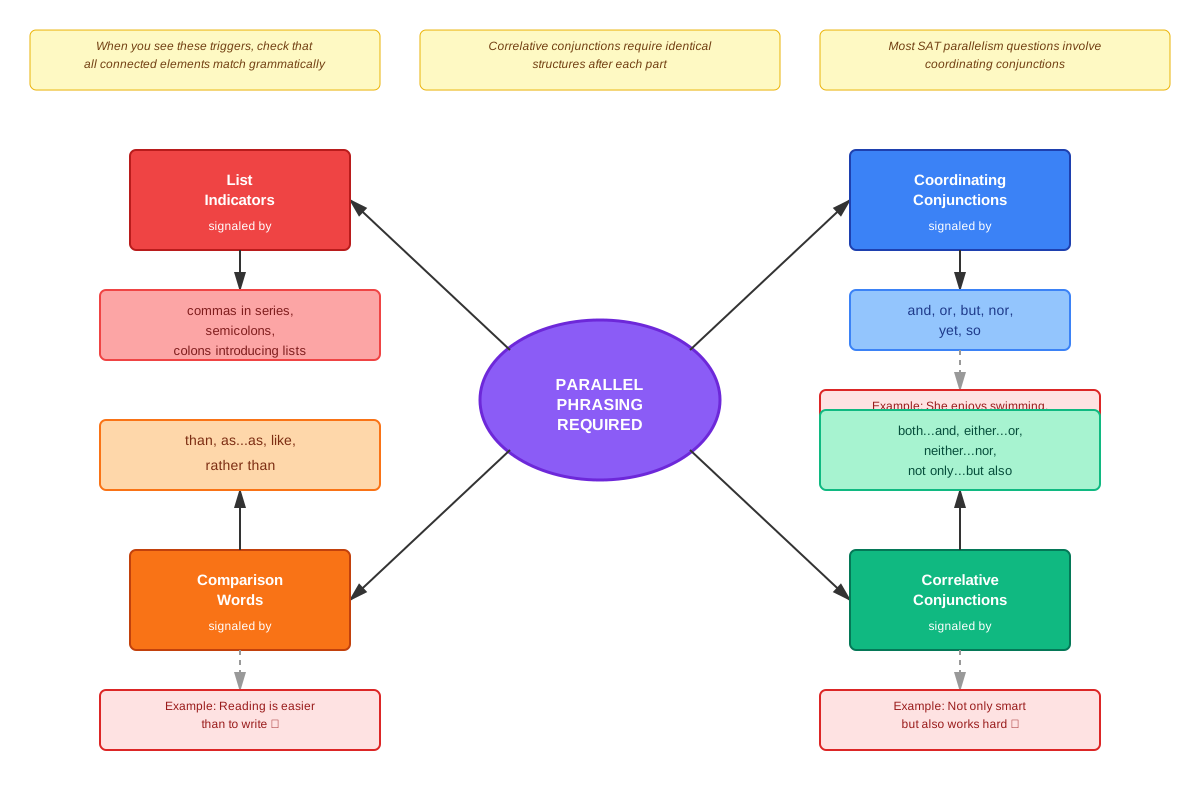
SAT parallelism questions contain specific trigger words and patterns that signal the need to check for parallel structure:
- Lists with commas and "and": Any series of three or more items automatically requires parallelism analysis
- Correlative conjunctions: "both/and," "either/or," "neither/nor," "not only/but also," "whether/or"
- Comparison words: "than," "as...as," "like," "unlike," "compared to"
- Compound structures: Multiple verbs sharing one subject, or multiple subjects sharing one verb
Exam Tip: When you see a list or comparison, immediately check whether all elements share the same grammatical form. This takes 5-10 seconds and prevents careless errors.
Systematic Approach
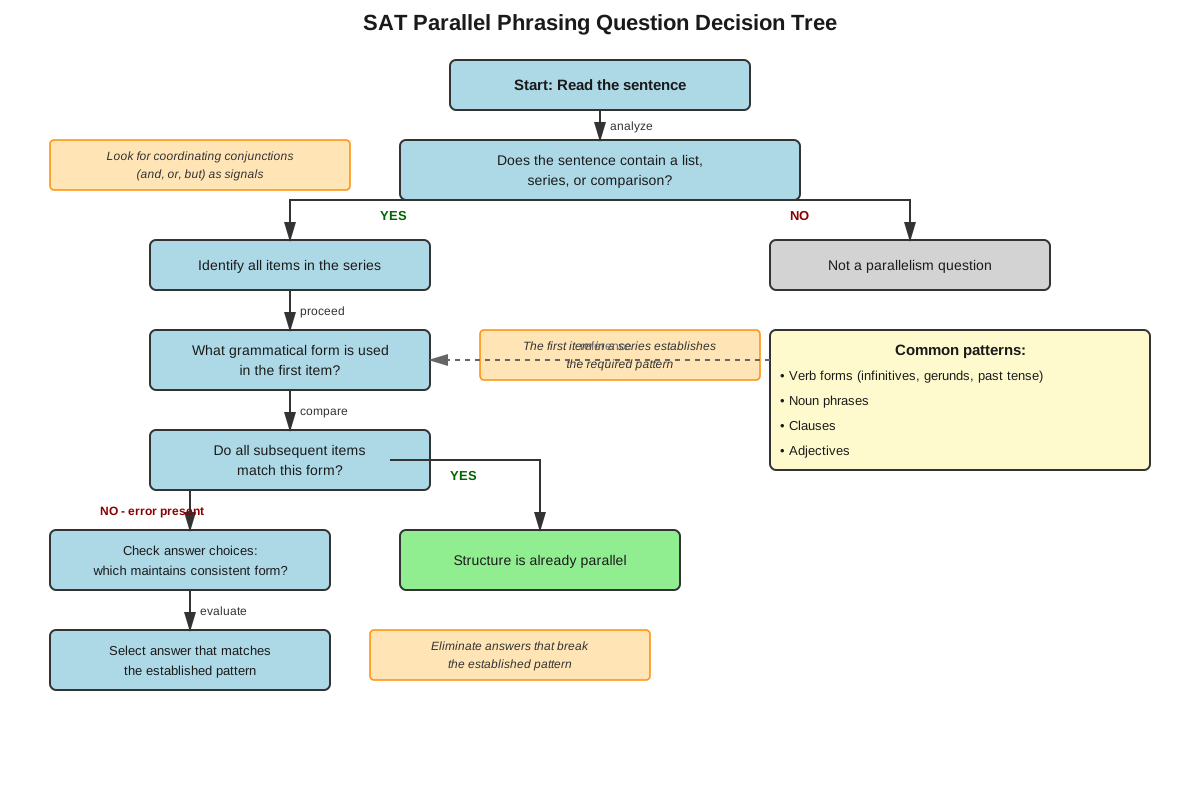
Use this four-step process for every potential parallelism question:
- Identify parallel elements: Circle or mentally note all items that should be parallel (list items, compared elements, etc.)
- Determine the grammatical form: Label each element's grammatical category (noun, verb, infinitive, gerund, phrase type)
- Check for consistency: Verify that all elements match the same grammatical pattern
- Eliminate non-parallel choices: Cross out any answer choice that maintains or creates structural inconsistency
Time Management
Parallelism questions are among the fastest to answer once you recognize the pattern. Allocate 20-30 seconds per question:
- 5 seconds: Identify the parallel elements
- 10 seconds: Check grammatical forms
- 10 seconds: Eliminate wrong answers and confirm correct choice
- 5 seconds: Mark answer and move on
Process of Elimination
When multiple answer choices seem plausible, use these elimination strategies:
- Eliminate mixed forms first: Any choice mixing infinitives with gerunds, or nouns with verb phrases, is automatically wrong
- Check correlative conjunction placement: If the conjunctions don't immediately precede parallel structures, eliminate that choice
- Prefer concision: Among parallel options, the most concise choice is typically correct
- Trust grammatical analysis over sound: Don't rely on what "sounds right"—analyze the actual grammatical structure
Common Trap Patterns
The SAT frequently includes these trap answer choices:
- Partially parallel: Three items where two are parallel but the third breaks the pattern
- Plausible but non-parallel: Choices that sound natural in speech but violate formal parallelism rules
- Overcorrection: Choices that fix the parallelism error but introduce a new error (wrong word, unclear meaning)
- Misplaced conjunctions: Correlative conjunctions placed before the wrong words, creating non-parallel structures
Memory Techniques
The "Same Family" Mnemonic
Remember: Parallel elements must come from the same grammatical family. Visualize grammatical categories as families at a reunion—nouns sit with nouns, verbs with verbs, infinitives with infinitives. Mixing families creates chaos, just like mixing grammatical forms creates parallelism errors.
The "Mirror Test"
For correlative conjunctions, use the mirror test: whatever grammatical structure follows the first conjunction must be mirrored after the second. If "not only" is followed by a verb phrase, "but also" must be followed by a verb phrase. Imagine the conjunctions as mirrors reflecting identical structures.
The "Three-Check System"
For lists, use three checks:
- Check One: First item's form
- Check Two: Second item matches first
- Check Three: Third (and any additional) items match the pattern
If all three checks pass, the structure is parallel.
The "FANBOYS + Form" Rule
When you see coordinating conjunctions (FANBOYS: for, and, nor, but, or, yet, so), remember: FANBOYS + Form consistency. Whatever grammatical form appears before the conjunction must match the form after it.
Acronym: PARALLEL
Parts of speech must match
All items in series
Require identical structure
And correlative conjunctions
Link equivalent forms
Lists need consistency
Every element
Like the others
Summary
Parallel phrasing is a fundamental grammatical principle requiring that sentence elements serving equivalent functions maintain identical structural forms. On the SAT Reading and Writing section, parallelism questions test whether students can identify and correct structural inconsistencies in lists, comparisons, and compound structures. The core rule is simple: grammatically equivalent elements require structurally equivalent forms—nouns with nouns, verbs with verbs, infinitives with infinitives, and phrases with matching phrases. Mastery requires recognizing trigger patterns (lists, correlative conjunctions, comparisons), systematically analyzing grammatical forms, and eliminating non-parallel answer choices. These questions appear frequently (8-12% of Expression of Ideas items) and can be answered quickly once pattern recognition becomes automatic. Success depends on analyzing actual grammatical structure rather than relying on what "sounds right," as many parallelism violations sound acceptable in casual speech but violate formal written conventions.
Key Takeaways
- Parallel structure requires all grammatically equivalent elements to maintain identical forms throughout lists, comparisons, and compound structures
- The most common parallelism errors involve mixing infinitives with gerunds, or shifting between different grammatical categories mid-series
- Correlative conjunctions (both/and, either/or, not only/but also) must be followed by parallel structures immediately after each conjunction
- SAT parallelism questions appear in 8-12% of Expression of Ideas items and can be answered in 20-30 seconds with systematic analysis
- Recognition triggers include lists with three or more items, comparison words (than, as), and correlative conjunctions
- Eliminate answer choices by checking whether all parallel elements share the same grammatical form—don't rely on what "sounds right"
- Parallelism connects to broader writing principles of clarity, consistency, and rhetorical effectiveness tested throughout the SAT Reading and Writing section
Related Topics
Verb Tense Consistency: While parallel structure requires matching verb forms within series, verb tense consistency governs tense usage throughout passages. Mastering parallelism provides the foundation for understanding when and why tenses should remain consistent versus when shifts are appropriate.
Modifier Placement: Parallel structure often involves parallel modifiers (adjectives, adverbs, phrases). Understanding modifier placement rules enhances the ability to construct and recognize proper parallel structures involving descriptive elements.
Concision and Wordiness: Many SAT questions test both parallelism and concision simultaneously. Mastering parallel structure enables students to recognize when answer choices are both non-parallel and unnecessarily wordy, improving efficiency on multi-concept questions.
Rhetorical Synthesis: Advanced parallelism appears in rhetorical devices like anaphora (repetition of opening words) and isocolon (parallel clauses of similar length). Understanding basic parallelism enables progression to these sophisticated rhetorical techniques.
Practice CTA
Now that you understand the principles of parallel phrasing, it's time to reinforce your mastery through active practice. Complete the practice questions to test your ability to identify parallelism errors and select correct answer choices under timed conditions. Use the flashcards to drill recognition of common parallelism patterns and trigger words. Remember: parallelism questions are among the fastest to answer once you internalize the patterns, giving you valuable time for more challenging items. Every practice question you complete builds the automatic recognition that leads to perfect scores on test day. Start practicing now to transform this high-yield topic into guaranteed points on your SAT!
Sign up free to keep reading
Create a free AnvayaPrep account to finish this SAT guide on Parallel phrasing — plus flashcards and practice questions.