Overview
Verb tense is one of the most frequently tested grammar concepts on the SAT Reading and Writing section, appearing in approximately 10-15% of all Standard English Conventions questions. Mastery of verb tense requires understanding not only the grammatical rules governing when to use each tense, but also the ability to recognize temporal context clues within sentences and passages. The SAT tests whether students can identify and correct verb tense errors that disrupt the logical sequence of events or contradict time markers present in the text.
The SAT verb tense questions assess a student's ability to maintain consistency and accuracy in verb usage across various contexts. These questions typically present a sentence or short passage where one verb is underlined, and students must determine whether the verb tense is appropriate given the surrounding context. Unlike simple grammar drills, SAT verb tense questions require careful analysis of time relationships, signal words, and the logical flow of actions. Students must distinguish between simple, progressive, perfect, and perfect progressive forms across past, present, and future timeframes.
Understanding verb tense is foundational to the broader RW (Reading and Writing) section because it connects directly to sentence structure, logical coherence, and the author's intended meaning. Verb tense errors can fundamentally alter what a sentence communicates, making this topic essential not only for grammar questions but also for comprehending complex passages. Strong verb tense skills support success in related areas such as subject-verb agreement, parallel structure, and rhetorical synthesis, as all these concepts require attention to grammatical consistency and logical relationships within text.
Learning Objectives
- [ ] Identify key features of verb tense, including the twelve major tense forms and their appropriate contexts
- [ ] Explain how verb tense appears on the SAT, including question formats and common testing patterns
- [ ] Apply verb tense rules to answer SAT-style questions with accuracy and efficiency
- [ ] Distinguish between simple, progressive, perfect, and perfect progressive aspects across all three time frames
- [ ] Recognize temporal signal words and phrases that indicate which verb tense is required
- [ ] Evaluate verb tense consistency within complex sentences and multi-sentence contexts
- [ ] Correct verb tense errors by analyzing the logical sequence of events in a passage
Prerequisites
- Basic sentence structure: Understanding subjects, verbs, and objects is essential because verb tense questions require identifying the main verb and its relationship to other sentence elements
- Parts of speech identification: Recognizing verbs, helping verbs, and verb phrases enables students to locate the elements being tested
- Reading comprehension fundamentals: The ability to extract meaning from context is necessary because verb tense selection depends on understanding the timeline of events described
- Familiarity with regular and irregular verb forms: Knowledge of how verbs change form (walk/walked/walking, go/went/gone) provides the foundation for applying tense rules
Why This Topic Matters
Verb tense mastery extends far beyond standardized testing into every form of academic and professional writing. Clear communication requires precise temporal relationships—readers must understand when events occurred relative to each other and to the present moment. In scientific writing, verb tense conventions distinguish between established facts (present tense), completed studies (past tense), and ongoing research (present perfect). In historical analysis, proper verb tense usage helps readers track complex sequences of events across different time periods.
On the SAT specifically, verb tense questions appear in 3-5 questions per test administration, making them one of the highest-yield grammar topics to master. These questions typically appear as part of the Standard English Conventions domain and are worth the same number of points as any other question, but they often require less time to answer than rhetorical questions when students have solid foundational knowledge. The College Board reports that verb tense questions have moderate difficulty levels, with approximately 60-70% of test-takers answering them correctly, meaning that mastery of this topic provides a competitive advantage.
Verb tense questions on the SAT most commonly appear in three formats: (1) selecting the correct tense for an underlined verb within a sentence, (2) maintaining tense consistency across a passage, and (3) choosing the appropriate tense based on temporal signal words or phrases. Passages may come from any content area—science, history, literature, or social studies—but the underlying grammatical principles remain constant. The SAT particularly favors testing the distinction between simple past and present perfect, the appropriate use of past perfect to show sequence, and the correct application of future tense forms.
Core Concepts
The Twelve Verb Tenses
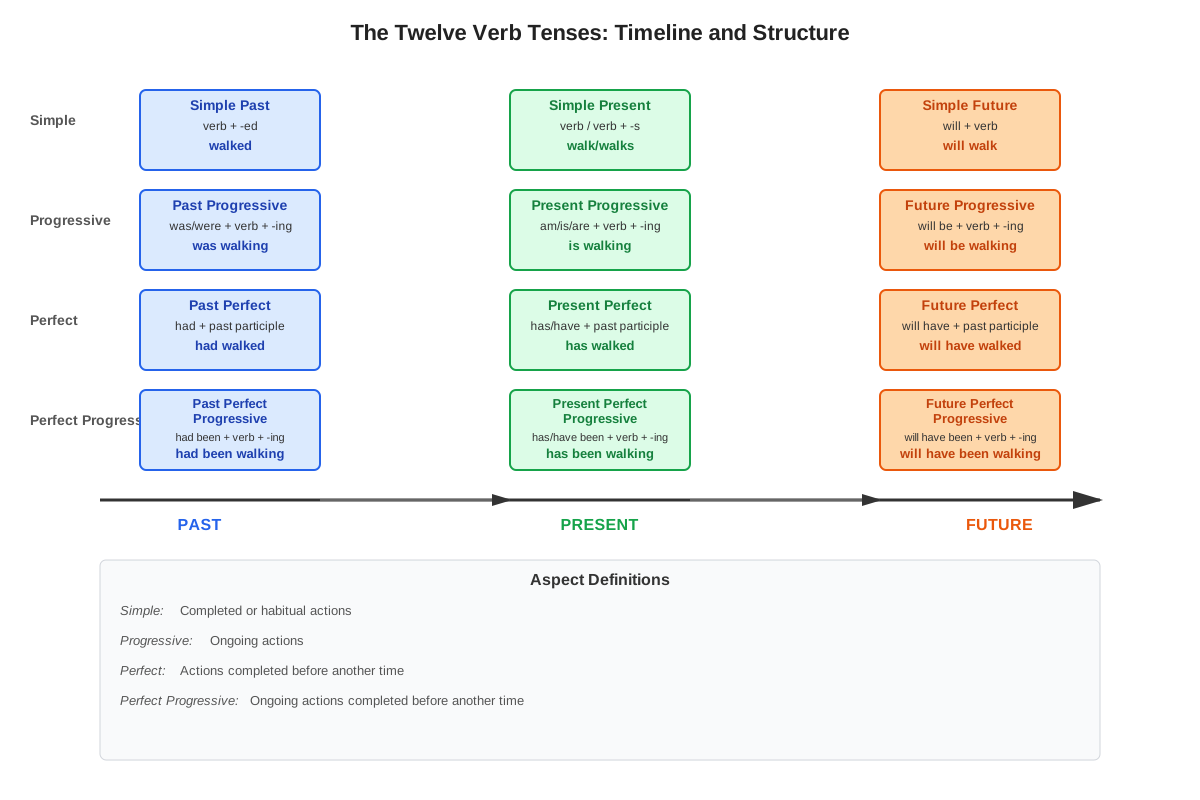
English contains twelve primary verb tense forms, created by combining three time frames (past, present, future) with four aspects (simple, progressive, perfect, perfect progressive). Understanding this systematic structure helps students recognize patterns and make logical choices on the SAT.
| Time Frame | Simple | Progressive | Perfect | Perfect Progressive |
|---|---|---|---|---|
| Past | walked | was walking | had walked | had been walking |
| Present | walk/walks | am/is/are walking | have/has walked | have/has been walking |
| Future | will walk | will be walking | will have walked | will have been walking |
Simple tenses express actions or states without emphasizing duration or completion. The simple present describes habitual actions, general truths, or scheduled future events. The simple past describes completed actions. The simple future describes actions that will occur.
Progressive tenses (also called continuous tenses) emphasize ongoing action at a specific time. They use forms of "be" plus the present participle (-ing form). The present progressive shows action happening now, the past progressive shows action that was in progress at a specific past moment, and the future progressive shows action that will be in progress at a specific future time.
Perfect tenses emphasize completion or the relationship between two time points. They use forms of "have" plus the past participle. The present perfect connects past actions to the present moment or describes actions that occurred at an unspecified time. The past perfect shows which of two past actions occurred first. The future perfect describes actions that will be completed before a specific future time.
Perfect progressive tenses combine the concepts of completion and ongoing action, using forms of "have been" plus the present participle. These tenses emphasize the duration of an action up to a particular point in time.
Temporal Signal Words
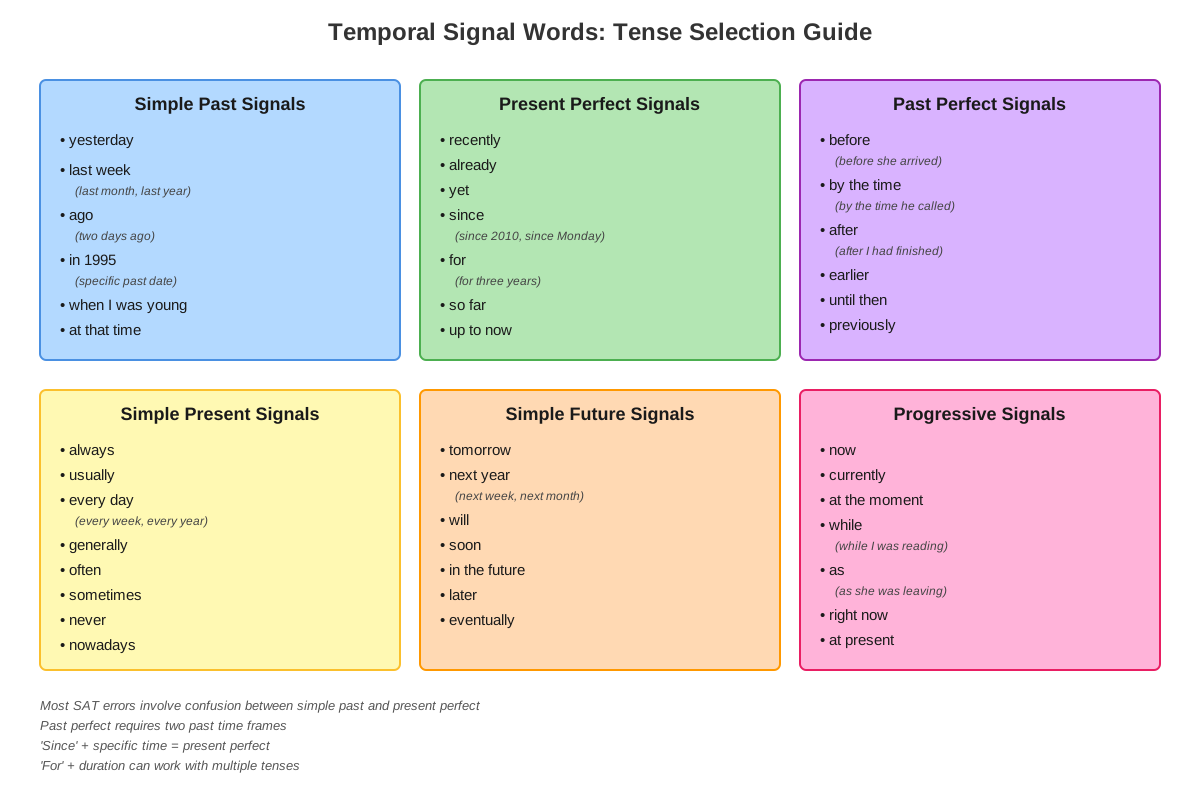
The SAT frequently includes temporal signal words that indicate which verb tense is appropriate. Recognizing these markers is crucial for answering questions quickly and accurately.
Present tense signals: now, today, currently, always, never, usually, often, every day, in general
Past tense signals: yesterday, last week, ago, in 1995, when, during that time, at that moment, then
Present perfect signals: since, for (with duration), already, yet, ever, never, recently, so far, up to now, just
Past perfect signals: before, by the time, after, when (indicating sequence), earlier, previously, by then
Future tense signals: tomorrow, next week, soon, later, in the future, eventually, will
Tense Consistency
One of the most commonly tested concepts on the SAT verb tense questions is maintaining consistency within and across sentences. When multiple actions occur in the same time frame, verbs should generally use the same tense unless there is a logical reason for a shift.
Consistent: "The scientist conducted the experiment and recorded the results." (Both verbs in simple past)
Inconsistent: "The scientist conducted the experiment and records the results." (Illogical shift from past to present)
However, tense shifts are appropriate when the timeline actually changes:
Appropriate shift: "The scientist conducted the experiment last year, and she now believes the results were significant." (Past action, then present belief about that past action)
Sequence of Events with Past Perfect
The past perfect tense is essential for showing which of two past actions occurred first. The SAT frequently tests whether students can recognize situations requiring past perfect to clarify sequence.
Pattern: When describing two past events, use past perfect for the earlier action and simple past for the later action.
Example: "By the time the rescue team arrived, the survivors had already built a shelter." (Building the shelter happened first, arrival happened second, both in the past)
Common error: Using simple past for both actions when sequence matters: "By the time the rescue team arrived, the survivors already built a shelter." (Incorrect—doesn't clearly show which happened first)
Present Perfect vs. Simple Past
The distinction between present perfect and simple past is heavily tested on the SAT. The key difference lies in whether the action connects to the present moment.
Use present perfect when:
- The exact time is unspecified: "Scientists have discovered many exoplanets."
- The action continues to the present: "She has lived in Boston for ten years." (Still lives there)
- The action has present relevance: "The committee has decided to postpone the vote." (The decision affects the present)
Use simple past when:
- The time is specified: "Scientists discovered Pluto in 1930."
- The action is completely finished: "She lived in Boston for ten years." (No longer lives there)
- The action has no emphasized connection to now: "The committee decided to postpone the vote last week."
Future Tense Forms
The SAT tests various ways of expressing future time, and students must recognize which form is most appropriate for the context.
Simple future (will + base verb): "The conference will begin tomorrow."
Future progressive (will be + -ing): "At this time tomorrow, the conference will be taking place."
Future perfect (will have + past participle): "By next month, the researchers will have completed the study."
Present tense for scheduled events: "The train leaves at 6:00 PM." (Acceptable for fixed schedules)
Present progressive for planned future: "We are meeting with the advisor next week." (Acceptable for definite plans)
Concept Relationships
The twelve verb tenses form an interconnected system where understanding one tense illuminates the others. Simple tenses serve as the foundation, with progressive, perfect, and perfect progressive aspects building upon them by adding layers of meaning about duration, completion, and temporal relationships. The progression from simple → progressive → perfect → perfect progressive represents increasing complexity in how actions relate to time.
Temporal signal words → determine → appropriate verb tense selection. These signal words function as context clues that guide students toward the correct answer, making them essential for efficient problem-solving. When a sentence contains "since 2010," this phrase directly points toward present perfect tense; when it contains "in 2010," simple past becomes appropriate.
Tense consistency depends on understanding both individual tense meanings and logical sequence of events. Students must first identify what each verb tense communicates, then evaluate whether the combination of tenses in a sentence or passage creates a coherent timeline. This evaluation process requires synthesizing multiple concepts simultaneously.
Past perfect tense specifically relates to simple past tense through the concept of relative time. While simple past places an action in the past, past perfect places an action in the "past of the past," creating a two-level temporal structure. This relationship extends to present perfect and future perfect, which similarly show relationships between time points in their respective frames.
The connection between verb tense and other RW topics is substantial. Subject-verb agreement requires identifying the correct verb form, which includes tense. Parallel structure often requires maintaining consistent tense across items in a series. Logical coherence questions may hinge on whether verb tenses accurately reflect the sequence of events described. Understanding verb tense thus supports success across multiple question types in the Standard English Conventions domain.
Quick check — test yourself on Verb tense so far.
Try Flashcards →High-Yield Facts
⭐ The present perfect tense (have/has + past participle) is used for actions that began in the past and continue to the present or have present relevance, while simple past is used for completed actions at specific past times.
⭐ The past perfect tense (had + past participle) must be used to show which of two past actions occurred first when the sequence matters for meaning.
⭐ Temporal signal words like "since," "for," "already," and "yet" typically require present perfect tense, while words like "ago," "yesterday," and specific dates require simple past.
⭐ Tense consistency requires maintaining the same tense for actions occurring in the same time frame unless there is a logical reason for a shift.
⭐ The SAT tests whether students can identify the appropriate tense based on context, not whether they can recite tense names or conjugation rules.
- Progressive tenses (be + -ing) emphasize that an action is/was/will be ongoing at a particular moment in time.
- The simple present tense is used for habitual actions, general truths, and scheduled future events, not just for actions happening at this exact moment.
- Future time can be expressed through simple future (will + verb), present progressive (for definite plans), or simple present (for schedules), and the SAT tests which form is most appropriate for the context.
- When a sentence contains two clauses with different time frames, different tenses are not only acceptable but necessary for accuracy.
- The perfect progressive tenses (have/has/had been + -ing) emphasize the duration of an action up to a particular point and are less commonly tested than other forms.
- Irregular verbs (go/went/gone, see/saw/seen) are frequently used in SAT questions because students often confuse their past and past participle forms.
- The helping verbs "have," "has," "had," "will," and forms of "be" are crucial for identifying which tense is being used or should be used.
- Context clues about whether an action is finished, ongoing, or yet to occur are more important than memorizing tense rules in isolation.
Common Misconceptions
Misconception: Present perfect and simple past are interchangeable. → Correction: Present perfect (have/has + past participle) connects past actions to the present or indicates unspecified time, while simple past describes completed actions at specific past times. "I have lived here for five years" (still living here) differs from "I lived here for five years" (no longer living here).
Misconception: Past perfect should be used for any action that happened a long time ago. → Correction: Past perfect is used to show which of two past actions occurred first, not to indicate how long ago something happened. Use past perfect only when establishing sequence between two past events matters: "She had finished dinner before the guests arrived."
Misconception: The word "since" always requires present perfect tense. → Correction: While "since" often signals present perfect when indicating duration ("since 2010"), it can also mean "because" and appear with various tenses: "Since the experiment failed, the researchers revised their hypothesis" (simple past is correct here).
Misconception: Tense must remain constant throughout a passage or paragraph. → Correction: Tense should remain consistent only when actions occur in the same time frame. When the timeline shifts, tense should shift accordingly: "The ancient Romans built aqueducts that still stand today" (past action, present state—both tenses are correct).
Misconception: "Will" is the only way to express future time. → Correction: English expresses future time through multiple structures: simple future (will + verb), future progressive (will be + -ing), future perfect (will have + past participle), present progressive for plans ("I am meeting her tomorrow"), and simple present for schedules ("The train leaves at 6:00").
Misconception: Progressive tenses can be used with any verb. → Correction: Stative verbs (know, believe, understand, own, seem) typically do not take progressive forms. "I am knowing the answer" is incorrect; "I know the answer" is correct. However, the SAT rarely tests this distinction directly.
Misconception: The present tense only describes actions happening right now. → Correction: Simple present describes habitual actions ("She walks to school every day"), general truths ("Water boils at 100°C"), and scheduled future events ("The concert starts at 8:00 PM"), not just current actions.
Worked Examples
Example 1: Present Perfect vs. Simple Past
Question: The research team _____ three different methods over the past decade, but none has produced conclusive results.
A) tested
B) had tested
C) has tested
D) will test
Step 1: Identify temporal signal words
The phrase "over the past decade" indicates a time period that began in the past and extends to the present. This is a key signal for present perfect tense.
Step 2: Analyze the time frame
The testing began in the past (a decade ago) and the results are relevant to the present moment (the team still hasn't found conclusive results). This connection between past and present is the hallmark of present perfect.
Step 3: Eliminate incorrect options
- Option A (tested - simple past) would be correct only if the time period were completely finished or if a specific past time were mentioned: "The team tested three methods in 2010."
- Option B (had tested - past perfect) would be appropriate only if we were showing sequence between two past events: "The team had tested three methods before the funding ended."
- Option D (will test - future) contradicts the signal phrase "over the past decade," which indicates past-to-present time.
Step 4: Confirm the correct answer
Option C (has tested - present perfect) correctly shows that the testing occurred during a time period extending from the past to the present. The singular "has" agrees with the singular subject "team."
Answer: C
Connection to learning objectives: This example demonstrates how to identify temporal signal words ("over the past decade") and apply the distinction between present perfect and simple past based on whether the action connects to the present moment.
Example 2: Past Perfect for Sequence
Question: By the time European explorers arrived in the Americas, indigenous peoples _____ complex civilizations with advanced agricultural systems.
A) develop
B) developed
C) had developed
D) have developed
Step 1: Identify the two past events
Event 1: Indigenous peoples developed civilizations (earlier past event)
Event 2: European explorers arrived (later past event)
Both events are in the past, but one clearly happened before the other.
Step 2: Recognize the sequence signal
The phrase "by the time" is a strong indicator that we need to show which action happened first. This is the primary function of past perfect tense.
Step 3: Apply the past perfect rule
When two past events are mentioned and sequence matters, use past perfect (had + past participle) for the earlier event and simple past for the later event. The civilizations were already developed before the explorers arrived.
Step 4: Eliminate incorrect options
- Option A (develop - simple present) is incorrect because the events occurred in the past, not as general truths or habitual actions.
- Option B (developed - simple past) fails to show that the development happened before the arrival. Using simple past for both events would be: "European explorers arrived, and indigenous peoples developed civilizations," which incorrectly suggests the events happened at the same time or in unclear sequence.
- Option D (have developed - present perfect) would suggest the development continues to the present or has present relevance, but the sentence is clearly discussing historical events in a completed past time frame.
Step 5: Confirm the correct answer
Option C (had developed - past perfect) correctly shows that the development of civilizations was completed before the explorers arrived.
Answer: C
Connection to learning objectives: This example illustrates how to recognize situations requiring past perfect tense to clarify the sequence of past events, a frequently tested concept on the SAT. The ability to identify sequence signals like "by the time" is essential for efficient problem-solving.
Exam Strategy
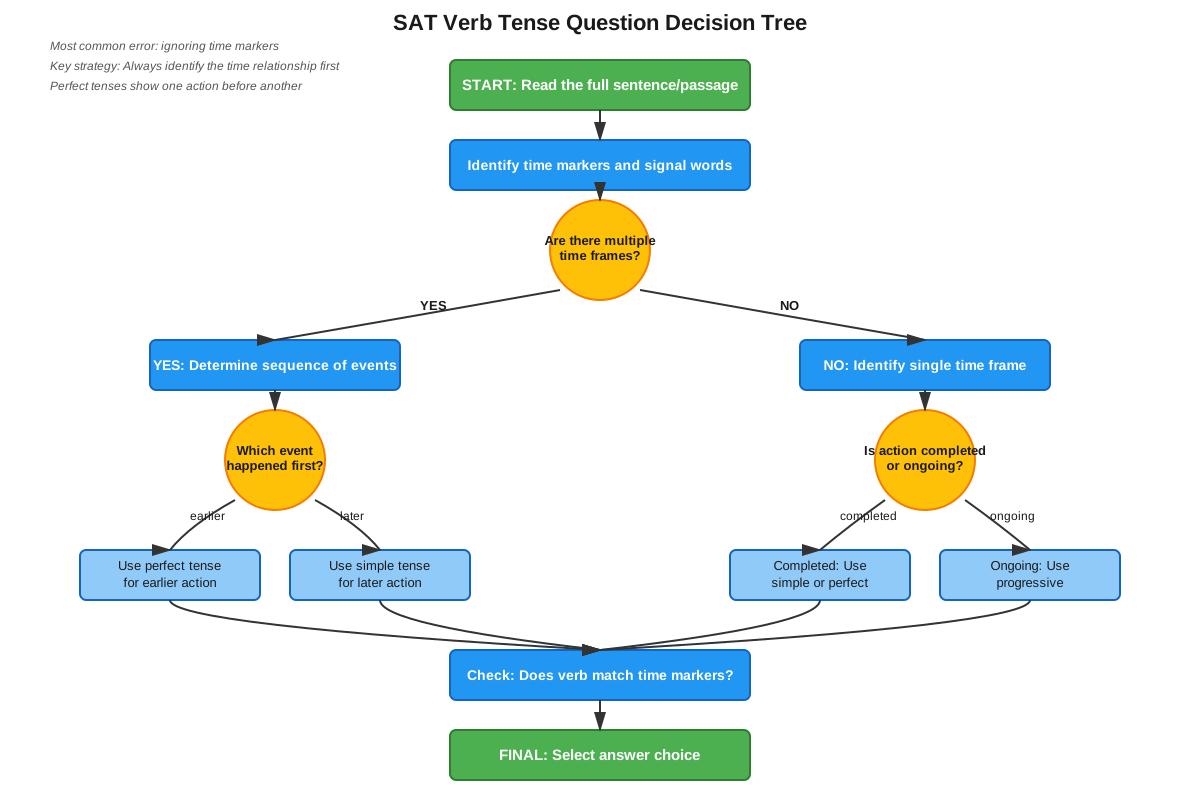
When approaching SAT verb tense questions, follow a systematic process that maximizes accuracy while minimizing time expenditure. First, read the entire sentence or passage to understand the overall timeline and context—never select an answer based solely on the underlined verb in isolation. The SAT deliberately includes context clues that indicate the correct tense, so missing these clues leads to errors.
Trigger words and phrases to watch for:
- Time-specific words: "yesterday," "in 1995," "next week," "currently," "now"
- Duration indicators: "since," "for," "during," "throughout"
- Sequence markers: "before," "after," "by the time," "when," "while"
- Completion indicators: "already," "yet," "just," "recently"
- Frequency words: "always," "never," "often," "usually" (often signal simple present)
Process-of-elimination strategy:
- Eliminate any tense that contradicts explicit time markers in the sentence
- Eliminate tenses that create illogical sequences of events
- If two options remain, check for subject-verb agreement errors or incorrect verb forms
- Choose the simplest tense that accurately conveys the meaning (the SAT rarely requires complex tenses without clear signals)
Time allocation advice: Verb tense questions should take 30-45 seconds each. If a question requires more than one minute, mark it for review and move on. These questions test recognition of patterns, not complex analysis, so extended deliberation usually indicates missing a key context clue. Return to difficult questions after completing easier ones, as fresh perspective often reveals the answer immediately.
Common question formats:
- Format 1: Single underlined verb with four tense options. Strategy: Identify the time frame from context, then select the tense that matches.
- Format 2: Multiple verbs in a passage with one underlined. Strategy: Check consistency with surrounding verbs and temporal markers.
- Format 3: Verb choice affects meaning. Strategy: Consider what each tense communicates about completion, duration, or sequence.
Exam Tip: When stuck between two tenses, ask yourself: "Is this action completely finished, or does it connect to the present?" This question resolves most present perfect vs. simple past dilemmas. Similarly, ask: "Do I need to show which of two past actions happened first?" to determine if past perfect is necessary.
Memory Techniques
PAST Acronym for Past Perfect Usage:
- Prior action (happened before another past action)
- Already completed (by the time the second action occurred)
- Sequence matters (the order is important to meaning)
- Two past events (both in the past, but one earlier)
"SINCE-FOR" Rule for Present Perfect:
Remember that SINCE points to a specific starting time (since 2010, since Monday, since childhood), while FOR indicates duration (for three years, for decades, for centuries). Both typically require present perfect tense when the action continues to the present.
Visualization Strategy for Tense Timeline:
Picture a horizontal timeline with three zones: PAST (left), PRESENT (center), FUTURE (right). Simple tenses place actions in one zone. Perfect tenses draw arrows between zones to show relationships. Progressive tenses add a "duration bar" showing ongoing action. This mental image helps determine which tense shows the correct temporal relationship.
"HAD-HAVE-WILL HAVE" Sequence:
For perfect tenses, remember the helping verb progression:
- HAD + past participle = past perfect (past of the past)
- HAVE/HAS + past participle = present perfect (past connected to present)
- WILL HAVE + past participle = future perfect (future looking back)
The "Yesterday-Today-Tomorrow" Test:
When uncertain about tense, mentally add time words:
- If "yesterday" fits naturally → simple past
- If "today" or "so far" fits → present perfect
- If "tomorrow" fits → future tense
This quick test often reveals the intended time frame.
Summary
Verb tense mastery on the SAT requires understanding the twelve major tense forms, recognizing temporal signal words, and applying logical principles about sequence and consistency. The most frequently tested distinctions involve present perfect versus simple past (determined by whether the action connects to the present), past perfect for showing sequence between two past events, and maintaining appropriate tense consistency within passages. Success on verb tense questions depends on reading for context rather than applying rules in isolation—the SAT provides temporal clues through signal words, logical relationships, and surrounding verb tenses. Students should focus on the five highest-yield concepts: (1) present perfect for unspecified past time or past-to-present duration, (2) past perfect for the earlier of two past actions, (3) simple past for completed actions at specific times, (4) tense consistency when actions share a time frame, and (5) appropriate tense shifts when the timeline changes. By systematically identifying time markers, analyzing sequence, and eliminating options that create logical contradictions, students can answer verb tense questions accurately and efficiently, typically within 30-45 seconds per question.
Key Takeaways
- Verb tense questions appear 3-5 times per SAT test and are among the most predictable grammar topics, making them high-yield for focused study
- Present perfect (have/has + past participle) connects past to present, while simple past describes completed actions—this distinction is the most frequently tested concept
- Past perfect (had + past participle) is required when showing which of two past actions occurred first, particularly with signal phrases like "by the time" or "before"
- Temporal signal words (since, for, ago, yesterday, already, yet) provide crucial context clues that indicate which tense is appropriate
- Tense consistency matters within a time frame, but appropriate tense shifts are necessary when the timeline changes
- Context is paramount—always read the full sentence or passage to identify time markers and logical relationships before selecting an answer
- The SAT tests practical application of verb tense in context, not memorization of grammatical terminology or conjugation tables
Related Topics
Subject-Verb Agreement: Mastering verb tense provides the foundation for subject-verb agreement because both topics require identifying the correct verb form. Agreement questions add the dimension of ensuring the verb matches its subject in number and person.
Parallel Structure: When items in a series include verbs, maintaining parallel structure often requires consistent verb tense. Understanding tense helps students recognize when parallelism is broken by inappropriate tense shifts.
Modifier Placement and Verb Phrases: Complex verb phrases (had been walking, will have completed) function as single units that can be separated by modifiers. Recognizing complete verb phrases is essential for both tense questions and modifier questions.
Rhetorical Synthesis: Some synthesis questions require choosing sentences that maintain appropriate tense consistency with surrounding text. Verb tense mastery enables students to evaluate whether new sentences fit logically into passages.
Logical Coherence: Advanced questions may test whether verb tense choices create logical sequences of events. This connects verb tense to broader reading comprehension skills about cause-effect relationships and chronological order.
Practice CTA
Now that you have mastered the core concepts of verb tense, it's time to apply your knowledge through targeted practice. Complete the practice questions to test your ability to identify correct verb tenses in SAT-style contexts, and use the flashcards to reinforce your recognition of temporal signal words and tense functions. Remember that verb tense questions reward systematic thinking—identify time markers, analyze sequence, and eliminate illogical options. With focused practice, these questions become some of the quickest and most reliable points on the SAT Reading and Writing section. Your investment in mastering this high-yield topic will pay dividends not only on test day but in all your academic writing. Start practicing now to build the pattern recognition and confidence that lead to perfect scores on verb tense questions!
Sign up free to keep reading
Create a free AnvayaPrep account to finish this SAT guide on Verb tense — plus flashcards and practice questions.