Overview
The distinction between affect vs effect represents one of the most frequently tested word choice questions in the SAT Reading and Writing section. These two words sound nearly identical when spoken, yet they serve fundamentally different grammatical functions and carry distinct meanings. Mastering this distinction is not merely an exercise in vocabulary memorization—it requires understanding parts of speech, recognizing contextual clues, and applying grammatical reasoning under timed conditions.
On the SAT, affect vs effect questions appear regularly within the Standard English Conventions domain, specifically testing a student's command of precise word choice and grammatical accuracy. The College Board deliberately includes these questions because they assess whether students can distinguish between words that are commonly confused in academic and professional writing. A single question may seem minor, but given the competitive nature of college admissions, every point matters. Students who confidently navigate these distinctions demonstrate the linguistic precision that colleges value.
This topic connects directly to broader RW (Reading and Writing) concepts including parts of speech identification, context-based word choice, and sentence structure analysis. Understanding affect versus effect strengthens overall grammatical awareness and prepares students for similar word pair challenges (such as accept/except, complement/compliment, and principal/principle). The analytical skills developed here transfer to multiple question types throughout the SAT Reading and Writing section, making this a high-leverage topic for score improvement.
Learning Objectives
- [ ] Identify key features of affect vs effect
- [ ] Explain how affect vs effect appears on the SAT
- [ ] Apply affect vs effect to answer SAT-style questions
- [ ] Distinguish between the verb and noun forms of both words in context
- [ ] Recognize contextual clues that signal which word is grammatically correct
- [ ] Evaluate sentences for proper usage and eliminate incorrect answer choices systematically
Prerequisites
- Basic parts of speech: Understanding the difference between nouns and verbs is essential because "affect" primarily functions as a verb while "effect" primarily functions as a noun.
- Sentence structure fundamentals: Recognizing subjects, verbs, and objects helps identify where each word fits grammatically within a sentence.
- Context clue recognition: The ability to use surrounding words and phrases to determine meaning supports correct word selection in ambiguous situations.
Why This Topic Matters
In professional and academic writing, confusing affect and effect signals a lack of attention to detail and can undermine credibility. College professors, employers, and standardized test creators all expect educated writers to use these words correctly. Beyond the classroom, clear communication in emails, reports, research papers, and presentations requires precise word choice. The ability to distinguish these commonly confused words demonstrates linguistic maturity and careful thinking.
On the SAT, affect vs effect questions appear with notable frequency—typically 1-2 questions per test administration. These questions fall under the Standard English Conventions category, which comprises approximately 26% of the Reading and Writing section. Given that the entire RW section contains 54 questions, students can expect to encounter word choice questions involving commonly confused pairs in nearly every test. The College Board specifically targets these distinctions because they separate students who have internalized grammatical principles from those who rely on "what sounds right."
These questions most commonly appear in sentence revision formats where students must select the word that maintains grammatical correctness and precise meaning. The passages may come from any content area—science, humanities, social studies, or literature—meaning students cannot predict the context. The surrounding sentence structure and meaning provide the only reliable clues for determining the correct answer.
Core Concepts
The Primary Distinction: Verb vs. Noun
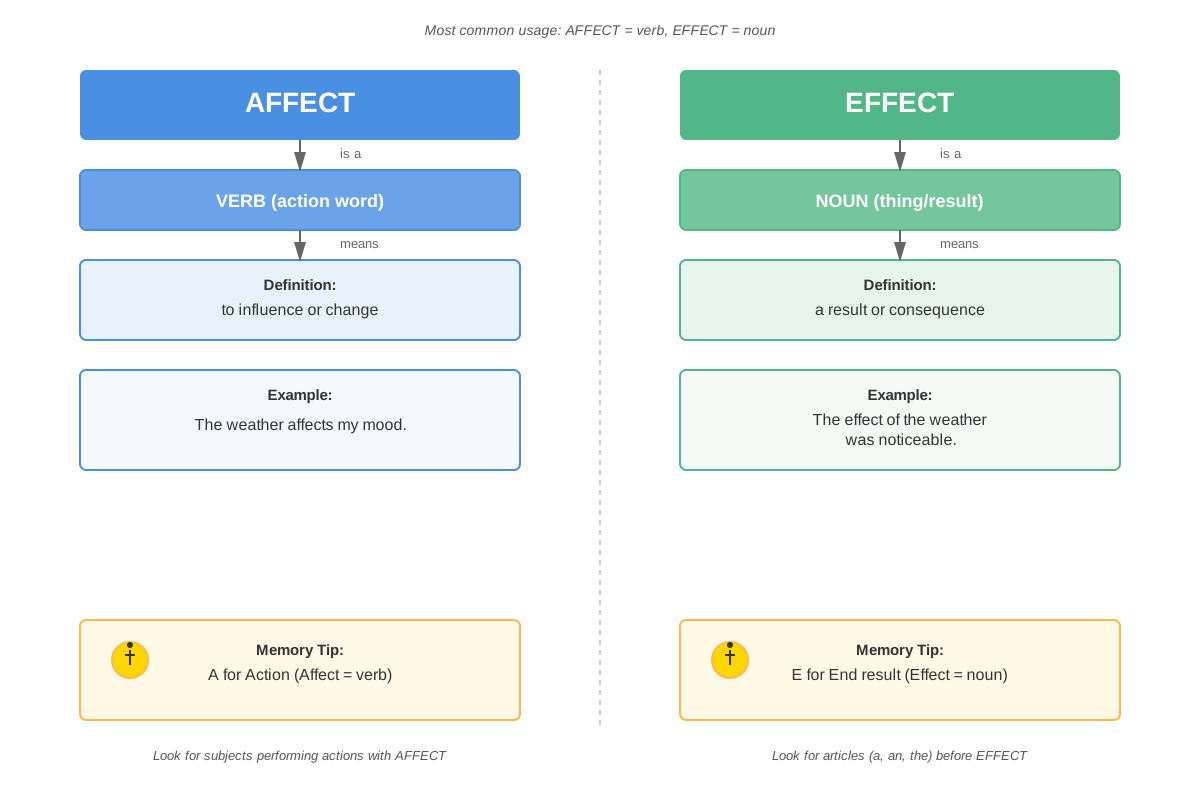
The fundamental rule governing affect vs effect centers on parts of speech. Affect functions primarily as a verb meaning "to influence" or "to produce a change in something." When you affect something, you are acting upon it, causing some alteration or impact. For example: "The new policy will affect student attendance." Here, "affect" serves as the action verb describing what the policy will do.
Effect, in contrast, functions primarily as a noun meaning "a result" or "a consequence." An effect is the outcome that occurs after something has been influenced or changed. For example: "The effect of the new policy was increased attendance." In this sentence, "effect" is the thing being discussed—the result itself.
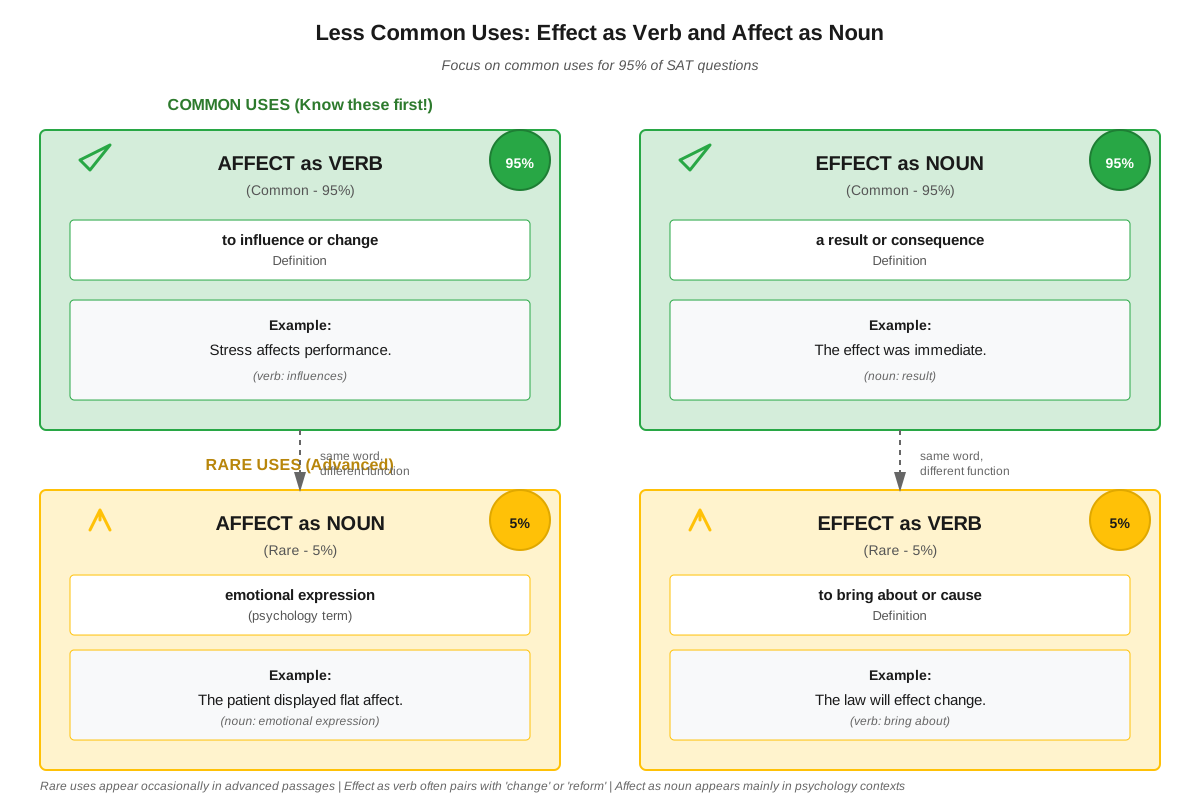
This verb-noun distinction accounts for approximately 95% of all usage cases on the SAT and in standard written English. Students who internalize this primary pattern can answer most questions correctly.
The Less Common Uses
While the primary distinction covers most cases, both words have secondary uses that occasionally appear on the SAT. Effect can function as a verb meaning "to bring about" or "to cause to happen," typically used in formal contexts. For example: "The principal effected significant changes in school policy." This usage means the principal caused or implemented these changes directly.
Affect can function as a noun in psychology, pronounced with emphasis on the first syllable (AFF-ect), referring to observable emotional expression. For example: "The patient displayed a flat affect." This specialized usage rarely appears on the SAT but exists in academic writing.
For SAT purposes, students should focus overwhelmingly on the primary verb-noun distinction while remaining aware that exceptions exist in formal or technical writing.
Contextual Clues for Identification
Several grammatical markers reliably signal which word belongs in a sentence:
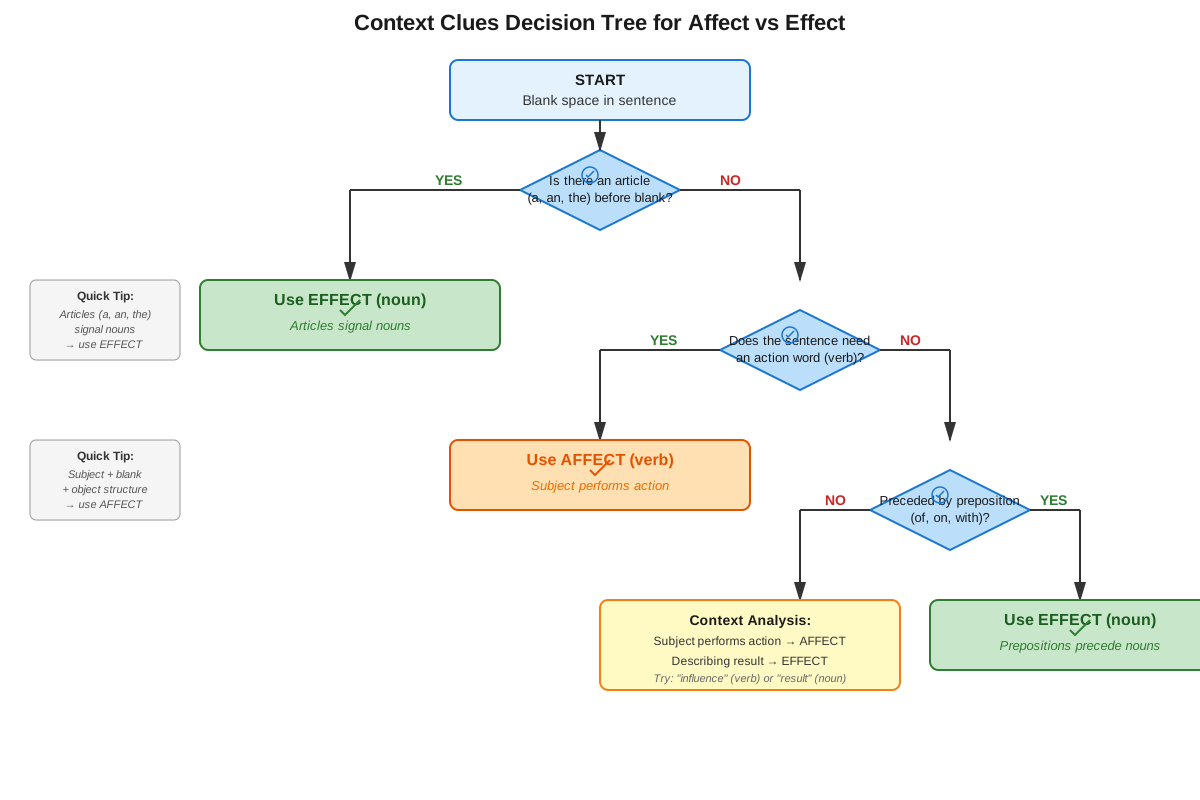
Articles and determiners: Words like "the," "an," "a," "this," "that," "these," and "those" precede nouns. If you see "the ___," you need the noun form: "the effect."
Auxiliary verbs: Words like "will," "can," "should," "must," and "might" precede main verbs. If you see "will ___," you need the verb form: "will affect."
Prepositions: The word "on" frequently appears with "effect" in the phrase "have an effect on," while "affect" stands alone as a verb: "affect the outcome."
Subject-verb agreement: If the word must agree with a subject and show action, use "affect." If the word receives action or serves as the subject itself, use "effect."
Comparison Table
| Feature | Affect (Primary) | Effect (Primary) |
|---|---|---|
| Part of Speech | Verb | Noun |
| Meaning | To influence, to change | A result, a consequence |
| Example Sentence | "Pollution affects air quality." | "Pollution has harmful effects." |
| Common Preceding Words | will, can, may, should, does not | the, an, this, these, negative |
| Question to Ask | "Is this word showing action?" | "Is this word naming a result?" |
| Memory Cue | Affect = Action (verb) | Effect = End result (noun) |
Application Process
When encountering an affect vs effect question on the SAT, follow this systematic approach:
- Identify the blank's grammatical role: Determine whether the sentence needs a verb (action word) or a noun (thing/result).
- Check for grammatical markers: Look for articles, auxiliary verbs, or prepositions that signal part of speech.
- Test the primary meanings: Substitute "influence" for affect and "result" for effect to see which makes logical sense.
- Verify with context: Ensure the chosen word maintains the sentence's intended meaning and grammatical structure.
Concept Relationships
The affect vs effect distinction connects directly to fundamental grammar concepts. Understanding parts of speech serves as the foundation—without recognizing verbs versus nouns, students cannot apply the primary rule. This knowledge builds upon sentence structure analysis, where identifying subjects, predicates, and objects clarifies each word's function.
The relationship flows as follows: Parts of Speech Mastery → Sentence Structure Recognition → Contextual Clue Identification → Correct Word Selection. Each step depends on the previous one, creating a hierarchical skill chain.
This topic also relates to other commonly confused word pairs tested on the SAT, including accept/except, complement/compliment, and principal/principle. The analytical approach used for affect versus effect—identifying grammatical function, checking contextual markers, and verifying meaning—applies equally to these similar challenges. Mastering one word pair strengthens the cognitive framework for handling all such distinctions.
Furthermore, this concept connects to precision in writing, a broader SAT Reading and Writing objective. The test consistently rewards students who select the most precise, grammatically appropriate word rather than a close approximation. This emphasis on exactness appears in vocabulary-in-context questions, transition word selection, and rhetorical synthesis tasks throughout the RW section.
High-Yield Facts
- ⭐ Affect is primarily a verb meaning "to influence" or "to produce a change"
- ⭐ Effect is primarily a noun meaning "a result" or "a consequence"
- ⭐ The phrase "have an effect on" uses the noun form, while "affect the outcome" uses the verb form
- ⭐ Articles (the, an, a) before the blank indicate you need effect (the noun)
- ⭐ Auxiliary verbs (will, can, should) before the blank indicate you need affect (the verb)
- The verb form "effect" means "to bring about" or "to implement" and appears in formal contexts
- The noun form "affect" refers to emotional expression in psychology terminology
- Approximately 95% of SAT questions test the primary verb-noun distinction
- The word "impact" can often substitute for either word, helping verify meaning: "impact" (verb) = affect; "an impact" (noun) = effect
- Negative constructions like "no effect" or "does not affect" follow the same grammatical rules as positive statements
- The phrase "cause and effect" always uses the noun form because it names a relationship
- "Affect" and "effect" are homophones in most dialects, making spelling the only reliable distinction in written text
Quick check — test yourself on Affect vs effect so far.
Try Flashcards →Common Misconceptions
Misconception: "Effect" is always a noun and "affect" is always a verb, with no exceptions.
Correction: While this rule covers 95% of cases, "effect" can function as a verb meaning "to bring about" (as in "effect change"), and "affect" can function as a noun in psychology contexts. However, SAT questions overwhelmingly test the primary uses.
Misconception: You can determine the correct word by how it sounds in the sentence.
Correction: Since affect and effect are homophones (sound identical), auditory judgment is unreliable. Only grammatical analysis and contextual understanding provide accurate guidance.
Misconception: "Impact" is always a safer choice than affect or effect.
Correction: While "impact" can sometimes substitute for these words, the SAT specifically tests whether students know the affect/effect distinction. Avoiding the issue doesn't demonstrate mastery, and "impact" may not fit the sentence's precise meaning or register.
Misconception: If the sentence discusses emotions or feelings, always use "affect."
Correction: Emotional contexts don't automatically require "affect." The grammatical function still determines the correct choice: "The sad movie affected her deeply" (verb) versus "The movie had an emotional effect on her" (noun).
Misconception: The phrase is "take effect" so "take affect" must also be correct.
Correction: "Take effect" is an idiom meaning "to become operative or begin working," using the noun form. There is no equivalent phrase "take affect"—the verb form would be "begin to affect" or simply "affect."
Misconception: Complex scientific or technical passages require the verb form "effect" more often.
Correction: The grammatical function, not the passage's complexity or subject matter, determines the correct word. Technical writing follows the same grammatical rules as other contexts.
Worked Examples
Example 1: Standard Verb-Noun Distinction
Question: Climate scientists have studied how rising ocean temperatures _____ marine ecosystems, documenting significant changes in species distribution and coral reef health.
A) effect
B) affect
C) have effected
D) are having effects on
Step 1 - Identify the grammatical role: The blank comes after "temperatures" (the subject) and before "marine ecosystems" (the object). This position requires a verb that shows what temperatures do to ecosystems.
Step 2 - Check for markers: The word "how" introduces a clause describing an action or process. No article appears before the blank, ruling out a noun.
Step 3 - Test primary meanings: Substitute "influence": "how rising ocean temperatures influence marine ecosystems." This makes logical sense. Substitute "a result": "how rising ocean temperatures a result marine ecosystems." This is grammatically nonsensical.
Step 4 - Verify with context: The sentence describes an ongoing action (what temperatures do), not a result. The verb form is needed.
Answer: B) affect
The verb "affect" correctly shows the action of temperatures influencing ecosystems. Choice A uses the noun form incorrectly. Choice C uses the rare verb form "effected" (meaning "brought about"), which doesn't fit the meaning—temperatures don't implement ecosystems, they influence them. Choice D changes the sentence structure unnecessarily and uses the noun form in a wordy construction.
Example 2: Noun Form with Article
Question: The new traffic regulations had an immediate _____ on commute times, reducing average travel duration by fifteen minutes during peak hours.
A) affect
B) affecting
C) effect
D) effecting
Step 1 - Identify the grammatical role: The blank follows "an immediate" and precedes "on commute times." The article "an" signals that a noun must follow.
Step 2 - Check for markers: The phrase "had an ___" requires a noun to complete the verb phrase. "Had" is the main verb; the blank provides its object.
Step 3 - Test primary meanings: Substitute "result": "had an immediate result on commute times." This works perfectly. Substitute "influence": "had an immediate influence on commute times." While this makes sense conceptually, "influence" is a different word—we need the noun form of our word pair.
Step 4 - Verify with context: The sentence describes the outcome or consequence of regulations, which is precisely what the noun "effect" means.
Answer: C) effect
The noun "effect" correctly names the result produced by the regulations. Choice A uses the verb form, which cannot follow the article "an." Choices B and D use participle forms that don't fit the grammatical structure—"had an affecting" and "had an effecting" are not standard English constructions.
Exam Strategy
When approaching SAT affect vs effect questions, implement this systematic process:
Step 1 - Identify the part of speech needed: Before looking at answer choices, determine whether the blank requires a verb (action) or noun (thing/result). This single step eliminates 50% of options immediately.
Step 2 - Look for grammatical markers: Scan the words immediately before and after the blank. Articles (the, an, a) demand nouns. Auxiliary verbs (will, can, should) demand main verbs. Prepositions often precede nouns.
Step 3 - Apply the primary rule: Use the verb form (affect) for actions and the noun form (effect) for results. This covers the vast majority of SAT questions.
Step 4 - Verify meaning: Substitute "influence" for affect and "result" for effect. The sentence should maintain logical coherence with the correct choice.
Trigger words and phrases to watch for:
- "have an ___ on" → always uses effect (noun)
- "will ___" or "can ___" → always uses affect (verb)
- "the ___ of" → always uses effect (noun)
- "does not ___" → always uses affect (verb)
- "negative ___" or "positive ___" → always uses effect (noun)
Process of elimination tips:
- Eliminate any verb form if an article precedes the blank
- Eliminate any noun form if an auxiliary verb precedes the blank
- Eliminate the rare verb form "effect" unless the sentence clearly means "to implement" or "to bring about"
- Eliminate answer choices that change the sentence's intended meaning, even if grammatically possible
Time allocation: These questions should take 20-30 seconds maximum. If you've internalized the verb-noun distinction, recognition is nearly instantaneous. Spending more than 45 seconds suggests uncertainty about grammatical fundamentals—make your best guess and move forward rather than overthinking.
Exam Tip: If you're uncertain, remember that "effect" as a noun appears far more frequently than "effect" as a verb. When in doubt between two uses of "effect," choose the noun interpretation.
Memory Techniques
The RAVEN Mnemonic:
Remember: Affect is a Verb, Effect is a Noun
This acronym captures the primary distinction in a memorable phrase. Visualize a raven (a smart bird) reminding you of the rule.
The Alphabet Trick:
Affect comes before Effect alphabetically, just as Action (verb) comes before End result (noun) in the cause-and-effect sequence. The action must happen first, then the result follows.
The Article Test:
Mentally insert "the" before the blank. If "the affect" sounds wrong but "the effect" sounds right, you need the noun. If neither sounds right, you probably need the verb.
The Substitution Method:
Create a mental substitution key:
- Affect = "to influence" (both start with vowels)
- Effect = "a result" (both start with vowels)
When you see the blank, substitute these phrases and choose the one that maintains grammatical sense.
Visual Association:
Picture Affect as an Arrow hitting a target (showing action/influence). Picture Effect as the End point or destination (showing result/outcome). The arrow (action) creates the end point (result).
Summary
The affect vs effect distinction represents a high-yield SAT Reading and Writing topic that tests grammatical precision and parts of speech mastery. The primary rule—affect functions as a verb meaning "to influence" while effect functions as a noun meaning "a result"—covers approximately 95% of all usage cases on the exam. Students must identify the grammatical role required by the sentence structure, check for contextual markers like articles and auxiliary verbs, and apply the appropriate word form. While secondary uses exist (effect as a verb meaning "to bring about" and affect as a psychological noun), SAT questions overwhelmingly test the primary distinction. Success requires moving beyond auditory judgment, since these words sound identical, and instead applying systematic grammatical analysis. The analytical framework developed for this word pair transfers to other commonly confused pairs throughout the RW section, making this a foundational skill for achieving top scores.
Key Takeaways
- Affect is primarily a verb (action word) meaning "to influence or change something"
- Effect is primarily a noun (thing word) meaning "a result or consequence"
- Articles (the, an, a) before the blank signal you need the noun form: effect
- Auxiliary verbs (will, can, should) before the blank signal you need the verb form: affect
- The phrase "have an effect on" uses the noun; the phrase "affect the outcome" uses the verb
- Systematic grammatical analysis, not auditory judgment, determines the correct choice
- This distinction appears 1-2 times per SAT administration and represents a high-probability scoring opportunity
Related Topics
Other Commonly Confused Word Pairs: The SAT frequently tests accept/except, complement/compliment, principal/principle, and similar homophones or near-homophones. The analytical approach mastered here—identifying grammatical function and checking contextual markers—applies directly to these challenges.
Parts of Speech Mastery: Deepening understanding of nouns, verbs, adjectives, and adverbs strengthens performance across multiple Standard English Conventions question types, including modifier placement and parallel structure.
Context Clues and Vocabulary in Context: The skill of using surrounding words to determine meaning extends beyond affect/effect to vocabulary questions throughout the Reading and Writing section.
Precision in Word Choice: The SAT rewards students who select the most precise, appropriate word for each context. This broader principle appears in transition word questions, rhetorical synthesis tasks, and style questions.
Mastering affect versus effect builds the grammatical foundation and analytical habits necessary for tackling these related topics with confidence.
Practice CTA
Now that you've mastered the core concepts, grammatical principles, and exam strategies for affect vs effect, it's time to cement your understanding through active practice. Complete the practice questions to test your ability to identify the correct word under timed conditions, just as you'll encounter on test day. Use the flashcards to reinforce the key distinctions and memory techniques until recognition becomes automatic. Remember: every point matters on the SAT, and this high-frequency topic represents a reliable opportunity to demonstrate your command of Standard English Conventions. Approach each practice question systematically, trust the grammatical principles you've learned, and watch your confidence grow. You've got this!
Sign up free to keep reading
Create a free AnvayaPrep account to finish this SAT guide on Affect vs effect — plus flashcards and practice questions.