Overview
Agreement with intervening phrases is one of the most frequently tested grammar concepts in the SAT Reading and Writing section. This topic examines a student's ability to identify the true subject of a sentence and ensure that the verb agrees with it in number, even when modifying phrases or clauses separate the subject from its verb. The SAT deliberately constructs sentences with complex intervening elements—prepositional phrases, relative clauses, appositives, and participial phrases—that can mislead test-takers into selecting verbs that agree with nearby nouns rather than the actual subject.
Mastering this concept is essential because sat agreement with intervening phrases questions appear in approximately 10-15% of all Standard English Conventions questions on the digital SAT. These questions test whether students can mentally "strip away" the intervening material to identify the core subject-verb relationship. The ability to recognize and navigate these structures directly impacts a student's score on the rw (Reading and Writing) section, as agreement errors are among the most common grammatical mistakes the test exploits.
This topic connects fundamentally to broader concepts of sentence structure, clause identification, and grammatical relationships within the Form, Structure, and Sense unit. Understanding subject-verb agreement with intervening phrases builds upon basic agreement principles while preparing students for more complex sentence construction analysis. It also reinforces skills in identifying essential versus non-essential information in sentences—a critical reading comprehension strategy that extends beyond grammar questions into the broader analytical demands of the SAT.
Learning Objectives
- [ ] Identify key features of Agreement with intervening phrases
- [ ] Explain how Agreement with intervening phrases appears on the SAT
- [ ] Apply Agreement with intervening phrases to answer SAT-style questions
- [ ] Distinguish between the grammatical subject and nearby nouns within intervening phrases
- [ ] Recognize common types of intervening structures that create agreement challenges
- [ ] Evaluate multiple verb forms to determine correct agreement in complex sentences
- [ ] Analyze sentence structure to locate the core subject-verb relationship efficiently
Prerequisites
- Basic subject-verb agreement rules: Understanding that singular subjects take singular verbs and plural subjects take plural verbs provides the foundation for recognizing when agreement is violated.
- Parts of speech identification: Recognizing nouns, verbs, prepositions, and pronouns enables students to parse sentence structure and identify which words function as subjects versus modifiers.
- Phrase and clause recognition: Distinguishing between independent clauses, dependent clauses, and phrases helps students identify which elements are intervening and which are essential to the sentence core.
- Singular and plural noun forms: Knowing irregular plural forms and collective nouns prevents confusion when determining whether subjects are singular or plural.
Why This Topic Matters
Subject-verb agreement with intervening phrases reflects real-world writing clarity and precision. In professional, academic, and technical writing, maintaining proper agreement ensures that readers can follow complex ideas without confusion. Writers who master this skill can construct sophisticated sentences with multiple layers of information while maintaining grammatical integrity. This competency signals advanced language proficiency and attention to detail—qualities valued in college-level writing and professional communication.
On the SAT, agreement questions with intervening phrases appear in approximately 2-3 questions per test, making them high-yield content for score improvement. These questions typically appear as Standard English Conventions items where students must select the grammatically correct verb form from four options. The College Board specifically designs these questions to test whether students can identify the true subject despite distracting elements placed between the subject and verb.
Common manifestations in SAT passages include: sentences with prepositional phrases containing plural nouns after singular subjects; relative clauses that interrupt subject-verb pairs; appositive phrases that add descriptive information between subjects and verbs; and participial phrases that modify subjects while containing their own nouns. The test writers deliberately place these structures in contexts where the intervening noun differs in number from the actual subject, creating a trap for students who rely on proximity rather than grammatical analysis.
Core Concepts
The Fundamental Agreement Principle
Agreement with intervening phrases requires that the verb in a sentence matches its subject in number (singular or plural) and person, regardless of any words, phrases, or clauses that appear between them. The core principle states that intervening material does not affect the grammatical relationship between a subject and its verb. Students must mentally isolate the subject-verb pair by temporarily removing or bracketing the intervening elements.
The challenge arises because English word order often places modifying information immediately before the verb, creating a false proximity effect. The human brain naturally associates nearby words, so when a plural noun appears immediately before a verb that should agree with a singular subject, many test-takers incorrectly select the plural verb form. The SAT exploits this cognitive tendency systematically.
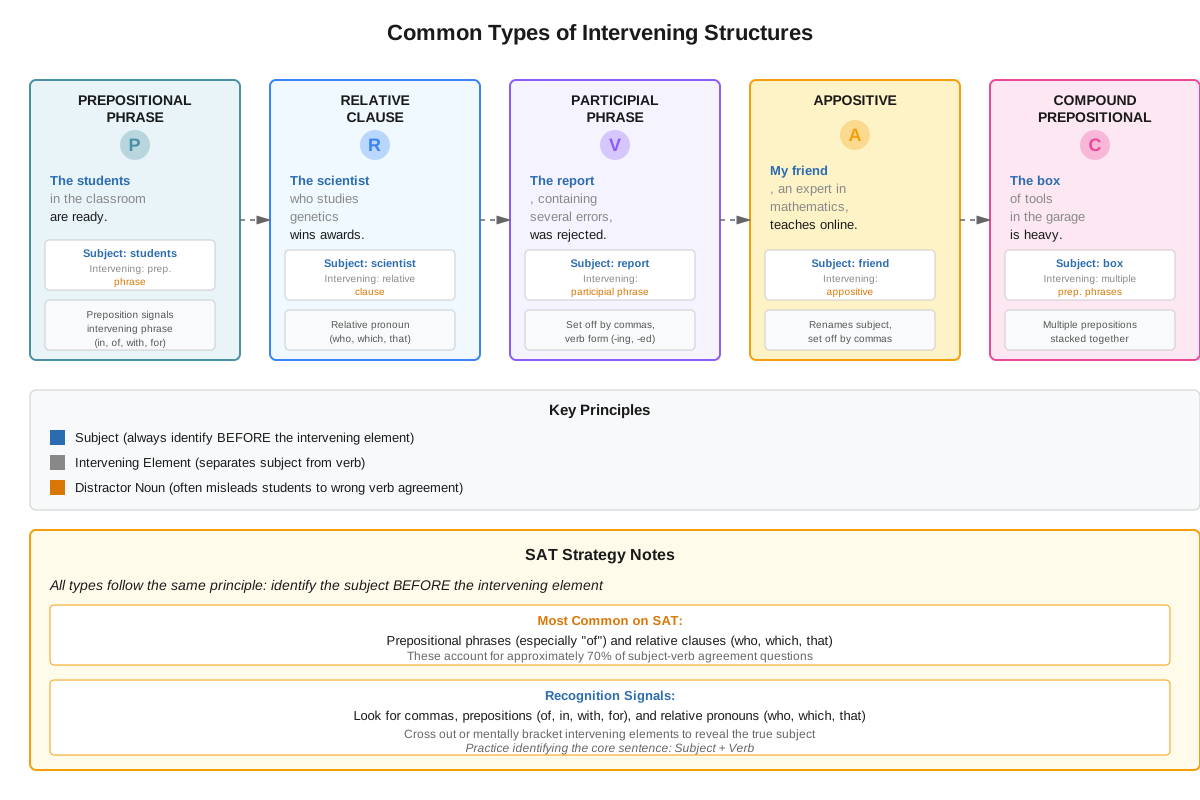
Types of Intervening Phrases
Prepositional Phrases
Prepositional phrases are the most common intervening structures on the SAT. A prepositional phrase begins with a preposition (such as of, in, with, for, between, among) and ends with a noun or pronoun called the object of the preposition. Crucially, the object of a preposition can never be the subject of the sentence.
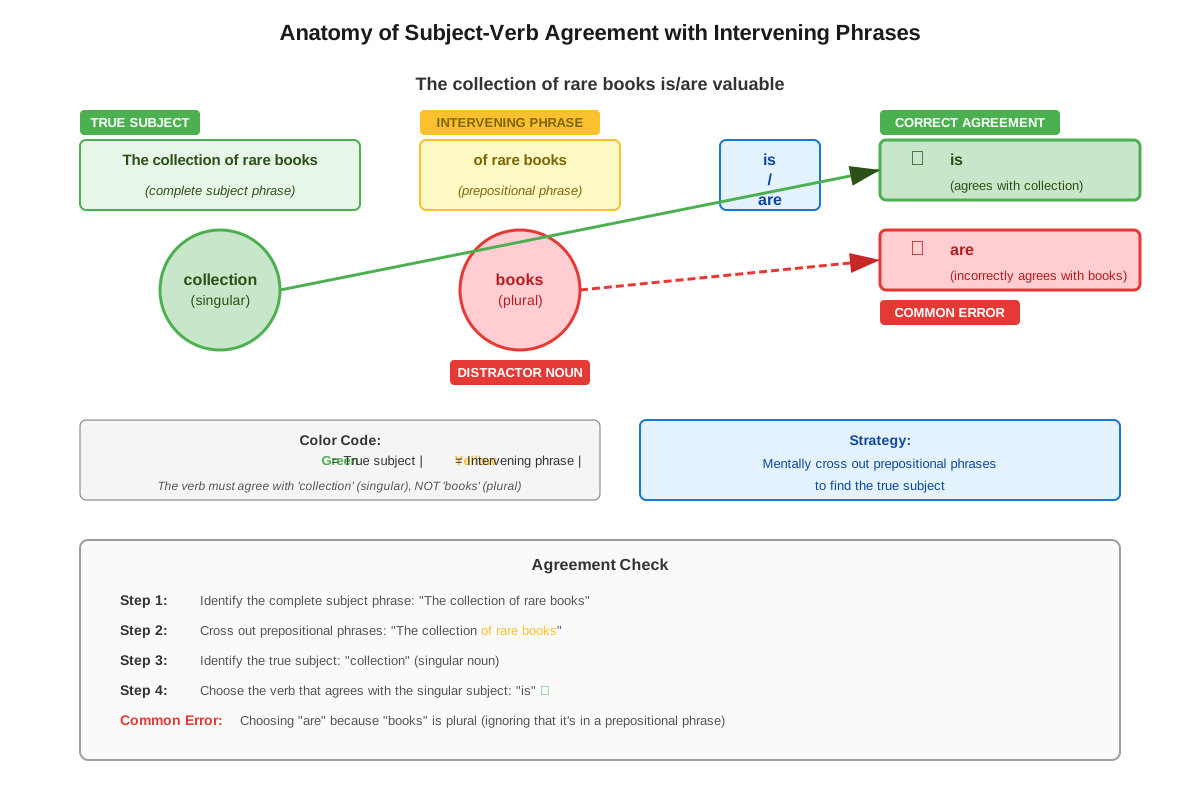
Consider this structure: "The collection of rare stamps is valuable." The subject is "collection" (singular), not "stamps" (plural). The prepositional phrase "of rare stamps" intervenes between the subject and verb. Students who focus on "stamps" might incorrectly choose "are," but the singular "is" correctly agrees with "collection."
Common prepositions that introduce intervening phrases include: of, in, on, at, with, for, from, to, by, about, between, among, through, during, without, within, and throughout.
Relative Clauses
Relative clauses (also called adjective clauses) begin with relative pronouns such as who, whom, whose, which, or that. These clauses provide additional information about a noun but do not change the number of the main subject.
Example: "The scientist who conducts experiments on marine mammals has published extensively." The subject is "scientist" (singular). The relative clause "who conducts experiments on marine mammals" intervenes, but "has" must agree with "scientist," not with "mammals."
Appositive Phrases
An appositive is a noun or noun phrase that renames or provides additional information about another noun. Appositives are typically set off by commas and can create significant distance between subjects and verbs.
Example: "The director, along with her entire production team, was present at the premiere." The subject is "director" (singular). The appositive phrase "along with her entire production team" does not change the subject's number, so "was" is correct, not "were."
Participial Phrases
Participial phrases begin with present participles (-ing forms) or past participles (-ed forms) and function as adjectives. These phrases can contain their own objects and modifiers, creating complex intervening structures.
Example: "The students participating in the advanced mathematics program have demonstrated exceptional aptitude." The subject is "students" (plural). The participial phrase "participating in the advanced mathematics program" intervenes but doesn't affect the plural verb "have."
Subject Identification Strategy
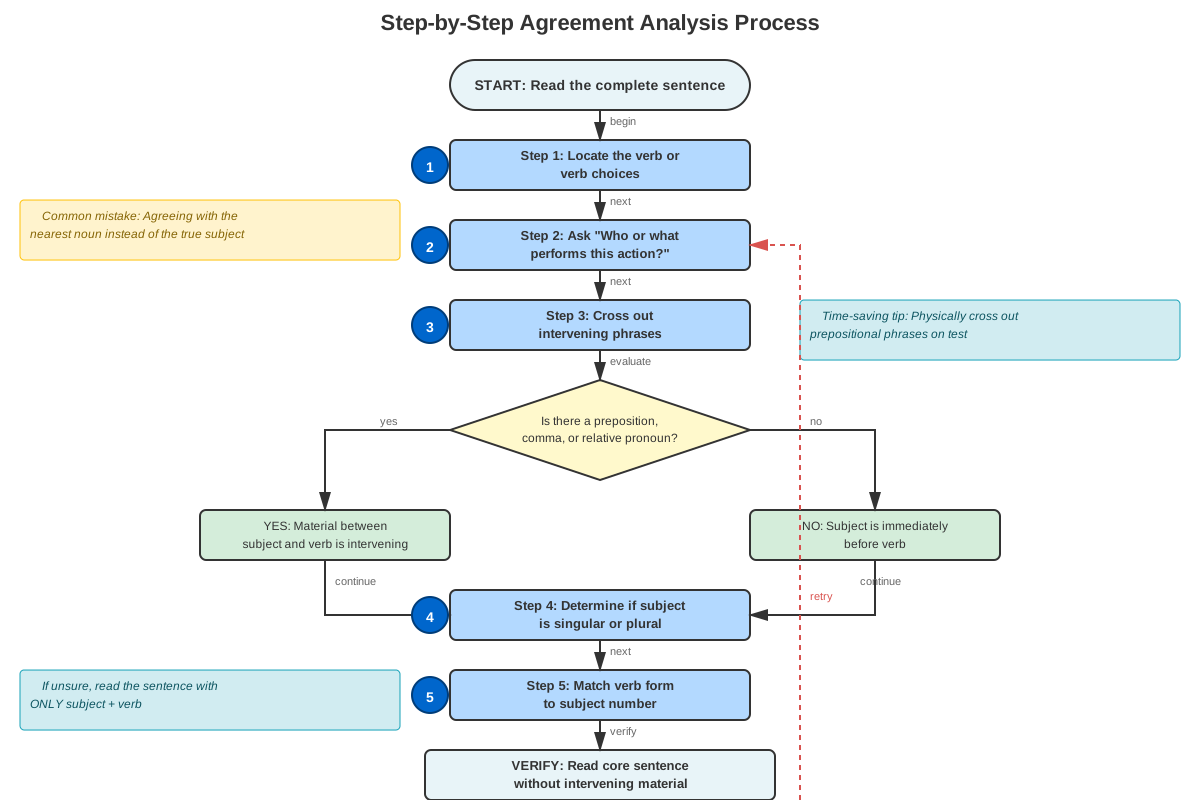
To correctly identify the subject in sentences with intervening phrases, follow this systematic approach:
- Locate the verb: Find the main action or state-of-being word in the sentence
- Ask "who" or "what": Determine what performs the action or exists in that state
- Eliminate prepositional phrases: Cross out or mentally bracket all phrases beginning with prepositions
- Ignore intervening clauses: Temporarily remove relative clauses and other modifying structures
- Verify the core relationship: Confirm that the remaining subject and verb form a logical, grammatically complete pair
Tricky Agreement Scenarios
| Scenario | Example | Correct Verb | Explanation |
|---|---|---|---|
| Compound preposition | The effects of the medication on patients are significant | are | "Effects" is plural; "medication" and "patients" are in prepositional phrases |
| Multiple intervening phrases | The book, despite its numerous errors and questionable sources, remains popular | remains | "Book" is singular; both "despite" phrase and "and" phrase intervene |
| Inverted sentence structure | Among the reasons for the policy change is cost reduction | is | "Cost reduction" is the singular subject; sentence is inverted |
| Collective noun with intervening phrase | The committee of elected representatives votes annually | votes | "Committee" is treated as singular; "of elected representatives" intervenes |
Phrases That Don't Affect Agreement
Certain phrases explicitly do not change the number of the subject, even though they add additional people or things to the sentence. These include phrases beginning with:
- along with
- as well as
- in addition to
- together with
- accompanied by
- including
- besides
- except
Example: "The CEO, together with the board members, has approved the merger." Despite mentioning board members, the subject remains "CEO" (singular), so "has" is correct.
Concept Relationships
The core concepts within agreement with intervening phrases build upon each other hierarchically. The fundamental agreement principle serves as the foundation, establishing that subjects and verbs must match in number regardless of intervening material. This principle leads directly to the need for subject identification strategies, which provide systematic methods for locating the true subject. Understanding types of intervening phrases (prepositional, relative clauses, appositives, participial) enables students to recognize what material to mentally remove when analyzing sentences. Finally, tricky agreement scenarios represent the application of all previous concepts to complex, test-like situations.
This topic connects to prerequisite knowledge of basic subject-verb agreement by adding the complication of intervening elements. It extends to related topics such as pronoun-antecedent agreement (where intervening phrases can similarly obscure the antecedent) and modifier placement (where understanding what modifies what clarifies sentence structure). The skills developed here—mentally parsing sentences into core and modifying elements—transfer directly to reading comprehension, where identifying main ideas versus supporting details follows similar analytical patterns.
Relationship map: Basic Agreement Rules → Subject Identification → Recognition of Intervening Structures → Application to Complex Sentences → Transfer to Pronoun Agreement and Sentence Structure Analysis
High-Yield Facts
⭐ The object of a prepositional phrase can never be the subject of a sentence—always look before the preposition to find the true subject.
⭐ Phrases beginning with "along with," "as well as," "in addition to," and "together with" do not change a singular subject to plural—the verb must still agree with the original subject.
⭐ Relative clauses (beginning with who, which, that) are intervening structures—the verb after the clause must agree with the noun before the clause, not with nouns inside the clause.
⭐ When multiple prepositional phrases appear in sequence, the subject appears before all of them—eliminate all prepositional phrases to find the core subject.
⭐ Inverted sentences place the subject after the verb—in these cases, intervening phrases may appear before the verb, but the subject still determines agreement.
- Appositive phrases, set off by commas or dashes, provide additional information but do not change the subject's number.
- Participial phrases (-ing or -ed phrases) modify nouns but are not part of the core subject-verb relationship.
- Collective nouns (team, committee, group, family) are typically treated as singular in American English, even when followed by prepositional phrases containing plural nouns.
- Compound subjects joined by "and" are plural, but this is different from a singular subject followed by an intervening phrase that mentions additional items.
- The verb "to be" (is/are, was/were) is the most commonly tested verb in agreement questions because its forms clearly distinguish singular from plural.
- Distance between subject and verb does not affect agreement—a subject and verb separated by 15 words must still agree.
- Indefinite pronouns (everyone, somebody, each, either, neither) are singular and remain singular even when followed by prepositional phrases with plural objects.
Quick check — test yourself on Agreement with intervening phrases so far.
Try Flashcards →Common Misconceptions
Misconception: The verb should agree with the noun closest to it.
Correction: The verb must agree with the grammatical subject of the sentence, regardless of proximity. Intervening phrases often place plural nouns near verbs that must remain singular to agree with singular subjects.
Misconception: Phrases like "along with" and "as well as" create compound subjects that require plural verbs.
Correction: These phrases are intervening elements, not conjunctions. Unlike "and," which creates compound subjects, these phrases do not change a singular subject to plural. "The teacher, along with her students, is attending" is correct.
Misconception: If a sentence mentions multiple people or things, the verb should be plural.
Correction: Only the grammatical subject determines verb number. A sentence can mention many plural nouns in prepositional phrases while maintaining a singular subject that requires a singular verb.
Misconception: Collective nouns followed by "of [plural noun]" take plural verbs because the group contains multiple members.
Correction: In American English, collective nouns typically take singular verbs when the group acts as a unit. "The team of players wins consistently" treats the team as a single entity.
Misconception: Long, complex sentences have different agreement rules than short sentences.
Correction: Agreement rules remain constant regardless of sentence length or complexity. Longer sentences simply require more careful analysis to identify the subject-verb pair.
Misconception: Relative clauses change the number of the subject they modify.
Correction: Relative clauses provide additional information but do not alter the grammatical properties of the noun they modify. A singular subject remains singular even when followed by a relative clause containing plural nouns.
Worked Examples
Example 1: Prepositional Phrase Intervention
Question: The collection of ancient manuscripts, some dating back to the 12th century, (is/are) housed in the university's special archives.
Step 1 - Identify the verb options: The choice is between "is" (singular) and "are" (plural).
Step 2 - Locate potential subjects: The sentence contains "collection," "manuscripts," "century," and "archives" as nouns.
Step 3 - Eliminate prepositional phrases:
- "of ancient manuscripts" is a prepositional phrase (begins with "of")
- "to the 12th century" is a prepositional phrase (begins with "to")
- "in the university's special archives" is a prepositional phrase (begins with "in")
Step 4 - Identify the core subject: After removing prepositional phrases, the sentence reads: "The collection... (is/are) housed." The subject is "collection," which is singular.
Step 5 - Apply agreement: A singular subject requires a singular verb.
Answer: "is" is correct. The complete sentence reads: "The collection of ancient manuscripts, some dating back to the 12th century, is housed in the university's special archives."
Connection to learning objectives: This example demonstrates how to identify the key feature of intervening prepositional phrases and apply the agreement principle to select the correct verb form—directly addressing the application objective.
Example 2: Multiple Intervening Structures
Question: The director of the research laboratories, who oversees more than fifty scientists and technicians, (has/have) announced a major breakthrough in renewable energy.
Step 1 - Identify the verb options: The choice is between "has" (singular) and "have" (plural).
Step 2 - Analyze the sentence structure: This sentence contains both a prepositional phrase and a relative clause between the subject and verb.
Step 3 - Eliminate the prepositional phrase: "of the research laboratories" is a prepositional phrase. Removing it gives: "The director... who oversees more than fifty scientists and technicians, (has/have) announced..."
Step 4 - Identify the relative clause: "who oversees more than fifty scientists and technicians" is a relative clause modifying "director." This entire clause is intervening material.
Step 5 - Find the core relationship: After removing both intervening structures: "The director... (has/have) announced a major breakthrough." The subject is "director" (singular).
Step 6 - Check for distractors: The sentence contains "laboratories" (plural), "scientists" (plural), and "technicians" (plural), but all of these appear in intervening structures, not as the main subject.
Step 7 - Apply agreement: A singular subject requires a singular verb.
Answer: "has" is correct. The complete sentence reads: "The director of the research laboratories, who oversees more than fifty scientists and technicians, has announced a major breakthrough in renewable energy."
Connection to learning objectives: This example shows how multiple types of intervening phrases can appear in a single sentence, requiring students to systematically eliminate each type to identify the true subject—demonstrating mastery of both identification and application objectives.
Exam Strategy
When approaching agreement with intervening phrases questions on the SAT, implement this systematic process:
Step 1 - Recognize the question type: Agreement questions typically present a sentence with an underlined verb and ask you to choose the correct form. The answer choices will differ only in verb number (singular vs. plural) or occasionally in tense combined with number.
Step 2 - Locate the verb: Identify which word is the verb that must agree with a subject. This is usually the underlined portion or immediately adjacent to it.
Step 3 - Work backward to find the subject: Starting from the verb, move backward through the sentence asking "who or what performs this action?" Stop when you find a noun that logically performs the action.
Step 4 - Eliminate intervening material: Use your pencil (or the annotation tool on the digital SAT) to bracket or cross out prepositional phrases, relative clauses, and appositive phrases between the subject and verb.
Step 5 - Verify the core sentence: Read the sentence with only the subject and verb to ensure it makes logical sense and sounds grammatically correct.
Trigger words to watch for:
- Prepositions: of, in, with, for, among, between (signal that a phrase is intervening)
- Relative pronouns: who, which, that (introduce clauses that are intervening)
- Commas or dashes: often set off intervening appositive or participial phrases
- Phrases: "along with," "as well as," "in addition to," "together with" (do not create compound subjects)
Process-of-elimination tips:
- If you see a plural noun immediately before the verb but a singular noun earlier in the sentence, the singular noun is likely the subject
- Eliminate answer choices that would agree with nouns inside prepositional phrases rather than the main subject
- When two answer choices differ only in singular vs. plural, focus exclusively on identifying the subject's number
- If the sentence sounds awkward when you read only the subject and verb together, you may have identified the wrong subject
Time allocation: Spend 30-45 seconds on agreement questions. If you cannot identify the subject within 20 seconds, use the elimination strategy: cross out all prepositional phrases and try again. Do not spend more than one minute on any single question.
Exam Tip: On the digital SAT, use the annotation tool to strike through prepositional phrases. This visual strategy helps prevent your eye from being drawn to incorrect nouns when selecting the verb form.
Memory Techniques
Mnemonic for common prepositions (objects of these prepositions cannot be subjects):
"Of In With For Among" - Remember "OIWFA" (Oh, I Won't Fall Again) to recall that phrases beginning with these prepositions are intervening structures.
The Bracket Method: Visualize placing brackets [ ] around any phrase that begins with a preposition or relative pronoun. Everything inside the brackets is "invisible" for agreement purposes. Practice drawing these brackets on practice problems until the mental process becomes automatic.
The "Who/What Does What?" Question: Create a simple three-word question for every sentence: "Who does what?" or "What does what?" The answer to "who" or "what" is your subject; the answer to "does what" is your verb. Everything else is decoration.
The Singular/Plural Hand Signal: When reading a sentence, make a fist for singular subjects and spread your fingers for plural subjects. This kinesthetic reinforcement helps cement the subject's number in your mind before you look at verb choices.
Acronym for phrases that don't create compound subjects: "AWAIT"
- Along with
- With
- As well as
- In addition to
- Together with
These phrases do not change a singular subject to plural, unlike "and."
Visualization strategy: Picture the subject and verb as two magnets that must connect. Intervening phrases are like pieces of paper between the magnets—they create distance but don't affect the magnetic attraction. The magnets (subject and verb) must still match in polarity (number).
Summary
Agreement with intervening phrases is a high-yield SAT grammar concept that tests whether students can identify the true subject of a sentence and ensure the verb agrees with it in number, despite the presence of modifying phrases and clauses between them. The fundamental principle is that prepositional phrases, relative clauses, appositive phrases, and participial phrases do not affect subject-verb agreement—only the grammatical subject determines whether the verb should be singular or plural. Success on these questions requires systematic elimination of intervening material to isolate the core subject-verb relationship. Students must recognize that proximity does not determine agreement; a plural noun immediately before the verb does not make the verb plural if the actual subject is singular. Mastering this concept involves understanding the types of intervening structures, applying a consistent identification strategy, and avoiding common traps such as assuming phrases like "along with" create compound subjects. This skill appears in 2-3 questions per SAT test and directly impacts scores in the Standard English Conventions category.
Key Takeaways
- The verb must agree with the grammatical subject, not with nouns in intervening phrases, regardless of proximity or sentence length
- Prepositional phrases (beginning with of, in, with, for, among, etc.) are the most common intervening structures—their objects can never be the sentence subject
- Phrases like "along with," "as well as," and "in addition to" do not create compound subjects; they are intervening elements that don't change a singular subject to plural
- Systematically eliminate all prepositional phrases and relative clauses to reveal the core subject-verb relationship
- Relative clauses (beginning with who, which, that) and appositive phrases provide additional information but do not change the subject's number
- The SAT deliberately places plural nouns near verbs that must agree with singular subjects to create traps for unwary test-takers
- Practice the "bracket method"—mentally or physically marking intervening phrases—to train your eye to focus on the true subject
Related Topics
Pronoun-Antecedent Agreement: Just as verbs must agree with subjects despite intervening phrases, pronouns must agree with their antecedents even when modifying phrases separate them. Mastering subject-verb agreement with intervening phrases provides the analytical framework for pronoun agreement questions.
Modifier Placement and Dangling Modifiers: Understanding which phrases modify which nouns requires the same sentence-parsing skills used to identify intervening phrases. Recognizing the relationship between modifiers and the words they describe builds on the structural analysis practiced in agreement questions.
Parallel Structure: Complex parallel constructions often include intervening phrases within each parallel element. The ability to identify core structures while ignoring intervening material helps students recognize whether parallel elements maintain consistent grammatical form.
Restrictive vs. Non-Restrictive Clauses: Relative clauses that function as intervening phrases may be either restrictive (essential to meaning) or non-restrictive (additional information). Understanding this distinction deepens comprehension of how intervening structures function within sentences.
Practice CTA
Now that you understand the principles of agreement with intervening phrases, it's time to cement your mastery through active practice. Complete the practice questions associated with this topic, focusing on applying the systematic elimination strategy to each sentence. Use the flashcards to reinforce your recognition of common intervening structures and trigger words. Remember, every practice question you complete strengthens your ability to quickly and accurately identify subjects in complex sentences—a skill that will serve you not only on the SAT but throughout your academic career. Approach each practice item as an opportunity to refine your technique, and review any mistakes carefully to understand where your analysis went astray. You've got this!
Sign up free to keep reading
Create a free AnvayaPrep account to finish this SAT guide on Agreement with intervening phrases — plus flashcards and practice questions.