Overview
Apostrophes are one of the most frequently tested punctuation marks in the SAT Reading and Writing (RW) section, appearing in multiple questions across nearly every test administration. These small but mighty punctuation marks serve two primary functions: showing possession (ownership) and indicating contractions (where letters have been omitted). Despite their straightforward rules, apostrophe questions consistently trip up test-takers because they require distinguishing between similar-sounding words and recognizing subtle grammatical relationships.
On the SAT, apostrophe questions fall within the Standard English Conventions domain, specifically testing a student's ability to recognize correct punctuation usage in context. These questions typically present a sentence with an underlined portion containing a word that may or may not need an apostrophe, followed by four answer choices that include various apostrophe placements or no apostrophe at all. The College Board includes apostrophe questions because they assess both grammatical knowledge and careful reading—skills essential for college-level writing and comprehension.
Mastering apostrophes connects directly to broader concepts in the Form, Structure, and Sense unit. Proper apostrophe usage clarifies meaning, prevents ambiguity, and demonstrates command of standard written English conventions. This topic intersects with noun recognition, pronoun usage, and sentence structure analysis—all critical skills for the SAT Reading and Writing section. Students who master apostrophes gain confidence in punctuation questions overall and develop sharper attention to grammatical detail that benefits performance across multiple question types.
Learning Objectives
- [ ] Identify key features of apostrophes, including their appearance and placement in words
- [ ] Explain how apostrophes appear on the SAT, including question format and common patterns
- [ ] Apply apostrophe rules to answer SAT-style questions accurately and efficiently
- [ ] Distinguish between possessive nouns, contractions, and plural forms without apostrophes
- [ ] Recognize and correct common apostrophe errors in timed testing conditions
- [ ] Evaluate answer choices by systematically eliminating incorrect apostrophe usage
Prerequisites
- Basic noun identification: Recognizing singular and plural nouns is essential because apostrophe placement differs based on whether a noun is singular or plural.
- Understanding of contractions: Familiarity with common contracted forms (it's, they're, who's) helps distinguish them from possessive pronouns.
- Pronoun knowledge: Knowing that possessive pronouns (its, their, whose) never take apostrophes prevents a major category of errors.
- Sentence structure awareness: Identifying the relationship between nouns and what they possess requires understanding basic sentence components.
Why This Topic Matters
Apostrophes represent a high-yield topic for SAT preparation because they appear consistently across test administrations and follow predictable, learnable rules. Unlike some grammar concepts that involve subjective style choices, apostrophe usage follows clear conventions, making these questions highly scorable for prepared students. Statistically, students can expect to encounter 2-4 apostrophe questions per SAT, representing approximately 5-10% of the Standard English Conventions questions.
In real-world applications, correct apostrophe usage demonstrates attention to detail and professionalism in written communication. College professors, employers, and professional contexts all expect proper apostrophe usage. Misplaced or missing apostrophes can change meaning entirely—consider the difference between "the student's books" (one student) and "the students' books" (multiple students)—or create confusion that undermines credibility.
On the SAT, apostrophe questions typically appear in two formats: as standalone Standard English Conventions questions where students must choose the correctly punctuated version of an underlined word, or embedded within longer passages where apostrophe errors must be identified and corrected. The passages span various subjects—science, history, literature, and social studies—but the apostrophe rules remain constant regardless of content. Common scenarios include possessive nouns in historical contexts ("the nation's founding"), scientific descriptions ("the experiment's results"), and literary analysis ("the author's technique").
Core Concepts
Possessive Apostrophes for Singular Nouns
The most fundamental apostrophe rule involves showing possession for singular nouns. To form the possessive of a singular noun, add an apostrophe followed by the letter "s" ('s), regardless of what letter the noun ends with. This rule applies universally: "the dog's collar," "James's book," "the class's assignment," and "the boss's office" all follow this pattern.
The possessive form indicates that something belongs to or is associated with the noun. On the SAT, these constructions appear frequently because they test whether students can distinguish between a possessive noun (requiring 's) and a simple plural (requiring only s with no apostrophe). The key diagnostic question is: "Does something belong to this noun?" If yes, an apostrophe is needed.
Possessive Apostrophes for Plural Nouns
Plural nouns follow different apostrophe rules depending on how they form their plural. For regular plurals ending in "s" (like "students," "teachers," or "countries"), add only an apostrophe after the existing "s" to show possession: "the students' lockers," "the teachers' lounge," "the countries' representatives."
For irregular plurals that don't end in "s" (like "children," "women," "people," "mice"), treat them like singular nouns and add 's: "the children's playground," "the women's rights," "the people's choice." This distinction is heavily tested on the SAT because it requires students to first identify whether a noun is singular or plural, then apply the appropriate rule.
| Noun Type | Example | Possessive Form | SAT Example |
|---|---|---|---|
| Singular | student | student's | The student's essay was excellent. |
| Regular Plural | students | students' | The students' essays were excellent. |
| Irregular Plural | children | children's | The children's books are colorful. |
| Singular ending in s | James | James's | James's presentation impressed everyone. |
Contractions and Apostrophes
Contractions use apostrophes to indicate where letters have been removed when combining two words. Common contractions tested on the SAT include: "it's" (it is/it has), "they're" (they are), "you're" (you are), "who's" (who is/who has), "there's" (there is), and "let's" (let us). The apostrophe marks the exact location where letters were omitted.
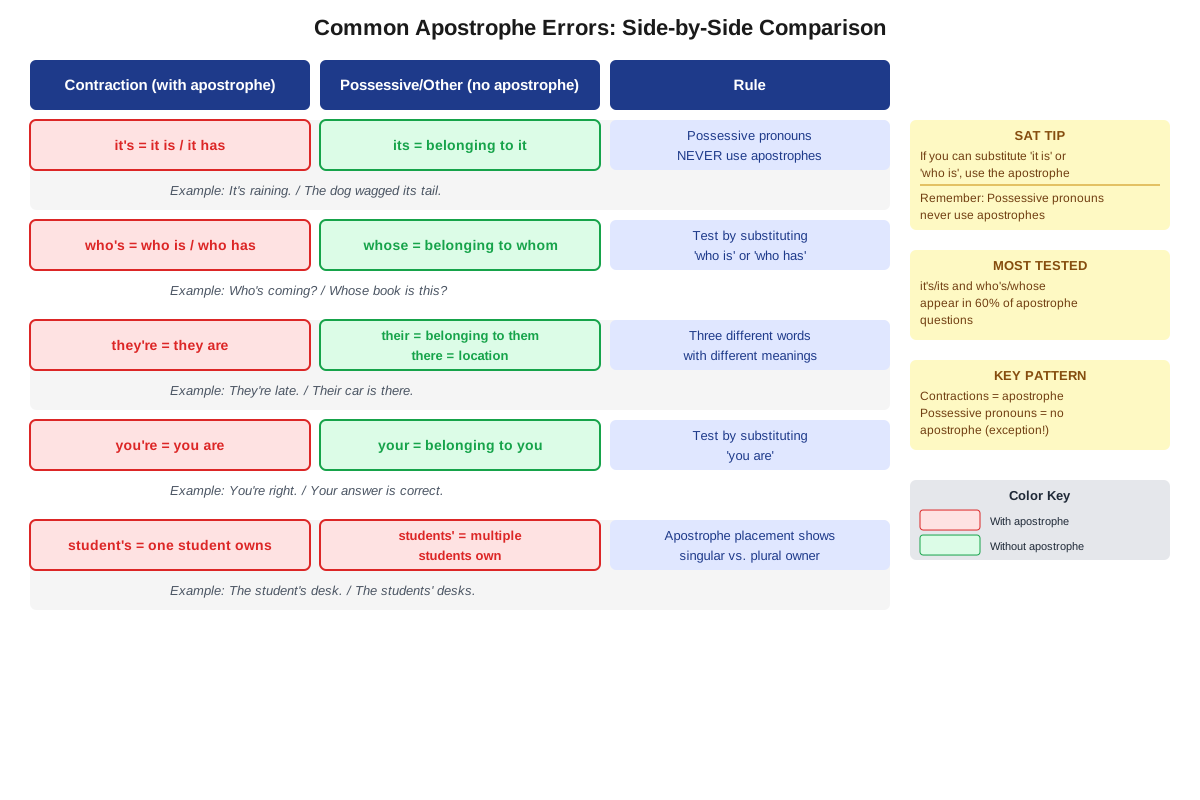
The SAT frequently tests whether students can distinguish between contractions and sound-alike possessive pronouns. This represents one of the highest-yield apostrophe concepts because it appears consistently and follows an absolute rule: possessive pronouns never take apostrophes. The words "its," "their," "your," "whose," and "theirs" are already possessive and never need apostrophes.
The Its/It's Distinction
The its/it's distinction deserves special attention as it represents the single most commonly tested apostrophe concept on the SAT. "It's" is always and only a contraction meaning "it is" or "it has." "Its" is the possessive form of "it," meaning "belonging to it." To determine which form is correct, substitute "it is" or "it has" into the sentence. If the substitution makes sense, use "it's"; if not, use "its."
Example: "The company announced [its/it's] new policy." Substituting: "The company announced it is new policy" makes no sense, so "its" is correct. Conversely: "I think [its/it's] going to rain" becomes "I think it is going to rain," which works, so "it's" is correct.
Plural Forms Without Apostrophes
A critical concept for SAT success is recognizing when not to use apostrophes. Simple plural nouns—words indicating more than one of something—never take apostrophes. "The students walked to class," "Three books sat on the shelf," and "Many countries participated" all use plural forms without apostrophes because nothing is being possessed and no contraction is being formed.
The SAT includes answer choices with incorrect apostrophes in simple plurals specifically to test whether students understand this distinction. Phrases like "apple's for sale" or "many student's" represent common errors that appear as wrong answer choices. The diagnostic question remains: "Is something being possessed, or is this just more than one thing?" If it's just quantity, no apostrophe is needed.
Compound Possessives and Joint Ownership
When multiple nouns share ownership of something, only the last noun takes the possessive form: "Jack and Jill's bucket" indicates one bucket belonging to both. When each noun possesses something separately, both take possessive forms: "Jack's and Jill's buckets" indicates separate buckets. While less commonly tested than basic possessives, these constructions occasionally appear in SAT passages, particularly in historical or literary contexts describing relationships between people or entities.
Time and Money Expressions
Apostrophes appear in expressions involving time and money to show a possessive relationship: "a day's work," "two weeks' notice," "a dollar's worth," "five years' experience." These constructions follow standard possessive rules—singular time periods take 's, plural time periods take s'. The SAT includes these expressions because they test whether students recognize possessive relationships beyond simple ownership of physical objects.
Concept Relationships
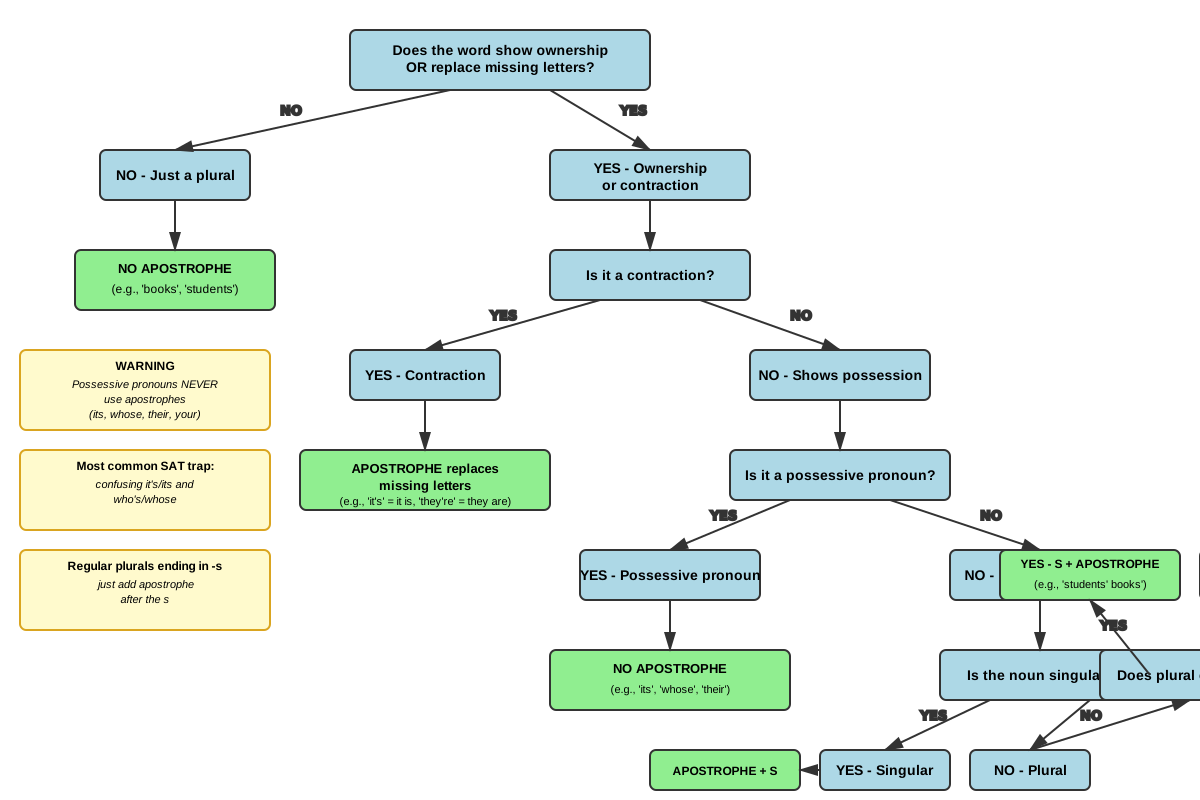
The core apostrophe concepts form an interconnected system where each rule builds upon fundamental grammatical knowledge. Noun identification serves as the foundation → enabling recognition of singular versus plural forms → which determines whether to apply singular possessive rules ('s) or plural possessive rules (s' or 's for irregulars). Simultaneously, contraction recognition branches from understanding word combinations → requiring distinction from sound-alike possessive pronouns → particularly the its/it's distinction that synthesizes both branches.
The relationship between apostrophe usage and broader SAT grammar concepts is equally important. Apostrophe mastery connects to pronoun-antecedent agreement (understanding what "its" refers to), sentence structure analysis (identifying possessive relationships within complex sentences), and meaning in context (determining whether possession or plurality is intended). These connections explain why apostrophe questions often appear in passages where careful reading is required to understand relationships between nouns and their modifiers.
The progression from basic to advanced apostrophe usage follows this path: Simple singular possessives → Regular plural possessives → Irregular plural possessives → Contractions versus possessive pronouns → Compound possessives → Time/money expressions. Each level incorporates previous knowledge while adding complexity, making systematic study essential for complete mastery.
Quick check — test yourself on Apostrophes so far.
Try Flashcards →High-Yield Facts
⭐ Possessive pronouns (its, their, your, whose, theirs) never take apostrophes under any circumstances.
⭐ "It's" always means "it is" or "it has"—if you can't substitute these phrases, use "its" instead.
⭐ Singular nouns form possessives by adding 's, even if they already end in "s" (James's, class's).
⭐ Regular plural nouns ending in "s" form possessives by adding only an apostrophe after the "s" (students', teachers').
⭐ Simple plural nouns indicating quantity never take apostrophes (books, students, countries).
- Irregular plural nouns that don't end in "s" form possessives by adding 's (children's, women's, people's).
- Contractions use apostrophes to mark where letters have been omitted (they're = they are, who's = who is).
- The words "there," "their," and "they're" are completely different: "there" indicates location, "their" shows possession, "they're" means "they are."
- Time and money expressions use possessive forms (a week's time, two dollars' worth, five minutes' delay).
- When testing apostrophe usage, substitute the full form of contractions or ask "does something belong to this noun?" to verify correctness.
- Joint ownership requires only one apostrophe on the final noun (Tom and Jerry's house), while separate ownership requires apostrophes on both (Tom's and Jerry's houses).
- The SAT never tests archaic or highly unusual apostrophe rules—focus on the core patterns that appear consistently.
Common Misconceptions
Misconception: All words ending in "s" need only an apostrophe to show possession. → Correction: Only plural nouns ending in "s" take just an apostrophe (students'). Singular nouns ending in "s" still take 's (James's, class's, boss's).
Misconception: "Its" with an apostrophe is the possessive form because other possessives use apostrophes. → Correction: "Its" is already possessive without an apostrophe. "It's" is exclusively a contraction for "it is" or "it has." Possessive pronouns (its, their, your, whose) never take apostrophes.
Misconception: Plural nouns need apostrophes to show there's more than one. → Correction: Simple plurals never take apostrophes. "The students walked" is correct; "The student's walked" is wrong. Apostrophes show possession or contraction, not plurality.
Misconception: "Who's" and "whose" are interchangeable. → Correction: "Who's" is a contraction meaning "who is" or "who has." "Whose" is possessive, meaning "belonging to whom." Test by substituting "who is"—if it works, use "who's"; if not, use "whose."
Misconception: Apostrophes go before the "s" in all possessive forms. → Correction: Apostrophe placement depends on whether the noun is singular or plural. Singular nouns and irregular plurals take 's (dog's, children's), but regular plurals take s' (dogs', students').
Misconception: Contractions are too informal for the SAT and should always be avoided. → Correction: The SAT tests correct contraction usage, not whether contractions are appropriate. If a passage uses contractions, the correct answer will maintain that style with proper apostrophe placement.
Misconception: Names ending in "s" are exceptions that only take an apostrophe without additional "s." → Correction: Modern standard English adds 's to singular names ending in "s" (James's, Charles's). While older style guides varied, the SAT follows contemporary rules requiring 's for all singular possessives.
Worked Examples
Example 1: Possessive vs. Plural vs. Contraction
Question: The research team published _____ findings after three years of data collection.
A) it's
B) its
C) its'
D) it's'
Solution Process:
Step 1: Identify what the sentence needs. The blank comes before "findings," suggesting a possessive relationship—the findings belong to the research team.
Step 2: Determine what word should fill the blank. The pronoun "it" refers back to "research team," so we need a form of "it."
Step 3: Test "it's" by substituting "it is" or "it has": "The research team published it is findings" makes no grammatical sense. Therefore, "it's" (choice A) is incorrect.
Step 4: Recognize that "its" is the possessive form of "it" and never takes an apostrophe. Choice B is correct.
Step 5: Eliminate choices C and D because possessive pronouns never take apostrophes, and "its'" and "it's'" are not valid forms in English.
Answer: B) its
Connection to Learning Objectives: This example demonstrates the critical its/it's distinction and applies the rule that possessive pronouns never take apostrophes—one of the highest-yield concepts for SAT apostrophe questions.
Example 2: Singular vs. Plural Possessive
Question: The _____ contributions to the field of genetics revolutionized modern medicine.
A) scientist's
B) scientists
C) scientists'
D) scientist
Solution Process:
Step 1: Analyze the sentence structure. "Contributions" is the subject, and something about scientists relates to these contributions.
Step 2: Determine the relationship. The contributions belong to or come from the scientists, indicating a possessive relationship. This eliminates choice D (no possession shown) and choice B (simple plural with no possession).
Step 3: Decide between singular and plural. The sentence says "contributions" (plural) that "revolutionized" (plural verb), suggesting multiple contributions from multiple scientists. The context implies more than one scientist made contributions.
Step 4: Apply the appropriate possessive rule. For plural nouns ending in "s," add only an apostrophe after the "s": scientists'.
Step 5: Verify by reading the complete sentence: "The scientists' contributions" correctly indicates that multiple scientists made contributions.
Answer: C) scientists'
Connection to Learning Objectives: This example requires identifying whether a noun is singular or plural before applying the correct possessive form, demonstrating mastery of the core apostrophe placement rules based on noun number.
Exam Strategy
When approaching SAT apostrophes questions, employ a systematic three-step process: First, identify whether the word in question needs an apostrophe at all by determining if it shows possession or is a contraction. Second, if possession is involved, determine whether the possessing noun is singular or plural. Third, apply the appropriate rule and eliminate answer choices that violate apostrophe conventions.
Trigger words and phrases that signal apostrophe questions include: any word ending in "s" in the underlined portion, possessive pronouns (its, their, whose), common contractions (it's, they're, who's), and time/money expressions (years' experience, dollar's worth). When you see these elements, immediately activate your apostrophe analysis protocol.
Process of elimination is particularly powerful for apostrophe questions because wrong answers often contain clear violations of apostrophe rules. Immediately eliminate: (1) any answer showing possessive pronouns with apostrophes (its', their's, who's when meaning possession), (2) simple plurals with apostrophes when no possession exists (student's meaning multiple students), and (3) contractions where the full form doesn't make grammatical sense.
For its/it's questions specifically, use the substitution test every time: replace the word with "it is" or "it has." If the sentence still makes sense, "it's" is correct; if not, "its" is correct. This mechanical test eliminates ambiguity and works 100% of the time.
Time allocation for apostrophe questions should be brief—these questions typically require 15-30 seconds once you've mastered the rules. If you find yourself spending more than 45 seconds on an apostrophe question, you likely need to review the core concepts. The predictable nature of apostrophe rules means these should be among your fastest, most confident answers.
Exam Tip: When in doubt between two possessive forms, identify whether the possessing noun is singular or plural by looking at context clues in the surrounding sentence. Verbs, pronouns, and other modifiers often reveal whether one or multiple entities are involved.
Memory Techniques
The "It's/Its" Mnemonic: Remember "It's has an apostrophe because it's a contraction—the apostrophe shows something's missing." Conversely, "Its has no apostrophe because possessive pronouns are complete—nothing's missing."
The Possessive Pronoun Rule: Create the acronym "ITTY" for possessive pronouns that never take apostrophes: Its, Their, Theirs, Your, Yours, (plus Whose). None of these words ever need apostrophes.
Singular vs. Plural Possessive Visualization: Picture a single student holding one book with a sign reading "student's book" (apostrophe before s). Then picture multiple students holding books with a sign reading "students' books" (apostrophe after s). The apostrophe's position shows whether one or many possess something.
The Contraction Test Song: Create a mental jingle: "If you can say 'it is,' then it's with apostrophe fits. If you cannot say 'it is,' then its without apostrophe is his." (The rhyme helps cement the substitution test.)
The Plural Rule Reminder: Remember "Plurals are simple—just add S" (no apostrophe). When you see a word that's just indicating "more than one," think "simple plural, simple s, no apostrophe mess."
Summary
Apostrophes serve two primary functions on the SAT: showing possession and indicating contractions. Mastery requires understanding that singular nouns form possessives with 's, regular plural nouns ending in "s" form possessives with s', and irregular plurals form possessives with 's. The critical distinction between contractions (it's, they're, who's) and possessive pronouns (its, their, whose) represents the highest-yield concept, with the its/it's difference appearing most frequently. Simple plural nouns never take apostrophes—they indicate quantity, not possession. Success on SAT apostrophe questions depends on systematically identifying whether a word shows possession or contraction, determining if possessing nouns are singular or plural, and applying the appropriate rule. The substitution test for contractions (replacing "it's" with "it is") provides a foolproof verification method. These questions are highly scorable because they follow absolute rules without subjective interpretation, making them essential targets for score improvement in the Reading and Writing section.
Key Takeaways
- Possessive pronouns (its, their, your, whose) never take apostrophes; contractions (it's, they're, you're, who's) always do
- Singular possessives always use 's regardless of the noun's ending letter (student's, James's, class's)
- Regular plural possessives use s' (students', teachers'), while irregular plural possessives use 's (children's, women's)
- Simple plurals indicating quantity never take apostrophes (books, students, countries)
- The substitution test for "it's" (replace with "it is" or "it has") works 100% of the time to determine correct usage
- Apostrophe questions are highly predictable and follow absolute rules, making them among the most scorable grammar questions on the SAT
- Context clues in surrounding sentences reveal whether nouns are singular or plural, guiding correct apostrophe placement
Related Topics
Pronoun-Antecedent Agreement: Understanding what pronouns refer to helps determine whether possessive forms are singular or plural, directly supporting apostrophe usage decisions. Mastering apostrophes strengthens overall pronoun skills.
Subject-Verb Agreement: Identifying whether subjects are singular or plural—the same skill needed for apostrophe placement—transfers directly to ensuring verbs match their subjects in number.
Comma Usage and Punctuation: Apostrophes represent one component of broader punctuation mastery. Students who understand apostrophe rules often find other punctuation concepts more accessible.
Modifier Placement: Possessive constructions function as modifiers, so understanding apostrophes connects to recognizing how descriptive elements relate to the nouns they modify.
Standard English Conventions: Apostrophes fall within the larger category of grammar rules tested on the SAT. Mastery here builds confidence for tackling other convention questions involving verb tense, pronoun case, and sentence structure.
Practice CTA
Now that you've mastered the core concepts of apostrophe usage, it's time to cement your knowledge through active practice. Complete the practice questions to test your ability to identify correct apostrophe usage under timed conditions, and use the flashcards to reinforce the key distinctions between possessives, contractions, and plurals. Remember: apostrophe questions are among the most predictable and scorable on the SAT—consistent practice transforms these from potential stumbling blocks into reliable points. Every apostrophe question you answer correctly moves you closer to your target score!
Sign up free to keep reading
Create a free AnvayaPrep account to finish this SAT guide on Apostrophes — plus flashcards and practice questions.