Overview
Collective nouns represent one of the most frequently tested grammatical concepts in the SAT Reading and Writing section, appearing in questions that assess subject-verb agreement and pronoun-antecedent agreement. A collective noun is a singular word that refers to a group of people, animals, or things functioning as a single unit—examples include "team," "committee," "family," "jury," and "audience." The challenge for test-takers lies in determining whether these nouns should be treated as singular or plural, which depends on whether the group is acting as one unified entity or as individual members performing separate actions.
Understanding collective nouns is essential for SAT success because these questions appear with remarkable consistency across test administrations. The College Board specifically targets this concept because it reveals a student's command of formal written English and their ability to recognize subtle distinctions in meaning. Questions involving collective nouns typically appear in the Standard English Conventions domain, where students must identify and correct errors in grammar, usage, and punctuation. These questions often present sentences where the verb or pronoun must agree with a collective noun, requiring students to analyze context carefully to determine the intended meaning.
Within the broader framework of Form, Structure, and Sense, collective nouns connect directly to agreement principles, sentence structure, and the relationship between grammatical form and semantic meaning. Mastering this topic strengthens overall command of subject-verb agreement, pronoun reference, and the ability to analyze how context determines grammatical choices. Success with collective nouns also builds the analytical skills necessary for tackling more complex agreement scenarios involving compound subjects, indefinite pronouns, and inverted sentence structures that appear throughout the RW section.
Learning Objectives
- [ ] Identify key features of collective nouns and distinguish them from regular plural nouns
- [ ] Explain how collective nouns appears on the SAT in agreement questions and context-dependent scenarios
- [ ] Apply collective nouns to answer SAT-style questions with accuracy and confidence
- [ ] Determine whether a collective noun requires singular or plural agreement based on contextual clues
- [ ] Recognize common collective nouns that frequently appear in SAT passages and questions
- [ ] Analyze pronoun-antecedent agreement when collective nouns serve as antecedents
- [ ] Evaluate sentence meaning to select appropriate verb forms with collective nouns
Prerequisites
- Basic subject-verb agreement rules: Understanding that singular subjects take singular verbs and plural subjects take plural verbs provides the foundation for determining how collective nouns function in sentences
- Parts of speech identification: Recognizing nouns, verbs, and pronouns enables students to identify the grammatical relationships that collective noun questions test
- Sentence structure fundamentals: Knowing how to locate the subject and main verb in a sentence is essential for analyzing agreement patterns with collective nouns
- Pronoun-antecedent agreement basics: Understanding that pronouns must agree with their antecedents in number helps when collective nouns serve as antecedents
Why This Topic Matters
Collective nouns appear in approximately 8-12% of Standard English Conventions questions on the SAT, making them a high-yield topic that directly impacts scores. The College Board consistently includes 1-2 questions per test that specifically assess understanding of collective noun agreement, and several additional questions may involve collective nouns as part of more complex agreement scenarios. These questions are particularly valuable because they are highly predictable—once students master the underlying principles, they can answer these questions quickly and accurately, building confidence and saving time for more challenging items.
In real-world writing and professional communication, proper handling of collective nouns demonstrates linguistic sophistication and attention to detail. Academic writing, business correspondence, and formal publications all require writers to make deliberate choices about collective noun agreement based on intended meaning. News organizations, for example, follow specific style guidelines about whether to treat collective nouns as singular or plural, and understanding these conventions helps students become more effective communicators across contexts.
On the SAT, collective noun questions typically appear in two formats: error identification questions where students must recognize incorrect agreement, and revision questions where students must select the grammatically correct option from multiple choices. These questions often embed collective nouns in complex sentences with multiple clauses, prepositional phrases, or intervening words designed to distract from the true subject. Passages may come from various domains—science, humanities, social studies, or literature—but the grammatical principle remains constant, making this a universally applicable skill across all SAT collective nouns question types.
Core Concepts
Definition and Characteristics of Collective Nouns
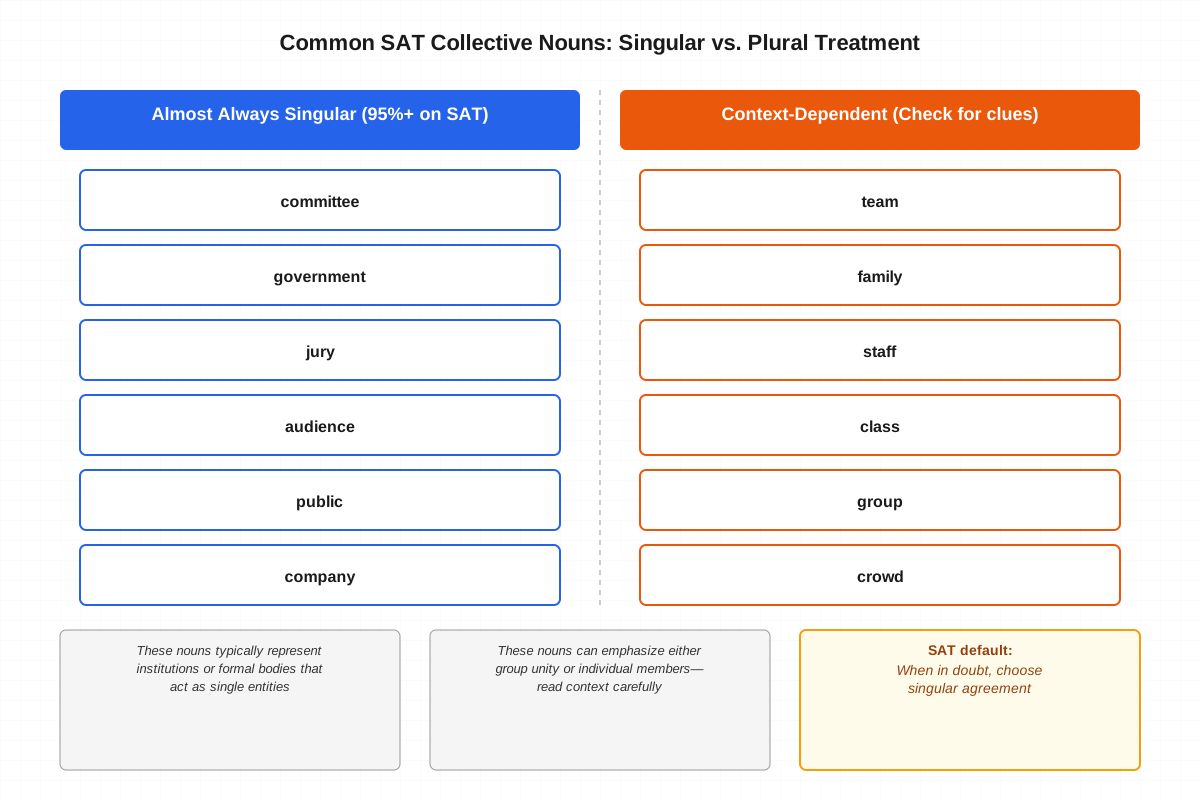
A collective noun is a singular noun that denotes a group of individuals, animals, or objects considered as a single unit. Unlike regular plural nouns that refer to multiple separate entities, collective nouns use singular form to represent multiple members functioning together. Common examples include: team, committee, family, jury, audience, staff, faculty, government, company, orchestra, herd, flock, and class.
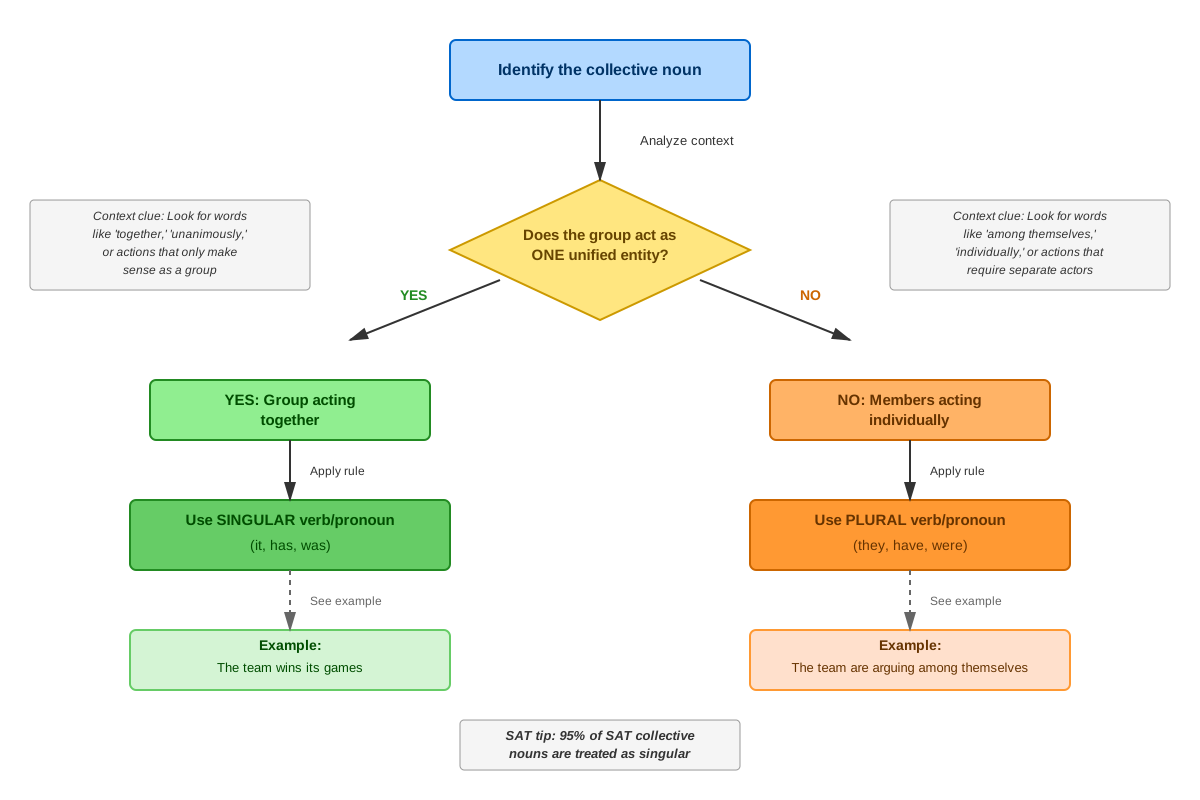
The defining characteristic of collective nouns is their dual nature: they are grammatically singular (one team, one committee) but semantically plural (composed of multiple members). This duality creates the complexity that the SAT tests. The key principle is that collective nouns take singular verbs and pronouns when the group acts as a unified whole, but they take plural verbs and pronouns when emphasis falls on individual members acting separately.
American vs. British English Conventions
Understanding the distinction between American and British English conventions is crucial for SAT success. The SAT follows American English conventions, which strongly prefer treating collective nouns as singular in most contexts. In American English, sentences like "The team is winning" and "The committee has decided" are standard. British English, by contrast, more frequently treats collective nouns as plural ("The team are winning"), but this usage is considered incorrect on the SAT.
| Feature | American English (SAT Standard) | British English (Not SAT Standard) |
|---|---|---|
| Default treatment | Singular | Often plural |
| Example | The jury has reached a verdict | The jury have reached a verdict |
| Pronoun reference | The team celebrated its victory | The team celebrated their victory |
| Consistency | Strongly preferred | Less rigid |
Singular Treatment: The Default Rule
In the vast majority of SAT questions, collective nouns should be treated as singular entities. This means they pair with singular verbs (is, has, was, does) and singular pronouns (it, its). The singular treatment applies when the sentence emphasizes the group acting as one cohesive unit with a shared purpose or unified action.
Examples of correct singular treatment:
- The orchestra performs every Friday evening
- The committee has submitted its final report
- The family is moving to a new city
- The jury was sequestered during deliberation
The singular treatment is the safe default assumption on the SAT unless clear contextual evidence indicates that individual members are acting independently.
Plural Treatment: The Exception
Collective nouns take plural verbs and pronouns when the sentence explicitly emphasizes individual members of the group acting separately, with different actions, opinions, or characteristics. This usage is less common on the SAT but does appear, making it essential to recognize the contextual clues that signal plural treatment.
Examples of correct plural treatment:
- The jury were divided in their opinions (individual jurors held different views)
- The committee have submitted their individual reports (separate reports from different members)
- The team are traveling to their respective homes (each member going to a different location)
Key indicators for plural treatment include:
- Words emphasizing individuality: "individual," "respective," "different," "separate"
- Actions that logically cannot be performed collectively
- Explicit reference to disagreement or division within the group
- Possessive pronouns referring to multiple separate possessions
Subject-Verb Agreement with Collective Nouns
Subject-verb agreement questions represent the most common way collective nouns appear on the SAT. Students must identify whether the verb form matches the intended meaning of the collective noun. The challenge increases when intervening phrases separate the subject from the verb, creating opportunities for distraction.
Process for determining correct agreement:
- Identify the collective noun serving as the subject
- Analyze the context to determine if the group acts as one unit (singular) or as individuals (plural)
- Eliminate intervening phrases that might distract from the true subject
- Select the verb form that matches the determined number
- Verify that the entire sentence maintains consistent treatment
Example analysis:
"The committee of experienced researchers [has/have] published its findings."
- Subject: "committee" (collective noun)
- Intervening phrase: "of experienced researchers" (can be mentally removed)
- Context: publishing findings is a unified group action
- Correct answer: "has" (singular verb)
- Confirmation: "its findings" maintains singular consistency
Pronoun-Antecedent Agreement with Collective Nouns
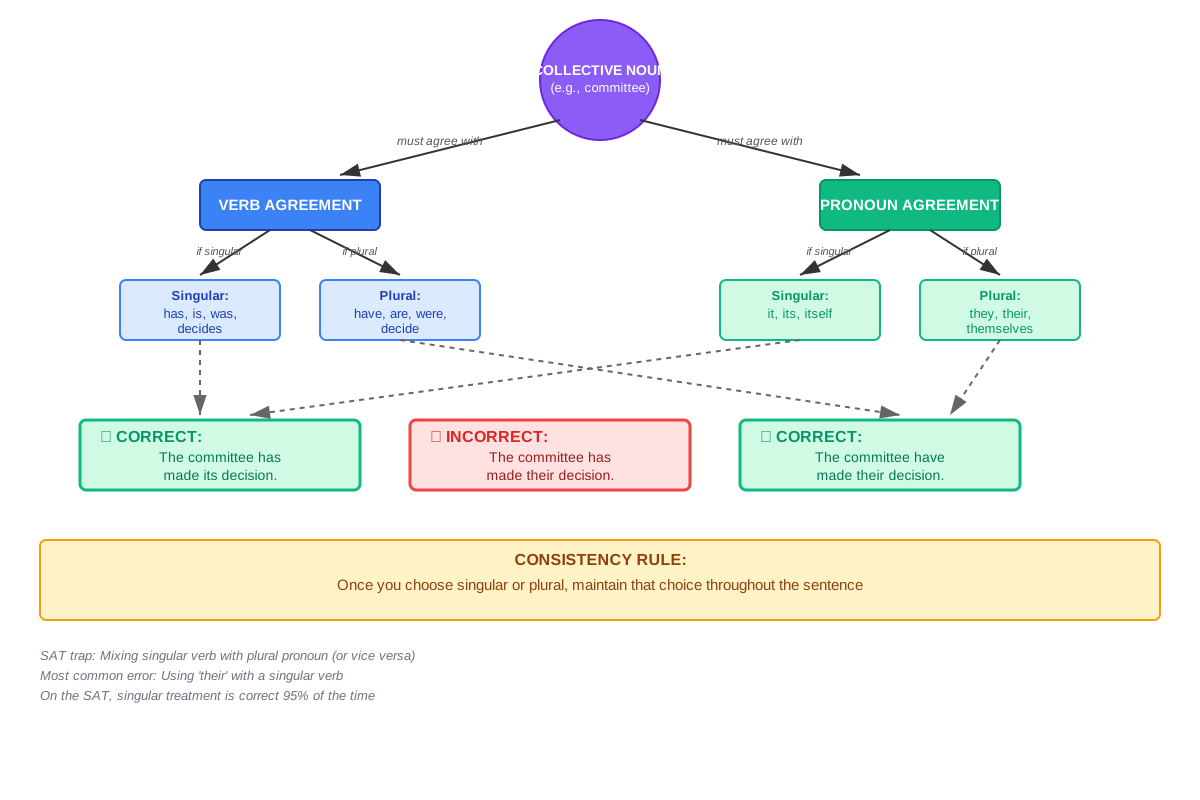
When collective nouns serve as antecedents for pronouns, the same singular/plural principle applies. The pronoun must match the number treatment established for the collective noun. Consistency throughout the sentence is crucial—mixing singular and plural references to the same collective noun is always incorrect on the SAT.
Correct consistent usage:
- The company announced its merger plans, and it expects shareholder approval
- The orchestra performed its final concert before it disbanded
Incorrect inconsistent usage:
- ❌ The team celebrated its victory, and they thanked the fans
- ❌ The jury reached their verdict after it deliberated for six hours
Common Collective Nouns on the SAT
Certain collective nouns appear with greater frequency on the SAT. Familiarity with these high-yield terms enables faster recognition and analysis:
Organizations and groups: committee, board, council, commission, panel, staff, faculty, administration, government, congress, parliament
Family and social units: family, couple, pair, group, crowd, audience, public
Professional and academic: team, crew, cast, band, orchestra, choir, class, student body
Business entities: company, corporation, firm, business, organization, association
Animal groups: herd, flock, pack, swarm, school (of fish)
Concept Relationships
The concept of collective nouns connects directly to the broader principle of subject-verb agreement, serving as a specialized application that requires contextual analysis beyond simple singular/plural identification. While basic subject-verb agreement relies on identifying whether a subject is singular or plural based on form, collective nouns demand that students analyze meaning and context to determine the appropriate treatment.
Collective nouns → require analysis of → contextual meaning → which determines → singular or plural treatment → which governs → verb form selection and pronoun choice
This topic also connects to pronoun-antecedent agreement, as collective nouns frequently serve as antecedents requiring pronoun reference. The consistency principle links these concepts: once a collective noun's number is established through verb choice, all subsequent pronouns must maintain that same number throughout the sentence or passage.
The relationship to American English conventions distinguishes SAT collective noun usage from informal speech or British English, where plural treatment is more common. Understanding this relationship helps students override intuitions based on conversational English and apply formal written standards.
Finally, collective nouns relate to sentence structure analysis because SAT questions often embed collective nouns in complex sentences with intervening phrases, relative clauses, or compound structures designed to obscure the subject-verb relationship. Success requires the ability to identify the core subject and verb while mentally eliminating distracting elements.
Quick check — test yourself on Collective nouns so far.
Try Flashcards →High-Yield Facts
⭐ Collective nouns are treated as singular in American English (SAT standard) unless context explicitly emphasizes individual members acting separately
⭐ The most common collective nouns on the SAT include: team, committee, family, jury, audience, staff, company, and government
⭐ Singular collective nouns pair with singular verbs (is, has, was) and singular pronouns (it, its)
⭐ Consistency is mandatory—never mix singular and plural references to the same collective noun within a sentence
⭐ Intervening prepositional phrases (like "of the members") do not change the number of the collective noun subject
- Plural treatment requires explicit contextual clues such as "individual," "respective," "divided," or "separate"
- The phrase "a number of" is plural, while "the number of" is singular (though these are not collective nouns, they often appear in similar questions)
- Collective nouns maintain their singular form even when referring to large groups (one committee of 50 people is still singular)
- British English conventions that treat collective nouns as plural are incorrect on the SAT
- When in doubt, default to singular treatment—it is correct in approximately 85-90% of SAT collective noun questions
Common Misconceptions
Misconception: Collective nouns are always plural because they refer to multiple people or things → Correction: Collective nouns are grammatically singular in American English when the group acts as one unit, regardless of how many individuals comprise the group. The SAT tests the grammatical number, not the semantic plurality.
Misconception: If a collective noun is followed by "of [plural noun]," the verb should be plural to match the plural noun → Correction: Intervening prepositional phrases do not determine verb agreement. In "The committee of researchers has decided," the subject is "committee" (singular), not "researchers." The verb must agree with the actual subject, not with objects of prepositions.
Misconception: Using "they/their" with collective nouns is always acceptable because it sounds natural in conversation → Correction: While increasingly common in informal speech, the SAT requires formal written English standards where collective nouns take singular pronouns (it/its) unless context explicitly demands plural treatment. Conversational usage does not determine SAT correctness.
Misconception: All collective nouns can be treated as either singular or plural based on personal preference → Correction: The choice between singular and plural treatment is determined by context and meaning, not preference. The sentence's emphasis on unified action versus individual actions dictates the correct grammatical treatment.
Misconception: Once a collective noun is treated as plural in one part of a sentence, it can be treated as singular in another part → Correction: Consistency is absolute. If a collective noun takes a plural verb, all pronouns referring to it must also be plural. Mixing singular and plural references to the same collective noun is always incorrect on the SAT.
Misconception: Collective nouns like "police" and "people" follow the same rules as "team" and "committee" → Correction: Words like "police" and "people" are actually plural nouns, not collective nouns, and always take plural verbs. True collective nouns have singular form but can take singular or plural agreement based on context.
Worked Examples
Example 1: Subject-Verb Agreement with Intervening Phrase
Question: The committee of distinguished scientists [has/have] announced its breakthrough discovery in renewable energy technology.
Step 1 - Identify the subject: The subject is "committee," which is a collective noun. The phrase "of distinguished scientists" is a prepositional phrase that modifies "committee" but does not change its number.
Step 2 - Analyze the context: The sentence describes the committee making an announcement as a unified group. There is no indication that individual scientists are acting separately. The unified action of "announcing" a single "breakthrough discovery" signals collective action.
Step 3 - Determine singular or plural treatment: Because the committee acts as one unit, singular treatment is appropriate.
Step 4 - Check for consistency: The pronoun "its" later in the sentence confirms singular treatment, maintaining consistency.
Step 5 - Select the correct verb: "Has" is the singular verb form that agrees with the singular collective noun "committee."
Answer: has
Key takeaway: Intervening prepositional phrases are distractors. Always identify the true subject and ignore modifying phrases when determining agreement.
Example 2: Pronoun-Antecedent Agreement with Context Clues
Question: The jury was sequestered during the trial, and after three days of deliberation, [it/they] reached a unanimous verdict.
Step 1 - Identify the antecedent: The antecedent is "jury," a collective noun that appears earlier in the sentence.
Step 2 - Analyze established agreement: The verb "was sequestered" is singular, establishing that the jury is being treated as a single unit. This creates an expectation of consistency.
Step 3 - Examine the context of the pronoun: The phrase "reached a unanimous verdict" describes a unified decision by the jury acting as one body. "Unanimous" specifically indicates collective agreement, not individual actions.
Step 4 - Apply consistency principle: Since the jury was treated as singular with "was," and the context emphasizes unified action, the pronoun must also be singular.
Step 5 - Evaluate both options: "It" maintains singular consistency and matches the collective action. "They" would be inconsistent with the earlier singular verb and would incorrectly emphasize individual jurors rather than the unified body.
Answer: it
Key takeaway: Once a collective noun's number is established through verb choice, maintain that same number throughout the sentence. Words like "unanimous" signal collective action requiring singular treatment.
Example 3: Recognizing Plural Treatment Context
Question: After the performance, the cast [was/were] traveling to their respective homes in different cities across the country.
Step 1 - Identify the subject: "Cast" is a collective noun referring to the group of performers.
Step 2 - Analyze the context carefully: The phrase "their respective homes in different cities" explicitly emphasizes that individual cast members are going to different locations. This is not a unified action but rather multiple separate actions by individual members.
Step 3 - Identify plural treatment indicators: "Respective" is a key word that signals individual, separate actions. "Different cities" reinforces that each person is doing something different.
Step 4 - Determine appropriate treatment: Because the emphasis is on individual members acting separately, plural treatment is required.
Step 5 - Verify consistency: The pronoun "their" confirms plural treatment, so the verb must also be plural.
Answer: were
Key takeaway: Watch for explicit indicators of individual action such as "respective," "individual," "different," or "separate." These words signal the rare cases where collective nouns take plural agreement on the SAT.
Exam Strategy
When approaching SAT collective nouns questions, employ a systematic strategy that minimizes errors and maximizes efficiency. First, quickly scan the sentence to identify any collective nouns—look for words like team, committee, family, jury, staff, or company. Once identified, immediately check whether the question involves verb agreement, pronoun agreement, or both.
Trigger words and phrases to watch for:
- Collective nouns themselves: team, committee, family, jury, audience, staff, company, government, class, group
- Plural treatment indicators: "respective," "individual," "separate," "different," "divided," "disagree"
- Intervening phrases: "of the [plural noun]" between subject and verb
- Consistency markers: pronouns (it/its vs. they/their) that must match the collective noun's treatment
Process-of-elimination approach:
- Eliminate any option that creates inconsistency (mixing singular and plural references to the same collective noun)
- Remove options that follow British English conventions (treating collective nouns as plural without contextual justification)
- Eliminate choices where the verb agrees with a word in an intervening phrase rather than the actual subject
- When two options remain, default to singular treatment unless explicit context demands plural
Time allocation: Collective noun questions should take 20-30 seconds once you recognize the pattern. Spend 5-10 seconds identifying the collective noun and analyzing context, then 10-15 seconds applying the agreement rule and checking consistency. If a question takes longer than 45 seconds, mark it for review and move on—these questions follow predictable patterns, so extended deliberation rarely helps.
Exam Tip: If you're uncertain whether a collective noun should be singular or plural, choose singular. Approximately 85-90% of SAT collective noun questions require singular treatment, making it the statistically safer choice when context is ambiguous.
Common trap patterns:
- Placing plural nouns in prepositional phrases near collective nouns to tempt incorrect plural agreement
- Using collective nouns in complex sentences where the verb appears far from the subject
- Presenting answer choices that sound natural in conversation but violate formal written English standards
- Creating sentences where one part uses correct agreement but another part breaks consistency
Memory Techniques
COLLECTIVE Acronym for Analysis:
- Context determines treatment
- One unit = singular
- Look for "respective" or "individual" for plural
- Locate the true subject (ignore intervening phrases)
- Eliminate inconsistent options
- Consistency throughout the sentence
- Treat as singular when uncertain
- It/its for singular, they/their for plural
- Verify American English standards
- Examine the entire sentence structure
Visualization Strategy: Picture a collective noun as a container (like a box or circle) holding multiple individuals. When the container moves as one unit, use singular. When you can see the individual items inside moving separately, use plural. This mental image helps distinguish between unified and individual actions.
The "Default Singular" Rule: Create a mental shortcut: "Collective = Singular unless proven otherwise." This mnemonic reminds you that singular treatment is the default, and plural treatment requires explicit justification from context.
Consistency Check Mnemonic: "Once you pick, you must stick." Once a collective noun is treated as singular or plural, that treatment must continue throughout the sentence. This rhyme helps remember the consistency requirement.
High-Frequency Collective Nouns List (memorize these): Team, Committee, Family, Jury, Audience, Staff, Company, Government, Class, Group, Faculty, Board, Council, Orchestra, Cast. Knowing these on sight speeds recognition and analysis.
Summary
Collective nouns represent a high-yield SAT topic that tests students' command of formal written English and their ability to analyze context to determine appropriate grammatical agreement. These singular nouns denoting groups of individuals—such as team, committee, family, and jury—follow American English conventions that strongly prefer singular treatment when the group acts as a unified entity. Students must master the principle that collective nouns take singular verbs and pronouns (is, has, it, its) in the vast majority of contexts, with plural treatment reserved for situations where context explicitly emphasizes individual members acting separately. Success requires identifying collective nouns quickly, analyzing contextual clues for unified versus individual action, eliminating intervening phrases that distract from the true subject, and maintaining absolute consistency in number throughout the sentence. The ability to recognize trigger words like "respective" and "individual" that signal plural treatment, combined with the default assumption of singular treatment when context is neutral, enables students to answer these predictable questions accurately and efficiently, contributing directly to higher scores in the Standard English Conventions domain.
Key Takeaways
- Collective nouns are treated as singular in American English (SAT standard) unless context explicitly emphasizes individual members acting separately
- The most common SAT collective nouns include team, committee, family, jury, audience, staff, company, and government
- Consistency is mandatory—never mix singular and plural references to the same collective noun within a sentence
- Intervening prepositional phrases do not change the number of the collective noun subject
- When uncertain, default to singular treatment, which is correct in approximately 85-90% of SAT questions
- Watch for plural treatment indicators: "respective," "individual," "separate," "different," or "divided"
- Collective noun questions appear in 8-12% of Standard English Conventions items, making them high-yield for score improvement
Related Topics
Subject-Verb Agreement with Compound Subjects: Building on collective noun mastery, this topic explores how subjects joined by "and," "or," or "nor" determine verb number, requiring similar contextual analysis skills.
Pronoun-Antecedent Agreement: Collective nouns frequently serve as antecedents, making this topic a natural extension that deepens understanding of pronoun reference and consistency requirements.
Indefinite Pronouns: Like collective nouns, indefinite pronouns (everyone, each, some, all) require careful analysis to determine singular or plural treatment, using similar contextual reasoning skills.
Inverted Sentence Structure: Advanced agreement questions place verbs before subjects, requiring the same subject identification skills developed through collective noun practice but in more complex sentence patterns.
American vs. British English Conventions: Understanding broader differences between these standards helps students recognize why certain constructions that sound natural may be incorrect on the SAT.
Practice CTA
Now that you've mastered the core concepts of collective nouns, it's time to cement your understanding through active practice. Complete the practice questions to apply these principles to authentic SAT-style scenarios, and use the flashcards to reinforce high-yield facts and common patterns. Remember that collective noun questions are among the most predictable on the SAT—consistent practice transforms this topic from a potential weakness into a reliable source of quick, confident points. Each practice question you complete strengthens your pattern recognition and builds the automaticity that leads to faster, more accurate performance on test day. You've invested the time to learn the concepts; now invest a few more minutes to make them permanent through deliberate practice!
Sign up free to keep reading
Create a free AnvayaPrep account to finish this SAT guide on Collective nouns — plus flashcards and practice questions.