Overview
Indefinite pronouns are a critical component of the SAT Reading and Writing section, appearing frequently in questions that test grammatical precision and sentence structure. These pronouns refer to non-specific persons, places, things, or amounts—words like "everyone," "something," "neither," and "few." Unlike definite pronouns that point to specific antecedents, indefinite pronouns operate with intentional ambiguity, making them both useful in writing and challenging in standardized testing contexts.
Mastering indefinite pronouns is essential for SAT success because they appear in multiple question types within the RW section. Students encounter them in subject-verb agreement questions, pronoun-antecedent agreement tasks, and logical expression items. The College Board frequently tests whether students can identify when an indefinite pronoun requires a singular or plural verb, when it needs a matching pronoun reference, and when its use creates clarity or confusion in a sentence. These questions often appear deceptively simple but require precise grammatical knowledge to answer correctly.
Understanding sat indefinite pronouns connects directly to broader concepts in Form, Structure, and Sense. Pronoun usage affects sentence clarity, grammatical correctness, and logical flow—all core competencies the SAT evaluates. This topic intersects with subject-verb agreement, pronoun reference, and sentence structure, making it a foundational skill that supports performance across multiple question categories in the Reading and Writing section.
Learning Objectives
- [ ] Identify key features of indefinite pronouns
- [ ] Explain how indefinite pronouns appears on the SAT
- [ ] Apply indefinite pronouns to answer SAT-style questions
- [ ] Distinguish between singular, plural, and variable indefinite pronouns
- [ ] Recognize and correct subject-verb agreement errors involving indefinite pronouns
- [ ] Evaluate pronoun-antecedent agreement when indefinite pronouns serve as antecedents
- [ ] Analyze sentence clarity issues created by ambiguous indefinite pronoun usage
Prerequisites
- Basic pronoun types: Understanding personal, possessive, and demonstrative pronouns provides the foundation for distinguishing indefinite pronouns from other pronoun categories
- Subject-verb agreement fundamentals: Recognizing how subjects and verbs must agree in number is essential because indefinite pronouns frequently serve as sentence subjects
- Antecedent identification: The ability to identify what a pronoun refers to helps students understand when indefinite pronouns create reference problems
- Sentence structure basics: Knowledge of independent clauses, subjects, and predicates enables students to locate indefinite pronouns within complex sentence structures
Why This Topic Matters
Indefinite pronouns appear in approximately 8-12% of SAT Reading and Writing questions, making them a high-frequency topic that directly impacts scores. Questions involving indefinite pronouns typically appear in the Standard English Conventions domain, which comprises roughly 26% of the entire RW section. Students who master this topic gain a significant advantage because these questions follow predictable patterns and can be answered quickly with the right knowledge.
In real-world writing, indefinite pronouns enable concise expression and help writers make general statements without excessive specificity. Professional writing, academic papers, and formal communication all rely on indefinite pronouns to convey ideas efficiently. Understanding their proper use improves not only test performance but also college-level writing skills.
On the SAT, indefinite pronouns most commonly appear in three question formats: subject-verb agreement questions where the indefinite pronoun is the subject, pronoun-antecedent agreement questions where students must choose a pronoun that correctly refers to an indefinite pronoun antecedent, and sentence revision questions where indefinite pronoun usage affects clarity or conciseness. The test frequently embeds these pronouns in complex sentences with intervening phrases to obscure the grammatical relationship students must identify.
Core Concepts
Definition and Function of Indefinite Pronouns
Indefinite pronouns are pronouns that refer to non-specific people, places, things, or amounts. Unlike definite pronouns (he, she, it, they) that point to clearly identified antecedents, indefinite pronouns operate with deliberate generality. They allow speakers and writers to reference entities without naming them specifically. Common examples include "everyone," "somebody," "nothing," "all," "some," and "neither."
These pronouns function grammatically like nouns, serving as subjects, objects, or complements in sentences. Their indefinite nature makes them particularly useful for making general statements, but this same quality creates potential agreement challenges that the SAT frequently tests.
Categories by Number Agreement
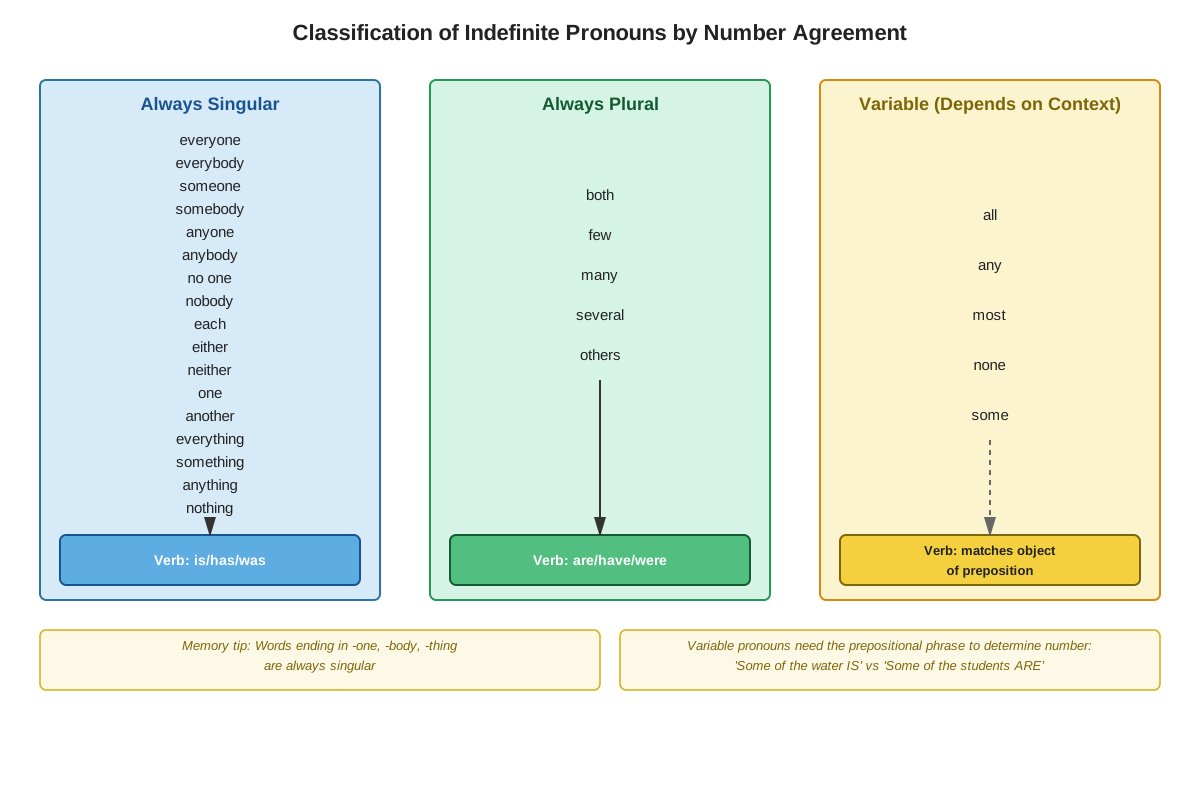
Indefinite pronouns fall into three distinct categories based on whether they require singular or plural verb forms:
| Category | Pronouns | Verb Agreement | Example |
|---|---|---|---|
| Always Singular | anyone, everyone, someone, no one, anybody, everybody, somebody, nobody, anything, everything, something, nothing, each, either, neither, one, another, much | Singular verb | Everyone is ready. |
| Always Plural | both, few, many, several, others | Plural verb | Few are available. |
| Variable | all, any, more, most, none, some | Depends on context | All of the water is gone. / All of the students are here. |
The singular indefinite pronouns represent the largest and most frequently tested category. Despite often referring to multiple people conceptually (like "everyone"), these pronouns are grammatically singular and require singular verbs. This counterintuitive rule creates a common testing opportunity for the SAT.
Singular Indefinite Pronouns
The singular indefinite pronouns include all words ending in "-one," "-body," and "-thing," plus the words "each," "either," "neither," "one," "another," and "much." These pronouns always take singular verbs and singular pronoun references, regardless of the conceptual plurality they might suggest.
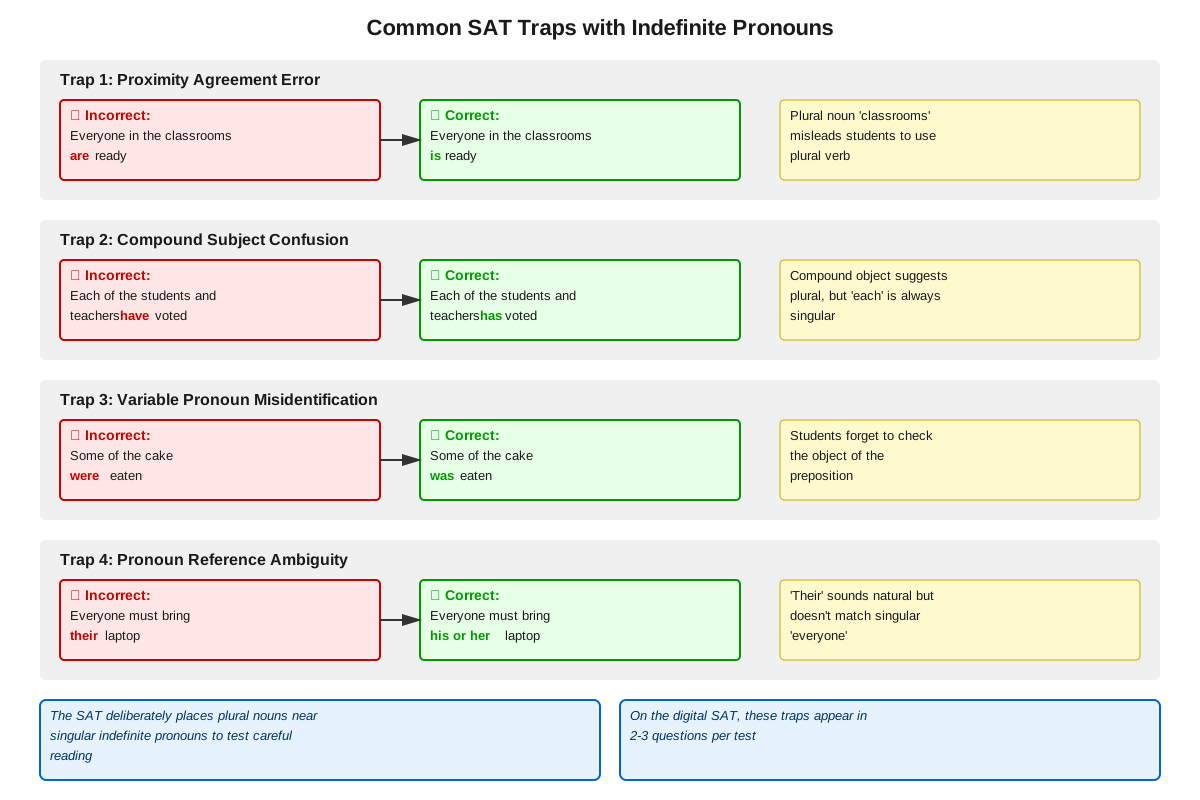
The SAT frequently tests these pronouns by placing intervening prepositional phrases between the pronoun and its verb: "Everyone in the three classes is required to attend." The phrase "in the three classes" might tempt students toward a plural verb, but "everyone" remains singular.
When these pronouns serve as antecedents, they require singular pronoun references: "Each of the students must bring his or her laptop" (or the increasingly accepted singular "their" in contemporary usage, though the SAT traditionally prefers "his or her" or sentence restructuring).
Plural Indefinite Pronouns
The plural indefinite pronouns—"both," "few," "many," "several," and "others"—consistently require plural verbs and plural pronoun references. These pronouns are less frequently tested than singular ones because they create fewer agreement complications.
Example: "Several of the proposals have merit, and they deserve further consideration." Both the verb "have" and the pronoun "they" correctly match the plural "several."
Variable Indefinite Pronouns
The variable indefinite pronouns—"all," "any," "more," "most," "none," and "some"—present the most complex agreement scenario. Their number depends on the noun in the prepositional phrase that follows them. If that noun is singular or uncountable, the pronoun takes a singular verb; if plural and countable, it takes a plural verb.
Examples:
- "Some of the evidence is compelling." (evidence = uncountable/singular)
- "Some of the witnesses are credible." (witnesses = countable/plural)
- "None of the water was contaminated." (water = uncountable/singular)
- "None of the samples were contaminated." (samples = countable/plural)
The SAT tests this concept by presenting sentences where students must identify the referent noun to determine correct verb agreement.
Indefinite Pronouns as Antecedents
When indefinite pronouns serve as antecedents for other pronouns, agreement becomes crucial. Singular indefinite pronouns require singular pronoun references, which traditionally meant "he or she," "his or her," or "him or her." However, contemporary usage increasingly accepts singular "they" for indefinite pronoun antecedents, and the SAT has begun reflecting this shift.
Traditional: "Everyone should submit his or her application by Friday."
Contemporary: "Everyone should submit their application by Friday."
The SAT may present both forms as correct, though it more commonly tests whether students can identify agreement errors rather than choosing between these two acceptable forms.
Clarity and Ambiguity Issues
Beyond agreement, indefinite pronouns can create clarity problems when their reference becomes ambiguous. The SAT occasionally tests whether students can identify when an indefinite pronoun makes a sentence unclear or when a more specific noun would improve comprehension.
Unclear: "Someone left something in the room, and it needs to be returned."
Clearer: "Someone left a notebook in the room, and it needs to be returned."
Concept Relationships
Indefinite pronouns connect directly to subject-verb agreement because they frequently serve as sentence subjects, requiring students to identify the correct verb form. The singular indefinite pronouns → create agreement challenges → especially when separated from their verbs by intervening phrases.
These pronouns also relate to pronoun-antecedent agreement when they function as antecedents for subsequent pronouns. Singular indefinite pronouns → require singular pronoun references → which may be "he or she," "his or her," or singular "they."
The variable indefinite pronouns → connect to prepositional phrases → because the object of the preposition determines whether the pronoun is treated as singular or plural. Understanding this relationship requires students to identify the true subject versus modifying phrases.
Indefinite pronouns also intersect with sentence clarity and precision, as their inherent vagueness can sometimes obscure meaning. This connects to broader rhetorical skills tested in the RW section, where students must evaluate whether word choices effectively communicate intended meaning.
Quick check — test yourself on Indefinite pronouns so far.
Try Flashcards →High-Yield Facts
⭐ All indefinite pronouns ending in "-one," "-body," or "-thing" are singular and require singular verbs (everyone is, somebody has, nothing was)
⭐ The pronouns "each," "either," and "neither" are always singular, even when followed by prepositional phrases with plural objects (each of the students is)
⭐ The variable pronouns "all," "any," "more," "most," "none," and "some" take their number from the noun in the following prepositional phrase
⭐ Intervening prepositional phrases do not change the number of the indefinite pronoun subject (everyone in the rooms is, not are)
⭐ The pronouns "both," "few," "many," "several," and "others" are always plural and require plural verbs
- The pronoun "none" can be singular or plural depending on context, despite traditional rules claiming it's always singular
- When an indefinite pronoun is the antecedent, the referring pronoun must match in number (singular indefinite pronouns traditionally take "his or her" or contemporary singular "they")
- The word "one" can function as an indefinite pronoun meaning "a person" or as a number adjective
- Compound subjects joined by "or" or "nor" with indefinite pronouns follow the proximity rule (neither the teacher nor the students are)
- The SAT rarely tests obscure indefinite pronouns like "naught" or "aught," focusing instead on common ones
Common Misconceptions
Misconception: "Everyone" and "everybody" are plural because they refer to multiple people → Correction: These pronouns are grammatically singular despite their conceptual plurality. They always require singular verbs: "Everyone is here," not "Everyone are here."
Misconception: The noun in a prepositional phrase following an indefinite pronoun determines the verb for all indefinite pronouns → Correction: Only variable indefinite pronouns (all, any, more, most, none, some) take their number from the prepositional phrase object. Singular indefinite pronouns remain singular regardless: "Each of the students is" (not "are").
Misconception: "None" is always singular because it means "not one" → Correction: "None" is a variable indefinite pronoun that can be singular or plural depending on its referent: "None of the water is" (singular) versus "None of the students are" (plural).
Misconception: Using singular "they" with indefinite pronouns is always incorrect on the SAT → Correction: The SAT has evolved to accept singular "they" with indefinite pronoun antecedents, reflecting contemporary usage standards, though it may still present "his or her" as correct in some contexts.
Misconception: "Neither" and "either" can be plural when referring to two plural groups → Correction: These pronouns are always singular when functioning as subjects: "Neither of the teams is ready" (not "are ready"). However, in "neither...nor" constructions, the verb agrees with the closer subject.
Misconception: All indefinite pronouns are vague and should be avoided in good writing → Correction: Indefinite pronouns serve important functions in making general statements and avoiding unnecessary specificity. They become problematic only when they create genuine ambiguity or when more precise language would significantly improve clarity.
Worked Examples
Example 1: Subject-Verb Agreement with Intervening Phrase
Question: Which choice completes the sentence with correct subject-verb agreement?
"Each of the research proposals submitted by the graduate students _____ a detailed methodology section."
A) require
B) are requiring
C) requires
D) have required
Solution:
Step 1: Identify the subject. The subject is "each," an indefinite pronoun that is always singular.
Step 2: Eliminate the intervening prepositional phrases. "Of the research proposals" and "submitted by the graduate students" are modifying phrases that do not affect the subject's number.
Step 3: Determine the correct verb form. Since "each" is singular, it requires a singular verb.
Step 4: Evaluate the choices:
- A) "require" - plural verb, incorrect
- B) "are requiring" - plural verb, incorrect
- C) "requires" - singular verb, correct
- D) "have required" - plural verb, incorrect
Answer: C
This question demonstrates the SAT's common strategy of separating the indefinite pronoun subject from its verb with multiple intervening phrases to obscure the agreement relationship. Students must identify the true subject and ignore the plural nouns in the modifying phrases.
Example 2: Variable Indefinite Pronoun Agreement
Question: Which choice completes the sentence with correct subject-verb agreement?
"Most of the evidence presented during the trial _____ the defendant's testimony, but some of the witnesses _____ contradicted it."
A) supports; has
B) support; has
C) supports; have
D) support; have
Solution:
Step 1: Identify both subjects. The subjects are "most" and "some," both variable indefinite pronouns.
Step 2: Determine the referent for each. "Most" refers to "evidence" (singular/uncountable), and "some" refers to "witnesses" (plural/countable).
Step 3: Apply the variable pronoun rule. "Most of the evidence" takes a singular verb because "evidence" is uncountable. "Some of the witnesses" takes a plural verb because "witnesses" is countable and plural.
Step 4: Evaluate the choices:
- A) "supports" (singular) and "has" (singular) - first verb correct, second incorrect
- B) "support" (plural) and "has" (singular) - both incorrect
- C) "supports" (singular) and "have" (plural) - both correct
- D) "support" (plural) and "have" (plural) - first incorrect, second correct
Answer: C
This example illustrates how the SAT tests understanding of variable indefinite pronouns by requiring students to analyze two different contexts within a single sentence. Success requires identifying the referent noun for each pronoun and determining whether it's countable/uncountable and singular/plural.
Exam Strategy
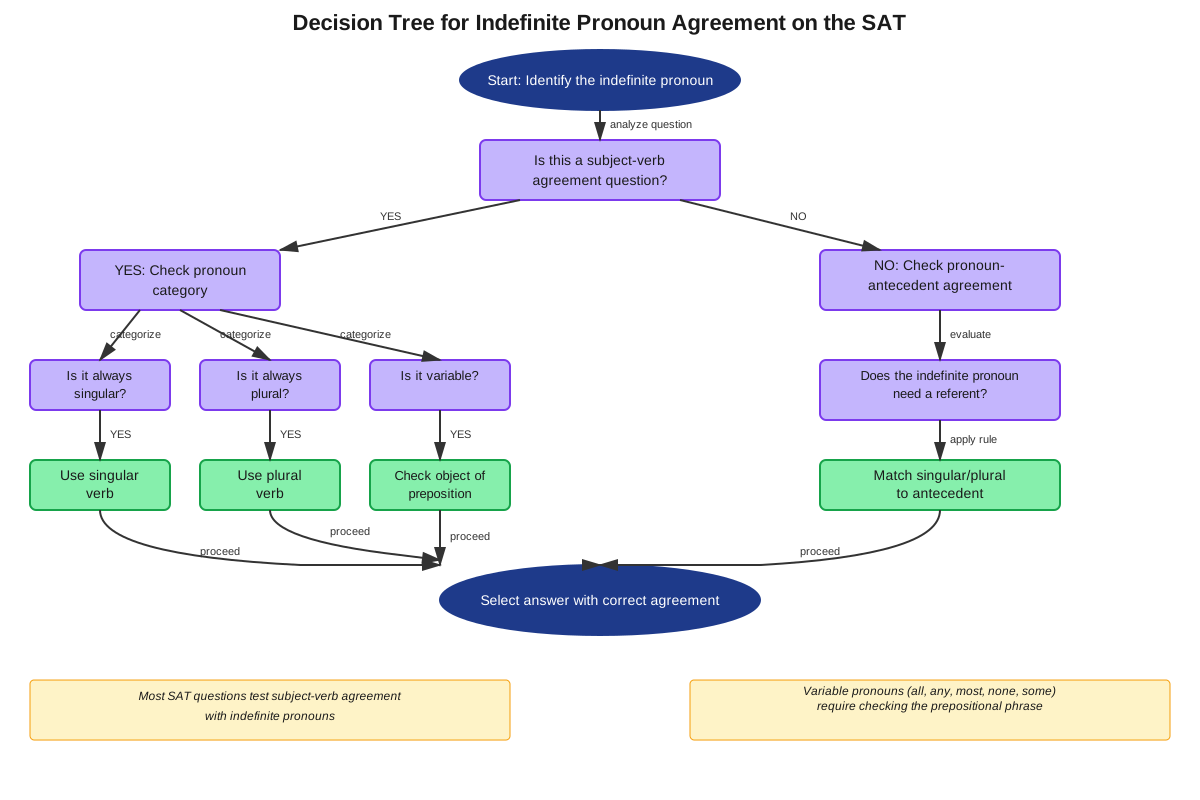
When approaching sat indefinite pronouns questions, follow this systematic process:
Step 1: Identify the indefinite pronoun. Look for words like everyone, each, some, all, few, many, etc. These often appear as sentence subjects in agreement questions.
Step 2: Classify the pronoun. Determine whether it's always singular, always plural, or variable. Memorize the three categories to make this determination quickly.
Step 3: Locate the verb or referring pronoun. Find what must agree with the indefinite pronoun—either a verb or another pronoun.
Step 4: Eliminate intervening phrases. Cross out prepositional phrases and other modifiers between the subject and verb to see the agreement relationship clearly.
Step 5: For variable pronouns, identify the referent. Look at the noun in the prepositional phrase following the pronoun to determine singular or plural treatment.
Exam Tip: The SAT loves to place long, complex prepositional phrases between indefinite pronoun subjects and their verbs. Train yourself to mentally bracket these phrases to avoid distraction.
Trigger words to watch for: "each," "every," "everyone," "everybody," "anyone," "anybody," "someone," "somebody," "no one," "nobody," "either," "neither" (all singular); "both," "few," "many," "several" (all plural); "all," "any," "some," "most," "none" (variable).
Process of elimination tips:
- If you see a singular indefinite pronoun with a plural verb, eliminate that choice immediately
- If a prepositional phrase contains a plural noun, be suspicious of plural verbs—the test is likely trying to trick you
- When choosing between "his or her" and "their" for singular indefinite pronouns, both may be acceptable; look for other errors in the choices
Time allocation: These questions should take 30-45 seconds once you've mastered the concept. If you're spending more than a minute, you may be overthinking. Apply the rules mechanically rather than relying on what "sounds right."
Memory Techniques
The "-ONE, -BODY, -THING" Rule: Remember that anything ending in these three suffixes is singular. Visualize these endings as singular entities: ONE person, ONE body, ONE thing.
The BFMSO Acronym for Plural Pronouns: Both, Few, Many, Several, Others—all plural, all the time.
The "Variable Six" Mnemonic: All Any More Most None Some—remember "AAMMNS" or think "A AM Not Sure" to recall that these six require checking the referent.
The EEN Rule: Each, Either, Neither—three words that sound like they might be plural but are always singular. Visualize them as "KEEN" (with K silent) to remember they're singular.
Visualization Strategy: Picture singular indefinite pronouns as single dots (•) and plural ones as multiple dots (• • •). When you see "everyone," visualize a single dot, reinforcing its singular nature despite referring to many people.
The Prepositional Phrase Parentheses Trick: Mentally put parentheses around prepositional phrases: "Each (of the students) is ready." This visual technique helps you see the true subject-verb relationship.
Summary
Indefinite pronouns are non-specific pronouns that refer to unidentified people, places, things, or amounts, and they appear frequently in SAT Reading and Writing questions testing subject-verb agreement and pronoun-antecedent agreement. These pronouns fall into three categories: always singular (including all "-one," "-body," "-thing" words, plus each, either, neither), always plural (both, few, many, several, others), and variable (all, any, more, most, none, some). The SAT most commonly tests singular indefinite pronouns by placing intervening prepositional phrases between the pronoun and its verb to obscure the agreement relationship. Variable indefinite pronouns require students to identify the referent noun in the following prepositional phrase to determine whether singular or plural agreement is appropriate. Mastering this topic requires memorizing the three categories, practicing the identification of true subjects versus modifying phrases, and applying agreement rules mechanically rather than relying on what sounds correct.
Key Takeaways
- Indefinite pronouns ending in "-one," "-body," or "-thing" are always singular and require singular verbs, regardless of conceptual plurality
- The pronouns "each," "either," and "neither" are always singular, even when followed by prepositional phrases with plural objects
- Variable indefinite pronouns (all, any, more, most, none, some) take their number from the noun in the following prepositional phrase
- Intervening prepositional phrases between subject and verb do not affect agreement—identify the true subject and ignore modifiers
- The SAT frequently tests indefinite pronouns in subject-verb agreement questions, pronoun-antecedent agreement questions, and clarity/precision questions
- Both "his or her" and singular "they" may be acceptable for singular indefinite pronoun antecedents on the contemporary SAT
- Memorizing the three categories (always singular, always plural, variable) enables quick, accurate responses to indefinite pronoun questions
Related Topics
Subject-Verb Agreement: Mastering indefinite pronouns provides the foundation for understanding more complex subject-verb agreement scenarios, including compound subjects, inverted sentence structures, and collective nouns.
Pronoun-Antecedent Agreement: Understanding how indefinite pronouns function as antecedents connects to broader pronoun reference skills, including ambiguous pronoun reference and pronoun case.
Sentence Structure and Clarity: The study of indefinite pronouns extends to questions about sentence effectiveness, where vague pronoun usage may need revision for clarity.
Collective Nouns and Agreement: The principles learned with variable indefinite pronouns apply similarly to collective nouns, which can be singular or plural depending on context.
Parallel Structure: Indefinite pronouns often appear in parallel construction questions, where maintaining consistent pronoun usage across sentence elements is tested.
Practice CTA
Now that you've mastered the core concepts of indefinite pronouns, it's time to reinforce your learning through active practice. Complete the practice questions to test your ability to identify indefinite pronouns, apply agreement rules, and answer SAT-style questions under timed conditions. Use the flashcards to memorize the three categories and drill the most commonly tested pronouns until recognition becomes automatic. Remember: indefinite pronouns appear in 8-12% of RW questions, making this high-yield topic worth your focused attention. Every question you master here translates directly to points on test day!
Sign up free to keep reading
Create a free AnvayaPrep account to finish this SAT guide on Indefinite pronouns — plus flashcards and practice questions.