Overview
Compound subjects are a fundamental grammatical structure that appears frequently on the SAT Reading and Writing (RW) section, particularly in questions testing subject-verb agreement and sentence structure. A compound subject consists of two or more subjects joined by a coordinating conjunction (such as "and," "or," or "nor") that share the same verb. Understanding how compound subjects function is critical for identifying grammatical errors and selecting correct verb forms on the SAT.
The SAT tests compound subjects primarily through subject-verb agreement questions, where students must determine whether a verb correctly matches its compound subject in number (singular or plural). These questions often feature tricky constructions where the compound subject is separated from its verb by modifying phrases or clauses, making it challenging to identify the true subject. Mastering compound subjects enables students to navigate these deliberately confusing sentence structures and select the grammatically correct answer choice with confidence.
This topic connects directly to broader concepts in the Form, Structure, and Sense unit, including subject-verb agreement, sentence structure, and coordination. A strong grasp of compound subjects also supports understanding of parallel structure, comma usage with coordinating conjunctions, and the logical flow of complex sentences—all high-yield areas for SAT success.
Learning Objectives
- [ ] Identify key features of compound subjects
- [ ] Explain how compound subjects appears on the SAT
- [ ] Apply compound subjects to answer SAT-style questions
- [ ] Distinguish between compound subjects joined by "and" versus those joined by "or" or "nor"
- [ ] Recognize compound subjects separated from their verbs by intervening phrases
- [ ] Determine correct verb number agreement with various compound subject constructions
Prerequisites
- Basic subject-verb agreement: Understanding that singular subjects take singular verbs and plural subjects take plural verbs is essential for applying compound subject rules
- Parts of speech identification: Recognizing nouns, pronouns, verbs, and conjunctions allows students to identify the components of compound subjects
- Coordinating conjunctions (FANBOYS): Familiarity with "for, and, nor, but, or, yet, so" helps students identify when subjects are being joined into compound structures
- Phrase and clause recognition: Distinguishing between essential sentence elements and modifying phrases prevents confusion when subjects are separated from verbs
Why This Topic Matters
Compound subjects represent a high-frequency testing point on the SAT, appearing in approximately 15-20% of all grammar questions in the Reading and Writing section. The College Board deliberately constructs questions that exploit common errors students make with compound subjects, particularly when determining whether a verb should be singular or plural. These questions often appear in the Standard English Conventions domain, which comprises roughly half of the RW section's grammar content.
In real-world writing, compound subjects allow for more efficient and sophisticated sentence construction. Rather than writing multiple short sentences ("The manager approved the plan. The director approved the plan."), writers can combine subjects for clarity and flow ("The manager and director approved the plan."). This skill translates directly to the essay portion of standardized tests and college-level academic writing.
On the SAT, compound subject questions typically appear in two formats: identifying errors in given sentences or selecting the correct verb form to complete a sentence. The test makers frequently place distracting prepositional phrases or relative clauses between the compound subject and its verb, testing whether students can maintain focus on the true grammatical subject. Questions may also test the subtle distinction between compound subjects joined by "and" (which are typically plural) versus those joined by "or" or "nor" (which follow proximity rules).
Core Concepts
Definition and Basic Structure
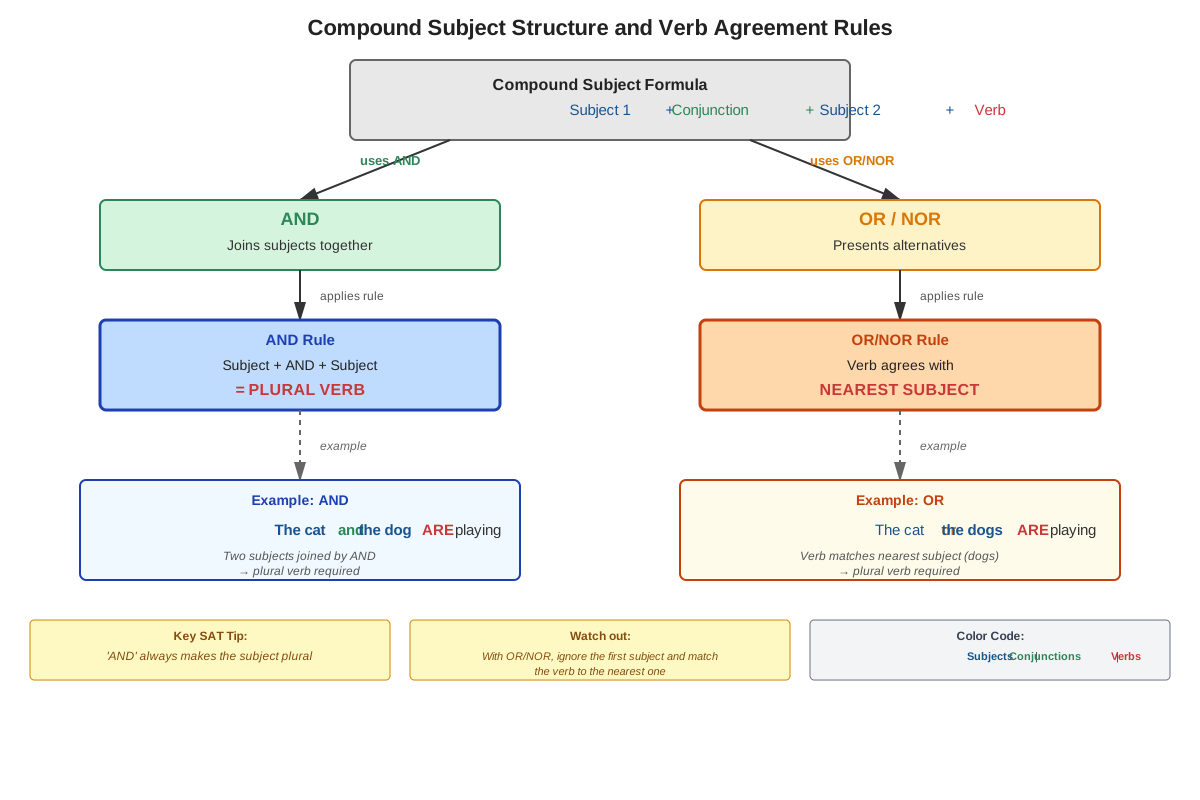
A compound subject consists of two or more simple subjects that are joined by a coordinating conjunction and share the same predicate. The most common coordinating conjunctions used to form compound subjects are "and," "or," and "nor." When multiple subjects perform the same action or are described by the same predicate, combining them into a compound subject creates more concise and elegant sentences.
Basic structure: Subject 1 + Conjunction + Subject 2 + Verb + Rest of Predicate
Example: "The teacher and the students are excited about the field trip."
In this example, both "teacher" and "students" serve as subjects performing the action "are excited," making them a compound subject joined by "and."
Compound Subjects Joined by "And"
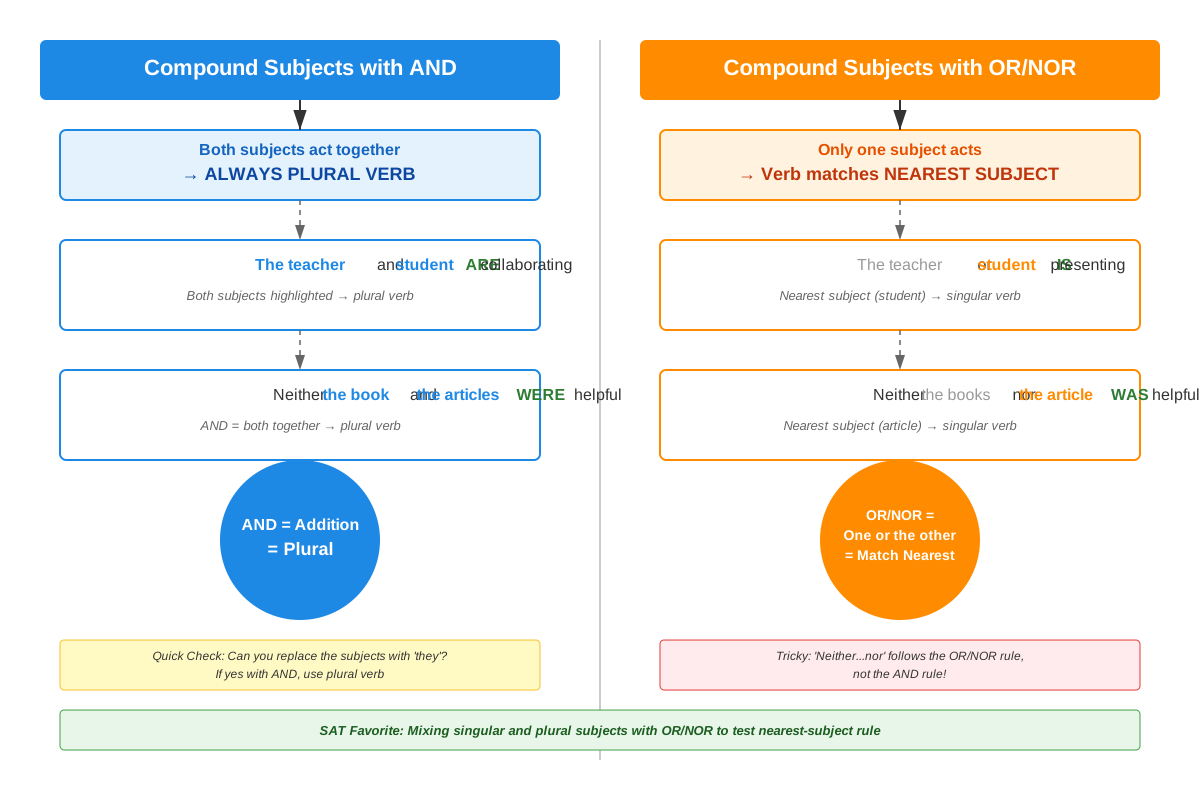
When two or more subjects are connected by the conjunction "and," they typically form a plural compound subject that requires a plural verb. This rule applies even when both individual subjects are singular, because "and" creates an additive relationship that results in multiple entities performing the action.
Rule: Subject 1 + and + Subject 2 = Plural verb
Examples:
- "The cat and the dog play together." (Both subjects are singular, but together they require the plural verb "play")
- "Mathematics and science are my favorite subjects."
- "The CEO and the board of directors have approved the merger."
Exception: When the compound subject refers to a single entity or concept, a singular verb is used. This occurs when the two subjects are so closely related that they function as one unit.
Examples:
- "Peanut butter and jelly is my favorite sandwich." (One type of sandwich)
- "The founder and CEO is speaking at the conference." (One person holding both titles)
Compound Subjects Joined by "Or" or "Nor"
When subjects are joined by "or" or "nor," the verb agreement follows the proximity rule (also called the "nearest subject rule"). The verb must agree in number with the subject closest to it. This differs from the "and" rule because "or" and "nor" present alternatives rather than combining subjects additively.
Rule: The verb agrees with the nearest subject
| Construction | Example | Verb Agreement |
|---|---|---|
| Singular or Singular | "The manager or the supervisor is responsible." | Singular (agrees with "supervisor") |
| Singular or Plural | "The manager or the employees are responsible." | Plural (agrees with "employees") |
| Plural or Singular | "The employees or the manager is responsible." | Singular (agrees with "manager") |
| Plural or Plural | "The teachers or the students are organizing the event." | Plural (agrees with "students") |
SAT Strategy Note: When you see "or" or "nor" joining subjects, immediately identify which subject is closest to the verb—that subject determines the verb form.
Compound Subjects with Intervening Phrases
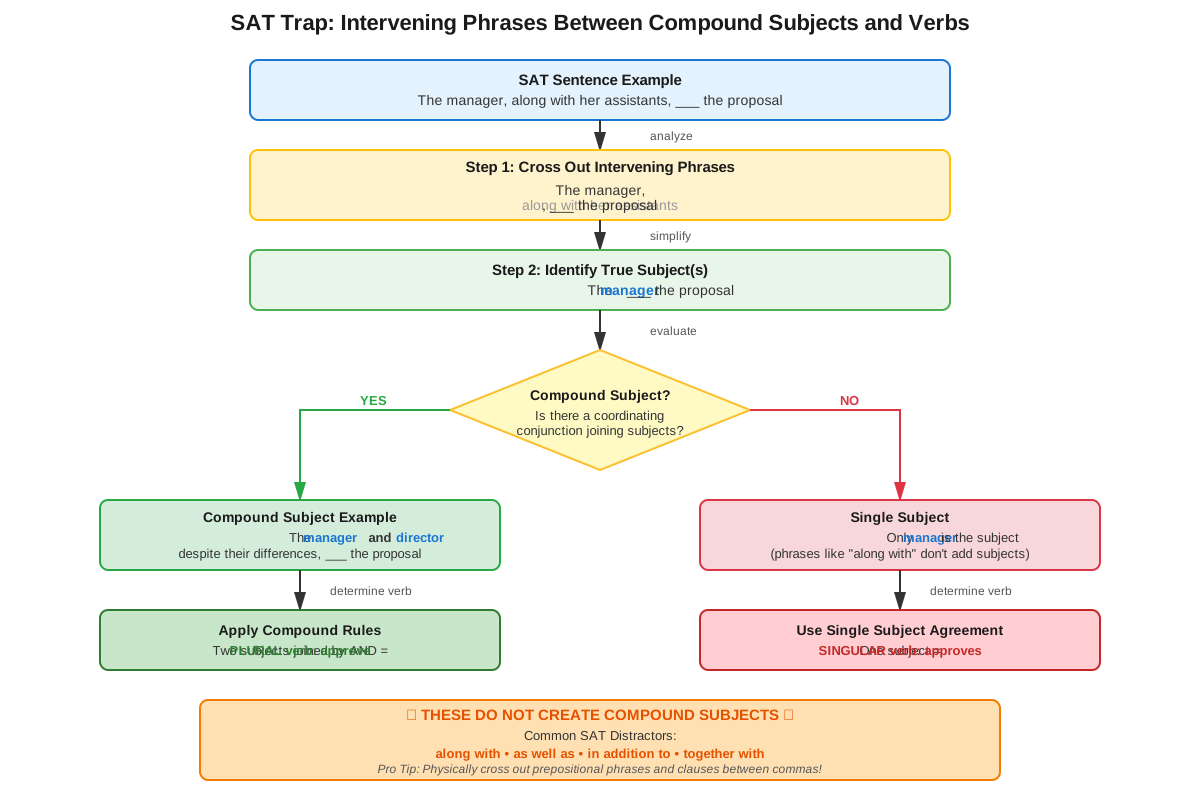
The SAT frequently tests compound subjects by inserting intervening phrases or clauses between the subject and verb. These modifying elements can distract students from identifying the true compound subject and determining correct verb agreement.
Common intervening elements include:
- Prepositional phrases: "of the committee," "in the laboratory," "with their colleagues"
- Relative clauses: "who studied abroad," "that were submitted yesterday"
- Participial phrases: "working on the project," "located in the northern region"
Critical Rule: Intervening phrases do NOT affect subject-verb agreement. Always identify the core compound subject and ignore modifying phrases when determining verb number.
Example with intervening phrase:
"The director, along with the producers and actors, is attending the premiere."
Analysis: Despite "producers and actors" appearing near the verb, the true subject is "director" (singular). The phrase "along with the producers and actors" is a modifying phrase, not part of a compound subject. The singular verb "is" correctly agrees with "director."
Contrast with true compound subject:
"The director and the producers are attending the premiere."
Here, "director and producers" forms a genuine compound subject joined by "and," requiring the plural verb "are."
Correlative Conjunctions with Compound Subjects
Correlative conjunctions are paired conjunctions that can join subjects: "either...or," "neither...nor," "not only...but also," "both...and." These follow specific agreement rules:
- Both...and: Always takes a plural verb (functions like "and")
- "Both the teacher and the student are prepared."
- Either...or and Neither...nor: Follow the proximity rule
- "Either the captain or the crew members are responsible."
- "Neither the students nor the teacher was aware of the change."
- Not only...but also: Follows the proximity rule
- "Not only the manager but also the employees were informed."
Concept Relationships
The concept of compound subjects serves as a foundation for multiple interconnected grammatical principles tested on the SAT. Understanding compound subjects requires first mastering basic subject-verb agreement, which establishes that subjects and verbs must match in number. This fundamental principle → extends to → compound subject constructions, where determining the correct number (singular or plural) becomes more complex.
Compound subjects connect directly to coordinating conjunctions, as these conjunctions (particularly "and," "or," and "nor") determine how subjects combine and which agreement rules apply. The choice of conjunction → determines → whether the compound subject is additive (requiring plural verbs) or alternative (following proximity rules).
The relationship between compound subjects and intervening modifiers represents a critical testing point. The SAT deliberately places prepositional phrases, relative clauses, or participial phrases between compound subjects and their verbs to test whether students can maintain focus on the core grammatical structure. Mastering phrase recognition → enables → accurate identification of true compound subjects → leads to → correct verb selection.
Compound subjects also relate to parallel structure, as the subjects joined by conjunctions should maintain grammatical parallelism. For example, "The student and studying hard" lacks parallelism, while "The student and the tutor" maintains it. Understanding compound subjects → supports → recognizing and creating parallel constructions → enhances → overall sentence clarity and correctness.
Finally, compound subjects connect to pronoun agreement, as pronouns referring back to compound subjects must match in number. A compound subject joined by "and" → requires → plural pronouns ("they," "their"), while subjects joined by "or" or "nor" → require → pronouns agreeing with the nearest antecedent.
Quick check — test yourself on Compound subjects so far.
Try Flashcards →High-Yield Facts
⭐ Compound subjects joined by "and" almost always require plural verbs, even when both individual subjects are singular.
⭐ When compound subjects are joined by "or" or "nor," the verb agrees with the subject nearest to it (proximity rule).
⭐ Intervening phrases between the compound subject and verb do not affect verb agreement—always identify the core subjects.
⭐ The phrase "along with" (and similar phrases like "as well as," "in addition to," "together with") does NOT create a compound subject—it creates a modifying phrase.
⭐ "Both...and" always creates a plural compound subject, while "either...or" and "neither...nor" follow the proximity rule.
- Compound subjects can consist of more than two subjects: "The teacher, the principal, and the superintendent are meeting."
- When a compound subject refers to a single entity or person, use a singular verb: "The author and illustrator is signing books today" (one person with both roles).
- Indefinite pronouns (everyone, somebody, each) remain singular even when part of a compound subject with "and": This is rare, but "each student and each teacher has" uses singular because "each" modifies both.
- Collective nouns in compound subjects follow standard compound subject rules: "The team and the coach are celebrating."
- On the SAT, if you're unsure about a compound subject question, try removing intervening phrases and reading the sentence with just the subjects and verb to check agreement.
Common Misconceptions
Misconception: Any subjects connected by a conjunction form a compound subject requiring a plural verb.
Correction: Only subjects joined by "and" typically require plural verbs. Subjects joined by "or" or "nor" follow the proximity rule, and phrases like "along with" or "as well as" don't create true compound subjects—they create modifying phrases that don't affect verb agreement.
Misconception: The verb should agree with the subject that "sounds right" or seems most important.
Correction: Verb agreement follows specific grammatical rules, not subjective judgment. For "and," use plural verbs; for "or/nor," match the nearest subject; ignore intervening phrases regardless of how they sound.
Misconception: When multiple nouns appear before a verb, they always form a compound subject.
Correction: Only nouns joined by coordinating conjunctions and functioning as subjects create compound subjects. Nouns within prepositional phrases ("of the students"), appositives, or other modifying structures are not part of the compound subject.
Misconception: "Neither...nor" constructions always take singular verbs because "neither" is singular.
Correction: "Neither...nor" follows the proximity rule. "Neither the teacher nor the students are" uses a plural verb because "students" (plural) is nearest to the verb, even though "neither" suggests singularity.
Misconception: Compound subjects separated by long phrases or clauses might require singular verbs because the subjects seem disconnected.
Correction: The length or complexity of intervening material is irrelevant to verb agreement. A compound subject joined by "and" requires a plural verb regardless of how much text separates the subjects from the verb: "The student who studied all night and the tutor who provided guidance are both exhausted."
Worked Examples
Example 1: Identifying Correct Verb Agreement with "And"
Question: The research team's findings and the professor's analysis (is/are) being published in the journal next month.
Step 1: Identify the compound subject
The compound subject consists of two elements joined by "and":
- "findings" (plural noun)
- "analysis" (singular noun)
Step 2: Check for intervening phrases
- "The research team's" modifies "findings" (possessive, not a separate subject)
- "the professor's" modifies "analysis" (possessive, not a separate subject)
Step 3: Apply the compound subject rule
Since the subjects are joined by "and," they form a plural compound subject requiring a plural verb, regardless of whether the individual subjects are singular or plural.
Step 4: Eliminate intervening phrases mentally
Read: "findings and analysis are being published"
Answer: are
Reasoning: "Findings and analysis" joined by "and" creates a plural compound subject. Even though "analysis" is singular, the compound subject as a whole requires the plural verb "are." This question tests whether students can recognize that "and" creates an additive relationship requiring plural agreement.
Example 2: Applying the Proximity Rule with "Or"
Question: Neither the students in the advanced class nor the teacher (was/were) aware of the schedule change announced yesterday.
Step 1: Identify the conjunction and subjects
The correlative conjunction "neither...nor" joins:
- "students" (plural)
- "teacher" (singular)
Step 2: Determine which rule applies
"Neither...nor" follows the proximity rule—the verb must agree with the subject nearest to it.
Step 3: Identify the nearest subject
"Teacher" (singular) is the subject closest to the verb.
Step 4: Check for distracting elements
- "in the advanced class" is a prepositional phrase modifying "students" (ignore it)
- "announced yesterday" modifies "change" (ignore it)
Step 5: Apply proximity rule
The verb must agree with "teacher" (singular), so use "was."
Answer: was
Reasoning: Despite "students" being plural and appearing first, the proximity rule requires the verb to agree with "teacher," the nearest subject. The prepositional phrase "in the advanced class" is designed to distract by placing a plural noun ("class") near the verb, but it doesn't affect agreement. This question tests understanding of both the proximity rule and the ability to ignore intervening phrases.
Exam Strategy
When approaching sat compound subjects questions on the rw section, follow this systematic process:
Step 1: Locate the verb and work backward
Find the verb in question first, then identify what subjects are performing that action. This prevents getting distracted by nouns in modifying phrases.
Step 2: Identify all subjects and the conjunction joining them
Circle or mentally note each subject and the coordinating conjunction. Ask: "What is performing the action?" and "What word joins these subjects?"
Step 3: Apply the appropriate rule
- If "and" → plural verb (with rare exceptions for single entities)
- If "or" or "nor" → proximity rule (match nearest subject)
- If "both...and" → plural verb
- If "either...or" or "neither...nor" → proximity rule
Step 4: Eliminate intervening phrases
Cross out or ignore prepositional phrases, relative clauses, and participial phrases between subjects and verbs. Read the sentence with just subjects and verb to check agreement.
Trigger words to watch for:
- "along with," "as well as," "in addition to," "together with": These do NOT create compound subjects; they create modifying phrases
- "or," "nor": Signal proximity rule application
- "and": Usually signals plural verb requirement
- "each," "every": When modifying compound subjects, these can create singular agreement
Process of elimination tips:
- If answer choices include both singular and plural verbs, immediately identify the compound subject structure and conjunction
- Eliminate answers that violate the basic "and" = plural or "or/nor" = proximity rules
- Be suspicious of answer choices that seem to agree with nouns in intervening phrases rather than true subjects
- When two answers seem grammatically possible, check whether the compound subject might refer to a single entity (rare exception)
Time allocation:
Compound subject questions should take 30-45 seconds. If you're spending more time, you're likely overthinking. Apply the rules mechanically: identify subjects, identify conjunction, apply the appropriate rule, select answer.
Memory Techniques
AND = ADD (Plural)
Remember that "and" adds subjects together, creating a plural compound subject. Visualize two separate items being added into one group that requires a plural verb.
OR/NOR = NEAR
For "or" and "nor," think "NEARest subject wins." The verb agrees with whichever subject is nearest (closest) to it.
FANBOYS Compound Check
Use the FANBOYS acronym (For, And, Nor, But, Or, Yet, So) to identify coordinating conjunctions, but remember only And, Nor, and Or typically join subjects. When you see these three, check for compound subjects.
Cross Out the Middle
Visualize drawing a line through everything between the subject and verb. If you can cross out phrases and the sentence still makes grammatical sense, those phrases don't affect agreement.
Both = Two (Plural)
"Both...and" contains the word "both," which inherently means two or more, so it always requires a plural verb.
The Proximity Rhyme
"When you see OR or NOR, / Match the subject that's before / The verb—the one that's nearest more."
Summary
Compound subjects represent a critical testing point on the SAT Reading and Writing section, requiring students to identify multiple subjects joined by coordinating conjunctions and determine correct verb agreement. The fundamental principle is straightforward: compound subjects joined by "and" typically require plural verbs because they create an additive relationship, while those joined by "or" or "nor" follow the proximity rule, with the verb agreeing with the nearest subject. The SAT complicates these questions by inserting intervening phrases and clauses between subjects and verbs, testing whether students can maintain focus on the core grammatical structure. Success requires systematically identifying the true subjects, recognizing the conjunction joining them, ignoring modifying phrases, and applying the appropriate agreement rule. Mastering compound subjects enables students to navigate some of the most common grammar questions on the test and supports broader understanding of subject-verb agreement, parallel structure, and sentence construction—all essential skills for achieving a high score on the SAT.
Key Takeaways
- Compound subjects joined by "and" require plural verbs (with rare exceptions for single entities)
- Compound subjects joined by "or" or "nor" follow the proximity rule—the verb agrees with the nearest subject
- Intervening phrases between compound subjects and verbs do not affect verb agreement and should be mentally eliminated
- Phrases like "along with," "as well as," and "together with" create modifying phrases, not compound subjects
- Correlative conjunctions follow specific rules: "both...and" requires plural verbs, while "either...or" and "neither...nor" follow the proximity rule
- Systematically identify subjects and conjunctions before selecting verb forms
- Compound subject questions appear frequently on the SAT and are highly predictable once you master the core rules
Related Topics
Subject-Verb Agreement with Collective Nouns: Understanding how collective nouns (team, committee, family) affect verb agreement builds on compound subject knowledge and addresses another high-frequency SAT testing point.
Parallel Structure: Compound subjects must maintain grammatical parallelism, making this a natural extension of compound subject mastery that improves overall sentence construction skills.
Pronoun-Antecedent Agreement: Pronouns referring to compound subjects must agree in number, connecting pronoun usage to compound subject rules.
Comma Usage with Coordinating Conjunctions: Understanding when to use commas with conjunctions joining independent clauses relates to the coordinating conjunctions used in compound subjects.
Complex Sentence Structure: Mastering compound subjects enables students to analyze more sophisticated sentence constructions involving multiple clauses and subjects.
Practice CTA
Now that you've mastered the core concepts of compound subjects, it's time to reinforce your learning through active practice. Complete the practice questions to test your ability to identify compound subjects, apply agreement rules, and navigate the tricky constructions the SAT uses to challenge students. Use the flashcards to drill the key rules and exceptions until they become automatic. Remember: compound subject questions are highly predictable and follow consistent rules—with focused practice, these questions become reliable points on test day. You've built the foundation; now strengthen it through application!
Sign up free to keep reading
Create a free AnvayaPrep account to finish this SAT guide on Compound subjects — plus flashcards and practice questions.