Overview
The distinction between fewer vs less represents one of the most frequently tested grammar concepts in the SAT Reading and Writing section. This seemingly simple rule governs how we quantify nouns in English, yet it trips up countless test-takers who rely on conversational habits rather than formal grammar rules. Understanding when to use "fewer" versus "less" demonstrates command of Standard English conventions—a core competency the College Board assesses throughout the exam.
On the SAT fewer vs less questions appear regularly in the Standard English Conventions domain, typically embedded within sentence revision or error identification formats. These questions test whether students can distinguish between countable and uncountable nouns, then apply the appropriate quantifier. The College Board favors this topic because it efficiently separates students who understand grammatical precision from those who write by ear alone. A single question may seem minor, but mastering this distinction contributes to the cumulative score that can make the difference between good and exceptional performance.
This topic connects directly to broader RW (Reading and Writing) principles of grammatical agreement, noun classification, and formal register. The fewer/less distinction parallels other quantifier rules (such as "number" versus "amount" or "many" versus "much"), creating a network of related concepts that reinforce proper noun modification. Students who master this topic develop sharper analytical skills for identifying noun types—a foundational ability that supports success across multiple question categories in the Standard English Conventions domain.
Learning Objectives
- [ ] Identify key features of fewer vs less
- [ ] Explain how fewer vs less appears on the SAT
- [ ] Apply fewer vs less to answer SAT-style questions
- [ ] Distinguish between countable and uncountable nouns in context
- [ ] Recognize common exceptions and edge cases in fewer/less usage
- [ ] Evaluate sentence correctness when multiple quantifiers appear as answer choices
Prerequisites
- Basic noun classification: Understanding the difference between concrete and abstract nouns provides the foundation for distinguishing countable from uncountable items.
- Sentence structure fundamentals: Recognizing subjects, verbs, and objects helps locate the noun being quantified and assess whether the quantifier is appropriate.
- Standard English conventions awareness: Familiarity with formal versus informal language registers explains why conversational usage often differs from SAT-tested rules.
Why This Topic Matters
In academic and professional writing, the fewer vs less distinction signals grammatical sophistication and attention to detail. Universities, employers, and standardized tests use this rule as a litmus test for formal writing competence. Beyond the classroom, publications ranging from scientific journals to business reports maintain this distinction, making it essential for clear, credible communication.
On the SAT, fewer/less questions appear with remarkable consistency—typically 1-2 questions per test administration. These questions most commonly surface in the Standard English Conventions category, where students must select the grammatically correct revision of an underlined portion. The College Board presents these questions in various formats: sometimes as standalone sentence corrections, other times embedded within passage-based editing tasks. The questions often include distractors that sound natural in casual speech but violate formal grammar rules, specifically targeting students who haven't internalized the countable/uncountable distinction.
The practical importance extends beyond test scores. College-level writing assignments, graduate school applications, and professional correspondence all demand this level of grammatical precision. Admissions officers and professors notice these details, using them as indicators of a student's readiness for rigorous academic work. Furthermore, the analytical thinking required to classify nouns and select appropriate quantifiers strengthens broader critical thinking skills applicable across disciplines.
Core Concepts
The Fundamental Rule
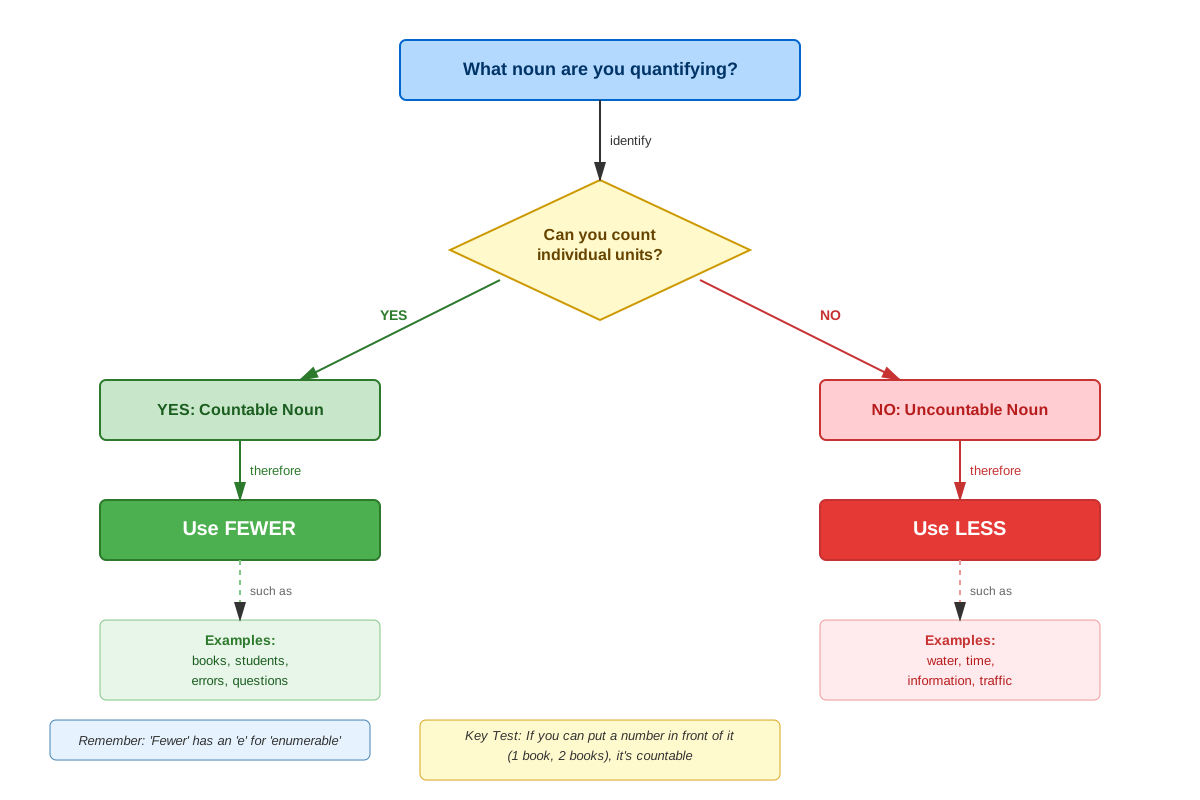
The fewer vs less distinction hinges on a single critical factor: whether the noun being quantified is countable or uncountable. Fewer modifies countable nouns—items that can be enumerated as discrete units (one apple, two apples, three apples). Less modifies uncountable nouns—substances, concepts, or qualities that cannot be separated into individual units (water, happiness, information).
This rule applies regardless of whether the specific number is stated. The question is not "Can I count this particular amount?" but rather "Is this type of noun inherently countable?" For example, even when discussing "less than one hour," we use "less" because time in this context functions as a continuous quantity rather than discrete units.
Countable Nouns: When to Use "Fewer"
Countable nouns represent distinct, separable items that can be pluralized. These nouns answer the question "How many?" rather than "How much?" Common categories include:
- Physical objects: books, cars, students, cookies, computers
- People and animals: teachers, dogs, citizens, employees
- Events: meetings, concerts, accidents, celebrations
- Units of measurement when counted discretely: dollars (individual bills/coins), pounds (individual weight units), miles (individual distance units)
The key test: Can you place a number directly before the noun and make it plural? If yes, use "fewer."
Examples of correct usage:
- The library has fewer books than last year.
- Fewer students enrolled in the advanced course.
- The new policy resulted in fewer accidents.
Uncountable Nouns: When to Use "Less"
Uncountable nouns (also called mass nouns or non-count nouns) represent substances, abstractions, or collective concepts that cannot be separated into individual units without changing their nature. These nouns answer "How much?" and typically cannot be pluralized. Categories include:
- Substances and materials: water, sand, air, rice, furniture
- Abstract concepts: happiness, knowledge, information, advice, evidence
- Activities and states: work, sleep, traffic, research
- Collective categories: money (as a concept, not individual bills), time (as duration), luggage, equipment
Examples of correct usage:
- The drought left us with less water than anticipated.
- Students experienced less stress after the schedule change.
- The new route involves less traffic.
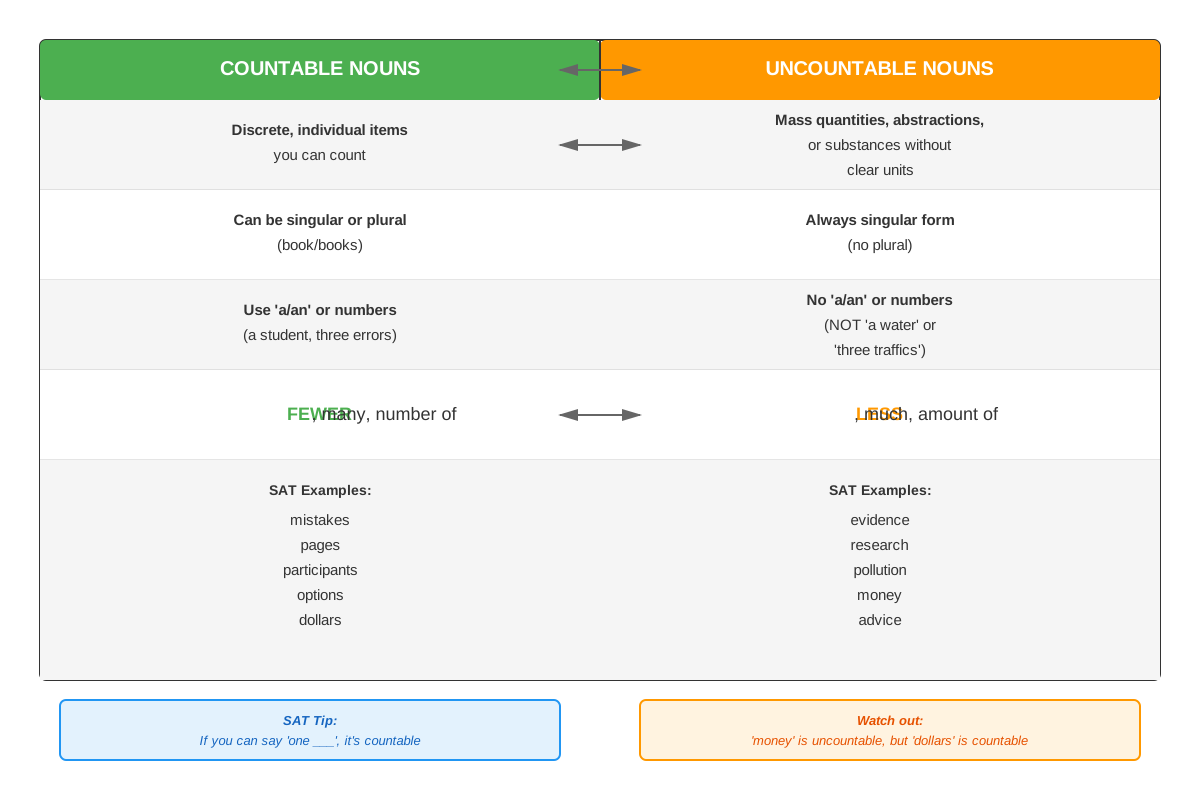
The Comparison Table
| Feature | Fewer | Less |
|---|---|---|
| Noun Type | Countable | Uncountable |
| Question Answered | How many? | How much? |
| Pluralization | Noun can be plural | Noun cannot be plural |
| Example Nouns | apples, questions, errors | water, time, money |
| Sample Sentence | Fewer people attended | Less attention was paid |
| Common Pairs | number, many | amount, much |
Special Cases and Exceptions
Certain nouns shift between countable and uncountable depending on context, requiring careful analysis:
Time: Generally uncountable when referring to duration (less time), but countable when referring to specific instances (fewer hours, fewer minutes, fewer days). The distinction depends on whether you're measuring continuous duration or discrete units.
Money: Use "less money" when referring to the abstract concept of wealth or value, but "fewer dollars" when counting specific currency units. "The project costs less money" versus "I have fewer dollars in my wallet."
Distance: Similar to time—"less distance" for continuous measurement, but "fewer miles" or "fewer kilometers" when counting specific units.
Food items: "Less rice" (measured as a substance) versus "fewer grains of rice" (counted individually). "Less chicken" (as meat) versus "fewer chickens" (as animals).
Comparative and Superlative Forms
The fewer/less distinction extends to comparative constructions:
- Fewer than / Less than: Use with countable/uncountable nouns respectively
- The fewest / The least: Superlative forms following the same rule
- As few as / As little as: Alternative constructions maintaining the distinction
Concept Relationships
The fewer vs less rule connects directly to the broader category of quantifier agreement, which includes parallel distinctions like "number versus amount" (number of students, amount of water) and "many versus much" (many questions, much confusion). These paired quantifiers all depend on the same underlying principle: noun countability.
This concept flows from noun classification → quantifier selection → grammatical agreement. Students must first identify whether a noun is countable or uncountable, then select the appropriate quantifier, and finally ensure the entire phrase maintains grammatical consistency. The process mirrors other agreement rules tested on the SAT, such as subject-verb agreement and pronoun-antecedent agreement.
The fewer/less distinction also relates to register and formality. Informal speech often uses "less" for both countable and uncountable nouns ("less people," "less problems"), but formal written English—the standard tested on the SAT—maintains the distinction rigorously. Understanding this relationship helps students recognize why an answer that "sounds right" may be grammatically incorrect in formal contexts.
Finally, this topic connects to precision in academic writing. The same analytical thinking required to classify nouns and select appropriate quantifiers applies to choosing precise vocabulary, constructing parallel structures, and maintaining consistent verb tenses—all high-frequency SAT topics.
Quick check — test yourself on Fewer vs less so far.
Try Flashcards →High-Yield Facts
⭐ Fewer modifies countable nouns (items you can enumerate); less modifies uncountable nouns (substances or concepts you measure).
⭐ The test for countability: Can you put a number before the noun and make it plural? If yes, use "fewer."
⭐ Common countable nouns requiring "fewer": people, students, questions, errors, items, problems, opportunities.
⭐ Common uncountable nouns requiring "less": time, money, water, information, evidence, stress, traffic, work.
⭐ "Fewer than" and "less than" follow the same countable/uncountable distinction as their base forms.
- Time is uncountable as duration (less time) but countable as specific units (fewer hours, fewer days).
- Money is uncountable as a concept (less money) but countable as currency units (fewer dollars).
- The phrase "10 items or less" commonly seen in stores is grammatically incorrect; it should be "10 items or fewer."
- "Number" pairs with "fewer" (a smaller number of students); "amount" pairs with "less" (a smaller amount of effort).
- Collective nouns like "furniture," "luggage," and "equipment" are uncountable and take "less."
- Abstract nouns (happiness, knowledge, freedom) are typically uncountable and require "less."
- Food items can be either countable or uncountable depending on whether you're referring to discrete items or bulk substance.
- The superlative forms maintain the distinction: "the fewest" for countable, "the least" for uncountable.
Common Misconceptions
Misconception: If something involves numbers or measurements, use "fewer." → Correction: The presence of numbers doesn't determine the rule; noun countability does. "Less than 50 miles" is correct because distance is measured continuously, even though 50 is a number. However, "fewer than 50 students" is correct because students are countable individuals.
Misconception: "Less" is always wrong with plural nouns. → Correction: While "fewer" typically accompanies plural nouns, some plural forms represent uncountable concepts. "Less than two hours" is correct because we're measuring duration as a continuous quantity, not counting individual hour-units separately.
Misconception: Informal usage determines correctness on the SAT. → Correction: The SAT tests formal Standard English conventions. Phrases like "less people" or "less problems" are common in casual speech but incorrect on the exam. The test specifically targets these informal constructions as distractors.
Misconception: "Amount" and "fewer" can be paired together. → Correction: "Amount" pairs with "less" (both for uncountable nouns), while "number" pairs with "fewer" (both for countable nouns). "A large amount of fewer students" is grammatically inconsistent; it should be either "a smaller number of students" or "fewer students."
Misconception: All food nouns are uncountable. → Correction: Food nouns shift between countable and uncountable depending on context. "Fewer cookies" (discrete items) versus "less cookie dough" (substance). "Fewer apples" versus "less applesauce." The form and context determine countability.
Misconception: "Data" always takes "less" because it's information. → Correction: "Data" can be treated as either countable (fewer data points) or uncountable (less data) depending on whether you're referring to discrete data points or information as a mass. Modern usage increasingly treats "data" as uncountable, but both forms appear in formal writing.
Worked Examples
Example 1: Passage-Based Revision
Question: The new traffic pattern has resulted in significantly _____ accidents at the intersection, though the total amount of congestion has remained roughly the same.
A) less
B) fewer
C) lesser
D) lower
Step 1: Identify the noun being quantified
The word modifies "accidents." We need to determine whether "accidents" is countable or uncountable.
Step 2: Apply the countability test
Can we say "one accident, two accidents, three accidents"? Yes—accidents are discrete, countable events. We can enumerate them as separate incidents.
Step 3: Select the appropriate quantifier
Since "accidents" is countable, we need "fewer," not "less."
Step 4: Eliminate incorrect options
- Option A ("less") is incorrect because it modifies uncountable nouns
- Option C ("lesser") is an adjective meaning "of lower quality or importance," not a quantifier
- Option D ("lower") doesn't appropriately quantify accidents
Answer: B (fewer)
Connection to learning objectives: This example demonstrates how to identify noun countability (accidents = countable events), apply the fewer/less rule, and eliminate distractors that sound plausible but violate formal grammar conventions.
Example 2: Comparative Construction
Question: The revised curriculum requires students to memorize _____ information than the previous version, allowing them to focus on developing critical thinking skills instead.
A) fewer
B) less
C) a smaller number of
D) a reduced amount of
Step 1: Identify the noun
The quantifier modifies "information."
Step 2: Determine countability
Can we say "one information, two informations"? No—"information" is an uncountable noun. It represents a mass concept that cannot be separated into discrete units without changing its nature (we might say "pieces of information" or "bits of information," but "information" itself remains uncountable).
Step 3: Apply the rule
Uncountable nouns require "less," not "fewer."
Step 4: Evaluate all options
- Option A ("fewer") is incorrect for uncountable nouns
- Option B ("less") correctly modifies the uncountable noun "information"
- Option C ("a smaller number of") is incorrect because "number" pairs with countable nouns
- Option D ("a reduced amount of") would be grammatically correct (since "amount" pairs with uncountable nouns), but it's unnecessarily wordy compared to the concise "less"
Answer: B (less)
Connection to learning objectives: This example shows how to recognize uncountable nouns (information), distinguish between paired quantifiers (number/amount), and select the most concise grammatically correct option—a key SAT strategy.
Exam Strategy
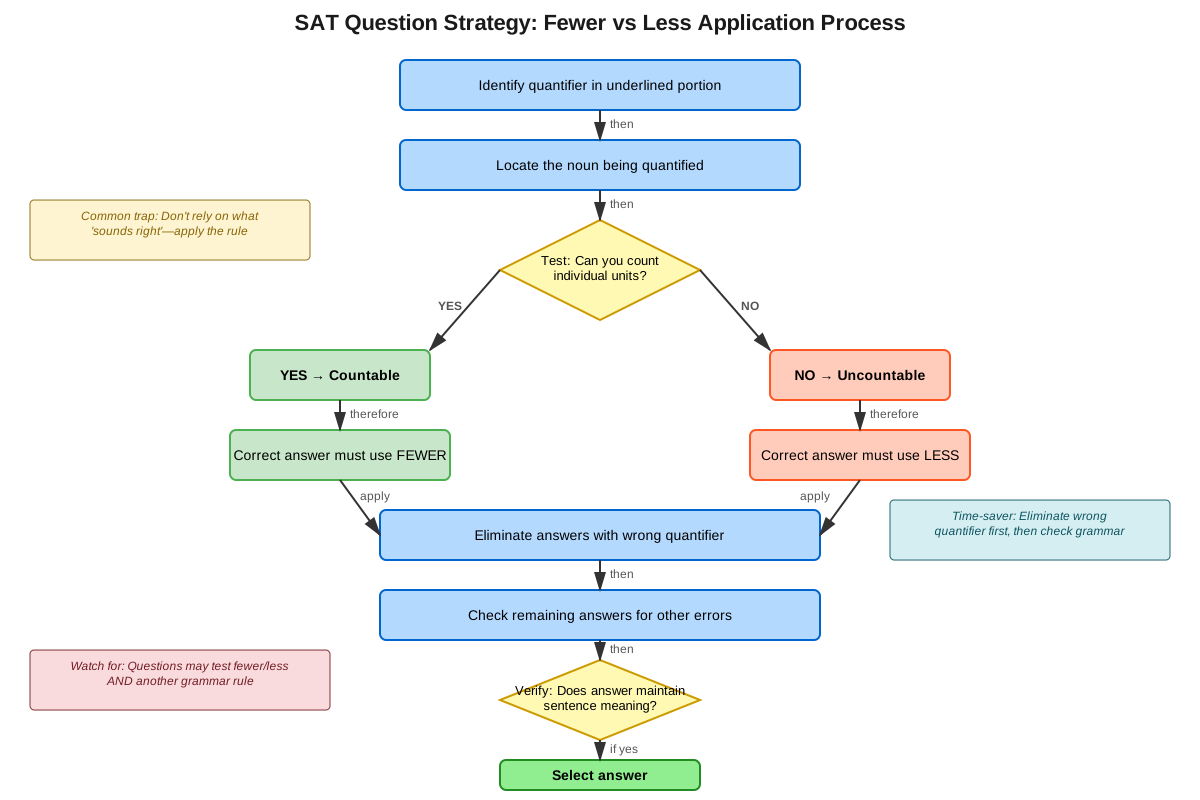
When approaching SAT fewer vs less questions, follow this systematic process:
Step 1: Locate the noun being quantified
Identify exactly which noun the quantifier modifies. Sometimes the noun appears immediately after the quantifier; other times, additional words intervene. Ensure you've identified the correct noun before proceeding.
Step 2: Apply the pluralization test
Ask: "Can I put a number before this noun and make it plural?" If yes, the noun is countable and requires "fewer." If no, it's uncountable and requires "less."
Step 3: Watch for trigger words
Certain words signal countability:
- Countable indicators: number, many, several, various, individual
- Uncountable indicators: amount, much, quantity (when referring to mass), degree
If you see "number of" in the sentence, the noun is countable; if you see "amount of," it's uncountable.
Step 4: Eliminate based on formality
If an answer choice uses "less" with a clearly countable plural noun (like "less students" or "less problems"), eliminate it immediately. The SAT specifically includes these informal constructions as distractors.
Step 5: Consider context for ambiguous nouns
For nouns that can be either countable or uncountable (time, money, distance), examine how the sentence uses them. Are they referring to discrete units or continuous measurement?
Exam Tip: When two answer choices differ only in "fewer" versus "less," the question is specifically testing this distinction. Focus entirely on noun countability—other grammatical considerations are likely already correct in both options.
Time allocation: These questions should take 20-30 seconds once you've mastered the concept. The analysis is straightforward: identify the noun, determine countability, select the appropriate quantifier. Don't overthink or second-guess based on what "sounds better"—apply the rule mechanically.
Memory Techniques
The COUNT Mnemonic:
- Countable nouns
- Obviously plural
- Use "fewer"
- Not countable?
- Then use "less"
Visualization Strategy: Picture a grocery store checkout. The sign reading "10 items or fewer" (grammatically correct) shows discrete, countable items you can pick up individually—apples, boxes, cans. Now picture a bulk bin with flour or rice—you measure "less" of this substance, not "fewer" grains. This concrete image helps distinguish countable items from measurable substances.
The Pairing Anchor: Remember that "fewer" and "number" both contain the letter combination "er," while "less" and "amount" both end in consonant clusters. This phonetic connection reinforces the correct pairings:
- Fewer → number (both have "er")
- Less → amount (both end in consonant + t/s)
The Question Test: Train yourself to automatically ask "How many?" or "How much?" when you see a quantifier. "How many?" signals countable (fewer); "How much?" signals uncountable (less). This becomes an instant mental check.
Summary
The fewer vs less distinction represents a fundamental rule of Standard English grammar that the SAT tests consistently. The entire concept rests on a single principle: noun countability. Fewer modifies countable nouns—discrete items that can be enumerated and pluralized (students, questions, errors). Less modifies uncountable nouns—substances, abstractions, or collective concepts that cannot be separated into individual units (water, information, time as duration). Success on SAT questions requires identifying the noun being quantified, determining whether it's countable or uncountable, and selecting the appropriate quantifier. While informal speech often uses "less" for both categories, formal written English maintains this distinction rigorously, making it a reliable test of grammatical sophistication. The rule extends to related quantifier pairs (number/amount, many/much) and applies consistently across comparative and superlative forms. Mastering this topic requires moving beyond what "sounds right" to what formal grammar rules dictate—a shift that characterizes successful SAT performance across all Standard English Conventions questions.
Key Takeaways
- Fewer is for countable nouns (items you can enumerate); less is for uncountable nouns (substances or concepts you measure)
- Apply the pluralization test: if you can put a number before the noun and make it plural, use "fewer"
- Common countable nouns include people, students, questions, errors, and problems—all require "fewer"
- Common uncountable nouns include time (as duration), money (as a concept), information, and abstract concepts—all require "less"
- The SAT specifically tests this distinction by offering informal constructions (like "less people") as distractors
- Related quantifier pairs follow the same pattern: "number" pairs with "fewer," "amount" pairs with "less"
- Context matters for ambiguous nouns—determine whether the sentence treats them as discrete units or continuous quantities
Related Topics
Quantifier Agreement (Number vs. Amount): This parallel distinction reinforces the countable/uncountable principle. "Number" pairs with countable nouns and "fewer," while "amount" pairs with uncountable nouns and "less." Mastering fewer/less provides the foundation for this related concept.
Subject-Verb Agreement with Collective Nouns: Understanding which nouns are countable versus uncountable helps determine whether collective nouns take singular or plural verbs, extending the analytical skills developed in this topic.
Pronoun-Antecedent Agreement: The ability to identify noun types (countable/uncountable, singular/plural) directly supports selecting appropriate pronouns, making fewer/less mastery foundational for broader agreement rules.
Parallel Structure with Quantifiers: Advanced questions may test whether quantifiers maintain parallel structure across a sentence or list, requiring consistent application of the fewer/less distinction.
Practice CTA
Now that you've mastered the fewer vs less distinction, reinforce your understanding by completing the practice questions and reviewing the flashcards. These exercises will help you internalize the countability test and develop the automatic recognition needed for quick, confident answers on test day. Remember: every question you practice strengthens the neural pathways that make these distinctions second nature. The difference between a good score and a great score often comes down to mastering high-frequency topics like this one—you're building the foundation for SAT success, one concept at a time!
Sign up free to keep reading
Create a free AnvayaPrep account to finish this SAT guide on Fewer vs less — plus flashcards and practice questions.