Overview
Misplaced modifiers represent one of the most frequently tested grammatical concepts in the SAT Reading and Writing (RW) section. A modifier is a word, phrase, or clause that describes, clarifies, or provides additional information about another element in a sentence. When a modifier is positioned incorrectly—too far from the word it's meant to modify or placed ambiguously—it creates confusion about what the writer intended to communicate. The SAT tests students' ability to recognize these placement errors and select revisions that position modifiers logically and clearly next to the words they describe.
Understanding misplaced modifiers is essential for SAT success because these questions appear consistently across multiple test administrations, typically in 2-4 questions per exam. The College Board emphasizes clarity and precision in writing, and modifier placement directly impacts whether a sentence communicates its intended meaning effectively. Students who master this concept gain a significant advantage, as these questions follow predictable patterns and can be answered quickly once the underlying principles are understood.
Within the broader context of Form, Structure, and Sense, misplaced modifiers connect to fundamental principles of sentence construction and logical expression. This topic intersects with subject-verb agreement, pronoun reference, and parallel structure—all elements that contribute to clear, effective communication. Mastering sat misplaced modifiers strengthens overall grammatical intuition and improves performance across multiple question types in the rw section, making it a high-yield area for focused study.
Learning Objectives
- [ ] Identify key features of misplaced modifiers in sentences
- [ ] Explain how misplaced modifiers appears on the SAT
- [ ] Apply misplaced modifiers to answer SAT-style questions
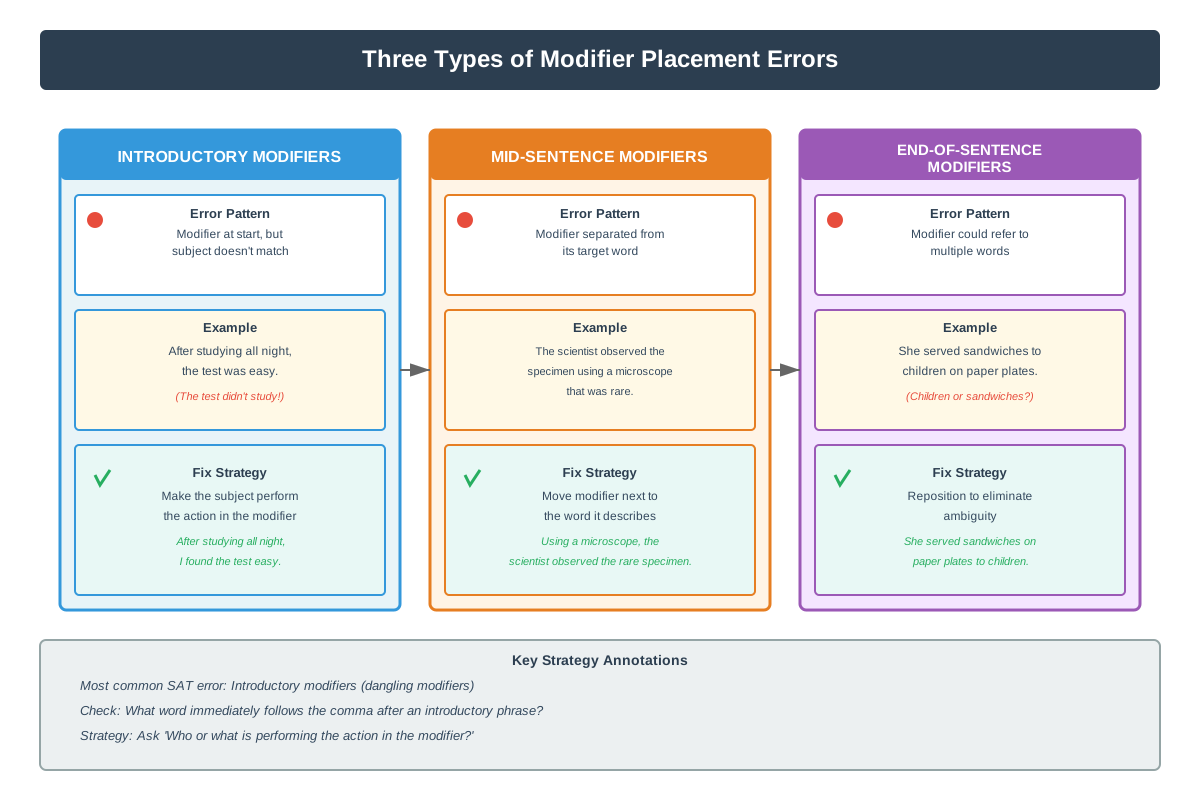
- [ ] Distinguish between different types of modifier placement errors (introductory, mid-sentence, and end-of-sentence)
- [ ] Evaluate multiple answer choices to determine which placement creates the clearest, most logical sentence
- [ ] Recognize dangling modifiers as a specific subcategory of placement errors
Prerequisites
- Basic sentence structure: Understanding subjects, verbs, and objects is necessary to identify what element a modifier should logically describe
- Parts of speech recognition: Knowing adjectives, adverbs, phrases, and clauses helps identify modifying elements in sentences
- Logical reasoning skills: The ability to determine intended meaning versus actual meaning is crucial for spotting modifier errors
Why This Topic Matters
Misplaced modifiers appear in real-world writing across professional, academic, and everyday contexts. In professional communication, modifier errors can create embarrassing misunderstandings or undermine credibility. In academic writing, precise modifier placement ensures that complex ideas are communicated accurately. The ability to identify and correct these errors demonstrates sophisticated command of written English—a skill valued by colleges and employers alike.
On the SAT, modifier questions typically appear 2-4 times per test, representing approximately 5-10% of the Reading and Writing section. These questions most commonly appear in the "Standard English Conventions" category, though they also intersect with "Expression of Ideas" when modifier placement affects clarity and style. The College Board consistently tests modifier placement because it directly measures a student's ability to recognize and produce clear, effective prose.
SAT misplaced modifiers questions typically present a sentence with an underlined portion, followed by four answer choices. The original sentence contains a modifier placement error, and students must select the revision that positions the modifier logically. These questions often appear in passages about science, history, or social studies, where complex information requires precise expression. Common scenarios include introductory participial phrases, relative clauses, and prepositional phrases that need to be positioned adjacent to the words they modify.
Core Concepts
What Are Modifiers?
A modifier is any word, phrase, or clause that provides descriptive information about another element in a sentence. Modifiers answer questions like "which one?", "what kind?", "how?", "when?", or "where?" about the words they describe. Single-word modifiers include adjectives (describing nouns) and adverbs (describing verbs, adjectives, or other adverbs). Phrase and clause modifiers include participial phrases, prepositional phrases, infinitive phrases, and relative clauses.
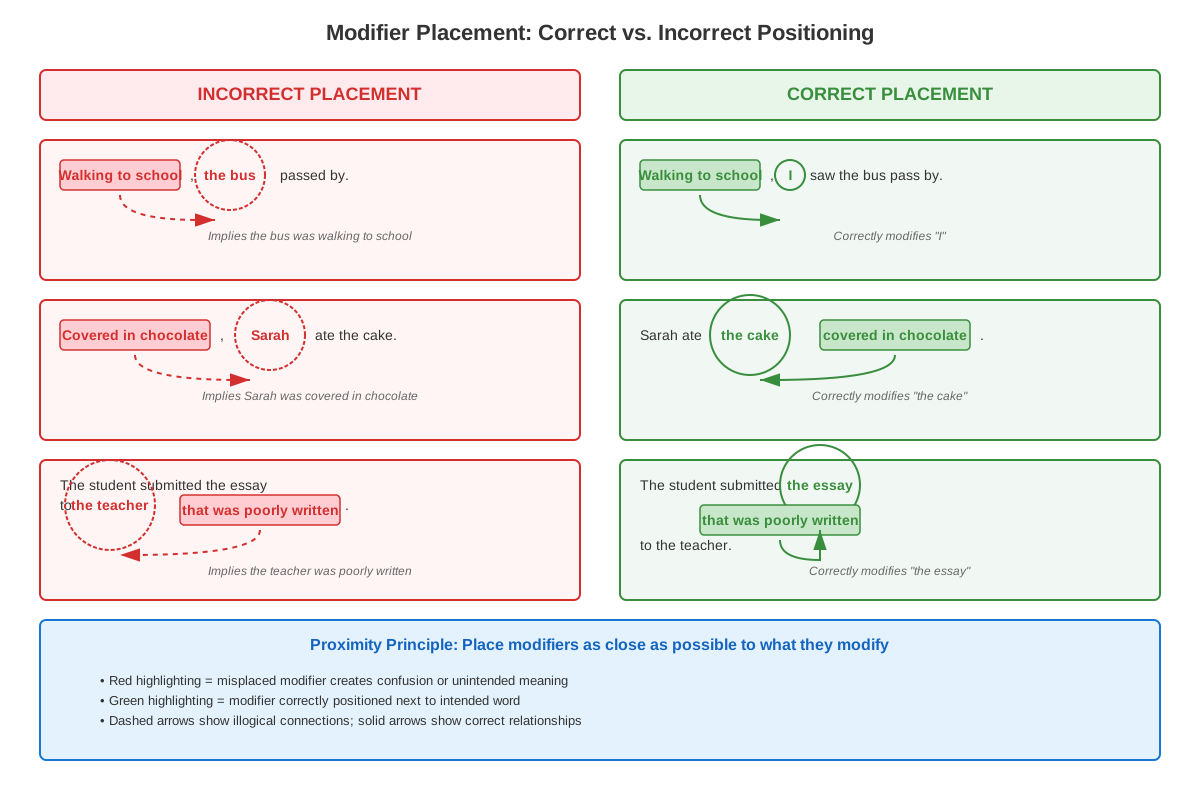
For a sentence to communicate clearly, modifiers must be positioned as close as possible to the words they modify. When this proximity principle is violated, the sentence becomes ambiguous, illogical, or unintentionally humorous.
Types of Misplaced Modifiers
Introductory Modifier Errors
The most common type of modifier error on the SAT involves introductory modifying phrases. These phrases appear at the beginning of a sentence, set off by a comma, and must logically describe the subject that immediately follows the comma.
Incorrect: Walking through the museum, the ancient artifacts fascinated me.
Correct: Walking through the museum, I was fascinated by the ancient artifacts.
In the incorrect version, the introductory phrase "Walking through the museum" appears to modify "ancient artifacts," suggesting that the artifacts themselves were walking. The subject immediately following the comma must be the person or thing performing the action described in the introductory phrase.
Mid-Sentence Modifier Errors
Modifiers placed in the middle of sentences can create ambiguity when they could logically modify words on either side. These squinting modifiers leave readers uncertain about the writer's intended meaning.
Ambiguous: Students who study regularly often perform better on exams.
Clear: Students who regularly study often perform better on exams.
Clear: Students who study often regularly perform better on exams.
The placement of "regularly" determines whether it modifies "study" or "perform better," changing the sentence's meaning.
End-of-Sentence Modifier Errors
Modifiers placed at the end of sentences must clearly connect to the appropriate word earlier in the sentence. When multiple potential antecedents exist, confusion results.
Unclear: The professor discussed the research with students that was groundbreaking.
Clear: The professor discussed the groundbreaking research with students.
The relative clause "that was groundbreaking" should modify "research," not "students," so it must be positioned adjacent to the word it describes.
Dangling Modifiers
A dangling modifier is a specific type of error where the word being modified doesn't actually appear in the sentence at all. This creates logical impossibility, as the modifier describes something that exists only in the writer's mind, not on the page.
Dangling: After studying for hours, the test seemed easier.
Correct: After studying for hours, I found the test seemed easier.
Correct: After I studied for hours, the test seemed easier.
In the dangling version, "the test" cannot logically perform the action "studying for hours." The person who studied must appear as the subject following the comma.
The Proximity Principle
The fundamental rule governing modifier placement is the proximity principle: modifiers should be positioned as close as possible to the words they modify. This principle applies regardless of modifier type or sentence position. When evaluating answer choices on the SAT, the correct option will always place the modifier adjacent to its logical target, eliminating ambiguity and creating clear meaning.
Modifier Placement and Sentence Logic
Beyond grammatical correctness, modifier placement affects sentence logic and meaning. Consider how placement changes meaning:
| Sentence | Meaning |
|---|---|
| Only I gave Sarah five dollars. | No one else gave her money; I was the sole giver. |
| I only gave Sarah five dollars. | I gave her money but did nothing else for her. |
| I gave only Sarah five dollars. | Sarah was the only recipient; I gave no one else money. |
| I gave Sarah only five dollars. | The amount was limited to five dollars, nothing more. |
The word "only" modifies different elements depending on its position, demonstrating how placement fundamentally alters meaning. SAT questions exploit this principle by testing whether students can identify which placement creates the intended logical relationship.
Concept Relationships
The concept of misplaced modifiers connects directly to fundamental principles of sentence structure. Understanding subjects and predicates enables identification of what element should logically follow an introductory modifier. Knowledge of phrases and clauses helps recognize modifying elements that need proper placement.
Relationship map:
- Sentence structure knowledge → enables identification of subjects and modifiers → allows recognition of misplaced modifiers → leads to selection of correct answer choices
- Logical reasoning skills → support evaluation of intended meaning → help distinguish between grammatically possible but logically flawed placements → improve accuracy on ambiguous cases
- Proximity principle → governs all modifier placement → applies to introductory, mid-sentence, and end-of-sentence modifiers → serves as universal test for correctness
Misplaced modifiers also connect to broader writing principles tested in the Expression of Ideas questions. Clear modifier placement contributes to effective style, logical organization, and precise communication—all valued by the SAT. Students who master modifier placement often see improvement in their ability to evaluate sentence effectiveness and rhetorical choices.
High-Yield Facts
⭐ Introductory modifying phrases must be followed immediately by the word they logically describe—this is the most frequently tested modifier concept on the SAT.
⭐ The subject following an introductory comma must be able to perform the action described in the introductory phrase—if it cannot, the modifier is misplaced or dangling.
⭐ Modifiers should be positioned as close as possible to the words they modify—distance creates ambiguity and potential misreading.
⭐ Dangling modifiers occur when the word being modified doesn't appear in the sentence at all—the correct answer will add the missing element.
⭐ Relative clauses (beginning with who, which, that) must immediately follow the nouns they modify—separation causes confusion about what is being described.
- Participial phrases (beginning with -ing or -ed verbs) function as adjectives and must modify nouns or pronouns, not entire clauses.
- Prepositional phrases can modify either nouns or verbs, but their position determines which element they describe.
- The word "only" is a frequent source of modifier placement questions because its position dramatically changes sentence meaning.
- Adverbs can often be moved within sentences, but their placement affects emphasis and sometimes meaning.
- When evaluating answer choices, eliminate options that create new errors even if they fix the original modifier problem—the correct answer must be completely error-free.
Quick check — test yourself on Misplaced modifiers so far.
Try Flashcards →Common Misconceptions
Misconception: Any sentence with a modifier at the beginning is incorrect. → Correction: Introductory modifiers are grammatically correct when they logically describe the subject that immediately follows the comma. The error occurs only when the subject cannot logically perform the action described in the modifier.
Misconception: Modifiers can describe the general idea of a sentence rather than a specific word. → Correction: Effective modifiers must describe specific nouns, pronouns, verbs, adjectives, or adverbs—not vague concepts or entire clauses. When a modifier seems to describe a general idea, it's usually dangling.
Misconception: Longer sentences are more likely to contain modifier errors. → Correction: Sentence length doesn't determine whether modifiers are correctly placed. Short sentences can contain modifier errors, and long sentences can have perfect modifier placement. Focus on logical relationships, not sentence length.
Misconception: If a sentence sounds acceptable when read aloud, its modifiers are correctly placed. → Correction: Many modifier errors sound acceptable in casual speech but violate written English conventions. The SAT tests formal written English, where modifier placement must be logically precise, not just conversationally acceptable.
Misconception: Passive voice constructions automatically create modifier errors. → Correction: Passive voice doesn't inherently cause modifier problems, though it can make errors more likely. The key is ensuring that the subject following an introductory modifier can logically perform the action described, whether the sentence uses active or passive voice.
Misconception: Modifiers can be placed anywhere in a sentence as long as the meaning is eventually clear. → Correction: While readers might eventually figure out the intended meaning, the SAT requires immediate clarity. Modifiers must be positioned to eliminate any ambiguity or initial misreading, even if context would eventually clarify the meaning.
Worked Examples
Example 1: Introductory Participial Phrase
Question: Having studied marine biology for decades, the ocean's ecosystems were thoroughly understood by Dr. Martinez.
Which choice best revises the underlined portion?
A) NO CHANGE
B) Dr. Martinez thoroughly understood the ocean's ecosystems
C) the ocean's ecosystems became thoroughly understood to Dr. Martinez
D) a thorough understanding of the ocean's ecosystems was achieved by Dr. Martinez
Solution Process:
Step 1: Identify the introductory modifier. "Having studied marine biology for decades" is a participial phrase that must describe the subject immediately following the comma.
Step 2: Determine what can logically perform the action. Who or what "studied marine biology for decades"? Dr. Martinez studied, not "the ocean's ecosystems."
Step 3: Evaluate each answer choice:
- Choice A: "the ocean's ecosystems" cannot study marine biology—this is a misplaced modifier error
- Choice B: "Dr. Martinez" can logically study marine biology—this correctly places the modifier
- Choice C: "the ocean's ecosystems" still cannot study—this doesn't fix the error
- Choice D: "a thorough understanding" cannot study—this creates a dangling modifier
Step 4: Verify the correct answer. Choice B places Dr. Martinez immediately after the comma, creating a logical connection between the modifier and the subject. The sentence now clearly communicates that Dr. Martinez studied and therefore understood the ecosystems.
Answer: B
Connection to learning objectives: This example demonstrates how to identify the key feature of misplaced modifiers (illogical subject following introductory phrase) and apply the correction strategy to select the right answer choice.
Example 2: Relative Clause Placement
Question: The archaeologist examined the pottery fragments with her assistant that dated to the Bronze Age.
Which choice creates the clearest, most logical sentence?
A) NO CHANGE
B) The archaeologist examined with her assistant the pottery fragments that dated to the Bronze Age
C) The archaeologist, with her assistant, examined the pottery fragments that dated to the Bronze Age
D) With her assistant, the archaeologist examined the pottery fragments that dated to the Bronze Age
Solution Process:
Step 1: Identify the modifier. "that dated to the Bronze Age" is a relative clause that should describe the pottery fragments, not the assistant.
Step 2: Recognize the problem. In the original sentence, "that dated to the Bronze Age" immediately follows "her assistant," suggesting the assistant dated to the Bronze Age—an illogical meaning.
Step 3: Evaluate each answer choice:
- Choice A: The relative clause follows "assistant," creating the illogical meaning described above
- Choice B: This awkwardly splits "examined" from "the pottery fragments" and still places "that dated" somewhat ambiguously
- Choice C: This places "with her assistant" as a parenthetical element and positions "that dated to the Bronze Age" immediately after "pottery fragments"—clear and logical
- Choice D: This fixes the modifier problem but changes emphasis by making "with her assistant" an introductory element, which is acceptable but less direct than C
Step 4: Select the best answer. Choice C most clearly and directly places the relative clause adjacent to "pottery fragments" while maintaining natural sentence flow.
Answer: C
Connection to learning objectives: This example shows how to distinguish between different types of modifier placement errors (relative clause vs. introductory phrase) and evaluate multiple answer choices to determine which creates the clearest meaning.
Exam Strategy
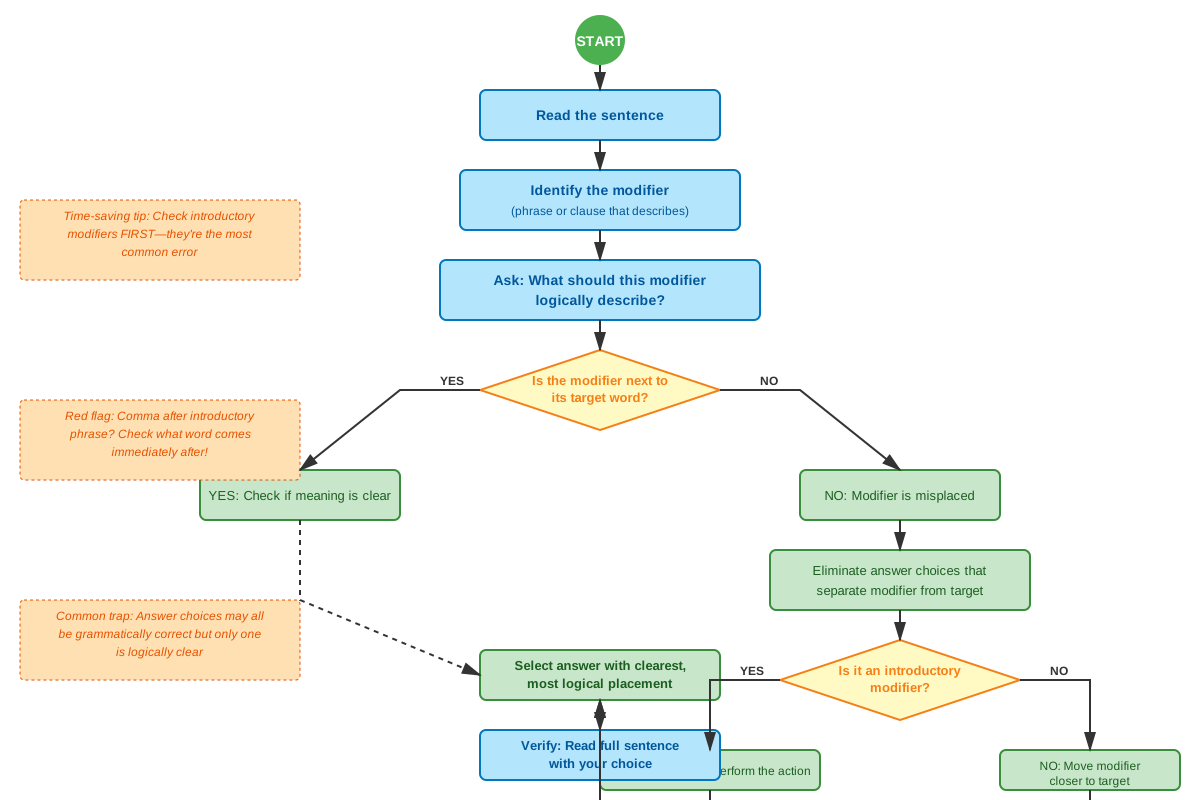
When approaching sat misplaced modifiers questions, follow this systematic process:
Step 1: Identify the modifier. Look for introductory phrases before commas, relative clauses (who, which, that), participial phrases (-ing or -ed verb forms), and prepositional phrases. These are the most common modifying elements tested.
Step 2: Locate what the modifier describes. Ask yourself: What word or phrase is this modifier meant to describe? For introductory modifiers, the answer must be the subject immediately following the comma.
Step 3: Check logical connection. Can the identified word logically perform the action or possess the quality described by the modifier? If not, you've found a modifier error.
Step 4: Eliminate illogical choices. Cross out any answer choice that maintains the illogical relationship or creates a new modifier error.
Step 5: Verify the remaining choices. Ensure the correct answer doesn't introduce new grammatical errors (subject-verb disagreement, pronoun errors, etc.) while fixing the modifier problem.
Exam Tip: Trigger phrases to watch for include introductory participial phrases (beginning with -ing or -ed verbs), "only" and other limiting modifiers, and relative clauses separated from their antecedents. When you see a comma after an introductory phrase, immediately check whether the subject can logically perform the action described.
Time allocation: Modifier questions should take 30-45 seconds once you've mastered the concept. Spend 10-15 seconds identifying the modifier and what it should describe, then 15-20 seconds evaluating answer choices, and 5-10 seconds verifying your selection.
Process of elimination tips:
- Eliminate any choice where the subject following an introductory comma cannot perform the action described
- Eliminate choices that place relative clauses far from their antecedents
- Eliminate choices that fix the modifier error but introduce new grammatical problems
- When two choices seem grammatically correct, choose the one that creates the clearest, most direct meaning
Memory Techniques
Mnemonic for introductory modifiers: "COMMA = CAN"
After an introductory modifying phrase and comma, the subject must be something that CAN logically perform the action described.
Visualization strategy: Picture the modifier as an arrow that must point directly at the word it describes. If you have to draw the arrow across multiple words or around other sentence elements, the modifier is probably misplaced.
The "Who's doing what?" test: For any introductory phrase, ask "Who or what is doing the action described?" That answer must be the subject immediately following the comma.
Acronym for evaluation: PLACE your modifiers correctly
- Proximity: Keep modifiers close to what they modify
- Logic: Ensure the connection makes sense
- Adjacency: Position modifiers next to their targets
- Clarity: Eliminate ambiguity
- Eliminate: Remove illogical placements
The "swap test": If you can swap the modifier and the word it describes and create a logical sentence, they're correctly paired. Example: "Walking through the museum, I saw artifacts" → "I, walking through the museum, saw artifacts" (still logical, so the pairing is correct).
Summary
Misplaced modifiers represent a high-yield, predictable question type on the SAT Reading and Writing section. These errors occur when descriptive words, phrases, or clauses are positioned too far from the elements they're meant to modify, creating ambiguity or illogical meaning. The most frequently tested scenario involves introductory modifying phrases that must be followed immediately by a subject capable of performing the described action. Success on these questions requires identifying the modifier, determining what it should logically describe, and selecting the answer choice that positions the modifier adjacent to its target. The proximity principle—keeping modifiers as close as possible to the words they modify—governs all correct placements. Students who master the systematic approach of identifying modifiers, checking logical connections, and eliminating illogical placements can answer these questions quickly and accurately, gaining valuable points on a consistent question type.
Key Takeaways
- Introductory modifying phrases must be immediately followed by the subject they logically describe—this is the most tested modifier concept
- The proximity principle requires modifiers to be positioned as close as possible to the words they modify
- Dangling modifiers occur when the word being modified doesn't appear in the sentence at all
- Relative clauses (who, which, that) must immediately follow the nouns they describe
- Always ask "Who or what can logically perform this action?" when evaluating introductory modifiers
- Modifier questions appear 2-4 times per SAT, making them high-yield for focused study
- The correct answer will always create clear, unambiguous meaning by placing modifiers adjacent to their logical targets
Related Topics
Parallel Structure: Mastering modifier placement enhances understanding of parallel structure, as both concepts require maintaining consistent grammatical relationships within sentences. Parallel structure questions often involve modifiers that must be positioned consistently across list items.
Pronoun-Antecedent Agreement: Like modifiers, pronouns must clearly connect to their antecedents. The logical reasoning skills developed through modifier practice transfer directly to pronoun reference questions.
Subject-Verb Agreement: Understanding sentence subjects—essential for modifier questions—directly supports subject-verb agreement mastery, as both require identifying the true subject of a clause.
Sentence Effectiveness: Modifier placement affects not just grammatical correctness but also clarity and style, connecting to Expression of Ideas questions about effective communication.
Practice CTA
Now that you've mastered the core concepts of misplaced modifiers, it's time to cement your understanding through active practice. Attempt the practice questions to apply these strategies to SAT-style problems, and use the flashcards to reinforce key definitions and rules. Remember: modifier questions are highly predictable and appear consistently on every SAT. The time you invest in mastering this concept will pay immediate dividends on test day. Each practice question you complete strengthens your ability to spot modifier errors quickly and select correct answers confidently. You've got this!
Sign up free to keep reading
Create a free AnvayaPrep account to finish this SAT guide on Misplaced modifiers — plus flashcards and practice questions.