Overview
Modifier errors represent one of the most frequently tested grammatical concepts in the SAT Reading and Writing (RW) section. These errors occur when a descriptive word, phrase, or clause is incorrectly positioned in a sentence, creating confusion about what is being modified. On the SAT, modifier errors typically appear in questions that ask students to identify the most grammatically correct version of a sentence or to revise a sentence for clarity and precision.
Understanding modifier errors is essential for SAT success because these questions appear consistently across multiple test administrations, often accounting for 2-4 questions per exam. The College Board tests modifier errors because they assess a student's ability to construct clear, unambiguous sentences—a fundamental skill for college-level writing. Students who master this topic gain a significant advantage, as modifier questions follow predictable patterns and can be answered quickly and accurately with the right approach.
Modifier errors connect to broader concepts in sentence structure, including subject-verb relationships, parallel structure, and logical sentence construction. Mastering modifiers strengthens overall grammatical intuition and improves performance on other question types within the Form, Structure, and Sense unit. The ability to identify and correct modifier errors also enhances reading comprehension, as students become more attuned to how sentence elements relate to one another.
Learning Objectives
- [ ] Identify key features of modifier errors
- [ ] Explain how modifier errors appears on the SAT
- [ ] Apply modifier errors to answer SAT-style questions
- [ ] Distinguish between dangling modifiers and misplaced modifiers
- [ ] Recognize correct modifier placement in complex sentence structures
- [ ] Evaluate multiple answer choices to select the option with proper modification
Prerequisites
- Basic sentence structure: Understanding subjects, verbs, and objects is necessary to identify what a modifier should logically describe
- Parts of speech: Recognizing adjectives, adverbs, phrases, and clauses helps identify modifying elements in sentences
- Clause types: Distinguishing between independent and dependent clauses aids in understanding how introductory modifiers function
- Logical relationships: The ability to determine logical connections between sentence elements is fundamental to spotting modification errors
Why This Topic Matters
Modifier errors test a student's ability to construct clear, professional writing—a skill that extends far beyond standardized testing. In academic writing, professional communication, and everyday correspondence, proper modifier placement ensures that ideas are conveyed precisely and without ambiguity. Misplaced modifiers can create unintentionally humorous or confusing statements that undermine credibility.
On the SAT, modifier questions appear with high frequency, typically 2-4 times per test in the Reading and Writing section. These questions usually present a sentence with an underlined portion and ask students to select the revision that best maintains clarity and grammatical correctness. The College Board particularly favors testing dangling modifiers at the beginning of sentences, where an introductory phrase must logically connect to the subject that immediately follows it.
Common SAT passage contexts for modifier errors include biographical narratives, scientific descriptions, historical accounts, and procedural explanations. The test often embeds modifier errors in sentences describing actions, characteristics, or temporal relationships. Students who recognize the patterns of modifier errors can quickly eliminate incorrect answer choices and select the grammatically sound option, often completing these questions in under 30 seconds.
Core Concepts
What Are Modifiers?
A modifier is a word, phrase, or clause that describes, clarifies, or provides additional information about another element in a sentence. Modifiers can be single words (adjectives and adverbs) or groups of words (phrases and clauses). The fundamental rule governing modifiers is that they must be placed as close as possible to the word or phrase they modify to avoid confusion.
Examples of modifiers:
- Adjective: "The red car" (modifies "car")
- Adverb: "She ran quickly" (modifies "ran")
- Phrase: "Covered in snow, the mountain looked majestic" (modifies "mountain")
- Clause: "The book that I borrowed is excellent" (modifies "book")
Dangling Modifiers
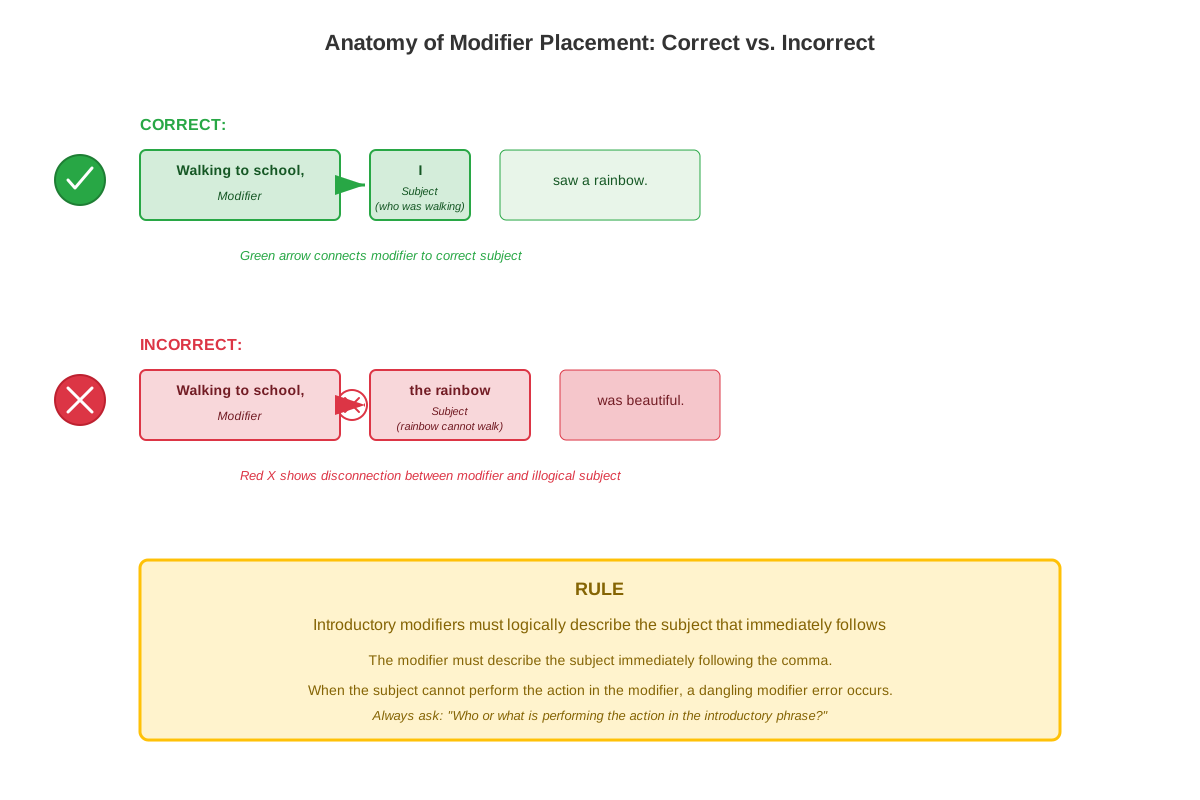
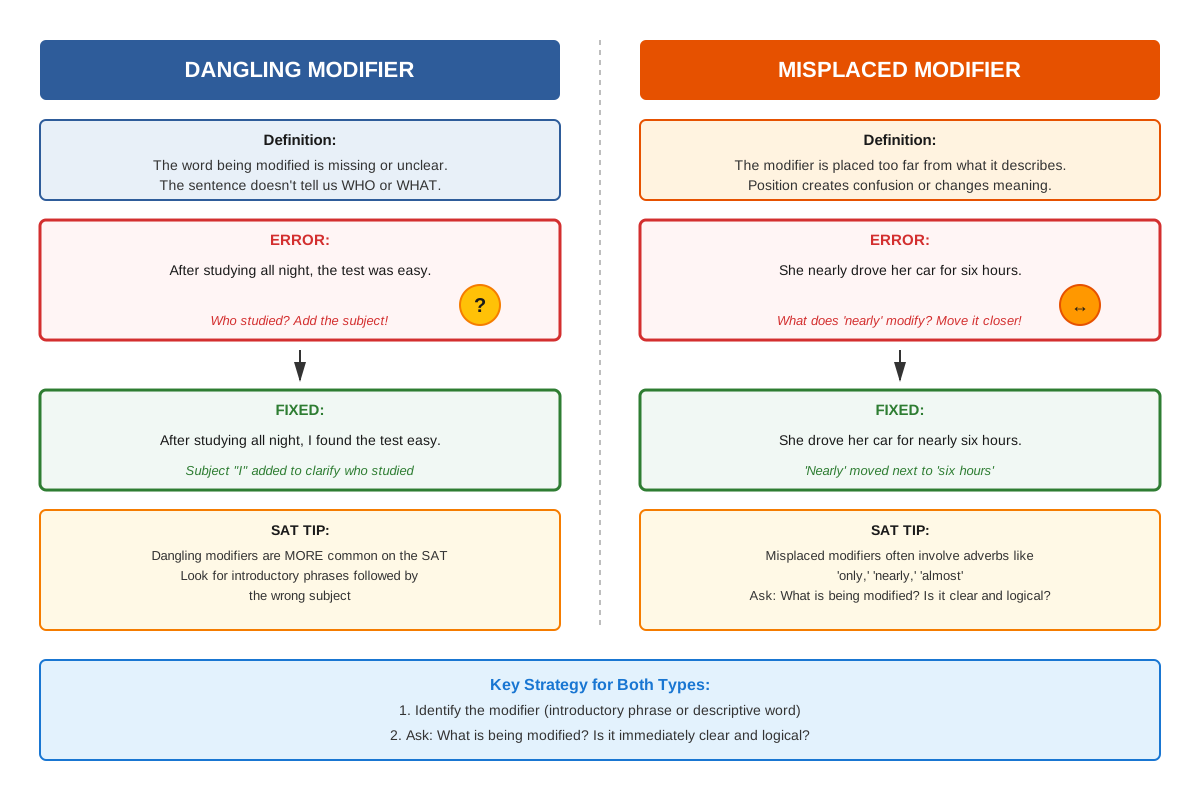
A dangling modifier occurs when a modifying phrase or clause does not logically connect to any word in the sentence, or when the word it should modify is missing entirely. This error most commonly appears with introductory phrases, particularly those beginning with present participles (-ing verbs), past participles (-ed verbs), or infinitives (to + verb).
Structure of a dangling modifier error:
[Introductory Modifier], [Subject] [Verb] [Rest of sentence]The subject immediately following the comma must be what the introductory modifier describes. If it isn't, the modifier "dangles" without a clear connection.
Incorrect example: "Walking through the park, the flowers were beautiful."
- The introductory phrase "Walking through the park" suggests that the flowers were walking, which is illogical.
Correct version: "Walking through the park, I noticed the beautiful flowers."
- Now the subject "I" logically performs the action of walking.
Misplaced Modifiers
A misplaced modifier occurs when a modifier is positioned too far from the word it modifies, or when its placement creates ambiguity about what it describes. Unlike dangling modifiers, misplaced modifiers do have a word to modify in the sentence, but the placement causes confusion.
Common types of misplaced modifiers:
| Type | Description | Example (Incorrect) | Correction |
|---|---|---|---|
| Limiting modifiers | Words like "only," "almost," "nearly," "just" | "She only ate vegetables yesterday" (implies she did nothing but eat) | "She ate only vegetables yesterday" |
| Squinting modifiers | Modifiers that could describe words on either side | "Students who study frequently succeed" (frequently study or frequently succeed?) | "Students who frequently study succeed" |
| Misplaced phrases | Phrases separated from what they modify | "The dog belongs to my neighbor with brown spots" | "The dog with brown spots belongs to my neighbor" |
Introductory Modifying Phrases
The SAT heavily tests introductory modifying phrases, which appear at the beginning of a sentence before the main clause. These phrases set up context, describe circumstances, or provide additional information about the subject.
Three main types tested on the SAT:
- Participial phrases (beginning with -ing or -ed verbs):
- "Having completed the assignment, Maria submitted her work."
- "Exhausted from the journey, the travelers rested."
- Prepositional phrases (beginning with prepositions):
- "At the age of sixteen, she published her first novel."
- "During the experiment, the scientists observed unusual results."
- Infinitive phrases (beginning with "to" + verb):
- "To improve her skills, she practiced daily."
- "To understand the theory, students must review the fundamentals."
Critical rule: Whatever immediately follows the comma after an introductory phrase must be the noun that the phrase logically modifies.
Relative Clause Modifiers
Relative clauses begin with relative pronouns (who, whom, whose, which, that) and modify nouns. These clauses must be positioned immediately after the noun they modify to maintain clarity.
Incorrect: "The report was filed by the analyst that contained errors."
- This suggests the analyst contained errors.
Correct: "The report that contained errors was filed by the analyst."
- Now the relative clause clearly modifies "report."
Appositive Modifiers
An appositive is a noun or noun phrase that renames or provides additional information about another noun. Appositives must be placed directly next to the noun they describe.
Correct usage: "Dr. Chen, a renowned physicist, delivered the lecture."
- The appositive "a renowned physicist" clearly describes Dr. Chen.
Incorrect usage: "The lecture was delivered by Dr. Chen, a groundbreaking discovery in quantum mechanics."
- The appositive illogically describes Dr. Chen rather than the lecture's content.
Concept Relationships
The concepts within modifier errors are hierarchically related. At the foundation lies the basic principle of proximity: modifiers must be placed near what they modify. This principle branches into two main error types: dangling modifiers (where the modified element is missing or illogical) and misplaced modifiers (where the modified element exists but is too distant or ambiguous).
Relationship map:
Modifier Placement Principle
    ↓
    ├→ Dangling Modifiers (missing logical subject)
    │   ├→ Introductory participial phrases
    │   ├→ Introductory infinitive phrases
    │   └→ Introductory prepositional phrases
    │
    └→ Misplaced Modifiers (ambiguous placement)
        ├→ Limiting modifiers (only, almost, nearly)
        ├→ Relative clause modifiers (who, which, that)
        └→ Appositive modifiers
Modifier errors connect to prerequisite knowledge of sentence structure by requiring students to identify subjects, verbs, and the logical relationships between clauses. They also relate to parallel structure (another SAT topic) because both concepts involve maintaining consistent grammatical patterns. Additionally, modifier mastery supports pronoun reference questions, as both require clear antecedents and logical connections between sentence elements.
Quick check — test yourself on Modifier errors so far.
Try Flashcards →High-Yield Facts
⭐ The word immediately following an introductory modifying phrase must be what the phrase logically describes.
⭐ Dangling modifiers occur when the subject being modified is missing from the sentence entirely.
⭐ The word "only" should be placed immediately before the word or phrase it limits.
⭐ Participial phrases beginning with -ing or -ed verbs at the start of a sentence must modify the subject that follows.
⭐ Relative clauses (beginning with who, which, that) must be placed immediately after the noun they modify.
- Misplaced modifiers create ambiguity about what is being described, even when the modified element exists in the sentence.
- Limiting modifiers (only, almost, nearly, just, merely) change meaning based on their position in the sentence.
- Appositive phrases must be placed directly next to the noun they rename or describe.
- Prepositional phrases at the beginning of sentences often create dangling modifiers if the subject doesn't match.
- The SAT typically presents modifier errors in the context of biographical, scientific, or historical passages.
- Infinitive phrases (to + verb) at the beginning of sentences must describe the subject that immediately follows the comma.
- Squinting modifiers can logically modify words on either side, creating ambiguity that must be resolved through repositioning.
Common Misconceptions
Misconception: Any sentence beginning with an -ing word contains a dangling modifier.
Correction: Sentences with introductory participial phrases are correct when the subject immediately following the comma logically performs the action described in the phrase. "Running quickly, the athlete finished first" is correct because the athlete is running.
Misconception: Modifiers can be placed anywhere in a sentence as long as the modified word appears somewhere.
Correction: Modifiers must be positioned close to what they modify to avoid ambiguity. Distance between a modifier and its target creates confusion, even if the modified element exists in the sentence.
Misconception: The word "only" can be placed anywhere before the verb without changing meaning.
Correction: The position of "only" significantly changes sentence meaning. "She only ate vegetables" (did nothing but eat) differs from "She ate only vegetables" (ate nothing but vegetables).
Misconception: If a sentence sounds acceptable when read aloud, it doesn't contain a modifier error.
Correction: Many modifier errors sound acceptable in casual speech but violate formal written grammar rules tested on the SAT. Logical analysis, not just intuition, is required to identify these errors.
Misconception: Dangling modifiers only occur with -ing words at the beginning of sentences.
Correction: Dangling modifiers can occur with various introductory elements, including past participles (-ed), infinitives (to + verb), and prepositional phrases. Any introductory modifier can dangle if the subject doesn't match.
Misconception: Relative clauses can modify the nearest noun, even if it's not immediately adjacent.
Correction: Relative clauses must be placed directly after the specific noun they modify. Even one intervening word can create ambiguity or error.
Worked Examples
Example 1: Dangling Modifier with Participial Phrase
Original sentence:
"Having studied marine biology for decades, the ocean's ecosystems were well understood by Dr. Martinez."
Analysis:
- Identify the introductory modifier: "Having studied marine biology for decades"
- Determine what logically performs this action: Dr. Martinez (a person can study)
- Identify what immediately follows the comma: "the ocean's ecosystems"
- Check for logical connection: Can ecosystems study marine biology? No—this is a dangling modifier.
Correction process:
The subject immediately after the comma must be "Dr. Martinez" because she is the one who studied marine biology.
Corrected sentence:
"Having studied marine biology for decades, Dr. Martinez understood the ocean's ecosystems well."
Learning objective addressed: This example demonstrates how to identify dangling modifiers and apply the correction principle that the subject following an introductory phrase must logically perform the action described.
Example 2: Misplaced Limiting Modifier
Original sentence:
"The researcher only observed three species during the expedition."
Analysis:
- Identify the limiting modifier: "only"
- Determine current placement: before the verb "observed"
- Analyze current meaning: The researcher did nothing but observe (didn't collect, photograph, or document)
- Determine intended meaning: The researcher observed exactly three species (not four or five)
- Identify what "only" should limit: "three species"
Correction process:
Move "only" to immediately before "three species" to clarify that the limitation applies to the number of species, not the action performed.
Corrected sentence:
"The researcher observed only three species during the expedition."
Alternative correct version:
"During the expedition, the researcher observed only three species."
Learning objective addressed: This example shows how to recognize misplaced limiting modifiers and demonstrates that modifier placement directly affects sentence meaning, a key skill for SAT modifier questions.
Exam Strategy
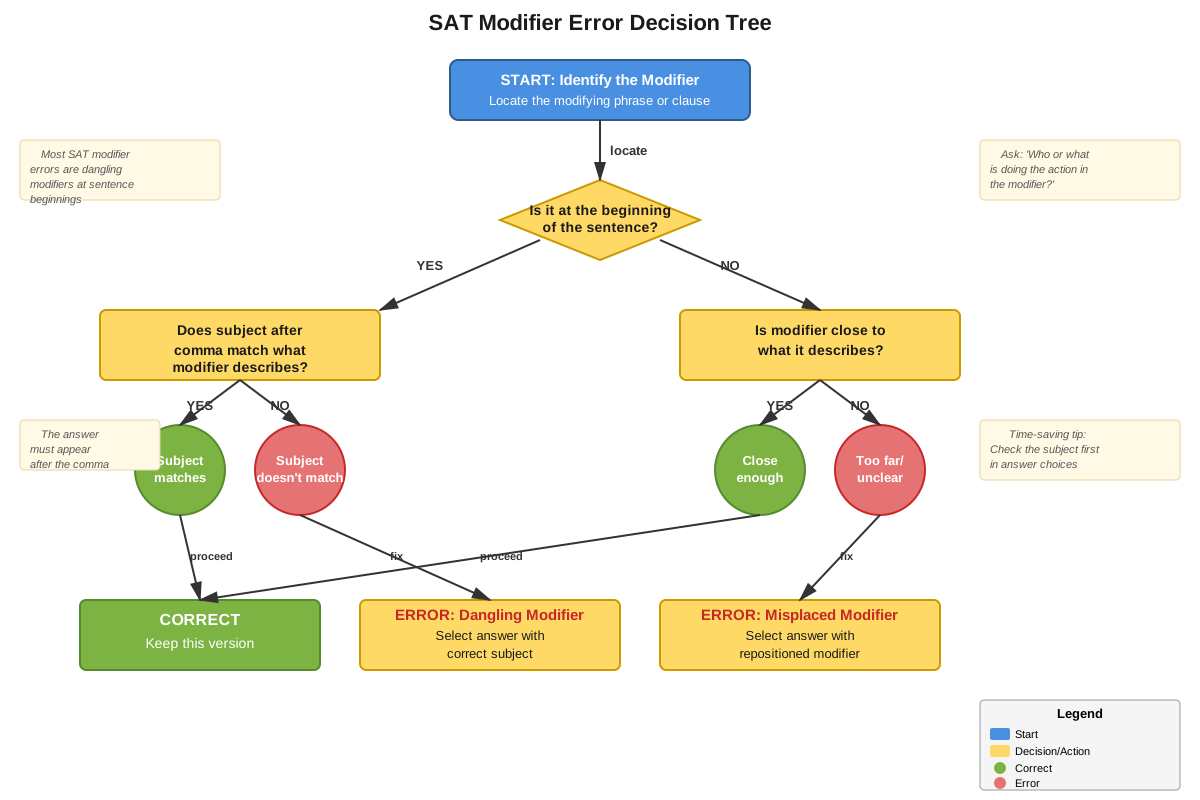
When approaching sat modifier errors questions on the SAT, follow this systematic process:
Step 1: Identify introductory elements
Immediately scan for phrases before the main clause, especially those beginning with -ing words, -ed words, "to" + verb, or prepositional phrases. These are high-probability locations for modifier errors.
Step 2: Apply the "who/what" test
For introductory modifiers, ask: "Who or what is performing this action?" The answer must be the subject immediately following the comma. If it isn't, you've found a dangling modifier.
Step 3: Check limiting modifiers
Look for words like "only," "almost," "nearly," "just," and "merely." Verify they're placed immediately before the word they limit. If not, the sentence likely contains a misplaced modifier.
Step 4: Examine relative clauses
When you see "who," "which," or "that," ensure the clause immediately follows the noun it modifies. Any separation creates ambiguity or error.
Exam Tip: The SAT rarely tests more than one type of modifier error in a single question. Once you identify the error type, focus your analysis on that specific issue.
Trigger words and phrases to watch for:
- Sentence-opening -ing words (Walking, Running, Having completed, Being)
- Sentence-opening "To" + verb (To understand, To improve, To achieve)
- Sentence-opening "At" phrases (At the age of, At the beginning)
- The word "only" anywhere in the sentence
- Relative pronouns (who, which, that) not immediately following a noun
Process of elimination strategy:
- Eliminate any answer choice where the subject following an introductory phrase doesn't logically match the modifier
- Eliminate choices where "only" or similar limiting modifiers are positioned incorrectly
- Eliminate choices where relative clauses are separated from their antecedents
- Among remaining choices, select the one with the clearest, most logical modification
Time allocation:
Modifier questions should take 30-45 seconds once you recognize the pattern. Spend 10 seconds identifying the error type, 15 seconds analyzing answer choices, and 10 seconds confirming your selection.
Memory Techniques
Mnemonic for dangling modifiers: "COMMA SUBJECT MATCH"
- After an introductory modifier and comma, the SUBJECT must MATCH what the modifier describes
Visualization technique for introductory modifiers:
Picture a bridge connecting the introductory phrase to the subject. If the bridge doesn't logically connect (e.g., "flowers" can't "walk"), the modifier dangles.
"ONLY" placement rule: "ONLY touches what it limits"
Physically imagine the word "only" touching the word it restricts. "She ate only vegetables" → "only" touches "vegetables."
Acronym for modifier error types: "DIM"
- Dangling modifiers (missing logical subject)
- Introductory phrase errors (most common SAT type)
- Misplaced modifiers (wrong position)
The "Who's doing what?" question:
For every introductory phrase, immediately ask "Who's doing what?" The answer must be the subject after the comma.
Relative clause rule: "STICK TOGETHER"
Relative clauses and their nouns must stick together like magnets—no separation allowed.
Summary
Modifier errors represent a high-yield, predictable question type on the SAT Reading and Writing section. These errors occur when descriptive elements are incorrectly positioned, creating ambiguity or illogical connections. The two main types are dangling modifiers (where the modified element is missing or illogical) and misplaced modifiers (where placement creates confusion). The SAT most frequently tests introductory modifying phrases, particularly those beginning with participles, infinitives, or prepositions. The fundamental rule is that the subject immediately following an introductory modifier must logically perform or be described by that modifier. Success on these questions requires systematic analysis: identify the modifier, determine what it should describe, verify the subject matches, and eliminate answer choices that violate modification principles. Mastering modifier errors provides quick, reliable points on the SAT and strengthens overall grammatical precision.
Key Takeaways
- The subject immediately following an introductory modifying phrase must be what the phrase logically describes—this is the most tested modifier concept on the SAT
- Dangling modifiers occur when the word being modified is missing or illogical; misplaced modifiers occur when placement creates ambiguity
- Limiting modifiers like "only" must be placed immediately before the word they limit to convey the intended meaning
- Relative clauses (who, which, that) must be positioned directly after the noun they modify without intervening words
- Introductory participial phrases (-ing and -ed verbs) are the highest-yield modifier error type on the SAT
- Systematic analysis beats intuition: always identify the modifier, determine what it should describe, and verify logical connection
- Modifier questions follow predictable patterns and can be answered quickly once you recognize the error type
Related Topics
Parallel Structure: Modifier mastery connects to parallel structure because both require maintaining consistent grammatical patterns and logical relationships between sentence elements. Understanding modifiers helps identify when parallel elements are improperly modified.
Pronoun Reference: Like modifiers, pronouns must have clear antecedents. The skills used to identify what a modifier describes transfer directly to determining what a pronoun refers to.
Subject-Verb Agreement: Correctly identifying subjects (necessary for modifier questions) is also essential for subject-verb agreement questions. Modifier mastery strengthens subject identification skills.
Sentence Structure and Boundaries: Understanding how clauses and phrases function within sentences supports both modifier analysis and comma splice/fragment identification.
Logical Comparison: Both modifier errors and comparison errors require students to verify that sentence elements are logically connected and clearly expressed.
Practice CTA
Now that you understand the principles of modifier errors, it's time to reinforce your learning through active practice. Complete the practice questions to test your ability to identify and correct modifier errors under timed conditions. Use the flashcards to memorize key rules and trigger words that signal potential errors. Remember: modifier questions are among the most predictable on the SAT—consistent practice transforms them into quick, reliable points. Each practice question you complete strengthens your pattern recognition and builds the confidence needed for test day success. Start practicing now to master this high-yield topic!
Sign up free to keep reading
Create a free AnvayaPrep account to finish this SAT guide on Modifier errors — plus flashcards and practice questions.