Overview
Plural nouns represent one of the most frequently tested grammatical concepts in the SAT Reading and Writing section. While forming plurals might seem straightforward—simply add an "s" to most words—the SAT specifically tests students' ability to recognize when plural forms are appropriate in context, distinguish between singular and plural constructions, and identify errors in subject-verb agreement and pronoun-antecedent relationships that stem from plural noun usage. Understanding plural noun conventions is essential not only for answering direct grammar questions but also for comprehending complex passages where clarity depends on correctly identifying whether authors are discussing one entity or multiple entities.
The SAT RW section embeds plural noun questions within its Standard English Conventions domain, where they appear in approximately 15-20% of grammar-focused items. These questions rarely ask students to simply identify whether a noun is singular or plural in isolation. Instead, the exam tests whether students can recognize agreement errors, choose contextually appropriate forms, and understand how plural nouns interact with other sentence elements like verbs, pronouns, and modifiers. Mastery of this topic directly impacts performance on questions involving subject-verb agreement, pronoun clarity, and logical consistency within sentences and paragraphs.
Within the broader framework of Form, Structure, and Sense, plural nouns serve as foundational building blocks for sentence construction and meaning. They connect intimately with verb conjugation, pronoun usage, possessive forms, and even punctuation (particularly apostrophe placement). Students who thoroughly understand plural noun conventions gain a significant advantage in quickly identifying errors and selecting correct answers, often eliminating two or three incorrect options within seconds of reading a question.
Learning Objectives
- [ ] Identify key features of plural nouns and their formation patterns
- [ ] Explain how plural nouns appears on the SAT and in what question formats
- [ ] Apply plural nouns to answer SAT-style questions with accuracy and efficiency
- [ ] Distinguish between regular and irregular plural formations in context
- [ ] Recognize and correct subject-verb agreement errors involving plural nouns
- [ ] Evaluate pronoun-antecedent agreement when plural nouns serve as antecedents
- [ ] Analyze contextual clues to determine whether singular or plural forms are appropriate
Prerequisites
- Basic parts of speech identification: Students must recognize nouns as words that name people, places, things, or ideas, as plural noun questions require first identifying the noun in question.
- Subject-verb relationship fundamentals: Understanding that subjects and verbs must agree in number is essential, since plural noun errors often manifest as agreement problems.
- Sentence structure basics: Recognizing subjects, predicates, and modifiers helps students locate plural nouns and assess their grammatical relationships within sentences.
- Pronoun function: Knowing that pronouns replace nouns enables students to check whether plural pronouns correctly refer to plural antecedents.
Why This Topic Matters
Plural nouns appear in virtually every written passage students encounter, making them ubiquitous in both academic and professional contexts. In scientific writing, distinguishing between "the cell divides" and "the cells divide" fundamentally changes meaning. In historical texts, understanding whether an author discusses "the revolution" or "the revolutions" affects comprehension of scope and scale. Legal documents, business communications, and technical manuals all depend on precise plural noun usage to convey accurate information.
On the SAT specifically, plural noun questions appear in 3-5 questions per test administration, accounting for approximately 8-12% of the Standard English Conventions questions. These questions typically present themselves in three formats: direct subject-verb agreement questions where students must choose the correctly conjugated verb based on a plural subject; pronoun-antecedent agreement questions where plural nouns require plural pronouns; and contextual appropriateness questions where students must determine from surrounding context whether a singular or plural noun makes logical sense. The College Board frequently embeds plural noun testing within longer sentences containing multiple clauses, requiring students to identify the true subject despite intervening phrases.
Common manifestations in exam passages include scientific descriptions with technical plural terms (phenomena, criteria, data), historical narratives discussing groups versus individuals, and argumentative essays where precision about singular versus plural concepts affects logical coherence. The SAT particularly favors testing irregular plurals, Latin and Greek plurals, and situations where prepositional phrases separate subjects from verbs, creating opportunities for agreement errors.
Core Concepts
Regular Plural Formation
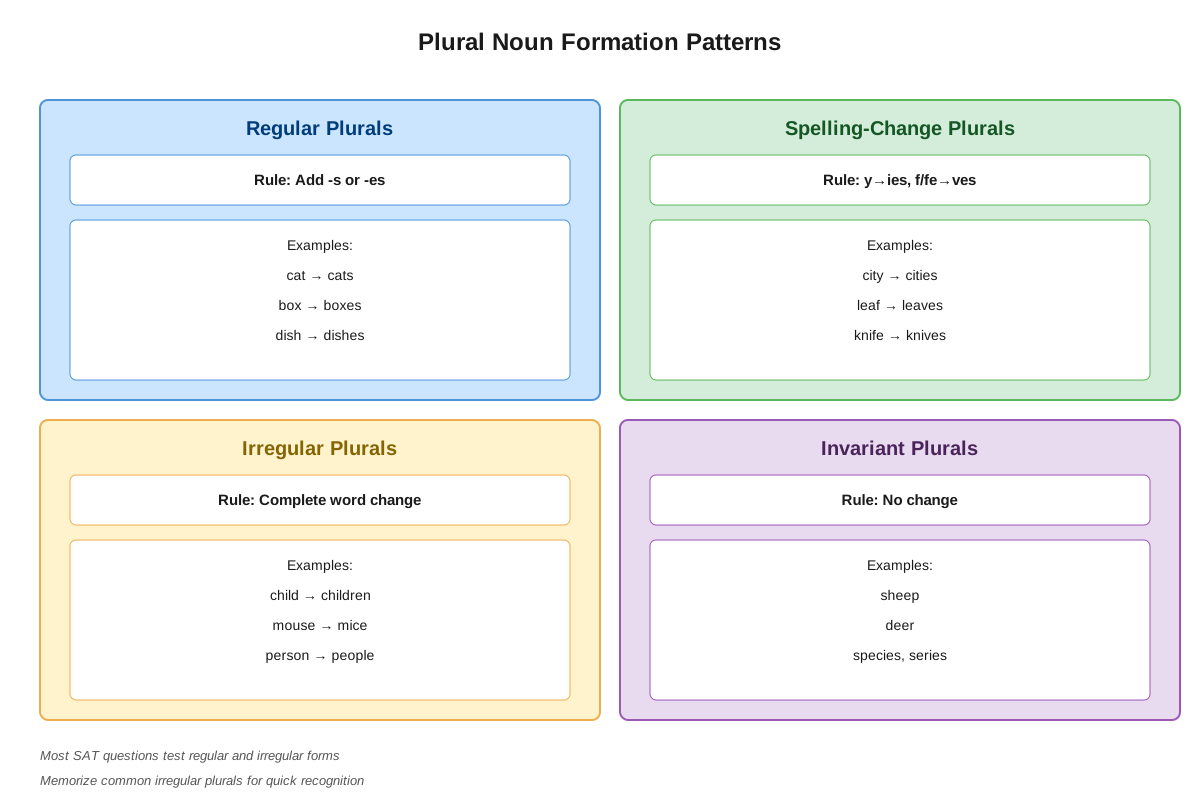
The foundation of sat plural nouns understanding begins with regular formation patterns. Most English nouns form plurals by adding -s to the singular form: book becomes books, car becomes cars, idea becomes ideas. However, several categories require modified endings. Nouns ending in -s, -x, -z, -ch, or -sh add -es: bus/buses, box/boxes, church/churches, dish/dishes. This pattern prevents awkward consonant clusters and maintains pronounceability.
Nouns ending in a consonant plus -y change the -y to -i and add -es: city/cities, baby/babies, country/countries. Conversely, nouns ending in a vowel plus -y simply add -s: boy/boys, key/keys, day/days. This distinction appears frequently on the SAT because it tests pattern recognition rather than simple memorization.
Nouns ending in -f or -fe often change to -ves: leaf/leaves, knife/knives, life/lives, shelf/shelves. However, exceptions exist (chief/chiefs, roof/roofs), making this category particularly high-yield for testing. Nouns ending in -o follow inconsistent patterns: some add -s (photo/photos, piano/pianos), while others add -es (hero/heroes, potato/potatoes). The SAT rarely tests -o plurals directly but includes them in passages where students must recognize correct forms.
Irregular Plural Formation
Irregular plural formations constitute a high-yield testing area because they cannot be predicted by rules. Several categories merit specific attention:
Vowel-change plurals alter internal vowels rather than adding endings: man/men, woman/women, foot/feet, tooth/teeth, goose/geese, mouse/mice. These ancient English forms persist in modern usage and appear frequently in SAT passages.
Unchanged plurals maintain identical singular and plural forms: sheep, deer, fish, species, series, means. Context alone determines number: "The sheep is grazing" versus "The sheep are grazing." The SAT tests these by requiring students to select verbs or pronouns that agree with context-determined number.
Latin and Greek plurals retain their classical formations, particularly in academic and scientific contexts. These represent extremely high-yield SAT content:
| Singular Ending | Plural Ending | Example |
|---|---|---|
| -us | -i | stimulus/stimuli, radius/radii, cactus/cacti |
| -is | -es | crisis/crises, thesis/theses, analysis/analyses |
| -on | -a | phenomenon/phenomena, criterion/criteria |
| -um | -a | datum/data, medium/media, curriculum/curricula |
| -a | -ae | formula/formulae, antenna/antennae, larva/larvae |
The SAT particularly favors testing "data," "media," "phenomena," and "criteria" because these words commonly appear in academic passages and are frequently misused in casual speech. Students must recognize that "the data show" (not "shows") and "these criteria are" (not "this criteria is") represent correct forms.
Compound Noun Plurals
Compound nouns form plurals according to their structure. In hyphenated compounds, the principal word becomes plural: mother-in-law/mothers-in-law, passer-by/passers-by, attorney-at-law/attorneys-at-law. In closed compounds (written as one word), the ending becomes plural: spoonfuls, handfuls, toothbrushes. The SAT occasionally tests these in context, requiring students to recognize correct forms within sentences.
Plural Nouns in Subject-Verb Agreement
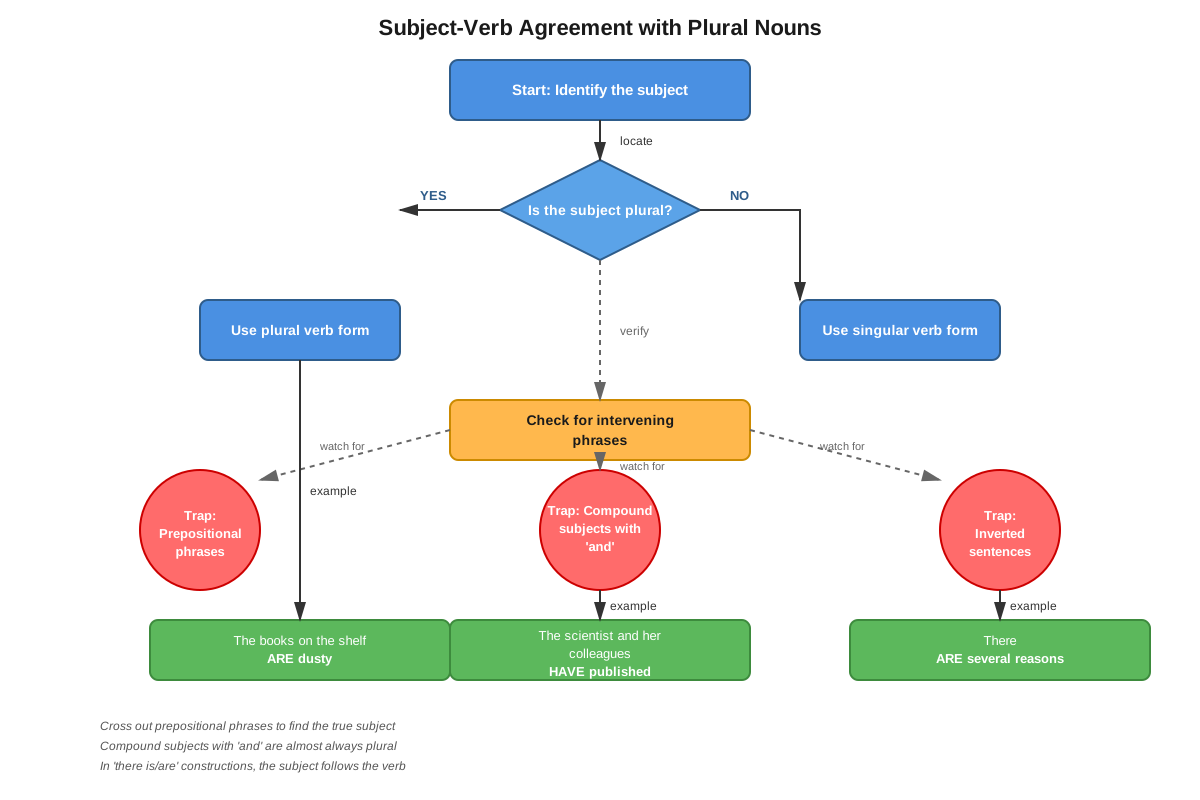
The primary way the SAT tests plural nouns involves subject-verb agreement. English verbs must match their subjects in number: singular subjects take singular verbs, plural subjects take plural verbs. In present tense, singular verbs typically end in -s (he walks, she runs, it seems), while plural verbs use the base form (they walk, we run, these seem).
The SAT creates difficulty by inserting prepositional phrases, relative clauses, or appositives between subjects and verbs:
- "The collection of stamps is valuable" (singular subject "collection")
- "The students in the classroom are studying" (plural subject "students")
- "The effects of pollution on marine ecosystems remain unclear" (plural subject "effects")
Students must identify the true subject by mentally eliminating intervening phrases. The noun closest to the verb is not necessarily the subject.
Plural Nouns and Pronoun Agreement
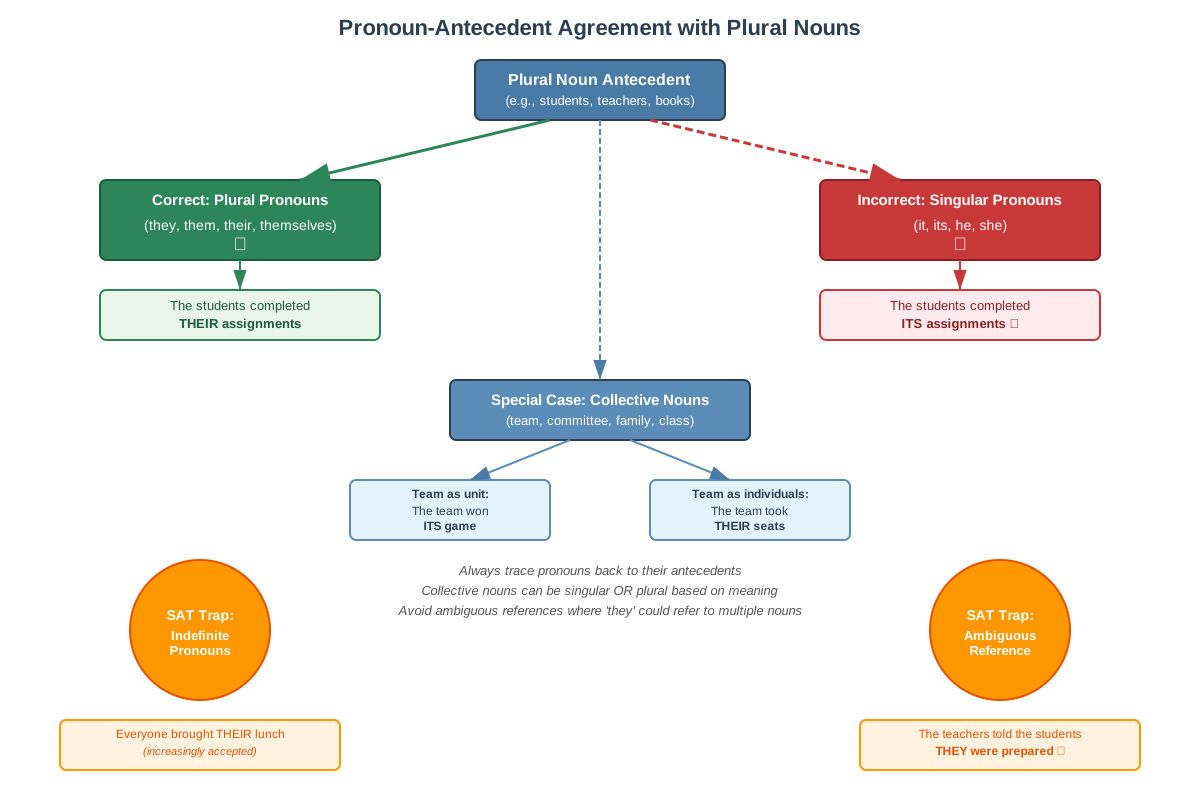
Pronoun-antecedent agreement requires plural pronouns to refer to plural antecedents. The SAT tests this by presenting sentences where pronoun number must match a plural noun:
- "The scientists published their findings" (plural "scientists" requires plural "their")
- "Each of the students submitted his or her paper" (singular "each" requires singular pronouns)
- "The committee members expressed their concerns" (plural "members" requires plural "their")
Particular attention must be paid to indefinite pronouns (each, every, either, neither, one, everyone, someone, anyone, no one), which are grammatically singular despite sometimes referring to multiple people conceptually.
Contextual Appropriateness of Plural Forms
Beyond mechanical correctness, the SAT tests whether plural or singular forms make logical sense in context. Students must read surrounding sentences to determine whether an author discusses one entity or multiple entities:
"The researcher examined the effect/effects of temperature on plant growth."
If the passage discusses only one consequence, "effect" is correct; if multiple consequences, "effects" is correct. This requires comprehension, not just grammar knowledge.
Concept Relationships
Plural noun mastery connects directly to multiple grammatical concepts, forming an interconnected web of Standard English Conventions. The relationship map flows as follows:
Plural Nouns → Subject-Verb Agreement: Correctly identifying whether a noun is singular or plural determines verb conjugation. This represents the most direct and frequently tested relationship.
Plural Nouns → Pronoun-Antecedent Agreement: Plural nouns require plural pronouns (they, them, their, these, those), while singular nouns require singular pronouns (it, its, this, that, he, she). Errors occur when writers lose track of antecedent number across sentence boundaries.
Plural Nouns → Possessive Formation: Plural possessives follow different apostrophe rules than singular possessives (students' vs. student's), connecting plural noun knowledge to punctuation.
Plural Nouns → Modifier Agreement: Demonstrative adjectives (this/these, that/those) must agree in number with the nouns they modify, creating another agreement relationship.
Contextual Meaning → Plural Noun Choice: Comprehension of passage content determines whether singular or plural forms are logically appropriate, connecting grammar to reading comprehension.
These relationships mean that plural noun questions rarely test only plural formation; they simultaneously assess agreement, punctuation, or logical consistency, making them efficient vehicles for testing multiple skills.
High-Yield Facts
⭐ Most SAT plural noun questions test subject-verb agreement rather than plural formation itself.
⭐ Prepositional phrases between subjects and verbs are the most common distractor technique; the object of a preposition is never the subject.
⭐ Latin and Greek plurals (data, media, phenomena, criteria) are extremely high-yield and frequently misused in answer choices.
⭐ Irregular plurals that don't change form (sheep, deer, fish, species) require careful attention to context and verb agreement.
⭐ Compound subjects joined by "and" are plural and take plural verbs, while subjects joined by "or" or "nor" take verbs that agree with the nearest subject.
- Collective nouns (team, committee, family, group) are grammatically singular in American English and take singular verbs, though they may take plural verbs in British English contexts.
- Indefinite pronouns (everyone, someone, each, every) are singular despite seeming to refer to multiple people.
- Nouns ending in -s that are singular (news, mathematics, physics, economics) take singular verbs despite their plural appearance.
- The word "data" is technically plural (datum is singular) and should take plural verbs in formal academic writing, though singular usage is increasingly accepted in informal contexts.
- Plural nouns never take apostrophes unless showing possession; "apple's" means belonging to one apple, while "apples" means multiple apples.
- Words borrowed from other languages often retain their original plural forms in academic and scientific writing (phenomena, curricula, analyses).
- The phrase "one of the [plural noun] who/that" takes a plural verb because the relative clause modifies the plural noun, not "one."
Quick check — test yourself on Plural nouns so far.
Try Flashcards →Common Misconceptions
Misconception: The noun closest to the verb is always the subject. → Correction: The true subject may be separated from the verb by prepositional phrases, relative clauses, or appositives. Students must identify the actual subject by analyzing sentence structure, not proximity. In "The purpose of these regulations is clear," "purpose" (singular) is the subject, not "regulations."
Misconception: All nouns ending in -s are plural. → Correction: Some singular nouns end in -s (news, mathematics, politics, economics, measles, mumps) and take singular verbs. Additionally, some plural nouns don't end in -s (children, men, women, people, teeth, feet). Form alone doesn't determine number.
Misconception: "Data" and "media" can be treated as singular nouns. → Correction: In formal academic writing and on the SAT, these Latin plurals should be treated as plural ("the data show," "the media are"). Though singular usage appears in casual speech, the SAT tests formal standard English conventions.
Misconception: Collective nouns are always plural because they refer to groups. → Correction: In American English, collective nouns (team, committee, family, jury, audience) are grammatically singular and take singular verbs when the group acts as a unit: "The committee has reached a decision." They take plural verbs only when emphasizing individual members acting separately.
Misconception: Compound subjects are always plural. → Correction: Subjects joined by "and" are plural (Tom and Jerry are friends), but subjects joined by "or" or "nor" take verbs that agree with the nearest subject: "Neither the students nor the teacher was present" (singular verb agrees with singular "teacher"). "Either the teacher or the students were present" (plural verb agrees with plural "students").
Misconception: Indefinite pronouns like "everyone" are plural because they refer to multiple people. → Correction: Indefinite pronouns (everyone, someone, anyone, no one, each, every, either, neither) are grammatically singular and take singular verbs and pronouns: "Everyone has his or her opinion" (not "their opinion" in formal writing, though this is evolving).
Misconception: Plural possessives are formed by adding 's to plural nouns. → Correction: Regular plural possessives add only an apostrophe after the existing -s: "the students' books" (belonging to multiple students). Only irregular plurals that don't end in -s add 's: "the children's toys."
Worked Examples
Example 1: Subject-Verb Agreement with Intervening Phrase
Question: The collection of rare manuscripts from various European monasteries (is/are) housed in the university library.
Step 1 - Identify the subject: Locate the main noun that performs the action or exists in the state described by the verb. Here, "collection" is the subject. "Manuscripts" and "monasteries" are objects of prepositions ("of rare manuscripts," "from various European monasteries") and cannot be subjects.
Step 2 - Determine subject number: "Collection" is singular, despite referring to multiple manuscripts. The word itself is singular.
Step 3 - Eliminate intervening elements: Cross out prepositional phrases mentally: "The collection ~~of rare manuscripts from various European monasteries~~ (is/are) housed..."
Step 4 - Match verb to subject: Singular subject "collection" requires singular verb "is."
Answer: "is"
Connection to learning objectives: This example demonstrates identifying plural versus singular nouns in complex sentences and applying agreement rules to answer SAT-style questions. The SAT frequently uses this exact pattern—a singular subject followed by a prepositional phrase containing plural nouns—to create attractive wrong answers.
Example 2: Latin Plural Recognition and Agreement
Question: The phenomena observed during the experiment (suggests/suggest) that the hypothesis requires revision.
Step 1 - Recognize the plural form: "Phenomena" is the plural of "phenomenon" (Greek origin). Despite appearing unusual, it is definitively plural.
Step 2 - Identify the subject: "Phenomena" is the subject of the sentence. "Experiment" is the object of the preposition "during."
Step 3 - Apply agreement rule: Plural subject requires plural verb. In present tense, plural verbs use the base form without -s.
Step 4 - Select correct verb: "Suggest" (plural) is correct; "suggests" (singular) is incorrect.
Answer: "suggest"
Additional analysis: Students might be tempted to choose "suggests" because "phenomena" looks or sounds singular to those unfamiliar with Greek plurals. The SAT specifically tests these classical plurals because they appear frequently in academic and scientific writing. Other high-yield examples include "criteria are" (not "criteria is"), "data show" (not "data shows"), and "analyses reveal" (not "analysis reveal" when plural).
Connection to learning objectives: This example illustrates identifying key features of irregular plural nouns, explaining how the SAT tests classical plurals in academic contexts, and applying this knowledge to select grammatically correct answers.
Exam Strategy
When approaching SAT plural nouns questions, implement this systematic process:
Step 1 - Identify the decision point: Determine what the question asks you to choose. Look for underlined portions containing nouns, verbs, or pronouns, as these signal potential agreement issues.
Step 2 - Locate the subject: Find the true subject by identifying the noun or pronoun performing the action or existing in the state described. Mentally eliminate prepositional phrases (starting with of, in, on, at, by, for, from, with, etc.), relative clauses (starting with who, which, that), and appositives (renaming phrases set off by commas).
Step 3 - Determine subject number: Decide whether the subject is singular or plural. Watch for irregular plurals, Latin/Greek plurals, collective nouns, and indefinite pronouns. When in doubt, consider whether you could replace the noun with "it" (singular) or "they" (plural).
Step 4 - Check all agreement relationships: Verify that verbs match the subject in number, pronouns match their antecedents, and demonstrative adjectives (this/these, that/those) match their nouns.
Step 5 - Verify contextual logic: Read surrounding sentences to confirm whether singular or plural forms make sense given the passage's meaning. Sometimes both forms are grammatically possible, but only one is logically appropriate.
Trigger words and phrases to watch for:
- Prepositional phrases between subjects and verbs (of, in, on, with, from, by, for, at)
- Latin/Greek plurals: data, media, phenomena, criteria, analyses, theses, stimuli
- Collective nouns: team, committee, group, family, audience, jury, class
- Indefinite pronouns: each, every, everyone, someone, anyone, no one, either, neither
- Compound subjects: joined by "and" (plural) versus "or"/"nor" (agrees with nearest)
- Irregular plurals: men, women, children, people, teeth, feet, sheep, deer, fish, species
Process-of-elimination tips:
- Immediately eliminate options where verbs don't agree with subjects in number
- Cross out answers containing "data is," "media is," "phenomena is," or "criteria is" in formal academic contexts
- Eliminate options where plural pronouns (they, their, them) refer to singular antecedents or vice versa
- Remove answers where demonstrative adjectives don't match noun number (this + plural noun, these + singular noun)
Time allocation: Plural noun questions should take 20-30 seconds once you've mastered the patterns. If you spend more than 45 seconds, mark the question and return to it after completing easier items. The systematic approach above becomes automatic with practice, allowing rapid identification and correction of errors.
Memory Techniques
FANBOYS-P Mnemonic for Prepositional Phrase Starters: Remember common prepositions that create phrases between subjects and verbs: From, At, Near, By, Of, Yonder (archaic but memorable), Since, Plus (in, on, with, for, to). When you see these, mentally bracket the phrase to find the true subject.
"DATA MEDIA PHENOMENA CRITERIA" Chant: Memorize this phrase to remember the four most commonly tested Latin/Greek plurals. Repeat it as a rhythm: "DATA are, MEDIA are, PHENOMENA are, CRITERIA are." The singular forms (datum, medium, phenomenon, criterion) are less commonly used but worth knowing.
The "Eliminate the Middle" Technique: Visualize placing parentheses around everything between the subject and verb. This physical/mental action helps you see the core sentence structure: "The collection (of rare manuscripts from various monasteries) is valuable."
Irregular Plural Families: Group irregular plurals by pattern:
- Vowel-change family: man/men, woman/women, foot/feet, tooth/teeth, goose/geese, mouse/mice
- No-change family: sheep, deer, fish, species, series, means
- Classical family: See the Latin/Greek plural table in Core Concepts
The "They Test" for Number: When uncertain whether a noun is singular or plural, try replacing it with "it" or "they." If "they" sounds natural, the noun is plural; if "it" sounds natural, it's singular. "The data [they] show" confirms "data" is plural.
AND = ADD Mnemonic: Subjects joined by "AND" ADD together to become plural. "Tom and Jerry are friends" (plural). This helps distinguish from "or"/"nor" constructions.
Summary
Plural nouns represent a foundational element of Standard English Conventions tested extensively on the SAT Reading and Writing section. While basic plural formation follows predictable patterns (adding -s or -es to most nouns), the SAT focuses on more sophisticated applications: recognizing irregular and classical plurals, maintaining subject-verb agreement when intervening phrases separate subjects from verbs, ensuring pronoun-antecedent agreement, and selecting contextually appropriate singular or plural forms. The exam particularly favors testing Latin and Greek plurals (data, media, phenomena, criteria) that appear in academic writing, irregular plurals that don't follow standard patterns, and agreement relationships complicated by prepositional phrases or collective nouns. Success requires systematic identification of true subjects, determination of their number, and verification that all related sentence elements agree. Students who master these patterns can quickly eliminate incorrect answers and confidently select grammatically correct, contextually appropriate options, significantly improving their performance on 8-12% of Standard English Conventions questions.
Key Takeaways
- Subject-verb agreement is the primary way the SAT tests plural noun knowledge; always identify the true subject before selecting a verb form
- Prepositional phrases between subjects and verbs are the most common distractor; mentally eliminate them to find the core sentence structure
- Latin and Greek plurals (data, media, phenomena, criteria) are extremely high-yield and should always take plural verbs in formal academic writing
- Irregular plurals include vowel-change forms (men, women, feet, teeth), unchanged forms (sheep, deer, fish, species), and classical forms requiring memorization
- Collective nouns (team, committee, family) are grammatically singular in American English despite referring to groups
- Context determines appropriateness: sometimes both singular and plural forms are grammatically correct, but only one makes logical sense given the passage meaning
- Systematic approach (identify subject → determine number → check agreement → verify context) enables rapid, accurate answers on plural noun questions
Related Topics
Subject-Verb Agreement: This broader topic encompasses plural noun agreement but extends to other agreement challenges including inverted sentence structures, compound subjects, and agreement with indefinite pronouns. Mastering plural nouns provides the foundation for this more comprehensive topic.
Pronoun-Antecedent Agreement: Understanding plural nouns enables proper pronoun selection, as pronouns must match their antecedents in number, person, and sometimes gender. This topic builds directly on plural noun knowledge.
Possessive Forms: Both singular and plural possessives require apostrophe placement that depends on whether the noun is singular or plural, connecting punctuation to plural noun mastery.
Verb Tenses and Conjugation: While plural noun questions focus on number agreement, understanding how verbs conjugate differently for singular versus plural subjects in various tenses represents a natural extension of this knowledge.
Modifier Placement and Agreement: Demonstrative adjectives (this/these, that/those) and other modifiers must agree with nouns in number, creating another application of plural noun understanding.
Practice CTA
Now that you've mastered the core concepts of plural nouns and their application on the SAT, it's time to reinforce your learning through active practice. Attempt the practice questions designed specifically for this topic, paying special attention to identifying subjects, determining their number, and verifying agreement relationships. Use the flashcards to drill irregular plurals, Latin and Greek plurals, and common agreement patterns until recognition becomes automatic. Remember: the difference between a good score and a great score often comes down to mastering these high-frequency, predictable patterns. Every practice question you complete builds the pattern recognition and speed you need for test day success. You've got this!
Sign up free to keep reading
Create a free AnvayaPrep account to finish this SAT guide on Plural nouns — plus flashcards and practice questions.