Overview
Verb voice is a fundamental grammatical concept that determines the relationship between a sentence's subject and its action. In English, verbs can be expressed in either active voice (where the subject performs the action) or passive voice (where the subject receives the action). On the SAT Reading and Writing section (RW), understanding verb voice is crucial for answering questions about sentence structure, clarity, and effectiveness. The College Board frequently tests whether students can identify when passive voice weakens a sentence or when active voice would create more direct, powerful prose.
Mastery of sat verb voice questions directly impacts performance on approximately 5-8% of the Reading and Writing section, appearing in both Standard English Conventions questions and Rhetorical Synthesis questions. These questions assess whether students can recognize when a sentence's voice creates ambiguity, obscures the actor, or fails to maintain consistency with surrounding sentences. Students who understand verb voice can quickly identify sentences that lack clarity due to unnecessary passive constructions and can select revisions that improve directness and readability.
Within the broader Form, Structure, and Sense unit, verb voice connects intimately with subject-verb agreement, verb tense consistency, and sentence structure. A strong command of verb voice enables students to evaluate not just grammatical correctness but also stylistic effectiveness—a dual focus that characterizes many high-difficulty SAT questions. This topic serves as a bridge between pure grammar knowledge and rhetorical awareness, making it essential for students aiming for top scores in the 700-800 range.
Learning Objectives
- [ ] Identify key features of verb voice in sentences
- [ ] Explain how verb voice appears on the SAT
- [ ] Apply verb voice to answer SAT-style questions
- [ ] Distinguish between appropriate and inappropriate uses of passive voice
- [ ] Evaluate sentences for clarity and directness based on voice choice
- [ ] Recognize how verb voice affects emphasis and meaning in context
- [ ] Revise sentences to improve effectiveness through voice modification
Prerequisites
- Basic sentence structure: Understanding subjects, verbs, and objects is essential because verb voice fundamentally alters the relationship between these elements
- Verb tense recognition: Identifying verb tenses helps distinguish voice constructions, as passive voice requires auxiliary verbs combined with past participles
- Reading comprehension fundamentals: Grasping context and meaning enables students to determine when voice choice affects clarity or emphasis in passages
Why This Topic Matters
In professional and academic writing, verb voice directly affects clarity, conciseness, and impact. Active voice typically creates more direct, engaging prose that clearly identifies who performs actions, while passive voice can obscure responsibility or shift emphasis to the action's recipient. Scientists use passive voice to emphasize experimental procedures over researchers; journalists employ active voice to create immediacy and accountability. Understanding when each voice serves a purpose distinguishes competent writers from exceptional ones.
On the SAT, verb voice appears in approximately 3-5 questions per test administration, representing a high-yield topic relative to study time investment. These questions typically appear as Standard English Conventions items asking students to select the most effective revision or as Rhetorical Synthesis questions requiring students to complete sentences in ways that maintain consistency with passage tone and structure. The College Board particularly favors questions where passive voice creates ambiguity about who performs an action or where active voice would better match the directness of surrounding sentences.
Common manifestations include: passages discussing scientific research where passive voice may or may not be appropriate; historical narratives where active voice creates more vivid storytelling; argumentative essays where voice choice affects the strength of claims; and informational texts where clarity depends on identifying actors. Students encounter verb voice questions in passages ranging from 25 to 150 words, with the voice issue typically appearing in a single sentence that must be evaluated against context.
Core Concepts
Active Voice Fundamentals
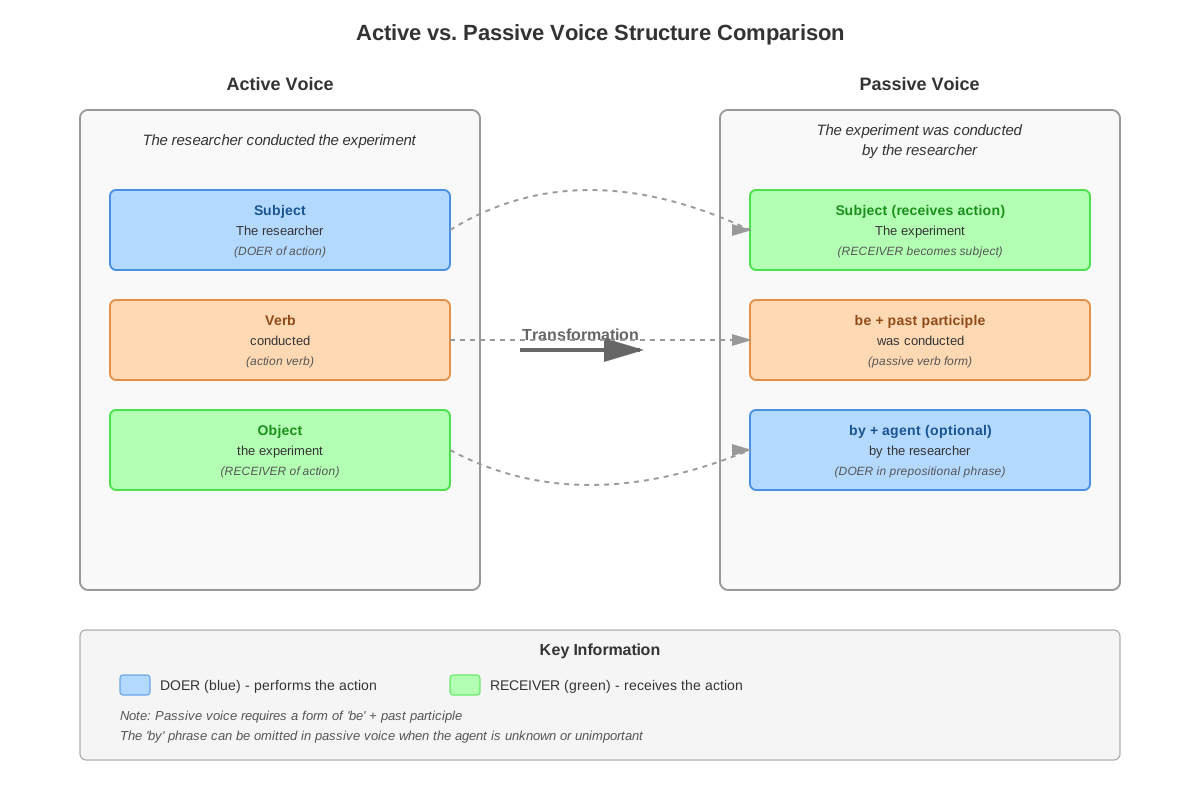
Active voice occurs when the sentence's subject performs the action expressed by the verb. The basic structure follows the pattern: Subject → Verb → Object. In active voice, the actor comes first, making sentences direct and clear about who does what. For example, "The researcher conducted the experiment" places the researcher (actor) before the action (conducted) and the recipient (experiment).
Active voice creates several advantages: it uses fewer words, establishes clear responsibility, generates more dynamic prose, and helps readers quickly identify cause-and-effect relationships. On the SAT, active voice is generally preferred unless context specifically requires passive construction. The College Board values conciseness and clarity, both hallmarks of active voice.
Passive Voice Fundamentals
Passive voice occurs when the sentence's subject receives the action rather than performing it. The structure follows: Subject (receiver) → Form of "to be" + Past Participle → (optional) by + Actor. For example, "The experiment was conducted by the researcher" places the experiment (receiver) first, uses the auxiliary verb "was," and relegates the actor to a prepositional phrase—or omits it entirely.
Passive voice constructions always include a form of the verb "to be" (is, are, was, were, been, being) combined with a past participle (the -ed form of regular verbs or irregular past participles like "written," "done," "seen"). Recognizing this combination is crucial for identifying passive voice on the SAT. The actor may appear in a "by" phrase or may be completely absent, which can create ambiguity.
When Passive Voice Is Appropriate
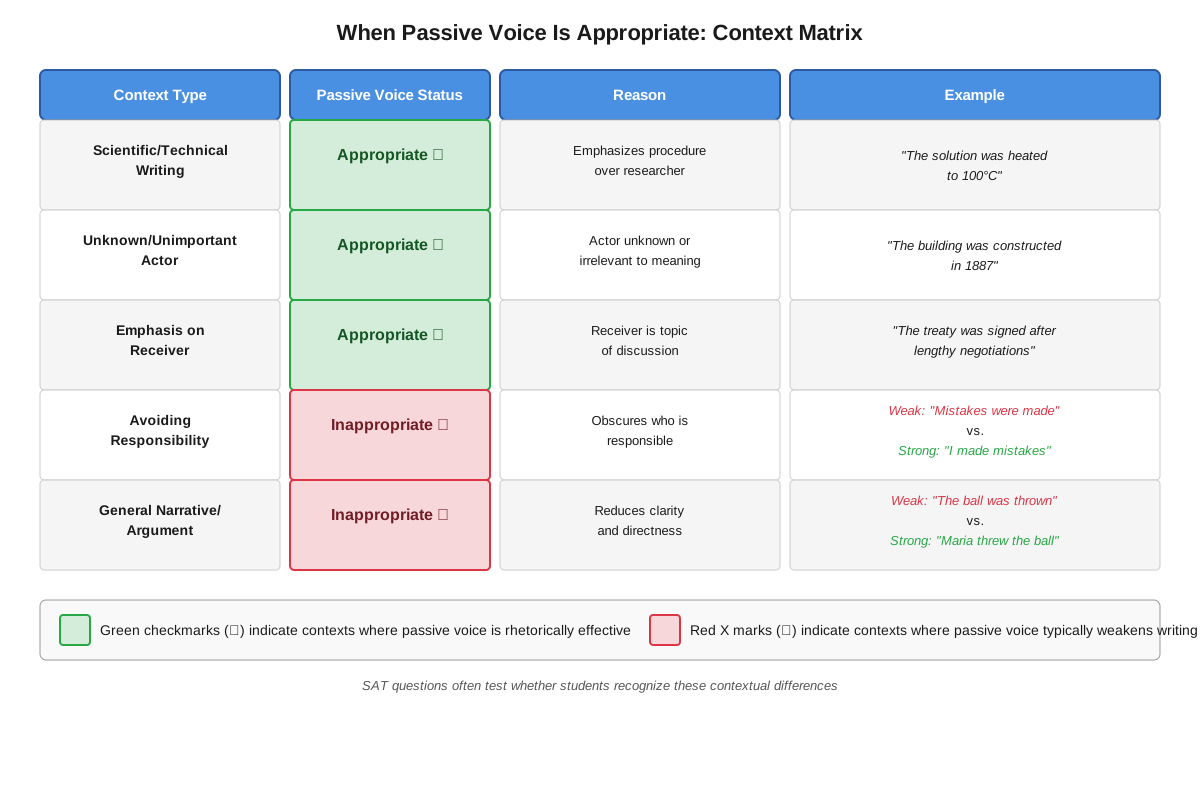
Despite active voice being generally preferred, passive voice serves legitimate purposes in specific contexts:
- When the actor is unknown or irrelevant: "The ancient temple was built in 300 BCE" (we don't know who built it)
- When emphasizing the action's recipient: "The vaccine was administered to 10,000 participants" (focus on participants, not administrators)
- When maintaining consistent subjects across sentences: If a paragraph focuses on a particular subject, keeping it as the grammatical subject even when it receives action maintains flow
- In scientific or technical writing conventions: "The solution was heated to 100°C" follows disciplinary norms
- When the actor is obvious from context: "The suspect was arrested yesterday" (clearly by police)
Identifying Voice in Complex Sentences
Some sentences make voice identification challenging through complex structures or multiple clauses. Key identification strategies include:
- Look for "to be" + past participle combinations: This construction always signals passive voice
- Ask "Who/what performs the action?": If the answer is the subject, it's active; if the subject receives the action, it's passive
- Check for "by" phrases: While not always present, "by [actor]" often indicates passive voice
- Examine each clause independently: Compound and complex sentences may mix voices
| Feature | Active Voice | Passive Voice |
|---|---|---|
| Subject role | Performs action | Receives action |
| Word count | Typically fewer words | Typically more words |
| Verb structure | Simple verb form | "To be" + past participle |
| Actor position | Beginning (subject) | End (by phrase) or absent |
| Clarity | Usually clearer | Can be ambiguous |
| Emphasis | On actor | On action or recipient |
Voice and Meaning
Voice choice fundamentally affects sentence meaning and emphasis. Consider these examples:
- Active: "The committee rejected the proposal" (emphasizes committee's decision-making)
- Passive: "The proposal was rejected" (emphasizes proposal's fate, de-emphasizes committee)
- Passive with actor: "The proposal was rejected by the committee" (emphasizes proposal but includes actor)
On the SAT, questions often hinge on whether voice choice aligns with the passage's focus. If a passage discusses a scientist's groundbreaking work, active voice keeps the scientist prominent: "Dr. Chen discovered the enzyme" rather than "The enzyme was discovered by Dr. Chen." Conversely, if the passage traces an object's history, passive voice may appropriately maintain focus: "The manuscript was copied numerous times" rather than "Scribes copied the manuscript numerous times."
Voice Consistency
Passages typically maintain consistent voice unless shifting for rhetorical effect. Unnecessary voice shifts create choppy, confusing prose. The SAT tests whether students recognize inappropriate shifts:
- Inconsistent: "The team analyzed the data, and several errors were identified."
- Consistent (active): "The team analyzed the data and identified several errors."
- Consistent (passive): "The data were analyzed, and several errors were identified."
Maintaining voice consistency helps readers follow the logical flow and understand relationships between ideas. When SAT questions present sentences with voice shifts, the correct answer typically maintains the voice established in surrounding sentences unless context demands a change.
Concept Relationships
Verb voice connects to multiple grammatical and rhetorical concepts. At the foundational level, subject-verb agreement must be maintained regardless of voice; passive constructions don't exempt writers from ensuring subjects and verbs match in number. Verb tense interacts with voice because passive constructions require appropriate tense forms of "to be" combined with past participles—understanding tense helps identify and correct voice issues.
Moving to rhetorical concerns, voice directly affects sentence structure and variety. While varied sentence structures engage readers, unnecessary voice shifts create confusion rather than variety. Conciseness and clarity, core SAT values, typically favor active voice because it uses fewer words and more directly communicates who does what. However, emphasis and focus, equally important rhetorical tools, sometimes require passive voice to keep attention on specific subjects or objects.
The relationship map flows as follows: Basic verb knowledge → Voice identification → Voice appropriateness evaluation → Context-based voice selection → Effective communication. Students must first recognize voice, then understand when each voice serves the passage's purpose, and finally select or revise sentences to optimize clarity and emphasis. This progression mirrors the cognitive demands of SAT questions, which rarely ask students merely to identify voice but instead require evaluating voice effectiveness in context.
High-Yield Facts
- ⭐ Passive voice always contains a form of "to be" (is, are, was, were, been, being) plus a past participle
- ⭐ Active voice is generally preferred on the SAT unless context specifically requires passive construction
- ⭐ Passive voice can obscure who performs an action, creating ambiguity that the SAT considers a weakness
- ⭐ Voice should remain consistent within a passage unless rhetorical purpose demands a shift
- ⭐ When the actor is unknown, irrelevant, or obvious, passive voice may be appropriate
- Active voice typically uses fewer words than passive voice expressing the same idea
- The subject of a passive sentence receives the action rather than performing it
- Passive voice can appropriately emphasize the action's recipient rather than the actor
- Scientific and technical writing sometimes conventionally uses passive voice
- Unnecessary passive constructions make prose less direct and engaging
- Voice choice affects sentence emphasis and can change what readers focus on
- Multiple clauses in one sentence can use different voices, but consistency is generally preferred
- The "by [actor]" phrase in passive constructions is optional and often omitted
- Converting passive to active voice requires identifying the true actor and making it the subject
- Context determines whether active or passive voice better serves the passage's purpose
Quick check — test yourself on Verb voice so far.
Try Flashcards →Common Misconceptions
Misconception: All passive voice is grammatically incorrect and should always be avoided. → Correction: Passive voice is grammatically correct and sometimes rhetorically appropriate when the actor is unknown, irrelevant, or when emphasis should fall on the action's recipient rather than the performer. The SAT tests appropriate voice choice, not blanket avoidance of passive constructions.
Misconception: Any sentence with "was" or "were" uses passive voice. → Correction: Forms of "to be" appear in many constructions beyond passive voice, including past progressive tense ("was running") and linking verb constructions ("was happy"). Passive voice specifically requires "to be" plus a past participle where the subject receives rather than performs the action.
Misconception: Passive voice always includes a "by [actor]" phrase. → Correction: The actor in passive constructions is optional and frequently omitted. "The window was broken" is passive voice even without specifying who broke it. This omission often creates the ambiguity that SAT questions address.
Misconception: Longer sentences always use passive voice, and shorter sentences use active voice. → Correction: While passive constructions often add words, length alone doesn't determine voice. "The comprehensive study was conducted" (passive) is shorter than "The research team conducted the comprehensive study" (active). Voice depends on the subject's relationship to the action, not sentence length.
Misconception: Scientific writing requires passive voice throughout. → Correction: While passive voice appears frequently in scientific writing to emphasize procedures and results, modern scientific style increasingly favors active voice for clarity. The SAT recognizes that even in scientific contexts, active voice often communicates more effectively.
Misconception: Changing voice always changes meaning. → Correction: Voice changes emphasis and focus but often preserves core meaning. "The committee approved the budget" and "The budget was approved by the committee" convey the same basic information but emphasize different elements. However, omitting the actor in passive voice ("The budget was approved") can change meaning by removing information.
Misconception: Voice and verb tense are the same thing. → Correction: Voice (active or passive) and tense (past, present, future, etc.) are independent features. A sentence can be past tense active ("The team won"), past tense passive ("The game was won"), present tense active ("The team wins"), or present tense passive ("The game is won"). Voice concerns who performs the action; tense concerns when it occurs.
Worked Examples
Example 1: Identifying Inappropriate Passive Voice
Question: Which choice completes the text with the most logical and precise word or phrase?
The archaeologist Maria Reiche dedicated her life to studying the Nazca Lines in Peru. For decades, she meticulously mapped the ancient geoglyphs, and numerous theories about their purpose ______.
A) were developed by her
B) she developed
C) had been developed
D) developing them
Solution:
Step 1: Identify the passage's focus and voice pattern. The passage focuses on Maria Reiche as the subject, using active voice: "dedicated," "mapped." The sentence structure keeps Reiche as the active agent of her work.
Step 2: Analyze each option's voice and consistency.
- Option A uses passive voice ("were developed by her"), which shifts away from the active pattern and uses more words unnecessarily
- Option B uses active voice ("she developed"), maintaining consistency with the passage's focus on Reiche as the actor
- Option C uses passive voice without specifying the actor, creating ambiguity about who developed the theories
- Option D creates a fragment with an incomplete verb form
Step 3: Evaluate appropriateness. Since the passage emphasizes Reiche's active contributions and she is clearly the developer of the theories, active voice maintains focus and clarity. The passive construction in A is grammatically correct but stylistically inferior because it adds words and weakens the direct connection between Reiche and her intellectual work.
Step 4: Select the answer. Option B is correct because it maintains active voice, keeps Reiche as the subject performing the action, uses fewer words, and aligns with the passage's established pattern of highlighting her agency and accomplishments.
Connection to Learning Objectives: This example demonstrates identifying voice features (passive construction in A and C), explaining how voice appears on the SAT (as a choice between active and passive in context), and applying voice knowledge to select the most effective option based on consistency and clarity.
Example 2: Recognizing Appropriate Passive Voice
Question: Which choice completes the text so that it conforms to the conventions of Standard English?
The ancient Library of Alexandria was one of the largest and most significant libraries of the ancient world. Although the exact circumstances remain debated, the library ______ sometime between the third and seventh centuries CE, resulting in the loss of countless irreplaceable texts.
A) was destroying
B) destroyed
C) was destroyed
D) had destroyed
Solution:
Step 1: Determine the logical relationship between subject and action. The library is the subject, but logically, the library did not perform the action of destruction—it received the action. The library was the victim, not the agent, of destruction.
Step 2: Analyze voice requirements. Since the library received rather than performed the action, passive voice is grammatically necessary. Additionally, the passage doesn't specify who destroyed the library (the actor is unknown or debated), making passive voice appropriate for this context.
Step 3: Evaluate each option:
- Option A ("was destroying") uses past progressive active voice, illogically suggesting the library destroyed something
- Option B ("destroyed") uses simple past active voice, again making the library the destroyer
- Option C ("was destroyed") uses passive voice, correctly positioning the library as the recipient of destruction
- Option D ("had destroyed") uses past perfect active voice, maintaining the illogical active construction
Step 4: Consider tense and context. The simple past passive ("was destroyed") appropriately indicates a completed action in the past without specifying the exact time or agent, which aligns with the passage's statement that "exact circumstances remain debated."
Step 5: Select the answer. Option C is correct because passive voice is both grammatically necessary (the library received the action) and rhetorically appropriate (the actor is unknown/debated, and emphasis belongs on the library's fate rather than the destroyer's identity).
Connection to Learning Objectives: This example shows identifying when passive voice is appropriate rather than problematic, distinguishing between voice options, and applying voice knowledge to select grammatically and rhetorically correct answers based on logical subject-action relationships.
Exam Strategy
When approaching SAT verb voice questions, follow this systematic process:
Step 1: Read for context first. Before evaluating answer choices, understand the passage's focus, tone, and established patterns. Determine whether the passage emphasizes actors (suggesting active voice) or recipients/actions (potentially suggesting passive voice). Note the voice used in surrounding sentences.
Step 2: Identify the subject and its logical relationship to the action. Ask: "Does the subject perform or receive this action?" If the subject logically performs the action and is known, active voice is typically preferred. If the subject receives the action or the actor is unknown/irrelevant, passive voice may be appropriate.
Step 3: Watch for trigger words and constructions. Passive voice always includes "to be" + past participle. When you see "is/are/was/were/been/being" followed by a verb ending in -ed or an irregular past participle, you've identified passive voice. Look for "by [actor]" phrases, though remember they're optional in passive constructions.
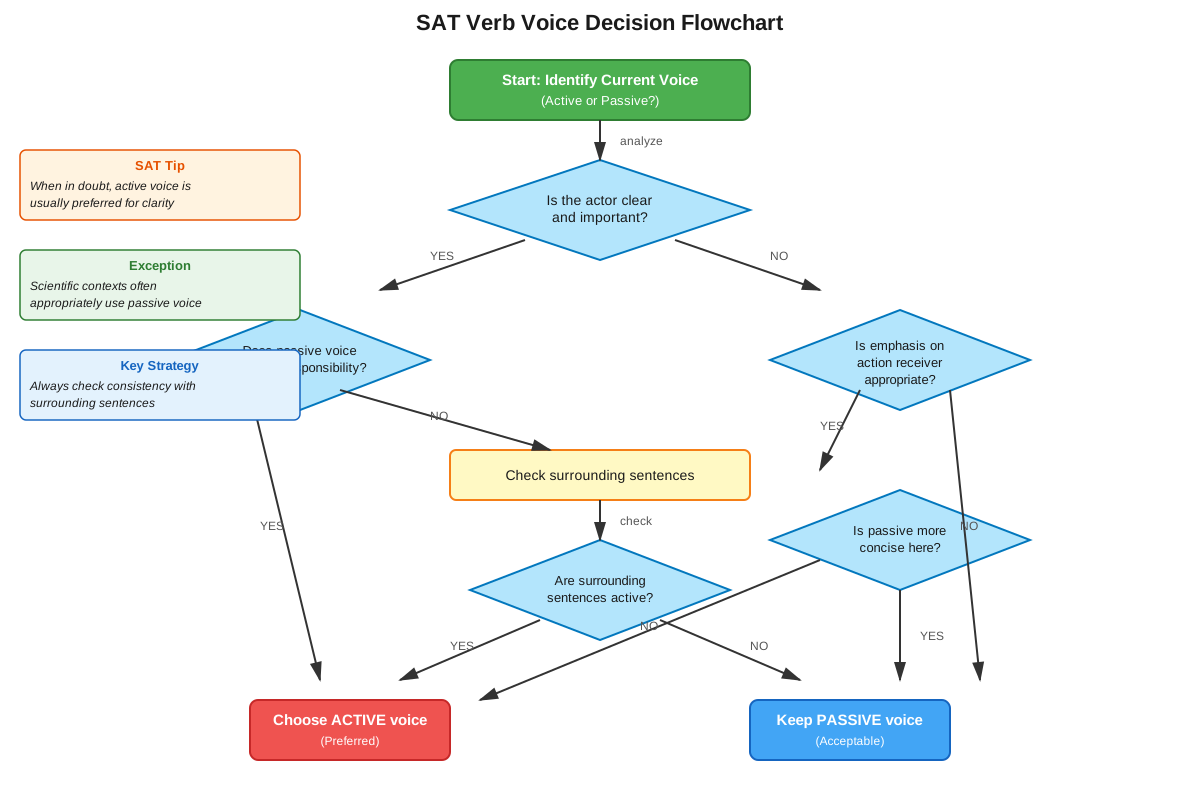
Step 4: Apply the preference hierarchy. On the SAT, follow this decision tree:
- If active voice is clear, concise, and maintains consistency → choose active
- If the actor is unknown, irrelevant, or obvious → passive may be appropriate
- If emphasis should fall on the recipient rather than actor → passive may be appropriate
- If scientific/technical context conventionally uses passive → passive may be appropriate
- When in doubt between equally clear options → choose active voice
Step 5: Use process of elimination strategically. Eliminate options that:
- Create illogical subject-action relationships (library destroying itself)
- Shift voice unnecessarily from the established pattern
- Use passive voice when the actor is known, relevant, and should be emphasized
- Add unnecessary words through passive construction without rhetorical benefit
- Create ambiguity by omitting important information about who performs actions
Time allocation: Spend 30-45 seconds on voice questions. They require context evaluation but shouldn't demand extensive analysis. If you're spending more than a minute, you're likely overthinking—trust your instinct about which voice sounds clearer and more direct in context.
Exam Tip: When two options seem equally grammatical, choose the one that uses fewer words and more directly states who does what. The SAT values conciseness and clarity, both hallmarks of active voice.
Memory Techniques
PASSIVE Acronym for identifying passive voice:
- Past participle present
- Actor absent or in "by" phrase
- Subject receives action
- Sentence includes "to be"
- Inactive subject (doesn't perform action)
- Verb form: "to be" + past participle
- Emphasis on recipient
The "By Zombie" Test: To identify passive voice, try inserting "by zombies" after the verb. If it makes grammatical sense, the sentence uses passive voice. "The experiment was conducted [by zombies]" works grammatically, confirming passive voice. "The researcher conducted [by zombies]" doesn't work, confirming active voice.
Active = Actor First: Remember that active voice puts the actor (the one doing the action) first in the sentence. If you can identify who or what performs the action and it comes before the verb, you're likely looking at active voice.
Visualization Strategy: Picture active voice as an arrow pointing forward from subject to object (Subject → Action → Object), showing direct movement. Picture passive voice as an arrow pointing backward (Object ← Action ← Subject), showing reversed or indirect movement.
The Three Questions: When evaluating voice, ask:
- Who/what does it? (Identifies the actor)
- Is the actor the subject? (If yes → active; if no → passive)
- Does the context need this voice? (Determines appropriateness)
Summary
Verb voice, the grammatical feature determining whether a sentence's subject performs or receives an action, represents a high-yield SAT topic that bridges grammar knowledge and rhetorical awareness. Active voice, where subjects perform actions, creates direct, concise prose that clearly identifies actors and their actions. Passive voice, constructed with "to be" plus a past participle, positions subjects as action recipients and may obscure or omit actors entirely. While active voice is generally preferred on the SAT for its clarity and conciseness, passive voice serves legitimate purposes when actors are unknown, irrelevant, or when emphasis should fall on recipients rather than performers. Success on SAT verb voice questions requires identifying voice constructions, evaluating voice appropriateness based on context and passage consistency, and selecting options that optimize clarity while maintaining logical subject-action relationships. Students must recognize that voice choice affects not just grammatical correctness but also emphasis, clarity, and rhetorical effectiveness—making voice questions tests of both technical knowledge and contextual judgment.
Key Takeaways
- Passive voice always contains "to be" + past participle; active voice uses simpler verb forms with subjects performing actions
- Active voice is preferred on the SAT unless context specifically requires passive construction for emphasis, unknown actors, or conventional usage
- Voice should remain consistent within passages unless rhetorical purpose demands a shift
- Passive voice can obscure responsibility and add unnecessary words, but it appropriately emphasizes recipients when actors are irrelevant or unknown
- Evaluate voice choices based on context, passage focus, and logical subject-action relationships rather than applying blanket rules
- The SAT tests voice as a rhetorical choice affecting clarity and emphasis, not just as a grammatical feature
- Converting between voices requires identifying the true actor and determining whether it should be the grammatical subject
Related Topics
Subject-Verb Agreement: Mastering verb voice builds directly into subject-verb agreement because passive constructions can complicate identifying the true subject that must agree with the verb in number. Understanding voice helps students correctly identify subjects even in complex passive sentences.
Verb Tense and Consistency: Voice and tense interact closely since passive constructions require appropriate tense forms of "to be." Students who master voice can more easily identify and correct tense errors in passive constructions.
Sentence Structure and Variety: Voice choice affects sentence structure and contributes to (or detracts from) effective variety. Understanding voice enables students to evaluate whether structural variations enhance or confuse prose.
Conciseness and Wordiness: Since passive voice typically uses more words than active voice, mastering voice directly supports identifying and eliminating wordiness—another high-yield SAT skill.
Rhetorical Synthesis: Advanced questions requiring students to complete sentences based on context often hinge on voice choice. Voice mastery enables students to select completions that maintain appropriate emphasis and consistency.
Practice CTA
Now that you've mastered the fundamentals of verb voice, it's time to cement your understanding through active practice. The concepts you've learned—identifying voice constructions, evaluating appropriateness, and selecting effective options—become automatic only through repeated application. Challenge yourself with the practice questions and flashcards designed specifically for this topic. Each practice item reinforces the decision-making process you'll use on test day, building the speed and confidence that distinguish top scorers. Remember: understanding verb voice intellectually is just the first step; applying it accurately under timed conditions is what translates knowledge into points. You've invested the time to learn—now invest the time to practice, and watch your performance improve!
Sign up free to keep reading
Create a free AnvayaPrep account to finish this SAT guide on Verb voice — plus flashcards and practice questions.