Overview
Inference from data is a critical skill tested extensively in the SAT Reading and Writing section. This competency requires students to analyze quantitative information presented in tables, graphs, charts, and data sets, then draw logical conclusions that are directly supported by the evidence. Unlike pure reading comprehension, these questions demand that test-takers synthesize numerical information with textual context to identify what the data actually demonstrates.
The SAT frequently integrates data-driven questions throughout the Reading and Writing section, making this one of the highest-yield topics for score improvement. These questions assess whether students can distinguish between what data explicitly shows versus what it merely suggests, identify trends and patterns in numerical presentations, and recognize when a conclusion oversteps the boundaries of the evidence provided. Mastering sat inference from data questions is essential because they appear in multiple question types and often determine the difference between a good score and an excellent one.
Within the broader rw (Reading and Writing) framework, inference from data represents the intersection of analytical reading skills and quantitative reasoning. This topic connects directly to evidence-based reading, logical reasoning, and the fundamental SAT principle that correct answers must be fully supported by the passage or data provided. Students who excel at data inference demonstrate the college-readiness skill of evaluating research findings, interpreting statistical information, and making evidence-based judgments—competencies that extend far beyond the exam itself.
Learning Objectives
- [ ] Identify key features of Inference from data
- [ ] Explain how Inference from data appears on the SAT
- [ ] Apply Inference from data to answer SAT-style questions
- [ ] Distinguish between valid inferences and unsupported conclusions when analyzing data presentations
- [ ] Recognize common data presentation formats (tables, bar graphs, line graphs, scatterplots) and extract relevant information efficiently
- [ ] Evaluate answer choices by comparing them directly against quantitative evidence
- [ ] Identify when data supports, contradicts, or is insufficient to confirm a stated claim
Prerequisites
- Basic graph reading skills: Understanding axes, labels, legends, and scales is essential for extracting information from visual data presentations
- Fundamental mathematical operations: Addition, subtraction, percentages, and basic comparisons enable calculation and trend identification
- Reading comprehension fundamentals: The ability to understand passage context helps determine what data is relevant to answer specific questions
- Understanding of evidence-based reasoning: Recognizing that conclusions must be directly supported by provided information is foundational to all SAT inference questions
Why This Topic Matters
Data inference skills extend far beyond standardized testing into academic research, professional decision-making, and informed citizenship. In college coursework across disciplines—from social sciences to natural sciences—students must regularly interpret research findings, evaluate statistical claims, and draw appropriate conclusions from quantitative evidence. In professional contexts, the ability to analyze data presentations and make sound judgments determines success in fields ranging from business analytics to public policy.
On the SAT specifically, data inference questions appear with remarkable frequency. Approximately 15-20% of Reading and Writing questions involve some form of data analysis or interpretation. These questions typically appear in passages about scientific studies, social science research, or informational texts that include supporting data. The College Board has increasingly emphasized these questions in recent test administrations, reflecting the growing importance of data literacy in higher education.
Common manifestations include questions asking students to identify which statement is best supported by a table showing experimental results, determine what a graph reveals about a trend over time, recognize limitations in what data can demonstrate, or select the conclusion that most accurately reflects statistical information. These questions often accompany passages about research studies, historical trends, economic patterns, or scientific investigations where quantitative evidence supports or illustrates the author's claims.
Core Concepts
Understanding Data Inference
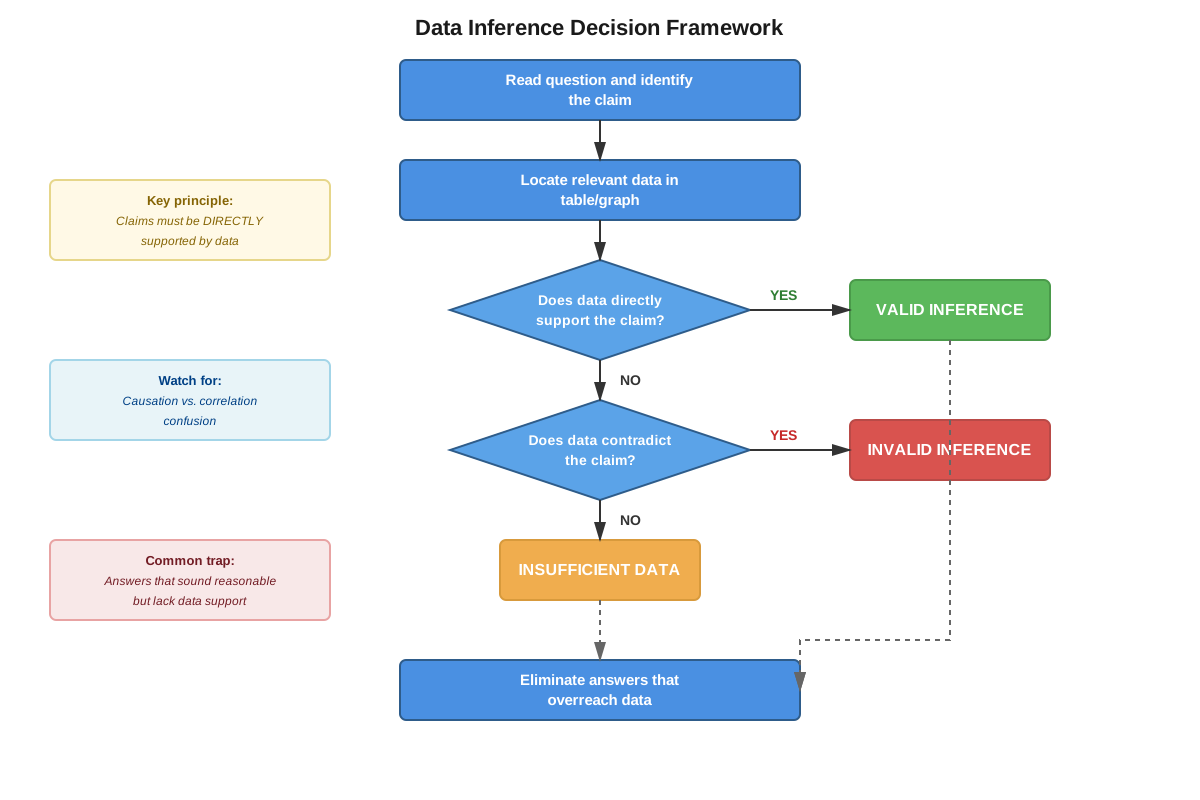
Inference from data refers to the process of drawing logical conclusions based exclusively on information presented in quantitative formats such as tables, graphs, charts, and numerical data sets. Unlike speculation or assumption, valid data inference requires that every conclusion be directly traceable to specific evidence in the data presentation. The SAT tests whether students can identify what data actually demonstrates versus what it might suggest or what someone might hope it shows.
The fundamental principle underlying all data inference questions is that the correct answer must be fully supported by the data without requiring additional assumptions or outside knowledge. If a conclusion requires information not present in the data, it exceeds the scope of valid inference. This principle aligns with the broader SAT philosophy that correct answers are always defensible through direct textual or numerical evidence.
Types of Data Presentations
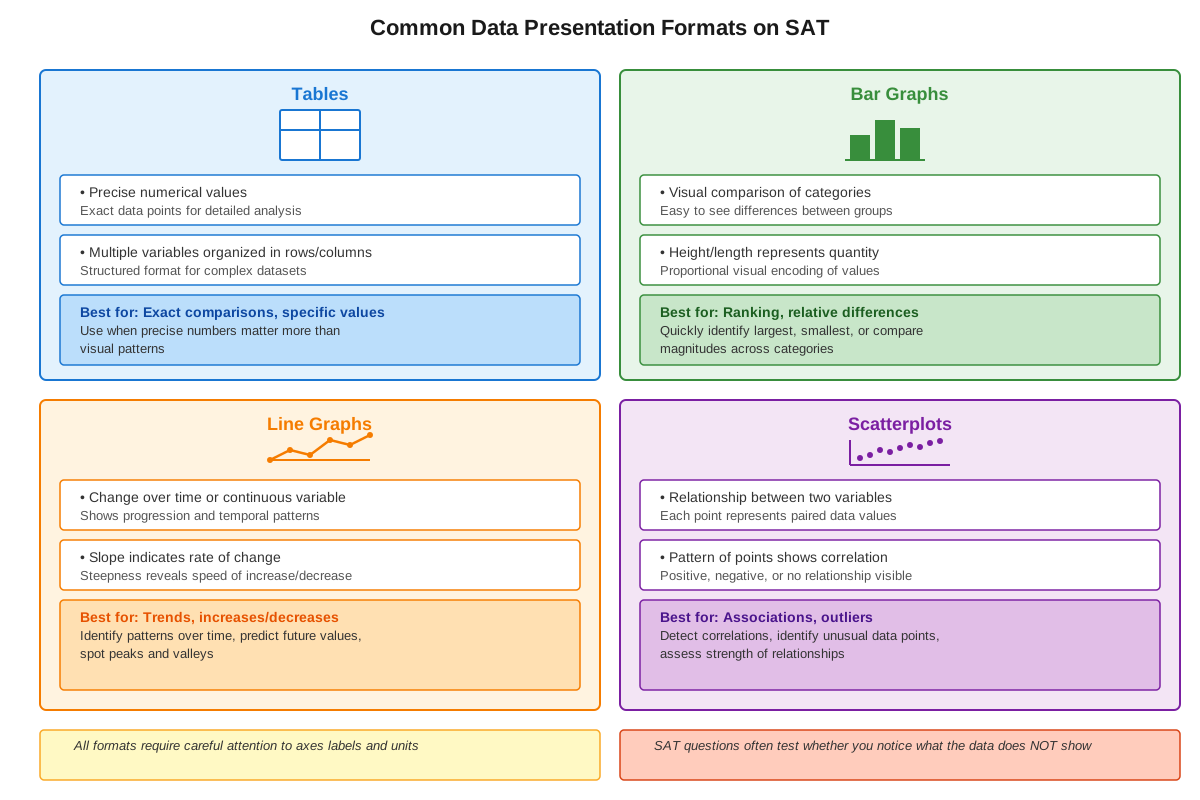
The SAT employs several standard formats for presenting quantitative information:
| Data Format | Key Features | Common Uses | Reading Strategy |
|---|---|---|---|
| Tables | Rows and columns organizing numerical values | Comparing multiple variables across categories | Identify row/column headers first, then locate specific values |
| Bar Graphs | Rectangular bars representing quantities | Comparing discrete categories or groups | Compare bar heights; check if bars represent counts or percentages |
| Line Graphs | Connected points showing change over time | Illustrating trends, growth, or decline | Identify overall direction; note inflection points where trends change |
| Scatterplots | Individual points showing relationship between two variables | Demonstrating correlation or patterns | Look for clustering, general direction, and outliers |
| Pie Charts | Circular segments representing parts of a whole | Showing proportions or percentages | Verify segments sum to 100%; compare relative sizes |
Valid Versus Invalid Inferences
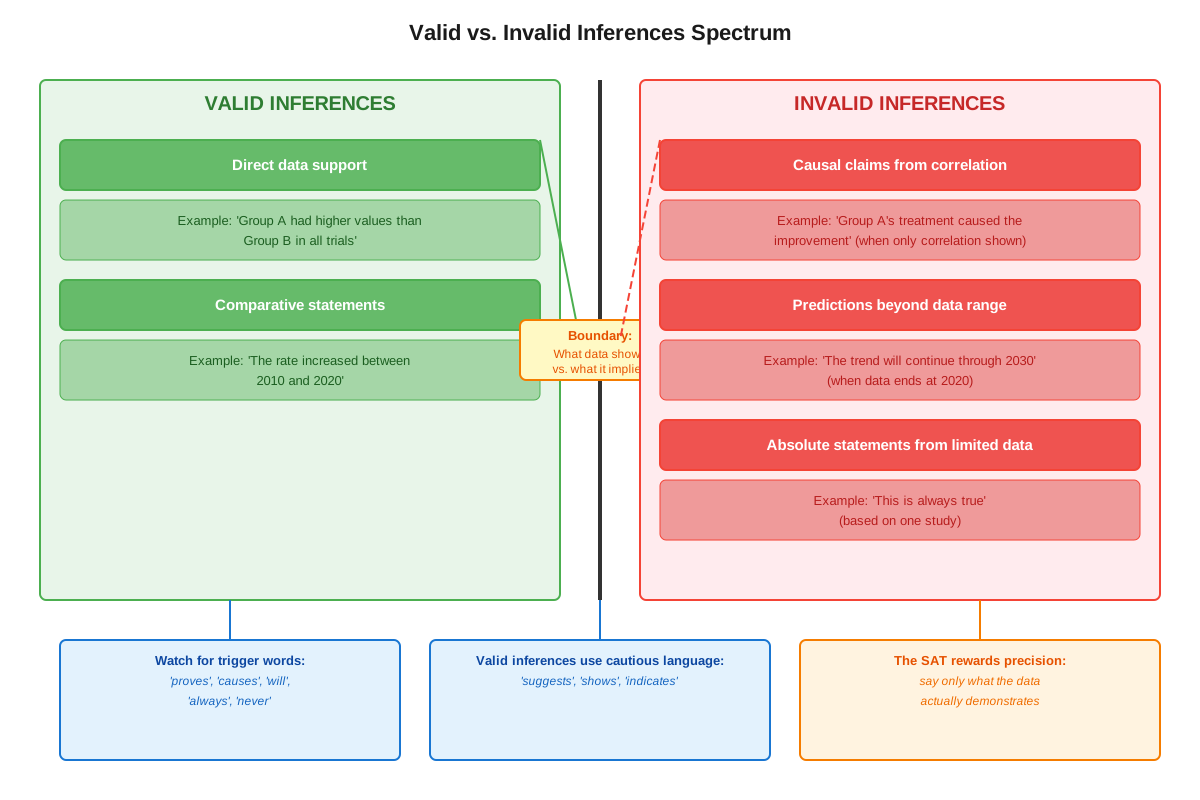
A valid inference is a conclusion that follows necessarily and directly from the data presented. For example, if a table shows that City A had 50,000 residents in 2010 and 75,000 in 2020, a valid inference is "City A's population increased between 2010 and 2020." This conclusion requires no assumptions and is directly supported by the numbers.
An invalid inference extends beyond what the data actually demonstrates. Using the same example, concluding "City A will have 100,000 residents by 2030" would be invalid because it requires assuming the growth trend will continue at the same rate—an assumption not supported by the data provided. Similarly, concluding "City A became more prosperous" would be invalid because population increase doesn't necessarily indicate economic prosperity; this conclusion imports outside assumptions about what population growth means.
Identifying Trends and Patterns
Data inference questions frequently ask students to identify trends—consistent patterns of increase, decrease, or stability over time or across categories. When analyzing trends, students must:
- Determine the direction: Is the overall pattern increasing, decreasing, fluctuating, or remaining stable?
- Assess consistency: Does the trend hold across all data points, or are there exceptions?
- Quantify magnitude: Is the change substantial or minimal relative to the scale?
- Recognize limitations: Does the data cover sufficient range to establish a genuine trend?
For example, if a line graph shows test scores of 72, 75, 78, 81, and 84 over five years, the trend is clearly increasing and consistent. However, if scores show 72, 85, 73, 84, 75, the pattern is fluctuating without a clear trend.
Comparing Data Points
Many SAT questions require comparing specific values within a data presentation. Effective comparison involves:
- Identifying the relevant data points: Locate exactly which values the question asks about
- Performing necessary calculations: Determine differences, ratios, or percentages as needed
- Expressing relationships accurately: Use precise language (greater than, approximately equal to, twice as large)
- Avoiding overstatement: Don't exaggerate differences or claim precision the data doesn't support
Recognizing Data Limitations
Sophisticated data inference questions test whether students understand what data cannot demonstrate. Common limitations include:
- Causation versus correlation: Data showing two variables changing together doesn't prove one causes the other
- Temporal scope: Data from a limited time period may not represent long-term patterns
- Sample limitations: Data from one group may not generalize to other populations
- Missing variables: Unmeasured factors might explain observed patterns
- Measurement precision: Data rounded to whole numbers cannot support conclusions requiring decimal precision
Integrating Data with Passage Context
SAT data inference questions typically appear alongside passages that provide context for the quantitative information. Students must synthesize textual and numerical information to:
- Understand what the data measures and why it was collected
- Interpret technical terms or variables defined in the passage
- Recognize which aspects of the passage the data supports or illustrates
- Identify when passage claims align with or diverge from data evidence
Concept Relationships
The concepts within data inference form a hierarchical structure where foundational skills enable more complex analysis. Understanding data presentations (tables, graphs, charts) serves as the base skill, allowing students to extract basic information. This extraction ability leads to identifying trends and patterns, which requires comparing multiple data points and recognizing relationships. Pattern recognition then enables distinguishing valid from invalid inferences, as students must evaluate whether proposed conclusions genuinely follow from observed patterns.
Recognizing data limitations represents an advanced application that builds on all previous skills—students must understand what the data shows, identify patterns, and then critically evaluate what conclusions those patterns can and cannot support. Finally, integrating data with passage context synthesizes all these skills with reading comprehension, creating the complete competency the SAT assesses.
This topic connects to prerequisite knowledge of basic graph reading and mathematical operations, which provide the technical foundation for data extraction. It also relates closely to evidence-based reading skills, as both require identifying what information directly supports a conclusion. The logical reasoning developed through data inference transfers to other SAT question types, particularly those asking students to identify assumptions, evaluate arguments, or recognize logical flaws.
Relationship Map: Basic data literacy → Data extraction from presentations → Pattern and trend identification → Valid inference construction → Limitation recognition → Context integration → Complete SAT data inference mastery
High-Yield Facts
⭐ Valid inferences must be directly supported by the data without requiring additional assumptions or outside knowledge
⭐ Correlation shown in data does not establish causation—two variables changing together doesn't prove one causes the other
⭐ When comparing data points, always verify you're reading the correct row, column, or data series before selecting an answer
⭐ Trend questions require examining the overall pattern, not just two isolated data points
⭐ If an answer choice uses absolute language (always, never, all, none) when data shows exceptions, it's likely incorrect
- Data presented as percentages requires different interpretation than raw numbers—a small percentage of a large group may exceed a large percentage of a small group
- Line graphs show change over time; the steepness of the line indicates the rate of change
- Tables organize information systematically; always check both row and column headers before extracting values
- Scatterplots demonstrate relationships between two variables; points clustering along a line suggest correlation
- When data includes error bars or ranges, conclusions must account for this uncertainty rather than treating values as precise
- The scale and units of measurement significantly affect interpretation—always check axis labels and legends
- Data covering a limited time period or sample may not represent broader patterns or populations
- If a question asks what data "suggests" versus what it "proves," the correct answer for "proves" must be more definitively supported
- Multiple data presentations in one question may require synthesizing information from different sources
- The absence of data about something is not evidence that it doesn't exist or didn't occur
Quick check — test yourself on Inference from data so far.
Try Flashcards →Common Misconceptions
Misconception: If two variables both increase over time in a data set, one must be causing the other to increase.
Correction: Correlation does not establish causation. Both variables might be influenced by a third factor not shown in the data, or their simultaneous increase might be coincidental. Valid inference can only state that both increased together, not that one caused the other.
Misconception: A trend shown across five data points will definitely continue in the same direction.
Correction: Data showing a pattern over a limited range does not guarantee the pattern will continue. Valid inference describes what the data shows within the measured range but cannot predict future values without additional evidence.
Misconception: If data shows Group A has a higher percentage than Group B, Group A must have more total members.
Correction: Percentages represent proportions, not absolute quantities. A smaller group with a higher percentage might have fewer total members than a larger group with a lower percentage. Always distinguish between relative (percentage) and absolute (count) comparisons.
Misconception: All information in a data table or graph is relevant to answering the question.
Correction: SAT data presentations often include more information than needed for any single question. Part of the skill is identifying which specific data points are relevant to the question being asked and ignoring extraneous information.
Misconception: If the data doesn't explicitly contradict a statement, that statement can be inferred from the data.
Correction: Valid inference requires positive support, not merely the absence of contradiction. A statement must be actively supported by the data to be a correct inference, even if the data doesn't disprove it.
Misconception: Precise numerical calculations are always necessary to answer data inference questions.
Correction: Many SAT data questions test conceptual understanding rather than calculation ability. Often, recognizing which value is larger or identifying a general trend is sufficient without computing exact differences or percentages.
Misconception: Data presented in a scientific study must be accurate and reliable.
Correction: While SAT passages typically present data from legitimate sources, the test assesses whether students can identify what the data shows regardless of its real-world validity. The question is always "What does this data demonstrate?" not "Is this data correct?"
Worked Examples
Example 1: Table Analysis with Trend Identification
Passage Context: A researcher studied the number of bird species observed in a forest preserve over five years.
Data Table:
| Year | Number of Species Observed |
|---|---|
| 2018 | 47 |
| 2019 | 52 |
| 2020 | 49 |
| 2021 | 54 |
| 2022 | 58 |
Question: Which statement is best supported by the data?
A) The number of bird species living in the preserve increased every year.
B) The preserve's bird population grew steadily from 2018 to 2022.
C) More bird species were observed in 2022 than in 2018.
D) The preserve will have over 60 observed species by 2024.
Solution Process:
Step 1: Identify what the data actually measures—"species observed," not total bird population or species living in the preserve. This distinction is crucial.
Step 2: Evaluate each answer choice against the data:
Choice A: Check if the number increased "every year." From 2019 (52) to 2020 (49), the number decreased. This choice is contradicted by the data. Eliminate.
Choice B: This claims the "bird population" grew, but the data measures "species observed," not population. Additionally, it claims "steady" growth, but the 2019-2020 decrease contradicts this. Eliminate.
Choice C: Compare 2022 (58 species) to 2018 (47 species). 58 > 47, so more species were indeed observed in 2022 than 2018. This is directly supported. Keep.
Choice D: This predicts future values, which requires assuming the trend will continue. The data only shows what happened through 2022, not what will happen in 2024. Eliminate.
Answer: C
Key Learning Objective Addressed: This example demonstrates applying data inference to SAT-style questions by distinguishing between what data directly shows (more species in 2022 than 2018) versus unsupported conclusions (predictions, causation, or claims about unmeasured variables).
Example 2: Graph Interpretation with Limitation Recognition
Passage Context: A study examined the relationship between hours of weekly exercise and reported stress levels among 200 office workers.
Scatterplot Description: The x-axis shows "Hours of Exercise per Week" (0-10), and the y-axis shows "Stress Level Score" (0-100). Points are scattered but show a general downward trend from upper left to lower right, with stress scores generally decreasing as exercise hours increase.
Question: Based on the data, which conclusion is valid?
A) Exercise causes stress levels to decrease in office workers.
B) Office workers who exercise more tend to report lower stress levels.
C) All office workers should exercise at least 5 hours weekly to reduce stress.
D) Workers who don't exercise have stress levels above 70.
Solution Process:
Step 1: Recognize the data type—a scatterplot shows correlation between two variables but cannot establish causation.
Step 2: Evaluate each choice:
Choice A: Uses causal language ("causes"). Scatterplots show correlation, not causation. The relationship might be reversed (lower stress enables more exercise), or a third factor might influence both. Eliminate.
Choice B: Uses appropriate correlation language ("tend to"). This accurately describes the downward trend shown in the scatterplot without claiming causation. Keep.
Choice C: Makes a prescriptive recommendation ("should") based on observational data. The data shows correlation but doesn't establish that exercise will reduce stress for any individual, nor does it identify an optimal amount. Eliminate.
Choice D: Uses absolute language ("all") about workers who don't exercise. Even if the general trend shows higher stress at lower exercise levels, scatterplots typically show variation—some points at 0 hours of exercise likely have stress scores below 70. Eliminate.
Answer: B
Key Learning Objective Addressed: This example illustrates identifying key features of data inference, particularly recognizing data limitations (correlation vs. causation) and distinguishing valid inferences (describing observed patterns) from invalid ones (claiming causation, making predictions, or using absolute language when data shows variation).
Exam Strategy
Systematic Approach to Data Inference Questions
- Read the question first: Identify exactly what information you need before examining the data
- Locate relevant data: Find the specific table, graph section, or data points the question references
- Extract needed values: Write down or mentally note the specific numbers or patterns required
- Predict an answer: Before looking at choices, determine what the data shows
- Eliminate wrong answers: Remove choices that contradict data, require assumptions, or overstate conclusions
- Verify the remaining choice: Confirm your selection is fully supported by the data
Trigger Words and Phrases
Words indicating valid, supported inferences: "according to the data," "the data shows," "based on the table," "the graph indicates," "supported by," "demonstrated by"
Words suggesting potentially invalid inferences: "proves that," "will definitely," "always," "never," "must be," "causes," "explains why"
Comparison language requiring careful verification: "more than," "less than," "approximately equal," "twice as large," "the greatest," "the least"
Process of Elimination Tips
Eliminate choices that:
- Reference variables not included in the data presentation
- Claim causation when data only shows correlation
- Make predictions about future values without supporting evidence
- Use absolute language (all, none, always, never) when data shows exceptions
- Require mathematical precision the data doesn't support (e.g., claiming exact percentages from a graph with approximate values)
- Contradict any data point shown in the presentation
Keep choices that:
- Describe patterns or trends actually visible in the data
- Use appropriately qualified language (tend to, generally, suggest)
- Compare specific values that can be verified in the presentation
- Acknowledge limitations or uncertainty when present in the data
Time Allocation
Data inference questions typically require 45-75 seconds each. Allocate time as follows:
- 15 seconds: Read question and identify relevant data location
- 20 seconds: Extract and compare necessary values
- 20 seconds: Evaluate answer choices
- 10 seconds: Verify selection and move on
If a question requires complex calculations, consider whether estimation or pattern recognition might be sufficient. The SAT rarely requires precise computation when conceptual understanding can answer the question.
Memory Techniques
VALID Inference Checklist:
- Verifiable: Can you point to specific data supporting this conclusion?
- Appropriate scope: Does the conclusion stay within what the data measures?
- Logical: Does the conclusion follow necessarily from the data?
- Independent: Does the conclusion require no outside assumptions?
- Direct: Is the connection between data and conclusion straightforward?
TREND Analysis Mnemonic - "DAMP":
- Direction: Is it increasing, decreasing, or stable?
- Amount: How large is the change?
- Monotonicity: Is the change consistent or variable?
- Period: Over what timeframe does the trend occur?
Correlation vs. Causation Reminder: "Together ≠ Therefore"
When two variables change together, they correlate, but this doesn't mean one therefore causes the other.
Table Reading Strategy - "RLCV":
- Read the title/caption first
- Look at labels (row and column headers)
- Check units and scale
- Verify specific values needed
Summary
Inference from data represents a critical SAT Reading and Writing skill that requires students to analyze quantitative information and draw conclusions supported exclusively by the evidence presented. Mastery involves understanding various data presentation formats (tables, graphs, charts), extracting relevant information efficiently, identifying trends and patterns, and distinguishing between valid inferences that follow directly from the data versus invalid conclusions that require unsupported assumptions. The fundamental principle is that correct answers must be fully defensible through the data provided, without importing outside knowledge or extending beyond what the numbers actually demonstrate. Students must recognize data limitations, particularly the distinction between correlation and causation, and avoid answer choices that predict future values, claim absolute certainty when data shows variation, or reference variables not included in the presentation. Success requires systematic analysis: reading questions carefully to identify what information is needed, locating relevant data points, comparing values accurately, and eliminating choices that contradict evidence or overstate conclusions. This competency appears frequently on the SAT and reflects essential college-readiness skills for evaluating research, interpreting statistical information, and making evidence-based judgments across academic disciplines.
Key Takeaways
- Valid data inferences must be directly supported by the quantitative evidence without requiring additional assumptions or outside knowledge
- Correlation between variables does not establish causation—data showing two things changing together doesn't prove one causes the other
- Always verify you're reading the correct data points (right row, column, or data series) before selecting an answer
- Distinguish between what data measures versus what it doesn't measure—conclusions about unmeasured variables are invalid
- Eliminate answer choices using absolute language (always, never, all, none) when the data shows exceptions or variation
- Trends describe patterns within the data range shown but cannot predict future values without additional evidence
- Percentages and raw numbers require different interpretations—higher percentages don't necessarily mean larger absolute quantities
- The systematic approach (read question → locate data → extract values → predict answer → eliminate → verify) improves accuracy and efficiency
Related Topics
Evidence-Based Reading: Data inference skills directly support the broader SAT emphasis on evidence-based reasoning, where all conclusions must be traceable to specific textual or numerical support. Mastering data inference strengthens the fundamental skill of distinguishing between what sources actually state versus what readers might assume.
Quantitative Information in Science Passages: Many SAT science passages include experimental data, research findings, or observational studies. The data inference skills developed here enable students to evaluate scientific claims, understand research methodology, and interpret results accurately.
Argument Analysis: Recognizing valid versus invalid inferences from data connects to evaluating the strength of arguments. Understanding when evidence actually supports a conclusion versus when it's insufficient or misapplied is essential for both data questions and argument-based reading questions.
Statistical Literacy: While the SAT doesn't require advanced statistics knowledge, data inference questions develop foundational statistical thinking—understanding variability, recognizing patterns, and drawing appropriate conclusions from numerical evidence—that supports more advanced quantitative reasoning.
Practice CTA
Now that you've mastered the core concepts of inference from data, it's time to apply these skills to authentic SAT-style questions. The practice questions and flashcards will reinforce your ability to analyze data presentations quickly and accurately, distinguish valid from invalid inferences, and avoid common traps. Remember: every practice question you complete strengthens your pattern recognition and builds the confidence you need to excel on test day. Approach each practice item systematically, verify your answers against the data, and review any mistakes to understand exactly where your reasoning diverged from the evidence. Your investment in deliberate practice with data inference questions will yield significant score improvements across the Reading and Writing section!
Sign up free to keep reading
Create a free AnvayaPrep account to finish this SAT guide on Inference from data — plus flashcards and practice questions.