Overview
Logical inference is one of the most critical skills tested in the SAT Reading and Writing section. This cognitive process requires students to draw conclusions that are not explicitly stated in a passage by analyzing the information provided and determining what must be true based on the evidence. Unlike simple comprehension questions that ask students to identify information directly stated in the text, logical inference questions demand that test-takers connect ideas, recognize implications, and extend their understanding beyond the literal words on the page.
On the SAT, sat logical inference questions appear frequently throughout the Reading and Writing section, making up a substantial portion of the inference-based questions that students encounter. These questions assess whether students can think critically about what an author implies, suggests, or indicates without stating directly. Mastering this skill is essential not only for achieving a competitive score but also for developing the analytical reading abilities necessary for college-level coursework. The ability to make sound inferences separates students who merely understand surface-level content from those who can engage deeply with complex texts.
Within the broader RW (Reading and Writing) framework, logical inference serves as a foundational skill that connects to virtually every other reading competency. It builds upon basic comprehension while supporting more advanced skills like analyzing rhetorical strategies, understanding authorial purpose, and evaluating arguments. Students who excel at logical inference can better navigate challenging passages across all content domains—from literature and history to science and social studies—because they can extract meaning that goes beyond explicit statements.
Learning Objectives
- [ ] Identify key features of logical inference
- [ ] Explain how logical inference appears on the SAT
- [ ] Apply logical inference to answer SAT-style questions
- [ ] Distinguish between valid inferences and unsupported assumptions
- [ ] Evaluate the strength of evidence supporting different inferences
- [ ] Recognize common inference patterns in various passage types
Prerequisites
- Basic reading comprehension: The ability to understand explicitly stated information is necessary before drawing conclusions about implicit meaning
- Vocabulary knowledge: Understanding the denotative and connotative meanings of words helps identify subtle implications in passages
- Sentence structure analysis: Recognizing how clauses relate to each other enables students to see logical connections between ideas
- Evidence identification: Knowing how to locate relevant textual support is essential for validating inferences
Why This Topic Matters
Logical inference represents a fundamental thinking skill that extends far beyond standardized testing. In academic settings, students constantly make inferences when analyzing literature, interpreting historical documents, evaluating scientific claims, and synthesizing research. In professional contexts, the ability to read between the lines, anticipate implications, and draw sound conclusions from incomplete information proves invaluable across virtually every career path. Whether analyzing market trends in business, interpreting patient symptoms in healthcare, or evaluating legal precedents in law, logical inference remains an essential cognitive tool.
On the SAT specifically, inference questions constitute approximately 20-25% of all Reading and Writing questions, making them one of the most frequently tested question types. These questions appear across all passage types—literary narratives, historical documents, scientific explanations, and argumentative essays. The College Board consistently includes logical inference questions because they effectively measure college readiness: the ability to engage with complex texts at a level beyond surface comprehension.
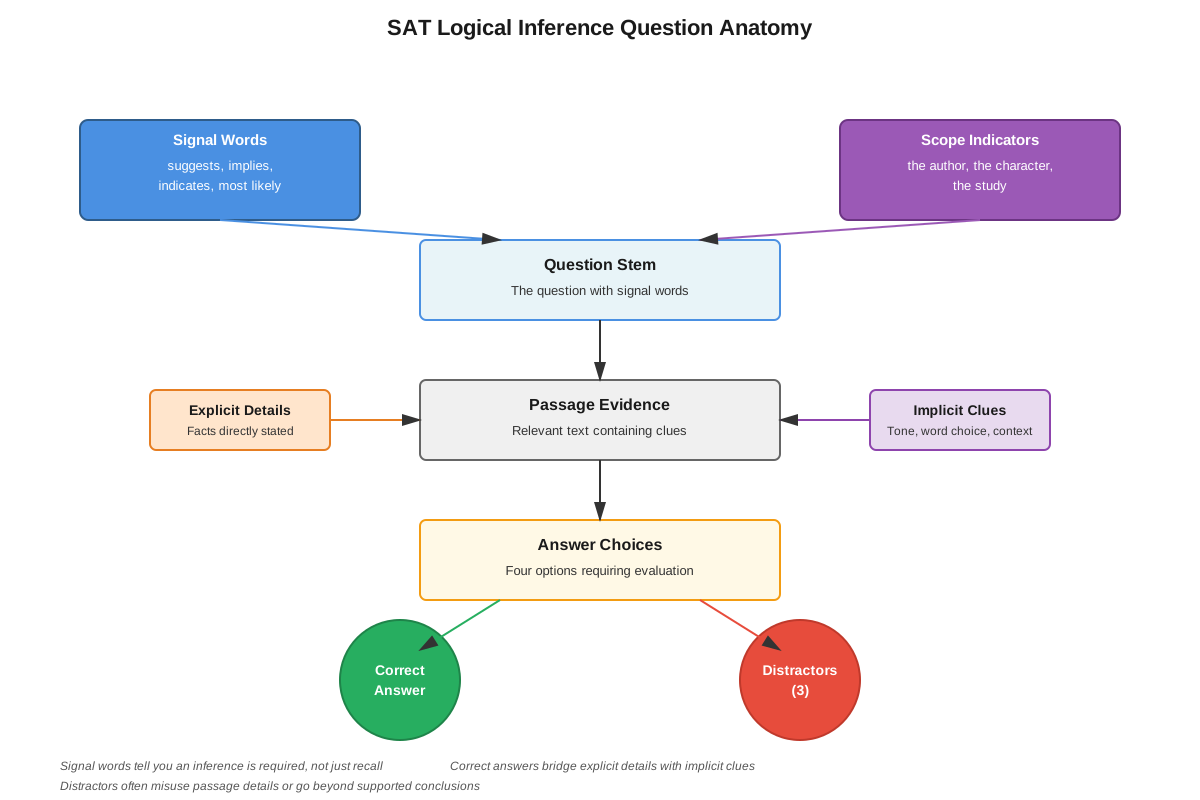
Common manifestations of logical inference on the SAT include questions asking what a passage "suggests," "implies," or "indicates" about a topic. Students might be asked to infer a character's motivation in a literary passage, determine the likely outcome of a scientific process described in an informational text, or identify an unstated assumption underlying an author's argument. These questions often include answer choices that are technically true but not supported by the passage, making the ability to distinguish between valid and invalid inferences crucial for success.
Core Concepts
What Is Logical Inference?
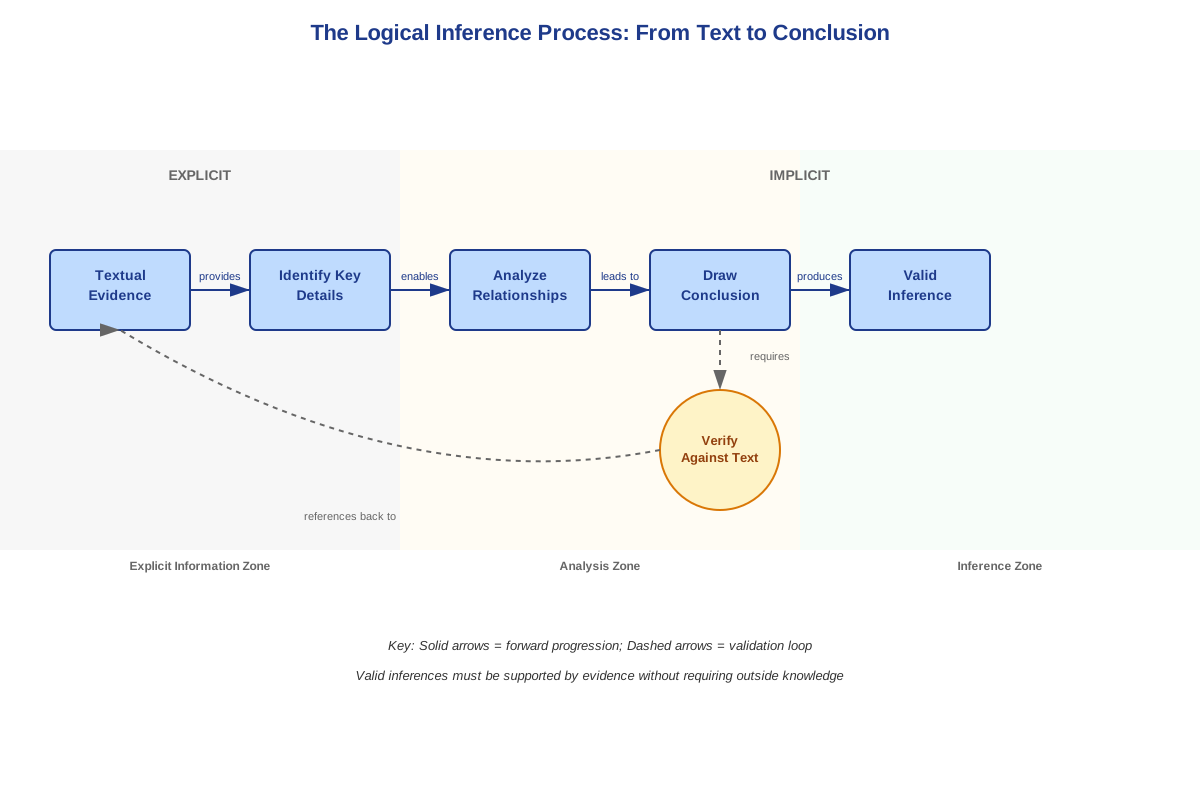
A logical inference is a conclusion drawn from evidence and reasoning rather than from explicit statements. When making an inference, readers use information directly stated in a text, combined with their background knowledge and logical reasoning, to determine what must be true, what is likely true, or what the author implies without stating directly. The key characteristic distinguishing inference from simple comprehension is that inferences require an intellectual leap—connecting dots that the author has not explicitly connected.
Valid inferences must be firmly grounded in textual evidence. They represent conclusions that follow logically and necessarily from the information provided, not merely possibilities that could be true. For example, if a passage states, "Maria checked her watch for the third time in five minutes and tapped her foot rapidly," a valid inference would be that Maria feels impatient or anxious. This conclusion follows logically from the behavioral cues described, even though the passage never explicitly states Maria's emotional state.
Types of Inferences on the SAT
The SAT tests several distinct categories of logical inference, each requiring slightly different analytical approaches:
Character-based inferences appear in literary passages and require students to determine motivations, emotions, attitudes, or personality traits based on actions, dialogue, and descriptions. These inferences often involve understanding subtext in conversations or recognizing the significance of behavioral details.
Causal inferences ask students to identify cause-and-effect relationships that are implied but not explicitly stated. A passage might describe a sequence of events, and students must infer what caused a particular outcome or what will likely result from a described situation.
Comparative inferences require recognizing implied similarities or differences between concepts, time periods, or perspectives. These often appear in historical or scientific passages where authors discuss multiple subjects without explicitly stating how they relate.
Purpose and attitude inferences involve determining an author's unstated intentions, opinions, or perspectives based on word choice, tone, and the information they choose to include or emphasize.
The Inference Process
Making valid inferences follows a systematic process that students can apply consistently:
- Identify the question focus: Determine exactly what the question asks you to infer (motivation, outcome, attitude, etc.)
- Locate relevant evidence: Find the specific passage sections that relate to the inference question
- Analyze the evidence: Consider what the stated information suggests or implies
- Apply logical reasoning: Connect the evidence to reach a conclusion that must follow
- Verify against the text: Ensure the inference is supported by evidence and doesn't contradict any passage information
- Eliminate unsupported options: Rule out answer choices that go too far, contradict the passage, or lack textual support
Evidence Requirements for Valid Inferences
| Inference Strength | Evidence Requirement | Example |
|---|---|---|
| Must be true | Directly and necessarily follows from stated facts | "The experiment was conducted at -20°C" → The experiment occurred below freezing |
| Strongly suggested | Multiple pieces of evidence point to the same conclusion | Several behavioral indicators suggest a character's nervousness |
| Reasonably implied | Evidence makes the conclusion more likely than alternatives | Context clues suggest an author's skeptical attitude |
| Possible but unsupported | Could be true but lacks sufficient textual evidence | Speculation beyond what the passage indicates |
Common Inference Indicators
SAT passages contain linguistic signals that often indicate where inferences should be drawn. Qualifying language such as "suggests," "appears to," "seems to," or "might" indicates the author is implying rather than stating directly. Descriptive details that seem unnecessary for basic comprehension often carry inferential significance—authors include these details because they want readers to draw conclusions from them. Contrasts and comparisons frequently signal that readers should infer relationships or differences. Rhetorical questions typically imply answers that the author expects readers to infer.
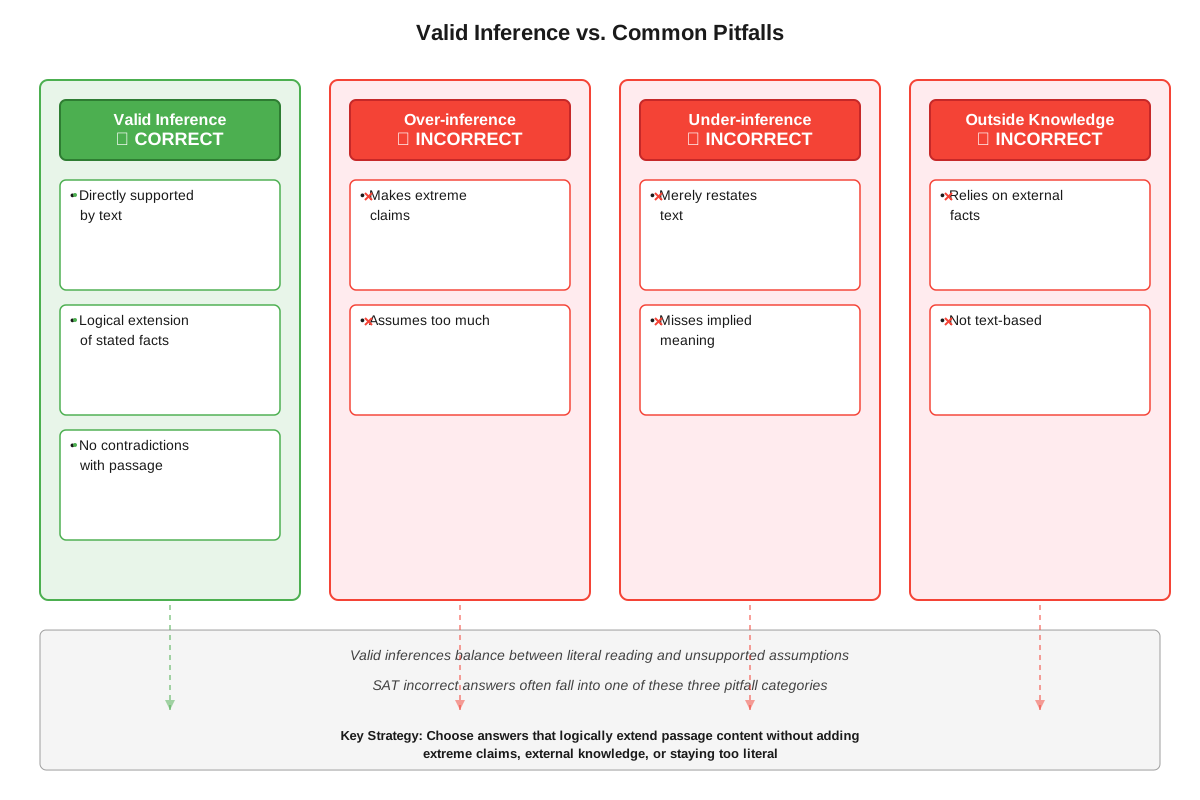
Boundaries of Valid Inference
Understanding what constitutes an invalid inference is as important as recognizing valid ones. Overgeneralization occurs when students draw broader conclusions than the evidence supports. If a passage discusses one scientist's research methods, inferring that "all scientists use these methods" would exceed the textual support. Assumption introduction happens when students bring in outside knowledge or personal opinions not grounded in the passage. Contradiction represents the most clearly invalid inference type—any conclusion that conflicts with stated information cannot be correct. Speculation involves making guesses about possibilities rather than drawing conclusions that logically follow from evidence.
Concept Relationships
Logical inference serves as a central hub connecting multiple reading comprehension skills. Basic comprehension provides the foundation—students must first understand what is explicitly stated before determining what is implied. This relationship flows unidirectionally: comprehension enables inference, but inference skills don't necessarily improve basic comprehension.
Evidence-based reasoning and logical inference exist in a reciprocal relationship. Making valid inferences requires identifying and analyzing evidence, while the process of evaluating evidence often involves inferring its significance and implications. These skills reinforce each other cyclically.
The connection between vocabulary knowledge and inference is particularly strong. Understanding connotations, figurative language, and subtle word choice differences enables students to recognize implications that would otherwise remain invisible. For example, distinguishing between "confident" and "arrogant" allows readers to infer different authorial attitudes.
Textual analysis skills—including recognizing tone, identifying rhetorical strategies, and understanding structure—all depend heavily on inference. Authors rarely announce "I am now using irony" or "My tone is skeptical"; readers must infer these elements from textual clues.
The relationship map flows as follows: Vocabulary + Comprehension → Evidence Identification → Logical Inference → Textual Analysis → Critical Evaluation. Each skill builds upon and enables the next, with logical inference occupying the crucial middle position that transforms basic understanding into sophisticated analysis.
High-Yield Facts
- ⭐ Valid inferences must be directly supported by textual evidence and cannot contradict any information in the passage
- ⭐ The correct answer to an inference question is often the most conservative option that stays closest to what the passage directly supports
- ⭐ Inference questions frequently use trigger words like "suggests," "implies," "indicates," "most likely," and "probably"
- ⭐ Wrong answers often include information that is true in the real world but not supported by the specific passage
- ⭐ Character emotions and motivations in literary passages must be inferred from actions, dialogue, and descriptions rather than assumed
- Causal inferences require identifying logical cause-and-effect relationships even when the passage doesn't explicitly state "because" or "therefore"
- Comparative inferences involve recognizing implied similarities or differences between concepts discussed in the passage
- The strongest inferences are those that would be true in virtually any reasonable interpretation of the passage
- Descriptive details in passages often serve as clues for inferences rather than merely providing atmosphere
- Inference questions may ask about what happens before or after the passage timeframe based on information provided
Quick check — test yourself on Logical inference so far.
Try Flashcards →Common Misconceptions
Misconception: Any statement that could possibly be true based on the passage is a valid inference.
Correction: Valid inferences must be strongly supported by evidence and follow logically from the passage. Mere possibility is insufficient; the inference should be the most reasonable conclusion based on the evidence provided.
Misconception: Using outside knowledge or real-world information strengthens inference answers.
Correction: SAT inference questions must be answered based solely on passage content. Even if outside knowledge makes an answer seem correct, it's wrong if the passage doesn't support it. The test assesses reading comprehension, not general knowledge.
Misconception: The correct inference answer will restate information directly from the passage.
Correction: Inference questions require going beyond what's explicitly stated. Answers that merely repeat passage information typically represent comprehension questions, not inference questions. Valid inference answers express conclusions that follow from stated information but aren't directly stated themselves.
Misconception: Longer, more detailed answer choices are more likely to be correct.
Correction: Answer length doesn't correlate with correctness. In fact, longer answers sometimes include additional details that go beyond textual support, making them incorrect despite seeming thorough. Focus on logical support rather than answer length.
Misconception: If part of an answer choice is supported by the passage, the entire answer is correct.
Correction: Every component of an answer choice must be supported by the passage. Partially correct answers are completely wrong on the SAT. Even if 90% of an answer is valid, an unsupported 10% makes it incorrect.
Misconception: Extreme language in answer choices (always, never, must, impossible) automatically makes them wrong.
Correction: While extreme language often signals incorrect answers, some inferences do involve certainty when the passage provides sufficient evidence. Evaluate whether the passage supports the extreme claim rather than automatically eliminating it.
Worked Examples
Example 1: Literary Inference
Passage excerpt: "Thomas glanced at the letter on his desk for what must have been the hundredth time that morning. Each time, he reached toward it, then pulled his hand back as if the paper might burn him. Finally, he stood abruptly, grabbed his coat, and left the office without a word to anyone."
Question: Based on the passage, which statement about Thomas is most strongly supported?
Answer choices:
A) Thomas is excited about the contents of the letter
B) Thomas feels conflicted about reading or responding to the letter
C) Thomas has already read the letter multiple times
D) Thomas is leaving to mail an important response
Solution process:
Step 1: Identify what we need to infer—Thomas's emotional state or attitude toward the letter.
Step 2: Locate relevant evidence:
- "glanced at the letter...hundredth time" suggests repeated attention
- "reached toward it, then pulled his hand back" indicates hesitation
- "as if the paper might burn him" implies fear or anxiety
- "stood abruptly...left...without a word" suggests avoidance behavior
Step 3: Analyze the evidence. The repeated glancing shows the letter occupies his thoughts, but the pulling back and eventual departure without addressing it indicate avoidance. The simile about burning suggests anxiety or fear.
Step 4: Apply logical reasoning. Someone who repeatedly looks at something but can't bring themselves to engage with it is experiencing internal conflict—they're drawn to it but also resistant.
Step 5: Evaluate answers:
- A) Excitement doesn't align with avoidance behavior—eliminated
- B) Conflicted matches the pattern of attraction (repeated glancing) and avoidance (pulling back, leaving)—strong candidate
- C) The passage says he "glanced" at it, not read it; he pulls back before touching it—eliminated
- D) Nothing suggests he's mailing anything; he's avoiding the letter—eliminated
Answer: B. The evidence strongly supports that Thomas experiences internal conflict about the letter, demonstrated through his contradictory behaviors of repeated attention and consistent avoidance.
Example 2: Scientific Inference
Passage excerpt: "The researchers observed that coral reefs in areas with higher fish diversity showed significantly less algae coverage than reefs with lower fish diversity. Additionally, they noted that herbivorous fish populations were substantially larger in the high-diversity areas. The team measured algae levels across 50 reef sites over three years, controlling for water temperature, sunlight exposure, and nutrient levels."
Question: The passage most strongly suggests which of the following about the relationship between fish diversity and algae coverage?
Answer choices:
A) Algae growth directly causes changes in fish diversity
B) Herbivorous fish likely contribute to controlling algae levels on reefs
C) Water temperature is the primary factor determining algae coverage
D) All types of fish equally affect algae populations
Solution process:
Step 1: Identify the inference focus—the causal or correlational relationship between fish diversity and algae.
Step 2: Locate evidence:
- High fish diversity correlates with less algae
- High diversity areas have more herbivorous fish
- Other factors (temperature, sunlight, nutrients) were controlled
Step 3: Analyze the evidence. The correlation between diversity and algae could have multiple explanations, but the passage specifically mentions herbivorous fish populations. Controlling for other variables suggests the fish-algae relationship isn't explained by those factors.
Step 4: Apply logical reasoning. Herbivorous fish eat plant matter (algae). Higher herbivorous fish populations in low-algae areas suggests these fish may be consuming the algae. The controlled variables eliminate alternative explanations.
Step 5: Evaluate answers:
- A) Reverses the likely causal direction; nothing suggests algae causes fish diversity changes—eliminated
- B) Logically connects herbivorous fish (which eat algae) to lower algae levels—strong candidate
- C) Contradicts the passage, which controlled for temperature, suggesting it's not the primary factor—eliminated
- D) Overgeneralizes; the passage specifically mentions herbivorous fish, not all fish types—eliminated
Answer: B. The evidence supports inferring that herbivorous fish contribute to algae control, as their higher populations correlate with lower algae levels, and they consume plant matter by definition.
Exam Strategy
When approaching sat logical inference questions, begin by carefully reading the question stem to identify exactly what type of inference is required. Questions asking what a passage "suggests" or "implies" signal inference questions, as do questions about what "most likely" occurred or what can be "reasonably concluded." This identification step prevents confusion with other question types.
Exam Tip: Circle or underline the specific aspect you need to infer (character motivation, causal relationship, author's attitude, etc.) before looking at answer choices. This focus prevents distraction from attractive but irrelevant options.
Develop a systematic approach to evidence evaluation. Return to the passage and locate the specific lines relevant to the inference question. Read slightly before and after these lines to ensure full context. Mark or mentally note the evidence that will support your inference. This grounding in textual evidence prevents the common error of selecting answers that seem reasonable but lack passage support.
Trigger words that signal inference questions include: suggests, implies, indicates, most likely, probably, apparently, seems to, appears to, can reasonably be concluded, best supports the idea that, most strongly supports. When you encounter these phrases, shift into inference mode rather than simple comprehension mode.
For process of elimination, systematically evaluate each answer choice against the passage evidence:
- Eliminate answers that contradict passage information
- Eliminate answers that require outside knowledge not provided in the passage
- Eliminate answers that go too far beyond what the evidence supports
- Eliminate answers that are too vague or don't address the specific inference requested
- Choose the remaining answer that has the strongest textual support
Time allocation for inference questions should be approximately 60-75 seconds per question. These questions require more careful analysis than simple comprehension questions but shouldn't consume excessive time. If you find yourself debating between two answers for more than 30 seconds, mark your best choice, flag the question if possible, and return to it if time permits.
Watch for wrong answer patterns specific to inference questions. "Could be true" answers present scenarios that are possible but not supported by evidence. "Too extreme" answers make claims stronger than the passage supports. "Reversal" answers flip the actual relationship described. "Out of scope" answers address topics not covered in the passage. Recognizing these patterns accelerates elimination.
Memory Techniques
INFER acronym for the inference process:
- Identify the question focus
- Notice relevant evidence
- Find logical connections
- Eliminate unsupported options
- Review your choice against the passage
PASS for evaluating answer choices:
- Passage-supported (does evidence exist?)
- Accurate (does it match the evidence?)
- Specific (does it address the question?)
- Safe (does it avoid overreaching?)
Visualize inference questions as bridge-building: the passage provides one side of the river (stated information), and the answer provides the other side (the conclusion). Your job is to determine whether a sturdy, logical bridge connects them. If the bridge requires too many unsupported assumptions or contradicts the terrain, it's not valid.
For remembering the difference between comprehension and inference, use this mental image: Comprehension is like reading a map's labels; inference is like determining where someone is heading based on the direction they're walking. Both use the map, but inference requires additional reasoning.
Create the mnemonic "EVIDENCE FIRST" and mentally repeat it before selecting inference answers. This reminder prevents the common error of choosing answers that seem correct based on general knowledge rather than passage support.
Summary
Logical inference represents a critical SAT Reading and Writing skill that requires students to draw conclusions not explicitly stated in passages by analyzing evidence and applying reasoning. Valid inferences must be firmly grounded in textual evidence, following logically from stated information without contradicting any passage content. The SAT tests various inference types—including character-based, causal, comparative, and attitudinal inferences—across all passage genres. Success requires a systematic approach: identifying the specific inference requested, locating relevant evidence, analyzing what that evidence suggests, and selecting the answer choice most strongly supported by the passage. Common pitfalls include relying on outside knowledge, selecting answers that merely could be true rather than must be true, and choosing options that go beyond textual support. Students must distinguish between valid inferences that follow necessarily from evidence and invalid assumptions that introduce unsupported information. Mastering logical inference not only improves SAT performance but also develops essential critical thinking skills applicable across academic disciplines and professional contexts.
Key Takeaways
- Logical inference requires drawing conclusions from evidence rather than identifying explicitly stated information
- Valid inferences must be directly supported by passage evidence and cannot contradict any passage information
- The correct inference answer is typically the most conservative option that stays closest to textual support
- Inference questions use trigger words like "suggests," "implies," "indicates," and "most likely"
- Wrong answers often include information that is true in general but not supported by the specific passage
- Systematic evaluation of evidence and elimination of unsupported options leads to correct answers
- Inference skills connect to and enable other advanced reading comprehension abilities
Related Topics
Evidence-Based Reading: Builds directly on inference skills by requiring students to identify which passage excerpts support specific conclusions or inferences. Mastering logical inference provides the foundation for evaluating evidence quality and relevance.
Rhetorical Analysis: Extends inference skills to determine author's purpose, tone, and persuasive strategies. Understanding what authors imply enables deeper analysis of how and why they construct arguments.
Comparative Reading: Applies inference skills across multiple texts, requiring students to infer relationships, similarities, and differences between passages. Strong inference abilities make comparative analysis more efficient and accurate.
Command of Evidence Questions: Directly tests the connection between inferences and supporting evidence by asking students to identify which passage lines best support a given conclusion.
Vocabulary in Context: Requires inferring word meanings from surrounding context, applying the same evidence-based reasoning process used in broader inference questions.
Practice CTA
Now that you've mastered the core concepts of logical inference, it's time to put your skills into action! Complete the practice questions to reinforce your understanding and build confidence with SAT-style inference questions. The flashcards will help you internalize key concepts and strategies for quick recall on test day. Remember, logical inference is a skill that improves with deliberate practice—each question you work through strengthens your ability to recognize evidence, draw valid conclusions, and eliminate unsupported answers. You're building not just test-taking skills but critical thinking abilities that will serve you throughout your academic career. Start practicing now to transform your understanding into mastery!
Sign up free to keep reading
Create a free AnvayaPrep account to finish this SAT guide on Logical inference — plus flashcards and practice questions.