Overview
Drawing reasonable conclusions is one of the most critical skills tested in the SAT Reading and Writing (RW) section. This skill requires students to go beyond what is explicitly stated in a passage and make logical inferences based on textual evidence. Unlike simple recall questions, SAT reasonable conclusion questions demand that test-takers synthesize information, recognize patterns, and extend the author's ideas to their logical endpoints—all while staying firmly grounded in what the text actually supports.
The ability to draw reasonable conclusions is fundamental to academic success and critical thinking. On the SAT, these questions typically present a passage followed by a prompt asking what can be "reasonably concluded," "inferred," or "suggested" based on the text. The challenge lies in distinguishing between conclusions that are fully supported by evidence and those that go too far, introduce outside knowledge, or make unsupported leaps. Students must walk a fine line: being analytical enough to read between the lines, yet disciplined enough not to over-interpret or bring in their own assumptions.
This topic sits at the heart of the Inferences unit and connects directly to other essential RW skills including textual evidence analysis, author's purpose, and logical reasoning. Mastering reasonable conclusions strengthens overall reading comprehension and prepares students for the analytical demands of college-level coursework. Because these questions appear frequently throughout the SAT and often determine the difference between a good score and an excellent one, developing systematic strategies for approaching them is essential for test success.
Learning Objectives
- [ ] Identify key features of reasonable conclusion questions on the SAT
- [ ] Explain how reasonable conclusion questions appear on the SAT and what makes them distinct from other question types
- [ ] Apply reasonable conclusion strategies to answer SAT-style questions accurately and efficiently
- [ ] Distinguish between conclusions that are fully supported by textual evidence and those that overreach
- [ ] Evaluate answer choices systematically using evidence-based reasoning
- [ ] Recognize common trap answers and avoid logical fallacies in conclusion-drawing
- [ ] Synthesize multiple pieces of textual information to form cohesive inferences
Prerequisites
- Basic reading comprehension: Understanding literal meaning is the foundation before making inferences; students must grasp what is explicitly stated before determining what is implied
- Textual evidence identification: Recognizing which specific sentences or phrases support a claim is essential because reasonable conclusions must be anchored in concrete evidence
- Vocabulary in context: Understanding word meanings and nuances helps students interpret subtle implications and authorial tone that inform valid conclusions
- Logical reasoning fundamentals: Basic understanding of cause-and-effect relationships and logical connections enables students to extend ideas appropriately without making unsupported leaps
Why This Topic Matters
Drawing reasonable conclusions is not merely an academic exercise—it's a fundamental life skill. In professional settings, employees must regularly interpret data, anticipate outcomes, and make evidence-based decisions. In personal life, critical evaluation of news sources, advertisements, and arguments requires the same careful reasoning tested in SAT conclusion questions. Medical professionals diagnose based on symptoms, lawyers build cases from evidence, and scientists form hypotheses from observations—all applications of reasonable conclusion-drawing.
On the SAT specifically, reasonable conclusion questions appear with high frequency, typically comprising 15-20% of all Reading and Writing questions. These questions appear across all passage types: literary fiction, historical documents, scientific articles, and argumentative essays. The College Board consistently includes these questions because they assess college-readiness skills that predict academic success. Students who master this topic see measurable score improvements because these questions often separate mid-range scorers from high achievers.
Common manifestations include questions asking what "can reasonably be concluded," what the passage "suggests," what "is most likely true," or what the author "would probably agree with." These questions may focus on character motivations in literary passages, experimental implications in science texts, historical causation in social studies passages, or logical extensions of arguments. The versatility of this question type means students encounter it repeatedly throughout the exam, making mastery particularly high-yield for score improvement.
Core Concepts
What Makes a Conclusion "Reasonable"
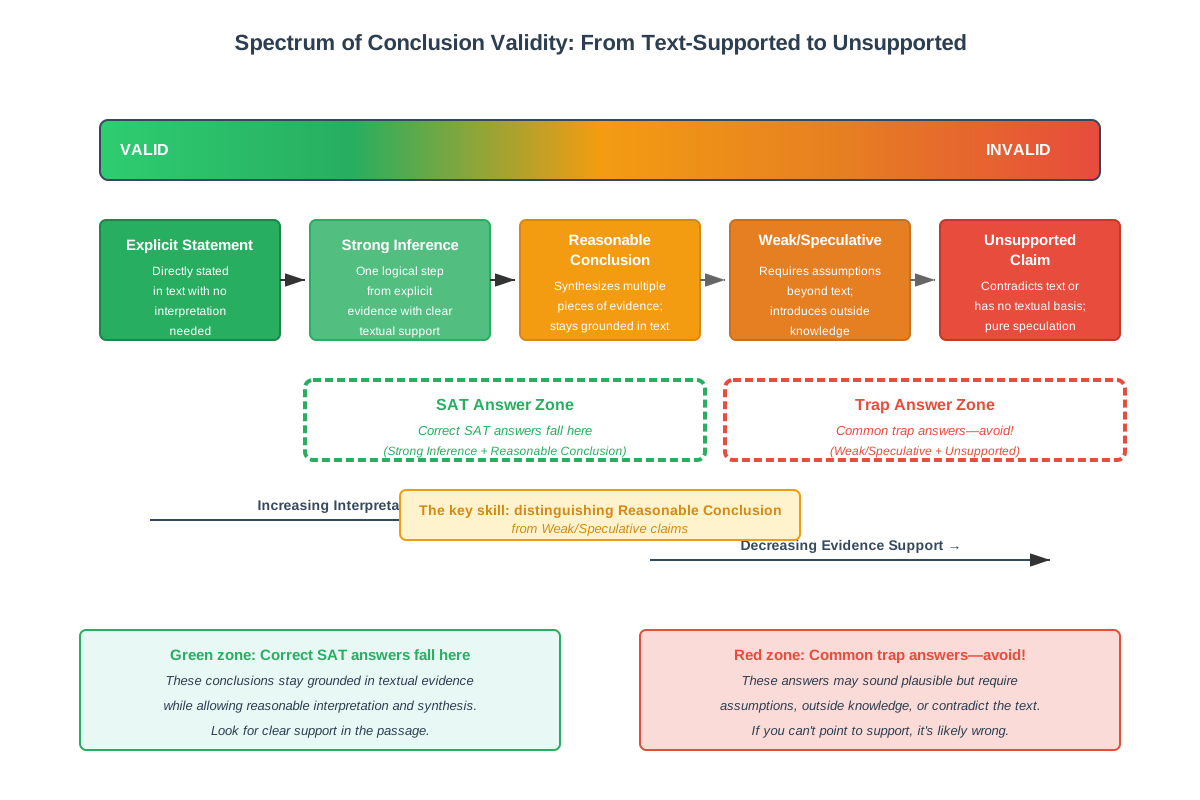
A reasonable conclusion is an inference that is directly supported by evidence in the passage without requiring outside knowledge or making unsupported logical leaps. The key characteristic is that it must be more likely true than false based solely on what the text provides. Reasonable conclusions exist in the space between explicit statements and wild speculation—they require analytical thinking but remain firmly tethered to textual evidence.
Three criteria define reasonable conclusions:
- Evidence-based: Every reasonable conclusion must point to specific textual support
- Logically sound: The reasoning connecting evidence to conclusion must be valid
- Appropriately limited: The conclusion should not extend beyond what the evidence can support
The Inference Spectrum
Understanding where conclusions fall on the inference spectrum helps students calibrate their reasoning:
| Level | Description | SAT Acceptability | Example |
|---|---|---|---|
| Explicit Statement | Directly stated in text | Not an inference | "The experiment lasted three weeks" |
| Close Inference | One small logical step from text | Ideal SAT answer | "The researchers needed at least three weeks of data" |
| Moderate Inference | Requires connecting multiple pieces | Sometimes acceptable | "The researchers planned this timeline deliberately" |
| Distant Inference | Multiple logical steps required | Usually incorrect | "The researchers had limited funding" |
| Speculation | Unsupported by text | Always incorrect | "The researchers were under pressure from administrators" |
SAT reasonable conclusion questions typically reward close inferences and occasionally moderate inferences when sufficient evidence exists. The test never rewards speculation or conclusions requiring outside knowledge.
Evidence Sufficiency
Determining whether evidence sufficiently supports a conclusion is the core skill. Students must ask: "Does the text give me enough information to be confident this conclusion is more likely true than false?" Sufficient evidence typically includes:
- Direct statements that logically lead to the conclusion
- Multiple supporting details that collectively point in the same direction
- Cause-and-effect relationships explicitly or implicitly established
- Patterns or trends demonstrated through examples or data
- Author's tone or emphasis that signals importance or attitude
Insufficient evidence includes vague statements, single ambiguous details, or information that could support multiple contradictory conclusions equally well.
The "Must Be True" vs. "Could Be True" Distinction
Critical to SAT success is understanding that reasonable conclusions must be true based on the passage, not merely could be true. Many trap answers present scenarios that are possible but not supported. For example, if a passage states "The scientist conducted experiments for years before publishing," a reasonable conclusion is "The scientist valued thorough research" (must be true based on the behavior described). However, "The scientist faced rejection from journals" merely could be true—it's possible but not supported by evidence.
Synthesis and Integration
Many SAT reasonable conclusion questions require synthesizing information from multiple sentences or paragraphs. Students must:
- Identify relevant pieces of information scattered throughout the passage
- Recognize how these pieces relate to each other
- Combine them into a coherent understanding
- Draw a conclusion that reflects this integrated understanding
For example, a passage might mention in paragraph one that a historical figure faced criticism, in paragraph two that they persisted with their work, and in paragraph three that their ideas eventually gained acceptance. A reasonable conclusion synthesizing these elements might be: "The figure demonstrated resilience in the face of initial opposition."
Scope Limitations
Reasonable conclusions must match the scope of the evidence. If a passage discusses one scientist's experiment, conclusions should be about that experiment or that scientist—not about "all scientists" or "science in general." Scope errors are among the most common reasons students select incorrect answers. The SAT deliberately includes trap answers that are factually true in the real world but exceed the scope of what the specific passage supports.
Concept Relationships
The skill of drawing reasonable conclusions builds directly on textual evidence identification—students must first locate relevant evidence before determining what it supports. This skill connects to author's purpose analysis because understanding why an author includes certain information helps predict what conclusions they want readers to draw. Similarly, tone and attitude recognition informs reasonable conclusions about an author's beliefs or a character's motivations.
Within the topic itself, concepts flow logically: Understanding what makes a conclusion "reasonable" (definition) → Recognizing the inference spectrum (calibration) → Evaluating evidence sufficiency (assessment) → Distinguishing "must be true" from "could be true" (precision) → Synthesizing multiple pieces of information (integration) → Respecting scope limitations (boundaries).
This topic also prepares students for Command of Evidence questions, where they must select textual support for claims, and for rhetorical analysis, where they must infer how authors build arguments. The logical reasoning developed here transfers to the entire Reading and Writing section and even to the Math section's word problems, where students must infer what questions are actually asking.
Relationship Map:
Evidence Identification → Reasonable Conclusion → Command of Evidence Questions
Author's Purpose → Reasonable Conclusion → Rhetorical Analysis
Logical Reasoning → Reasonable Conclusion → Argument Evaluation
High-Yield Facts
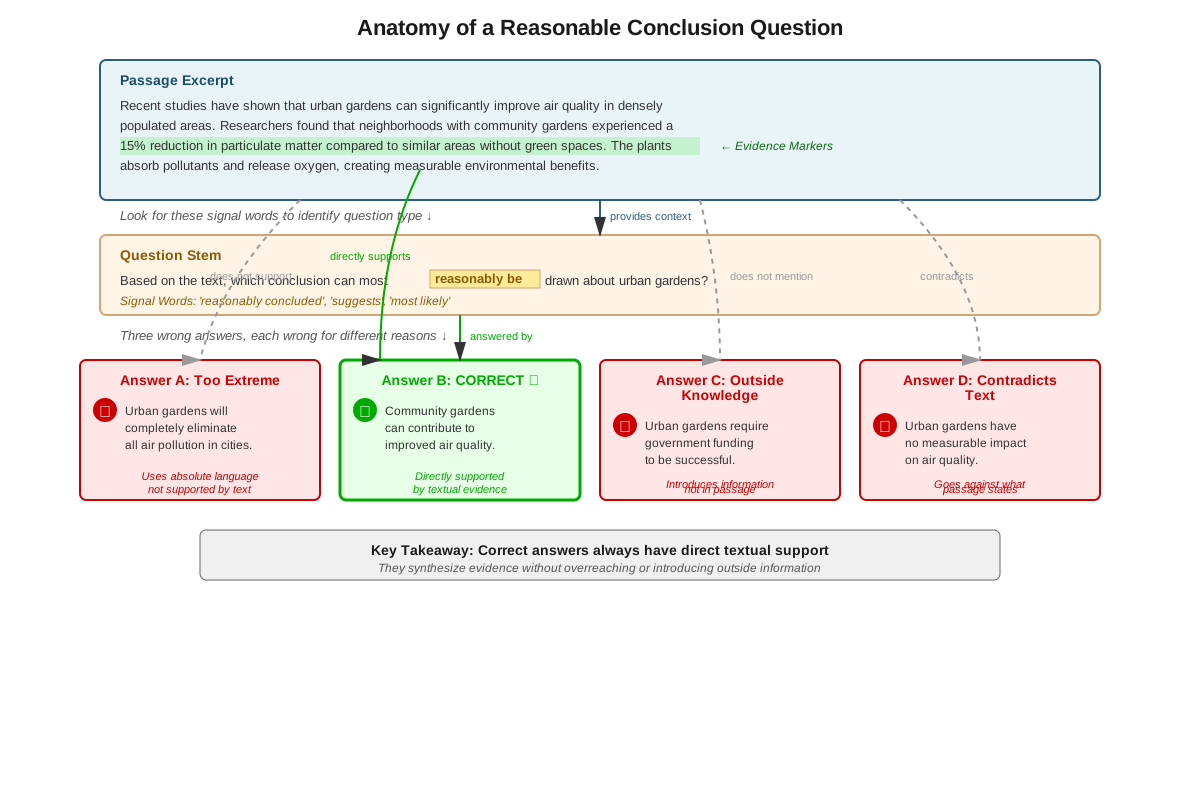
⭐ Reasonable conclusions must be supported by specific textual evidence, not outside knowledge or assumptions
⭐ The correct answer will be more conservative than trap answers—it won't overreach beyond what the text supports
⭐ Questions use trigger phrases like "can reasonably be concluded," "suggests," "most likely," "probably," and "implies"
⭐ Trap answers often present real-world truths that aren't supported by the specific passage
⭐ If you cannot point to specific evidence in the passage that supports an answer, it's wrong
- Reasonable conclusion questions appear across all passage types: literary, historical, scientific, and argumentative
- Synthesis questions requiring integration of multiple details are increasingly common on recent SATs
- Scope errors (conclusions too broad or too narrow) are the most frequent mistake students make
- The SAT never requires specialized subject knowledge to draw reasonable conclusions
- Extreme language in answer choices ("always," "never," "only") is usually incorrect unless the passage uses equally extreme language
- Character motivation questions in literary passages are a common application of reasonable conclusion skills
- Scientific passages often ask what can be concluded about experimental results or implications
- Historical passages frequently test conclusions about causation or significance of events
- The correct answer often paraphrases or synthesizes passage content rather than quoting it directly
- Time pressure causes students to select answers that "sound good" rather than checking textual support
Quick check — test yourself on Reasonable conclusion so far.
Try Flashcards →Common Misconceptions
Misconception: If something is true in the real world, it's a reasonable conclusion from the passage.
Correction: Reasonable conclusions must be supported by the specific passage, regardless of real-world truth. The SAT tests reading comprehension, not general knowledge. Always verify that the passage itself provides evidence for the conclusion.
Misconception: Reasonable conclusions must be explicitly stated somewhere in the passage.
Correction: If something is explicitly stated, it's not an inference—it's a direct statement. Reasonable conclusions require one logical step beyond what's explicitly written, connecting evidence to an unstated but supported idea.
Misconception: The longest or most detailed answer choice is usually correct.
Correction: Length doesn't indicate correctness. The SAT often includes lengthy trap answers with impressive-sounding but unsupported claims. The correct answer is the one best supported by evidence, regardless of length.
Misconception: If part of an answer choice is supported by the passage, the whole answer is correct.
Correction: Every part of an answer choice must be supported. The SAT frequently includes trap answers that are half-right—they contain some accurate information but add unsupported claims. The entire answer must be reasonable based on the text.
Misconception: You should use your personal opinions or experiences to evaluate answer choices.
Correction: Personal reactions are irrelevant. The question asks what the passage supports, not what you believe or have experienced. Students must set aside their own views and focus exclusively on textual evidence.
Misconception: Reasonable conclusions are always about the main idea of the passage.
Correction: While some conclusion questions address main ideas, many focus on specific details, character motivations, experimental implications, or localized arguments. Students must read carefully to determine what specific aspect the question addresses.
Misconception: If you can imagine a scenario where an answer might be true, it's reasonable.
Correction: Possibility isn't sufficient—the conclusion must be probable based on passage evidence. Many trap answers present imaginable scenarios that lack textual support. The standard is "must be true based on the passage," not "could possibly be true in some scenario."
Worked Examples
Example 1: Literary Passage
Passage:
"Margaret had spent three years perfecting her technique, practicing daily even when her hands ached from the cold studio. Other students had long since moved on to teaching positions or performance careers, but she remained, refining each movement until it satisfied her exacting standards. Her instructor had stopped offering corrections months ago, simply nodding with what might have been approval or resignation."
Question: Based on the passage, which conclusion about Margaret is most reasonable?
Answer Choices:
A) Margaret lacks the talent to succeed professionally in her field
B) Margaret's dedication to perfection may have delayed her career advancement
C) Margaret's instructor believes she will never improve further
D) Margaret practices more than any other student in the program
Step-by-Step Solution:
First, identify what the passage directly tells us:
- Margaret practiced for three years, perfecting her technique
- She practiced daily despite discomfort
- Other students moved on to careers
- She remained to refine her work to her own standards
- Her instructor stopped giving corrections and now just nods
Now evaluate each answer:
Choice A: The passage never suggests Margaret lacks talent. In fact, her instructor's silence could indicate she's already excellent. This introduces unsupported negative judgment. Eliminate.
Choice B: The passage states other students "moved on to teaching positions or performance careers" while Margaret "remained, refining each movement." This directly supports that her perfectionism kept her in school while others advanced professionally. The word "may" appropriately limits the claim. Strong candidate.
Choice C: The instructor's nod "might have been approval or resignation"—the passage explicitly presents both as possibilities, so we cannot conclude definitively which. This answer claims certainty where the text provides ambiguity. Eliminate.
Choice D: The passage says Margaret practiced daily, but never compares her practice time to other students. "More than any other student" is unsupported. Eliminate.
Correct Answer: B
This answer makes a close inference connecting Margaret's continued refinement (stated) with delayed career advancement (reasonably concluded by comparing her timeline to other students'). It uses appropriately cautious language ("may have") and stays within the scope of what the passage supports.
Example 2: Scientific Passage
Passage:
"Researchers observed that coral reefs exposed to higher water temperatures showed a 40% increase in bleaching events compared to reefs in cooler waters. However, reefs located near freshwater river outlets demonstrated resilience, with bleaching rates only 15% higher than baseline despite elevated temperatures. The team hypothesized that nutrient influx from rivers might provide corals with resources to better withstand thermal stress, though they acknowledged that multiple variables could explain the pattern."
Question: Which conclusion is best supported by the passage?
Answer Choices:
A) Freshwater nutrients definitely protect coral reefs from temperature-related bleaching
B) River outlets should be created near all coral reefs to prevent bleaching
C) The proximity to freshwater sources may partially mitigate temperature-related stress in coral reefs
D) Coral reefs will adapt to climate change if given sufficient nutrients
Step-by-Step Solution:
Identify key evidence:
- Higher temperatures → 40% increase in bleaching
- Reefs near river outlets → only 15% increase despite high temperatures
- Researchers hypothesized nutrients might help
- Researchers acknowledged multiple possible explanations
Evaluate answers:
Choice A: "Definitely protect" is too strong. The researchers "hypothesized" and "acknowledged that multiple variables could explain the pattern." The passage presents correlation, not proven causation. Eliminate.
Choice B: This is a practical recommendation not supported by the passage. The research observed existing conditions but didn't test creating new river outlets. This also ignores potential negative effects of freshwater on marine ecosystems. Eliminate.
Choice C: "May partially mitigate" matches the cautious, evidence-based tone of the passage. River-adjacent reefs showed less bleaching (15% vs. 40%), supporting "partially mitigate." "May" acknowledges uncertainty, matching the researchers' acknowledgment of multiple possible variables. Strong candidate.
Choice D: The passage discusses one study's observations, not long-term adaptation or climate change broadly. "Will adapt" claims certainty about the future that the passage doesn't support. This vastly exceeds the scope. Eliminate.
Correct Answer: C
This answer appropriately synthesizes the evidence (river-adjacent reefs bleached less) with the researchers' cautious interpretation (hypothesis with acknowledged limitations). The language matches the certainty level the evidence supports—possibility, not certainty.
Exam Strategy
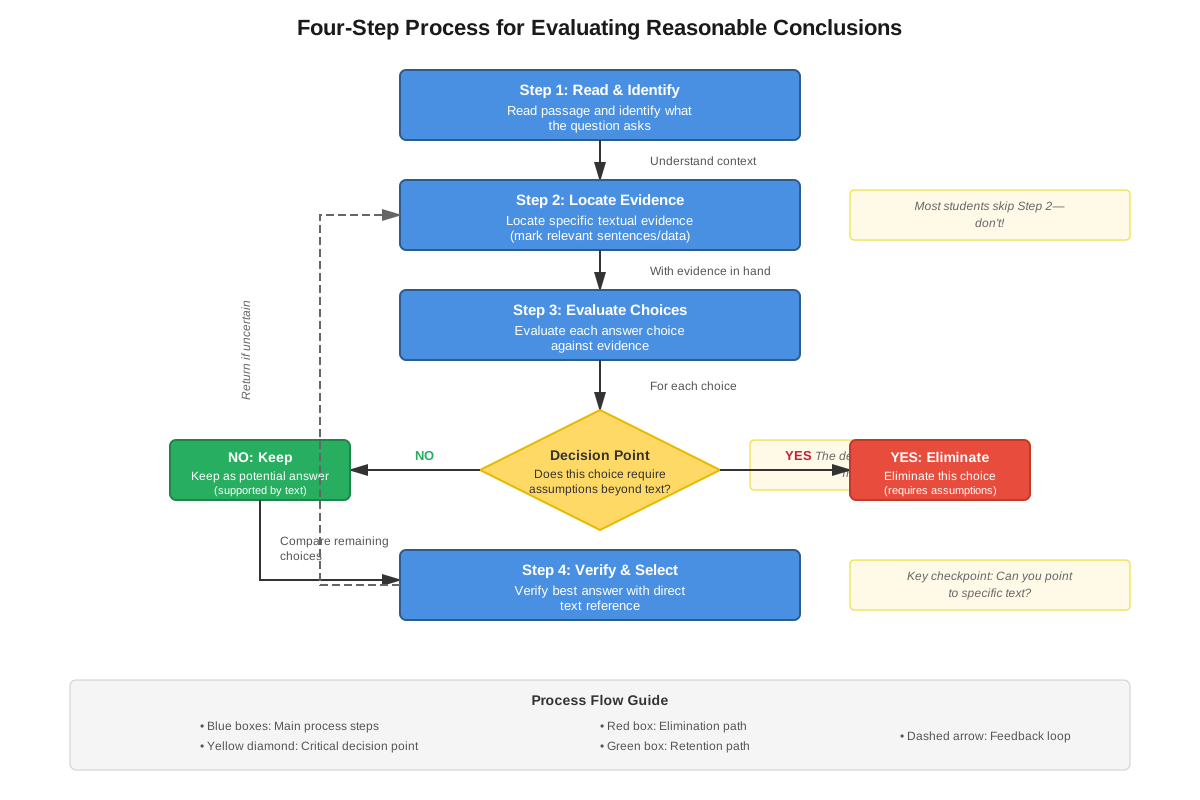
The Four-Step Approach
- Read the question first: Know what you're looking for before reading the passage. This focuses your attention on relevant information.
- Identify and mark evidence: As you read, underline or mentally note sentences that seem relevant to the question. Don't just read passively.
- Predict before looking at answers: Based on the evidence, formulate your own conclusion before seeing answer choices. This prevents trap answers from seeming attractive.
- Eliminate systematically: Check each answer against the passage, eliminating those that lack support, overreach, or introduce unsupported ideas.
Trigger Words and Phrases
Questions asking for reasonable conclusions typically include:
- "can reasonably be concluded"
- "suggests"
- "implies"
- "most likely"
- "probably"
- "based on the passage"
- "it can be inferred"
- "the author would most likely agree"
When you see these phrases, immediately shift into evidence-checking mode. Your task is finding what the passage supports, not what seems generally true.
Process of Elimination Tips
Eliminate answers that:
- Require outside knowledge not in the passage
- Use extreme language ("always," "never," "only," "must") unless the passage is equally extreme
- Introduce new concepts not mentioned or implied in the passage
- Are too broad (generalizing beyond the passage's scope)
- Are too narrow (missing important qualifications the passage includes)
- Contradict any part of the passage
- Are only partially supported (even if 80% is right, 20% wrong makes it incorrect)
Keep answers that:
- Point to specific textual evidence
- Use appropriately cautious language ("may," "suggests," "likely")
- Synthesize multiple pieces of passage information
- Match the passage's tone and certainty level
- Stay within the scope of what's discussed
Time Allocation
Reasonable conclusion questions typically require 45-75 seconds:
- 20-30 seconds: Reading the passage carefully
- 10-15 seconds: Identifying relevant evidence
- 20-30 seconds: Evaluating answer choices
If you're spending more than 90 seconds, you're likely overthinking. Make your best choice and move on—you can always return if time permits.
Exam Tip: If you're stuck between two answers, check which one requires fewer assumptions. The answer requiring the smallest logical leap from the text is usually correct.
Memory Techniques
The SCOPE Acronym
Supported by text
Cautious language
One logical step
Passage-based only
Evidence-checkable
Before selecting an answer, verify it meets all SCOPE criteria.
The "Point to It" Rule
Physically point to (or mentally identify) the specific sentence(s) supporting your answer. If you can't point to evidence, the answer is wrong. This simple physical action prevents selecting answers that "feel right" but lack support.
The Goldilocks Principle
Think of answer choices as "too hot" (overreaching), "too cold" (too obvious/not really an inference), or "just right" (one logical step from evidence). The SAT rewards "just right" conclusions.
Visualization: The Evidence Bridge
Picture the passage on one side of a river and the conclusion on the other. The evidence is a bridge connecting them. If the bridge has gaps (missing evidence), you can't safely cross. If the bridge is too long (too many logical steps), it's unstable. The correct answer has a short, solid bridge of evidence.
Summary
Drawing reasonable conclusions on the SAT requires balancing analytical thinking with disciplined adherence to textual evidence. Students must go beyond literal comprehension to make logical inferences, but they must avoid the trap of over-interpreting or introducing outside knowledge. The key is recognizing that reasonable conclusions must be more likely true than false based solely on passage evidence, requiring typically one logical step from what's explicitly stated. Success depends on systematically checking each answer choice against specific textual support, eliminating those that overreach, introduce unsupported ideas, or exceed the passage's scope. The most common errors involve selecting real-world truths that the passage doesn't support, choosing answers that are only partially correct, or making logical leaps that require too many assumptions. By focusing on evidence sufficiency, appropriate scope, and cautious language, students can consistently identify conclusions that are truly reasonable based on what they've read.
Key Takeaways
- Reasonable conclusions must be supported by specific textual evidence—if you cannot point to supporting sentences, the answer is wrong
- The correct answer typically requires one small logical step from the text, not multiple leaps or assumptions
- Trap answers often present real-world truths or possibilities that lack passage support—always verify evidence
- Scope matters critically: conclusions must match the breadth and limitations of what the passage discusses
- Cautious language ("may," "suggests," "likely") is usually more defensible than absolute claims unless the passage itself is absolute
- Synthesis questions requiring integration of multiple details are increasingly common—practice connecting scattered information
- The "must be true" standard is higher than "could be true"—possibility isn't sufficient for SAT reasonable conclusions
Related Topics
Command of Evidence: After mastering reasonable conclusions, students should study how to select textual evidence that supports given claims—essentially the reverse skill of drawing conclusions from evidence.
Author's Purpose and Point of View: Understanding why authors include information and what perspectives they hold enables more sophisticated conclusions about their intended meanings and implications.
Rhetorical Analysis: Drawing conclusions about how arguments work and why authors make specific choices builds on the same evidence-evaluation skills used for reasonable conclusions.
Quantitative Evidence: Scientific and social science passages often include data, graphs, or statistics requiring students to draw reasonable conclusions from numerical information.
Comparative Reading: Some SAT passages present two related texts, requiring students to draw conclusions about how the authors' views relate—an advanced application of reasonable conclusion skills.
Practice CTA
Now that you understand the principles of drawing reasonable conclusions, it's time to apply these strategies to actual SAT-style questions. The practice questions and flashcards will help you internalize the evidence-checking process and develop the instinct for recognizing well-supported conclusions versus attractive traps. Remember: every expert test-taker started where you are now. The difference between good and great scores often comes down to mastering exactly this skill—the ability to make logical inferences while staying disciplined about textual support. Your practice will build the confidence and automaticity you need to excel on test day. Start practicing now, and watch your accuracy improve with each question you analyze systematically!
Sign up free to keep reading
Create a free AnvayaPrep account to finish this SAT guide on Reasonable conclusion — plus flashcards and practice questions.