Overview
The colon before explanation is one of the most frequently tested punctuation concepts in the SAT Reading and Writing (RW) section. A colon serves as a powerful punctuation mark that signals to readers: "Pay attention—what follows will clarify, specify, or expand upon what I just said." On the SAT, understanding when and how to use a colon before an explanation separates students who guess from those who confidently select the correct answer within seconds.
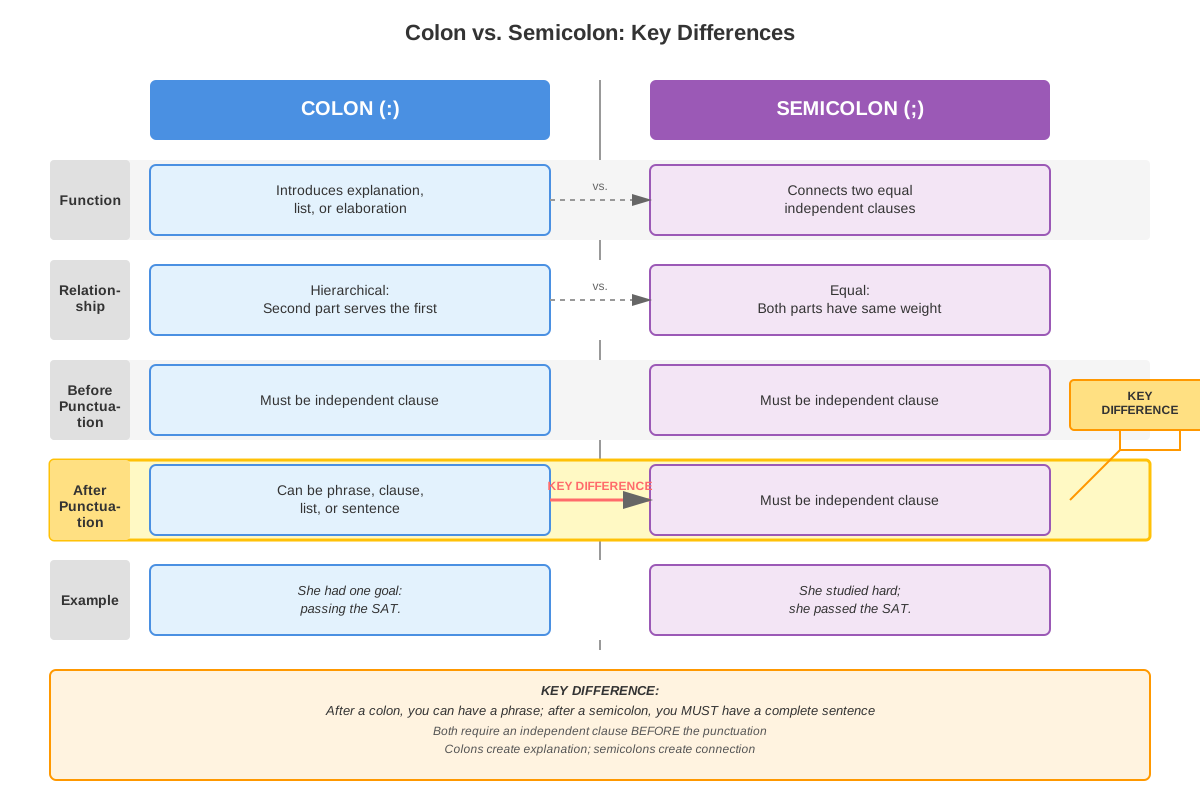
Mastering the sat colon before explanation rule is essential because it appears in approximately 10-15% of all punctuation questions on the exam. These questions test whether students can recognize when a complete independent clause precedes the colon and when the material following the colon genuinely explains, elaborates, or specifies the preceding statement. Unlike semicolons, which connect two independent clauses of equal weight, colons create a hierarchical relationship where the second part serves the first by providing necessary clarification or detail.
This topic connects directly to broader punctuation principles tested throughout the rw section, including sentence structure, independent versus dependent clauses, and the logical flow of ideas. Students who master colon usage demonstrate sophisticated understanding of how punctuation shapes meaning and guides reader comprehension—skills that extend beyond the SAT into college-level writing and professional communication.
Learning Objectives
- [ ] Identify key features of colon before explanation
- [ ] Explain how colon before explanation appears on the SAT
- [ ] Apply colon before explanation to answer SAT-style questions
- [ ] Distinguish between correct and incorrect colon usage in complex sentences
- [ ] Recognize the structural requirements that must precede a colon
- [ ] Evaluate whether alternative punctuation marks would be more appropriate than a colon in given contexts
Prerequisites
- Independent clauses: Understanding what constitutes a complete sentence is essential because a colon must follow an independent clause that can stand alone.
- Dependent clauses: Recognizing incomplete thoughts helps students avoid placing colons after sentence fragments.
- Basic punctuation marks: Familiarity with periods, commas, and semicolons provides context for when colons are the superior choice.
- Sentence structure: Knowledge of subjects, verbs, and objects enables students to analyze whether a clause before a colon is grammatically complete.
Why This Topic Matters
In real-world writing, colons serve as signposts that prepare readers for important information. Professional writers, journalists, and academics use colons to introduce explanations, lists, quotations, and examples with precision and clarity. The ability to use colons correctly demonstrates writing maturity and helps readers navigate complex ideas efficiently.
On the SAT, colon questions appear in the Standard English Conventions domain, typically as part of the 11-15 grammar and punctuation questions students encounter. These questions often present four punctuation options (colon, semicolon, comma, or period) and ask students to select the most appropriate choice. According to College Board data, colon questions have moderate difficulty ratings, with approximately 60-70% of test-takers answering them correctly—meaning mastery of this topic provides a competitive advantage.
The SAT tests colon usage in diverse contexts: scientific passages explaining research findings, historical texts introducing examples of social movements, literary excerpts elaborating on character motivations, and argumentative essays specifying supporting evidence. Questions may appear in any passage type, making this a universally applicable skill across all SAT reading materials.
Core Concepts
The Fundamental Rule: Complete Clause Before the Colon
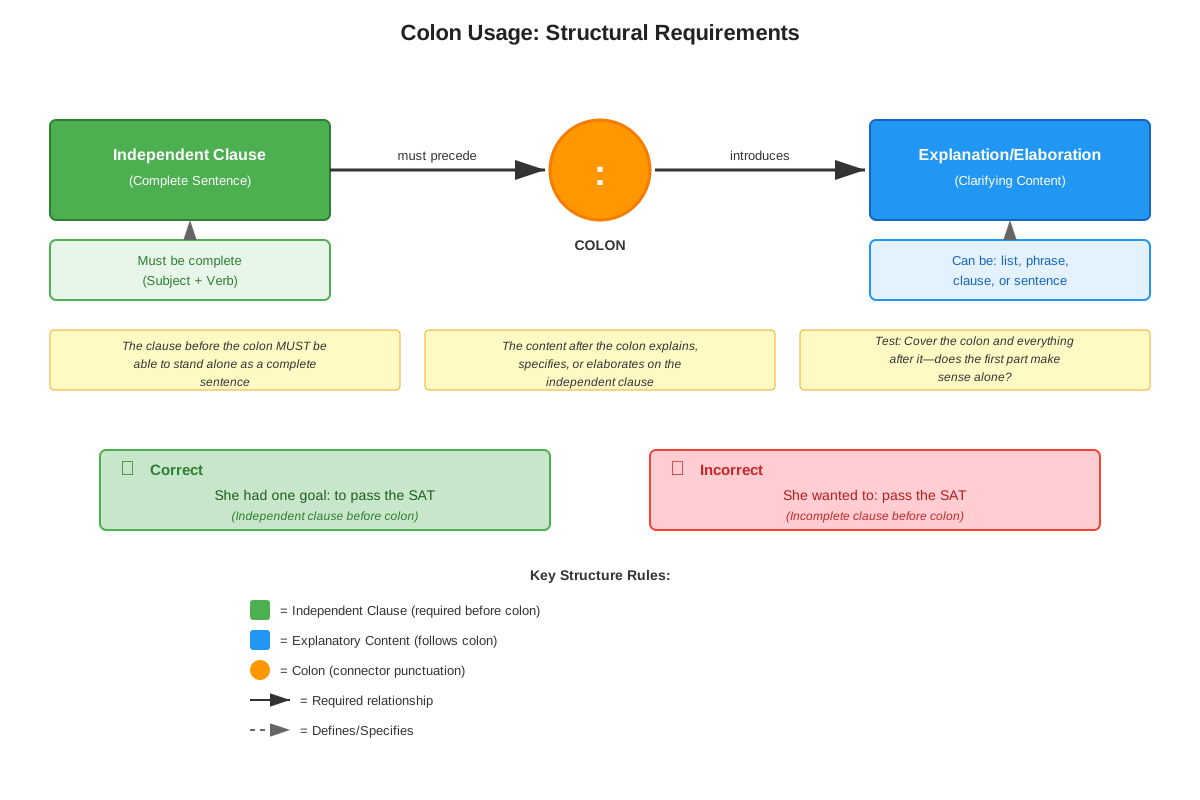
The cardinal rule for colon before explanation is that a grammatically complete independent clause must precede the colon. This means the text before the colon must contain a subject and verb and express a complete thought that could stand alone as a sentence. Consider this correct example:
"The research revealed an unexpected finding: urban gardens increased biodiversity by 40% compared to traditional parks."
The clause "The research revealed an unexpected finding" is complete—it has a subject (research), verb (revealed), and expresses a full thought. The colon then introduces the specific finding that explains what was unexpected.
What Follows the Colon: Explanatory Content
After the colon, the content must genuinely explain, elaborate, specify, or clarify what came before. This explanatory material can take several forms:
Single word or phrase: "She had one goal: victory."
Complete sentence: "The experiment failed for a clear reason: the temperature exceeded safe parameters."
List of items: "The museum features three permanent collections: Renaissance paintings, ancient sculptures, and modern installations."
Extended explanation: "Darwin's theory revolutionized biology: it provided a mechanism for how species change over time through natural selection, challenging prevailing beliefs about the fixity of species."
The key is that the material after the colon must have a direct explanatory relationship to what precedes it. The colon essentially replaces phrases like "namely," "that is," or "in other words."
The Independence Test
To verify correct colon usage, apply the independence test: read the clause before the colon and ask, "Is this a complete sentence?" If the answer is no, the colon is incorrect. Consider these examples:
| Sentence | Before Colon Complete? | Correct? |
|---|---|---|
| The ingredients are: flour, sugar, and eggs. | No ("The ingredients are" is incomplete) | ❌ Incorrect |
| We need three ingredients: flour, sugar, and eggs. | Yes ("We need three ingredients" is complete) | ✅ Correct |
| The reason is: budget constraints. | No ("The reason is" is incomplete) | ❌ Incorrect |
| The project failed for one reason: budget constraints. | Yes (complete thought) | ✅ Correct |
Colons vs. Other Punctuation
Understanding when to choose a colon over competing punctuation marks is crucial for SAT success:
Colon vs. Semicolon: A semicolon connects two independent clauses of equal importance. A colon creates hierarchy, where the second part serves the first by explaining it. Use a colon when the second part answers "what?" or "which one?" about the first part.
Colon vs. Comma: Commas separate elements but don't signal the strong explanatory relationship that colons establish. Use a colon when you want to emphasize that what follows directly explains or specifies what preceded.
Colon vs. Dash: Dashes can introduce explanations but are less formal and more interruptive. Colons are more appropriate for formal academic writing typical of SAT passages.
The "Announcement" Function
Colons often function as announcement markers, signaling that important clarifying information follows. Think of the colon as saying, "Here's what I mean" or "Specifically." This announcement quality makes colons particularly effective before:
- Definitions: "Photosynthesis is a vital process: the conversion of light energy into chemical energy by plants."
- Examples: "The author employs several rhetorical devices: metaphor, repetition, and rhetorical questions."
- Explanations of causes: "The expedition was abandoned: severe weather made progress impossible."
- Specifications: "The committee reached a unanimous decision: all members voted to approve the proposal."
Common SAT Colon Contexts
On the SAT, colon questions typically appear in these contexts:
- Scientific explanations: Passages describing research often use colons to introduce findings or methodology details.
- Historical specifications: Texts about historical events use colons to specify dates, locations, or particular examples.
- Literary analysis: Passages analyzing texts employ colons to introduce quotations or specific textual evidence.
- Argumentative elaboration: Persuasive passages use colons to introduce supporting evidence or counterarguments.
Concept Relationships
The colon before explanation concept builds directly on understanding of independent clauses. Without recognizing what constitutes a complete sentence, students cannot apply the fundamental rule that a complete clause must precede the colon. This prerequisite knowledge → enables → correct colon identification.
Within punctuation more broadly, colon usage connects to the hierarchy of punctuation marks. Periods create full stops → semicolons connect related independent clauses → colons create explanatory relationships → commas separate elements within clauses. Understanding this hierarchy helps students select the punctuation mark that best matches the logical relationship between sentence parts.
The colon concept also relates to sentence variety and style. Writers who master colons → can create → more sophisticated sentence structures → which demonstrate → advanced writing proficiency. This progression explains why the SAT tests colon usage: it's a marker of college-ready writing skills.
Finally, colon usage connects to reading comprehension. Recognizing colons as signals of explanation → helps students → identify main ideas and supporting details → which improves → overall passage understanding. This bidirectional relationship means that studying colons benefits both grammar and reading performance.
High-Yield Facts
⭐ A colon must be preceded by a grammatically complete independent clause that can stand alone as a sentence.
⭐ The material following a colon must explain, specify, elaborate, or clarify what came before it.
⭐ Colons can introduce single words, phrases, complete sentences, or lists—as long as they explain the preceding clause.
⭐ The phrase before a colon should NOT end with a verb that requires an object (incorrect: "The colors are: red, blue, and green").
⭐ On the SAT, if you can insert "namely," "that is," or "in other words" before the explanatory material, a colon is likely correct.
- Colons create a hierarchical relationship where the second part serves the first, unlike semicolons which connect equals.
- You should NOT capitalize the first word after a colon unless it begins a proper noun or a complete sentence that you want to emphasize (though SAT typically uses lowercase).
- Multiple sentences can follow a colon if they all work together to explain the preceding clause.
- Colons are more formal than dashes and more emphatic than commas for introducing explanations.
- If the clause before the colon is incomplete, the colon is always incorrect, regardless of what follows.
Quick check — test yourself on Colon before explanation so far.
Try Flashcards →Common Misconceptions
Misconception: Any sentence can be followed by a colon if you want to add more information.
Correction: Only grammatically complete independent clauses can precede colons. The clause before the colon must be able to stand alone as a complete sentence with a subject, verb, and complete thought.
Misconception: Colons and semicolons are interchangeable punctuation marks.
Correction: Semicolons connect two independent clauses of equal weight, while colons create a hierarchical relationship where the second part explains or specifies the first. Use a colon when the second part answers a question about the first part.
Misconception: You should always capitalize the first word after a colon.
Correction: On the SAT, the first word after a colon is typically lowercase unless it's a proper noun or begins a complete sentence that the author wants to emphasize as independent. Most SAT passages use lowercase after colons.
Misconception: A colon can follow "such as" or "including" to introduce examples.
Correction: Phrases like "such as" and "including" already introduce examples, so adding a colon creates redundancy. Write "The kit includes essential items such as bandages and antiseptic" NOT "The kit includes essential items such as: bandages and antiseptic."
Misconception: If a list follows, you should always use a colon.
Correction: A colon before a list is only correct if a complete independent clause precedes it. "The ingredients are: flour, eggs, sugar" is incorrect because "The ingredients are" is incomplete. Correct: "You need three ingredients: flour, eggs, and sugar."
Worked Examples
Example 1: Scientific Research Passage
Question: Which choice completes the sentence with correct punctuation?
"The study's methodology was rigorous and comprehensive___ researchers collected data from 50 sites across three continents over a five-year period."
A) , (comma)
B) ; (semicolon)
C) : (colon)
D) . (period)
Step 1: Identify whether the first clause is independent.
"The study's methodology was rigorous and comprehensive" is a complete sentence with subject (methodology), verb (was), and complete thought. ✓
Step 2: Determine the relationship between the two parts.
The second part ("researchers collected data from 50 sites...") explains HOW the methodology was rigorous and comprehensive. It specifies what made it rigorous. This is an explanatory relationship.
Step 3: Evaluate each option.
- Option A (comma): Creates a comma splice (two independent clauses incorrectly joined by comma alone). Incorrect.
- Option B (semicolon): Connects two independent clauses but doesn't signal the explanatory relationship. Grammatically acceptable but not optimal.
- Option C (colon): Signals that what follows explains the preceding statement. Perfect for this explanatory relationship. ✓
- Option D (period): Creates two separate sentences, losing the connection between the claim and its explanation. Acceptable but less effective.
Answer: C (colon)
Reasoning: The colon is superior because it explicitly signals that the second part explains the first, helping readers understand that the data collection details support the claim about rigorous methodology.
Example 2: Historical Analysis Passage
Question: Which choice completes the sentence with correct punctuation?
"The Declaration of Independence contains a crucial assertion___ all people possess certain unalienable rights."
A) , (comma)
B) ; (semicolon)
C) : (colon)
D) — (dash)
Step 1: Check if the first clause is complete.
"The Declaration of Independence contains a crucial assertion" is complete—it has subject (Declaration), verb (contains), and expresses a full thought. ✓
Step 2: Analyze the relationship.
The second part ("all people possess certain unalienable rights") specifies WHAT the crucial assertion is. This is a direct specification/explanation of the assertion mentioned in the first clause.
Step 3: Test the "namely" substitution.
"The Declaration of Independence contains a crucial assertion, namely that all people possess certain unalienable rights." This works perfectly, confirming that a colon is appropriate.
Step 4: Evaluate options.
- Option A (comma): Too weak for this relationship; doesn't signal that what follows specifies the assertion. Incorrect.
- Option B (semicolon): The second part isn't an independent clause (no subject-verb structure that stands alone). Incorrect.
- Option C (colon): Perfect—signals that what follows specifies the assertion. ✓
- Option D (dash): Could work but is less formal than a colon for academic writing. Less optimal.
Answer: C (colon)
Reasoning: The colon correctly introduces the specific content of the assertion, creating the explanatory relationship the sentence requires.
Exam Strategy
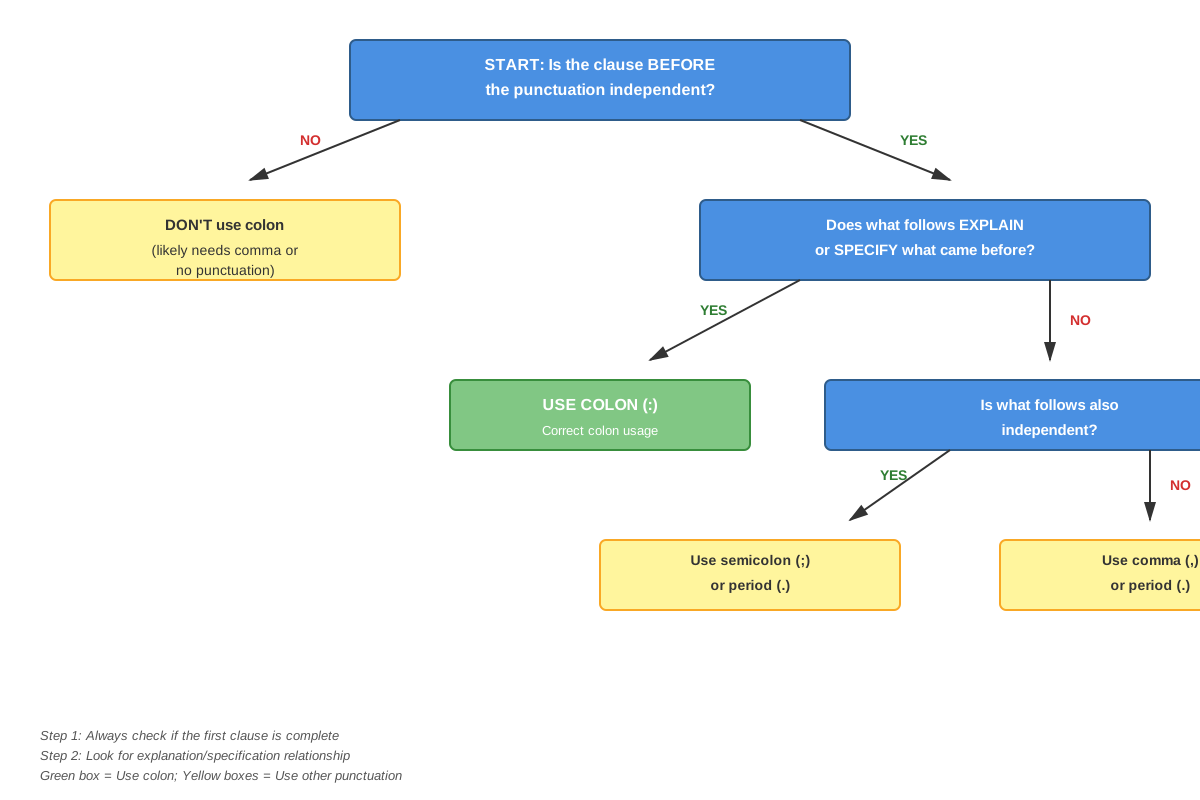
When approaching sat colon before explanation questions, follow this systematic process:
Step 1: Identify the punctuation decision point
SAT questions will underline or highlight the punctuation mark in question. Immediately focus on the clause before this point.
Step 2: Apply the independence test
Read only the words before the potential colon. Ask: "Is this a complete sentence with subject, verb, and complete thought?" If no, eliminate the colon option immediately.
Step 3: Check for explanatory relationship
If the first clause is complete, examine what follows. Does it explain, specify, elaborate, or clarify the first part? Can you insert "namely," "that is," or "in other words" between the parts? If yes, the colon is likely correct.
Step 4: Watch for trigger phrases
Certain phrases signal that a colon may follow:
- "one reason"
- "a crucial point"
- "the following"
- "an important finding"
- "a significant result"
- "the main idea"
These phrases announce that specification or explanation will follow, making colons appropriate.
Step 5: Eliminate incorrect alternatives
- If both parts are independent clauses of equal importance, choose semicolon over colon
- If the first clause is incomplete, eliminate colon immediately
- If no explanatory relationship exists, eliminate colon
Time allocation: Spend no more than 30-45 seconds on colon questions. The independence test should take 10 seconds, the relationship check another 10 seconds, and option elimination the remaining time.
Exam Tip: If you're stuck between a colon and semicolon, ask: "Does the second part answer a question about the first part?" If yes, choose colon. If the parts are simply related ideas of equal weight, choose semicolon.
Memory Techniques
The "Complete Before, Explain After" Mnemonic:
Complete clause Before
Explanation After
Remember "CBEA" or think "Complete Before, Explain After" as your colon checklist.
The "Namely" Test:
Whenever you see a potential colon, mentally insert the word "namely" where the colon would go. If the sentence makes sense with "namely," the colon is correct. This works because colons and "namely" serve the same function: introducing specifications.
Visual Memory Aid:
Picture a colon (:) as two eyes looking forward, saying "Look at this explanation!" The eyes (dots) represent the complete statement looking ahead to the explanation that follows.
The "Question-Answer" Framework:
Think of the colon as an invisible question mark. The first part raises a question (What finding? Which reason? What assertion?), and the part after the colon answers it. If this question-answer relationship exists, use a colon.
Acronym for What Follows Colons:
Lists
Examples
Explanations
Quotations
Remember "LEEQ" (sounds like "leak")—colons let explanatory information "leak" into your sentence.
Summary
The colon before explanation is a high-yield SAT punctuation concept that requires students to recognize two essential elements: a grammatically complete independent clause before the colon and genuinely explanatory content after it. The colon creates a hierarchical relationship where the second part serves the first by specifying, clarifying, or elaborating on it—essentially answering an implicit question about the preceding statement. On the SAT, colon questions appear frequently across all passage types and test whether students can distinguish colons from competing punctuation marks like semicolons, commas, and periods. Mastery requires applying the independence test (ensuring the clause before the colon can stand alone), verifying the explanatory relationship (confirming the second part explains the first), and recognizing trigger phrases that signal forthcoming explanations. Students who systematically check these criteria can confidently answer colon questions within 30-45 seconds, securing points that separate competitive scores from exceptional ones.
Key Takeaways
- A colon must follow a grammatically complete independent clause that can stand alone as a sentence—this is the non-negotiable rule
- The content after a colon must explain, specify, elaborate, or clarify what came before, creating a hierarchical relationship
- Apply the "namely" test: if you can insert "namely" or "that is" where the colon goes, the colon is likely correct
- Colons differ from semicolons because they create explanation relationships rather than connecting equals
- Watch for trigger phrases like "one reason," "a crucial point," and "the following" that signal explanations requiring colons
- On the SAT, colon questions appear in 10-15% of punctuation items across all passage types
- Never use a colon after incomplete phrases like "such as," "including," or "are" without additional words
Related Topics
Semicolon Usage: Understanding when to use semicolons versus colons deepens punctuation mastery, as both connect sentence parts but create different logical relationships.
Independent vs. Dependent Clauses: Advanced clause identification enables students to quickly apply the independence test required for colon questions.
Dash Usage: Studying how dashes introduce explanations and interruptions helps students distinguish between informal and formal explanatory punctuation.
Comma Rules: Comprehensive comma knowledge prevents confusion about when commas versus colons are appropriate for introducing information.
Sentence Structure and Variety: Mastering colons contributes to sophisticated sentence construction skills tested throughout the SAT Writing section.
Practice CTA
Now that you understand the principles of colon before explanation, it's time to cement your knowledge through active practice. Attempt the practice questions designed specifically for this topic, paying careful attention to applying the independence test and identifying explanatory relationships. Use the flashcards to reinforce the key rules and trigger phrases until they become automatic. Remember: every colon question you master is a guaranteed point on test day—and these points add up quickly to create the score difference that matters for college admissions. You've learned the strategy; now make it instinctive through deliberate practice!
Sign up free to keep reading
Create a free AnvayaPrep account to finish this SAT guide on Colon before explanation — plus flashcards and practice questions.