Overview
Parentheses are one of the most versatile punctuation marks tested on the SAT Reading and Writing (RW) section, appearing in questions that assess a student's ability to recognize proper punctuation usage within complex sentences. These curved brackets serve a specific grammatical function: they enclose supplementary information that adds detail, clarification, or commentary to a sentence without disrupting its core meaning. Understanding when and how to use parentheses correctly is crucial for SAT success, as the exam frequently presents questions requiring students to choose between parentheses, commas, dashes, and other punctuation marks to set off nonessential information.
The SAT tests parentheses within the broader context of punctuation conventions, specifically focusing on how writers incorporate additional information into sentences while maintaining clarity and grammatical correctness. Questions involving parentheses typically appear in the Standard English Conventions domain, where students must identify the most appropriate punctuation choice for a given context. These questions assess whether students understand that parenthetical information must be truly supplementary—meaning the sentence must remain grammatically complete and logically coherent if the parenthetical content is removed.
Mastering parentheses connects directly to broader punctuation concepts tested on the SAT, including the use of commas for nonrestrictive clauses, dashes for emphasis, and semicolons for joining independent clauses. The ability to distinguish when parentheses are preferable to other punctuation marks demonstrates sophisticated understanding of sentence structure, tone, and the relationship between main ideas and supporting details. This skill extends beyond isolated punctuation questions, as it enhances overall reading comprehension and the ability to parse complex academic prose—both essential for achieving a competitive SAT score.
Learning Objectives
- [ ] Identify key features of parentheses and their grammatical function
- [ ] Explain how parentheses appears on the SAT and in what question formats
- [ ] Apply parentheses to answer SAT-style questions with accuracy
- [ ] Distinguish between parentheses, commas, and dashes for setting off nonessential information
- [ ] Evaluate whether information is truly supplementary and appropriate for parenthetical treatment
- [ ] Recognize common patterns in SAT questions that test parentheses usage
- [ ] Demonstrate mastery by correctly punctuating complex sentences containing parenthetical elements
Prerequisites
- Basic sentence structure: Understanding subjects, verbs, and complete sentences is essential because parenthetical information must not disrupt the grammatical completeness of the main clause.
- Independent and dependent clauses: Recognizing clause types helps determine whether information can be set off with parentheses or requires different punctuation.
- Comma usage fundamentals: Since commas serve similar functions to parentheses in some contexts, distinguishing between these marks requires baseline comma knowledge.
- Nonrestrictive vs. restrictive elements: Understanding which sentence elements are essential versus supplementary determines when parentheses are appropriate.
Why This Topic Matters
Parentheses appear regularly on the SAT Reading and Writing section, making them a high-yield topic for test preparation. According to exam analysis, punctuation questions constitute approximately 10-15% of the Standard English Conventions questions, and parentheses specifically appear in 2-4 questions per test administration. These questions often serve as quick points for well-prepared students, as they follow predictable patterns and test clearly defined rules.
In real-world writing, parentheses serve critical functions in academic, professional, and technical communication. They allow writers to include citations, define acronyms, provide numerical data, offer brief explanations, or insert editorial comments without disrupting the flow of the main text. Scientific papers use parentheses for statistical information; legal documents employ them for cross-references; and journalistic writing incorporates them for clarification. Mastering parentheses thus develops practical writing skills that extend far beyond test day.
On the SAT, parentheses questions typically appear in two formats: identifying correct punctuation in context and choosing between functionally equivalent punctuation marks (parentheses, commas, or dashes). The exam often embeds these questions within passages about science, history, or social studies, requiring students to maintain focus on grammatical correctness while processing complex content. Questions may ask students to select the appropriate punctuation for a phrase that defines a term, provides an example, or adds supplementary detail. Understanding the nuanced differences between punctuation options—particularly when parentheses signal truly tangential information versus when commas or dashes better suit the context—separates high-scoring students from those who struggle with these questions.
Core Concepts
Definition and Function of Parentheses
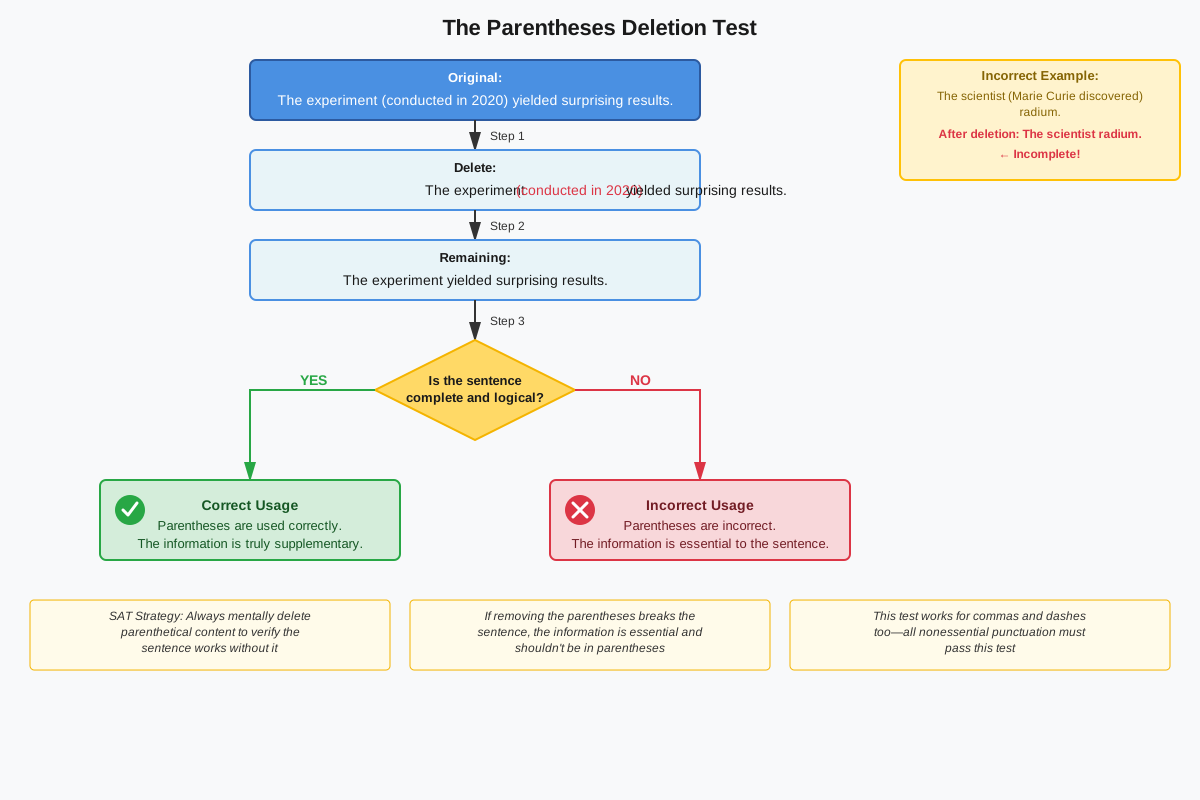
Parentheses are paired punctuation marks—an opening parenthesis "(" and a closing parenthesis ")"—that enclose supplementary, nonessential information within a sentence. The defining characteristic of parenthetical content is that it can be completely removed without affecting the grammatical structure or core meaning of the sentence. This "removal test" serves as the primary method for determining whether parentheses are appropriate: if deleting the enclosed material leaves a complete, coherent sentence, the parentheses are correctly used.
Parentheses create the strongest separation between the main sentence and the additional information, more so than commas or dashes. They signal to readers that the enclosed content is distinctly subordinate to the main idea—often providing background information, clarification, examples, or asides that enhance understanding but aren't crucial to the sentence's primary message. On the SAT parentheses questions, this hierarchical relationship between main and supplementary content is frequently tested.
Types of Information Enclosed in Parentheses
Several categories of information commonly appear within parentheses, and recognizing these patterns helps students identify correct usage on the SAT:
Definitions and clarifications: Parentheses often enclose brief explanations of technical terms or unfamiliar concepts.
- Example: "The mitochondria (the powerhouse of the cell) generate ATP through cellular respiration."
Examples and illustrations: When providing specific instances of a general concept, parentheses can set off these examples.
- Example: "Several Romance languages (such as Spanish, French, and Italian) evolved from Latin."
Numerical data and statistics: Dates, percentages, and other numerical information frequently appear in parentheses.
- Example: "The study included a large sample size (n = 1,247) to ensure statistical validity."
Acronyms and abbreviations: After introducing a full term, writers often place its abbreviated form in parentheses.
- Example: "The Environmental Protection Agency (EPA) regulates air quality standards."
Citations and references: Academic writing uses parentheses for in-text citations.
- Example: "Recent research supports this conclusion (Johnson, 2022)."
Editorial comments or asides: Writers may insert brief commentary that's tangential to the main point.
- Example: "The proposal (which had been debated for months) finally passed."
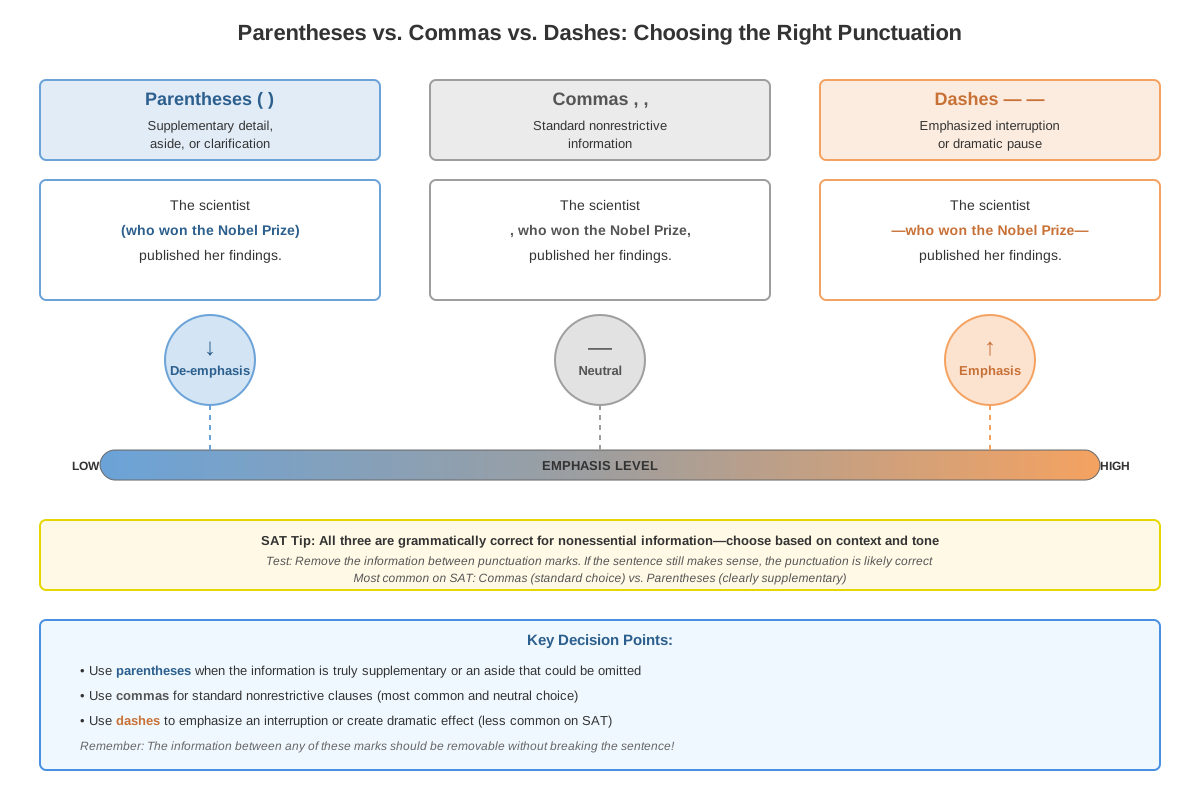
Parentheses vs. Commas vs. Dashes
The SAT frequently tests the distinction between three punctuation marks that can set off nonessential information: parentheses, commas, and dashes. Understanding when each is most appropriate requires recognizing subtle differences in emphasis and integration:
| Punctuation | Level of Separation | Emphasis | Best Used For |
|---|---|---|---|
| Commas | Weakest | Neutral | Information closely integrated with the main sentence; standard nonrestrictive elements |
| Dashes | Medium | Strong emphasis | Information that deserves attention or creates dramatic effect; sudden breaks in thought |
| Parentheses | Strongest | De-emphasis | Truly supplementary information; technical details; asides that are distinctly subordinate |
Commas create the gentlest separation and are the default choice for nonrestrictive clauses and phrases that flow naturally within the sentence. They suggest the information is relevant and worth noting but not essential to the core meaning.
Dashes (specifically em dashes) create emphasis and draw attention to the enclosed information. They signal that the material is important enough to warrant a noticeable interruption in the sentence flow. Dashes can also indicate abrupt shifts in thought or tone.
Parentheses minimize the importance of the enclosed information, treating it as supplementary detail that readers could skip without losing the main point. They create the most distinct separation between primary and secondary content.
Grammatical Rules for Parentheses
Several specific rules govern correct parentheses usage, and the SAT tests these conventions directly:
Rule 1: The main sentence must be grammatically complete without the parenthetical content. This is the fundamental test for correct usage. Remove everything between the parentheses (including the parentheses themselves), and the remaining sentence must be properly structured and punctuated.
Rule 2: Punctuation placement with parentheses follows specific patterns. When a parenthetical element appears mid-sentence, any punctuation mark that would normally follow the last word before the opening parenthesis should be placed after the closing parenthesis instead. However, punctuation that belongs to the parenthetical content itself stays inside the parentheses.
- Correct: "The experiment (which took three years to complete) yielded surprising results."
- Incorrect: "The experiment, (which took three years to complete) yielded surprising results."
Rule 3: Complete sentences within parentheses require internal punctuation. If the parenthetical content forms a complete sentence and appears within another sentence, it typically doesn't begin with a capital letter or end with a period (though question marks and exclamation points may be retained). If the parenthetical sentence stands alone, it follows standard capitalization and punctuation rules.
- Mid-sentence: "The data (see Table 3 for details) support this hypothesis."
- Standalone: "The results were conclusive. (The research team published their findings in 2023.)"
Rule 4: Parentheses always come in pairs. This seems obvious but is occasionally tested through questions about missing or misplaced closing parentheses.
Common SAT Question Patterns
The SAT presents parentheses questions in predictable formats that students can learn to recognize:
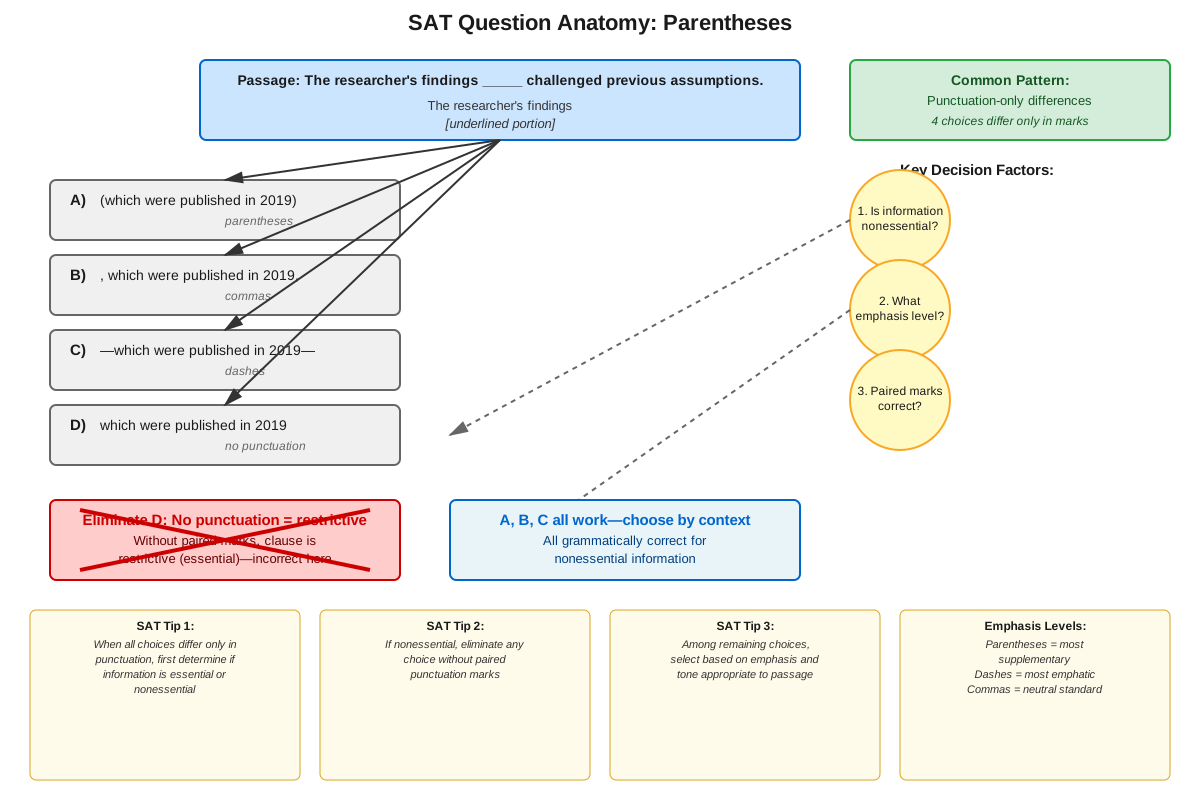
Pattern 1: Choosing between punctuation options. Questions provide four answer choices that differ only in punctuation, requiring students to select the option that correctly uses parentheses, commas, dashes, or no punctuation.
Pattern 2: Identifying errors in punctuation. Students must recognize when parentheses are incorrectly used—either because the enclosed information is essential rather than supplementary, or because the punctuation placement violates standard conventions.
Pattern 3: Determining appropriate emphasis. Questions may ask students to choose punctuation that achieves a specific rhetorical effect, such as de-emphasizing technical details (favoring parentheses) or highlighting important information (favoring dashes).
Concept Relationships
The concepts within parentheses usage form an interconnected system where understanding one element reinforces others. The definition and function of parentheses serves as the foundation, establishing that these marks enclose nonessential information. This leads directly to understanding types of information enclosed in parentheses, which provides concrete examples of how the abstract definition manifests in actual writing. Recognizing these types enables students to apply the removal test—checking whether the sentence remains complete without the parenthetical content.
The relationship between parentheses, commas, and dashes builds on the foundational understanding by introducing comparative analysis. Once students grasp what parentheses do, they can distinguish when other punctuation marks might be more appropriate based on emphasis and integration. This comparative understanding connects to grammatical rules for parentheses, which provide the technical specifications for correct usage. Finally, all these concepts converge in common SAT question patterns, where theoretical knowledge translates into practical test-taking skills.
The connection to prerequisite topics is equally important. Understanding sentence structure enables students to perform the removal test effectively—they must recognize whether removing parenthetical content leaves a grammatically complete sentence. Knowledge of nonrestrictive versus restrictive elements directly determines when parentheses are appropriate, as only nonrestrictive (nonessential) information can be enclosed. Familiarity with comma usage provides the comparative baseline for understanding when parentheses offer a better alternative for setting off information.
This topic also connects forward to broader writing skills tested on the SAT. Mastering parentheses enhances sentence variety and sophistication, allowing writers to incorporate complex information without creating unwieldy sentences. It supports rhetorical effectiveness by enabling precise control over emphasis and information hierarchy. These skills prove valuable not only for punctuation questions but also for the essay portion and reading comprehension, where understanding how authors structure and emphasize information aids interpretation.
High-Yield Facts
⭐ Parentheses enclose nonessential information that can be removed without affecting the sentence's grammatical completeness or core meaning.
⭐ The removal test is the primary method for verifying correct parentheses usage: delete the parenthetical content and check if the sentence remains complete and coherent.
⭐ Parentheses create stronger separation than commas and de-emphasize information more than dashes do.
⭐ When parenthetical content appears mid-sentence, punctuation that belongs to the main sentence goes outside the closing parenthesis.
⭐ The SAT frequently asks students to choose between parentheses, commas, and dashes for setting off nonessential information.
- Parentheses commonly enclose definitions, examples, numerical data, acronyms, citations, and editorial comments.
- A complete sentence within parentheses that appears mid-sentence typically doesn't begin with a capital letter or end with a period.
- Parentheses always appear in pairs—an opening and closing mark.
- Information enclosed in parentheses should be truly supplementary, not essential to understanding the main point.
- On the SAT, parentheses questions often appear in passages about science, history, or social studies where technical terms or data require clarification.
- Choosing parentheses over commas signals that the information is distinctly subordinate to the main idea.
- Choosing dashes over parentheses signals that the information deserves emphasis or creates dramatic effect.
Quick check — test yourself on Parentheses so far.
Try Flashcards →Common Misconceptions
Misconception: Parentheses and commas are completely interchangeable for setting off nonessential information.
Correction: While both can set off nonessential information, they create different effects. Parentheses strongly de-emphasize content and create greater separation, while commas integrate information more smoothly into the sentence flow. The SAT tests this distinction by asking which punctuation best suits the context and intended emphasis.
Misconception: Any additional information can be placed in parentheses.
Correction: Only truly nonessential, supplementary information belongs in parentheses. If the information is necessary for understanding the sentence's core meaning or if removing it would change the sentence's essential message, parentheses are inappropriate. Essential information should be integrated into the main sentence structure.
Misconception: Punctuation always goes inside the closing parenthesis.
Correction: Punctuation placement depends on whether it belongs to the parenthetical content or the main sentence. Punctuation that's part of the main sentence goes outside the closing parenthesis, while punctuation that belongs only to the parenthetical content stays inside.
Misconception: Parentheses are always the best choice for de-emphasizing information.
Correction: While parentheses do de-emphasize content, sometimes commas are more appropriate if the information needs to be smoothly integrated, or the writing style calls for less dramatic separation. Context and tone matter when choosing punctuation.
Misconception: If a sentence has parentheses, it must also have commas or other internal punctuation.
Correction: Parentheses function independently of other punctuation marks. A sentence can have parentheses without any commas, or it can have both if the sentence structure requires additional punctuation for other reasons. Each punctuation mark serves its own grammatical function.
Misconception: Longer parenthetical elements are incorrect.
Correction: The length of parenthetical content doesn't determine correctness—what matters is whether the information is truly supplementary and whether the sentence remains complete without it. However, excessively long parenthetical elements can reduce readability, so brevity is generally preferred in good writing.
Worked Examples
Example 1: Choosing Appropriate Punctuation
Question: The research team discovered a new species of beetle _____ which had distinctive markings on its thorax _____ in the Amazon rainforest.
Which choice completes the text with the most logical and precise punctuation?
A) (which had distinctive markings on its thorax)
B) —which had distinctive markings on its thorax—
C) , which had distinctive markings on its thorax,
D) which had distinctive markings on its thorax
Solution Process:
Step 1: Identify whether the underlined portion contains essential or nonessential information. The phrase "which had distinctive markings on its thorax" provides additional descriptive detail about the beetle but isn't necessary to identify which beetle the sentence discusses. The sentence's core meaning—that researchers discovered a new beetle species in the Amazon—remains intact without this detail. This indicates the information is nonessential.
Step 2: Apply the removal test. Reading the sentence without the phrase: "The research team discovered a new species of beetle in the Amazon rainforest." This is grammatically complete and coherent, confirming the information is nonessential and requires some form of punctuation to set it off. This eliminates option D.
Step 3: Determine the appropriate level of emphasis. The descriptive detail about markings is standard scientific information—neither particularly emphasized nor extremely subordinate. It's relevant context that readers should note but not skip over entirely.
Step 4: Evaluate remaining options. Option A (parentheses) would strongly de-emphasize this information, suggesting it's barely relevant—inappropriate for a distinguishing characteristic of a newly discovered species. Option B (dashes) would emphasize the information dramatically, which seems excessive for a straightforward descriptive detail. Option C (commas) provides neutral punctuation that integrates the information smoothly while indicating it's nonessential.
Answer: C) , which had distinctive markings on its thorax,
Connection to Learning Objectives: This example demonstrates the ability to distinguish between parentheses, commas, and dashes for setting off nonessential information (Learning Objective 4) and to apply parentheses concepts to answer SAT-style questions (Learning Objective 3).
Example 2: Identifying Correct Parentheses Usage
Question: The Industrial Revolution (beginning in the late 18th century) transformed manufacturing processes, and it (the revolution) had profound social consequences that reshaped urban life.
Which revision, if any, improves the sentence's punctuation?
A) NO CHANGE
B) The Industrial Revolution (beginning in the late 18th century) transformed manufacturing processes, and it had profound social consequences that reshaped urban life.
C) The Industrial Revolution, beginning in the late 18th century, transformed manufacturing processes, and it (the revolution) had profound social consequences that reshaped urban life.
D) The Industrial Revolution beginning in the late 18th century transformed manufacturing processes, and it had profound social consequences that reshaped urban life.
Solution Process:
Step 1: Evaluate the first parenthetical element "(beginning in the late 18th century)." Apply the removal test: "The Industrial Revolution transformed manufacturing processes..." This works grammatically. The time frame is supplementary information that adds context but isn't essential to the sentence's core meaning. Parentheses are acceptable here, though commas would also work.
Step 2: Evaluate the second parenthetical element "(the revolution)." This phrase clarifies what "it" refers to. Apply the removal test: "...and it had profound social consequences that reshaped urban life." While grammatically complete, the pronoun "it" becomes ambiguous without the clarification. However, the real issue is whether this clarification needs parentheses at all. The phrase "the revolution" is redundant—the antecedent "Industrial Revolution" is clear from context, making this clarification unnecessary.
Step 3: Consider whether the clarification improves the sentence. Good writing avoids unnecessary words. Since "it" clearly refers to "the Industrial Revolution" (the subject of the previous clause), adding "(the revolution)" clutters the sentence without adding value. Removing this parenthetical element entirely would improve clarity and conciseness.
Step 4: Evaluate answer choices. Option A keeps both parenthetical elements, including the unnecessary one. Option B removes the problematic second parenthetical element while keeping the first, which appropriately sets off the time frame. Option C changes the first parentheses to commas (acceptable but not necessary) while keeping the problematic second parenthetical element. Option D removes all punctuation, making "beginning in the late 18th century" restrictive, which changes the meaning inappropriately.
Answer: B) The Industrial Revolution (beginning in the late 18th century) transformed manufacturing processes, and it had profound social consequences that reshaped urban life.
Connection to Learning Objectives: This example requires identifying key features of parentheses (Learning Objective 1), evaluating whether information is truly supplementary (Learning Objective 5), and applying these concepts to answer SAT-style questions (Learning Objective 3).
Exam Strategy
When approaching SAT parentheses questions, employ a systematic strategy that maximizes accuracy and efficiency:
Step 1: Identify the question type. Quickly determine whether the question asks about punctuation choice, error identification, or rhetorical effect. This focuses your analysis on the relevant criteria.
Step 2: Apply the removal test immediately. Before evaluating answer choices, mentally remove the potentially parenthetical content and check if the remaining sentence is grammatically complete and logically coherent. If the sentence breaks down without the content, parentheses (and other nonessential punctuation) are incorrect. This single test eliminates wrong answers quickly.
Step 3: Watch for trigger words and phrases. Certain constructions signal parenthetical content:
- "such as," "for example," "including" (introducing examples)
- "that is," "in other words," "specifically" (providing clarification)
- Dates, numbers, and statistics
- Acronyms following full terms
- "which" clauses (often nonrestrictive)
Step 4: Evaluate emphasis and integration. If multiple punctuation options would be grammatically correct, consider the rhetorical effect:
- Choose parentheses when information is distinctly subordinate, technical, or tangential
- Choose commas when information should be smoothly integrated with neutral emphasis
- Choose dashes when information deserves emphasis or creates dramatic effect
Step 5: Check punctuation placement. Verify that punctuation belonging to the main sentence appears outside the closing parenthesis, while punctuation belonging only to the parenthetical content stays inside.
Step 6: Use process of elimination strategically. On questions offering four punctuation variations:
- First eliminate options that fail the removal test
- Then eliminate options with incorrect punctuation placement
- Finally choose between remaining options based on appropriate emphasis
Time allocation advice: Parentheses questions should take 30-45 seconds each. They're typically more straightforward than questions about semicolons or complex sentence structure. If you find yourself spending more than a minute, you're likely overthinking—return to the removal test and basic rules.
Exam Tip: When stuck between commas and parentheses, default to commas unless the information is clearly technical, tangential, or distinctly subordinate. Commas are more commonly correct on the SAT because they represent standard, neutral punctuation for nonessential elements.
Memory Techniques
The REMOVE Mnemonic for testing parentheses:
- Read the sentence without the parenthetical content
- Evaluate grammatical completeness
- Make sure the meaning stays intact
- Observe whether information is truly supplementary
- Verify punctuation placement
- Eliminate wrong answers systematically
The Emphasis Spectrum Visualization: Picture a horizontal line representing emphasis levels:
Parentheses -------- Commas -------- Dashes
(de-emphasize)     (neutral)      (emphasize)
When choosing punctuation, visualize where the information falls on this spectrum.
The Parentheses Pair Reminder: Think of parentheses as "punctuation hugs"—they always come in pairs, wrapping around the supplementary information. Just as you wouldn't hug someone with only one arm, you can't use parentheses with only one mark.
The Supplementary Signal Acronym (DEANS) for common parenthetical content:
- Definitions and clarifications
- Examples and illustrations
- Acronyms and abbreviations
- Numerical data and statistics
- Side comments and editorial asides
The Punctuation Placement Rule: "Main sentence punctuation lives outside; parenthetical punctuation lives inside." Visualize the parentheses as a house—punctuation that belongs to the house stays inside, while punctuation for the neighborhood (main sentence) stays outside.
Summary
Parentheses are essential punctuation marks that enclose nonessential, supplementary information within sentences, creating the strongest separation between main content and additional details. The SAT tests parentheses usage by requiring students to distinguish when these marks are appropriate versus when commas or dashes better suit the context, and by assessing whether students understand that parenthetical content must be truly removable without affecting sentence completeness or core meaning. The removal test—deleting parenthetical content to verify the sentence remains grammatically complete—serves as the primary strategy for evaluating correct usage. Parentheses typically enclose definitions, examples, numerical data, acronyms, and editorial comments, always appearing in pairs with specific rules governing punctuation placement. Success on SAT parentheses questions requires recognizing that these marks de-emphasize information more than commas and create less emphasis than dashes, making them ideal for technical details and tangential information that enhances but doesn't define the main point.
Key Takeaways
- Parentheses enclose nonessential information that can be completely removed without affecting the sentence's grammatical structure or core meaning—always apply the removal test to verify correct usage.
- The SAT frequently tests the distinction between parentheses (de-emphasizing), commas (neutral), and dashes (emphasizing) for setting off supplementary information.
- Punctuation belonging to the main sentence goes outside the closing parenthesis, while punctuation belonging only to the parenthetical content stays inside.
- Common parenthetical content includes definitions, examples, numerical data, acronyms, citations, and editorial comments—recognizing these patterns helps identify correct usage.
- Parentheses always appear in pairs and create the strongest separation between primary and secondary content among the three main options for setting off nonessential information.
- When choosing between punctuation options on the SAT, consider both grammatical correctness and rhetorical effect—the context determines which mark best serves the sentence's purpose.
- Mastering parentheses enhances overall punctuation skills and supports sophisticated sentence construction, contributing to higher scores across multiple question types in the Reading and Writing section.
Related Topics
Comma Usage for Nonrestrictive Elements: Understanding how commas set off nonessential clauses and phrases provides the foundation for distinguishing when parentheses offer a better alternative. Mastering parentheses enables more nuanced comma usage.
Dash Usage and Emphasis: Learning how em dashes create emphasis and dramatic interruption complements parentheses knowledge, allowing precise control over information hierarchy and rhetorical effect in complex sentences.
Semicolons and Sentence Structure: While semicolons join independent clauses rather than setting off nonessential information, understanding their function alongside parentheses develops comprehensive punctuation mastery for SAT success.
Restrictive vs. Nonrestrictive Clauses: This grammatical concept directly determines when parentheses (and other nonessential punctuation) are appropriate, making it essential for advanced punctuation questions.
Sentence Variety and Sophistication: Mastering parentheses enables writers to incorporate complex information without creating unwieldy sentences, supporting the broader goal of effective, sophisticated writing tested throughout the SAT.
Practice CTA
Now that you've mastered the core concepts of parentheses usage, it's time to solidify your understanding through active practice. Attempt the practice questions designed specifically for this topic—they mirror actual SAT question formats and difficulty levels, providing authentic preparation for test day. Use the flashcards to reinforce high-yield facts and rules, ensuring quick recall during the exam. Remember: understanding concepts is the first step, but applying them under timed conditions builds the confidence and automaticity needed for top scores. Every practice question you complete strengthens your punctuation skills and brings you closer to your target score. You've got this!
Sign up free to keep reading
Create a free AnvayaPrep account to finish this SAT guide on Parentheses — plus flashcards and practice questions.