Overview
Attribution in synthesis is a critical skill tested in the SAT Reading and Writing section, specifically within the Rhetorical Synthesis domain. This concept requires students to properly credit sources when combining information from multiple texts into a coherent written response. On the SAT, attribution questions assess whether students can identify which synthesis correctly acknowledges where information originates while maintaining smooth, academic prose. Mastering this skill is essential because it appears frequently on the digital SAT and directly impacts a student's ability to demonstrate college-level writing competency.
The SAT tests attribution in synthesis through questions that present students with multiple source texts (typically 2-4 brief passages or data points) and ask them to select the response that best synthesizes the information while properly crediting each source. These questions evaluate not just comprehension of multiple texts, but also the ability to integrate information smoothly using appropriate attribution phrases like "according to," "as noted by," or "research by X indicates." Students must recognize that effective synthesis requires both accurate content integration and clear source acknowledgment.
Understanding attribution in synthesis connects directly to broader RW (Reading and Writing) skills tested throughout the SAT. This topic builds upon fundamental reading comprehension abilities while introducing the complexity of managing multiple sources simultaneously. It also relates to the SAT's emphasis on evidence-based writing, where claims must be supported by properly attributed information. Students who master attribution in synthesis demonstrate readiness for college-level research writing, where academic integrity and proper source citation are paramount.
Learning Objectives
- [ ] Identify key features of attribution in synthesis
- [ ] Explain how attribution in synthesis appears on the SAT
- [ ] Apply attribution in synthesis to answer SAT-style questions
- [ ] Distinguish between effective and ineffective attribution methods in synthesized text
- [ ] Evaluate synthesis options to determine which properly credits all relevant sources
- [ ] Construct mentally how multiple sources should be integrated with appropriate attribution language
Prerequisites
- Basic reading comprehension: Students must be able to understand individual passages independently before synthesizing multiple sources
- Understanding of main ideas and supporting details: Attribution requires identifying which source provides which specific information
- Familiarity with academic writing conventions: Recognizing formal tone and structure helps students identify appropriate attribution language
- Ability to compare and contrast information: Synthesis inherently involves noting similarities and differences across sources
Why This Topic Matters
Attribution in synthesis represents a fundamental academic skill that extends far beyond standardized testing. In college coursework, students must regularly integrate information from multiple sources while maintaining academic integrity through proper attribution. Failure to attribute sources correctly can result in plagiarism accusations, making this skill essential for academic success. In professional contexts, properly crediting sources builds credibility and allows readers to verify information independently.
On the SAT, sat attribution in synthesis questions appear with high frequency in the Reading and Writing section. Students can expect to encounter 1-2 attribution synthesis questions per test module, making this a high-yield topic for score improvement. These questions typically appear in the later portions of the Reading and Writing section and are often classified as medium to hard difficulty. The College Board has emphasized rhetorical synthesis skills in the digital SAT format, increasing the importance of mastering attribution techniques.
Attribution synthesis questions commonly appear in several formats on the exam. Students might encounter scientific research summaries requiring attribution to different research teams, historical accounts from multiple perspectives that need proper crediting, or data presentations from various studies that must be synthesized with clear source acknowledgment. The passages are typically brief (1-3 sentences each), but the synthesis requires careful attention to which source provides which specific claim or data point. Questions often include distractors that either omit necessary attribution, attribute information to the wrong source, or use awkward attribution phrasing that disrupts the flow of academic writing.
Core Concepts
What Is Attribution in Synthesis?
Attribution in synthesis refers to the practice of clearly indicating the source of information when combining content from multiple texts into a unified piece of writing. This process involves two simultaneous tasks: integrating information coherently and crediting each source appropriately. Effective attribution allows readers to understand which claims, data, or ideas originate from which source, maintaining transparency and academic integrity.
On the SAT, attribution synthesis questions present students with 2-4 brief source texts, each containing distinct information. Students must then select the answer choice that best synthesizes this information while properly attributing each piece of information to its correct source. The challenge lies in maintaining smooth, readable prose while ensuring every claim is properly credited.
Key Components of Effective Attribution
Effective attribution in synthesis contains several essential elements that SAT questions consistently test:
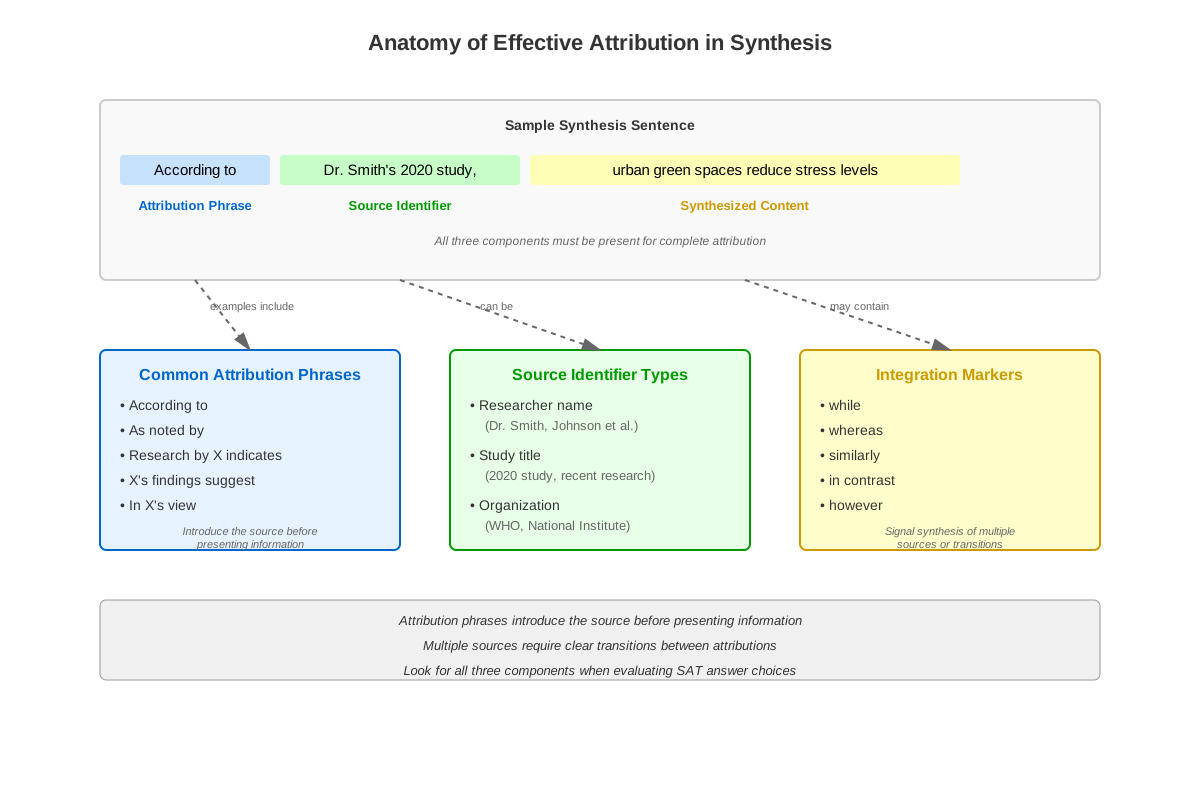
Source identification: Each distinct source must be clearly named or described. This might include researcher names, institutional affiliations, publication titles, or descriptive phrases like "the first study" or "the historical account."
Attribution phrases: These are the linguistic markers that signal where information comes from. Common attribution phrases include:
- According to [source]
- [Source] found that
- As [source] notes
- Research by [source] indicates
- [Source] argues that
- Data from [source] shows
Information accuracy: The synthesized text must accurately represent what each source actually states, without misattribution or confusion about which source provides which information.
Completeness: All relevant sources must be credited. Omitting attribution for one source while crediting others represents incomplete synthesis.
Attribution Placement and Syntax
The placement of attribution within sentences significantly affects both clarity and style. The SAT tests students' ability to recognize natural, effective attribution placement:
| Attribution Position | Example | Effectiveness |
|---|---|---|
| Beginning of sentence | According to Smith's research, urban temperatures have risen 2°C. | Clear, direct, emphasizes source |
| Middle of sentence | Urban temperatures, as Smith's research shows, have risen 2°C. | Integrates smoothly, maintains flow |
| End of sentence | Urban temperatures have risen 2°C, according to Smith's research. | Natural, but may separate claim from source |
| Embedded in clause | Smith's research indicates that urban temperatures have risen 2°C. | Professional, academic tone |
The SAT favors attribution that maintains smooth prose flow while ensuring clarity. Awkward or repetitive attribution phrases often appear in incorrect answer choices.
Synthesizing Multiple Sources
When synthesizing information from multiple sources, students must manage several sources simultaneously while maintaining clear attribution for each. The SAT tests this through questions requiring students to integrate 2-4 sources with distinct contributions.
Parallel information: When sources provide similar information, synthesis might note agreement: "Both Smith and Jones found that urban temperatures increased, with Smith reporting a 2°C rise and Jones documenting a 1.8°C increase."
Contrasting information: When sources disagree, synthesis must attribute each perspective clearly: "While Smith's research indicates a 2°C temperature increase, Jones's data suggests only a 1.2°C rise."
Complementary information: When sources provide different aspects of a topic, synthesis integrates them cohesively: "Smith documented temperature increases in urban areas, while Jones examined the resulting effects on local wildlife populations."
Common Attribution Errors Tested on the SAT
The SAT consistently includes wrong answer choices that contain specific attribution errors:
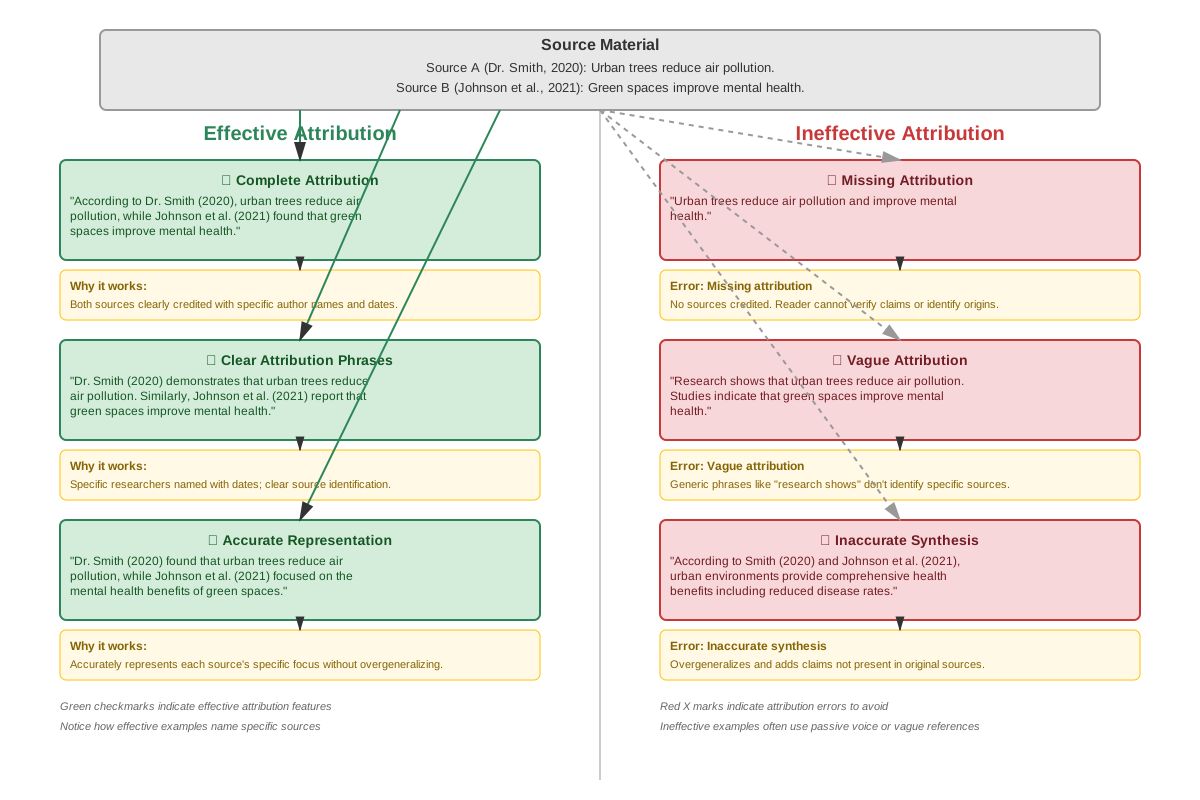
Misattribution: Crediting information to the wrong source. This is a common distractor that tests careful reading.
Omitted attribution: Failing to credit one or more sources. Answer choices might synthesize information correctly but forget to attribute all sources.
Vague attribution: Using unclear phrases like "research shows" or "studies indicate" without specifying which research or studies. The SAT requires specific source identification.
Redundant attribution: Unnecessarily repeating attribution phrases in ways that disrupt prose flow. While completeness is important, excessive attribution creates awkward writing.
Incorrect relationship indicators: Using words like "similarly" or "however" that misrepresent the relationship between sources.
Concept Relationships
Attribution in synthesis builds directly upon fundamental reading comprehension skills. Students must first understand each individual source (reading comprehension) → then identify the key information from each source (main idea identification) → next recognize relationships between sources (comparison/contrast) → finally integrate information with proper attribution (synthesis with attribution).
Within the topic itself, the concepts connect in a logical progression: understanding what attribution is → recognizing effective attribution phrases → learning proper placement and syntax → applying these skills to multiple sources simultaneously → avoiding common attribution errors. Each concept builds upon the previous one, creating a comprehensive skill set.
Attribution in synthesis also connects forward to other SAT Reading and Writing skills. It relates to the broader category of rhetorical synthesis questions, which include not just attribution but also purpose, audience, and tone considerations. Additionally, attribution skills support evidence-based reading questions, where students must track which passage provides which evidence for a claim. The ability to manage multiple sources with clear attribution also prepares students for cross-text connections questions that appear elsewhere in the Reading and Writing section.
High-Yield Facts
⭐ Attribution synthesis questions typically present 2-4 brief source texts that students must integrate into a single, properly attributed statement.
⭐ Every distinct source mentioned in the prompt must be credited in the correct answer choice; omitting attribution for even one source makes an answer incorrect.
⭐ Common attribution phrases include "according to," "as [source] notes," "[source] found that," and "research by [source] indicates."
⭐ Misattribution (crediting information to the wrong source) is one of the most common wrong answer distractors on SAT attribution questions.
⭐ Effective attribution maintains smooth prose flow while ensuring clarity about which source provides which information.
- Attribution can appear at the beginning, middle, or end of sentences, but must always clearly connect the information to its source.
- Vague attribution phrases like "studies show" or "research indicates" without specifying which studies or research are insufficient for SAT questions.
- When sources provide contrasting information, synthesis must use appropriate transition words (while, however, whereas) along with clear attribution.
- The SAT favors concise, professional attribution over wordy or repetitive phrasing.
- Attribution synthesis questions often appear in the latter portions of Reading and Writing modules and are typically classified as medium to hard difficulty.
Quick check — test yourself on Attribution in synthesis so far.
Try Flashcards →Common Misconceptions
Misconception: Attribution is only necessary for direct quotations. → Correction: On the SAT, attribution is required for all information derived from sources, including paraphrased content, data, findings, and claims. Even when not quoting directly, students must indicate which source provides which information.
Misconception: Using "studies show" or "research indicates" provides sufficient attribution. → Correction: The SAT requires specific source identification. Generic phrases without naming the actual source or study are considered vague attribution and appear in incorrect answer choices. Students must identify the specific researcher, study, or source.
Misconception: Attribution should be placed at the end of a paragraph or synthesis rather than with each individual claim. → Correction: Each distinct claim or piece of information needs attribution at the point where it appears. Waiting until the end creates ambiguity about which source provides which information, especially when synthesizing multiple sources.
Misconception: More attribution is always better, so repeating source names multiple times improves the synthesis. → Correction: While completeness is essential, excessive or redundant attribution disrupts prose flow and creates awkward writing. The SAT favors efficient attribution that credits sources clearly without unnecessary repetition.
Misconception: As long as all sources are mentioned somewhere in the synthesis, the specific attribution doesn't matter. → Correction: Accurate attribution requires matching each specific claim or data point to its correct source. Simply mentioning all sources without properly connecting each to its corresponding information constitutes misattribution, a common wrong answer type.
Misconception: Attribution synthesis questions are primarily about writing style rather than reading comprehension. → Correction: These questions equally test careful reading comprehension. Students must accurately understand what each source states before they can properly attribute information. Many wrong answers result from misreading sources rather than from poor attribution technique.
Worked Examples
Example 1: Scientific Research Synthesis
Source Texts:
Text 1: Dr. Martinez's 2022 study of coastal erosion in Florida found that sea levels rose an average of 3.2 millimeters per year between 2010 and 2020.
Text 2: Research conducted by the Chen team in 2023 examined the same Florida coastline and documented increased storm frequency, with major storms occurring 40% more often in the 2015-2020 period compared to 2005-2010.
Text 3: Environmental scientist Dr. Okafor's analysis suggests that the combination of rising sea levels and increased storm activity has accelerated coastal erosion rates beyond previous predictions.
Question: Which choice most effectively uses relevant information from the sources to accomplish the goal of synthesizing the research findings with proper attribution?
Answer Choices:
A) Studies show that Florida's coastline is experiencing increased erosion due to rising sea levels and more frequent storms.
B) Dr. Martinez found that sea levels rose 3.2 millimeters annually, while the Chen team documented 40% more major storms, and Dr. Okafor suggests these factors have accelerated coastal erosion beyond predictions.
C) According to Dr. Martinez, sea levels rose and storms increased, leading to accelerated coastal erosion as Dr. Okafor predicted.
D) Research by Dr. Okafor indicates that rising sea levels of 3.2 millimeters per year and 40% more frequent storms have accelerated coastal erosion.
Analysis:
Choice A fails because it uses vague attribution ("studies show") without identifying specific sources. This is insufficient for SAT standards.
Choice B correctly attributes each piece of information to its proper source: Martinez's sea level data, Chen team's storm frequency findings, and Okafor's synthesis conclusion. The attribution is clear, complete, and maintains good prose flow.
Choice C contains misattribution. It suggests Martinez documented both sea level rise and storm increases, when actually the Chen team documented storms. It also misrepresents Okafor's contribution as a prediction rather than an analysis of existing data.
Choice D misattributes the specific data points to Okafor, when actually Okafor provided the synthesis conclusion while Martinez and Chen provided the specific measurements.
Correct Answer: B
This example demonstrates the importance of carefully tracking which source provides which specific information and ensuring each piece of data is attributed to its correct origin.
Example 2: Historical Account Synthesis
Source Texts:
Text 1: Historian James Wu's account of the 1920s labor movement emphasizes the role of immigrant workers in organizing strikes across multiple industries.
Text 2: According to labor economist Dr. Sarah Patel's research, the 1920s saw a 35% decline in union membership despite increased strike activity.
Text 3: Cultural historian Dr. Rodriguez argues that media coverage of the era focused disproportionately on strike violence while ignoring workers' legitimate grievances.
Question: The student wants to synthesize information about the complexity of the 1920s labor movement. Which choice most effectively uses relevant information from the sources with proper attribution?
Answer Choices:
A) The 1920s labor movement was complex, involving immigrant workers organizing strikes even as union membership declined by 35%, though media coverage emphasized violence over grievances.
B) Wu highlights immigrant workers' organizing efforts, while Patel notes that union membership declined 35% despite strike activity, and Rodriguez argues that media coverage focused on violence rather than workers' grievances.
C) According to Wu and Patel, immigrant workers organized strikes but union membership declined, and media coverage was biased according to Rodriguez.
D) Historians agree that the 1920s labor movement involved immigrant organizing, declining membership, and biased media coverage.
Analysis:
Choice A synthesizes the information accurately but completely omits attribution for all three sources. While the content is correct, the lack of source crediting makes this insufficient for attribution synthesis questions.
Choice B provides complete, accurate attribution for each distinct piece of information: Wu's focus on immigrant organizing, Patel's membership data, and Rodriguez's media analysis. Each source is properly credited with its specific contribution.
Choice C uses attribution but creates awkward phrasing ("according to Wu and Patel") that incorrectly groups sources making different points. Wu and Patel addressed different aspects and shouldn't be combined in attribution. The phrase "was biased according to Rodriguez" is also awkward.
Choice D uses vague attribution ("historians agree") that doesn't specify which historians provided which information. This fails to meet SAT standards for specific source identification.
Correct Answer: B
This example illustrates how proper attribution requires both completeness (crediting all sources) and accuracy (matching each source to its specific contribution) while maintaining professional prose style.
Exam Strategy
When approaching sat attribution in synthesis questions, students should follow a systematic process to maximize accuracy and efficiency:
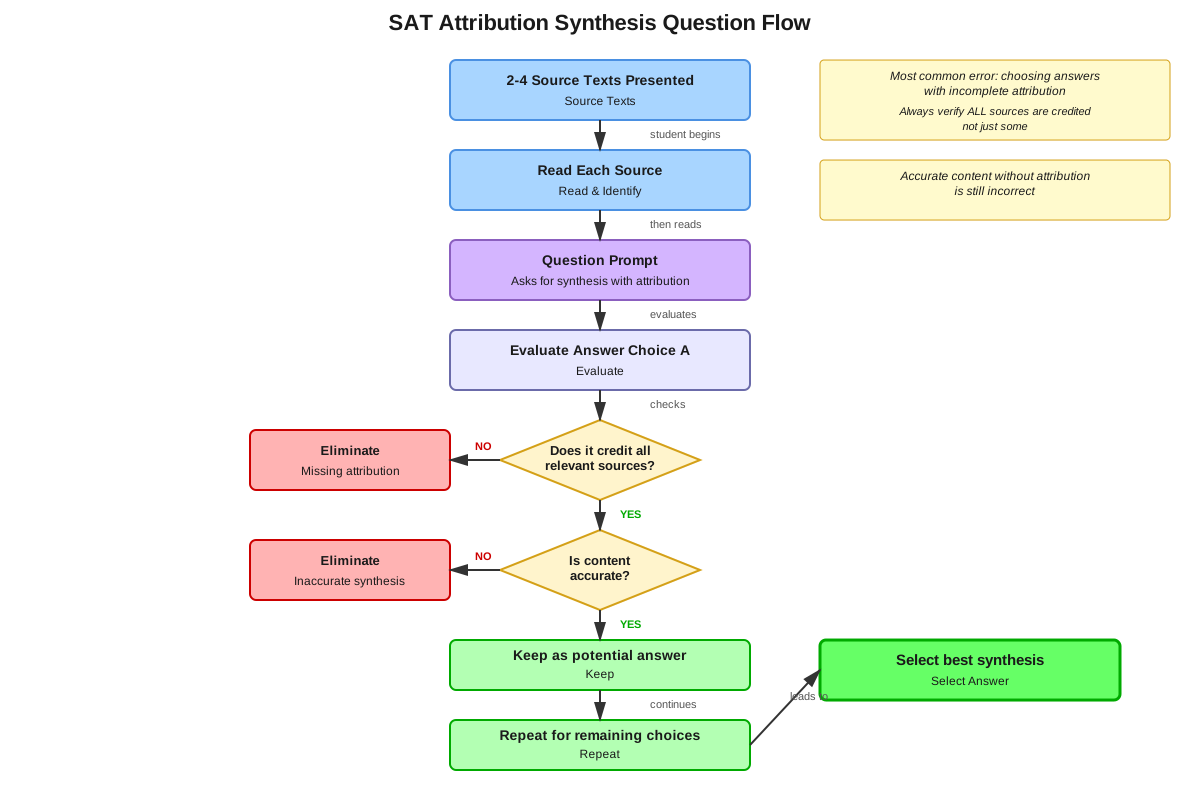
Step 1: Read all source texts carefully (60-90 seconds). Annotate or mentally note what specific information each source provides. Many students rush this step and later confuse which source states what, leading to misattribution errors.
Step 2: Identify the key information from each source that needs to be synthesized. Not every detail from every source will appear in the correct answer, but the main contribution of each source should be represented.
Step 3: Before reading answer choices, predict what proper attribution should look like. Mentally construct something like: "Source 1 says X, Source 2 says Y, Source 3 says Z." This prediction helps identify the correct answer more quickly.
Step 4: Eliminate answers with obvious attribution errors first:
- Eliminate choices with no attribution or vague attribution ("studies show")
- Eliminate choices that omit one or more sources entirely
- Eliminate choices that misattribute information to the wrong source
Step 5: Compare remaining choices for prose quality and completeness. The correct answer will have both accurate attribution and smooth, professional writing style.
Exam Tip: Watch for trigger phrases in wrong answers like "research shows," "studies indicate," or "experts agree" without naming specific sources. These vague attributions are red flags for incorrect choices.
Time allocation: Spend approximately 60-90 seconds reading the source texts carefully, then 30-45 seconds evaluating answer choices. Attribution synthesis questions deserve slightly more time than average because they require tracking multiple sources, but shouldn't exceed 2 minutes total.
Process of elimination specific to attribution:
- If an answer choice mentions only 2 sources when 3 were provided, eliminate it immediately
- If you spot information attributed to the wrong source, eliminate that choice without reading further
- If attribution phrases are awkward or repetitive ("According to Smith, Smith found that..."), the choice is likely incorrect
Common trigger words in correct answers: "according to," "as [source] notes," "[source] found/documented/argues," "research by [source]," "while [source A]... [source B]..." These phrases signal proper attribution technique.
Memory Techniques
CASE Acronym for Attribution Evaluation:
- Complete: All sources credited
- Accurate: Information matched to correct source
- Specific: Named sources, not vague phrases
- Effective: Smooth prose flow
Visualization Strategy: Picture each source as a different colored highlighter. As you read answer choices, mentally "highlight" each piece of information with its source's color. If colors don't match the original sources, that's misattribution. If one color is missing, that's incomplete attribution.
The "Who Said What?" Technique: After reading source texts, create a quick mental table:
- Source 1 = [key point]
- Source 2 = [key point]
- Source 3 = [key point]
Then check each answer choice against this mental table to verify proper attribution.
Attribution Phrase Bank: Memorize these common, effective attribution phrases that frequently appear in correct answers:
- According to [source]
- As [source] notes/indicates/suggests
- [Source] found/documented/argues that
- Research by [source] shows
- While [source A]..., [source B]...
- [Source]'s analysis indicates
The "Three-Check Method": For each answer choice, perform three quick checks:
- Are all sources mentioned? (Completeness check)
- Does each source get credit for its actual contribution? (Accuracy check)
- Does the attribution sound natural and professional? (Style check)
Summary
Attribution in synthesis is a high-yield SAT Reading and Writing skill that requires students to integrate information from multiple sources while properly crediting each source's contribution. Effective attribution involves three essential components: identifying each source specifically, using appropriate attribution phrases, and ensuring every piece of information is matched to its correct origin. The SAT tests this skill through questions presenting 2-4 brief source texts that students must synthesize into a single, properly attributed statement. Common wrong answer types include vague attribution without specific source identification, misattribution of information to incorrect sources, and incomplete attribution that omits one or more sources. Success on these questions requires careful reading of all source texts, systematic tracking of which source provides which information, and recognition of both complete and accurate attribution in answer choices. Students should eliminate choices with obvious attribution errors first, then evaluate remaining options for prose quality and completeness. Mastering attribution in synthesis demonstrates college-readiness for academic writing where proper source crediting is essential for integrity and credibility.
Key Takeaways
- Attribution synthesis questions require crediting every source specifically; vague phrases like "studies show" are insufficient and appear in wrong answers
- Misattribution (crediting information to the wrong source) is the most common distractor type; careful tracking of which source states what is essential
- Effective attribution balances completeness (crediting all sources) with smooth prose flow (avoiding awkward or repetitive phrasing)
- Common attribution phrases include "according to," "as [source] notes," and "[source] found that"—memorize these for quick recognition
- Systematic elimination of answers with missing sources, vague attribution, or misattribution significantly improves accuracy and speed
- Attribution synthesis questions typically appear 1-2 times per test module and are classified as medium to hard difficulty
- Success requires both careful reading comprehension (understanding what each source actually states) and synthesis skill (integrating multiple sources coherently)
Related Topics
Rhetorical Synthesis - Purpose and Audience: Building on attribution skills, these questions ask students to synthesize sources while considering the intended purpose or audience of the writing. Mastering attribution provides the foundation for these more complex synthesis tasks.
Evidence-Based Reading Questions: These questions require identifying which passage or portion of text provides evidence for a claim, similar to tracking which source provides which information in attribution synthesis.
Cross-Text Connections: Questions that ask students to identify relationships between paired passages build on the same multi-source management skills required for attribution synthesis.
Transitions and Cohesion: Understanding how to connect ideas smoothly relates directly to effective attribution placement and the use of appropriate transition words when synthesizing contrasting or complementary sources.
Academic Writing Conventions: Attribution synthesis connects to broader academic writing standards tested throughout the SAT, including formal tone, precise language, and evidence-based claims.
Practice CTA
Now that you've mastered the core concepts of attribution in synthesis, it's time to apply these skills to authentic SAT-style questions. The practice questions and flashcards will reinforce your ability to identify proper attribution, recognize common errors, and efficiently evaluate synthesis options under timed conditions. Remember: attribution synthesis is a high-yield topic that appears consistently on the SAT, making practice on this skill one of the most valuable investments of your study time. Approach each practice question systematically using the strategies outlined in this guide, and you'll build the confidence and accuracy needed to excel on test day. Your ability to synthesize multiple sources with proper attribution demonstrates college-level academic writing skills—master this, and you're well on your way to achieving your target score!
Sign up free to keep reading
Create a free AnvayaPrep account to finish this SAT guide on Attribution in synthesis — plus flashcards and practice questions.