Overview
Chronological synthesis is a critical skill tested in the SAT Reading and Writing (RW) section that requires students to organize information from multiple sources according to a time-based sequence. This question type challenges test-takers to identify the correct temporal order of events, developments, or discoveries by synthesizing details from several brief texts. Unlike simple reading comprehension questions that focus on a single passage, chronological synthesis questions demand that students extract relevant dates, time markers, and sequential information from multiple sources and then arrange them logically.
The SAT frequently includes chronological synthesis questions in the Rhetorical Synthesis subsection, making this a high-yield topic for test preparation. These questions typically present 2-4 short texts containing historical information, scientific discoveries, biographical details, or cultural developments, followed by a prompt asking students to complete a statement that accurately reflects the chronological order of events. Success on these questions requires careful attention to explicit dates, implicit time markers (such as "later," "previously," or "subsequently"), and the logical relationships between events across different sources.
Mastering chronological synthesis connects directly to broader SAT Reading and Writing skills, including information integration, evidence-based reasoning, and rhetorical analysis. This skill demonstrates a student's ability to work with multiple texts simultaneously—a fundamental academic competency that extends beyond standardized testing into college-level research and writing. Strong performance on chronological synthesis questions also indicates proficiency in identifying relevant information, distinguishing between primary details and supporting context, and constructing coherent narratives from fragmented sources.
Learning Objectives
- [ ] Identify key features of chronological synthesis questions on the SAT
- [ ] Explain how chronological synthesis appears on the SAT and what makes these questions distinctive
- [ ] Apply chronological synthesis strategies to answer SAT-style questions accurately and efficiently
- [ ] Distinguish between explicit temporal markers (dates, years) and implicit sequence indicators (transitional phrases, logical relationships)
- [ ] Evaluate answer choices by systematically checking each claim against the source texts
- [ ] Synthesize information from 2-4 brief passages to construct an accurate timeline of events
Prerequisites
- Basic reading comprehension: Understanding main ideas and supporting details in short passages is essential for extracting relevant temporal information from multiple texts
- Familiarity with transition words: Recognizing temporal transition words (before, after, during, subsequently) helps identify sequence relationships even when explicit dates are absent
- Evidence-based reasoning: The ability to support claims with textual evidence is fundamental to verifying the accuracy of chronological statements
- Multi-text analysis: Experience working with more than one passage simultaneously prepares students for the synthesis demands of these questions
Why This Topic Matters
Chronological synthesis represents a sophisticated cognitive skill that extends far beyond standardized testing. In academic settings, students must regularly synthesize information from multiple sources to construct research papers, compare historical accounts, or trace the development of scientific theories. Professional contexts—from legal analysis to medical case reviews—demand the ability to establish accurate timelines from disparate sources. The SAT tests this skill because it predicts college readiness and real-world analytical capabilities.
On the SAT, chronological synthesis questions appear with high frequency in the Reading and Writing section, typically comprising 1-2 questions per test administration. These questions fall within the Rhetorical Synthesis category, which accounts for approximately 8-10% of the total RW questions. The College Board has increasingly emphasized synthesis skills in recent test versions, making this topic particularly high-yield for current test-takers. Students who master chronological synthesis often see measurable score improvements because these questions, while initially challenging, become highly predictable once the underlying patterns are recognized.
Common manifestations of chronological synthesis on the SAT include: historical timelines tracing political movements or cultural shifts; scientific discovery sequences showing how research built upon previous findings; biographical sketches requiring students to order life events of notable figures; and technological development progressions illustrating innovation over time. The passages are typically 40-60 words each, presenting focused information that students must integrate to answer a single synthesis question.
Core Concepts
Understanding Chronological Synthesis
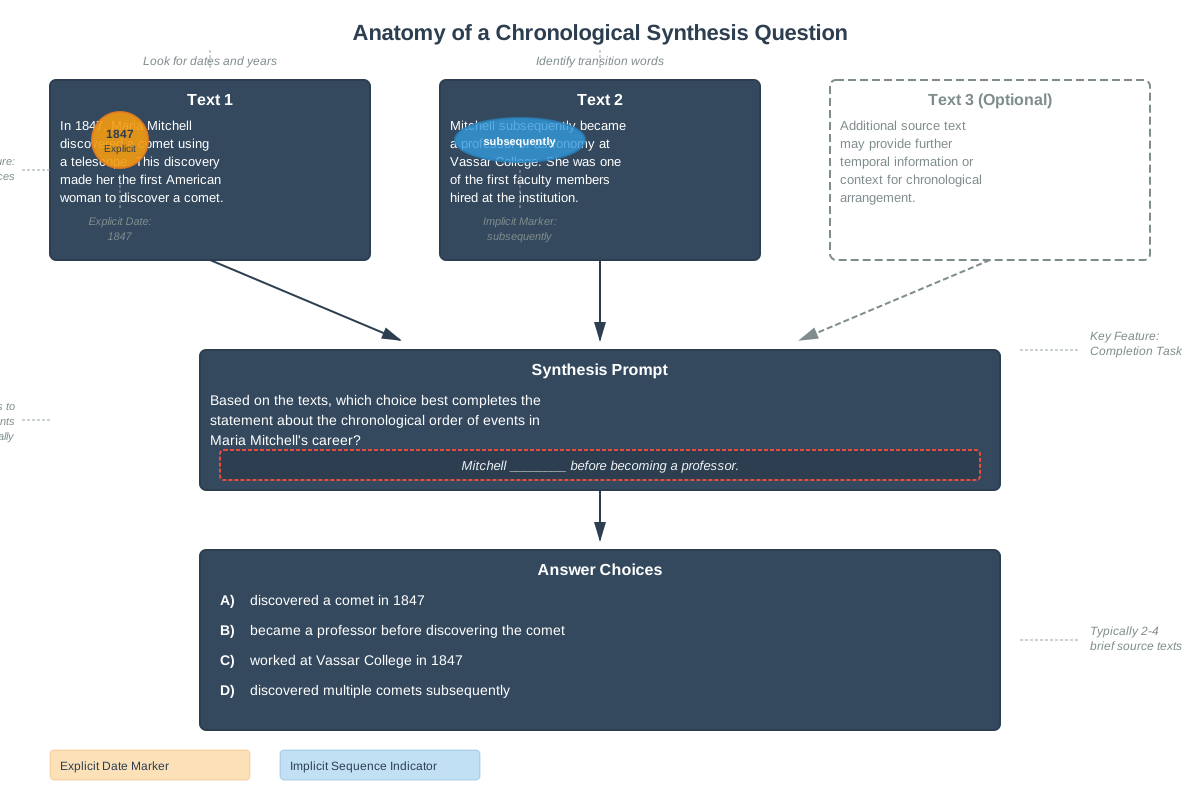
Chronological synthesis is the process of combining information from multiple independent sources to establish an accurate sequence of events, developments, or discoveries arranged by time. On the SAT chronological synthesis questions, this skill is tested through a specific question format: students receive 2-4 brief texts (labeled Text 1, Text 2, etc.), each containing temporal information about related subjects, followed by a prompt that begins with a phrase like "Based on the texts, which statement about [topic] is accurate?" or "A student researching [topic] has taken the following notes. The student wants to present the events in chronological order. Which choice most effectively uses relevant information from the notes to accomplish this goal?"
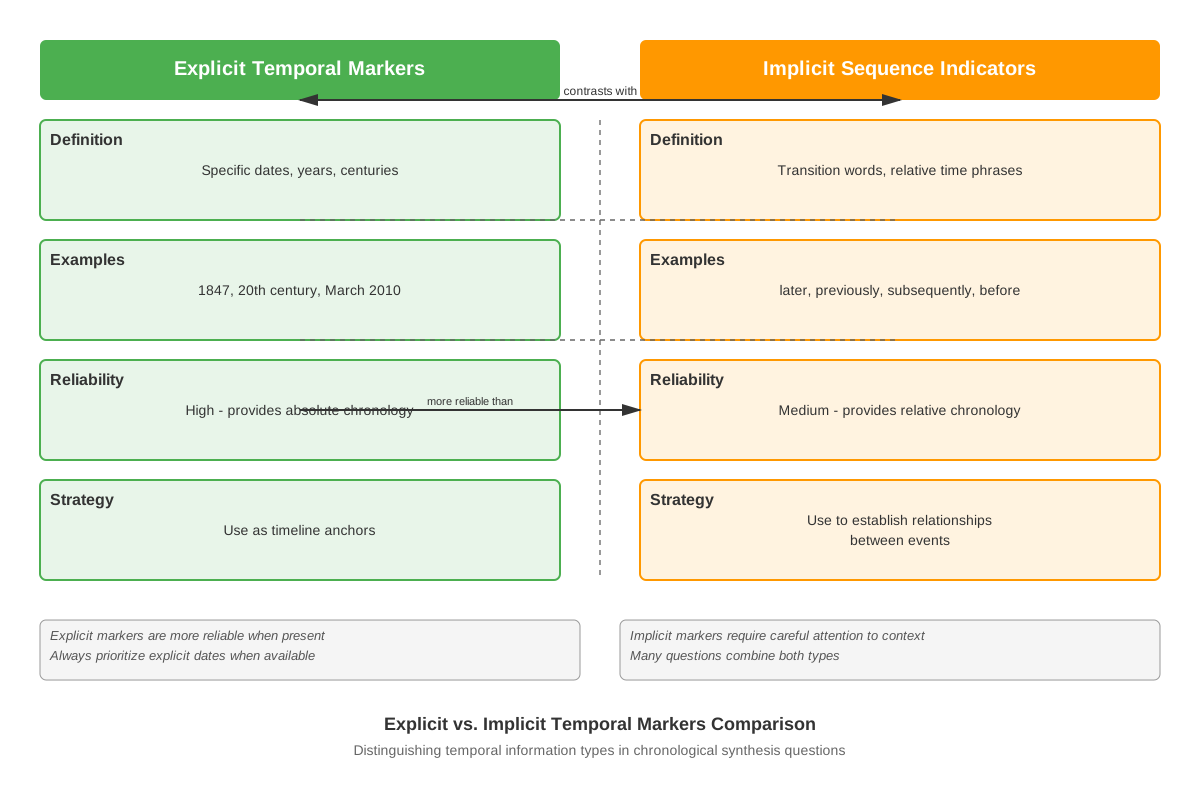
The fundamental challenge of chronological synthesis lies in extracting temporal markers from each text and then integrating them into a coherent timeline. These temporal markers fall into two categories: explicit markers (specific dates, years, or time periods) and implicit markers (relative time expressions like "earlier," "following," or "prior to"). Successful synthesis requires identifying both types of markers and understanding how they relate across different texts.
Explicit Temporal Markers
Explicit temporal markers provide concrete dates or time periods that allow for straightforward chronological ordering. These include:
- Specific years: "In 1847, Maria Mitchell discovered a comet"
- Date ranges: "Between 1920 and 1935, the Harlem Renaissance flourished"
- Centuries or decades: "During the 18th century, Enlightenment philosophy spread"
- Precise dates: "On July 20, 1969, Apollo 11 landed on the moon"
When texts contain explicit temporal markers, the synthesis task becomes primarily a matter of accurate extraction and comparison. Students must carefully note each date, ensure they understand what event or development it references, and then verify that answer choices correctly reflect the temporal sequence.
Implicit Temporal Markers
Implicit temporal markers establish sequence relationships without providing specific dates. These require more careful interpretation:
| Marker Type | Examples | What It Indicates |
|---|---|---|
| Prior action | "previously," "earlier," "before" | Event occurred before a reference point |
| Subsequent action | "later," "subsequently," "following" | Event occurred after a reference point |
| Causation | "as a result," "consequently" | Later event caused by earlier event |
| Continuation | "continued," "ongoing," "still" | Event persisted over time |
| Completion | "finally," "ultimately," "eventually" | Event concluded a sequence |
Understanding implicit markers is crucial because SAT passages often mix explicit dates in some texts with relative time expressions in others. Students must construct a complete timeline by integrating both types of information.
The Synthesis Process
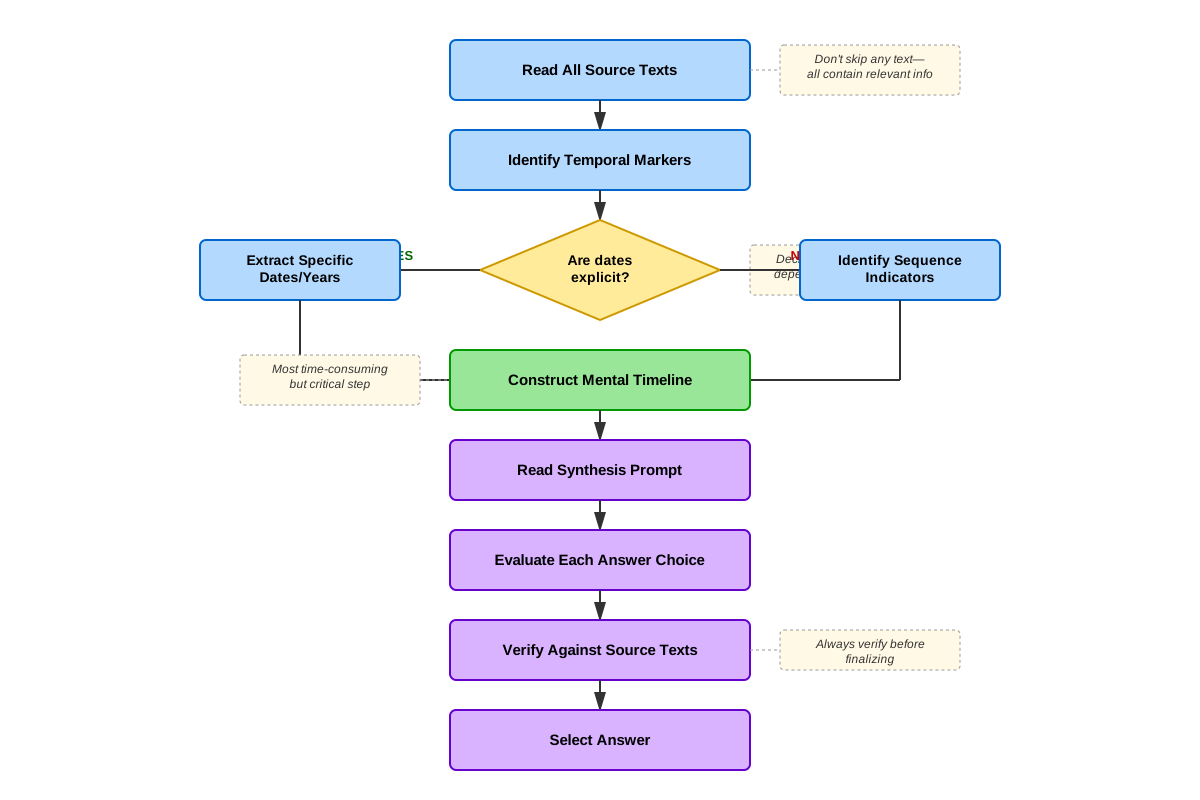
Effective chronological synthesis follows a systematic approach:
- Read all texts first: Quickly survey all provided passages before attempting to construct a timeline, noting the general subject and time period of each
- Extract temporal information: Identify and annotate every temporal marker (both explicit and implicit) in each text
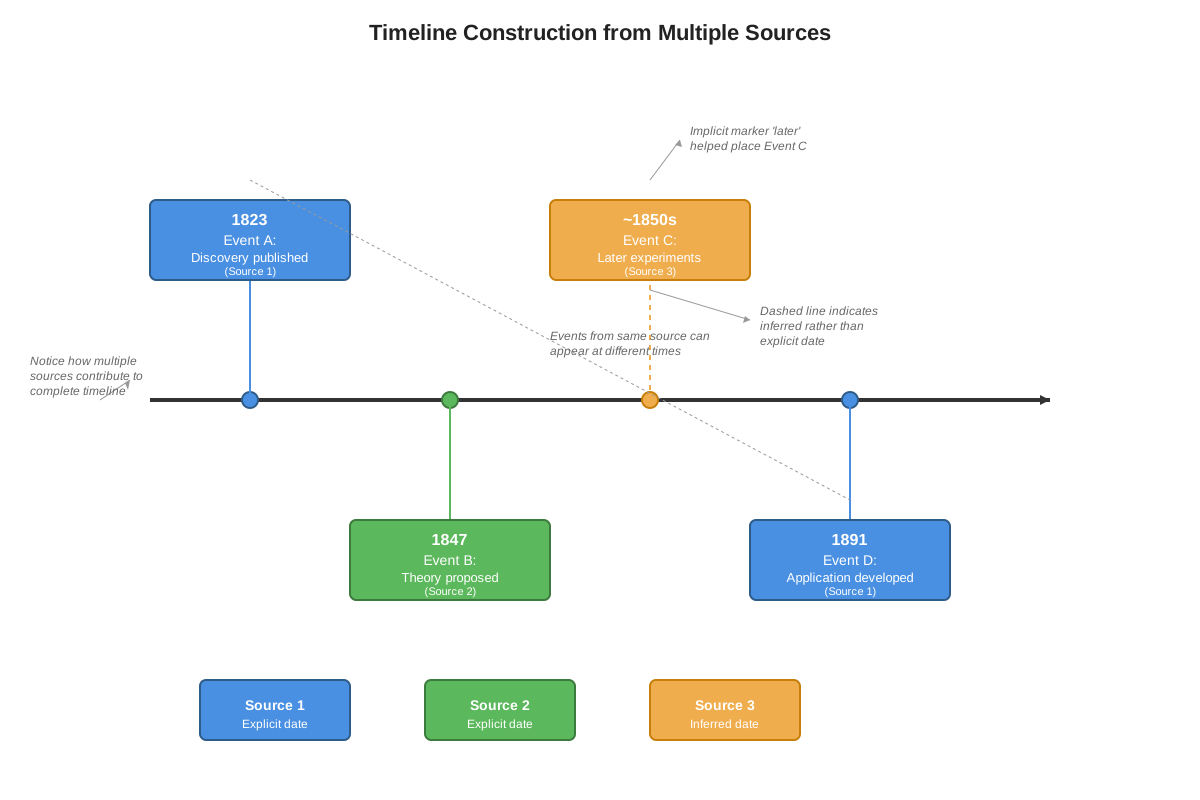
- Create a mental or written timeline: Arrange the events in chronological order based on the extracted information
- Evaluate answer choices systematically: Check each answer choice against the timeline, eliminating options that contain any chronological inaccuracy
- Verify the correct answer: Confirm that the remaining choice accurately reflects the sequence established by the texts
Cross-Text Integration
The defining feature of chronological synthesis questions is the requirement to integrate information across multiple texts. This differs from standard reading comprehension, where answers derive from a single passage. Cross-text integration demands that students:
- Track which information comes from which text: Avoid conflating details from different sources
- Identify connections between texts: Recognize when texts discuss related events or the same subject from different angles
- Resolve apparent contradictions: Determine whether texts actually conflict or simply emphasize different aspects of a timeline
- Maintain accuracy across all sources: Ensure the final synthesis reflects information from every relevant text, not just one or two
Common Question Formats
SAT chronological synthesis questions typically appear in two formats:
Format 1: Direct Synthesis Statement
"Based on the texts, which statement accurately describes the chronological order of [events/discoveries/developments]?"
This format presents four answer choices, each offering a different chronological sequence. Students must identify which sequence matches the timeline established by the texts.
Format 2: Student Notes Scenario
"A student researching [topic] has taken the following notes: [bulleted list of information]. The student wants to present the events in chronological order. Which choice most effectively uses relevant information from the notes to accomplish this goal?"
This format simulates a research scenario where students must organize notes into a coherent chronological presentation. Answer choices are typically complete sentences that incorporate information from the notes in different sequences.
Concept Relationships
Chronological synthesis builds directly upon fundamental reading comprehension skills, particularly the ability to identify main ideas and supporting details within individual passages. This foundational skill enables students to extract relevant temporal information from each text. The synthesis component then adds a layer of complexity by requiring integration across multiple sources—a skill that connects to evidence-based reasoning and argumentation.
Within the topic itself, the relationship flows as follows: Explicit temporal markers → provide the framework for → Timeline construction → which is refined by → Implicit temporal markers → leading to → Cross-text integration → resulting in → Accurate chronological synthesis. Each concept depends on the previous one, creating a hierarchical skill structure.
Chronological synthesis also relates closely to other rhetorical synthesis skills tested on the SAT, including causal synthesis (identifying cause-and-effect relationships across texts) and comparative synthesis (analyzing similarities and differences between sources). All synthesis question types share the common requirement of multi-text analysis, but chronological synthesis specifically emphasizes temporal sequencing rather than logical relationships or comparative analysis.
The connection to broader RW skills is significant: chronological synthesis questions test the same analytical abilities required for effective research writing, where students must consult multiple sources, extract relevant information, and present findings in a logical, organized manner. This makes chronological synthesis both a test-specific skill and a transferable academic competency.
High-Yield Facts
⭐ Chronological synthesis questions always provide 2-4 brief texts, each containing temporal information that must be integrated to answer correctly
⭐ Explicit temporal markers (specific dates, years) take precedence over implicit markers (relative time expressions) when both are present
⭐ Answer choices in chronological synthesis questions typically differ in the sequence of events, not in the events themselves
⭐ Every text provided contains relevant information; the SAT does not include decoy passages in synthesis questions
⭐ Incorrect answer choices usually contain one chronological error while getting other sequence relationships correct
- Temporal markers can appear anywhere in a text—beginning, middle, or end—requiring careful reading of complete passages
- Some chronological synthesis questions require understanding the logical relationship between events (cause-effect, prerequisite-consequence) to establish sequence
- The SAT may test chronological synthesis across various content domains: history, science, biography, technology, and cultural developments
- Questions may include events that occurred simultaneously, requiring students to recognize that not all relationships are strictly sequential
- Chronological synthesis questions typically take 60-90 seconds to answer when approached systematically, making them moderate in time investment
Quick check — test yourself on Chronological synthesis so far.
Try Flashcards →Common Misconceptions
Misconception: Chronological synthesis questions can be answered by reading only one or two of the provided texts → Correction: These questions specifically test the ability to integrate information across all provided texts. Each passage contains essential temporal information, and correct answers require synthesis of details from every source. Skipping any text significantly increases the likelihood of selecting an incorrect answer.
Misconception: The texts are always presented in chronological order → Correction: The SAT deliberately presents texts in non-chronological order to test synthesis skills. Text 1 might discuss the most recent event, while Text 3 describes the earliest development. Students must actively construct the timeline rather than assuming the presentation order reflects temporal sequence.
Misconception: Implicit temporal markers like "later" or "previously" are less important than specific dates → Correction: Implicit markers are equally important and often provide the only way to establish sequence relationships between events. Many correct answers depend on understanding relative time expressions, especially when texts mix dated and undated information.
Misconception: If an answer choice contains accurate information from the texts, it must be correct → Correction: All answer choices typically contain accurate information drawn from the texts; the distinguishing feature is whether the chronological sequence is correct. An answer can include true statements about events while presenting them in the wrong order, making it incorrect.
Misconception: Chronological synthesis questions are primarily about memorizing historical dates → Correction: These questions test analytical synthesis skills, not prior knowledge. All necessary temporal information is provided in the texts. Success depends on careful extraction and integration of given information, not on external historical knowledge.
Misconception: The longest or most detailed answer choice is usually correct → Correction: Answer choice length has no correlation with correctness in chronological synthesis questions. The SAT deliberately varies answer length to prevent test-taking shortcuts. The correct answer is determined solely by chronological accuracy, regardless of how much detail it includes.
Worked Examples
Example 1: Scientific Discovery Sequence
Text 1
In 1928, Alexander Fleming discovered penicillin when he noticed that a mold contaminating one of his bacterial cultures had killed the surrounding bacteria. This accidental observation would eventually revolutionize medicine.
Text 2
Howard Florey and Ernst Boris Chain successfully purified penicillin in 1940, making it possible to produce the antibiotic in quantities sufficient for medical use. Their work built directly on Fleming's earlier discovery.
Text 3
By 1945, penicillin was being mass-produced and had saved countless lives during World War II. The three scientists—Fleming, Florey, and Chain—shared the Nobel Prize in Physiology or Medicine that year for their contributions to developing this life-saving drug.
Question: Based on the texts, which statement accurately describes the development of penicillin as a medical treatment?
Answer Choices:
A) Fleming discovered penicillin in 1928, Florey and Chain purified it in 1940, and all three scientists received the Nobel Prize in 1945.
B) Florey and Chain purified penicillin in 1940, Fleming discovered it in 1928, and mass production began in 1945.
C) Fleming received the Nobel Prize in 1945, after which Florey and Chain purified penicillin in 1940 for mass production.
D) Mass production of penicillin began in 1945, following Fleming's 1928 discovery and preceding the 1940 purification by Florey and Chain.
Solution Process:
Step 1: Extract temporal markers from each text
- Text 1: 1928 - Fleming discovers penicillin
- Text 2: 1940 - Florey and Chain purify penicillin
- Text 3: 1945 - Mass production occurring; Nobel Prize awarded
Step 2: Construct timeline
1928 (discovery) → 1940 (purification) → 1945 (mass production and Nobel Prize)
Step 3: Evaluate each answer choice
- Choice A: Correct sequence (1928 → 1940 → 1945) ✓
- Choice B: Incorrect—lists purification (1940) before discovery (1928) ✗
- Choice C: Incorrect—places Nobel Prize (1945) before purification (1940) ✗
- Choice D: Incorrect—places purification (1940) after mass production (1945) ✗
Correct Answer: A
Key Learning Point: This example demonstrates the importance of explicit temporal markers. Each text provides a specific year, making the chronological sequence straightforward to establish. The challenge lies in carefully checking each answer choice against the established timeline, as incorrect options often get most relationships correct while reversing one crucial sequence.
Example 2: Historical Development with Implicit Markers
Text 1
The printing press, invented by Johannes Gutenberg around 1440, revolutionized the spread of information in Europe. Before this innovation, books were painstakingly copied by hand, making them rare and expensive.
Text 2
Following the introduction of movable type printing, literacy rates began to rise across Europe. This technological advancement enabled the mass production of books, making written materials accessible to a broader population.
Text 3
The Protestant Reformation, which began in 1517 when Martin Luther posted his Ninety-five Theses, was significantly aided by printing technology. Luther's ideas spread rapidly through printed pamphlets, reaching audiences that would have been impossible to access in earlier eras.
Question: A student researching the impact of printing technology has taken these notes. The student wants to present the developments in chronological order. Which choice most effectively uses relevant information from the notes to accomplish this goal?
Answer Choices:
A) After the Protestant Reformation began in 1517, Gutenberg invented the printing press around 1440, which subsequently increased literacy rates across Europe.
B) Gutenberg's invention of the printing press around 1440 preceded the rise in European literacy rates, which later facilitated the rapid spread of Reformation ideas beginning in 1517.
C) The rise in literacy rates across Europe occurred around 1440, before Gutenberg invented the printing press and Martin Luther began the Protestant Reformation in 1517.
D) Martin Luther's 1517 Reformation benefited from printing technology, which Gutenberg had invented around 1440, though literacy rates did not rise until after the Reformation began.
Solution Process:
Step 1: Extract temporal information
- Text 1: "around 1440" - printing press invented; "Before this innovation" - hand-copying era
- Text 2: "Following the introduction" - literacy rates rose (implicit: after 1440)
- Text 3: "1517" - Protestant Reformation began; "earlier eras" - confirms printing preceded Reformation
Step 2: Construct timeline
Pre-1440 (hand-copying) → ~1440 (printing press invented) → Post-1440 (literacy rises) → 1517 (Reformation benefits from printing)
Step 3: Note the implicit markers
- "Following the introduction" in Text 2 indicates literacy rise came after printing press
- "Earlier eras" in Text 3 confirms printing existed before Reformation
- Text 3 states Reformation "was significantly aided by" printing, indicating printing preceded it
Step 4: Evaluate answer choices
- Choice A: Places Reformation (1517) before printing press (1440) ✗
- Choice B: Correct sequence—printing (~1440) → literacy rise → Reformation (1517) ✓
- Choice C: Places literacy rise at 1440, before printing press invention ✗
- Choice D: Suggests literacy rates rose after 1517, contradicting the implicit sequence ✗
Correct Answer: B
Key Learning Point: This example illustrates the critical role of implicit temporal markers. While only two explicit dates appear (1440 and 1517), the phrases "Following the introduction," "Before this innovation," and "earlier eras" establish the complete chronological sequence. Students must recognize that implicit markers create binding sequence relationships just as explicit dates do.
Exam Strategy
Approaching chronological synthesis questions systematically maximizes accuracy and efficiency. Begin by reading the question stem first to understand what chronological relationship you need to establish—this primes your brain to notice temporal markers while reading. Then read all provided texts completely before attempting to construct a timeline; premature timeline construction often leads to errors when later texts provide contradictory or refining information.
Trigger words and phrases to watch for include:
- Explicit markers: years, centuries, decades, specific dates, "in [year]," "during [time period]"
- Prior action indicators: "before," "previously," "earlier," "prior to," "preceded"
- Subsequent action indicators: "after," "following," "later," "subsequently," "then"
- Causation markers: "as a result," "consequently," "led to," "enabled" (often imply temporal sequence)
- Completion markers: "finally," "ultimately," "eventually" (indicate end of sequence)
Exam Tip: Create a simple timeline notation system. Use arrows (→) to show sequence and write brief event labels with dates. For example: "Fleming 1928 → F&C purify 1940 → Nobel 1945"
Process-of-elimination strategy for chronological synthesis:
- Identify the earliest event mentioned across all texts—this anchors your timeline
- Eliminate any answer choice that doesn't place this event first
- Identify the latest event—eliminate choices that don't place it last
- For remaining choices, check the middle sequence relationships one by one
- The correct answer will have every single chronological relationship accurate; even one error makes a choice wrong
Time allocation: Budget 60-90 seconds for chronological synthesis questions. Spend 30-40 seconds reading and annotating the texts, 10-15 seconds constructing your timeline, and 20-30 seconds evaluating answer choices. If you find yourself exceeding 90 seconds, make your best educated guess and move on—these questions are worth the same single point as faster questions.
Critical Strategy: Never select an answer based on partial verification. Students often choose an answer after confirming it gets the first event correct without checking the complete sequence. Always verify every chronological relationship in your selected answer against the texts.
Memory Techniques
DATES Mnemonic for approaching chronological synthesis questions:
- Discover all temporal markers (both explicit and implicit)
- Arrange events in timeline order
- Test each answer choice systematically
- Eliminate options with any chronological error
- Select the answer that matches your timeline completely
Visualization strategy: Picture events as points on a horizontal timeline moving left to right (past to present). As you read each text, mentally place its event(s) on this timeline. This spatial representation helps prevent sequence confusion and makes it easier to spot chronological errors in answer choices.
The "Before/After" Quick Check: For each answer choice, identify the two events it claims occurred in sequence and ask: "Does the text support that Event A happened before Event B?" If you can't find textual support for that specific sequence relationship, eliminate the choice immediately.
Acronym for implicit markers - PLACE:
- Previously (indicates earlier event)
- Later (indicates subsequent event)
- After (indicates subsequent event)
- Consequently (often indicates later result)
- Earlier (indicates prior event)
When you encounter any PLACE word, immediately mark it and note what event it's positioning relative to what reference point.
Summary
Chronological synthesis is a high-yield SAT Reading and Writing skill that tests the ability to integrate temporal information from multiple brief texts to establish accurate event sequences. These questions present 2-4 passages containing explicit temporal markers (specific dates, years) and implicit markers (relative time expressions like "following" or "previously"), requiring students to construct a complete timeline by synthesizing information across all sources. Success depends on systematic extraction of temporal information, careful construction of chronological sequences, and methodical verification of answer choices against the established timeline. The key challenge lies not in understanding individual texts but in accurately integrating information across multiple sources while avoiding common pitfalls like assuming texts are presented in chronological order or selecting answers based on partial verification. Students who master the systematic approach—reading all texts first, extracting all temporal markers, constructing a timeline, and checking every sequence relationship in answer choices—can consistently answer these questions correctly within the recommended 60-90 second timeframe, making chronological synthesis a reliable source of points on the SAT.
Key Takeaways
- Chronological synthesis questions require integrating temporal information from 2-4 texts to establish accurate event sequences
- Both explicit markers (dates, years) and implicit markers (relative time expressions) are essential for constructing complete timelines
- The SAT deliberately presents texts in non-chronological order to test synthesis skills rather than simple reading comprehension
- Correct answers require every chronological relationship to be accurate; even one sequence error makes a choice wrong
- Systematic approaches (read all texts → extract markers → build timeline → verify choices) significantly improve accuracy and efficiency
- Every provided text contains relevant information; there are no decoy passages in synthesis questions
- Success depends on careful verification of complete sequences, not just confirming the first or most obvious chronological relationship
Related Topics
Causal Synthesis: Building on chronological synthesis skills, causal synthesis questions require students to identify cause-and-effect relationships across multiple texts. Mastering chronological synthesis provides the foundation for understanding how events relate not just temporally but causally.
Comparative Synthesis: This related skill involves analyzing similarities and differences between sources. The multi-text analysis abilities developed through chronological synthesis transfer directly to comparative synthesis questions.
Evidence-Based Reading: Chronological synthesis reinforces the fundamental SAT skill of supporting claims with textual evidence, as students must verify every sequence relationship against specific information in the passages.
Rhetorical Analysis: Understanding how authors structure information chronologically connects to broader rhetorical analysis skills, including recognizing organizational patterns and authorial choices in presenting information.
Practice CTA
Now that you've mastered the core concepts and strategies for chronological synthesis, it's time to put your knowledge into practice! Work through the practice questions to reinforce your systematic approach to extracting temporal markers, constructing timelines, and verifying answer choices. The flashcards will help you internalize key trigger words and common question patterns. Remember: chronological synthesis questions become highly predictable once you recognize the underlying patterns—consistent practice transforms this challenging question type into a reliable source of points on test day. You've built the foundation; now strengthen it through deliberate practice!
Sign up free to keep reading
Create a free AnvayaPrep account to finish this SAT guide on Chronological synthesis — plus flashcards and practice questions.