Overview
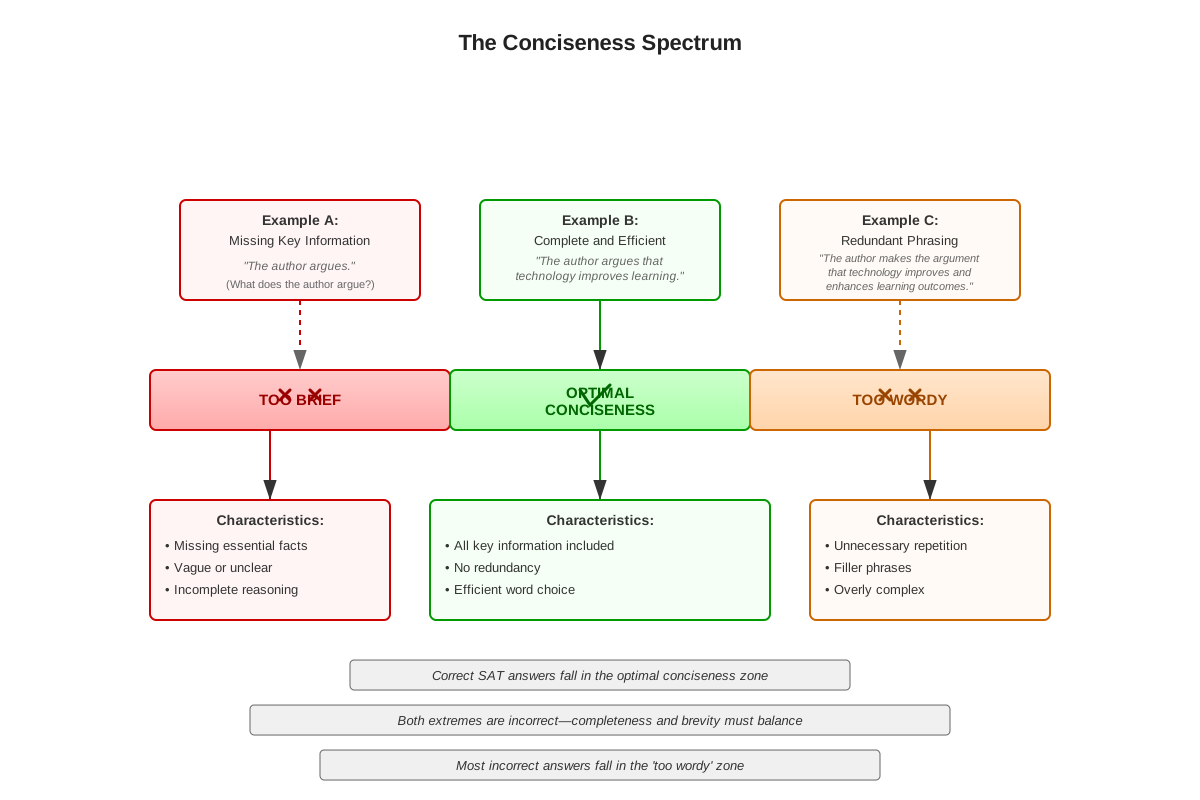
Concise synthesis is a critical skill tested in the SAT Reading and Writing (RW) section that requires students to combine information from multiple sources into a single, clear, and economical statement. Unlike traditional reading comprehension questions that focus on understanding a single passage, synthesis questions demand that test-takers identify relationships between ideas, recognize patterns across different texts or data points, and express these connections using the fewest words necessary while maintaining complete accuracy.
The SAT places significant emphasis on concise synthesis because it mirrors real-world academic and professional tasks: researchers must synthesize findings from multiple studies, journalists must combine information from various sources, and students must integrate evidence from different texts in their essays. The College Board specifically tests whether students can eliminate redundancy, avoid wordiness, and select the most streamlined way to convey complex information. This skill appears consistently throughout the digital SAT, particularly in questions that present students with notes from research or multiple brief texts and ask them to combine this information effectively.
Mastering sat concise synthesis connects directly to broader rhetorical synthesis skills within the rw section. While other rhetorical synthesis questions might focus on logical transitions, appropriate tone, or effective organization, concise synthesis specifically targets economy of expression. This topic builds upon fundamental reading comprehension skills and supports advanced writing abilities, making it essential for students aiming for scores in the upper percentile ranges. Understanding how to synthesize information concisely not only improves performance on direct synthesis questions but also enhances overall reading efficiency and writing clarity across the entire exam.
Learning Objectives
- [ ] Identify key features of concise synthesis in SAT questions
- [ ] Explain how concise synthesis appears on the SAT and what makes it distinct from other question types
- [ ] Apply concise synthesis principles to answer SAT-style questions accurately and efficiently
- [ ] Evaluate multiple answer choices to determine which option conveys information most concisely without losing meaning
- [ ] Recognize and eliminate redundant phrases, wordy constructions, and unnecessary repetition in synthesis tasks
- [ ] Distinguish between appropriately concise writing and writing that is too brief to convey complete information
Prerequisites
- Basic reading comprehension skills: Students must be able to understand main ideas and supporting details in short passages, as synthesis requires first comprehending individual pieces of information before combining them.
- Understanding of sentence structure: Knowledge of subjects, predicates, clauses, and phrases enables students to recognize when information can be combined or streamlined.
- Familiarity with SAT question formats: General experience with how SAT questions are structured helps students quickly identify what the question is asking and what the answer choices are testing.
- Basic vocabulary knowledge: A working vocabulary allows students to recognize when a single precise word can replace a longer phrase.
Why This Topic Matters
In academic settings, the ability to synthesize information concisely is fundamental to effective communication. College students regularly write research papers that require integrating multiple sources without excessive length, and professionals across fields must present complex information clearly and briefly. The skill of concise synthesis demonstrates intellectual maturity—the ability to see connections between ideas and express them efficiently shows mastery of content rather than mere familiarity.
On the SAT specifically, concise synthesis questions appear with high frequency in the Reading and Writing section. Students can expect to encounter 2-4 questions per test that directly assess synthesis skills, with conciseness being a primary evaluation criterion. These questions typically appear in the "Expression of Ideas" domain and are worth the same number of points as any other question, making them significant contributors to overall scores. The College Board has increased emphasis on synthesis questions in the digital SAT format, recognizing that these skills better predict college readiness than traditional isolated reading comprehension tasks.
Concise synthesis questions commonly appear in several formats: students might see a set of bullet-pointed notes from a student's research and must choose which sentence best combines the information; they might encounter brief descriptions of multiple studies and need to select the most economical summary; or they might be presented with overlapping information from different sources and asked to identify which statement captures all key points without redundancy. The questions explicitly instruct students to choose the answer that accomplishes the synthesis task "while maintaining the meaning of the notes" or "while being as concise as possible," making the evaluation criteria transparent.
Core Concepts
Definition of Concise Synthesis
Concise synthesis refers to the process of combining information from multiple sources or data points into a unified statement that conveys all essential information using the minimum number of words necessary. The term "synthesis" means bringing together separate elements into a coherent whole, while "concise" means expressing ideas briefly and clearly without unnecessary words. On the SAT, this skill is tested through questions that provide students with multiple pieces of information and ask them to select the answer choice that best combines these elements while eliminating redundancy and wordiness.
The key principle underlying concise synthesis is economy of expression—using language efficiently to maximize meaning while minimizing length. This does not mean writing telegraphically or omitting necessary information; rather, it means choosing precise words, eliminating repetition, and structuring sentences to avoid unnecessary phrases. Effective concise synthesis maintains complete accuracy and includes all relevant information while removing anything that doesn't contribute to meaning.
Components of Effective Synthesis
Successful concise synthesis on the SAT requires three essential components working together:
- Completeness: The synthesized statement must include all key information from the source material. Omitting important details, even to achieve brevity, results in an incorrect answer.
- Accuracy: The synthesis must faithfully represent the original information without distortion, exaggeration, or misrepresentation. Changing the meaning to achieve conciseness is never acceptable.
- Conciseness: Among statements that are both complete and accurate, the most concise option—the one using the fewest words—is correct. This means eliminating redundancy, wordiness, and unnecessary elaboration.
These three components exist in a hierarchy: completeness and accuracy are non-negotiable requirements, while conciseness serves as the deciding factor when multiple options meet the first two criteria.
Identifying Redundancy
Redundancy occurs when information is unnecessarily repeated, either through direct repetition or through the use of multiple words or phrases that convey the same meaning. Recognizing redundancy is crucial for concise synthesis because redundant elements are the primary target for elimination. Common types of redundancy include:
| Type of Redundancy | Example | Concise Version |
|---|---|---|
| Repetitive adjectives | "The final conclusion" | "The conclusion" |
| Overlapping phrases | "In the year of 1995" | "In 1995" |
| Unnecessary intensifiers | "Very unique" | "Unique" |
| Redundant pairs | "First and foremost" | "First" or "Foremost" |
| Implied information stated explicitly | "The reason is because" | "The reason is" or "Because" |
On synthesis questions, redundancy often appears when answer choices repeat information that's already implied by other words in the sentence or when they include multiple phrases that convey identical information from the source material.
Recognizing Wordiness
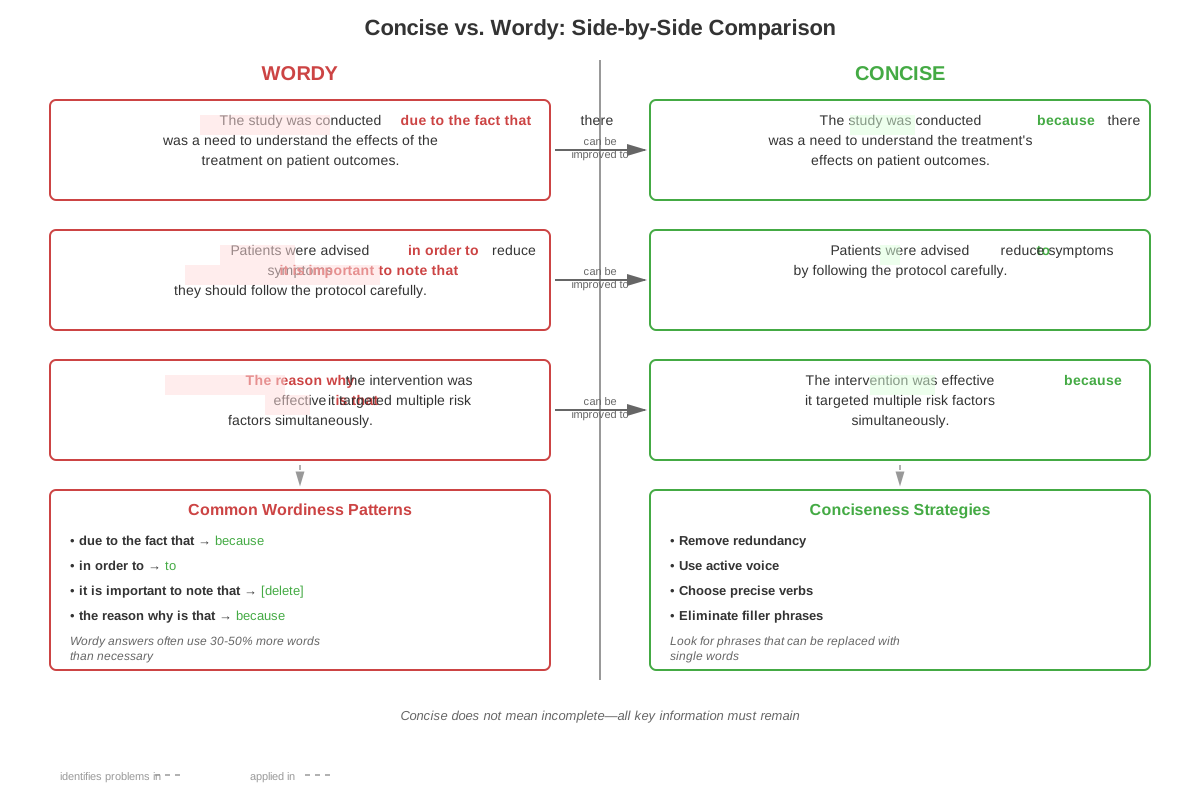
Wordiness differs from redundancy in that it involves using more words than necessary to express an idea, even when those words don't directly repeat information. Wordy constructions often include unnecessary prepositional phrases, weak verb phrases, or elaborate sentence structures when simpler alternatives exist. Common wordy patterns that appear in incorrect SAT answer choices include:
- Using "the fact that" when a simple noun or gerund would suffice
- Employing "in order to" instead of "to"
- Writing "due to the fact that" rather than "because"
- Using "at this point in time" instead of "now"
- Constructing passive voice sentences when active voice is clearer and shorter
Eliminating wordiness requires recognizing when a phrase can be replaced with a single word or when sentence structure can be simplified without losing meaning. For example, "made the decision to investigate" can become "decided to investigate," and "conducted an analysis of" can become "analyzed."
Synthesis Strategies
The SAT tests several specific strategies for achieving concise synthesis:
Strategy 1: Subordination and Embedding
Rather than expressing related ideas in separate clauses or sentences, effective synthesis embeds information within a single sentence structure. For example, instead of "The study was conducted in 2020. It examined sleep patterns," a concise synthesis would read "The 2020 study examined sleep patterns."
Strategy 2: Precise Word Choice
Selecting specific, precise vocabulary allows writers to convey complex ideas in fewer words. A single well-chosen verb can replace an entire phrase: "demonstrate" instead of "serve to show," "indicates" instead of "provides an indication of."
Strategy 3: Elimination of Implied Information
When context makes certain information obvious, stating it explicitly creates unnecessary length. If a passage discusses "marine biologists studying ocean ecosystems," there's no need to add "who work with ocean life" because that's implied by "marine biologists."
Strategy 4: Parallel Structure
When synthesizing multiple similar pieces of information, using parallel grammatical structures allows for efficient expression. Instead of "The first group showed improvement, and there was also improvement in the second group," write "Both groups showed improvement."
SAT Question Format
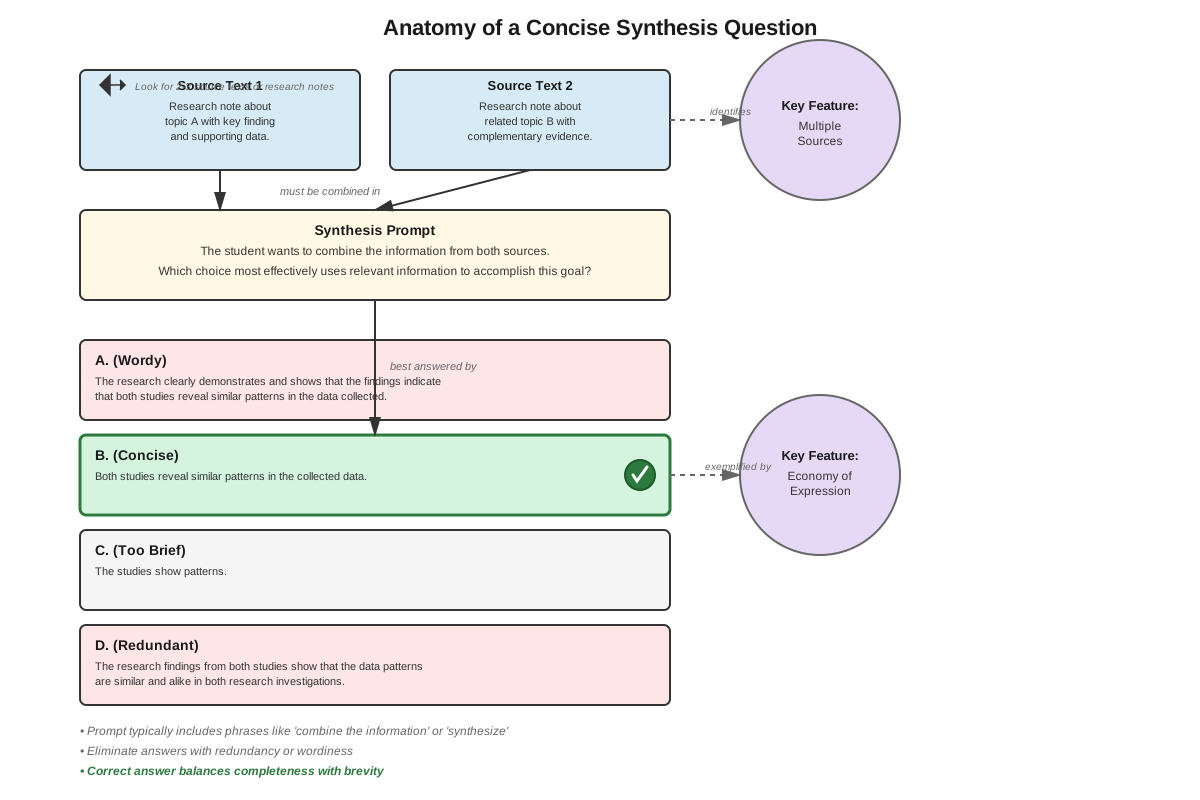
Concise synthesis questions on the SAT typically follow a consistent format. Students encounter a brief introduction explaining the context (often a student conducting research), followed by bullet-pointed notes or brief text excerpts containing the information to be synthesized. The question stem explicitly states the synthesis task and usually includes language about maintaining meaning while being concise. The four answer choices present different ways of combining the information, varying in completeness, accuracy, and conciseness.
The question stem might read: "The student wants to emphasize the similarity between the two studies while being as concise as possible. Which choice most effectively uses relevant information from the notes to accomplish this goal?" This explicit statement of criteria helps students understand exactly what the question is testing and how to evaluate answer choices systematically.
Concept Relationships
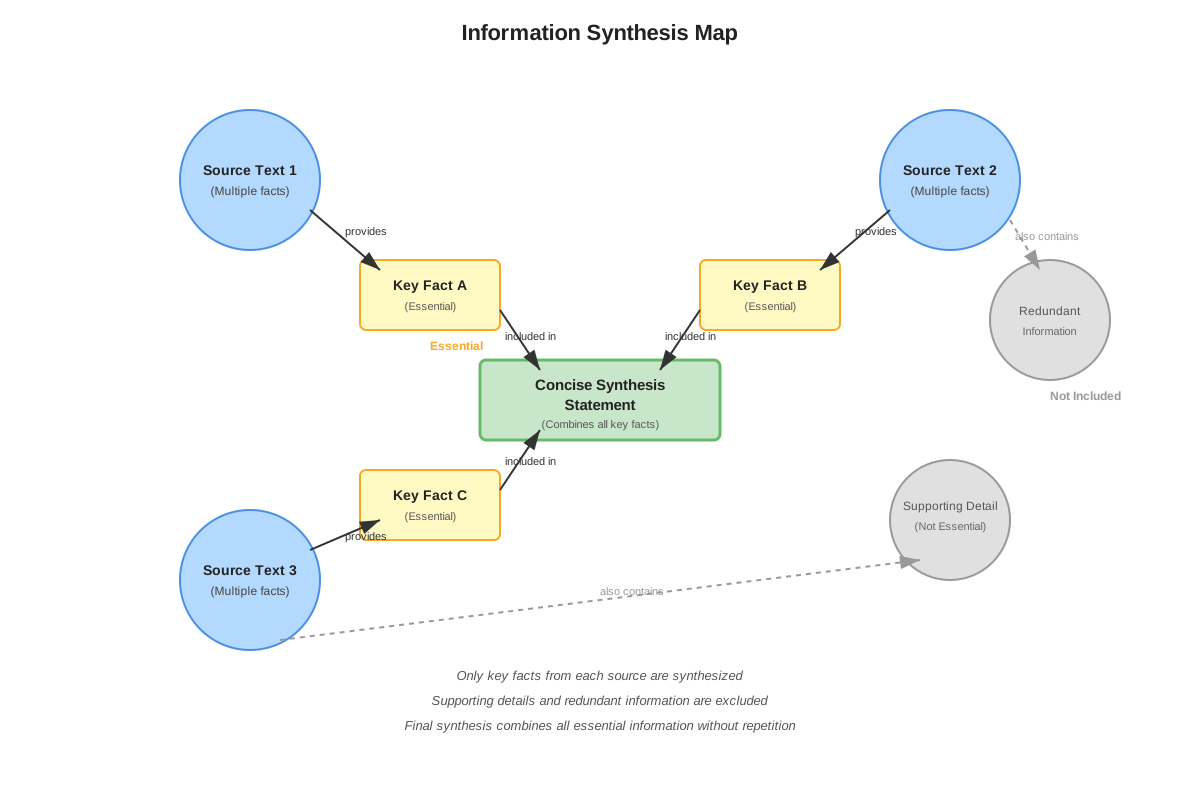
The concepts within concise synthesis build upon each other in a logical progression. Understanding redundancy and wordiness as distinct but related problems provides the foundation for recognizing what needs to be eliminated. These recognition skills then enable students to apply specific synthesis strategies like subordination, precise word choice, and parallel structure. All of these elements work together to achieve the three components of effective synthesis: completeness, accuracy, and conciseness.
Concise synthesis connects to prerequisite knowledge of sentence structure because recognizing opportunities for subordination and embedding requires understanding how clauses and phrases function. The topic also relates to vocabulary knowledge, as precise word choice depends on knowing specific terms that can replace longer phrases. Looking forward, mastering concise synthesis supports performance on other rhetorical synthesis questions involving transitions, tone, and organization, because all of these skills require combining information effectively while maintaining clarity.
The relationship map for this topic flows as follows:
Reading Comprehension → enables → Information Extraction → combines with → Recognition of Redundancy/Wordiness → informs → Application of Synthesis Strategies → produces → Concise, Complete, Accurate Synthesis → supports → Higher-Order Rhetorical Skills
High-Yield Facts
⭐ Concise synthesis questions explicitly state that the answer should be "as concise as possible" while maintaining meaning—this is the primary evaluation criterion after completeness and accuracy.
⭐ Redundancy (repeating information) and wordiness (using more words than necessary) are the two main targets for elimination in synthesis tasks.
⭐ The correct answer must include ALL key information from the source material—brevity never justifies omitting important details.
⭐ When multiple answer choices are complete and accurate, the shortest one is correct.
⭐ Common redundant phrases to eliminate include "the reason is because," "in the year of [year]," "final conclusion," and "past history."
- Synthesis questions typically provide 3-4 pieces of information in bullet-point format that must be combined into a single sentence.
- Active voice constructions are generally more concise than passive voice alternatives.
- Precise verbs (like "demonstrates" or "indicates") can replace wordy verb phrases (like "serves to show" or "provides an indication of").
- Information that is implied by context should not be stated explicitly in a concise synthesis.
- Parallel structure allows for efficient expression when synthesizing multiple similar pieces of information.
- The phrase "the fact that" is almost always unnecessary and can be eliminated or replaced with a simpler construction.
- Prepositional phrases can often be replaced with single adjectives or possessive constructions for greater conciseness.
- Subordinate clauses and embedded phrases are more concise than multiple independent clauses expressing related ideas.
- Intensifiers like "very," "really," and "quite" rarely add necessary meaning and usually create wordiness.
- The correct answer will never change the meaning of the source material to achieve brevity.
Quick check — test yourself on Concise synthesis so far.
Try Flashcards →Common Misconceptions
Misconception: Concise writing means using the absolute fewest words possible, even if it makes the sentence unclear or incomplete.
Correction: Concise synthesis requires using the fewest words necessary to convey complete and accurate information. Clarity and completeness are never sacrificed for brevity. If important information is omitted, the answer is incorrect regardless of how short it is.
Misconception: All repetition is redundant and should be eliminated.
Correction: Only unnecessary repetition constitutes redundancy. Sometimes repeating a key term is essential for clarity or emphasis. Redundancy specifically refers to repeating information that's already conveyed by other words in the sentence or stating information that's implied by context.
Misconception: Longer answer choices are always wrong on concise synthesis questions.
Correction: While the correct answer is typically among the shorter options when all choices are complete and accurate, length alone doesn't determine correctness. A longer answer that includes all necessary information is better than a shorter answer that omits key details. Evaluate completeness and accuracy first, then conciseness.
Misconception: Using sophisticated vocabulary always makes writing more concise.
Correction: Precise vocabulary contributes to conciseness only when a specific word accurately replaces a longer phrase. Using complex words unnecessarily or choosing words that don't precisely match the meaning of the source material creates problems. The goal is precision, not complexity.
Misconception: Passive voice is always wordy and should be avoided.
Correction: While active voice is often more concise, passive voice is sometimes necessary or more appropriate, particularly when the actor is unknown or when emphasis should fall on the action rather than the actor. The key is recognizing when passive voice adds unnecessary words versus when it serves a purpose.
Misconception: Synthesis questions have subjective answers based on writing style preferences.
Correction: SAT synthesis questions have objectively correct answers based on specific criteria: completeness, accuracy, and conciseness. The question stem explicitly states what the synthesis should accomplish, and one answer choice will best meet these stated criteria. This is not a matter of stylistic preference but of following clear guidelines.
Worked Examples
Example 1: Research Notes Synthesis
Question Setup:
While researching a topic, a student has taken the following notes:
- Photosynthesis occurs in plant cells.
- Chloroplasts are the organelles where photosynthesis takes place.
- Chloroplasts contain chlorophyll.
- Chlorophyll is a green pigment.
- Chlorophyll absorbs light energy.
The student wants to emphasize the role of chlorophyll in photosynthesis while being as concise as possible. Which choice most effectively uses relevant information from the notes to accomplish this goal?
Answer Choices:
A) Photosynthesis occurs in plant cells, specifically in organelles called chloroplasts, which contain chlorophyll, and chlorophyll is a green pigment that absorbs light energy.
B) Chlorophyll, the green pigment in chloroplasts, absorbs light energy for photosynthesis.
C) In plant cells, photosynthesis takes place in chloroplasts, where the green pigment chlorophyll absorbs light energy.
D) Chloroplasts contain chlorophyll, which is a green pigment, and this pigment absorbs light energy that is used in the process of photosynthesis that occurs in plant cells.
Step-by-Step Solution:
Step 1: Identify what information must be included
The question asks us to emphasize chlorophyll's role in photosynthesis. Essential information includes:
- Chlorophyll's function (absorbs light energy)
- Connection to photosynthesis
- Chlorophyll's location (chloroplasts)
- Chlorophyll's identity as a green pigment
Step 2: Evaluate each choice for completeness
- Choice A: Includes all information but doesn't emphasize chlorophyll (starts with photosynthesis and plant cells)
- Choice B: Includes chlorophyll, its color, location, and function; directly connects to photosynthesis
- Choice C: Includes all information but emphasizes plant cells and chloroplasts rather than chlorophyll
- Choice D: Includes all information but doesn't emphasize chlorophyll effectively
Step 3: Check accuracy
All choices accurately represent the information from the notes without distortion.
Step 4: Evaluate conciseness
- Choice A: 26 words, uses multiple clauses connected by "and," includes unnecessary "specifically"
- Choice B: 12 words, uses efficient embedding and precise structure
- Choice C: 18 words, clear but longer than necessary
- Choice D: 28 words, extremely wordy with redundant phrases like "which is" and "that is used in the process of"
Step 5: Select the best answer
Choice B is correct. It emphasizes chlorophyll by making it the subject, includes all essential information (green pigment, location in chloroplasts, function of absorbing light, connection to photosynthesis), and does so in the fewest words. The appositive phrase "the green pigment in chloroplasts" efficiently embeds descriptive information, and the sentence structure clearly shows chlorophyll's role.
Example 2: Multiple Studies Synthesis
Question Setup:
While researching a topic, a student has taken the following notes:
- A 2018 study by Dr. Martinez found that urban gardens increase local biodiversity.
- The study measured butterfly and bee populations in neighborhoods with and without gardens.
- A 2020 study by Dr. Chen examined the same question using different methods.
- Dr. Chen's study measured bird species diversity rather than insect populations.
- Both studies concluded that urban gardens support greater species diversity.
The student wants to present the relationship between the two studies while being as concise as possible. Which choice most effectively uses relevant information from the notes to accomplish this goal?
Answer Choices:
A) Although Dr. Martinez's 2018 study measured butterfly and bee populations while Dr. Chen's 2020 study measured bird species diversity, both studies reached the same conclusion that urban gardens increase local biodiversity.
B) Two studies, one in 2018 by Dr. Martinez and one in 2020 by Dr. Chen, used different methods to study urban gardens, with Martinez measuring insects and Chen measuring birds, but both found that urban gardens support greater species diversity.
C) Despite measuring different populations—Dr. Martinez studied insects in 2018 and Dr. Chen studied birds in 2020—both researchers concluded that urban gardens increase biodiversity.
D) Dr. Martinez's study and Dr. Chen's study both found that urban gardens increase biodiversity, even though the 2018 study by Martinez focused on butterflies and bees in neighborhoods with and without gardens, while the 2020 study by Chen examined bird species diversity using different methods.
Step-by-Step Solution:
Step 1: Identify the synthesis goal
The question asks us to present the relationship between the studies. The key relationship is that despite using different methods (measuring different animal populations), both reached the same conclusion.
Step 2: Determine essential information
- Both studies examined urban gardens and biodiversity
- The studies used different methods (Martinez: insects; Chen: birds)
- Both reached the same conclusion (gardens increase biodiversity)
- The studies occurred in different years (2018, 2020)
- Different researchers conducted them (Martinez, Chen)
Step 3: Evaluate completeness
All choices include the essential information about different methods and the same conclusion. Choices A and C are most focused on the relationship; choices B and D include more peripheral details.
Step 4: Check accuracy
All choices accurately represent the information, though choice D's phrase "in neighborhoods with and without gardens" adds detail that, while accurate, isn't necessary for showing the relationship between studies.
Step 5: Evaluate conciseness
- Choice A: 32 words, uses "Although...while" structure effectively but includes full titles and dates
- Choice B: 35 words, includes unnecessary phrase "used different methods to study urban gardens" when the different methods are already specified
- Choice C: 24 words, uses efficient "Despite measuring" construction and general terms "insects" and "birds"
- Choice D: 44 words, extremely wordy with multiple clauses and unnecessary details
Step 6: Select the best answer
Choice C is correct. It efficiently presents the relationship (despite different methods, same conclusion) using a concise "Despite measuring" construction. It generalizes "butterflies and bees" to "insects" and "bird species diversity" to "birds," which is accurate and more concise. The sentence structure clearly emphasizes the contrast (different methods) and similarity (same conclusion) that defines the relationship between the studies.
Exam Strategy
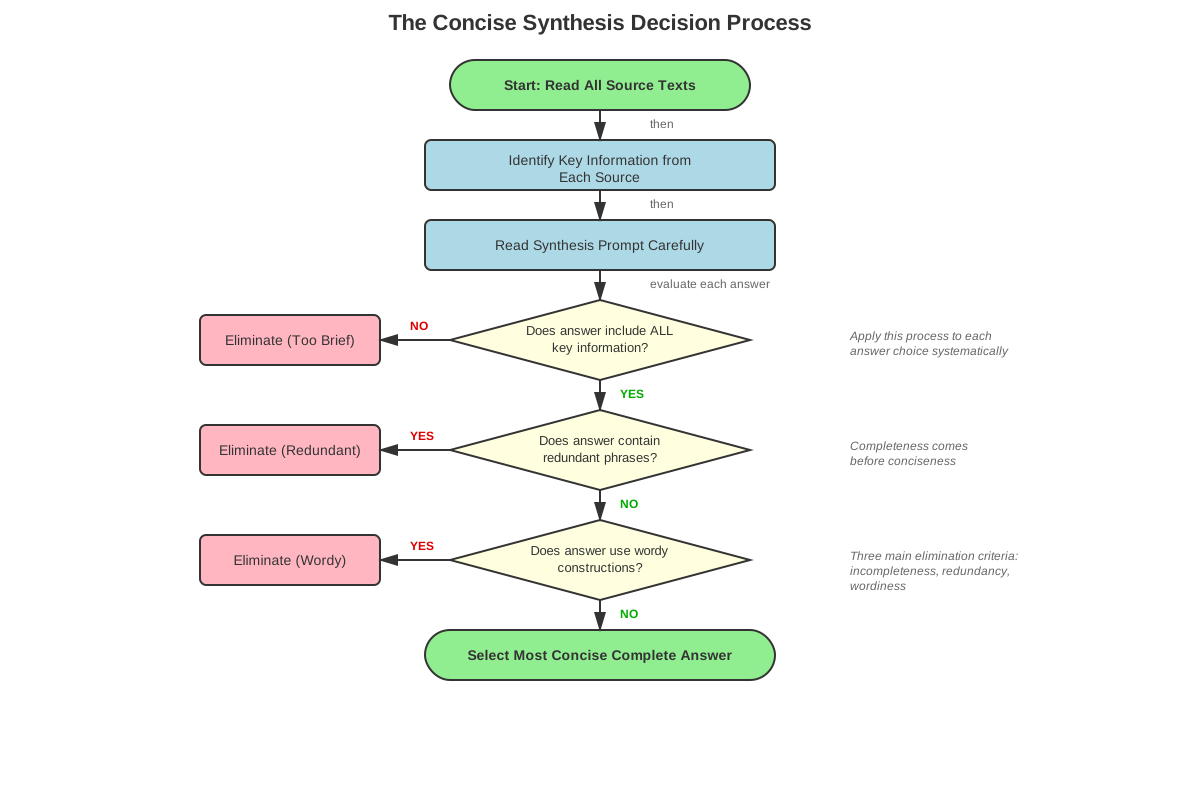
When approaching concise synthesis questions on the SAT, follow this systematic process:
Step 1: Read the question stem carefully to identify exactly what the synthesis should accomplish. Note any specific requirements like "emphasize," "present the relationship," or "highlight the contrast." The phrase "while being as concise as possible" signals that conciseness is a key evaluation criterion.
Step 2: Extract key information from the notes or source material. Identify which pieces of information are essential for accomplishing the stated goal and which are supporting details that might be omitted or condensed.
Step 3: Eliminate choices that are incomplete first. Any answer that omits essential information is incorrect regardless of how concise it is. This often eliminates 1-2 choices immediately.
Step 4: Check remaining choices for accuracy. Ensure that each choice faithfully represents the source material without distortion or misrepresentation. This may eliminate another choice.
Step 5: Among complete and accurate choices, select the most concise. Look for redundancy, wordiness, and unnecessary elaboration. The correct answer will typically be the shortest option that meets all criteria.
Exam Tip: Trigger phrases that signal concise synthesis questions include "while being as concise as possible," "most effectively uses relevant information," and "accomplish this goal." When you see these phrases, immediately focus on eliminating redundancy and wordiness.
Time allocation: Spend approximately 60-75 seconds on each synthesis question. These questions require careful reading of the notes (20-30 seconds), understanding the synthesis goal (10-15 seconds), and systematic evaluation of answer choices (30-40 seconds). Don't rush—synthesis questions reward methodical analysis.
Process of elimination tips specific to concise synthesis:
- Immediately eliminate any choice with obvious redundancy like "past history," "final conclusion," or "the reason is because"
- Cross out choices that begin with wordy constructions like "Due to the fact that" or "In spite of the fact that"
- Be suspicious of choices with multiple "and" or "which" clauses—these often signal wordiness
- Watch for choices that repeat information already implied by other words in the sentence
- If two choices seem equally concise, count the words—the SAT rewards the objectively shorter option when all other factors are equal
Memory Techniques
RACE Acronym for Evaluation Process:
- Read the synthesis goal carefully
- Assess completeness of each choice
- Check accuracy of remaining choices
- Eliminate wordiness to find the most concise option
Visualization Strategy: Picture the information from the notes as puzzle pieces that need to fit together. The correct synthesis creates the smallest possible picture that still shows all the essential pieces. Redundant or wordy choices are like using pieces that overlap or adding unnecessary border pieces.
The "Shrink Ray" Technique: Imagine applying a "shrink ray" to each answer choice. The correct answer is the one that shrinks the most while still containing all the essential information. This mental image helps students focus on eliminating unnecessary words.
RED FLAG Mnemonic for Common Wordiness:
- Repetitive phrases ("past history," "final conclusion")
- Extra prepositions ("in order to" → "to")
- Due to the fact that (replace with "because")
- Fact that (usually unnecessary)
- Long verb phrases ("made the decision" → "decided")
- At this point in time (replace with "now")
- Gerund phrases when simpler options exist
The Three C's: Remember that synthesis answers must be Complete, Correct (accurate), and Concise—in that order of priority. This hierarchy helps students evaluate systematically rather than jumping straight to length.
Summary
Concise synthesis is a high-yield SAT skill that requires combining information from multiple sources into a single, economical statement that maintains complete accuracy. The key to success lies in understanding the three essential components—completeness, accuracy, and conciseness—and applying them in that order. Students must first ensure that all essential information is included, then verify that the synthesis accurately represents the source material, and finally select the most concise option among those that meet the first two criteria. Recognizing redundancy (unnecessary repetition) and wordiness (using more words than necessary) enables students to eliminate incorrect choices efficiently. Effective synthesis strategies include subordination and embedding, precise word choice, elimination of implied information, and parallel structure. SAT synthesis questions explicitly state their evaluation criteria, making them objective rather than subjective, and they appear consistently throughout the Reading and Writing section. Mastering this skill requires systematic evaluation of answer choices using a clear process: read the synthesis goal, assess completeness, check accuracy, and eliminate wordiness.
Key Takeaways
- Concise synthesis questions require combining information while using the fewest words necessary to maintain complete accuracy—completeness and accuracy are never sacrificed for brevity
- Redundancy (repeating information) and wordiness (using more words than necessary) are the primary targets for elimination in synthesis tasks
- The correct answer must include ALL essential information from the source material as determined by the question's stated goal
- When multiple choices are complete and accurate, the shortest option is correct—this is an objective criterion, not a subjective preference
- Systematic evaluation using the RACE process (Read goal, Assess completeness, Check accuracy, Eliminate wordiness) ensures efficient and accurate answering
- Common wordy constructions to eliminate include "the fact that," "due to the fact that," "in order to," and redundant phrases like "past history"
- Synthesis questions explicitly state what the answer should accomplish, making the evaluation criteria transparent and objective
Related Topics
Rhetorical Transitions: After mastering concise synthesis, students should explore how to connect synthesized information using appropriate transitional words and phrases. This builds on synthesis skills by adding the dimension of logical flow between ideas.
Tone and Style Consistency: Understanding how to maintain appropriate tone while synthesizing information extends concise synthesis skills to include rhetorical awareness and audience consideration.
Evidence Integration: Learning to incorporate textual evidence into arguments requires synthesis skills combined with citation and analysis abilities, representing a more advanced application of the same core competencies.
Sentence Structure and Variety: Exploring different sentence structures helps students understand more options for achieving conciseness through subordination, coordination, and embedding.
Precision in Word Choice: Developing a more sophisticated vocabulary enables more concise expression by providing specific words that can replace longer phrases, directly supporting synthesis skills.
Practice CTA
Now that you've mastered the core concepts of concise synthesis, it's time to apply your knowledge! Work through the practice questions to test your ability to identify redundancy, eliminate wordiness, and select the most concise synthesis that maintains complete accuracy. Use the flashcards to reinforce key concepts like the three components of effective synthesis and common redundant phrases. Remember: systematic evaluation using the strategies you've learned will lead to consistent success on these high-yield questions. Each practice question you complete strengthens your ability to synthesize information efficiently—a skill that will serve you not only on the SAT but throughout your academic career. You've got this!
Sign up free to keep reading
Create a free AnvayaPrep account to finish this SAT guide on Concise synthesis — plus flashcards and practice questions.