Overview
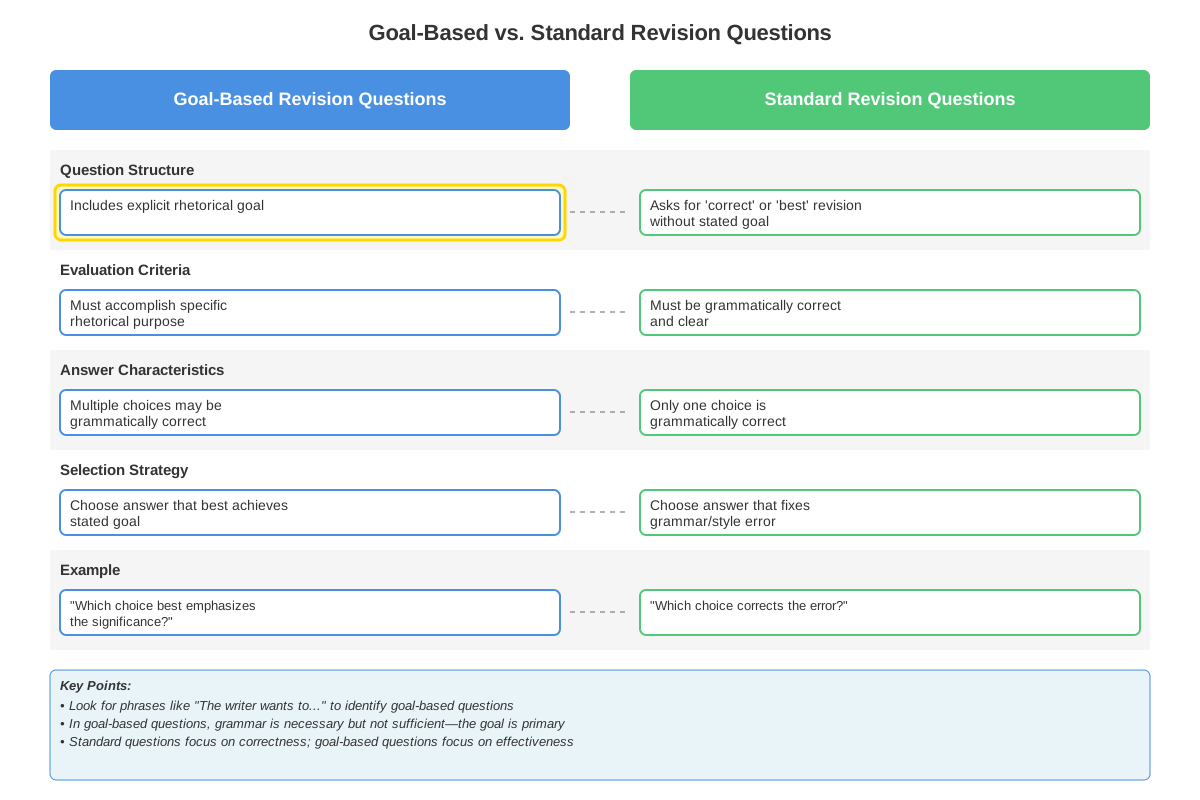
Goal-based revision is a critical skill tested in the SAT Reading and Writing section that requires students to evaluate and select the most appropriate revision to a text based on a specific rhetorical goal. Unlike simple grammar correction or style improvement questions, goal-based revision questions present students with a passage and an explicit objective that the writer wants to achieve. Students must then choose which revision best accomplishes that stated goal while maintaining clarity, coherence, and grammatical correctness.
This topic represents one of the most sophisticated question types in the SAT goal-based revision category because it demands that students think beyond surface-level correctness to consider authorial intent, audience awareness, and rhetorical effectiveness. These questions assess whether students can make purposeful writing decisions that align with specific communicative objectives—a skill essential for college-level writing and critical reading. The SAT frequently uses these questions to test students' understanding of how different sentence structures, word choices, and organizational patterns can achieve distinct rhetorical purposes.
Within the broader RW (Reading and Writing) section, goal-based revision questions bridge multiple competencies: they require grammatical knowledge, rhetorical awareness, reading comprehension, and the ability to evaluate effectiveness. Mastering this topic strengthens overall performance in Rhetorical Synthesis questions and enhances students' ability to analyze how writers craft arguments, convey information, and engage readers purposefully. These questions typically appear 2-4 times per SAT administration and are considered medium-to-high difficulty, making them essential for students targeting scores above 650 in the Reading and Writing section.
Learning Objectives
- [ ] Identify key features of goal-based revision questions on the SAT
- [ ] Explain how goal-based revision appears on the SAT and what makes it distinct from other question types
- [ ] Apply goal-based revision strategies to answer SAT-style questions accurately and efficiently
- [ ] Analyze the relationship between stated rhetorical goals and appropriate revision choices
- [ ] Evaluate multiple revision options by systematically comparing them against explicit criteria
- [ ] Distinguish between revisions that accomplish the stated goal and those that are merely grammatically correct
- [ ] Recognize common rhetorical goals tested on the SAT and the linguistic features that accomplish them
Prerequisites
- Basic sentence structure and grammar: Understanding subjects, predicates, clauses, and phrases is essential for evaluating whether revisions maintain grammatical correctness while achieving rhetorical goals.
- Reading comprehension skills: Students must accurately understand passage content and context to determine which revision best fits the author's purpose.
- Familiarity with rhetorical devices: Knowledge of techniques like emphasis, transition, elaboration, and concision helps students recognize how different revisions create different effects.
- Understanding of paragraph structure: Recognizing topic sentences, supporting details, and concluding statements enables students to evaluate how revisions affect overall coherence.
Why This Topic Matters
Goal-based revision questions assess a fundamental college-readiness skill: the ability to make purposeful writing decisions. In academic and professional contexts, writers constantly revise their work to achieve specific objectives—whether emphasizing a key point, establishing credibility, creating smooth transitions, or engaging particular audiences. The SAT tests this skill because it predicts success in college writing assignments where students must adapt their prose to meet assignment requirements and rhetorical situations.
On the SAT, goal-based revision questions typically appear 2-4 times per test administration, accounting for approximately 5-10% of the Reading and Writing section. These questions are considered high-yield because they test multiple competencies simultaneously and often differentiate between mid-range and high-scoring students. The College Board has increased emphasis on these questions in recent SAT versions, recognizing that they assess sophisticated literacy skills beyond basic grammar knowledge.
These questions commonly appear in passages across all content domains—literature, history/social studies, and science—and typically present scenarios where writers need to: introduce or conclude arguments effectively, provide appropriate transitions between ideas, emphasize specific information, establish tone or credibility, incorporate evidence smoothly, or achieve concision without losing essential meaning. Understanding the patterns in how these goals are tested enables students to approach questions strategically rather than relying solely on intuition.
Core Concepts
Understanding Goal-Based Revision Questions
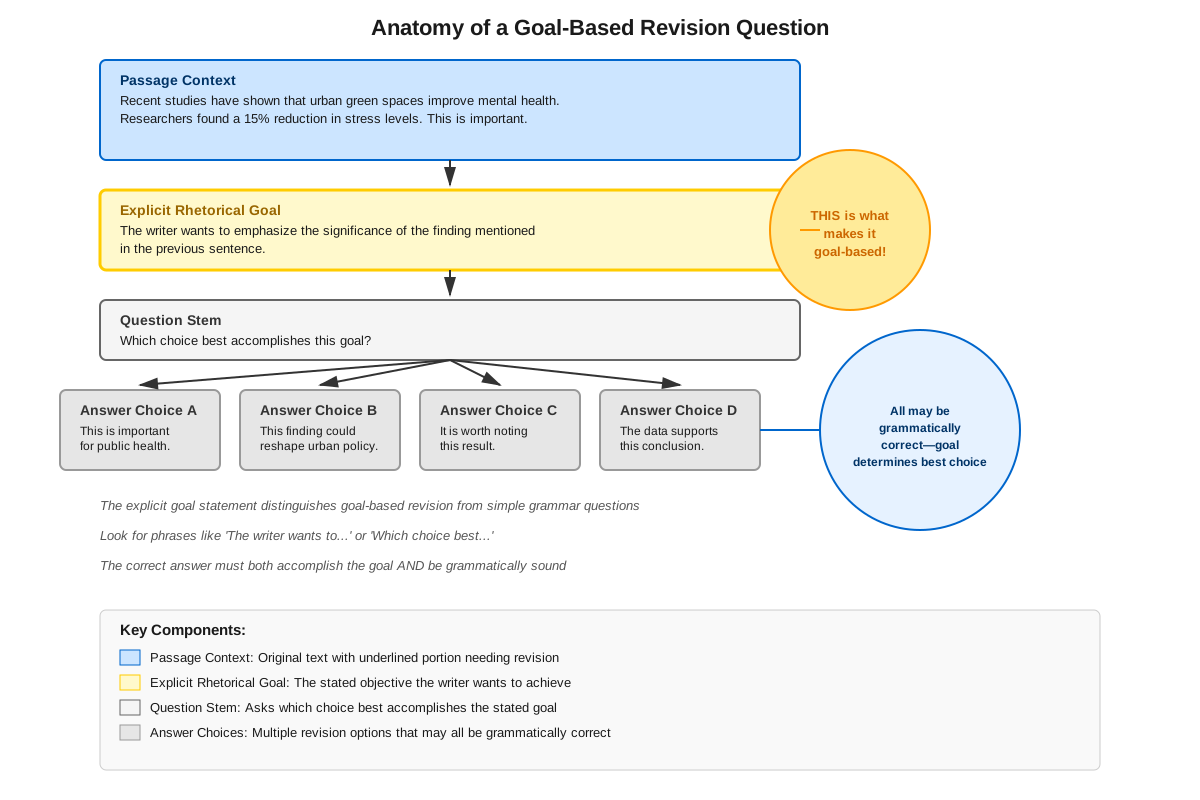
Goal-based revision questions present students with a passage excerpt followed by a specific objective the writer wants to accomplish. The question stem explicitly states what the revision should achieve, using phrases like "Which choice best accomplishes this goal?" or "Which choice most effectively establishes..." This explicit statement of purpose distinguishes these questions from other revision questions where students must infer what improvement is needed.
The structure of these questions typically includes:
- A passage context (usually 2-4 sentences)
- An underlined portion that needs revision
- A clearly stated goal or objective
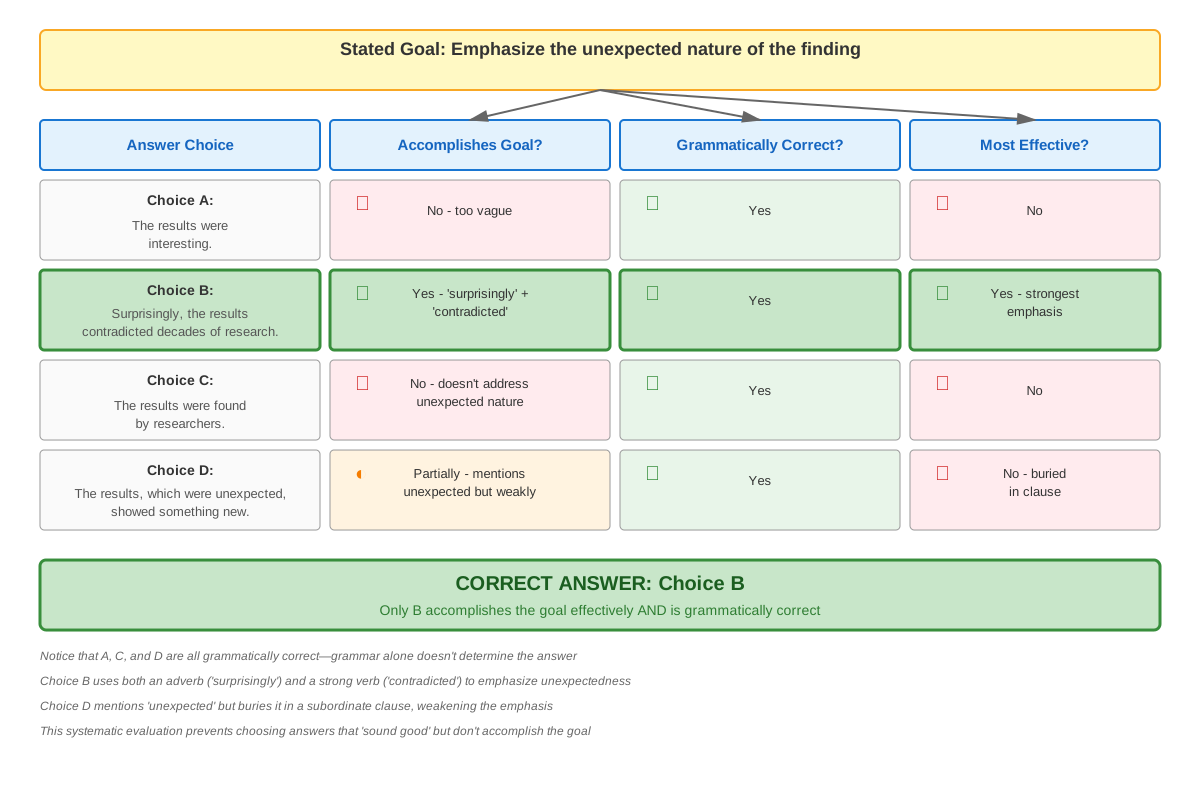
- Four answer choices that are often grammatically correct but vary in rhetorical effectiveness
The key challenge is that multiple answer choices may be grammatically acceptable, but only one optimally achieves the stated goal. This requires students to evaluate effectiveness rather than just correctness—a more sophisticated analytical task.
Common Rhetorical Goals Tested
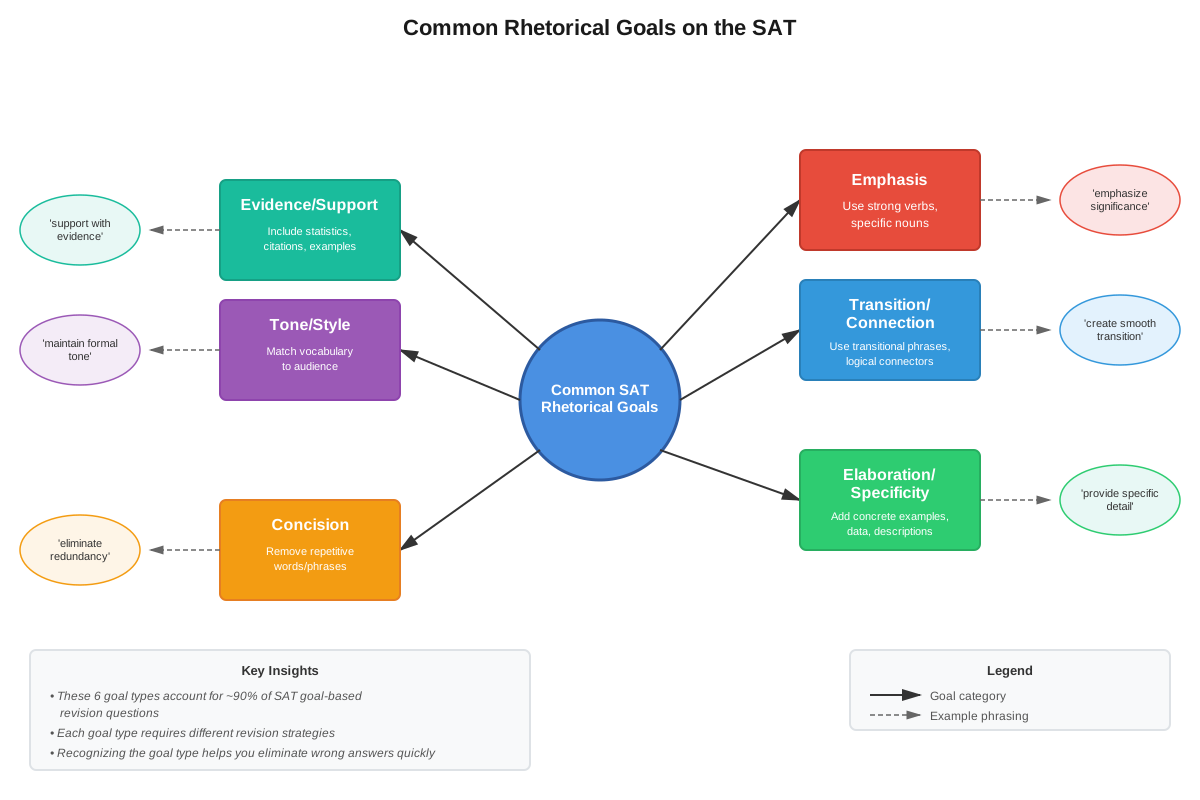
The SAT tests a finite set of rhetorical goals that recur across administrations. Understanding these categories helps students quickly identify what they're evaluating:
| Rhetorical Goal | What It Requires | Key Features to Look For |
|---|---|---|
| Emphasizing information | Making specific content more prominent or memorable | Placement at sentence beginning/end, specific word choice, sentence structure that highlights key ideas |
| Providing transitions | Creating logical connections between ideas | Transitional words/phrases, references to previous content, logical flow indicators |
| Establishing tone | Creating a specific attitude or register | Word choice (formal vs. informal), sentence complexity, emotional connotation |
| Introducing or concluding | Effectively beginning or ending a paragraph/passage | Broad-to-specific or specific-to-broad movement, summary language, forward-looking statements |
| Incorporating evidence | Smoothly integrating supporting details | Attribution phrases, contextual framing, grammatical integration |
| Achieving concision | Eliminating redundancy while preserving meaning | Removal of repetitive information, efficient phrasing, essential content retention |
| Establishing credibility | Building author authority or trustworthiness | Specific qualifications, objective language, evidence citation |
Evaluating Revision Effectiveness
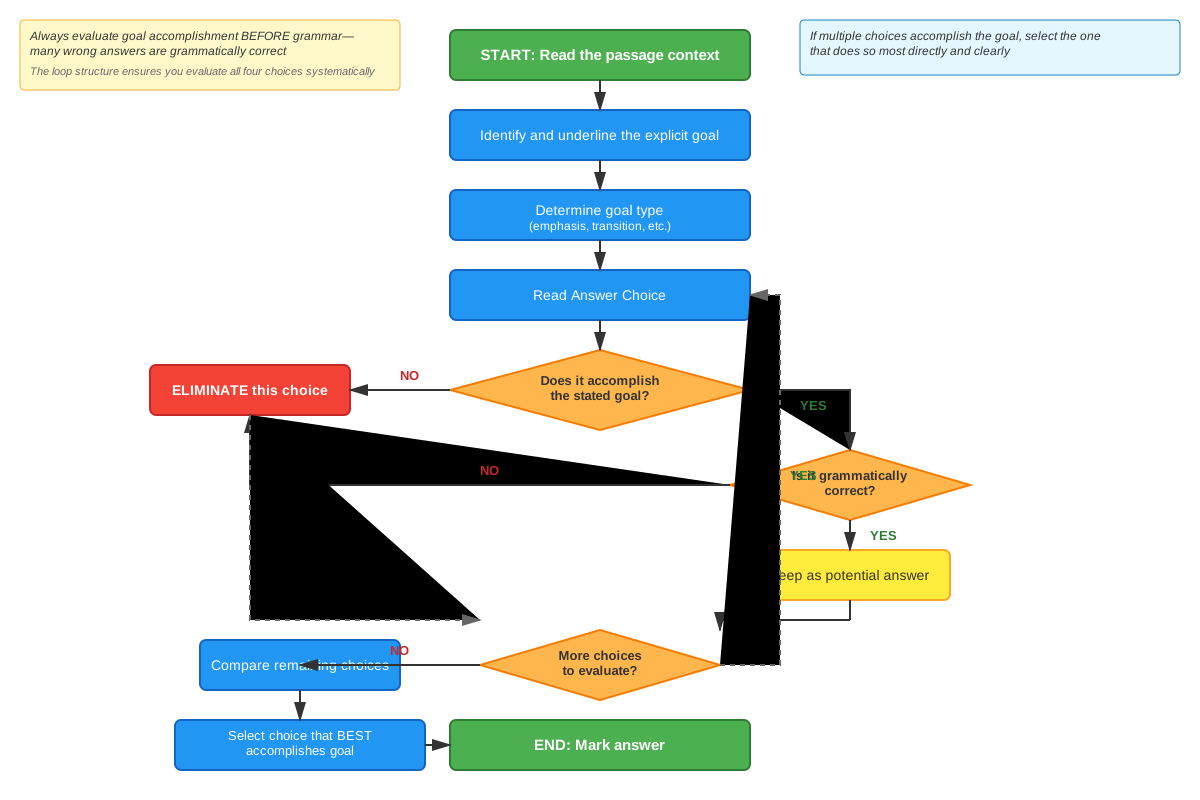
To determine which revision best accomplishes a stated goal, students must employ a systematic evaluation process:
- Identify the explicit goal: Read the question stem carefully to understand exactly what the revision must accomplish. Note specific requirements like "emphasize the significance" or "provide an effective transition."
- Understand the context: Comprehend what comes before and after the revision point. The surrounding sentences often contain crucial information about what the revision needs to connect to or build upon.
- Eliminate non-responsive choices: Remove options that don't address the stated goal at all, even if they're grammatically correct or stylistically appealing.
- Compare remaining options against the goal: Evaluate how directly and effectively each remaining choice accomplishes the specific objective. The best answer will achieve the goal most clearly and completely.
- Verify grammatical correctness and coherence: Ensure the selected revision maintains proper grammar and fits logically within the passage context.
The Role of Specificity and Detail
Many goal-based revision questions test whether students understand when to use specific versus general language. When a goal requires emphasis, introduction of a new concept, or establishment of credibility, specific details typically work better than vague generalizations. Conversely, when concluding or transitioning, broader language may be more appropriate.
For example, if the goal is to "emphasize the unique challenges faced by the research team," a revision mentioning "extreme temperatures reaching -40°F and equipment failures" accomplishes this better than one stating "difficult conditions." The specific details make the challenges concrete and memorable, thereby emphasizing them effectively.
Transition and Connection Strategies
Questions focused on providing effective transitions require students to recognize logical relationships between ideas. The SAT tests various transition types:
- Additive transitions: Furthermore, moreover, additionally (adding similar ideas)
- Contrastive transitions: However, nevertheless, conversely (showing opposition)
- Causal transitions: Therefore, consequently, as a result (showing cause-effect)
- Sequential transitions: First, subsequently, finally (showing order)
- Illustrative transitions: For example, specifically, in particular (providing examples)
The most effective transition choice depends on the logical relationship between the ideas being connected. Students must read carefully to understand whether the following sentence supports, contradicts, exemplifies, or results from the previous content.
Tone and Register Considerations
Some goal-based revision questions ask students to establish or maintain a particular tone—the attitude conveyed through word choice and style. Common tone objectives include:
- Formal/academic tone: Requires sophisticated vocabulary, complex sentence structures, objective language, and avoidance of colloquialisms
- Enthusiastic/positive tone: Uses words with positive connotations, energetic phrasing, and optimistic framing
- Cautious/measured tone: Employs qualifying language, acknowledges limitations, uses hedging phrases
- Objective/neutral tone: Avoids emotional language, presents information factually, maintains distance
Students must recognize that tone is created through cumulative word choices rather than single words, and the revision must match the tone established elsewhere in the passage.
Concept Relationships
Goal-based revision integrates multiple literacy skills into a single assessment task. At its foundation, it requires grammatical knowledge → which enables students to eliminate incorrect options → leading to rhetorical analysis → which allows evaluation of effectiveness → resulting in strategic decision-making about which revision best accomplishes the stated goal.
The relationship between stated goals and linguistic features is central: specific rhetorical objectives require specific linguistic strategies. For instance, the goal of "emphasizing information" connects to concepts of sentence structure (placement of key information), word choice (specific vs. general language), and syntax (using structures that highlight important content). Similarly, "providing transitions" connects to understanding logical relationships, cohesion devices, and paragraph structure.
Goal-based revision also connects to broader Rhetorical Synthesis skills tested elsewhere in the SAT RW section. The analytical process used here—identifying purpose, evaluating options against criteria, selecting the most effective choice—mirrors the thinking required for other synthesis questions involving combining sentences, organizing information, or selecting evidence. Mastering goal-based revision therefore strengthens performance across multiple question types.
Within individual questions, there's a hierarchical relationship: Context comprehension → enables → Goal identification → guides → Option evaluation → produces → Answer selection. Each step depends on the previous one, making systematic approach essential for consistent accuracy.
High-Yield Facts
⭐ Goal-based revision questions always include an explicit statement of what the revision should accomplish—read this carefully before evaluating answer choices.
⭐ Multiple answer choices are typically grammatically correct; the question tests rhetorical effectiveness, not just correctness.
⭐ The surrounding context (sentences before and after) contains essential information for determining which revision best fits.
⭐ Specific details and concrete language typically emphasize information more effectively than vague generalizations.
⭐ The most effective transition depends on the logical relationship between ideas, not just the presence of a transitional word.
- Goal-based revision questions appear 2-4 times per SAT administration, making them high-yield for score improvement.
- When the goal involves establishing tone, the revision must match the tone used elsewhere in the passage.
- Concision goals require eliminating redundancy while preserving all essential meaning—not just choosing the shortest option.
- Introductory revisions often work best when they move from general to specific or provide context for what follows.
⭐ Concluding revisions typically synthesize previous information or gesture toward broader implications rather than introducing new details.
- Questions asking to "emphasize the significance" require revisions that explicitly state importance or use language that highlights impact.
- Credibility-establishing revisions often include specific qualifications, credentials, or objective evidence rather than general claims.
- Effective evidence incorporation requires grammatical integration and contextual framing, not just insertion of facts.
- The word "best" in question stems signals that multiple options may partially work, but one is clearly most effective.
- Reading the entire passage context before evaluating choices prevents selecting revisions that seem good in isolation but don't fit the broader argument.
Quick check — test yourself on Goal-based revision so far.
Try Flashcards →Common Misconceptions
Misconception: The shortest answer choice is always correct when the goal involves concision.
Correction: Concision means eliminating redundancy while preserving essential meaning. The shortest option may omit important information needed to accomplish the stated goal. Always verify that the concise option retains all necessary content.
Misconception: Any grammatically correct option that relates to the topic accomplishes the stated goal.
Correction: Goal-based revision requires precise alignment with the specific objective stated in the question. An option might be correct and relevant but still not accomplish the particular goal (e.g., a goal to "emphasize challenges" isn't met by a revision that merely mentions challenges without highlighting their significance).
Misconception: Transition words alone create effective transitions between ideas.
Correction: Effective transitions require both appropriate transitional language AND logical connection to surrounding content. A transition word like "however" doesn't work if the ideas aren't actually contrasting. The relationship between ideas determines which transition is effective.
Misconception: Formal vocabulary automatically establishes credibility or academic tone.
Correction: Credibility comes from specific evidence, qualifications, and objective presentation—not just sophisticated words. Using complex vocabulary inappropriately can actually undermine credibility. Tone depends on overall register consistency, not individual word choices.
Misconception: The revision that sounds best or most interesting is the correct answer.
Correction: Personal preference is irrelevant in goal-based revision. The correct answer is determined solely by how effectively it accomplishes the explicitly stated goal, regardless of whether it sounds appealing. Students must evaluate objectively against stated criteria.
Misconception: You can answer goal-based revision questions without reading the surrounding context.
Correction: Context is essential for determining which revision fits logically, maintains coherence, and accomplishes the goal within the passage's argument. The same revision might work in one context but fail in another. Always read the full provided passage excerpt.
Misconception: If a revision accomplishes the stated goal, it's automatically correct even if it creates grammatical errors.
Correction: The correct answer must both accomplish the rhetorical goal AND maintain grammatical correctness and logical coherence. These are not mutually exclusive requirements—the SAT expects both.
Worked Examples
Example 1: Emphasizing Information
Passage Context:
"Marine biologists have long studied coral reef ecosystems. Recent research has revealed concerning trends. The team's findings indicate that coral bleaching events have increased in frequency over the past three decades."
Question:
The writer wants to emphasize the significance of the research findings. Which choice most effectively accomplishes this goal?
Answer Choices:
A) The team's findings indicate that coral bleaching events have increased in frequency over the past three decades.
B) The team's findings indicate a dramatic acceleration in coral bleaching events, with occurrences doubling every decade since 1990.
C) The team's findings indicate that coral bleaching has been studied extensively.
D) The team's findings indicate changes in coral reef conditions over time.
Step-by-Step Solution:
- Identify the goal: Emphasize the significance of the findings—make them seem important and impactful.
- Analyze the context: The passage discusses coral reef research and concerning trends, suggesting the findings should highlight something worrisome or notable.
- Evaluate each option:
- Option A: States the finding factually but doesn't emphasize significance. "Increased in frequency" is relatively neutral language.
- Option B: Uses "dramatic acceleration" (emphasizing severity) and provides specific quantification ("doubling every decade since 1990"), making the trend concrete and alarming. This emphasizes significance effectively.
- Option C: Shifts focus to the study itself rather than the findings' significance. Doesn't accomplish the goal.
- Option D: Extremely vague ("changes...over time") and doesn't emphasize anything. Weakens rather than emphasizes significance.
- Select the best answer: Option B most effectively emphasizes significance through both strong descriptive language ("dramatic acceleration") and specific, concrete details that make the trend's severity clear.
Key Takeaway: Emphasizing significance requires both strong language that highlights importance and specific details that make the impact concrete and measurable.
Example 2: Providing an Effective Transition
Passage Context:
"Photosynthesis allows plants to convert sunlight into chemical energy. This process involves complex biochemical reactions within chloroplasts. _______ Scientists have discovered that certain bacteria can perform similar energy conversion without chloroplasts, using different molecular mechanisms entirely."
Question:
Which choice provides the most effective transition to the information that follows?
Answer Choices:
A) In addition,
B) For example,
C) However,
D) Therefore,
Step-by-Step Solution:
- Identify the goal: Provide an effective transition—create a logical connection between the previous information and what follows.
- Analyze the relationship between ideas:
- Previous content: Describes photosynthesis in plants using chloroplasts
- Following content: Introduces bacteria that perform similar processes WITHOUT chloroplasts, using DIFFERENT mechanisms
- Logical relationship: This is a contrast or exception—the following sentence presents organisms that achieve similar results through different means
- Evaluate each option:
- Option A ("In addition"): Suggests adding similar information. Doesn't work because bacteria doing things differently isn't just additional similar information—it's contrasting information.
- Option B ("For example"): Suggests the bacteria are an example of photosynthesis in chloroplasts. This is incorrect—they specifically DON'T use chloroplasts.
- Option C ("However"): Signals contrast or exception, which matches the relationship. The bacteria contrast with plants by using different mechanisms and lacking chloroplasts.
- Option D ("Therefore"): Suggests cause-effect relationship. The bacteria's process isn't a result of plant photosynthesis—it's an alternative process.
- Select the best answer: Option C ("However") correctly signals the contrasting relationship between plant photosynthesis and bacterial energy conversion.
Key Takeaway: Effective transitions depend on accurately identifying the logical relationship between ideas. The same transition word won't work in all contexts—match the transition to the specific relationship between the content before and after.
Exam Strategy
Systematic Approach to Goal-Based Revision Questions
- Read the entire passage context first (10-15 seconds): Don't jump to answer choices. Understanding the full context is essential for evaluating which revision fits best.
- Identify and underline the stated goal (5 seconds): Make the objective explicit in your mind. Ask yourself: "What exactly does this revision need to accomplish?"
- Predict what type of revision might work (5 seconds): Before looking at choices, consider what features would accomplish the goal (e.g., "If I need to emphasize, I should look for specific details and strong language").
- Eliminate clearly non-responsive options (10 seconds): Remove choices that don't address the stated goal at all, even if they're grammatically correct.
- Compare remaining options directly against the goal (15-20 seconds): For each remaining choice, ask: "How well does this accomplish the specific stated objective?" Choose the one that most directly and completely achieves the goal.
- Verify your selection (5 seconds): Quickly confirm that your choice is grammatically correct and maintains logical coherence with surrounding sentences.
Total time allocation: 50-60 seconds per question
Trigger Words and Phrases to Watch For
Goal-based revision questions use specific language to signal what they're testing:
- "Emphasize" → Look for specific details, strong language, concrete examples
- "Provide an effective transition" → Identify the logical relationship between ideas
- "Establish [tone]" → Match word choice and register to the specified tone
- "Introduce" → Look for general-to-specific movement or contextual framing
- "Conclude" → Look for synthesis, broader implications, or summary language
- "Most effectively accomplishes" → Multiple options may partially work; find the best one
- "Incorporate evidence" → Ensure grammatical integration and contextual framing
- "Maintain consistency" → Match style, tone, or approach used elsewhere in passage
Process-of-Elimination Strategy
When stuck between two options:
- Reread the stated goal: Often one option accomplishes part of the goal while the other accomplishes it completely.
- Check specificity: For emphasis goals, the more specific option usually wins. For transition goals, the option that most precisely matches the logical relationship wins.
- Verify context fit: Read each option in the full passage context. The correct answer will flow naturally and maintain coherence.
- Avoid personal preference: Choose based on objective alignment with the stated goal, not which sounds better to you.
Common Traps to Avoid
- The "sounds good" trap: An option may be well-written but not accomplish the specific goal
- The "grammatically correct" trap: Correctness is necessary but not sufficient—effectiveness matters
- The "partially responsive" trap: An option may relate to the goal without fully accomplishing it
- The "extreme brevity" trap: For concision goals, the shortest option may omit essential information
- The "fancy vocabulary" trap: Complex words don't automatically create formal tone or credibility
Memory Techniques
The GREAT Acronym for Evaluation Process
Goal - Read and understand the stated goal first
Read - Read the full passage context carefully
Eliminate - Remove non-responsive options immediately
Analyze - Analyze remaining options against the specific goal
Test - Test your selection by reading it in context
Visualization Strategy: The Target Approach
Visualize the stated goal as a bullseye target. Each answer choice is an arrow:
- Bullseye: Directly and completely accomplishes the goal
- Inner ring: Partially accomplishes the goal or accomplishes it indirectly
- Outer ring: Relates to the topic but doesn't accomplish the goal
- Off target: Doesn't address the goal at all
Eliminate "off target" and "outer ring" options first, then choose the "bullseye" over "inner ring" options.
The SPECIFIC Mnemonic for Emphasis Goals
When the goal involves emphasizing information, remember SPECIFIC:
- Strong language (words that convey importance)
- Placement (key information at beginning or end)
- Examples (concrete instances)
- Concrete details (specific facts, numbers, names)
- Impact words (dramatic, significant, crucial)
- Focus (highlighting the most important element)
- Intensity (language that conveys magnitude)
- Clarity (making the important point unmistakable)
Transition Relationship Rhyme
"Add with 'furthermore,' contrast with 'however,'
Cause with 'therefore,' examples with 'for instance'—remember forever!"
This simple rhyme helps recall the four most common transition relationships tested on the SAT.
Summary
Goal-based revision questions assess students' ability to make purposeful writing decisions that accomplish specific rhetorical objectives. These questions present a passage excerpt with an underlined portion requiring revision and explicitly state what the revision should achieve. Success requires understanding that multiple options may be grammatically correct, but only one optimally accomplishes the stated goal. Students must systematically identify the goal, comprehend the surrounding context, eliminate non-responsive options, and select the revision that most effectively achieves the objective while maintaining grammatical correctness and logical coherence. Common goals include emphasizing information, providing transitions, establishing tone, introducing or concluding effectively, incorporating evidence, and achieving concision. The key to mastery is evaluating revisions objectively against stated criteria rather than relying on personal preference or intuition, and recognizing that effectiveness depends on precise alignment between linguistic features and rhetorical purposes.
Key Takeaways
- Goal-based revision questions explicitly state what the revision must accomplish—always read this goal carefully before evaluating options
- Multiple answer choices are typically grammatically correct; the question tests rhetorical effectiveness, not just correctness
- Context is essential—the sentences surrounding the revision point contain crucial information for determining which option fits best
- Specific details and concrete language typically emphasize information more effectively than vague generalizations
- Effective transitions depend on accurately identifying the logical relationship between ideas (addition, contrast, cause-effect, example)
- Systematic evaluation (identify goal → understand context → eliminate non-responsive options → compare remaining choices) produces consistent accuracy
- The correct answer must both accomplish the stated rhetorical goal AND maintain grammatical correctness and logical coherence
Related Topics
Sentence Combining and Synthesis: Goal-based revision builds on skills used in combining sentences effectively, as both require evaluating how different structures achieve different rhetorical purposes. Mastering goal-based revision enhances ability to combine sentences purposefully.
Transitions and Cohesion: Understanding how to provide effective transitions in goal-based revision questions directly connects to broader skills in creating coherent, well-organized writing where ideas flow logically.
Rhetorical Analysis: The analytical skills developed through goal-based revision—identifying purpose, evaluating effectiveness, recognizing how language creates effects—transfer directly to analyzing rhetorical strategies in reading passages.
Evidence Integration: Many goal-based revision questions focus on incorporating evidence effectively, connecting to broader skills in using textual support and integrating sources in academic writing.
Style and Tone: Goal-based revision questions that ask students to establish or maintain tone develop sensitivity to register, word choice, and stylistic consistency essential for sophisticated writing.
Practice CTA
Now that you've mastered the concepts and strategies for goal-based revision, it's time to apply your knowledge! Work through the practice questions to reinforce your systematic approach and build confidence with different types of rhetorical goals. Use the flashcards to memorize key trigger words and common goal types. Remember: goal-based revision questions reward careful, strategic thinking—read the stated goal first, understand the context fully, and evaluate each option objectively against the specific criteria. With practice, you'll develop the analytical skills to consistently identify the most effective revision. You've got this!
Sign up free to keep reading
Create a free AnvayaPrep account to finish this SAT guide on Goal-based revision — plus flashcards and practice questions.