Overview
The purpose of introduction is a critical concept in SAT Reading and Writing (RW) that tests a student's ability to understand how authors structure their texts and use opening paragraphs or sentences to achieve specific rhetorical goals. On the SAT, questions about introductions assess whether students can identify what function an opening serves—whether it establishes context, presents a problem, introduces a thesis, engages reader interest, or sets up the structure for what follows. This skill goes beyond simple comprehension; it requires analytical thinking about authorial intent and textual architecture.
Understanding the sat purpose of introduction is essential because these questions appear regularly in the Reading and Writing section, particularly within questions that ask about text structure and rhetorical choices. The College Board designs these questions to evaluate whether students can recognize how skilled writers craft openings that serve multiple strategic purposes simultaneously. An effective introduction might provide background information while also establishing the author's credibility, or it might present a surprising fact while foreshadowing the argument to come. Students who master this concept gain a significant advantage because they learn to read strategically, anticipating how texts will develop based on their opening moves.
This topic connects directly to broader concepts in rw such as main idea identification, argument structure, and rhetorical analysis. When students understand why authors make specific choices in their introductions, they develop stronger skills in predicting text development, identifying thesis statements, and recognizing organizational patterns. These interconnected skills form the foundation of advanced reading comprehension and are tested repeatedly throughout the SAT Reading and Writing section.
Learning Objectives
- [ ] Identify key features of Purpose of introduction
- [ ] Explain how Purpose of introduction appears on the SAT
- [ ] Apply Purpose of introduction to answer SAT-style questions
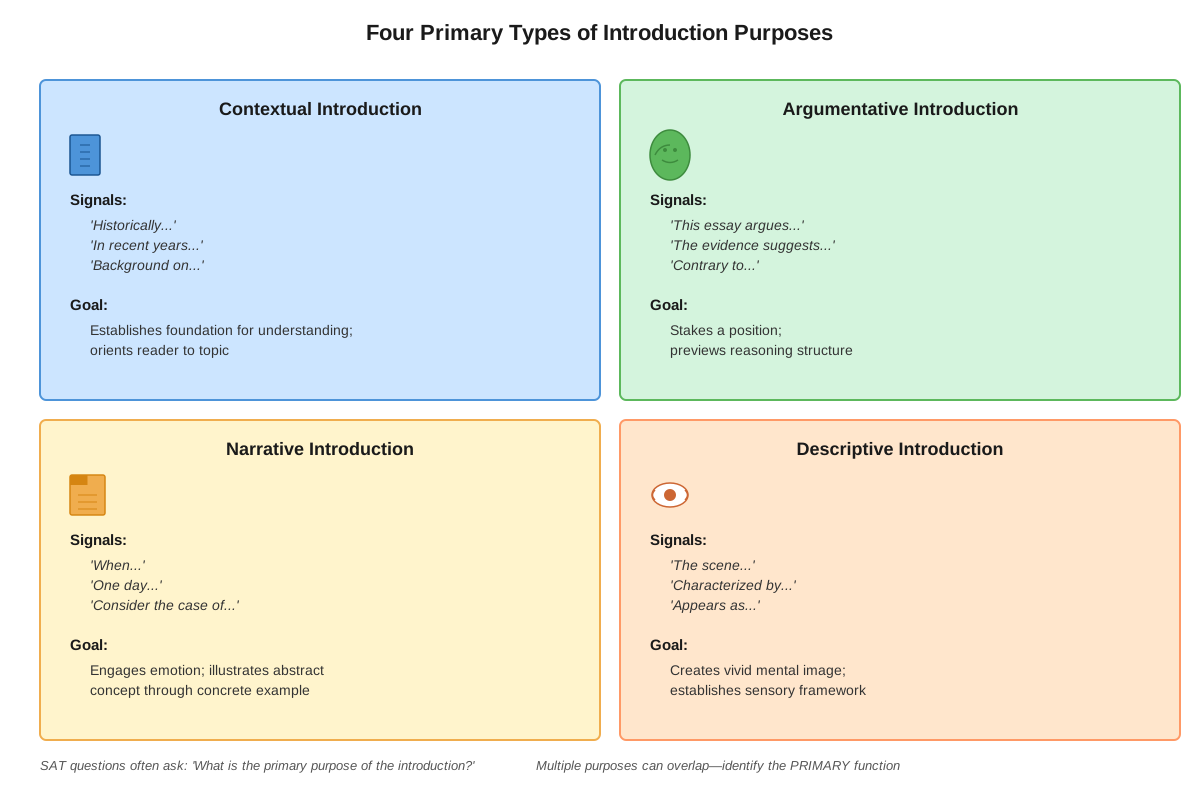
- [ ] Distinguish between different types of introductory purposes (contextual, argumentative, narrative, descriptive)
- [ ] Analyze how introductions establish tone, scope, and direction for entire passages
- [ ] Evaluate the effectiveness of different introductory strategies in various rhetorical contexts
- [ ] Recognize transition signals that connect introductions to body paragraphs
Prerequisites
- Basic paragraph structure: Understanding topic sentences, supporting details, and concluding sentences is essential because introductions follow similar organizational principles but serve broader purposes for entire texts.
- Main idea identification: Students must be able to distinguish between main ideas and supporting details to recognize how introductions preview or establish central claims.
- Rhetorical awareness: Familiarity with concepts like audience, purpose, and tone helps students understand why authors make specific choices in their opening paragraphs.
- Text structure vocabulary: Knowledge of terms like thesis, context, background information, and hook enables precise analysis of introductory elements.
Why This Topic Matters
In real-world reading and writing, introductions serve as critical gateways that determine whether readers continue engaging with a text. Professional writers, journalists, academics, and business communicators all invest significant effort in crafting effective openings because they understand that introductions shape reader expectations and establish the framework for everything that follows. Students who master the analysis of introductory purposes develop transferable skills applicable to college-level reading, professional communication, and their own writing.
On the SAT, questions about the purpose of introduction appear with high frequency, typically 2-4 times per test administration. These questions most commonly appear in two formats: direct questions asking "What is the main purpose of the introduction?" and comparative questions asking students to identify which choice best describes what the opening accomplishes. The College Board particularly favors passages from scientific articles, historical analyses, and argumentative essays where introductions serve clear structural functions. According to test analysis, approximately 15-20% of text structure questions specifically target introductory purposes, making this a high-yield topic for score improvement.
Common manifestations in exam passages include scientific articles that begin with background on a research problem, historical texts that establish temporal or cultural context, argumentative pieces that present a controversy or common misconception, and narrative-style passages that use anecdotes to introduce broader themes. The SAT consistently tests whether students can distinguish between what an introduction explicitly states and what function it serves in the larger text architecture.
Core Concepts
Defining Introduction Purpose
The purpose of introduction refers to the specific rhetorical function that an opening paragraph or section serves within a complete text. Unlike simply summarizing what an introduction says, identifying its purpose requires analyzing what the introduction does—how it prepares readers, what expectations it creates, and how it establishes the foundation for subsequent content. Introductions are strategic textual elements where authors make deliberate choices to achieve specific goals, and the SAT tests whether students can recognize these strategic choices.
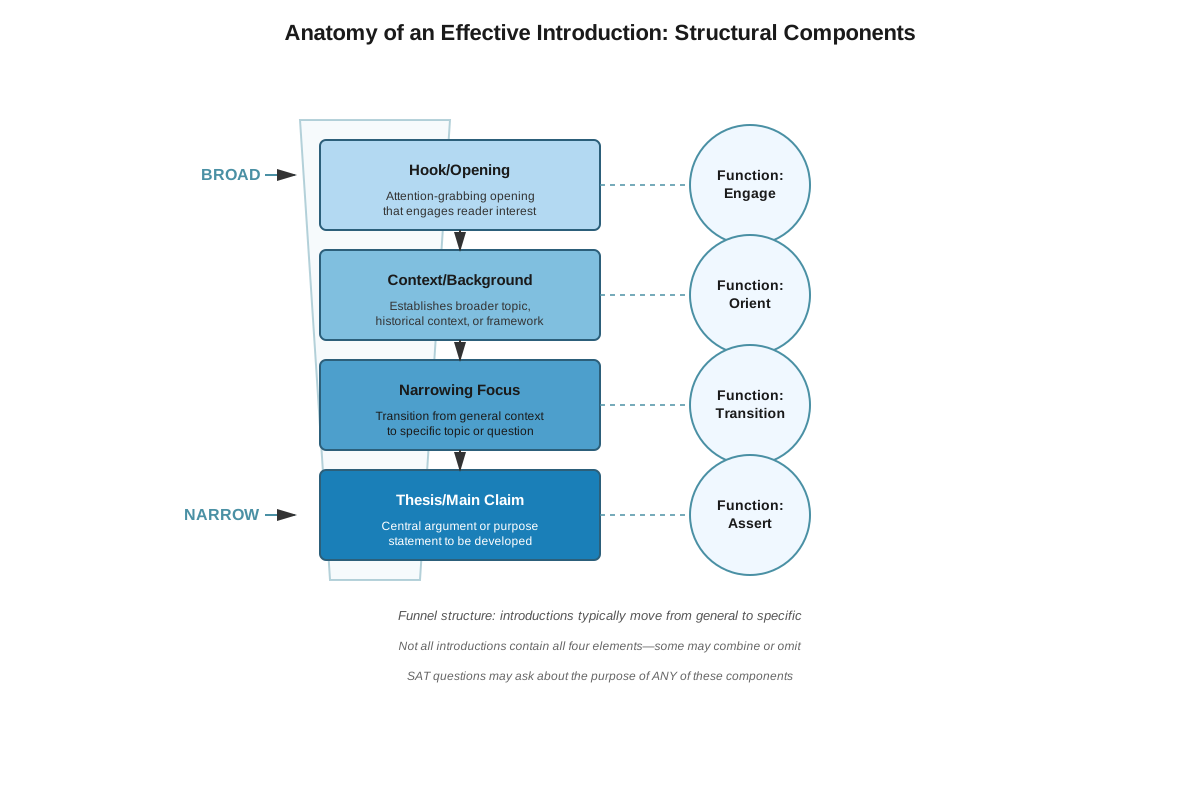
An introduction's purpose operates on multiple levels simultaneously. At the content level, it may provide necessary background information or define key terms. At the structural level, it establishes the organizational pattern the text will follow. At the rhetorical level, it positions the author's credibility, engages reader interest, and establishes tone. Skilled readers recognize that effective introductions accomplish several of these functions at once, and SAT questions often require distinguishing between primary and secondary purposes.
Types of Introductory Purposes
Different genres and rhetorical situations call for different introductory strategies. Understanding these common types helps students quickly categorize what they're reading and predict how the text will develop.
| Purpose Type | Primary Function | Common Features | Typical Genres |
|---|---|---|---|
| Contextual | Establish background information | Historical details, definitions, setting | Academic articles, historical analyses |
| Problem-Posing | Present a question or issue to be addressed | Research gaps, controversies, challenges | Scientific papers, argumentative essays |
| Thesis-Driven | State the main argument immediately | Clear claim, position statement | Opinion pieces, persuasive writing |
| Narrative | Use a story or anecdote to introduce themes | Specific examples, descriptive details | Feature articles, personal essays |
| Surprising/Provocative | Challenge assumptions or present unexpected information | Counterintuitive facts, bold claims | Popular science, journalism |
| Definitional | Clarify key concepts or terms | Explanations, distinctions, scope-setting | Technical writing, academic discourse |
Contextual Introductions
Contextual introductions prioritize establishing the necessary background information readers need to understand the discussion that follows. These openings typically provide historical context, explain the current state of knowledge in a field, or describe the circumstances surrounding an event or phenomenon. In scientific writing, contextual introductions often review previous research before identifying a gap that the current study addresses. In historical writing, they establish the time period, key figures, and relevant social or political conditions.
The SAT frequently uses passages with contextual introductions because they test whether students can distinguish between background information and the author's original contribution. A common question pattern presents a passage where the introduction describes existing theories or historical events, then asks students to identify that the purpose is "to provide context for the author's subsequent analysis" rather than "to argue for a particular interpretation."
Problem-Posing Introductions
Problem-posing introductions establish a question, challenge, controversy, or gap in knowledge that the rest of the text will address. This strategy is particularly common in academic and scientific writing, where authors follow the "problem-solution" structure. The introduction might present conflicting research findings, describe a phenomenon that current theories cannot explain, or highlight a practical challenge that needs addressing.
These introductions create forward momentum by establishing intellectual tension—readers want to know how the problem will be resolved. On the SAT, recognizing problem-posing introductions helps students anticipate that the body paragraphs will present the author's proposed solution, new evidence, or alternative framework. Questions might ask students to identify that the introduction's purpose is "to establish the research question the study investigates" or "to present a controversy that the author will attempt to resolve."
Thesis-Driven Introductions
Thesis-driven introductions state the author's main argument or position early and explicitly. This direct approach is common in persuasive writing, opinion pieces, and some academic essays. Rather than building gradually toward a claim, these introductions announce the central argument upfront, then use the body paragraphs to provide supporting evidence and reasoning.
The advantage of thesis-driven introductions is clarity—readers immediately understand the author's position and can evaluate the subsequent evidence with that framework in mind. On the SAT, these introductions test whether students can distinguish between the thesis statement itself and the purpose of presenting it early. A question might ask whether the introduction's purpose is "to state the author's position on a debated issue" rather than simply "to describe a debate."
Narrative and Anecdotal Introductions
Narrative introductions use specific stories, examples, or anecdotes to introduce broader themes or arguments. This strategy engages readers emotionally and makes abstract concepts concrete through particular instances. A passage about climate change might begin with a description of a specific coastal community facing flooding, or an article about educational policy might open with a student's experience.
The SAT tests whether students recognize that these specific examples serve an introductory function rather than being the passage's main focus. A common wrong answer choice might state that the passage's purpose is "to describe the experience of [specific example]," when the correct answer recognizes that the introduction "uses a specific case to illustrate a broader phenomenon that the passage will analyze."
Signals and Transitions from Introduction to Body
Effective introductions contain linguistic signals that indicate their purpose and connect to what follows. Recognizing these signals helps students quickly identify introductory purposes:
- Contextual signals: "Historically," "Until recently," "For decades," "Traditionally"
- Problem-posing signals: "However," "Yet," "Despite," "The question remains," "Researchers have struggled to explain"
- Thesis signals: "This paper argues," "I contend that," "The evidence suggests," "In fact"
- Transition signals: "To understand this phenomenon," "This raises the question," "The following analysis"
Concept Relationships
The purpose of introduction connects intimately with several other reading comprehension concepts. Understanding these relationships strengthens overall analytical skills:
Introduction Purpose → Main Idea: The introduction's purpose often directly relates to how the main idea is presented. A problem-posing introduction typically leads to a main idea that offers a solution or new perspective, while a thesis-driven introduction makes the main idea explicit from the start.
Introduction Purpose → Text Structure: The type of introduction predicts the organizational pattern that follows. Contextual introductions often precede chronological or descriptive structures, while problem-posing introductions typically lead to cause-effect or problem-solution structures.
Introduction Purpose → Author's Purpose: The broader author's purpose (to inform, persuade, entertain, or explain) manifests first in the introduction's purpose. A persuasive author's purpose typically employs thesis-driven or problem-posing introductions, while an informative purpose often uses contextual or definitional openings.
Introduction Purpose → Tone and Style: The introduction establishes the tone that continues throughout the passage. Academic introductions signal formal, objective tone, while narrative introductions may establish more personal or emotional tones.
Background Information → Thesis Statement → Supporting Evidence: This progression represents the internal structure of many introductions themselves, where contextual information leads to the author's claim, which the body paragraphs then support.
High-Yield Facts
⭐ The purpose of introduction questions appear 2-4 times per SAT test, making them high-frequency question types.
⭐ The most common introductory purposes on the SAT are contextual (providing background) and problem-posing (establishing a question or gap).
⭐ Wrong answer choices often confuse what the introduction says with what it does—focus on function, not content.
⭐ Transition words like "however," "yet," and "despite" often signal the shift from background context to the author's original contribution.
⭐ Scientific passages typically use problem-posing introductions that establish research questions or gaps in current knowledge.
- Narrative introductions using specific examples are designed to illustrate broader themes, not to focus on the specific case itself.
- Thesis-driven introductions are more common in argumentative passages than in informative or explanatory texts.
- The introduction's purpose should align with the passage's overall structure—misalignment suggests a wrong answer choice.
- Multiple purposes can coexist in a single introduction, but SAT questions ask for the primary or main purpose.
- Effective introductions create expectations that the body paragraphs fulfill—recognizing these expectations helps predict text development.
- The length of an introduction doesn't determine its purpose; even brief openings can serve complex rhetorical functions.
- Historical and cultural context provided in introductions typically serves to frame the author's analysis rather than being the focus itself.
- Introductions that present common beliefs or misconceptions usually do so to challenge or complicate them in the body paragraphs.
- The introduction's scope (broad to narrow or narrow to broad) indicates the organizational strategy of the entire passage.
- Questions about introduction purpose often include answer choices that describe purposes of body paragraphs instead—read carefully to distinguish.
Quick check — test yourself on Purpose of introduction so far.
Try Flashcards →Common Misconceptions
Misconception: The purpose of an introduction is always to state the thesis or main idea explicitly.
Correction: While some introductions do state the thesis directly (thesis-driven introductions), many serve other purposes such as providing context, posing a problem, or using narrative examples to introduce themes. The thesis may appear later in the passage, with the introduction serving to prepare readers for it.
Misconception: If an introduction describes a specific example or anecdote, the passage's main purpose must be to discuss that example.
Correction: Narrative introductions use specific examples as illustrative tools to introduce broader themes or arguments. The specific example is a rhetorical strategy, not the passage's focus. The body paragraphs typically move to general analysis or broader applications.
Misconception: Background information in an introduction is just "filler" before the important content begins.
Correction: Contextual information serves the essential purpose of establishing the framework readers need to understand the author's contribution. On the SAT, recognizing that an introduction "provides necessary context" is often the correct answer, as this context-setting is itself a deliberate rhetorical purpose.
Misconception: The purpose of an introduction can be determined by reading only the first sentence.
Correction: While the opening sentence is important, the introduction's full purpose often emerges across the entire opening paragraph or section. The first sentence might hook readers with a surprising fact, while subsequent sentences provide context and establish the research question.
Misconception: All introductions in scientific passages have the same purpose.
Correction: Scientific passages use varied introductory strategies depending on their specific rhetorical situation. Some establish research context, others present conflicting findings, some describe phenomena requiring explanation, and others challenge existing theories. Each serves a distinct purpose that shapes how the passage develops.
Misconception: If an introduction mentions multiple topics or ideas, it lacks a clear purpose.
Correction: Effective introductions often touch on multiple related ideas while serving a unified purpose. For example, an introduction might mention several historical events (multiple topics) while serving the single purpose of establishing the political context for the author's analysis.
Misconception: The purpose of an introduction is separate from the purpose of the overall passage.
Correction: The introduction's purpose directly supports and enables the passage's overall purpose. They work together as part of a unified rhetorical strategy. Understanding the introduction's purpose helps predict and understand the passage's development and main argument.
Worked Examples
Example 1: Scientific Passage with Problem-Posing Introduction
Passage Introduction:
"For decades, marine biologists have observed that certain species of deep-sea fish produce their own light through bioluminescence, using this ability to attract prey, communicate with potential mates, and evade predators. However, the evolutionary origins of bioluminescence have remained unclear. While some researchers have proposed that this trait evolved independently in multiple lineages, recent genetic evidence suggests a more complex picture. A new study by Chen et al. examines the genetic mechanisms underlying bioluminescence across 12 different fish families, revealing unexpected similarities that challenge previous assumptions about how this remarkable adaptation arose."
Question: What is the main purpose of the introduction?
Answer Choices:
A) To describe the various functions that bioluminescence serves for deep-sea fish
B) To present competing theories about bioluminescence and introduce new research that addresses this debate
C) To argue that bioluminescence evolved independently in multiple fish lineages
D) To explain the genetic mechanisms that enable deep-sea fish to produce light
Analysis:
First, identify what the introduction explicitly states versus what function it serves. The introduction does mention functions of bioluminescence (attracting prey, communication, evasion), but this is background information, not the primary purpose.
Next, look for transition signals that indicate the introduction's rhetorical move. The word "However" in the second sentence signals a shift from established knowledge to an unresolved question. The phrase "have remained unclear" explicitly identifies a gap in understanding.
The introduction then presents "competing theories" (independent evolution vs. "a more complex picture") and introduces "new research" (the Chen et al. study) that will address this uncertainty. This is the classic structure of a problem-posing introduction: establish what's known → identify what's unknown or debated → introduce new evidence or analysis that addresses the gap.
Correct Answer: B
Why the other choices are wrong:
- Choice A describes content mentioned in the introduction but not its purpose
- Choice C states one of the theories mentioned, not the introduction's function of presenting competing theories
- Choice D describes what the body paragraphs likely explain, not what the introduction accomplishes
Connection to Learning Objectives: This example demonstrates how to identify key features of introductory purpose (the problem-posing structure), recognize how this appears on the SAT (through questions about "main purpose"), and apply analytical skills to eliminate wrong answers that confuse content with function.
Example 2: Historical Passage with Contextual Introduction
Passage Introduction:
"In the early 20th century, American cities faced unprecedented challenges as rapid industrialization drew millions of rural residents and immigrants to urban centers. Housing shortages, inadequate sanitation systems, and dangerous working conditions created public health crises that municipal governments struggled to address. Progressive Era reformers responded to these conditions with ambitious campaigns for urban improvement, advocating for building codes, workplace safety regulations, and public health initiatives. Among these reformers, Jane Addams stands out for her innovative approach to social change through the settlement house movement, which sought to bridge class divides by bringing middle-class reformers into direct contact with immigrant communities."
Question: The introduction primarily serves to:
Answer Choices:
A) Argue that Progressive Era reforms successfully solved urban problems
B) Establish the historical context for discussing Jane Addams's contributions
C) Compare different approaches to urban reform in the early 20th century
D) Describe the living conditions of immigrants in American cities
Analysis:
This introduction follows a classic contextual pattern: broad historical situation → general response to that situation → specific focus that will be the passage's subject. The structure moves from general (urban challenges) to more specific (Progressive reformers) to most specific (Jane Addams).
The phrase "Among these reformers, Jane Addams stands out" signals that the previous information serves as context for the specific focus on Addams. The introduction doesn't present Addams's actual contributions or innovations—it sets up the framework for discussing them in the body paragraphs.
Notice that the introduction mentions several topics: industrialization, urban problems, Progressive reforms, and Jane Addams. However, the purpose isn't to discuss all these topics equally; rather, the earlier topics provide necessary context for understanding the significance of the specific focus (Addams).
Correct Answer: B
Why the other choices are wrong:
- Choice A makes a claim about reform success that the introduction doesn't argue for
- Choice C suggests comparison is the primary purpose, but the introduction establishes context rather than comparing approaches
- Choice D focuses on one detail mentioned in the context rather than the introduction's overall function
Key Strategy Demonstrated: When an introduction moves from broad to narrow focus, its purpose is typically contextual—establishing the framework for understanding the specific subject. The final sentence often signals what the passage will actually focus on, while earlier sentences provide necessary background.
Exam Strategy
Approaching Introduction Purpose Questions
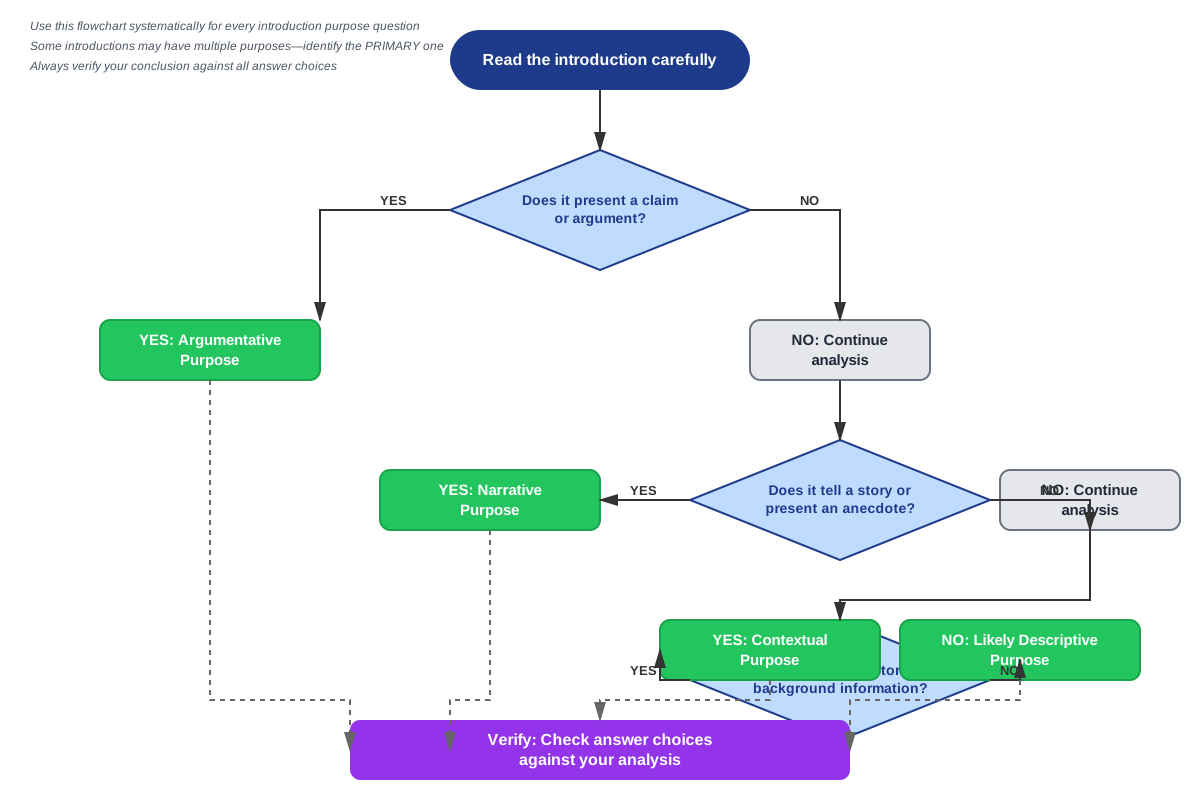
When encountering questions about the purpose of introduction on the SAT, follow this systematic approach:
- Read the entire introduction carefully before looking at answer choices. Don't try to predict the answer based on the first sentence alone.
- Identify structural signals such as "however," "yet," "despite," "among these," or "this raises the question." These transitions often mark the shift from background to the author's focus or from established knowledge to gaps/problems.
- Ask "What does this do?" not "What does this say?" Focus on function rather than content. An introduction might describe historical events, but its purpose is to establish context for analysis.
- Look for the "pivot point" where the introduction shifts from general background to the specific focus or from established knowledge to the author's contribution. This pivot often reveals the primary purpose.
- Eliminate answer choices that describe body paragraph purposes rather than introductory purposes. If a choice describes detailed analysis, specific evidence, or conclusions, it likely refers to later sections.
Trigger Words and Phrases
Watch for these high-frequency signals in both passages and answer choices:
In Passages:
- "However," "Yet," "Despite," "Although" → Often signal problem-posing or thesis-driven introductions
- "Historically," "Traditionally," "For years" → Often signal contextual introductions
- "Among these," "One notable example" → Often signal narrowing from general context to specific focus
- "The question remains," "Researchers have struggled" → Signal problem-posing introductions
- "This paper argues," "I contend" → Signal thesis-driven introductions
In Answer Choices:
- "Provide context/background" → Likely correct for contextual introductions
- "Establish/present a question/problem" → Likely correct for problem-posing introductions
- "Introduce research/analysis that addresses" → Often correct when new studies are mentioned
- "Describe" or "Explain" without "context" → Often wrong; too focused on content rather than function
- "Argue" or "Prove" → Usually wrong for introductions unless clearly thesis-driven
Process of Elimination Tips
Eliminate choices that:
- Describe specific details mentioned in the introduction rather than its overall function
- Attribute argumentative purposes to introductions that are clearly contextual
- Claim the introduction does something that actually happens in body paragraphs
- Mischaracterize the tone (e.g., claiming an objective introduction "criticizes" or "celebrates")
- Focus on secondary purposes while ignoring the primary purpose
Keep choices that:
- Use functional language ("establish," "provide," "introduce," "present")
- Accurately capture the introduction's relationship to the rest of the passage
- Align with the structural signals you identified in the passage
- Match the genre expectations (scientific passages often have problem-posing introductions)
Time Allocation
Introduction purpose questions should take approximately 45-60 seconds to answer. Spend:
- 20-25 seconds re-reading the introduction with purpose in mind
- 15-20 seconds evaluating answer choices
- 10-15 seconds confirming your answer by checking it against the passage
If you're spending more than 75 seconds, you may be overthinking. Trust the structural signals and functional language you've identified.
Memory Techniques
The CPTN Framework
Remember the four most common introduction purposes with CPTN (Captain):
- Contextual: Establishes background, historical setting, or current state of knowledge
- Problem-posing: Presents a question, gap, controversy, or challenge to address
- Thesis-driven: States the main argument or position explicitly
- Narrative: Uses specific examples or anecdotes to introduce broader themes
When you read an introduction, ask: "Is this passage's captain being Contextual, Problem-posing, Thesis-driven, or Narrative?"
The Function vs. Content Reminder
Use this simple phrase: "Purpose is about DOING, not DESCRIBING."
When evaluating answer choices, mentally add "The introduction DOES this:" before each choice. If the choice describes what the introduction says rather than what it accomplishes, eliminate it.
The Pivot Point Visualization
Imagine introductions as bridges with a pivot point in the middle:
[General/Background] ← PIVOT → [Specific Focus/Author's Contribution]
The pivot point (often marked by "however," "yet," "among these") reveals the introduction's purpose. Everything before the pivot is setup; everything after indicates what the passage will actually focus on.
The Genre-Purpose Connection
Create mental associations between common SAT passage genres and their typical introductory purposes:
- Scientific articles → Problem-posing (research gaps, unexplained phenomena)
- Historical analyses → Contextual (establishing time period, events, conditions)
- Argumentative essays → Thesis-driven or Problem-posing (stating position or presenting debate)
- Feature articles → Narrative (using specific examples to introduce themes)
These aren't absolute rules, but they provide useful starting expectations that help you read strategically.
Summary
The purpose of introduction is a high-yield SAT Reading and Writing concept that tests students' ability to analyze how authors structure texts and use opening paragraphs to achieve specific rhetorical goals. Rather than simply comprehending what an introduction says, students must identify what function it serves—whether establishing context, posing a problem, stating a thesis, or using narrative examples to introduce broader themes. The most common introductory purposes on the SAT are contextual (providing necessary background) and problem-posing (establishing questions or gaps that the passage addresses). Success on these questions requires distinguishing between content and function, recognizing structural signals like "however" and "yet" that mark rhetorical shifts, and understanding how introductions connect to overall passage structure. Students should focus on what introductions do rather than what they describe, eliminate answer choices that confuse introductory purposes with body paragraph purposes, and use genre expectations to guide their analysis. Mastering this concept strengthens broader reading comprehension skills and provides a significant advantage on the SAT, where introduction purpose questions appear regularly and test fundamental analytical abilities essential for college-level reading.
Key Takeaways
- Purpose of introduction questions test function, not content—focus on what the introduction accomplishes, not what it describes
- The four main introduction types are Contextual, Problem-posing, Thesis-driven, and Narrative, each serving distinct rhetorical functions
- Transition words like "however," "yet," and "despite" signal the pivot point where introductions shift from background to the author's focus or contribution
- Scientific passages typically use problem-posing introductions that establish research questions or gaps in current knowledge
- Wrong answers often describe body paragraph purposes or confuse specific details with overall function—eliminate choices that don't match the introduction's scope
- The introduction's purpose should align with and enable the passage's overall structure and argument—use this relationship to verify your answer
- Contextual introductions move from broad to narrow, establishing the framework for understanding the specific subject the passage will address
Related Topics
Main Idea and Central Claim: Understanding introduction purposes directly supports identifying main ideas, as introductions often preview or explicitly state the central claim. Mastering introduction analysis helps students distinguish between background information and the author's actual argument.
Text Structure and Organization: Introduction purposes connect intimately with overall text structure. Problem-posing introductions typically lead to problem-solution structures, while contextual introductions often precede chronological or descriptive organizations.
Rhetorical Analysis and Author's Purpose: Analyzing why authors choose specific introductory strategies deepens understanding of broader rhetorical purposes (to inform, persuade, explain). This progression from introduction analysis to comprehensive rhetorical analysis represents advanced reading skills.
Transition and Cohesion: The signals that indicate introduction purposes (however, yet, among these) are part of the broader system of transitions that create textual cohesion. Understanding these connections strengthens overall comprehension of how texts hold together.
Argument Structure and Evidence: Problem-posing and thesis-driven introductions establish the framework for understanding how authors build arguments with evidence. Recognizing these introductory strategies helps students anticipate and evaluate the evidence that follows.
Practice CTA
Now that you've mastered the core concepts of introduction purpose, it's time to apply your knowledge! Work through the practice questions to test your ability to identify different types of introductory purposes, distinguish between content and function, and eliminate wrong answer choices strategically. Use the flashcards to reinforce key terminology and the CPTN framework. Remember: every introduction purpose question you practice strengthens not just this specific skill but your overall reading comprehension and analytical abilities. These skills will serve you throughout the SAT and beyond. You've got this—let's put your knowledge into action!
Sign up free to keep reading
Create a free AnvayaPrep account to finish this SAT guide on Purpose of introduction — plus flashcards and practice questions.