Overview
The question and answer structure is a fundamental organizational pattern in nonfiction writing where an author poses a question—either explicitly or implicitly—and then provides a detailed answer or explanation. This rhetorical structure appears frequently on the SAT Reading and Writing (RW) section, making it essential for test-takers to recognize and understand. When authors employ this structure, they typically introduce a problem, puzzle, or inquiry in the opening sentences, then dedicate the remainder of the passage to exploring possible solutions, providing evidence, or explaining the answer comprehensively.
Understanding sat question and answer structure is critical because it directly impacts how students approach reading comprehension questions, particularly those asking about text structure, purpose, and main ideas. The College Board frequently includes passages organized around central questions because this structure mirrors academic and professional writing students will encounter in college. Recognizing this pattern allows test-takers to predict where key information will appear, identify the author's primary purpose, and eliminate incorrect answer choices more efficiently.
Within the broader context of Text Structure and Purpose, question and answer structure represents one of several organizational patterns alongside cause-and-effect, compare-and-contrast, chronological, and problem-solution structures. Mastering this particular structure enhances overall reading comprehension skills and provides a framework for understanding how authors develop and support their central claims. The ability to identify this structure quickly translates directly into improved performance on multiple question types, including main idea questions, purpose questions, and structure questions that appear consistently throughout the rw section.
Learning Objectives
- [ ] Identify key features of question and answer structure in SAT passages
- [ ] Explain how question and answer structure appears on the SAT
- [ ] Apply question and answer structure to answer SAT-style questions
- [ ] Distinguish between explicit and implicit questions within passages
- [ ] Predict where supporting evidence will appear based on structural recognition
- [ ] Analyze how authors transition from question to answer within a text
- [ ] Evaluate the completeness of answers provided to posed questions
Prerequisites
- Basic reading comprehension skills: Understanding main ideas and supporting details forms the foundation for recognizing organizational patterns.
- Familiarity with paragraph structure: Knowing how topic sentences and supporting sentences function helps identify where questions and answers appear.
- Understanding of author's purpose: Recognizing why authors write (to inform, persuade, explain) connects directly to how they structure their arguments.
- Knowledge of transition words: Words like "however," "therefore," and "consequently" signal shifts from question to answer.
Why This Topic Matters
Question and answer structure appears in approximately 15-20% of SAT Reading and Writing passages, making it one of the most frequently tested organizational patterns. This structure is particularly common in science and social science passages where researchers pose hypotheses or questions about phenomena and then present their findings. Understanding this pattern provides students with a predictable roadmap through complex texts, reducing cognitive load and improving reading efficiency.
In real-world contexts, question and answer structure dominates academic writing, scientific research papers, journalism, and professional communications. Scientists structure research papers around research questions; journalists organize investigative pieces around central mysteries or problems; business analysts frame reports around key questions stakeholders need answered. Mastering this structure on the SAT prepares students for the type of analytical reading required throughout college and professional careers.
On the SAT, question and answer structure typically appears in several ways: passages may open with a direct question in the first sentence, present a puzzle or mystery that scientists are trying to solve, describe a debate or disagreement that the passage will address, or introduce a phenomenon that requires explanation. Questions testing this structure often ask students to identify the main purpose of the passage, determine the function of specific paragraphs, or recognize how the author develops their central claim. Structure questions might ask: "Which choice best describes the overall structure of the text?" or "The author mentions [detail] primarily to..."
Core Concepts
Defining Question and Answer Structure
Question and answer structure is an organizational pattern where a text explicitly or implicitly poses a question, problem, or puzzle, then dedicates subsequent sentences or paragraphs to providing an answer, solution, or explanation. This structure creates a clear framework: the question establishes what the reader should be curious about, while the answer delivers the information that satisfies that curiosity. The question component may appear as a literal interrogative sentence, a statement about something unknown or puzzling, or a description of a debate or disagreement among experts.
The answer component typically includes evidence, examples, research findings, expert opinions, or logical reasoning that addresses the posed question. In well-constructed passages, the answer directly corresponds to the question's scope—neither too narrow nor too broad. Authors may provide partial answers, multiple perspectives, or acknowledge limitations in current understanding, but the passage's primary purpose remains addressing the central question.
Explicit vs. Implicit Questions
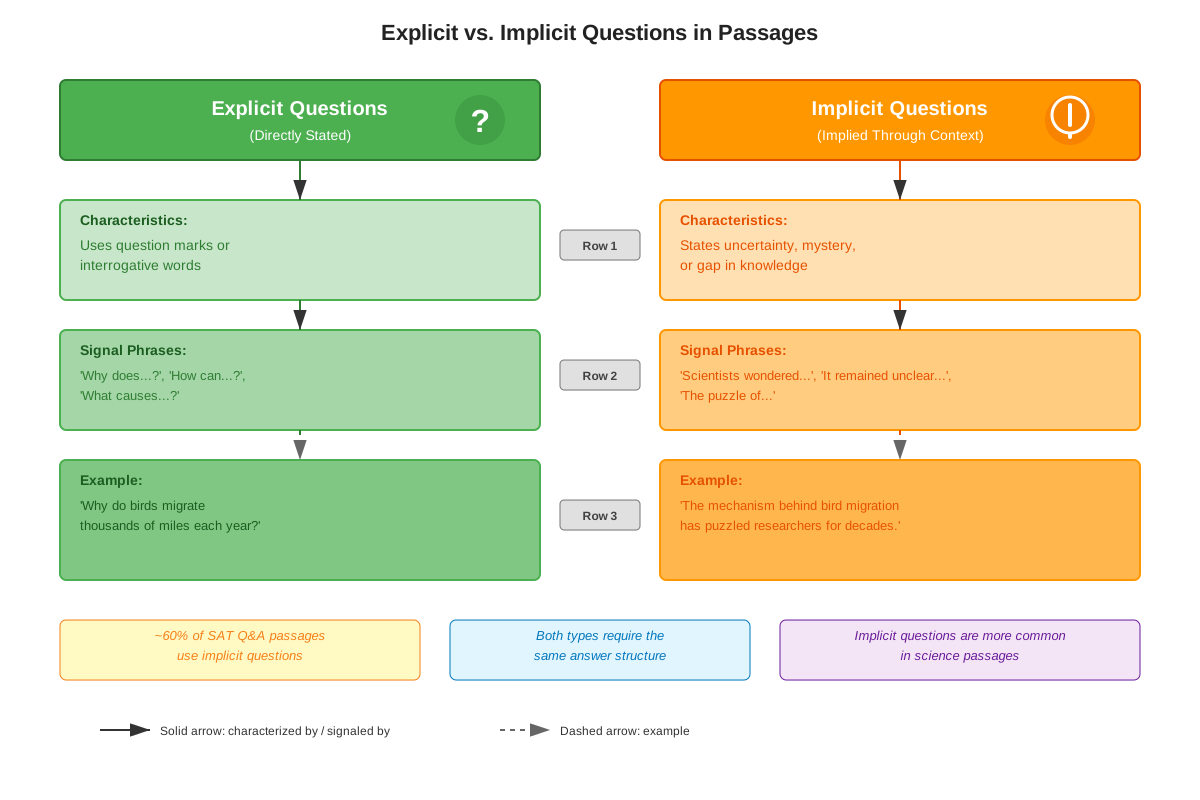
Explicit questions appear as direct interrogative sentences within the text. For example: "Why do monarch butterflies migrate thousands of miles each year?" The passage then proceeds to explain the biological and environmental factors driving this behavior. Explicit questions are easier to identify because they use question marks and interrogative words (who, what, when, where, why, how).
Implicit questions are suggested or implied rather than directly stated. An author might write: "Scientists have long puzzled over the disappearance of the Ancestral Puebloans from their cliff dwellings in the 13th century." This statement implies the question "Why did the Ancestral Puebloans abandon their homes?" without using interrogative syntax. Implicit questions often appear as statements about mysteries, debates, unknowns, or phenomena requiring explanation. Recognizing implicit questions requires identifying language that signals uncertainty, curiosity, or the need for explanation.
Structural Components and Markers
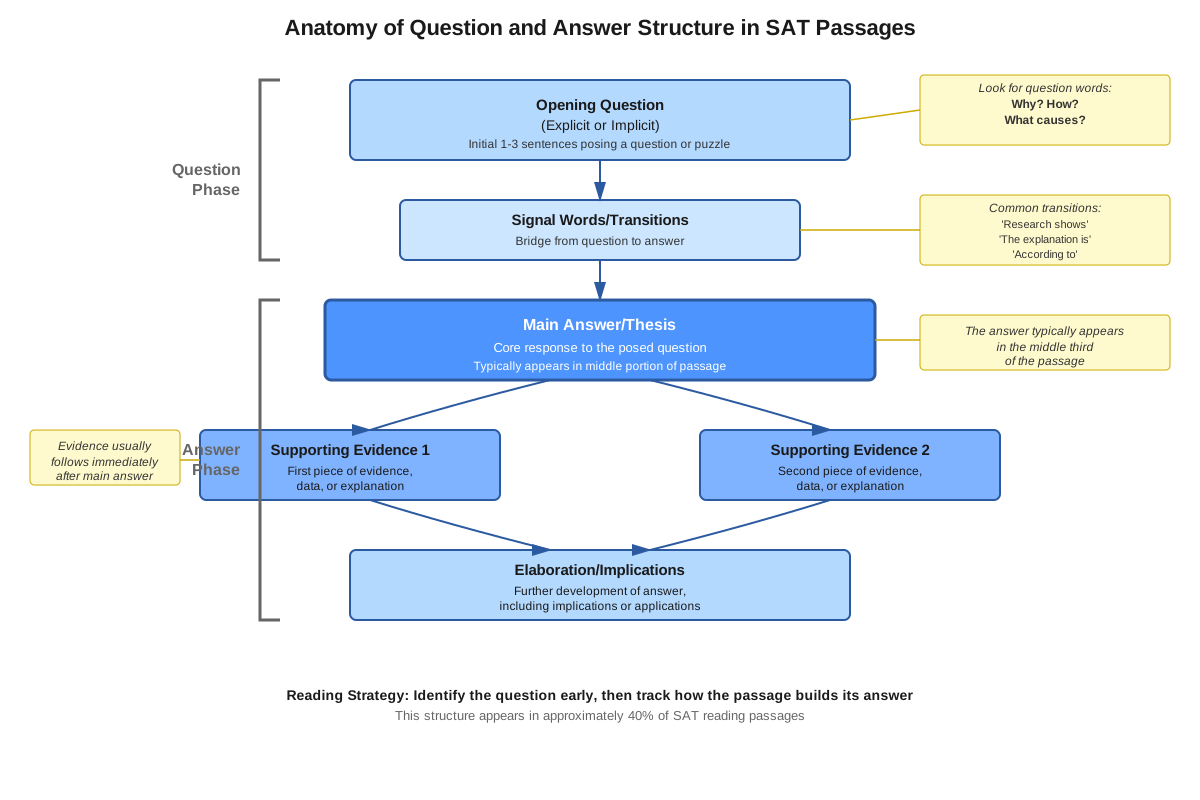
Question and answer passages typically follow a predictable sequence:
- Introduction of the question: The opening paragraph presents the central question, mystery, or problem
- Context or background: Brief information explaining why the question matters or what makes it puzzling
- Answer development: One or more paragraphs presenting the answer, often with supporting evidence
- Elaboration or qualification: Additional details, examples, or acknowledgment of limitations
- Conclusion: Restatement of the answer or implications of the findings
Textual markers that signal question and answer structure include:
| Signal Type | Examples | Function |
|---|---|---|
| Question words | Why, how, what causes, what explains | Introduce explicit questions |
| Uncertainty language | Puzzle, mystery, unclear, unknown, debate | Suggest implicit questions |
| Transition to answer | Research shows, evidence suggests, the answer lies in | Signal shift from question to answer |
| Explanatory language | Because, due to, results from, can be explained by | Provide causal answers |
| Qualification markers | However, although, while, partially | Indicate complex or nuanced answers |
Types of Questions in SAT Passages
SAT passages employ several categories of questions within this structure:
Causal questions ask why something happens or what causes a phenomenon. Example: "What causes the aurora borealis?" The answer explains the interaction between solar wind and Earth's magnetic field.
Definitional questions ask what something is or how it should be classified. Example: "What exactly constitutes consciousness?" The answer explores various definitions and criteria.
Process questions ask how something works or occurs. Example: "How do vaccines train the immune system?" The answer describes the mechanism step-by-step.
Comparative questions ask about differences or similarities. Example: "How do reptilian and mammalian hearts differ?" The answer contrasts the structures and functions.
Answer Development Patterns
Authors develop answers through several common patterns:
Single definitive answer: The passage provides one clear, well-supported answer to the posed question. This pattern appears most often in passages about established scientific facts or historical events with clear documentation.
Multiple perspectives: The passage presents several possible answers or competing theories, often in scientific or social science contexts where debate continues. The author may favor one perspective or remain neutral.
Partial or evolving answer: The passage acknowledges that the question cannot be fully answered with current knowledge but provides the best available explanation. This pattern often appears in cutting-edge research topics.
Qualified answer: The passage provides an answer but emphasizes conditions, exceptions, or limitations. Words like "typically," "generally," "in most cases," or "under certain conditions" signal this pattern.
Concept Relationships
Question and answer structure connects intimately with other organizational patterns. It often incorporates cause-and-effect structure when the question asks "why" and the answer explains causal relationships. For instance, a passage might ask "Why do coastal areas experience milder temperatures?" and answer by explaining how ocean thermal mass affects climate (cause-and-effect within question-and-answer framework).
The structure also relates to problem-solution structure, though they differ in emphasis. Problem-solution focuses on practical remedies or actions to address issues, while question-and-answer emphasizes explanation and understanding. A passage might ask "What causes antibiotic resistance?" (question-and-answer) versus "How can we combat antibiotic resistance?" (problem-solution).
Within the passage itself, concepts flow logically: Implicit/Explicit Question → Context/Background → Answer Introduction → Supporting Evidence → Elaboration/Qualification → Conclusion. Recognizing this flow helps students predict where specific information will appear. For example, if a question appears in the first sentence, the main answer typically appears by the end of the first paragraph or beginning of the second, with subsequent paragraphs providing supporting details.
Understanding question and answer structure also enhances comprehension of author's purpose. When an author uses this structure, their primary purpose is typically to inform or explain rather than to persuade or entertain. This recognition helps students answer purpose questions more accurately.
High-Yield Facts
⭐ Question and answer structure appears in 15-20% of SAT Reading and Writing passages, making it one of the most frequently tested organizational patterns.
⭐ The central question may be explicit (using a question mark) or implicit (suggested through language about mysteries, puzzles, or unknowns).
⭐ The answer to the posed question typically appears within the first two paragraphs, with remaining paragraphs providing supporting evidence and elaboration.
⭐ Transition words like "research shows," "evidence suggests," "the explanation lies in," and "scientists have found" signal the shift from question to answer.
⭐ When a passage opens with a question, the correct answer to "What is the main purpose?" will typically involve explaining, describing, or presenting information about that question's topic.
- Question and answer structure is most common in science and social science passages on the SAT.
- Authors may provide multiple possible answers to a question, especially when describing ongoing scientific debates.
- The scope of the answer should match the scope of the question—neither broader nor narrower.
- Implicit questions often use words like "puzzle," "mystery," "unclear," "debate," "unknown," or "surprising."
- The conclusion of a question-and-answer passage often restates the answer or discusses its implications rather than introducing new information.
- Recognizing this structure helps students predict where to find evidence for specific answer choices.
- Question and answer structure can be combined with other organizational patterns within the same passage.
- SAT questions frequently ask about the function of specific paragraphs in question-and-answer passages (e.g., "to provide evidence supporting the answer").
Quick check — test yourself on Question and answer structure so far.
Try Flashcards →Common Misconceptions
Misconception: Every passage that contains a question uses question and answer structure. → Correction: A passage uses question and answer structure only when a central question organizes the entire text. Passages may contain rhetorical questions or minor questions without being structured around answering them. The key is whether the question drives the passage's organization and purpose.
Misconception: The answer must appear immediately after the question. → Correction: While answers often appear soon after questions, authors may provide context, background, or explanation of why the question matters before presenting the answer. The answer might not appear until the second or even third paragraph in longer passages.
Misconception: Question and answer structure always provides a definitive, complete answer. → Correction: Many SAT passages acknowledge uncertainty, present multiple perspectives, or provide partial answers. Authors may explain that the question remains partially unanswered or that scientists continue to debate the answer. The structure is defined by the attempt to address the question, not by providing a conclusive answer.
Misconception: If a passage describes a problem, it uses question and answer structure. → Correction: Problem-solution structure differs from question-and-answer structure. Problems require action or remedies; questions require explanation or information. A passage about pollution solutions uses problem-solution structure, while a passage explaining what causes pollution uses question-and-answer structure.
Misconception: The question must use interrogative words like "why" or "how." → Correction: Implicit questions are extremely common on the SAT and may appear as statements about mysteries, puzzles, or unknowns without using interrogative syntax. "Scientists have debated the cause of the extinction" implies the question "What caused the extinction?" without using question format.
Misconception: All paragraphs in a question-and-answer passage directly answer the question. → Correction: Some paragraphs may provide background information, define terms, describe research methods, present counterarguments, or discuss implications without directly answering the central question. However, these paragraphs support the overall purpose of addressing the question.
Worked Examples
Example 1: Explicit Question Structure
Passage:
"Why do zebras have stripes? For over a century, scientists proposed various explanations: the stripes provide camouflage in tall grass, confuse predators, help with temperature regulation, or serve as social signals within herds. Recent research by wildlife biologist Tim Caro has provided compelling evidence for a different answer. After analyzing stripe patterns across different zebra populations and habitats, Caro's team found the strongest correlation between stripe intensity and the prevalence of disease-carrying flies. In regions with more biting flies, zebras displayed bolder, more contrasting stripes. Laboratory experiments confirmed that flies avoid landing on striped surfaces, apparently because the pattern disrupts their visual processing. Thus, zebra stripes appear to function primarily as a defense against parasitic insects."
Analysis:
- Identify the question: The passage opens with an explicit question: "Why do zebras have stripes?" This immediately signals question and answer structure.
- Locate context: The second sentence provides historical context by mentioning previous theories, establishing that this question has long interested scientists.
- Find the answer: The phrase "Recent research...has provided compelling evidence for a different answer" signals the transition to the answer. The answer is: zebra stripes defend against disease-carrying flies.
- Identify supporting evidence: The passage provides two types of evidence: correlation data (stripe intensity matches fly prevalence) and experimental data (flies avoid striped surfaces).
- Note the conclusion: The final sentence restates the answer with qualifying language ("appear to function primarily"), acknowledging this is the best current explanation.
SAT Question Application:
If asked "Which choice best describes the overall structure of the text?" the correct answer would be something like: "It poses a question about a biological feature and presents recent research that provides an answer." Incorrect answers might suggest the passage compares different species, traces historical development, or argues for a controversial position.
Example 2: Implicit Question Structure
Passage:
"The sudden collapse of the Maya civilization around 900 CE has puzzled archaeologists for decades. At its height, Maya society supported millions of people in sophisticated city-states with advanced mathematics, astronomy, and architecture. Yet within a relatively brief period, major cities were abandoned, and the population declined dramatically. Traditional explanations focused on warfare, disease, or environmental degradation, but none fully accounted for the speed and completeness of the collapse. Recent paleoclimatic research has revealed a crucial factor: an extended drought lasting decades struck the Maya heartland during the 9th century. Analysis of sediment cores and cave formations shows rainfall declined by up to 40% during this period. This severe water shortage would have devastated the intensive agriculture that supported dense urban populations, triggering food shortages, social unrest, and ultimately the abandonment of cities. While drought alone may not explain every aspect of the Maya collapse, it appears to have been the primary catalyst for this dramatic transformation."
Analysis:
- Identify the implicit question: The phrase "has puzzled archaeologists for decades" signals an unanswered question. The implied question is: "What caused the collapse of the Maya civilization?"
- Recognize the structure markers: Words like "puzzled," "traditional explanations," and "none fully accounted for" indicate this passage will address an explanatory question.
- Locate the answer transition: "Recent paleoclimatic research has revealed a crucial factor" signals the shift from question to answer.
- Identify the answer: Extended drought during the 9th century caused the Maya collapse.
- Note supporting evidence: Sediment cores and cave formations provide physical evidence of 40% rainfall decline.
- Recognize qualification: The final sentence qualifies the answer ("may not explain every aspect") while maintaining the main claim ("primary catalyst").
SAT Question Application:
For a question asking "The author mentions 'warfare, disease, or environmental degradation' primarily to," the correct answer would involve: "acknowledge previous explanations before presenting a more comprehensive answer." This recognizes how the author structures the passage to show why the new answer is superior to earlier ones.
Exam Strategy
When approaching SAT passages with question and answer structure, follow this systematic process:
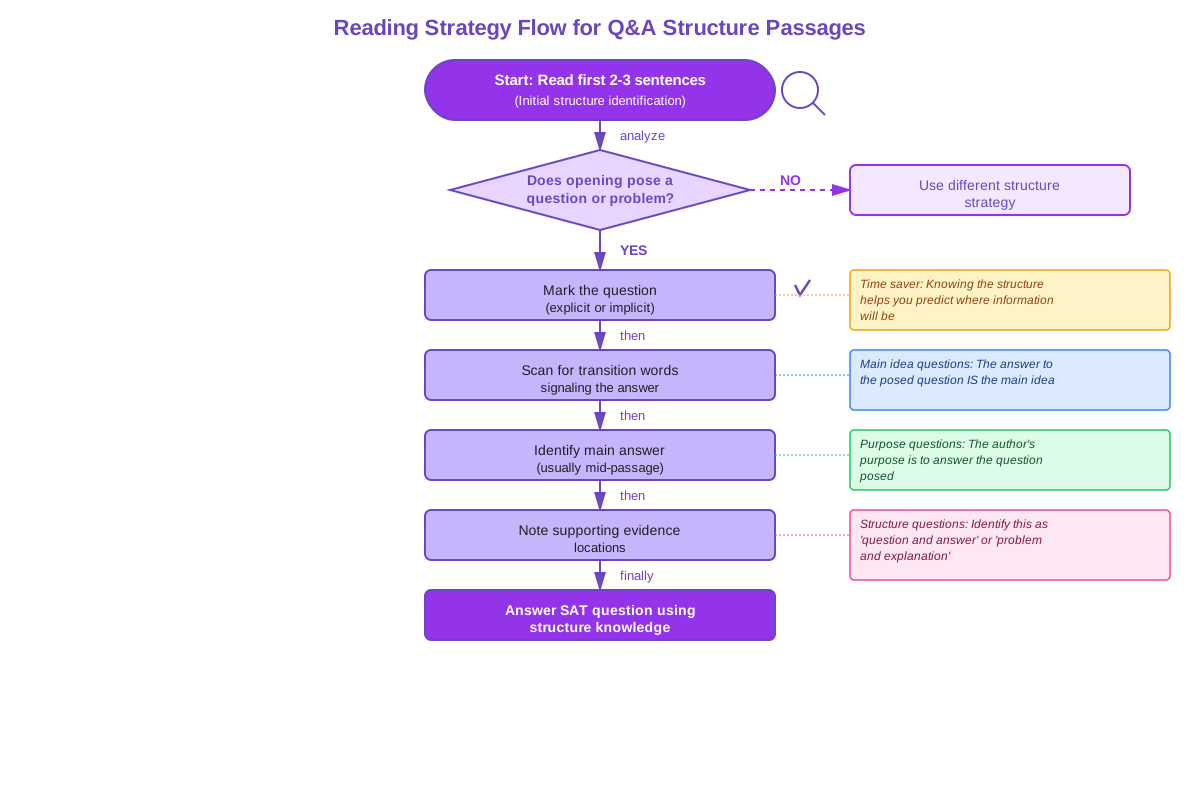
Step 1: Identify the structure quickly (15-20 seconds)
Read the first two sentences carefully. Look for explicit questions (question marks) or implicit question markers ("puzzle," "mystery," "unclear," "debate," "scientists wondered"). If you identify question and answer structure, you immediately know the passage's primary purpose is to explain or inform.
Step 2: Locate the answer (10-15 seconds)
The main answer typically appears within the first two paragraphs. Look for transition phrases like "research shows," "the answer lies in," "evidence suggests," or "scientists have found." Underline or mentally note where the answer begins.
Step 3: Map the passage structure (20-30 seconds)
Quickly identify what each paragraph does:
- Paragraph 1: Question + context
- Paragraph 2: Answer + initial evidence
- Paragraph 3: Additional evidence or elaboration
- Paragraph 4: Qualification or implications
This map helps you locate information quickly when answering questions.
Trigger words to watch for:
Question indicators: why, how, what causes, what explains, puzzle, mystery, unclear, unknown, debate, wondered, questioned, surprising, unexpected, paradox
Answer indicators: research shows, evidence suggests, scientists found, the explanation, the reason, because, due to, results from, can be attributed to, appears to be
Process of elimination tips:
When answering "main purpose" questions on question-and-answer passages, eliminate choices that:
- Suggest the author is arguing or persuading (these passages inform/explain)
- Mention comparing or contrasting (unless the answer involves comparison)
- Reference proposing solutions (that's problem-solution structure)
- Describe tracing historical development (that's chronological structure)
Keep choices that:
- Use words like "explain," "present research," "describe findings," "address a question"
- Match the scope of the question posed in the passage
Time allocation:
Spend slightly more time (30-45 seconds) on the first reading of question-and-answer passages compared to other structures. Understanding the question-answer relationship upfront saves time on individual questions because you know exactly where to find relevant information.
Memory Techniques
Q-A-E-C Acronym for passage structure:
- Question: What's being asked?
- Answer: What's the main response?
- Evidence: What supports the answer?
- Conclusion: How does it wrap up?
The "Detective Story" Visualization:
Think of question-and-answer passages as detective stories. The question is the mystery, the author is the detective, the evidence is the clues, and the answer is solving the case. This mental model helps you stay engaged and predict where information will appear.
"PUZZLE" Mnemonic for implicit question markers:
- Puzzle
- Unclear
- Zero consensus (debate)
- Zealous investigation (scientists wondered)
- Lacking explanation (mystery)
- Experts disagree
The "Signal Spotlight" Technique:
Visualize transition words as spotlights that illuminate where the answer begins. When you see "research shows" or "evidence suggests," imagine a spotlight turning on, highlighting the answer section.
The "Scope Match" Rule:
Remember: "Question scope = Answer scope." If the question asks about zebras specifically, the answer won't be about all animals. If the question asks about one cause, the answer won't list ten causes. Matching scope helps eliminate wrong answers.
Summary
Question and answer structure is a fundamental organizational pattern where passages pose a central question—either explicitly with interrogative syntax or implicitly through language about mysteries, puzzles, or unknowns—and then provide an answer supported by evidence and explanation. This structure appears in 15-20% of SAT Reading and Writing passages, particularly in science and social science contexts. Recognizing this pattern allows students to predict passage organization, identify main ideas quickly, and locate supporting evidence efficiently. The typical structure flows from question introduction through context and background to answer presentation, supporting evidence, and conclusion. Key markers include question words (why, how, what), uncertainty language (puzzle, mystery, debate), and transition phrases (research shows, evidence suggests). Understanding this structure directly improves performance on main idea questions, purpose questions, and structure questions. Students should identify the structure within the first two sentences, locate the main answer in the first two paragraphs, and map how subsequent paragraphs provide evidence or elaboration. The answer may be definitive or qualified, single or multiple, but always addresses the posed question as the passage's primary organizational principle.
Key Takeaways
- Question and answer structure organizes passages around a central question (explicit or implicit) and its answer, appearing in 15-20% of SAT passages
- Explicit questions use interrogative syntax with question marks; implicit questions use language about puzzles, mysteries, debates, or unknowns
- The main answer typically appears within the first two paragraphs, with subsequent paragraphs providing supporting evidence and elaboration
- Transition phrases like "research shows," "evidence suggests," and "the explanation lies in" signal the shift from question to answer
- Recognizing this structure helps predict passage organization, identify main purpose, and locate evidence quickly
- Question and answer structure differs from problem-solution (which focuses on remedies) and cause-and-effect (which may be incorporated within the answer)
- SAT questions frequently test whether students can identify the passage structure, determine paragraph functions, and recognize the main purpose as explaining or informing
Related Topics
Cause-and-Effect Structure: Many question-and-answer passages incorporate causal relationships when explaining "why" questions. Understanding cause-and-effect helps analyze how authors develop answers to causal questions.
Problem-Solution Structure: While distinct from question-and-answer, this structure shares the pattern of identifying an issue and addressing it. Distinguishing between these structures improves structural analysis skills.
Author's Purpose and Point of View: Question-and-answer passages typically serve informative or explanatory purposes. Understanding this connection helps answer purpose questions accurately.
Main Ideas and Supporting Details: Recognizing that the answer represents the main idea and subsequent evidence provides supporting details strengthens overall comprehension skills.
Compare-and-Contrast Structure: Some question-and-answer passages present multiple possible answers or competing theories, incorporating comparative elements within the answer section.
Practice CTA
Now that you understand question and answer structure, you're ready to apply these concepts to authentic SAT passages. The practice questions and flashcards will help you recognize this structure quickly, identify explicit and implicit questions, and answer structure-related questions with confidence. Remember: recognizing the structure in the first 30 seconds of reading gives you a roadmap through the entire passage. Each practice question you complete strengthens your pattern recognition skills and builds the automaticity you need for test day success. You've got this—time to put your knowledge into action!
Sign up free to keep reading
Create a free AnvayaPrep account to finish this SAT guide on Question and answer structure — plus flashcards and practice questions.