Overview
The role of analogy is a critical text structure concept tested on the SAT Reading and Writing (RW) section. An analogy functions as a comparison between two different things to clarify, explain, or illuminate a complex idea by relating it to something more familiar or concrete. On the SAT, understanding how authors use analogies helps students identify the purpose of specific textual elements, recognize organizational patterns, and comprehend how writers develop their arguments or explanations.
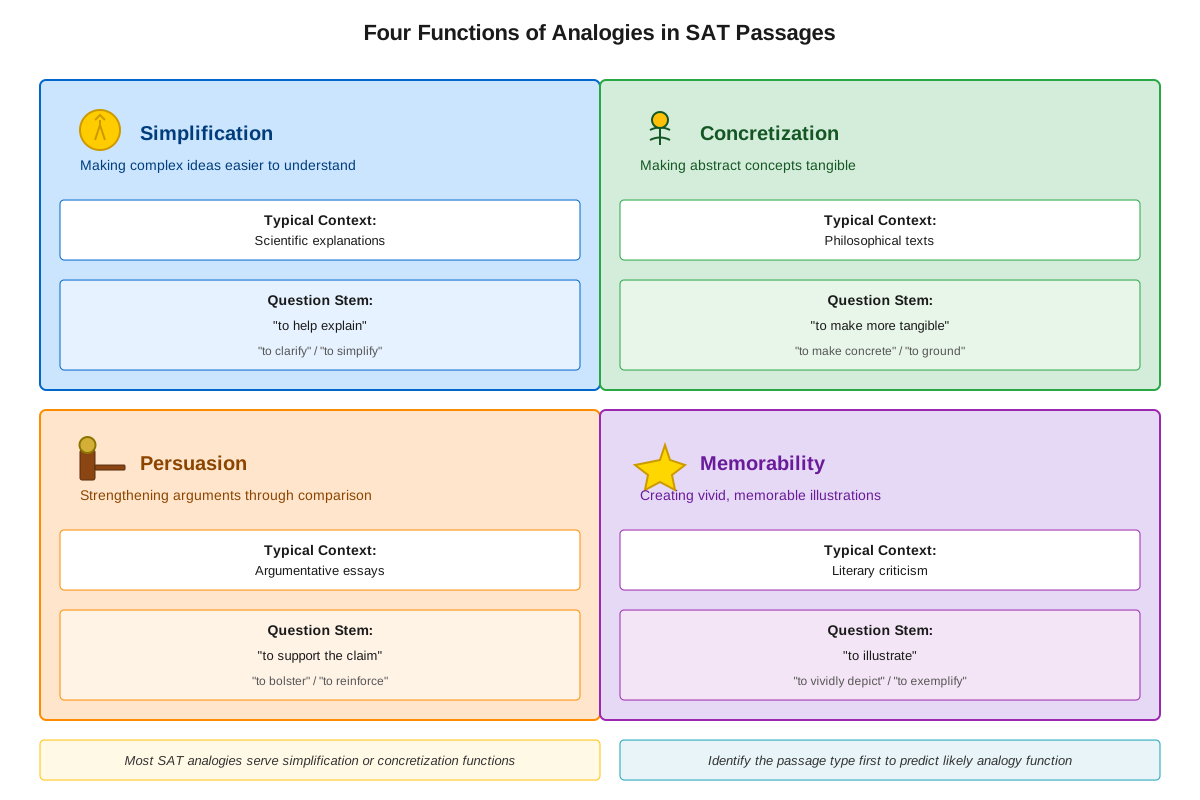
Analogies serve multiple rhetorical purposes in SAT passages: they can simplify abstract concepts, make scientific principles accessible to general audiences, strengthen persuasive arguments, or create memorable illustrations of difficult ideas. When the SAT role of analogy appears in questions, students must recognize not just that an analogy exists, but why the author chose to include it and how it functions within the broader text structure. This requires analytical thinking beyond simple comprehension—students must evaluate the relationship between the analogy and the main concept being explained.
Within the broader context of Text Structure and Purpose, the role of analogy connects to other organizational strategies like cause-and-effect relationships, compare-and-contrast structures, and problem-solution frameworks. Mastering analogy recognition enhances overall reading comprehension skills and prepares students to tackle the diverse passage types they'll encounter on test day, from scientific explanations to literary criticism. The ability to quickly identify and understand analogies directly impacts performance on questions about author's purpose, rhetorical choices, and text organization—all high-frequency question types on the digital SAT.
Learning Objectives
- [ ] Identify key features of role of analogy in SAT passages
- [ ] Explain how role of analogy appears on the SAT and what question formats test this concept
- [ ] Apply role of analogy to answer SAT-style questions accurately and efficiently
- [ ] Distinguish between effective and ineffective analogies in context
- [ ] Analyze the relationship between an analogy and the concept it illustrates
- [ ] Evaluate how analogies contribute to an author's overall purpose and argument structure
- [ ] Recognize signal words and phrases that introduce analogies in complex texts
Prerequisites
- Basic reading comprehension skills: Understanding literal meaning is necessary before analyzing figurative comparisons and structural elements
- Familiarity with main idea identification: Recognizing what concept an analogy explains requires understanding the passage's central focus
- Knowledge of author's purpose: Analogies serve specific rhetorical functions that connect to why an author wrote the text
- Understanding of comparison structures: Analogies are specialized comparisons requiring recognition of similarity relationships between unlike things
Why This Topic Matters
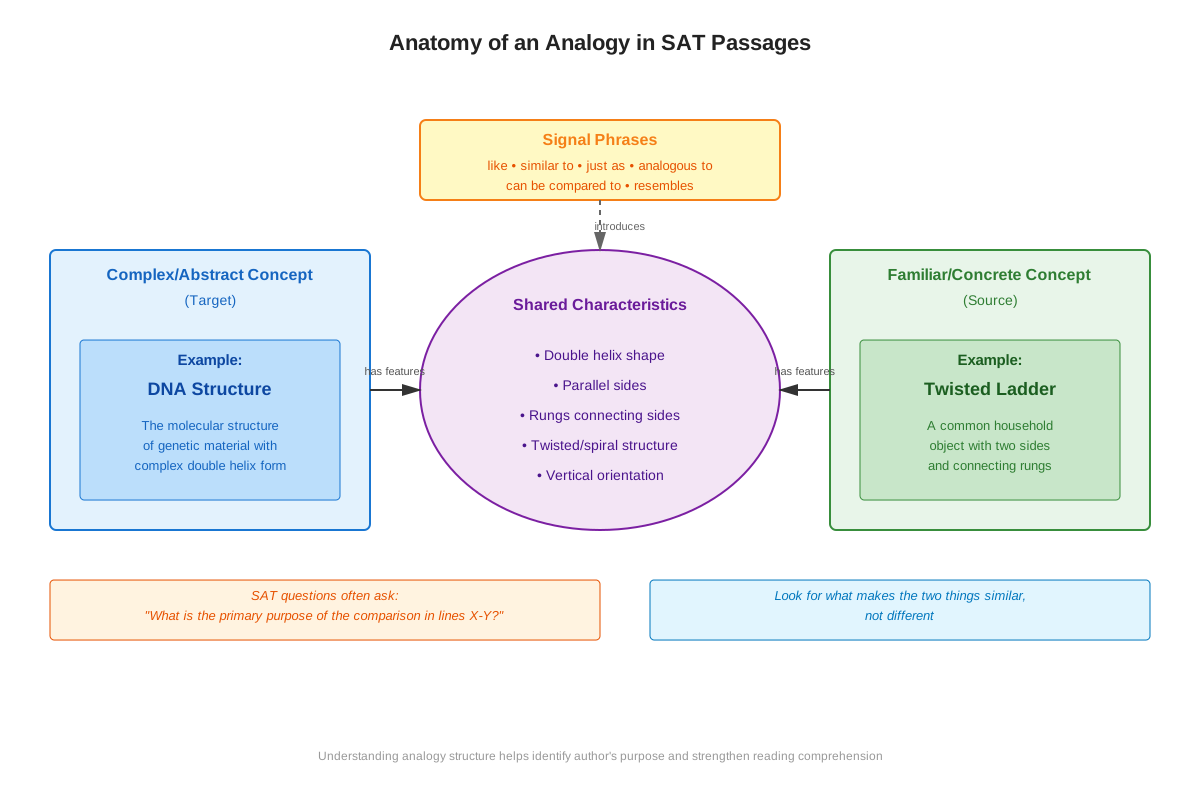
Understanding the role of analogy has significant real-world applications beyond standardized testing. Scientists use analogies to explain complex phenomena to non-specialist audiences (comparing DNA structure to a twisted ladder, for instance). Business leaders employ analogies to communicate strategic visions. Writers across disciplines rely on analogies to make abstract concepts tangible and memorable. Developing the ability to recognize and evaluate analogies strengthens critical thinking skills applicable to academic writing, professional communication, and everyday reasoning.
On the SAT, analogy-related questions appear with considerable frequency across the Reading and Writing section. Approximately 15-20% of Text Structure and Purpose questions involve identifying or understanding the function of analogies, comparisons, or illustrative examples. These questions typically appear in passages from natural sciences, social sciences, and humanities, where authors must bridge the gap between specialized knowledge and general readership.
Common manifestations of this topic on the exam include passages where authors compare biological processes to familiar mechanical systems, liken social phenomena to physical processes, or use everyday experiences to illuminate philosophical concepts. Questions may ask students to identify what function a specific analogy serves, determine what concept an analogy is meant to clarify, or recognize which statement best describes the relationship between an analogy and the main idea. The digital SAT format presents these questions as both standalone items and as part of paired passages where comparing analogical approaches becomes essential.
Core Concepts
Definition and Structure of Analogies
An analogy is a comparison that identifies a partial similarity between two things that are otherwise unlike. Unlike simple comparisons that examine similar objects (comparing two cars, for example), analogies draw connections between fundamentally different domains to illuminate understanding. The structure typically involves a source domain (the familiar concept used for comparison) and a target domain (the complex or abstract concept being explained). For instance, when an author compares the human brain to a computer, the computer serves as the source domain that helps readers understand the target domain—brain function.
Effective analogies share several key characteristics:
- Clarity of correspondence: The relationship between compared elements must be explicit and logical
- Accessibility: The source domain should be more familiar than the target domain
- Relevance: The comparison must illuminate the specific aspect of the concept the author wants to emphasize
- Limitations: Strong writers acknowledge where analogies break down, preventing reader confusion
Functions of Analogies in SAT Passages
Analogies serve multiple rhetorical purposes that SAT questions frequently test:
Explanatory Function: The most common role is simplifying complex information. Scientific passages often use analogies to make technical concepts accessible. An author might compare photosynthesis to a factory assembly line, helping readers visualize the step-by-step energy conversion process.
Persuasive Function: Analogies can strengthen arguments by connecting new ideas to accepted truths. If an author argues for protecting digital privacy by comparing personal data to physical property, the analogy leverages existing beliefs about property rights to support the new claim.
Illustrative Function: Analogies make abstract concepts concrete and memorable. A passage discussing economic principles might compare market equilibrium to a balanced scale, creating a visual mental model that aids comprehension and retention.
Organizational Function: Analogies can structure entire passages or sections, providing a framework that guides reader understanding throughout the text. An extended analogy comparing ecosystem dynamics to a symphony orchestra might organize multiple paragraphs, with each instrument representing a different species role.
Identifying Analogy Signal Words
Recognizing when authors introduce analogies helps students anticipate text structure and prepare for related questions. Common signal phrases include:
| Signal Type | Examples | Function |
|---|---|---|
| Direct comparison | "is like," "similar to," "resembles," "can be compared to" | Explicitly marks the analogy |
| Metaphorical | "serves as," "functions as," "acts as," "mirrors" | Indicates functional similarity |
| Hypothetical | "imagine," "consider," "think of," "picture" | Invites reader to visualize comparison |
| Explanatory | "in other words," "to put it another way," "essentially" | Signals a restatement using analogy |
Analyzing Analogy Effectiveness
Not all analogies serve their intended purpose equally well. SAT passages sometimes include questions that require evaluating whether an analogy successfully clarifies a concept. Strong analogies demonstrate:
- Structural correspondence: The relationships within the source domain mirror relationships in the target domain
- Appropriate scope: The analogy covers the relevant aspects without overextending
- Audience awareness: The source domain matches the intended readers' knowledge base
- Precision: The comparison highlights the specific feature or process the author wants to emphasize
Weak analogies may be too vague, rely on unfamiliar source domains, or create misleading implications about the target concept. Students must evaluate these qualities when questions ask about the effectiveness or purpose of a specific analogy.
Extended vs. Brief Analogies
SAT passages employ analogies at different scales:
Brief analogies appear as single sentences or phrases, providing quick clarification without extensive development. Example: "The cell membrane acts as a gatekeeper, controlling what enters and exits the cell." These require students to quickly identify the comparison and its purpose.
Extended analogies develop over multiple sentences or paragraphs, with various aspects of the source domain corresponding to different elements of the target domain. These create more complex structural relationships that SAT questions often explore. An extended analogy might compare the human immune system to a military defense system, with different immune cells corresponding to various military units, each with specialized functions.
Understanding this distinction helps students recognize the scope of analogy-based questions and locate relevant information efficiently.
Concept Relationships
The role of analogy connects intimately with other text structure concepts tested on the SAT. Analogies often support cause-and-effect explanations by making causal relationships more concrete—comparing a chain reaction to falling dominoes, for instance, clarifies both causation and sequence. Compare-and-contrast structures may incorporate analogies to make one element of the comparison more accessible, particularly when contrasting familiar and unfamiliar concepts.
Within the broader category of rhetorical devices, analogies relate closely to metaphors and similes, though analogies typically serve more explanatory than purely stylistic purposes. While metaphors create implicit comparisons ("time is money"), analogies explicitly develop the correspondence for instructional purposes ("managing time is like managing money: both require budgeting, tracking expenditures, and prioritizing investments").
The relationship flow operates as follows: Author's Purpose → Rhetorical Strategy Selection → Analogy Choice → Text Organization → Reader Comprehension. Understanding this chain helps students answer questions about why an author included a specific analogy—it traces back to the fundamental communicative goal. Additionally, Analogy Recognition → Function Identification → Main Idea Connection represents the analytical process students must perform when encountering analogy questions.
Prerequisite knowledge of author's purpose enables students to evaluate whether an analogy serves explanatory, persuasive, or illustrative functions. Main idea comprehension allows students to determine what concept the analogy clarifies. These connections make the role of analogy a integrative skill that draws on multiple reading competencies simultaneously.
High-Yield Facts
⭐ Analogies compare two fundamentally different things to clarify or explain a complex concept using something more familiar
⭐ The primary function of analogies in SAT passages is explanatory—making difficult concepts accessible to readers
⭐ Signal words like "similar to," "like," "resembles," "can be compared to," and "imagine" often introduce analogies
⭐ Questions about analogies typically ask what concept the analogy explains or what function it serves in the passage
⭐ Effective analogies have clear correspondence between the source domain (familiar) and target domain (complex concept)
- Extended analogies develop over multiple sentences with various corresponding elements between domains
- Analogies differ from simple comparisons because they connect unlike things rather than similar objects
- Authors may acknowledge limitations of analogies to prevent reader misunderstanding
- Scientific passages use analogies more frequently than literary passages on the SAT
- Recognizing an analogy's function requires understanding both the analogy itself and the passage's main idea
- Weak analogies may rely on unfamiliar source domains or create misleading implications
- Analogies can serve persuasive purposes by connecting new ideas to accepted beliefs
- The digital SAT may present questions asking students to identify which statement best describes an analogy's role
- Understanding analogy structure improves performance on questions about text organization and author's purpose
- Analogies often appear in passages explaining scientific processes, social phenomena, or abstract philosophical concepts
Quick check — test yourself on Role of analogy so far.
Try Flashcards →Common Misconceptions
Misconception: All comparisons in a passage are analogies → Correction: Analogies specifically compare unlike things for explanatory purposes. Comparing two similar objects (two different species of birds, for example) is a standard comparison, not an analogy. Analogies bridge different domains (comparing bird migration to human commuting patterns would be an analogy).
Misconception: The purpose of an analogy is always to simplify → Correction: While simplification is the most common function, analogies can also serve persuasive purposes (supporting an argument), illustrative purposes (making abstract concepts memorable), or organizational purposes (structuring a passage). SAT questions may test understanding of these varied functions.
Misconception: If an analogy appears in a passage, there will definitely be a question about it → Correction: Not every analogy generates a question. Students should understand analogies to comprehend the passage fully, but shouldn't assume every structural element will be directly tested. Focus on understanding how analogies contribute to overall meaning.
Misconception: Analogies and metaphors are identical → Correction: While related, analogies are typically more explicit and developed for explanatory purposes ("A is like B because..."), whereas metaphors create implicit comparisons for stylistic effect ("A is B"). SAT passages use analogies as teaching tools, making the comparison's purpose clear.
Misconception: The source domain in an analogy must be simpler than the target domain → Correction: The source domain must be more familiar to the intended audience, not necessarily simpler. An author might use a complex but well-known process (like cooking) to explain an unfamiliar but equally complex process (like chemical synthesis).
Misconception: Extended analogies are more important than brief analogies → Correction: Both types appear on the SAT with equal importance. Brief analogies can be just as functionally significant as extended ones. Question difficulty depends on the complexity of the relationship, not the length of the analogy.
Misconception: Identifying an analogy is sufficient for answering questions → Correction: Recognition is only the first step. SAT questions require analysis of the analogy's function, its relationship to the main idea, and its effectiveness. Students must move beyond identification to evaluation.
Worked Examples
Example 1: Scientific Explanation Passage
Passage Excerpt:
"Understanding how neurons communicate requires grasping the concept of neurotransmission. Think of neurons as houses on a street, separated by small gaps called synapses. When a neuron 'fires,' it's like a resident sending a message to the neighbor's house. But instead of walking across the yard, the message travels as chemical messengers—neurotransmitters—that float across the synaptic gap. The receiving neuron has special receptors, like mailboxes, designed to catch specific neurotransmitters. Once the message is received, the second neuron can decide whether to fire and pass the message along the street."
Question:
Which choice best describes the function of the underlined analogy in the passage?
A) To argue that neural communication is as simple as neighborhood interactions
B) To explain the process of neurotransmission using familiar spatial relationships
C) To contrast chemical and physical methods of communication
D) To suggest that neurons operate independently like separate households
Solution Process:
Step 1: Identify the analogy structure
- Source domain: houses on a street with residents sending messages
- Target domain: neurons communicating via neurotransmission
- Signal phrase: "Think of neurons as..."
Step 2: Determine what concept the analogy explains
The passage explicitly states the purpose: "Understanding how neurons communicate requires grasping the concept of neurotransmission." The analogy explains this specific process.
Step 3: Analyze the function
The analogy breaks down neurotransmission into familiar components:
- Neurons → houses (separate entities)
- Synapses → gaps between houses
- Neurotransmitters → messages floating across
- Receptors → mailboxes (receiving mechanisms)
This creates spatial and functional relationships readers can visualize.
Step 4: Evaluate answer choices
- A) Incorrect: The analogy explains, not argues; it doesn't claim simplicity
- B) Correct: Uses familiar spatial relationships (houses, gaps, mailboxes) to explain the unfamiliar process
- C) Incorrect: No contrast is being made; the analogy explains one method
- D) Incorrect: The analogy emphasizes communication between neurons, not independence
Answer: B
Connection to Learning Objectives: This example demonstrates identifying analogy features (structure, signal words), explaining how analogies appear (explanatory function in scientific passages), and applying knowledge to answer questions correctly.
Example 2: Social Science Argument Passage
Passage Excerpt:
"Critics argue that implementing universal basic income (UBI) would discourage work, but this concern misunderstands human motivation. Consider how we treat education: we don't worry that providing free public schooling will make people stop valuing learning. Instead, removing the financial barrier allows individuals to pursue education based on genuine interest and aptitude rather than economic necessity. Similarly, UBI would free people to choose work that aligns with their skills and passions rather than accepting any available job purely for survival. Just as free education elevated society by developing human potential, UBI could unlock creativity and productivity currently suppressed by economic anxiety."
Question:
The author uses the analogy to public education primarily to:
A) Demonstrate that UBI and public education have identical economic effects
B) Support the argument that removing financial barriers enhances rather than diminishes motivation
C) Explain the historical development of social welfare programs
D) Contrast educational policy with economic policy approaches
Solution Process:
Step 1: Identify the analogy and its context
- Source domain: free public education
- Target domain: universal basic income
- Context: Responding to criticism that UBI would discourage work
- Signal phrase: "Consider how we treat education"
Step 2: Determine the analogy's argumentative function
The author presents a counterargument structure:
- Critics claim UBI discourages work
- Analogy shows similar concern about education proved unfounded
- Conclusion: UBI would similarly enhance rather than diminish motivation
Step 3: Analyze the parallel being drawn
The analogy establishes correspondence:
- Free education removes financial barriers → UBI removes financial barriers
- Education doesn't reduce learning motivation → UBI wouldn't reduce work motivation
- Education allows pursuit based on interest → UBI allows work based on passion
- Education elevated society → UBI could unlock potential
Step 4: Evaluate answer choices
- A) Incorrect: "Identical effects" is too strong; the analogy shows parallel logic, not identical outcomes
- B) Correct: The analogy supports the argument by showing that removing financial barriers (in education) enhanced rather than diminished motivation, suggesting UBI would function similarly
- C) Incorrect: No historical development is discussed; the focus is on functional comparison
- D) Incorrect: The analogy creates a parallel, not a contrast
Answer: B
Connection to Learning Objectives: This example shows how analogies serve persuasive functions in argumentative passages, requiring students to analyze the relationship between the analogy and the author's claim, then apply this understanding to select the correct answer.
Exam Strategy
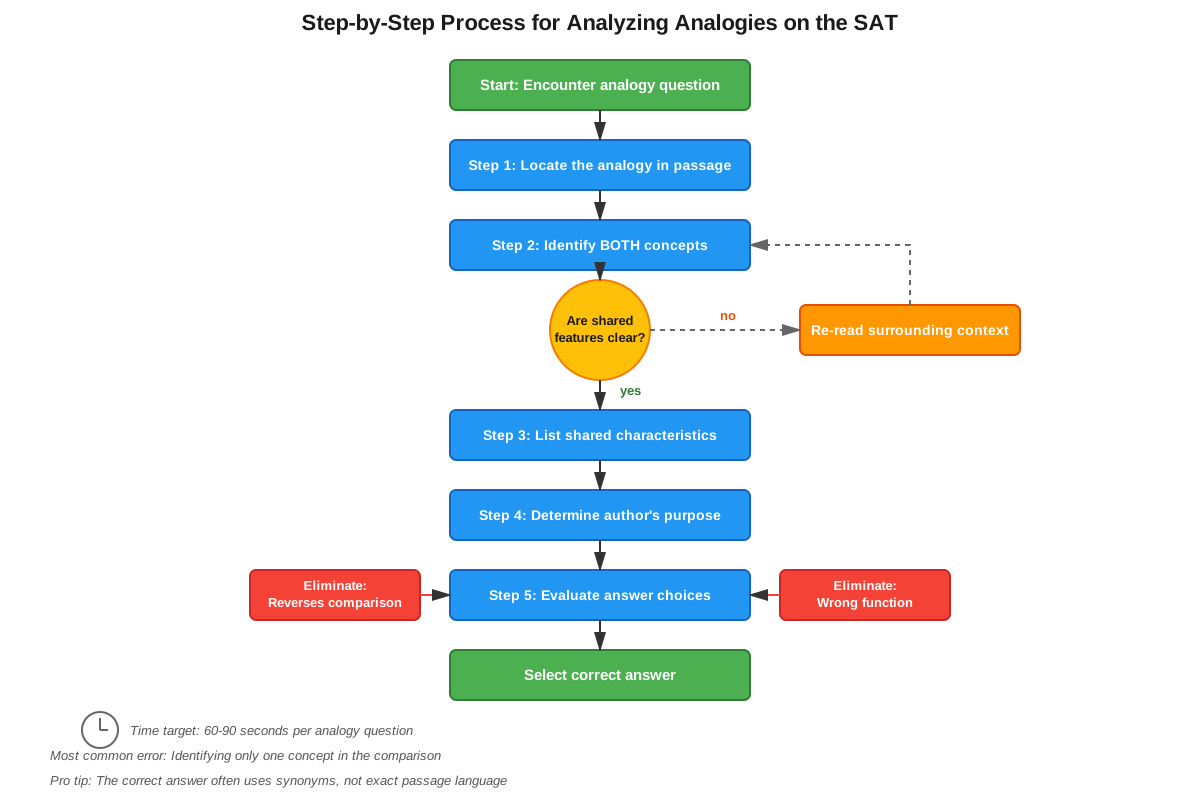
When approaching SAT questions about the role of analogy, employ this systematic process:
Step 1: Locate and Bracket the Analogy
Identify the complete analogy, including both what is being compared and what it's being compared to. Don't just focus on the signal word—understand the full scope of the comparison.
Step 2: Identify the Target Concept
Determine what complex or abstract idea the analogy is meant to clarify. Look at surrounding sentences for explicit statements of purpose or main ideas that the analogy supports.
Step 3: Determine the Function
Ask: Is this analogy explaining (making something clearer), persuading (supporting an argument), illustrating (making something memorable), or organizing (structuring the passage)? The passage context usually makes this clear.
Step 4: Eliminate Based on Function Mismatch
Wrong answers often misidentify the analogy's function. If the analogy clearly explains a process, eliminate answers suggesting it contrasts ideas or argues for a position.
Exam Tip: Watch for trigger words in questions: "function," "purpose," "serves to," "primarily to," and "role" all signal that you need to identify why the author included the analogy, not just what it compares.
Common Wrong Answer Patterns:
- Overgeneralization: Claims the analogy does more than it actually does ("proves" instead of "suggests")
- Undergeneralization: Focuses on a detail rather than the overall function
- Function confusion: Mistakes explanation for argument, or illustration for contrast
- Literal interpretation: Treats the analogy as a factual claim rather than a comparative tool
Time Management:
Analogy questions typically require 45-60 seconds. Spend 20 seconds locating and understanding the analogy, 15 seconds identifying its function, and 20-25 seconds evaluating answers. If you're uncertain, eliminate answers that misidentify the function first, then choose between remaining options based on scope and precision.
Process of Elimination Specific Tips:
- Eliminate answers using absolute language ("always," "never," "only") unless the passage explicitly supports such claims
- Remove answers that identify comparisons not actually made in the analogy
- Discard options that contradict the passage's main idea or author's purpose
- Watch for answers that confuse the source and target domains
Memory Techniques
SAFE Analogy Analysis (Mnemonic for approaching analogy questions):
- Source and target: Identify what's being compared to what
- Author's purpose: Why did the author include this comparison?
- Function: Explain, persuade, illustrate, or organize?
- Effectiveness: Does it successfully serve its purpose?
The Bridge Visualization: Picture an analogy as a bridge connecting two islands—the familiar island (source domain) and the unfamiliar island (target domain). The bridge's purpose is to help readers cross from what they know to what they're learning. This mental image helps remember that analogies connect different domains and facilitate understanding.
Function Acronym: PEIO
- Persuade: Supporting an argument
- Explain: Clarifying a complex concept
- Illustrate: Making abstract ideas concrete
- Organize: Structuring passage content
Signal Word Categories (Remember: "DISH"):
- Direct: "like," "similar to," "resembles"
- Invitational: "imagine," "consider," "think of"
- Substitutional: "serves as," "acts as," "functions as"
- Hypothetical: "suppose," "picture," "envision"
The Two-Domain Rule: Always identify both domains. If you can only identify one, you haven't fully understood the analogy. Practice stating: "The author compares [target] to [source] to [function]."
Summary
The role of analogy represents a crucial text structure concept on the SAT Reading and Writing section, requiring students to recognize, analyze, and evaluate comparative relationships that authors use to clarify complex ideas. Analogies function by connecting a familiar source domain to an unfamiliar target domain, creating correspondence that facilitates reader comprehension. On the SAT, these comparisons serve primarily explanatory functions in scientific passages, though they also appear in persuasive, illustrative, and organizational roles across various passage types. Success with analogy questions demands more than simple recognition—students must identify what concept the analogy explains, determine its specific function within the passage, and evaluate its effectiveness in serving the author's purpose. Signal words like "similar to," "like," "imagine," and "functions as" often introduce analogies, though students must look beyond these markers to understand the complete comparative structure. Effective test-taking strategy involves systematically locating both domains of the analogy, connecting it to the passage's main idea, determining its rhetorical function, and eliminating answer choices that misidentify purpose or scope. Mastering the role of analogy enhances overall reading comprehension and directly improves performance on high-frequency question types about text structure, author's purpose, and rhetorical choices.
Key Takeaways
- Analogies compare fundamentally different things (unlike domains) to explain complex concepts using familiar references
- The primary SAT function of analogies is explanatory, though persuasive and illustrative purposes also appear
- Effective analogy analysis requires identifying both the source domain (familiar) and target domain (complex concept being explained)
- Questions about analogies typically ask about function or purpose, not just identification of the comparison
- Signal words like "similar to," "like," "imagine," and "functions as" often introduce analogies but aren't always present
- Wrong answers frequently misidentify the analogy's function or confuse explanation with argument
- Understanding analogies requires connecting them to the passage's main idea and author's overall purpose
Related Topics
Text Structure: Cause and Effect - Analogies often support causal explanations by making cause-and-effect relationships more concrete and visualizable. Mastering analogy recognition enhances ability to identify how authors develop causal arguments.
Author's Purpose and Rhetorical Choices - Understanding why authors include specific textual elements, including analogies, connects directly to broader questions about rhetorical strategy and communicative intent throughout passages.
Compare and Contrast Structures - While analogies compare unlike things, standard compare-and-contrast structures examine similar entities. Distinguishing these organizational patterns improves overall text structure analysis.
Main Idea and Supporting Details - Analogies typically function as supporting details that clarify main ideas. Strengthening main idea identification skills enhances ability to determine what concept an analogy explains.
Inference and Evidence - Evaluating analogy effectiveness requires inferential reasoning about whether the comparison successfully supports the author's point, connecting to broader inference skills.
Practice CTA
Now that you've mastered the core concepts of analogy recognition and analysis, it's time to apply this knowledge! Work through the practice questions to test your ability to identify analogies, determine their functions, and answer SAT-style questions accurately. The flashcards will help reinforce key terminology and concepts for quick recall on test day. Remember: understanding the role of analogy isn't just about recognizing comparisons—it's about analyzing why authors make specific rhetorical choices and how those choices serve their communicative purposes. Each practice question you complete strengthens your analytical skills and builds the confidence you need to excel on the SAT Reading and Writing section. You've got this!
Sign up free to keep reading
Create a free AnvayaPrep account to finish this SAT guide on Role of analogy — plus flashcards and practice questions.