Overview
An anecdote is a brief, often personal story used to illustrate a larger point, engage readers emotionally, or provide concrete evidence for an abstract claim. On the SAT Reading and Writing section, understanding the role of anecdote is crucial because test-makers frequently ask students to identify why an author includes a specific story or personal narrative within a passage. These questions assess whether students can distinguish between mere storytelling and purposeful rhetorical strategy.
The SAT RW (Reading and Writing) section regularly features passages from various disciplines—science, history, literature, and social studies—where authors strategically deploy anecdotes to achieve specific communicative goals. An anecdote might open a scientific article to humanize complex research, appear mid-argument to provide compelling evidence, or conclude a passage to leave readers with a memorable impression. Recognizing that anecdotes serve deliberate functions rather than existing as decorative elements is essential for answering structure and purpose questions correctly.
Understanding the role of anecdote connects directly to broader concepts in text structure and purpose. Anecdotes represent one tool among many that authors use to organize information, support claims, and engage audiences. This topic intersects with identifying main ideas, understanding rhetorical strategies, analyzing evidence types, and recognizing how different text elements work together to achieve an author's purpose. Mastering anecdotal analysis strengthens overall reading comprehension and prepares students for the approximately 15-20% of SAT questions that focus on text structure and authorial choices.
Learning Objectives
- [ ] Identify key features of role of anecdote in SAT passages
- [ ] Explain how role of anecdote appears on the SAT
- [ ] Apply role of anecdote to answer SAT-style questions
- [ ] Distinguish between anecdotes and other forms of evidence (statistics, expert testimony, logical reasoning)
- [ ] Analyze how anecdote placement affects its rhetorical function within a passage
- [ ] Evaluate the effectiveness of anecdotes in supporting specific claims or purposes
- [ ] Predict likely SAT question stems related to anecdotal content
Prerequisites
- Basic reading comprehension skills: Understanding literal meaning is necessary before analyzing why an author includes specific content
- Familiarity with main idea identification: Recognizing the central claim helps determine how anecdotes support that claim
- Understanding of author's purpose: Knowing whether an author aims to inform, persuade, or entertain provides context for anecdotal choices
- Recognition of paragraph structure: Identifying topic sentences and supporting details helps locate where anecdotes function within arguments
Why This Topic Matters
Understanding the role of anecdote extends beyond standardized testing into real-world literacy. Journalists use anecdotes to make news stories relatable, scientists employ them to illustrate research implications, and advocates share personal narratives to drive policy changes. Recognizing when stories serve as evidence versus emotional manipulation develops critical thinking skills essential for navigating media, academic texts, and professional communications.
On the SAT, questions about anecdotes appear with high frequency—typically 2-4 questions per test administration. These questions fall into several categories: identifying the function of a specific paragraph or sentence, determining why an author includes particular information, analyzing how different parts of a passage relate to each other, and understanding rhetorical strategies. The College Board consistently tests whether students can move beyond surface-level comprehension to analyze structural and purposeful elements of texts.
Anecdotes commonly appear in SAT passages in three contexts: opening hooks that draw readers into unfamiliar topics, illustrative examples that make abstract concepts concrete, and humanizing elements that connect research or theory to lived experience. Science passages might begin with a patient's story before explaining medical research; history passages might include personal accounts to illustrate broader social movements; argumentative texts might use individual cases to support policy recommendations. Recognizing these patterns helps students anticipate question types and answer more efficiently.
Core Concepts
Definition and Characteristics of Anecdotes
An anecdote is a short narrative account of a particular incident or event, often personal or biographical in nature. Unlike comprehensive case studies or extended narratives, anecdotes are brief—typically one paragraph to a few sentences—and focus on a specific moment or experience. Key characteristics include: concrete details rather than abstract generalizations, chronological or narrative structure, identifiable characters or subjects, and a clear connection to a larger point the author wishes to make.
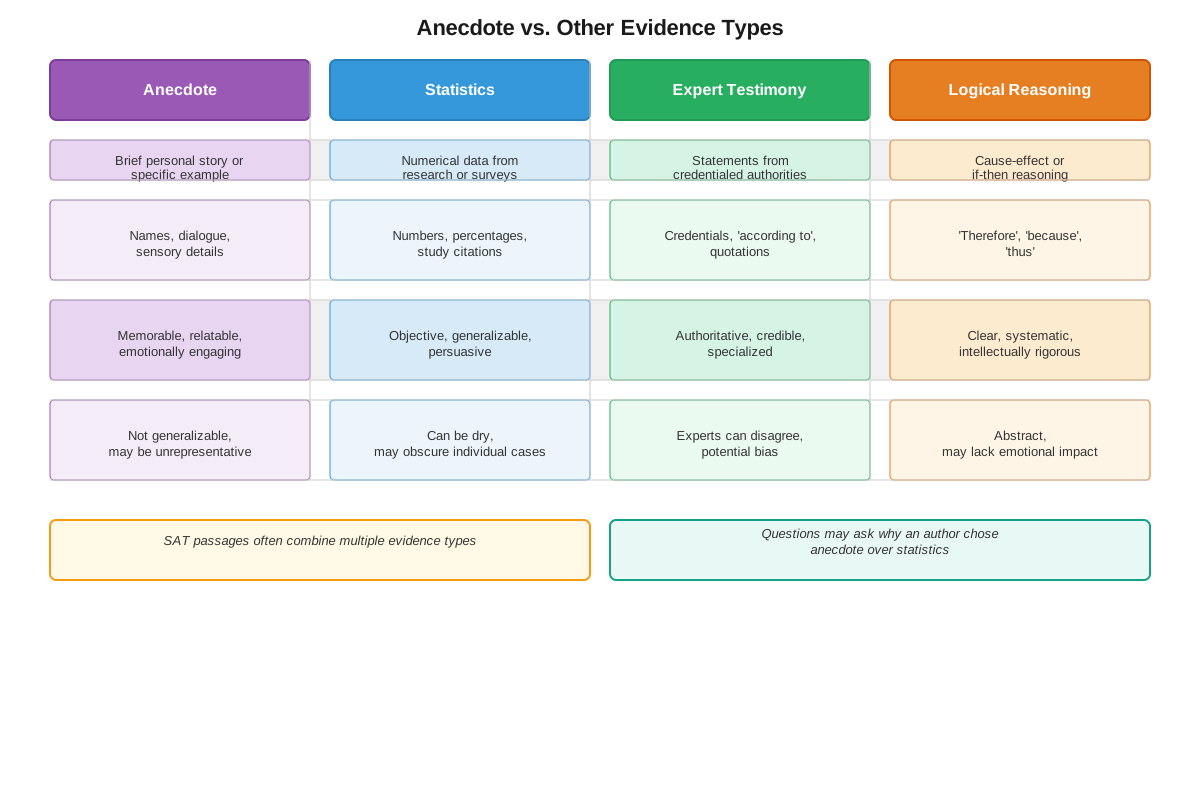
Anecdotes differ from other evidence types in important ways. While statistics provide numerical data and expert testimony offers authoritative opinions, anecdotes supply human-scale stories that readers can visualize and emotionally connect with. This emotional resonance makes anecdotes particularly effective for engaging audiences, though they may lack the generalizability of quantitative data.
Primary Functions of Anecdotes in SAT Passages
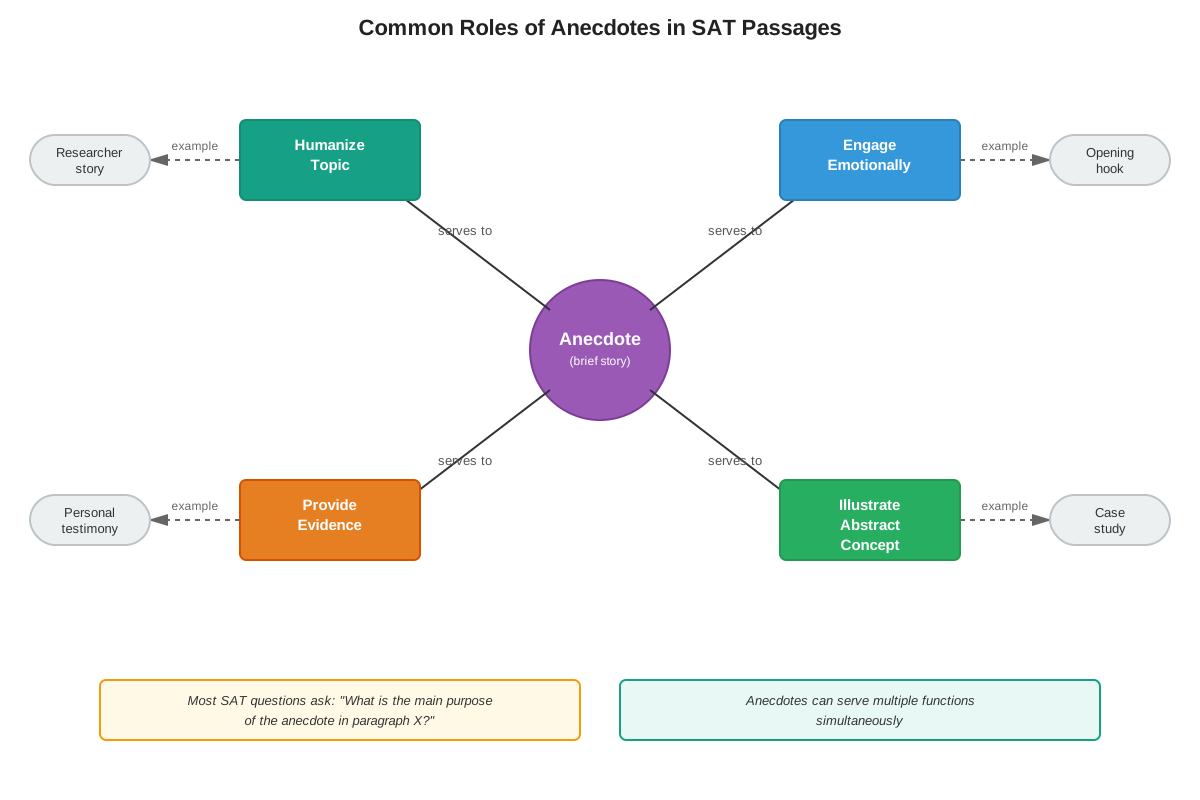
Anecdotes serve multiple rhetorical purposes, and the SAT tests whether students can identify which function applies in specific contexts:
Engagement and Interest: Authors frequently use anecdotes as opening hooks to capture attention and make unfamiliar topics accessible. A passage about quantum physics might begin with a story about a confused student to acknowledge the subject's difficulty before explaining concepts. This function prioritizes reader connection over evidence.
Illustration and Clarification: Anecdotes make abstract ideas concrete by providing specific examples. A discussion of economic inequality becomes more tangible when accompanied by a story about a family's financial struggles. Here, the anecdote serves as explanatory evidence that helps readers understand complex concepts.
Evidence and Support: Personal narratives can function as evidence supporting claims, particularly in social sciences and humanities. An argument about educational reform might include a teacher's experience to demonstrate a policy's real-world impact. The anecdote provides qualitative data supporting the author's position.
Humanization: Scientific and technical passages use anecdotes to remind readers that research affects real people. A medical study might include a patient's story to emphasize the human stakes of the research. This function balances objective information with subjective experience.
Transition and Connection: Anecdotes can bridge different sections of a passage, connecting abstract theory to practical application or linking historical context to contemporary relevance.
Analyzing Anecdote Placement
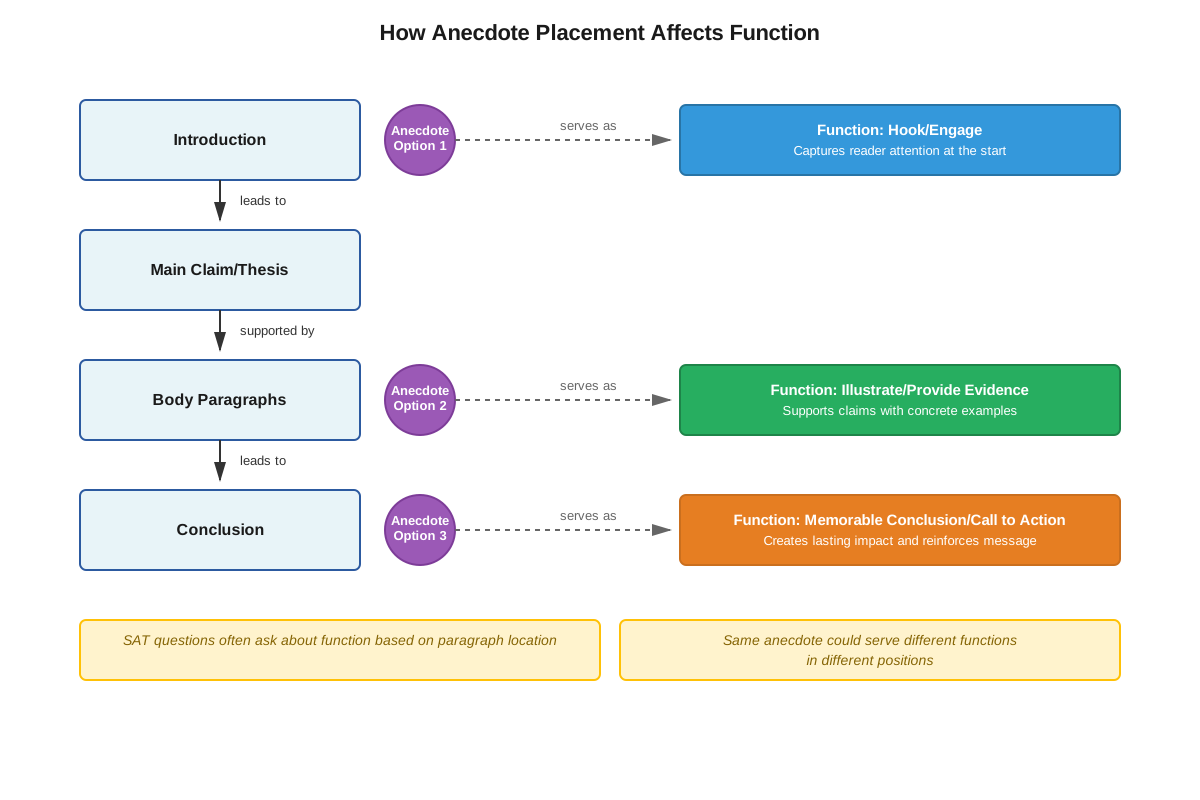
Where an anecdote appears within a passage significantly affects its function:
| Placement | Typical Function | SAT Question Focus |
|---|---|---|
| Opening paragraph | Hook readers; introduce topic; establish stakes | "The author begins with the story in order to..." |
| After abstract claim | Illustrate or clarify concept; provide concrete example | "The anecdote in lines X-Y primarily serves to..." |
| Before conclusion | Provide memorable final impression; synthesize ideas | "The author includes the example to..." |
| Mid-argument | Support claim with evidence; demonstrate real-world application | "The function of the narrative is to..." |
Distinguishing Anecdotes from Similar Elements
Students must differentiate anecdotes from related but distinct textual elements:
- Hypothetical scenarios: Unlike anecdotes (which describe actual events), hypotheticals present imagined situations ("Suppose a student were to...")
- Extended case studies: More comprehensive than anecdotes, case studies provide detailed analysis over multiple paragraphs
- Historical events: While historical accounts may be narrative, they differ from personal anecdotes in scope and purpose
- General examples: Anecdotes are specific stories; general examples may lack narrative structure ("Many students struggle with math")
Evaluating Anecdotal Effectiveness
The SAT occasionally asks students to consider how well an anecdote achieves its purpose. Effective anecdotes share these qualities: clear relevance to the main claim, appropriate level of detail (neither too sparse nor excessive), emotional resonance without manipulation, and logical connection to surrounding content. Weak anecdotes may seem tangential, overwhelm the argument they're meant to support, or appeal purely to emotion without logical connection.
Concept Relationships
The role of anecdote connects to multiple aspects of text structure and purpose. Understanding main ideas is prerequisite to analyzing anecdotes because determining an anecdote's function requires knowing what larger point it supports. An anecdote that seems irrelevant may actually support a subtle secondary claim, so accurate main idea identification is essential.
Anecdotes relate directly to evidence types and rhetorical strategies. Authors choose among various evidence forms—statistics, expert opinions, logical reasoning, and anecdotes—based on their purpose and audience. Recognizing this choice as deliberate rather than arbitrary helps students understand passage construction. The relationship flows: Author's Purpose → Evidence Selection → Anecdote Inclusion → Specific Function.
Within text structure, anecdotes interact with transitions and organizational patterns. An anecdote might serve as a transition between theoretical discussion and practical application, or it might exemplify a pattern of problem-solution or cause-effect. Understanding these organizational frameworks helps predict where anecdotes will appear and what roles they'll play.
The concept map flows as follows: Author's Purpose → determines → Rhetorical Strategy → includes → Evidence Selection → may involve → Anecdote → whose Role depends on → Placement and Context → which supports → Main Idea → which fulfills → Author's Purpose. This circular relationship emphasizes that all textual elements work together systematically.
High-Yield Facts
⭐ Anecdotes are brief narrative accounts used to illustrate larger points, not merely decorative stories
⭐ The most common SAT question stem about anecdotes asks about their function or purpose within the passage
⭐ Opening anecdotes typically serve to engage readers and introduce topics, while mid-passage anecdotes usually illustrate or support claims
⭐ Anecdotes provide qualitative, human-scale evidence that complements quantitative data like statistics
⭐ The SAT tests whether students can distinguish between an anecdote's surface content and its structural function
- Anecdotes in science passages often humanize research by connecting abstract findings to individual experiences
- Effective anecdotes maintain clear relevance to the passage's main idea without overwhelming the argument
- The same anecdote can serve multiple functions simultaneously (e.g., engaging readers while also providing evidence)
- SAT wrong answers often confuse an anecdote's content with its purpose (describing what happens rather than why it's included)
- Anecdotes differ from hypothetical scenarios because they describe actual events rather than imagined possibilities
- The placement of an anecdote within a passage provides crucial clues about its intended function
- Authors may use anecdotes to establish credibility by demonstrating real-world knowledge or experience
Quick check — test yourself on Role of anecdote so far.
Try Flashcards →Common Misconceptions
Misconception: Anecdotes are always personal stories about the author's own experience.
Correction: Anecdotes can describe anyone's experience—the author's, a research subject's, a historical figure's, or any individual whose story illustrates a point. The defining feature is the brief narrative structure, not whose story is told.
Misconception: Anecdotes serve only to make passages more interesting and don't contribute to the argument.
Correction: While anecdotes do engage readers, they serve substantive rhetorical functions including providing evidence, illustrating concepts, and supporting claims. The SAT specifically tests understanding of these functional roles.
Misconception: The correct answer to an anecdote question will summarize what happens in the story.
Correction: SAT questions about anecdotes ask why the author includes the story (its function), not what happens in it (its content). Correct answers focus on purpose: "to illustrate," "to provide evidence for," "to introduce," etc.
Misconception: Anecdotes are less valuable than statistics or expert testimony as evidence.
Correction: Different evidence types serve different purposes. Anecdotes provide human-scale, relatable evidence that helps readers connect emotionally and understand abstract concepts concretely. They complement rather than compete with other evidence forms.
Misconception: All narrative elements in a passage are anecdotes.
Correction: Anecdotes are specifically brief stories that illustrate larger points. Extended narratives, hypothetical scenarios, historical accounts, and general examples may share some narrative features but serve different functions and have different structures.
Misconception: If an anecdote appears at the beginning of a passage, its only function is to hook the reader.
Correction: Opening anecdotes often serve multiple simultaneous functions: engaging readers, introducing the topic, establishing stakes, and sometimes even presenting the central problem the passage will address.
Worked Examples
Example 1: Science Passage Opening
Passage Excerpt:
"When Maria Chen first noticed her hands trembling while pouring morning coffee, she dismissed it as caffeine jitters. Six months later, diagnosed with early-onset Parkinson's disease at age 42, she joined a clinical trial that would revolutionize treatment approaches. Chen's experience illustrates why researchers at Stanford University have intensified efforts to identify Parkinson's biomarkers in younger patients. Traditional diagnostic methods often miss early symptoms, delaying treatment when interventions could be most effective. The research team's new screening protocol, developed partly in response to cases like Chen's, detects neurological changes up to five years before visible symptoms appear."
Question: The author includes the anecdote about Maria Chen primarily to:
A) Argue that Parkinson's disease is becoming more common in younger populations
B) Illustrate the human impact of delayed diagnosis and introduce research motivated by such cases
C) Provide statistical evidence about Parkinson's disease prevalence
D) Suggest that caffeine consumption may contribute to neurological disorders
Analysis:
First, identify that the Maria Chen story is indeed an anecdote—a brief narrative about a specific individual's experience. Next, determine its placement: opening paragraph, suggesting it serves to engage readers and introduce the topic.
Now analyze the function by examining what follows the anecdote. The passage transitions from Chen's story to research efforts, explicitly stating "Chen's experience illustrates why researchers...have intensified efforts." This signal phrase directly connects the anecdote to the research discussion.
Evaluate each answer:
- A focuses on content (what the story is about) rather than function (why it's included), and the passage doesn't argue about disease prevalence trends
- B correctly identifies dual functions: showing human impact (humanization) and introducing research motivation (establishing context for the main topic)
- C is factually wrong—anecdotes provide qualitative, not statistical evidence
- D confuses a detail within the anecdote (coffee) with the anecdote's purpose
Correct Answer: B
The anecdote serves to humanize the medical issue while establishing why the research matters, a common dual function for opening anecdotes in science passages.
Example 2: Argumentative Passage Mid-Section
Passage Excerpt:
"Critics argue that universal basic income (UBI) would discourage work, but pilot programs suggest otherwise. Consider the experience of Stockton, California, where 125 residents received $500 monthly with no strings attached. Rather than quitting their jobs, recipients like Robert Taylor used the funds to pursue additional education. Taylor, a part-time warehouse worker, enrolled in community college courses while maintaining his employment. Within eighteen months, he completed a certification program and secured full-time work with benefits. This pattern appeared throughout the Stockton program: recipients invested in education, reduced debt, and sought better employment rather than abandoning work altogether. The data contradicts assumptions about human motivation and economic behavior."
Question: The author includes the example of Robert Taylor to:
A) Demonstrate that warehouse work provides insufficient income for basic needs
B) Counter the claim that UBI discourages work by providing a specific case of someone who used UBI to improve employment prospects
C) Prove that all UBI recipients will pursue higher education
D) Illustrate the challenges facing part-time workers in California
Analysis:
Identify the anecdote: Robert Taylor's story about using UBI funds for education while continuing to work. Note its placement: mid-passage, after introducing a counterargument ("Critics argue...but pilot programs suggest otherwise").
The anecdote's function relates to its position in the argument structure. The author presents a claim (UBI doesn't discourage work), then provides Taylor's story as evidence, then generalizes ("This pattern appeared throughout..."). The anecdote serves as a specific example supporting the broader claim.
Evaluate answers:
- A addresses content tangentially mentioned but not the anecdote's function in the argument
- B correctly identifies the function: countering a specific criticism with concrete evidence
- C overgeneralizes—the anecdote illustrates a pattern but doesn't claim universality
- D focuses on a detail rather than the anecdote's role in the argument structure
Correct Answer: B
The anecdote functions as evidence refuting a counterargument, a common mid-passage role where specific cases support general claims.
Exam Strategy
When approaching SAT questions about the role of anecdote, follow this systematic process:
Step 1: Confirm it's actually an anecdote. Verify that the referenced content is a brief narrative about a specific individual or event, not a hypothetical scenario, general example, or extended case study.
Step 2: Identify placement. Note whether the anecdote appears in the opening, middle, or conclusion of the passage, as placement strongly correlates with function.
Step 3: Read surrounding context. Examine the sentences immediately before and after the anecdote. Authors often include signal phrases like "This illustrates," "Consider the case of," or "For example" that explicitly state the anecdote's purpose.
Step 4: Connect to main idea. Determine how the anecdote relates to the passage's central claim. Does it introduce the topic, provide supporting evidence, illustrate an abstract concept, or humanize research?
Step 5: Eliminate content-focused answers. Wrong answers typically describe what happens in the anecdote rather than why the author includes it. If an answer summarizes the story without explaining its function, eliminate it.
Exam Tip: Watch for trigger phrases in question stems: "primarily serves to," "functions to," "included in order to," "the author uses the example to." These phrases signal that you need to identify purpose, not content.
Time allocation: Spend approximately 45-60 seconds on anecdote questions. These questions reward careful reading of context but don't require complex analysis. If you're uncertain, return to the signal phrases immediately surrounding the anecdote—authors often explicitly state the purpose.
Process of elimination strategy: First, eliminate answers that merely summarize the anecdote's content. Second, eliminate answers that describe functions inconsistent with the anecdote's placement (e.g., "to introduce the topic" for a mid-passage anecdote). Third, choose the answer that best matches both the surrounding context and the passage's overall purpose.
Common trigger words in correct answers: "illustrate," "demonstrate," "provide evidence for," "introduce," "emphasize," "support the claim that," "show," "exemplify." These action verbs describe functions rather than content.
Red flags in wrong answers: Answers that begin with "describe," "explain what," "tell the story of," or "recount" often focus on content rather than function. Answers containing extreme language ("prove," "all," "never") are typically incorrect because anecdotes provide specific examples, not universal proof.
Memory Techniques
PLACE Mnemonic for analyzing anecdote function:
- Placement: Where does it appear (opening, middle, end)?
- Link: How does it connect to surrounding sentences?
- Argument: What claim does it support?
- Context: What's the passage's overall purpose?
- Evidence: Does it prove, illustrate, or introduce?
Visualization Strategy: Picture anecdotes as bridges connecting abstract ideas (on one side) to concrete reality (on the other). When you encounter an anecdote, visualize what abstract concept it makes tangible. This mental image helps identify the "illustrate" or "clarify" function.
Function Categories Acronym - HISE:
- Hook (engage readers, typically opening)
- Illustrate (clarify abstract concepts)
- Support (provide evidence for claims)
- Emphasize (humanize or highlight importance)
Placement Pattern: Remember "OMS" - Opening anecdotes engage, Middle anecdotes support/illustrate, Summary anecdotes emphasize. While not absolute, this pattern holds for most SAT passages.
Question Stem Recognition: When you see "primarily serves to," "functions to," or "included in order to," mentally add "WHY?" in capital letters. This reminds you to focus on purpose rather than content.
Summary
Understanding the role of anecdote on the SAT requires recognizing that brief narrative accounts serve deliberate rhetorical functions rather than existing as decorative elements. Anecdotes engage readers, illustrate abstract concepts, provide qualitative evidence, and humanize research or theory. The SAT tests whether students can identify these functions by asking why authors include specific stories within passages. Success requires distinguishing between an anecdote's content (what happens) and its purpose (why it's included), analyzing how placement affects function, and connecting anecdotes to the passage's main idea. Opening anecdotes typically engage and introduce, mid-passage anecdotes usually illustrate or support claims, and concluding anecdotes often emphasize or synthesize. Effective SAT strategy involves reading surrounding context for signal phrases, eliminating content-focused answers, and selecting responses that describe rhetorical functions using action verbs like "illustrate," "support," or "demonstrate." Mastering this topic strengthens overall comprehension of text structure and authorial purpose.
Key Takeaways
- Anecdotes are brief narratives serving specific rhetorical functions: engagement, illustration, evidence, or humanization
- SAT questions focus on why authors include anecdotes, not what happens in them: always distinguish content from purpose
- Placement provides crucial clues: opening anecdotes typically engage/introduce; mid-passage anecdotes usually support/illustrate
- Signal phrases surrounding anecdotes often explicitly state their purpose: look for "This illustrates," "Consider," or "For example"
- Correct answers use function-focused language: "to illustrate," "to support," "to demonstrate," rather than content summaries
- Anecdotes complement other evidence types: they provide human-scale, qualitative support that makes abstract ideas concrete
- Effective analysis requires connecting anecdotes to the passage's main idea: determine how the specific story supports the broader claim
Related Topics
Evidence Types and Rhetorical Strategies: Understanding how authors choose among statistics, expert testimony, logical reasoning, and anecdotes to support claims builds on anecdotal analysis and prepares students for comprehensive passage analysis.
Text Structure and Organization: Recognizing how passages are organized (problem-solution, cause-effect, compare-contrast) helps predict where anecdotes will appear and what functions they'll serve.
Author's Purpose and Tone: Identifying whether an author aims to inform, persuade, entertain, or critique provides essential context for understanding why specific anecdotes are included.
Main Ideas and Supporting Details: Distinguishing central claims from supporting evidence is prerequisite to analyzing how anecdotes function as one type of supporting detail.
Transitions and Coherence: Understanding how authors connect ideas helps recognize when anecdotes serve as bridges between abstract theory and concrete application.
Mastering the role of anecdote enables progression to more complex analysis of how multiple rhetorical strategies work together to achieve an author's purpose, preparing students for the most challenging SAT reading comprehension questions.
Practice CTA
Now that you understand how anecdotes function in SAT passages, test your mastery with practice questions and flashcards. Focus on distinguishing between content and purpose, identifying placement patterns, and connecting anecdotes to main ideas. Each practice question you complete strengthens your ability to recognize rhetorical strategies quickly and accurately. Remember: the SAT rewards students who can analyze why authors make specific choices, not just what those choices contain. Your investment in understanding the role of anecdote will pay dividends across multiple questions on test day. Start practicing now to build the pattern recognition and analytical skills that lead to top scores!
Sign up free to keep reading
Create a free AnvayaPrep account to finish this SAT guide on Role of anecdote — plus flashcards and practice questions.