Overview
Structural shifts are pivotal moments in a text where the author changes direction, tone, focus, or approach. On the SAT Reading and Writing (RW) section, recognizing these shifts is essential for understanding how authors organize their ideas and develop arguments. A structural shift might occur when a passage moves from describing a problem to proposing a solution, from presenting one viewpoint to introducing a contrasting perspective, or from providing background information to analyzing its implications. These transitions serve as the architecture of effective writing, guiding readers through complex ideas in a logical progression.
Understanding sat structural shifts is crucial because the College Board frequently tests students' ability to identify how different parts of a text relate to one another. Questions may ask students to determine the function of a particular sentence, identify the relationship between paragraphs, or recognize how an author's approach changes throughout a passage. These questions assess reading comprehension at a sophisticated level—beyond simply understanding what a text says to grasping how it's constructed and why the author made specific organizational choices.
Within the broader context of Text Structure and Purpose, structural shifts represent the dynamic elements that give texts their movement and development. While other concepts in this unit focus on overall organizational patterns (such as chronological order, cause-and-effect, or compare-and-contrast), structural shifts examine the specific moments where these patterns change or evolve. Mastering this topic enables students to navigate complex passages more effectively, anticipate where arguments are heading, and answer questions about textual organization with confidence.
Learning Objectives
- [ ] Identify key features of structural shifts in SAT passages
- [ ] Explain how structural shifts appears on the SAT and the types of questions that test this concept
- [ ] Apply structural shifts knowledge to answer SAT-style questions accurately and efficiently
- [ ] Recognize common transition words and phrases that signal structural shifts
- [ ] Distinguish between different types of structural shifts (contrast, elaboration, causation, etc.)
- [ ] Analyze the rhetorical purpose behind an author's use of structural shifts
- [ ] Predict likely locations of structural shifts based on passage context and organization
Prerequisites
- Basic reading comprehension skills: Understanding literal meaning is necessary before analyzing structural relationships between ideas
- Familiarity with paragraph structure: Recognizing topic sentences and supporting details helps identify when focus shifts occur
- Knowledge of transition words: Understanding conjunctions and transitional phrases provides clues to structural changes
- Awareness of rhetorical purpose: Recognizing that authors write with specific goals helps explain why shifts occur
Why This Topic Matters
Structural shifts appear in virtually every SAT Reading and Writing passage, making this one of the most frequently tested concepts on the exam. According to test analysis, approximately 15-20% of questions in the Reading and Writing section directly or indirectly assess understanding of how texts are organized and how ideas relate to one another. Questions about structural shifts often appear as "function" questions (asking what role a sentence plays) or "relationship" questions (asking how one part of the text connects to another).
In real-world contexts, recognizing structural shifts is fundamental to critical reading across all disciplines. Scientific papers shift from reviewing existing research to presenting new findings. Historical analyses move from describing events to interpreting their significance. Persuasive essays transition from acknowledging opposing views to refuting them. Students who master this skill become more effective readers in college coursework, professional settings, and everyday information consumption.
On the SAT, structural shifts commonly appear in several ways: passages may present a theory before introducing evidence that challenges it; describe a phenomenon before explaining its causes; outline a problem before proposing solutions; or provide historical context before analyzing contemporary implications. The ability to recognize these shifts allows students to map the logical flow of arguments, making it easier to answer questions about main ideas, author's purpose, and the function of specific textual elements.
Core Concepts
What Are Structural Shifts?
A structural shift occurs when an author changes the direction, focus, tone, or approach within a text. These shifts are not random but serve specific rhetorical purposes—they help authors develop complex arguments, present multiple perspectives, or guide readers through layered ideas. Structural shifts can occur between paragraphs, between sentences within a paragraph, or even within a single sentence when an author uses contrasting clauses.
The key to identifying structural shifts lies in recognizing that the relationship between ideas has changed. While one section might describe something, the next might analyze it. While one paragraph presents facts, the next might interpret their meaning. These changes in function signal that a shift has occurred.
Types of Structural Shifts
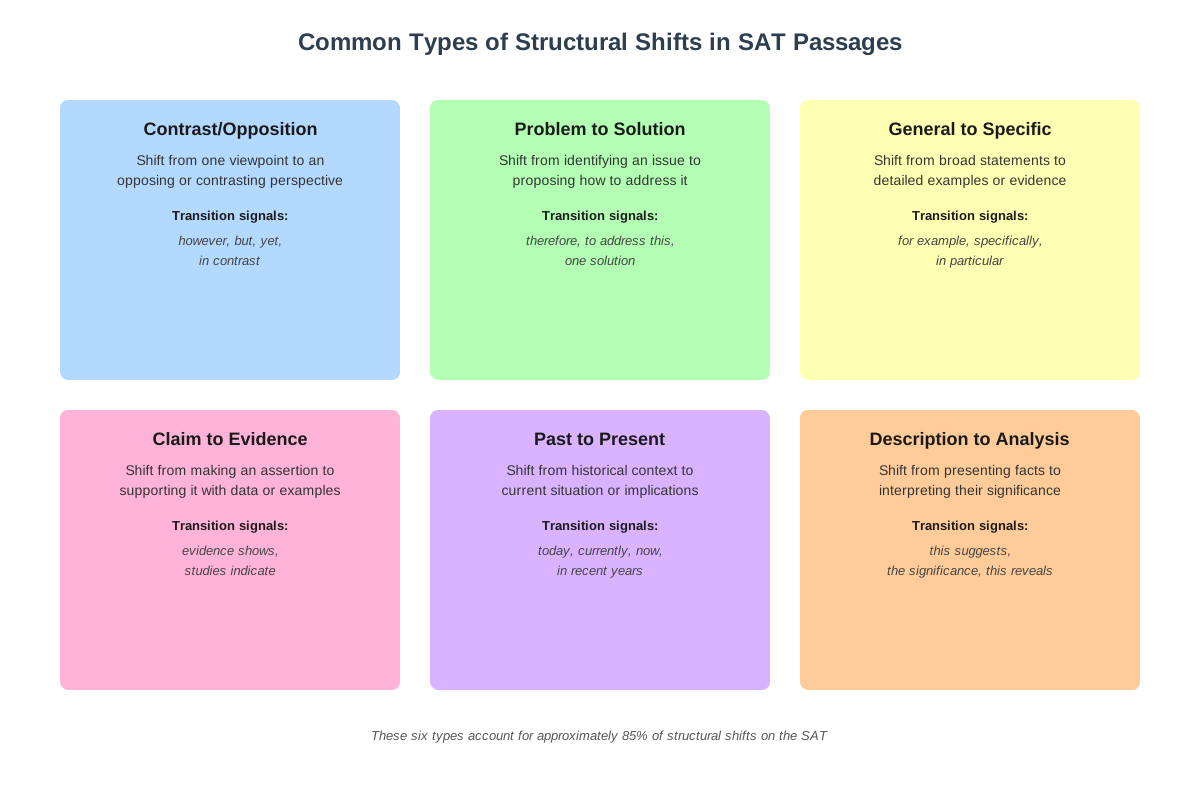
Understanding the different categories of structural shifts helps students anticipate and recognize them more quickly:
| Shift Type | Description | Common Signals |
|---|---|---|
| Contrast/Opposition | Moving from one viewpoint to an opposing or different viewpoint | however, but, yet, on the other hand, conversely, nevertheless |
| Elaboration/Expansion | Moving from a general statement to specific details or examples | for example, specifically, in particular, such as, to illustrate |
| Causation | Moving from effect to cause or vice versa | because, therefore, thus, consequently, as a result, due to |
| Temporal | Moving forward or backward in time | then, later, previously, before, after, subsequently |
| Problem-Solution | Moving from identifying an issue to proposing remedies | to address this, one solution, in response, to resolve |
| Concession-Rebuttal | Acknowledging an opposing view before refuting it | while it's true that, although, admittedly, granted, despite |
Markers of Structural Shifts
Several textual features signal that a structural shift is occurring or about to occur:
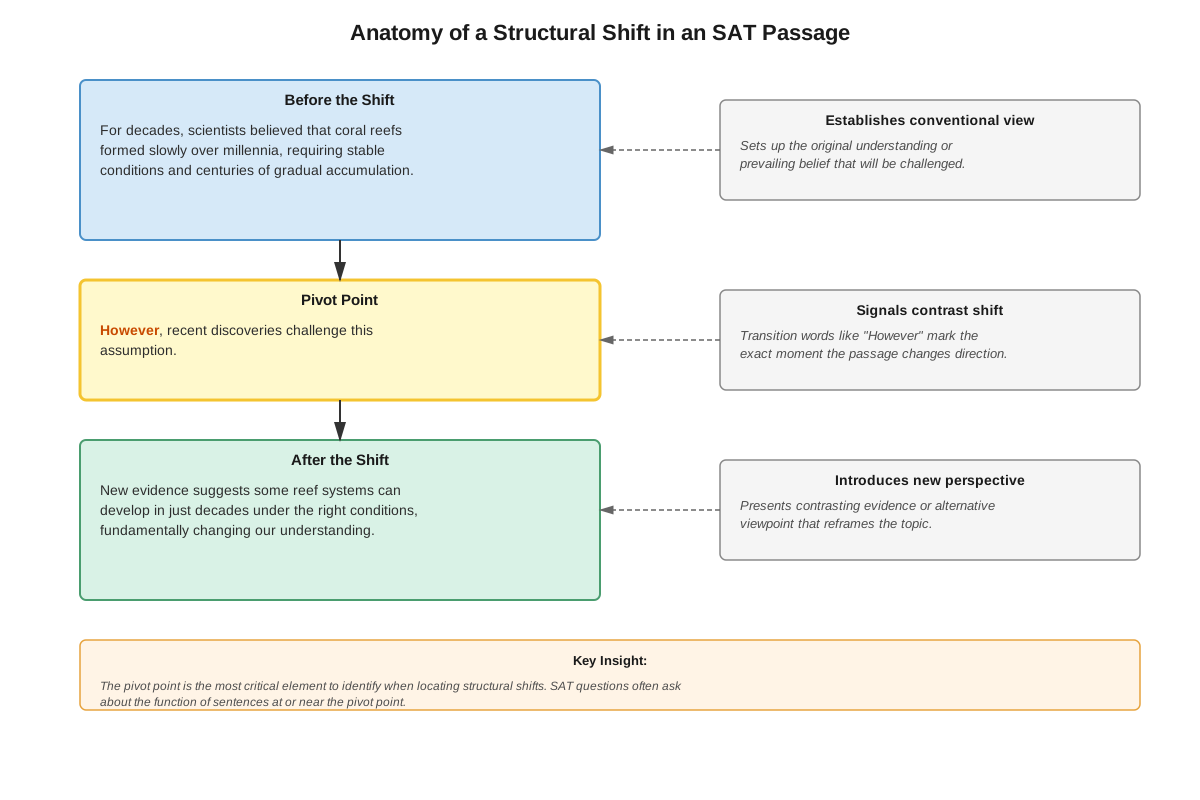
Transition words and phrases are the most obvious markers. Words like "however," "furthermore," "in contrast," and "consequently" explicitly signal that the relationship between ideas is changing. On the SAT, recognizing these transitions helps students quickly identify shifts without having to reread entire paragraphs.
Punctuation and formatting can also indicate shifts. A new paragraph typically signals a shift in focus or approach. Semicolons often separate contrasting ideas within a single sentence. Dashes may introduce elaborations or unexpected turns in thought.
Changes in verb tense or mood sometimes accompany structural shifts. A passage might use past tense to describe historical events, then shift to present tense when discussing contemporary relevance. Conditional language ("would," "could," "might") often signals a shift from describing what is to speculating about what could be.
Rhetorical questions frequently mark transitions, especially when an author shifts from presenting information to analyzing it or from describing a problem to exploring solutions.
The Function of Structural Shifts
Understanding why authors use structural shifts is as important as recognizing when they occur. Structural shifts serve several key functions:
- Building complexity: Shifts allow authors to present nuanced arguments that acknowledge multiple perspectives or layers of meaning
- Maintaining reader engagement: Varying the approach prevents monotony and keeps readers intellectually engaged
- Establishing credibility: Acknowledging counterarguments before refuting them demonstrates fairness and thorough thinking
- Creating emphasis: Shifting from general to specific or from description to analysis can highlight particularly important points
- Organizing information logically: Shifts help readers follow the progression of ideas from background to analysis to conclusion
Identifying Structural Shifts on the SAT
On the SAT, questions about structural shifts typically take several forms:
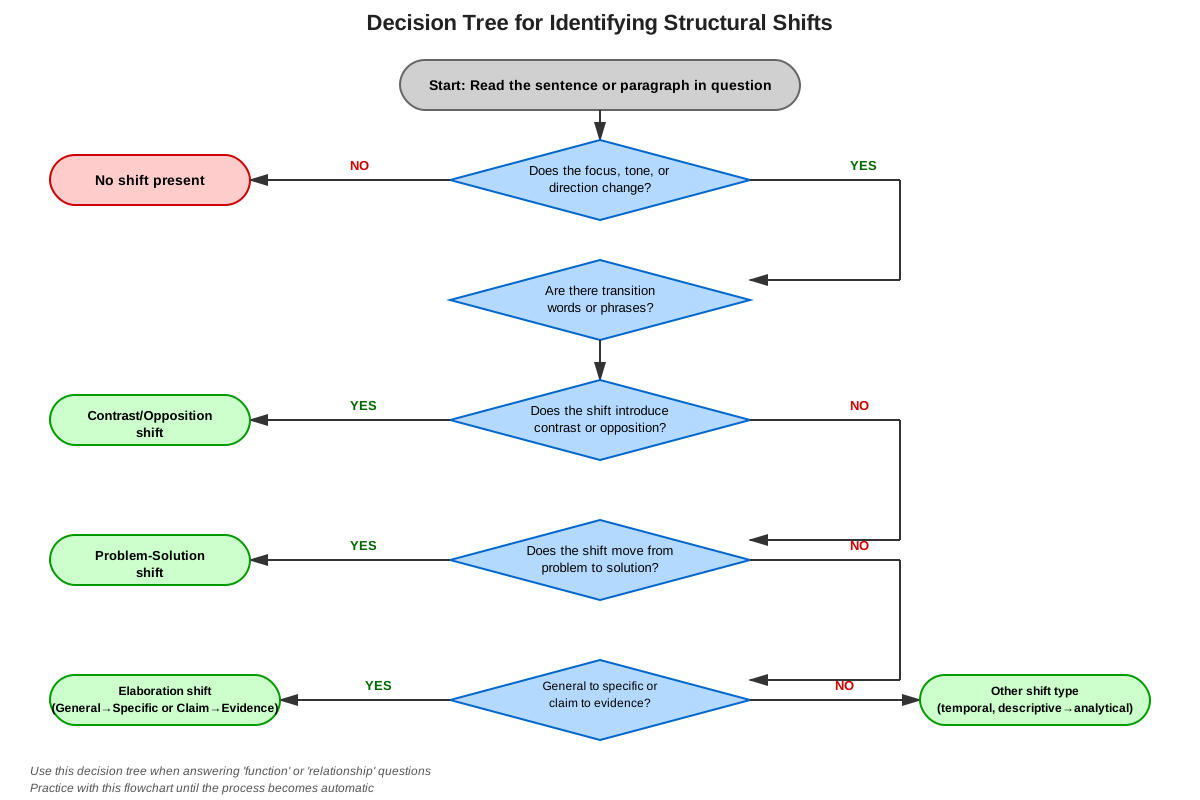
Function questions ask what role a particular sentence or paragraph plays in the passage. These questions require students to identify whether that portion introduces a new idea, provides evidence, offers a counterargument, or serves another structural purpose.
Relationship questions ask how one part of the text relates to another. Students must recognize whether the relationship is one of contrast, support, elaboration, causation, or another type.
Transition questions present a passage with a blank and ask which transitional word or phrase best fits. These questions directly test understanding of how ideas connect and where shifts occur.
To answer these questions successfully, students should:
- Read the sentence or paragraph in question carefully
- Examine what comes immediately before and after it
- Identify the relationship between these parts
- Match that relationship to the answer choices
Concept Relationships
Structural shifts connect intimately with other concepts in the Text Structure and Purpose unit. Understanding overall text organization provides the framework within which individual shifts occur—a compare-and-contrast essay will feature different types of shifts than a chronological narrative. Author's purpose explains why particular shifts occur; an author writing to persuade might use concession-rebuttal shifts, while one writing to inform might use elaboration shifts.
The relationship between concepts can be mapped as follows:
Author's Purpose → determines → Overall Text Structure → contains → Structural Shifts → marked by → Transition Words → guide → Reader Comprehension
Additionally, structural shifts relate to rhetorical strategies (another SAT concept) because shifts often coincide with changes in rhetorical approach—from logos to pathos, from description to analysis, from objective reporting to subjective interpretation.
Understanding structural shifts also enhances comprehension of main ideas and supporting details. Shifts often occur when an author moves from stating a main idea to providing supporting evidence, or from presenting details to drawing broader conclusions. Recognizing these shifts helps students distinguish between primary claims and secondary support.
High-Yield Facts
⭐ Structural shifts occur when an author changes direction, focus, tone, or approach within a text
⭐ Transition words like "however," "therefore," and "for example" are the most reliable signals of structural shifts
⭐ Contrast shifts (signaled by "but," "however," "yet") are among the most frequently tested on the SAT
⭐ Function questions asking "what role does this sentence play" directly test understanding of structural shifts
⭐ New paragraphs typically signal shifts in focus, even without explicit transition words
- Concession-rebuttal shifts (acknowledging then refuting counterarguments) demonstrate sophisticated argumentation
- Temporal shifts can move forward or backward in time and are often signaled by time-related transition words
- Elaboration shifts move from general statements to specific examples or details
- Causation shifts explain why something happened or what resulted from an event
- Problem-solution shifts are common in persuasive and analytical passages
Quick check — test yourself on Structural shifts so far.
Try Flashcards →Common Misconceptions
Misconception: Every new paragraph represents a major structural shift → Correction: While new paragraphs often signal shifts, some paragraphs continue developing the same idea from the previous paragraph. The shift occurs when the relationship between ideas changes, not simply when formatting changes.
Misconception: Transition words always appear at the beginning of sentences → Correction: Transition words can appear mid-sentence or even at the end. For example: "The theory seemed sound; evidence suggested otherwise, however."
Misconception: Structural shifts only occur between large sections of text → Correction: Shifts can occur within a single sentence, especially when authors use contrasting clauses connected by words like "but" or "although."
Misconception: All structural shifts are explicitly marked by transition words → Correction: Some shifts are implicit, indicated only by changes in content, focus, or approach. Skilled readers must recognize these unmarked shifts through careful attention to meaning.
Misconception: Identifying the transition word is sufficient to answer shift-related questions → Correction: Students must understand the relationship the transition word signals and how it connects ideas, not just recognize the word itself. "However" indicates contrast, but students must identify what is being contrasted.
Misconception: Structural shifts always indicate disagreement or opposition → Correction: Many shifts involve elaboration, causation, or temporal progression rather than contrast. Not all shifts are adversative.
Worked Examples
Example 1: Identifying a Contrast Shift
Passage excerpt:
"For decades, scientists believed that the human brain stopped developing new neurons after childhood. This assumption shaped research priorities and therapeutic approaches for neurological conditions. Recent studies using advanced imaging techniques, however, have revealed that neurogenesis—the formation of new neurons—continues throughout adult life in specific brain regions. This discovery has profound implications for treating age-related cognitive decline."
Question: The primary function of the third sentence (beginning with "Recent studies") is to:
A) Provide additional evidence supporting the traditional view of brain development
B) Introduce a finding that contradicts the previously held belief
C) Explain the methodology used in neurological research
D) Describe the symptoms of age-related cognitive decline
Solution:
Step 1: Identify what comes before the sentence in question. The first two sentences describe a long-held scientific belief that brain development stops after childhood.
Step 2: Examine the sentence itself. It begins with "Recent studies" and includes the transition word "however," which signals contrast or opposition.
Step 3: Determine what the sentence says. It states that new research shows neurogenesis continues in adults—directly contradicting the belief mentioned earlier.
Step 4: Match this relationship to the answer choices. The sentence introduces contradictory evidence, making B correct.
Why other answers are wrong:
- A is incorrect because the new finding contradicts rather than supports the traditional view
- C is incorrect because while methodology is mentioned, it's not the primary function
- D is incorrect because symptoms aren't described; implications for treatment are mentioned
Connection to learning objectives: This example demonstrates how to identify structural shifts (the contrast shift signaled by "however") and apply this knowledge to answer function questions.
Example 2: Recognizing an Elaboration Shift
Passage excerpt:
"Urban gardens provide numerous benefits to communities. _____ they improve air quality by absorbing carbon dioxide and releasing oxygen. They also create habitats for pollinators like bees and butterflies, supporting urban biodiversity. Additionally, these gardens offer residents access to fresh produce and opportunities for physical activity."
Question: Which choice provides the most effective transition to the examples that follow?
A) However,
B) For instance,
C) Consequently,
D) Nevertheless,
Solution:
Step 1: Analyze the relationship between the first sentence and what follows. The first sentence makes a general claim about urban gardens providing benefits.
Step 2: Examine what follows. The subsequent sentences provide specific examples of those benefits (air quality, habitats, fresh produce).
Step 3: Identify the type of shift. This is an elaboration shift—moving from general to specific.
Step 4: Select the transition that signals elaboration. "For instance" indicates that examples will follow, making B correct.
Why other answers are wrong:
- A ("However") signals contrast, but the examples support rather than contradict the opening claim
- C ("Consequently") signals causation, but the examples aren't results of the opening statement
- D ("Nevertheless") signals concession or contrast, which doesn't fit the supportive relationship
Connection to learning objectives: This example shows how recognizing the type of structural shift (elaboration) helps select appropriate transitions and understand textual organization.
Exam Strategy
When approaching SAT questions about structural shifts, follow this systematic process:
1. Read contextually: Never evaluate a sentence in isolation. Always read at least one sentence before and after the portion in question to understand the flow of ideas.
2. Identify transition markers: Look for explicit signals like transition words, punctuation changes, or new paragraphs. These provide immediate clues about shifts.
3. Determine the relationship: Ask yourself: Is this sentence contrasting with what came before? Providing an example? Explaining a cause? Introducing a solution? Naming the relationship type helps narrow answer choices.
4. Watch for trigger words: Certain phrases consistently appear in questions about structural shifts:
- "The primary function of this sentence is to..."
- "The author shifts from... to..."
- "Which choice provides the best transition..."
- "The relationship between these paragraphs is best described as..."
5. Use process of elimination strategically:
- Eliminate answers that describe the wrong type of relationship (e.g., "contrast" when the relationship is actually "elaboration")
- Eliminate answers that mischaracterize the content (e.g., "introduces a new topic" when the sentence continues discussing the same topic)
- Eliminate answers with extreme language that doesn't match the passage's tone
6. Time allocation: Spend approximately 45-60 seconds on structural shift questions. They require careful reading but shouldn't demand extensive analysis. If you're stuck, mark the question and return to it after completing easier questions.
Exam Tip: When a question asks about the function of a sentence, the correct answer will describe what the sentence does (its role in the passage structure), not what it says (its content). Focus on relationships, not just information.
Memory Techniques
SHIFT Acronym for identifying structural shifts:
- Signals: Look for transition words
- How: Determine how ideas relate (contrast, support, etc.)
- Identify: Name the type of shift
- Function: Consider why the author made this shift
- Test: Verify your answer against the passage context
The "But Test": When you encounter a transition word, mentally replace it with "but" or "and." If "but" makes sense, it's a contrast shift. If "and" makes sense, it's likely an elaboration or support shift. This quick test helps categorize relationships.
Visualization Strategy: Picture a passage as a journey with turns and direction changes. Structural shifts are the turns. Contrast shifts are U-turns or sharp turns. Elaboration shifts are continuing straight but going deeper. Causation shifts are following a path to see where it leads.
Common Contrast Transitions Mnemonic - "HONEY":
- However
- On the other hand
- Nevertheless
- Even so
- Yet
Common Elaboration Transitions Mnemonic - "FIST":
- For example
- In particular
- Specifically
- To illustrate
Summary
Structural shifts are the pivotal moments in texts where authors change direction, focus, or approach, and recognizing these shifts is essential for success on the SAT Reading and Writing section. These shifts serve important rhetorical functions—building complexity, maintaining engagement, and organizing information logically. The most common types include contrast shifts (signaled by "however," "but"), elaboration shifts (signaled by "for example," "specifically"), and causation shifts (signaled by "therefore," "because"). On the SAT, structural shifts appear in function questions asking what role a sentence plays, relationship questions asking how parts of a text connect, and transition questions requiring students to select appropriate connecting words. Success requires reading contextually, identifying transition markers, determining relationship types, and understanding that the correct answer describes what a sentence does structurally rather than merely what it says. Mastering structural shifts enables students to navigate complex passages efficiently, anticipate argument development, and answer organizational questions with confidence.
Key Takeaways
- Structural shifts mark changes in direction, focus, tone, or approach within texts and are tested on approximately 15-20% of SAT Reading and Writing questions
- Transition words like "however" (contrast), "for example" (elaboration), and "therefore" (causation) are the most reliable signals of structural shifts
- Function questions asking "what role does this sentence play" directly test understanding of structural shifts and require identifying relationships between ideas
- The most common shift types are contrast, elaboration, causation, temporal, problem-solution, and concession-rebuttal
- Always read sentences in context—examining what comes before and after—rather than evaluating them in isolation
- Correct answers to shift questions describe what a sentence does (its structural function) rather than what it says (its content)
- Recognizing structural shifts helps students map the logical flow of arguments and answer questions about organization, purpose, and textual relationships
Related Topics
Transition Words and Cohesion: Deeper study of how specific transition words create coherence and signal different types of relationships between ideas. Mastering structural shifts provides the foundation for understanding why particular transitions work in specific contexts.
Rhetorical Strategies: Examination of how authors use various techniques (appeals to logic, emotion, and credibility) to achieve their purposes. Structural shifts often coincide with changes in rhetorical strategy.
Argument Structure: Analysis of how claims, evidence, and reasoning work together in persuasive texts. Understanding structural shifts helps identify where authors introduce claims, provide support, or address counterarguments.
Text Organization Patterns: Study of overall organizational frameworks like chronological order, compare-and-contrast, cause-and-effect, and problem-solution. Structural shifts are the micro-level changes that occur within these macro-level patterns.
Author's Purpose and Tone: Investigation of why authors write and how their attitude toward the subject shapes textual choices. Recognizing structural shifts helps identify moments where purpose or tone changes.
Practice CTA
Now that you've mastered the core concepts of structural shifts, it's time to put your knowledge into action! Complete the practice questions to test your ability to identify different types of shifts, recognize transition markers, and answer function questions accurately. Use the flashcards to reinforce your understanding of key terms and shift types. Remember: recognizing structural shifts is a skill that improves with practice. Each question you work through strengthens your ability to navigate complex passages efficiently and confidently. You've built a strong foundation—now apply it and watch your SAT Reading and Writing scores improve!
Sign up free to keep reading
Create a free AnvayaPrep account to finish this SAT guide on Structural shifts — plus flashcards and practice questions.